#Immigration and Other Issues

For days, I have struggled with what to blog about today. My blog’s editorial calendar told me to write about the progress I’ve made over the last month or so on my southern historical novel manuscript with the working title, The Spanish Coin.

“Stand on your own two feet.”

While I’m establishing my “brand” as an author, on the one hand I’m advised to stay away from politics. On the other hand, I’m advised to stay true to myself. I have decided that if my political views cause someone to stop reading my blog, to vow to never read anything I write, to “unfriend” me on Facebook, or “unfollow” me on Twitter, I can live with that. What I cannot live with is myself if I sit idly by and fail to speak out when I see injustice or abuse of political power. One of my mother’s favorite sayings was, “Stand on your own two feet.” She taught me by example to speak up when I see a wrong.

US Travel Ban

Every writing-related subject I considered blogging about today seemed trivial in light of what has transpired in the executive branch of the US government since Donald Trump’s inauguration on January 20. I am compelled to speak out against the travel ban he has put into effect. Choosing the seven countries he did smacks of religious discrimination. People who have lived and worked in the US for years and some who at great personal risk assisted the US military in other countries were caught up in the confusion that has resulted from the issuance of this executive order.

Immigration & Refugees

I’m surprised France hasn’t asked us to return the tear-stained Statue of Liberty as the new “leader of the free world” also put a stop to immigrants entering the US for 120 days with the promise of “extreme vetting.” The vetting protocol already in place has worked well. No refugee or immigrant has perpetrated a terrorist attack on American soil since September 11, 2001, while 28 Americans have done just that.

World Refugee Day (June 20, 2017) will bring attention to the refugee issue. I hope by then the United States of America will once again be welcoming refugees who are trying to escape religious persecution and war.

“The pen is mightier than the sword.” ~ Edward Bulwer-Lytton in 1839

Our new president’s war on the US Constitution’s 1st Amendment’s guarantee of freedom of the press is most troubling of all. If reporters are shut out or merely fed a never-ending barrage of “alternative facts,” what is to become of the USA?

For at least the time being, I still have a right to have and to voice my opinion. My blog will continue to be about my journey as a writer, but as a citizen and a writer I have a responsibility to speak out. I love my country too much to keep silent.

Until my next blog post

I hope you have a good book to read. If you’re a writer, I hope you have productive writing time.

Janet


3 Things to Try on Social Media in January

As with my blog post three days ago, I’m trying something new today. My plan is to blog around the middle of each month about three things I want to try on social media that month. My plan looks good on paper. Time will tell.

Today I’ve selected new things to try on Twitter, my blog, and Quora.

Twitter

In her February 23, 2013 post, “Twitter Marketing 101: For Writers” on http://www.yourwriterplatform.com/twitter-marketing-for-writers/, Kimberley Grabas gives a number of tips for writers to use. (No, that’s not a typo. She posted these tips nearly four years ago. Since I just created a Twitter account in June of 2015, I’m still learning the basics.) The new tip I chose to institute this month was “add a header photo.”

Kimberley Grabas, offers helpful information about author platform building online. In the words of her official bio on her website:  “A Canadian writer and entrepreneur, Kimberley Grabas launched YourWriterPlatform.com in February 2013, where she helps a growing international community of thousands of rising “authorpreneurs” build their platforms, engage their fans and sell more books.” She can be followed on Twitter @writerplatform. Ms. Grabas recommends that you get creative with your header and to think of it as a billboard for your brand. I took this to heart on January 25, 2017, and started planning a photo I could design for my header. The operative words are, “started planning.”

Blogging

@KredBloggers Tweeted a link to “Four Tips to Boost Traffic (and Leads) With Compounding Blog Posts” by Lucy Jones on January 23, 2017, on www.marketingprofs.com. Lucy Jones is head of content at Strategic Internet Consulting, a full-service inbound marketing agency. Ms. Jones recommends that bloggers think of a post as an investment that will return compounding interest like a savings account. Such a blog post is one whose content is timeless or at least offers content that readers will still find useful for months or years to come. It will attract new followers the day it is originally posted and will still attract new followers when it is Tweeted about even at a later date.

I read Lucy Jones’ article about compounding blog posts three days ago and plan to put the idea into practice. Ms. Jones can be followed on Twitter: @LucyJones_SIC. (I can be followed @janetmorrisonbk.)

Quora.com

I created a profile on https://www.quora.com on January 24, 2017, after learning about it from Aaron Marsden’s “13 Vital Steps for Writing Blog Posts that Perform” on http://amarsden.com. He posted these steps on January 18, 2017, and the 12th step was “Answer questions on Quora.” The idea is to help someone, get my name out there, and lead people to my blog.

To quote Mr. Marsden, “Quora is a site where people ask questions and different users around the world respond with answers. Pretty simple.” I’d never heard of Quora, so I looked into it. I wrote my profile and filled out the education fill-in form. Now I wait for a history or writing question to come up that I feel qualified to answer.

Until my next blog post

I hope you have a good book to read. If you’re a writer, I hope you have productive writing time.

Janet

Have you tried any of the above things on social media and, if so, did you see good results?

George Washington Ate Here

That’s quite a change from my usual blog post titles! My post a few days ago was rather “heavy” in that it was about the things I think I need to do this year to further my writing career. I’m glad that’s out of the way now, so I can get back to more interesting topics. Today I’m doing something I haven’t done before in my blog. I’m sharing a small sample of my writing.

Did You Know?

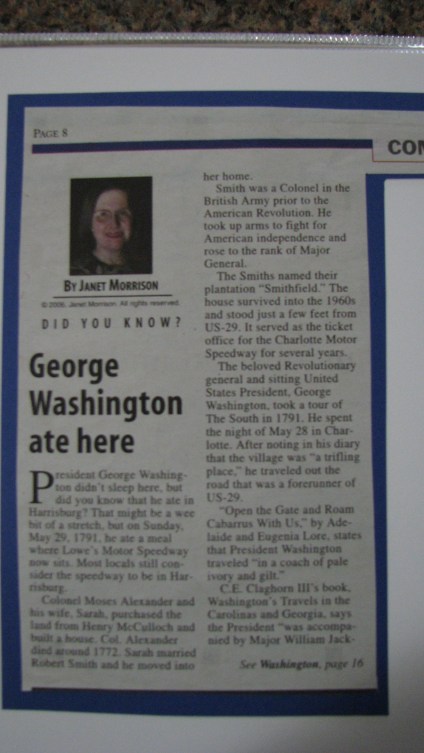
I wrote a local history column titled, “Did You Know?” in Harrisburg Horizons, a weekly newspaper here in Cabarrus County, North Carolina from May 2006 through December 2012. It was a perfect opportunity for me as it allowed me to do two of my favorite things:  historical research and writing. It was my first freelance writing job. I had complete control over when I worked on the column and what topics I chose. I had a deadline every two weeks, but the day-to-day freedom the work gave me was a perfect fit for me. Once-a-month in 2017 I plan to share one of my newspaper columns or an essay or short story I’ve written. Today’s offering is a slightly edited version of my May 31, 2006 newspaper column.

geo-washington-ate-here-005

George Washington Ate Here

President George Washington didn’t sleep here, but did you know that he ate in Harrisburg? That might be a wee bit of a stretch, but on Sunday, May 29, 1791, he ate a meal where Charlotte Motor Speedway now sits. Most locals still consider the speedway to be in Harrisburg, although it is now in the Concord city limits.

Colonel Moses Alexander and his wife, Sarah, purchased the land from Henry McCulloch and built a house. Col. Alexander died around 1772. Sarah married Robert Smith and he moved into her home.

Robert Smith was a Colonel in the British Army prior to the American Revolution. He took up arms to fight for American independence and rose to the rank of Major General.

The Smiths named their plantation “Smithfield.” The house survived into the 1960s and stood just a few feet from US-29. It served as the ticket office for the Charlotte Motor Speedway for several years.

The beloved Revolutionary general and sitting United States President, George Washington, took a tour of The South in 1791. As a result of that tour, there are numerous historical markers titled, “George Washington Slept Here.” There is no such roadside marker at the corner of US-29 and Morehead Road, but there should be one that says, “George Washington Ate Here.” President Washington spent the night of May 28, 1791 in Charlotte. After noting in his diary that the village was “a trifling place,” he traveled northeast out The Great Wagon Road which was a forerunner of US-29.

Open the Gate and Roam Cabarrus With Us,” by Adelaide and Eugenia Lore, states that President Washington traveled “in a coach of pale ivory and gilt.”

C.E. Claghorn III’s book, Washington’s Travels in the Carolinas and Georgia, says the President “was accompanied by Major William Jackson, five servants, two footmen, coachmen & postilion [guide], chariot & four horses, light baggage wagon drawn by two horses, four saddle horses plus one for himself.”

The green meadows and hardwood forests of our area probably reminded the President of his Virginia homeland. Our red clay rolling hills were in stark contrast to the sandy South Carolina Lowcountry he visited on his way to North Carolina.

Can you imagine how nervous Sarah Smith was on the days leading up to the President’s arrival? It would be interesting to know the menu she planned. Being late May, the summer staples of squash and beans were not in season.

Mrs. Smith’s spring garden possibly provided turnips, radishes, and an assortment of greens and herbs. No doubt a servant retrieved a well-cured country ham from the log smokehouse for the occasion. In my mind’s eye, I see a bowl of fresh wild strawberries on the dining table or perhaps strawberry shortcake with fresh cream drizzled on top for dessert.

I would have liked to have been privy to President Washington and Gen. Smith’s conversation. Perhaps the President “broke the ice” by asking Smith about the battles he participated in during the Revolution. They probably discussed political matters of the day such as the moving of the nation’s capital from New York City to Philadelphia the previous year.

After dining at “Smithfield,” President Washington returned to his coach and traveled to Colonel Martin Phifer’s “Red Hill” tavern near the Poplar Tent section of the county. He lodged at “Red Hill” that night before continuing on toward Salisbury at four o’clock the next morning.

Until my next blog post, I hope you have a good book to read. If you’re a writer, I hope you have quality writing time.  Feel free to Tweet about my blog or share it on other social media.

Janet

Sources I used as I researched this newspaper column’s subject:

Piedmont Neighbors:  Historical Sketches of Cabarrus, Stanly and Southern Rowan Counties, edited by Clarence D. Horton, Jr. and Kathryn L. Bridges.

Open the Gate and Roam Cabarrus With Us, by  Adelaide and Eugenia Lore, 1971.

The Historic Architecture of Cabarrus County, North Carolina, by Peter R. Kaplan, 1981.

A Light and Lively Look Back at Cabarrus County, North Carolina, by Helen Arthur-Cornett, 2004.

Washington’s Travels in the Carolinas and Georgia, by C.E. Claghorn III.

Save

Save

Save

Save

Save

My 2017 Writing Plan of Action

Here it is the end of the third week in January and I’m just now articulating my 2017 writing plan of action. The name itself sounds arrogant, but that isn’t my intention. As an aspiring author, I need a plan and I need to act. I call it a “plan of action” for my own encouragement and not to impress anyone.

My 2016 Plan of Action was short and to the point. In this year’s plan I’ve tried to get into specifics and goals for various social media. Here’s my 2017 plan:

Consistency, Consistency, Consistency

In real estate, the maxim is “Location, Location, Location.” If I am to establish my “brand” as a writer, my maxim must be, “Consistency, Consistency, Consistency.” Just as a character in a work of fiction has a distinguishable voice or way of speaking, my voice on social media needs to be consistent. My style of writing needs to be authentic and not all over the place. Likewise, I need to be consistent in my presence on social media. If I just blog on a whim, my audience will fall by the wayside. If I Tweet with no regularity, I’ll lose my followers. My challenge in 2017 will be to use social media on a consistent basis while making time to write. Being a relative newbie in the world of social media and not being technologically savvy, most days I feel overwhelmed by how much I have to learn. My actual writing has been taking a back seat lately. I must strike a healthy and productive balance in 2017 as I work toward getting my novel manuscript published. If I don’t, all the years I’ve spent writing the book and all the months I’ve spent sharpening my social media skills are all for naught.

My ideal reader

Writers are instructed to identify an ideal reader. This isn’t a real person. This is an imaginary person you write for. Some writers give this ideal reader a name and they have a visual concept of what that person looks like. I’ve concluded that my ideal reader is complex. Ultimately, my ideal reader is someone who enjoys southern historical fiction, has an interest in history but also keeps up with current events. My ideal reader is a well-informed citizen and not just a spectator. My ideal reader is not offended if I occasionally reveal my beliefs or civic concerns on social media. My ideal reader is not only willing to have his or her assumptions questioned but actually seeks out such literature. Does such a person exist? I’m counting on it!

It’s easy to sit here and wax poetic about my plans, but now comes the hard part. From what I’ve read, I need to determine on which social media platform(s) my ideal reader hangs out and then concentrate my efforts there.

http://www.janetswritingblog.com

Study my end-of-year 2016 reports, stats, etc. & determine what worked & what didn’t work & what I need to do differently in 2017. (I considered blogging three times a week; however, I concluded that’s too much for me. Instead, in addition to my regular Tuesday and Friday blog posts, I will occasionally blog on other days with no set schedule for these random posts.)

Plan blog topics for the year. (By that I mean, my first blog each month will be about what I read the previous month. My second blog each month will be a line I like from a book. My third blog each month will be a list of things I’ve learned about a particular topic. In other words, there will be a            pattern to my blog posts every month. If the plan doesn’t produce results, I need to make adjustments.)

Try to use my blog to increase my exposure as a writer & establish my brand. Set goals for number of followers & number of bloggers following my blog.

Make a list of blogs I’d like to guest blog on.

Figure out how to make necessary changes to my blog’s set up to improve its Search Engine Optimization.

By the way, if you have trouble reading my blog on your cell phone or tablet, please let me know so I can take actions to rectify the situation. Please let me know if you have difficulty seeing or downloading photos I include in some of my blog posts. I need feedback about any issues you’re having.

Twitter @janetmorrisonbk

Study my end-of-year 2016 reports, stats, etc. & determine what worked & what didn’t work & what I need to do differently in 2017.

Try to use Twitter to increase my exposure as a writer & establish my brand. In order to establish my brand, I need to create more original content as opposed to primarily retweeting content generated by others.

Set goals for number of Tweets and number of followers.

Pinterest:  http://www.pinterest.com/janet5049

Study my end-of-year 2016 reports, stats, etc. & determine what worked & what didn’t work & what I need to do differently in 2017.

Try to use Pinterest to increase my exposure as a writer & establish my brand. As with Twitter, I need to create more original Pins. Janet’s Writing Blog is my only Pinterest board that is 100% original content.

Evaluate my boards and the order in which I display them.

Set goals for number of followers for these boards: The Writing Life; Novel in Progress: The Spanish Coin; Blue Ridge Mountains; Great Smoky Mountains; I Need the Light; Sequel to The Spanish Coin; Janet’s Writing Blog; and Blog Odds & Ends.

Facebook:  Janet Morrison, Writer

Try to use Facebook to increase my exposure as a writer & establish my brand. My personal page is just what it sounds like. My “Janet Morrison, Writer” page is where people who are interested in my writing can “Like” me.

Set goal for number of “Likes” by Dec. 31, 2017.

Goodreads.com

Goodreads.com is a website I enjoy as a writer and as a reader. It’s free to create an account and then to participate as much or as little as you wish. You can search for books or authors and create a list of books you’ve read, are currently reading, or want to read. Book reviews and book ratings on a one- to five-star system are encouraged but not mandatory. I have been lax in writing reviews, and I don’t always rate books I’ve read. I need to increase my activity in 2017 in order to get the most benefit from this completely free website. Oh – and there are a multitude of book giveaway contests for account holders.

LinkedIn

Learn about the potential LinkedIn holds for a writer. (To say I rarely use LinkedIn now would be a huge  understatement.)

Try to use LinkedIn to increase my exposure as a writer & establish my brand.

Google+

Learn about the potential Google+ holds for a writer. (As with LinkedIn, I rarely use Google+.)

Try to use Google+ to increase my exposure as a writer & establish my brand.

Website:  www.JanetMorrisonBooks.com

Review analysis for end of 2016.

Figure out which changes I can make and how to accomplish them.

The Spanish Coin southern historical mystery novel manuscript

Get 2 beta readers to give me feedback.

Hire a professional editor to do a developmental edit.

Pursue getting a literary agent or self-publishing.

Only time will tell how successful I am in carrying out this grandiose plan. All these social media activities are touted as being necessary for authors. Truth be told, I’d rather just write!

If you took the time to read this entire blog post, you deserve a prize. I don’t have any to offer, but you do have my sincere appreciation.

Until my next blog post . . .

I hope you have a good book to read. If you’re a writer, I hope you have productive writing time.

In your chosen work, do you make an annual written plan?

Janet

What is a logline, and why do I need one?

I’m still learning the terminology used in the publishing business. The publishing business is changing every day, so I’ll always be playing catch up.

Sell Your Story in a Single Sentence

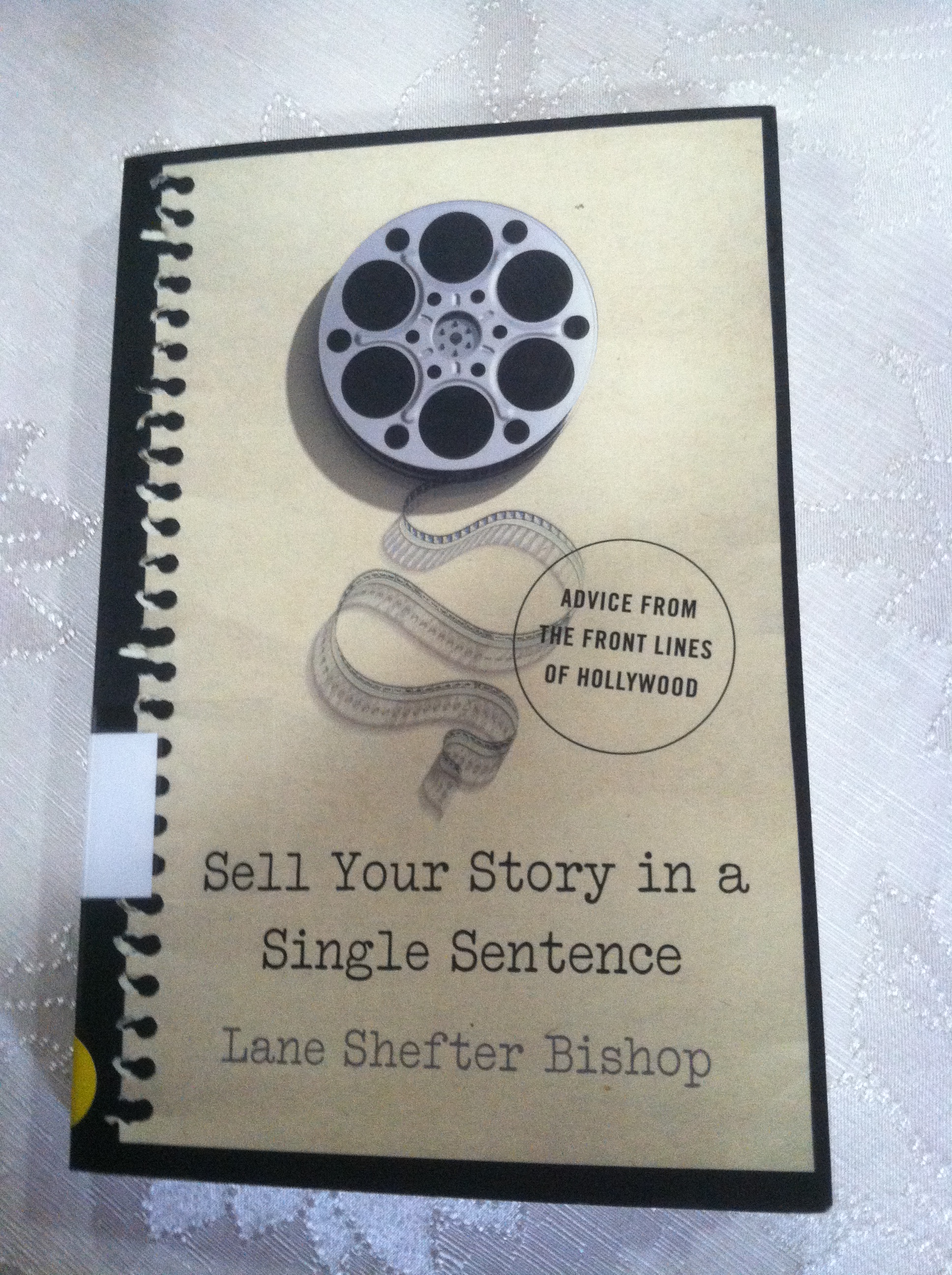
A library book caught my attention last week, so I checked it out. Sell Your Story in a Single Sentence, by Lane Shefter Bishop turned out to be one of the most helpful writing books I’ve read. Perhaps I feel that way because it was timely. It would have been even more beneficial if I could have read it a decade ago before I started writing my southern historical novel manuscript with the working title, The Spanish Coin. (Since Ms. Bishop published the book in 2016, that would have been impossible — but you get my point.)

Sell Your Story in a Single Sentence, by Lane Shefter Bishop
Sell Your Story in a Single  Sentence, by Lane Shefter   Bishop                                                                                                                         

Speaking of getting to the point . . .

Sell Your Story in a Single Sentence is an excellent “how to” book about the process of writing a logline. A logline is a single sentence that identifies a story’s protagonist, what the protagonist wants, and what’s at stake. Sounds easy?  Actually, it’s quite a process that involves many revisions and lots of rewriting.

When to write your logline

If I had known to create a logline before writing my novel’s manuscript, it would have helped me focus. Writing the logline after the fact, though, will help me evaluate my 97,000-word manuscript. I’ll have to make the best of having the cart before the horse. Next time I write a book, I’ll know to start with the logline.

Why do I need a logline?

I need a logline so I can precisely answer the question, “What’s your book about?” I will also need it to open my query letters to prospective literary agents or publishers. In that respect, the logline is like the “hook” or first line of a novel. If well written, it grabs the agent’s attention and makes him want to hear more. Ultimately, it makes a literary agent want to read my manuscript — or not read it.

My logline for The Spanish Coin

The following sentence is my logline in progress for The Spanish Coin:

When a widow is accused of her husband’s murder in the Carolina backcountry in 1771, she will stop at nothing to save herself and her unborn child.

Until my next blog post . . .

I hope you have a good book to read. If you’re a writer, I hope you have quality writing time.

Janet

P.S. Does my logline make you want to read The Spanish Coin? I would love to have your comments!

Save

First line from a novel by Jenny Milchman

“The children had never been this far from home before.” ~ from Ruin Falls, by Jenny Milchman

What thoughts does this first line from Jenny Milchman’s Ruin Falls bring to your mind?

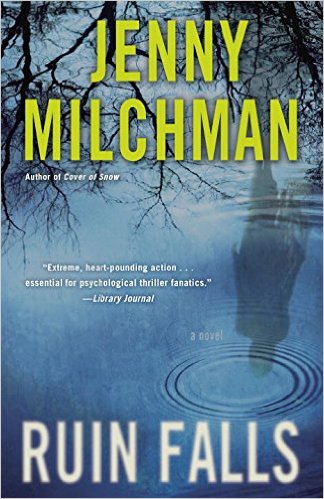
Ruin Falls, by Jenny Milchman

Cue from title

Indeed, the title gives a cue about the tone of the book. I don’t want to give too much away and spoil it for you, but I can say that the book involves the disappearance of two children and their mother’s desperate search for them. It is a book of suspense. Sometimes a reader can tell by the title what kind of book a novel is, but we all know that isn’t always true. “You can’t judge a book by its cover” comes to mind.

Speaking of judging a book . . .

Ruin Falls was an Indie Next Pick and a “Top Ten of 2014” selection by Suspense Magazine.

Author, Jenny Milchman

I decided to read Ruin Falls last year primarily because it fulfilled one of the 19 categories in the 2016 Mint Hill Library Reading Challenge — Read a book whose author has your initials. It was either that or read a book by James A. Michener. Time was not on my side, so I opted for Jenny Milchman. I’d read another of her books — Cover of Snow — several ears ago and liked it, so Ruin Falls was not a random choice. I will read other books she writes. I have not read her novel published in 2015 titled As Night Falls. It seems to be another suspense novel.

In addition to her writing talent, I admire Jenny Milchman for founding “Take Your Child to a Bookstore Day” in 2010.

Until my next blog post . . .

I hope you have a good book to read. If you’re a writer, I hope you have productive writing time.

Janet

Save

Save

Save

11 Things I’ve Learned about Grammar & Spelling

  1. Everyday is an adjective. (Spell-check wants me to change “everyday” to two words. Don’t trust spell-check.)
  2. Every day is a noun.
  3. Spell-check cannot be trusted when it comes to possessive tense. It thinks every “s” should be preceded by an apostrophe. (Pet peeve alert!)
  4. Anytime is an adverb that means “at any time.” Anytime is sometimes a subordinating conjunction. When used as the latter, it generally means “every time that.” The Merriam-Webster Dictionary gives 1926 as the year the word “anytime” came into general use. It is not found in The Oxford Dictionary.
  5. Any time must be two words when used in an adverbial phrase, such as “at any time” because “at” must be followed by a noun or a noun phrase. (Okay. I admit it. I’m lost!) Bottom line: When in doubt, use “any time.”
  6. When you have placed an apostrophe after a noun that ends in an “s” for more than 50 years, it is difficult to adopt the new practice of adding an apostrophe and an “s” in such cases.
  7. The Chicago Manual of Style is an excellent 1,000-plus-page grammar guide. It will confirm that you know how to write while simultaneously confounding you and teaching you that you haven’t mastered grammar after all.
  8. After being taught that “President” is always capitalized when naming the president of the United States of America, I learned the hard way while editing my vintage postcard book, The Blue Ridge Mountains of North Carolina, for Arcadia Publishing in 2014 that The Chicago Manual of Style demands a lower case “p.” I had to swallow my pride and write “president Andrew Jackson” and president Franklin D. Roosevelt” in my postcard book. The new lower case rule will never look correct to me!
  9. The older I get, the less confident I am about spelling.
  10. I’ve learned more about punctuation by studying the craft of writing in my middle age than I learned in school.
  11. As demonstrated by The Chicago Manual of Style, there are way too many grammar and punctuation rules for the English language! I have, no doubt, broken a dozen of those rules in this list of 11 items.

chicago-manual-of-style-005

Until my next blog post, I hope you have a good book to read. (***Shameless book promotion alert!***  Have you read The Blue Ridge Mountains of North Carolina? Ask for it at your favorite bookstore, or order it from Amazon.) If you are a writer, I wish you productive writing time.

Janet

Twitter:  @janetmorrisonbk

Facebook:  Janet Morrison, Writer

Pinterest:  https://www.pinterest.com/janet5049 (I have boards on writing, blogging, the Blue Ridge Mountains, the Great Smoky Mountains, music I like, quilting, knitting, needlepoint, crocheting, politics, health, hearing loss, Southernisms, books, authors, Scotland, faith, penmanship, dogs, Maxine-isms, genealogy, the Carolina Panthers, and lots of recipes. I invite you to follow my boards that interest you.)

Save

Save

Save

Save

Save

Save

Save

Save

A line I like from a novel by Anthony Doerr

“His voice was low and soft, a piece of silk you might keep in a drawer and pull out only on rare occasions, just to feel it between your fingers.” – from All the Light We Cannot See, by Anthony Doerr

The source of the sentence

That is Marie-Laure describing her great-uncle in All the Light We Cannot See, by Anthony Doerr. It would be a beautiful piece of imagery even if Marie-Laure were not blind. Knowing she cannot see with her eyes gives the sentence a deeper meaning.

What does this sentence make me do?

As a reader, it makes me shut my eyes and pretend I have a piece of silk to gently rub between my fingers. What a clever way to describe the heightened hearing of a person without sight!

As a lover of rich prose, the sentence makes me stop and read it again.

As a writer, it makes me grab a pen and write it in my writer’s notebook so I can revisit it any time I want to.

Pro or Con?

If you’ve followed my blog very long, you know I’m not a fast reader. Perhaps my noticing this particular line from Pulitzer Prize winner All the Light We Cannot See is a benefit of being a slow reader — something I’ve always considered a fault.

Until my next blog post . . .

I hope you have a good book to read. If you’re a writer, I wish you productive writing time.

Janet

Save

Save

Save

What I read in December

I’ve struggled over what to blog about today. It’s my custom for my first blog post of a new month to be about what I read the previous month. It has occurred to me that my blog readers might not care what I read.

Three books read

I only read the following three books in December:  Without Mercy, by Jefferson Bass; The Ghosts of Belfast, by Stuart Neville; and Silent Night, Deadly Night, by Richard L. Mabry, M.D.

Jefferson Bass is one of my favorite author or, more accurately, author teams. (More on that later.) Conversely, I had never read books by Stuart Neville or Richard L. Mabry, M.D. before.

Silent Night, Deadly Night, by Richard L. Mabry, M.D.

I follow Richard L. Mabry, M.D.’s blog. He is a retired physician whose new occupation is that of medical mystery writer. His medical expertise gives him a unique perspective on what violent murder does to the human body. In this Christmas novel, an older woman’s body is found in the snow. There are twists and turns as it becomes obvious that someone is also trying to kill her heirs.

The Ghosts of Belfast, by Stuart Neville

Stuart Neville was recommended to me by my ophthalmologist. My doctor, who guided me through my 2016 bout with shingles in my right eye (and will continue to direct my care as the pain and itching is lapping over into 2017) is a collector of first editions of mystery novels. At my most recent appointment he noticed I had a book with me and inquired about its title and author. It was The One Man, by Andrew Gross. When I explained the premise of the book to him, he asked if I had read any Stuart Neville books. I had not, so we both came out of my appointment with notes about new authors to try. He said that The Ghosts of Belfast was perhaps Mr. Neville’s best book, so I checked it out at the public library.

The protagonist in The Ghosts of Belfast is tormented and egged on by the ghosts of the 12 people he killed during the conflicts between the Protestants and Catholics in Northern Ireland. The only way he can escape from the 12 ghosts is to kill the men who forced him to kill them. There was more violence in The Ghosts of Belfast than I usually read, but the story line kept me too interested to not finish it. It was the first novel in Mr. Neville’s Jack Lennon Investigations Series.

Without Mercy, by Jefferson Bass

As stated earlier, Jefferson Bass is one of my favorite author duos. Jon Jefferson is the writer and Dr. William Bass is the expert adviser, forming the pen name, Jefferson Bass. Dr. Bass started the The Body Farm at the University of Tennessee at Knoxville in 1971 to advance the study of human decomposition and forensic science.

I have read all of The Body Farm series of novels by Jefferson Bass. If forensic science interests you and you enjoy reading mysteries, I recommend this series of books. I also recommend that you read them in their order of publication. It’s not absolutely necessary; however, in some cases it is helpful to know the personal and professional history of protagonist, Dr. Bill Brockton.

Without Mercy repeated a little too much of Dr. Brockton’s history to suit me. At times it seemed the rehashing of murder cases from earlier books in the series was being used to stretch this book. That was disappointing. The author’s note at the end of the novel indicated that Jefferson Bass, like Dr. Bill Brockton, was taking a sabbatical, leaving me to wonder if Without Mercy will be the last book written by this entertaining writing team. I hope not, because by next fall I’ll be going through “Jefferson Bass withdrawal” and yearning for another dose of East Tennessee murder drama.

Until my next blog post. . . I hope you have a good book to read and, if you’re a writer, I wish you productive writing time.

Janet

Did you meet your 2016 reading challenge?

Did you participate in a 2016 reading challenge and, if so, did you meet the challenge?

I blogged on March 11, 2016 and June 24, 2016 (How’s that 2016 reading challenge working for you?) that I was participating in the 2016 reading challenge offered by the Mint Hill Branch of the Charlotte-Mecklenburg Public Library. I had high hopes of reading books in at least 12 of the 19 categories. Unfortunately, I only read books in the following nine categories:

  1. Book published in 2015: The Bookseller, by Cynthia Swanson
  2. Book with a number in title: Tricky Twenty-Two, by Janet Evanovich
  3. Nonfiction book: No Better Friend: One Man, One Dog, and Their Extraordinary Story of Courage and Survival in World War II, by Robert Weintraub
  4. Book with a color in title: Gray Mountain, by John Grisham
  5. A humorous book: Miss Julia Delivers the Goods, by Ann B. Ross
  6. Book with a one-word title: Damaged, by Lisa Scottoline
  7. Mystery or thriller: Don’t Go, by Lisa Scottoline
  8. Book that might scare you: The Woman in Cabin 10, by Ruth Ware
  9. Book written by an author with my initials: Ruin Falls, by Jenny Milchman

I also read 36% of a 2015 Pulitzer Prize winner by Anthony Doerr, All the Light We Cannot See, before it had to be returned to the public library. I’m back on the wait list for it, so I hope to finish reading it in 2017. What was the book I read in 2016 that I still think about? No Better Friend: One Man, One Dog, and Their Extraordinary Story of Courage and Survival in World War II, by Robert Weintraub. I highly recommend it.

My personal reading goal for 2016 was to read 52 books. I read 31 books which, ironically, is the same number I read in 2015. My next blog post in a few days will be about the three books I’ve read so far in December.

I look forward to reading many interesting and entertaining books in 2017. If you missed my December 27, 2016 blog post, it was about the 2017 reading challenge I designed for myself. Feel free to adopt it or write your own challenge.

Until my next blog post, I hope you have a good book to read. If you’re a writer, I hope you have productive writing time.

Janet