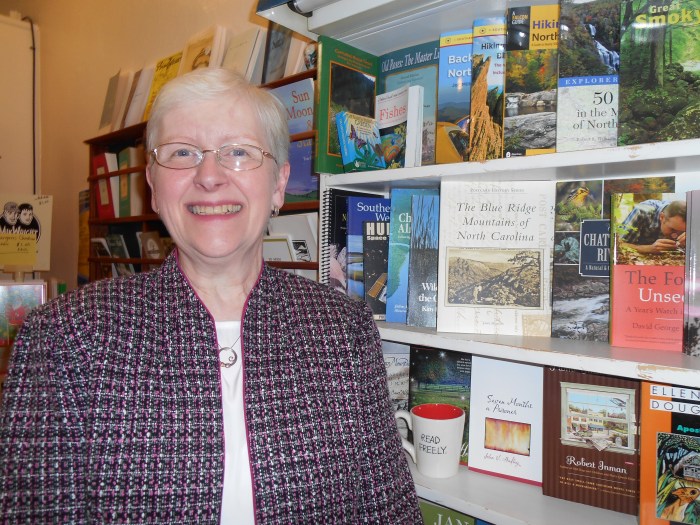
10 Things I Learned about Great Smoky Mountains National Park

Although the name of my vintage postcard book is The Blue Ridge Mountains of North Carolina, one of the chapters is about the Great Smoky Mountains National Park and Qualla Boundary. One of my blog posts in August was about the Eastern Band Cherokee Indians. Their land is the Qualla Boundary.

mountain-trip-aug-16-003
The Blue Ridge Mountains of North Carolina, by Janet Morrison on a shelf at Battery Park Book Exchange and Champagne Bar in Asheville, NC in August, 2016.


In today’s post I want to share 10 things I learned about the Great Smoky Mountains National Park as I did the research to write my vintage postcard book.

1. Great Smoky Mountains National Park is located in Swain and Haywood Counties in North Carolina and Blount, Sevier, and Cocks Counties in Tennessee.

2. A gap is a low point in an Appalachian Mountain ridge. Gaps are called notches or passes in other parts of the United States.

3. A new gap in the Smoky Mountains was discovered in 1872 more than a mile from Indian Gap. The newfound gap was aptly named Newfound Gap.

4. Although Clingmans Dome is the highest peak in Great Smoky Mountains National Park at an elevation of 6,643 feet, Mount LeConte is the tallest mountain from base to summit in the Great Smoky Mountains. Mount LeConte’s elevation is 6,593 feet, and it rises 5,301 feet from its base to its peak.

5. When a grassroots effort to raise $10 million to save the Great Smokies from logging came up short, John D. Rockefeller, Jr. donated the $5 million needed.

6. President Franklin D. Roosevelt allocated $1.5 million in federal funds to purchase the last of the land wanted for Great Smoky Mountains National Park.

7. President Franklin D. Roosevelt dedicated Great Smoky Mountains National Park in 1940.

8. It is illegal to willfully get within 150 feet of a black bear in Great Smoky Mountains National Park.

9. Newfound Gap Road (US-441) tunnels under itself at one place, forming a helix.

10. Much of the forest in Great Smoky Mountains National Park has been ravaged by the balsam woolly adelgid, an insect imported from Europe.

Want to know more about the Great Smoky Mountains? Look for my vintage postcard book, The Blue Ridge Mountains of North Carolina. It can be purchased online from Amazon or at some wonderful independent bookstores. If your favorite bookstore does not have the book, please ask them to order it from Arcadia Publishing and The History Press. It is also available for e-readers.

mountain-trip-aug-16-004
The Blue Ridge Mountains of North Carolina, by Janet Morrison, (center of photo) as displayed at Battery Park Book Exchange and Champagne Bar in Asheville, NC.

I was delighted a couple of weeks ago to find my book still prominently displayed at Battery Park Book Exchange and Champagne Bar in Asheville, North Carolina. This fabulous bookstore is located in the Grove Arcade Building, an iconic 269,000-square-foot downtown Asheville destination built in 1929. An image of a matte-finish postcard of the building is included in my book.

I hope you’re always reading a good book.

Until my next blog in a few days,

Janet

Save

Why Comparing Yourself to Other Writers Doesn’t Make Sense

This is my first attempt to reblog someone else’s blog post. This young blogger shows a lot of wisdom in this piece. If you are a struggling writer like I am, you might benefit from reading Meg Dowell’s words.

What I read in August

It was great to get back on track with reading after a couple of months of not being able to read due to shingles in my right eye. I was fortunate in August to read the four books I’ll write about below.

When I got shingles in May, I had read the first half of Most Wanted, by Lisa Scottoline. It is a popular book, so it took several weeks for me to get it from the public library after I was able to read. Most Wanted is a suspenseful novel about a couple who used the services of a sperm bank and then the wife fears that their donor is a serial killer.

The Bookseller, by Cynthia Swanson was not what I expected, but it turned out to be a page-turner after all. I was drawn to the novel by its title; however, the fact that the protagonist is a bookseller is not an integral part of the story. I was also prompted to check out the book because it is Ms. Swanson’s debut novel. The book’s premise is that Kitty Miller’s life blurs between her reality and the life she lives in her dreams. The deeper into the book one gets, the less clear it is which life is real and which one is only in her dreams. I was impressed with the author’s ability to move back and forth between the two story lines, and I look forward to her future books.

I had not planned to read two Lisa Scottoline books in August, but I rose to the top of the public library waitlist for her latest novel, Damaged. This is in Ms. Scottoline’s Rosato and DiNunzio law firm series. Once again, Mary DiNunzio gets herself in a tangled mess when she agrees to represent a 10-year-old special needs child who is not being adequately served by the school he attends. Like any good novel, just when you think things can’t get any worse — they do.

I read a nonfiction book in August whose characters will remain with me forever. Robert Weintraub’s No Better Friend: One Man, One Dog, and Their Extraordinary Story of Courage and Survival in WWII is the amazing story of a pointer named Judy and a British soldier named Frank Williams. Man and dog were held as prisoners by the Japanese during World War II. Judy seemed to have a sixth sense that enabled her to react in uncanny ways not only to move through the war with Mr. Williams but also to save the lives of Allied soldiers on more than one occasion. This true story escaped my knowledge until this summer. I’m glad it was displayed in such a way in an independent bookstore that it caught my eye. I’m a richer person for having read this book.

I wish for you a good book to read and, if you are a writer, productive hours of writing.

Janet

Writing Plan of Action Update

My “Writing Plan of Action – Revised June 15, 2015” sort of fell through the cracks. In fact, I soon forgot all about it! In my own defense, we remodeled our kitchen last summer. If you’ve ever lived through a kitchen remodeling project, you will remember how all-consuming that is.

Refresher on June 2015 Plan

Something reminded me on Monday that I had a writing plan. I was shocked to read that my last revision to it was made more than 14 months ago. In a nutshell, here is that old plan: Schedule book signings/author events; blog every five days or so; look for writing contests to enter or magazine articles to write; edit my historical novel manuscript (The Spanish Coin) one day every week; and start in earnest to find a literary agent.

I have failed on all counts.

Progress made on novel manuscript

I recently got back to work on The Spanish Coin after a strange year with many distractions.

Sometimes I think I read too many “How To” books about writing and don’t spend enough time writing. For instance, I read a recommendation that my characters’ thoughts should be italicized. After going back through the first 15 chapters doing that, I read a more convincing recommendation that thoughts should be blended into a novel through characters’ voices. The reasoning was that italics pull the reader out of the story. I went back through chapters 1 through 15 and converted the italicized thoughts into a more blended format. Then, I converted thoughts in chapters 16 through 20 from “she thought/he thought” to a blended format. I hope I got it right!

My Writing Plan of Action – Revised August 25, 2016

  • Hire a professional to evaluate my The Spanish Coin manuscript;
  • Edit manuscript in light of that evaluation;
  • Continue to blog every Friday;
  • Get back to work on a sequel to The Spanish Coin (tentatively titled The Banjo); and
  • Seek representation by a literary agent or self-publish.

Let’s hope I am more successful following my new plan than I was my old one!

Janet


The Eastern Band of Cherokee Indians

Writing The Blue Ridge Mountains of North Carolina was educational for me and I hope it is for its readers. Today my blog post is a list of 10 things I learned about The Eastern Band of Cherokee Indians as I did the research for that vintage postcard book.

Mt. trip Dec.11-14,2014 037
My book on the shelf at Battery Park Book Exchange & Champagne Bar in Asheville, NC.
  1. The legal name for the Cherokee people in North Carolina is The Eastern Band of Cherokee Indians.
  2. Because “Native American” can refer to anyone born in America, The North American Indian Women’s Association recommends using the term American Indians.
  3. The Great Smoky Mountains lay in the middle of the Cherokee Indians’ territory in the mid-1600s when Spanish explorer Hernando de Soto arrived.
  4. In the 1820s, a Cherokee by the name of Sequoyah invented the Cherokee syllabary, making the Cherokee one of the first American Indian tribes to have a written language.
  5. Cherokee women have always had much power within the tribe, owning property, and administering justice.
  6. Descendants of the Cherokee Indians who hid out in the mountains to avoid the 1838 forced march to Oklahoma known as the Trail of Tears lived on a land trust called the Qualla Boundary.
  7. The land the US government gives to an American Indian tribe is a reservation. The Cherokee do not live on a reservation. The Qualla Boundary is 57,000 acres of land purchased by the Cherokee Indians in the 1800s and held in trust by the US government.
  8. A papoose is a type of bag or apparatus for carrying a child. It is offensive to the Cherokee for others to call one of their infants a papoose.
  9. The Cherokee Indians never lived in tipis. They have always lived in houses.
  10. Cherokee Indians have played a ball game called ani-tsagi or anetso for hundreds of years.

Want to know more? Look for my vintage postcard book, The Blue Ridge Mountains of North Carolina in your local bookstore or online. It was published by Arcadia Publishing in 2014.

Janet's Bk Trip to Mts. 12.14 003

You can help me get the word out about Janet’s Writing Blog by telling your friends about it and by sharing it on Facebook, Pinterest, and Twitter. According to WordPress, my blog has been seen by people in 10 countries!

Until my next blog post, I hope you have a good book to read. If you are a writer, I hope you have productive and rewarding writing time.

Janet

Online sites for writers

Today’s post is about a half dozen websites for writers that I discovered this week. I do not endorse any of the websites. I’m merely sharing the sites with those of you who are writers and, in some cases, commenting on my first impressions of the sites.

Online-Utility.org

Online-Utility.org is a free online tool. It measures readability and calculates the grade level at which one could read your text with ease. It also instantaneously lists every sentence in your text that “it” suggests you “rewrite to improve readability.” I was stunned at the number of sentences this tool listed that needed my attention in the first 100 pages of my novel manuscript; however, the website description admits that “In general, these tests penalize writers for polysyllabic words and long, complex sentences.” After quickly perusing the Online-Utility.org list of my sentences that needed attention, I concluded that the great majority of my words had more than one syllable and I am guilty of writing a complex sentence on occasion. I am attempting to write fiction for adults. I concluded that this free online tool better serves someone who is writing for young children or new readers of the English language.

thewritingpractice.com

I also happened upon thewritingpractice. The site has articles about the craft of writing. I will definitely visit that website again.

Writers’ Village University

Another website is that of Writer’s Village University. This site offers college-level classes for its members. I have found few reviews of this site on objective websites but many posts from people asking if anyone has used it. The Writer’s Village University website lists numerous glowing remarks from students, but I find it suspect that there is not one single mediocre or negative review. The writing groups aspect of the website might be its best member benefit. The sites lacks sufficient course descriptions for me to join with confidence. I welcome feedback from any current or former members of the website.

inkandquills.com and The Spanish Coin

As energy allows, I continue to edit my historical novel manuscript I’m calling The Spanish Coin. I was up to chapter 16 of 20 putting my characters’ thoughts in italics when a couple of days ago I read Kaitlin Hillerich’s article titled “How to Write Your Character’s Thoughts” on inkandquills.com. Ms. Hillerich says putting thoughts in italics or using speech tags creates “a barrier between the character and the reader.” She sees thoughts in italics as an interruption by the writer. Ms. Hillerich recommends that the writer lets the character convey his or his thoughts with their own voice. In other words, you can stay in third person point of view but write so it seems like the character is the narrator. This approach makes sense to me, so I will start once more on the first page of my novel’s manuscript, remove the thoughts in italics, and try to accomplish what Ms. Hillerich recommends. I hope my next step after that will be getting a professional to critique my 95,852-word manuscript. If I keep reading “how to write” articles and blogs, I’ll never get The Spanish Coin published. I think I sub-consciously procrastinate because I dread getting umpteen rejection letters from literary agents.

jamigold.com

One website leads to another when I get online. I often start out on Pinterest.com and find many websites about writing. I do not read paranormal fiction, but I recently discovered the jamigold.com website about paranormal writing. I was pleasantly surprised to find a plethora of helpful blog posts there for any writer. Some posts are about self-publishing. There is a new blog series about planning your newsletter. There are posts about how to keep readers and types of extra content you might want to consider including on your website.

Janice Hardy’s Fiction University

The Jami Gold website led me to blog.janicehardy.com — Janice Hardy’s Fiction University. The site contains more than 1,000 articles about writing. Whew! I don’t know where to begin.

No wonder I haven’t finished editing my novel. I spend too much time reading about writing and not enough time writing. And did I mention I’m a procrastinator?

Feel free to tweet about my blog, pin my posts on one of your Pinterest boards, and tell your friends to visit my blog and my website, janetmorrisonbooks.com. Until my next post, I wish you a good book to read and productive writing time for those of you who are writers.

What I read in July

As has become my custom, my first blog in a new month is about the books I read in the previous month. After not being able to read for a couple of months due to illness, I have relished every minute I have been able to read since my eye recovered.

Storm Damage

July was a busy month. We are still cleaning up the storm damage the trees in our yard experienced due to high winds on several occasions. Dead limbs are still falling out of trees when there is a breeze and sometimes bringing down healthy limbs with them. If you’ve never lived out in the country with dozens of large old trees, you can’t fully appreciate what I’m talking about. It has been exhausting. I often fall asleep when I sit down to read or to catch up on work on the computer.

July Books

All that said, I only completed two books in July — Don’t Go, by Lisa Scottoline and The Truth According to Us, by Annie Barrows. I am reading several other books and will share my thoughts about them later. As I have stated before, I enjoy reading more than one book at a time.

Don’t Go

Lisa Scottoline is becoming one of my favorite fiction writers. Her books usually tug at your heartstrings and lead you down multiple roads as a mystery is solved. Don’t Go did not disappoint. A murder takes place (or was it an accident?) and for the next 300+ pages you are trying to figure out “whodunnit.” Just when you think you have the mystery solved, Ms. Scottoline takes you down a different path.

The Truth According to Us

In The Truth According to Us, Annie Barrows gives us a glimpse of life in a small town in Appalachia during the Great Depression era. She includes the conflict that can arise when there is an effort to unionize the employees of a textile mill in The South. The overriding story line, though, is relationships and information that family members can hide from other family members. The Truth According to Us is about family secrets. The truth as we know it might not be the truth at all.

Most Wanted

As July drew to a close, I finally reached the top of the public library’s waitlist for Most Wanted, by Lisa Scottoline. I read the first half of the novel in early May before I got shingles, and I looked forward to reading the rest of the book to see how Ms. Scottoline twisted and turned the plot to ultimately solve the mystery presented in the book. I finished reading Most Wanted earlier this week, but it goes on my August list for next month’s first blog.

Until I blog again, I wish you an enjoyable book to read and productive writing if that is your calling. If you wish to share this blog on social media, please feel free to do so.

Janet

Still catching up on e-mail

After being close to home except for medial appointments and church attendance for most of the spring and summer, I had a weekend in the mountains of North Carolina and several days with family in the Atlanta area earlier this week. It was refreshing to see some different scenery. The Blue Ridge and Smoky Mountains always lift my spirits. It felt good to see my brother’s family for the first time since December.

It is now time for me to start tackling the mountain of e-mails (more than 400) that have accumulated since I got shingles in early May. A few of them are personal, but most are from writing, quilting, or author sites or are notifications about the various blogs I follow.

I would be remiss if I did not comment on the history made last night at the Democratic National Convention in Philadelphia. I was beginning to wonder if I would live to see a woman nominated for US President by one of the two major political parties. Hillary Clinton accepted her party’s nomination last night. It was quite a moment for this old political science major! Our nation is 240 years old. It’s about time!

Until next Friday, happy reading!

Janet

10 Things I’ve Learned about Twitter

I’m new to Twitter this year. Call me old. Call me anti-social. I struggle with it. The following are 10 things I’ve learned about Twitter:

1. You not only are expected to send a tweet every day, you’re expected to send out tweets throughout the day.

2. It’s amazing how much you can say in 140 characters.

3. It’s amazing how much you can’t say in 140 characters.

4. Twitter for Dummies is too advanced for me.

5. As a hopeful would-be novelist, I’m told that I must have a presence and a following on Twitter.

6. As an introvert, I am pulled out of my comfort zone when I use Twitter.

7. All I wanted to do was write a book. At the age of 63, I didn’t bargain for Twitter.

8. By the time I get comfortable using Twitter, it will be obsolete.

9. Nothing I want to tweet about, such as #historicalfiction, is trending. I wonder why. LOL!

10. I might Tweet occasionally, but I refuse to let it or a SmartPhone dictate my life. If that means my novel, The Spanish Coin, will never be published… so be it.

I am willing to try to learn new things, but creating a presence on Twitter just might require more effort than I’m able to give it.

10 Things I Learned about the Blue Ridge Mountains

In the course of researching and writing my vintage postcard book, The Blue Ridge Mountains of North Carolina, the following are 10 key things I learned:

1. Construction of the Blue Ridge Parkway began in 1935.

2. The Civilian Conservation Corps (CCC) camps did much of the landscaping and construction cleanup along the Blue Ridge Parkway.

3. The Blue Ridge Mountains in North Carolina are divided into a number of sub-ranges including the Black Mountains, the Great Balsams, and the Plott Balsams.

4. The area in the southwestern corner of North Carolina is known as the Snowbird Mountains.

5. The Nantahala National Forest covers 500,000 acres.

6. The Joyce Kilmer-Slickrock Wilderness contains 13,000 acres in the Snowbirds area.

7. More than 100 species of trees are found in the old-growth forest in Joyce Kilmer-Slickrock Wilderness.

8. Construction of the Blue Ridge Parkway was completed in 1967 except for the “missing link” on Grandfather Mountain.

9. The Linn Cove Viaduct — a quarter-mile long engineering marvel that hugs Grandfather Mountain — completed the Blue Ridge Parkway in 1987.

10. Linville Gorge Wilderness covers nearly 12,000 acres in Burke County, North Carolina.

Want to learn more? Look for my vintage postcard book, The Blue Ridge Mountains of North Carolina. It can be purchased from Amazon.com or perhaps at your local bookstore.