Do you associate volcanoes with North Carolina?

Now that I have your attention… today’s blog post is about ancient history. This is one of the topics I wrote about in Harrisburg, Did You Know? Cabarrus History, Book 2.

Photo of a volcano by Guille Pozzi on Unsplash.com.
Photo by guille pozzi on Unsplash

Harrisburg, North Carolina sits inside a 22-mile syenite or ring dike. One can get a feel for it from several high points in the area, such as when traveling south from Concord on US-29 near the intersection with Union Cemetery Road. It’s like looking across a gigantic bowl.

Another possible place from which to catch a glimpse of the “bowl” is on NC-49 southbound after you pass Old Charlotte Road. The Charlotte downtown skyline is visible briefly from that location as well as the one referenced above on US-29.

Harrisburg, Did You Know? Cabarrus History, Book 2, by Janet Morrison

What, you may ask, is a syenite or ring dike? I’m no expert on volcanology, but my understanding is that it is a circular dike around a volcano.

According to 2001 Encyclopedia of Earthquakes and Volcanoes, by David Ritchie and Alexander E. Gates, Ph.D.:

“If magma is removed from the magma chamber beneath a volcano, it can undergo caldera collapse. The volcano and the area around it collapse because they are no longer being held up by the liquid. A series of concentric faults and cracks develop around the collapsing volcano. As they do, magma will squeeze up around the cracks and faults forming ring dikes.”

I’ll take their word for it.

In 1966, U.S. Geological Survey geologist Harry E. LeGrand and Henry Bell III led a scientific excursion in Cabarrus County to study our ring dike and other interesting rock and mineral deposits in the county.

You might be able to access a pdf of “Guidebook of Excursion in Cabarrus County, North Carolina, October 22-23,1966” by going to https://www.carolinageologicalsociety.org. Search for “1960s Field Trip Guidebooks” and then scroll down to find that particular guidebook.

The Harrisburg area has experienced a population explosion since 1966. The landmarks noted in the 1966 guidebook are either gone or more difficult to locate today. The concentric rings that were reportedly visible from the air in 1960 by R.G. Ray might not still be intact.

If you’d like to know more about this topic, the 1849 meteorite; Harrisburg’s first organized housing and business development of 100 years ago; the Morrison-Sims Store and Old Post Office; the flood of 1886, the Piedmont Area Development Association (P.A.D.A) of the 1960s; earthquakes that have been felt here; McCachren’s Store; Rocky River bridges in the 1870s; the Sauline Players; a tribute to George L. Govan; Rocky River Academy; the Rocky River Presbyterian Church’s fourth sanctuary which was completed in 1861; a 1777 estate sale; Hugh Smith Pharr and his mill; a 1907 attempted train robbery; 1816 – the year without a summer;

Also: items such as milk, apples, and dry cleaning that were all delivered to homes in the mid-1900s; Blume’s Store; high-speed trains; the boundaries of Township 1; early Harrisburg education; Pharr Grist Mill on Back Creek; how electricity came to Harrisburg; a 1912 church homecoming; Pioneer Mills Gold Mine and Community; a fellow named Collett Leventhorpe; a 1911-1912 debating society; and the tenth anniversary of the Harrisburg Branch of the Cabarrus County Public Library system… please purchase Harrisburg, Did You Know? Cabarrus History, Book 2.

The book also contains nearly 150 pages of my research notes on subjects I didn’t get to write about when I wrote a local history newspaper column from 2006-2012.

Harrisburg, Did You Know? Cabarrus History, Book 1 and Book 2 are available in paperback at Second Look Books, 4519 School House Commons in Harrisburg, NC.
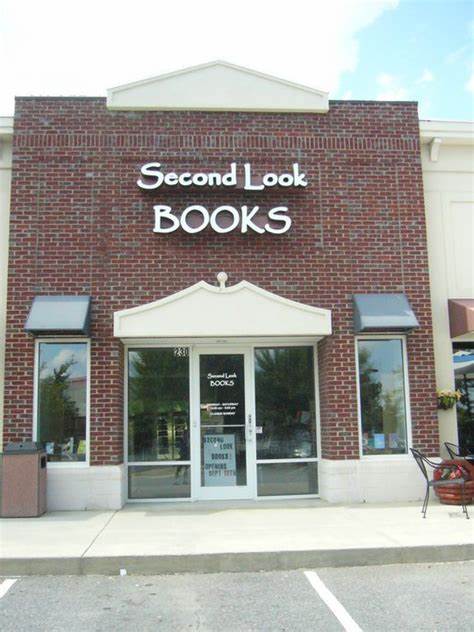
Second Look Books, 4519 School House Commons, Harrisburg, NC

They are also available in paperback and e-Book from Amazon at https://www.amazon.com/dp/B0BW2QMLHC/.
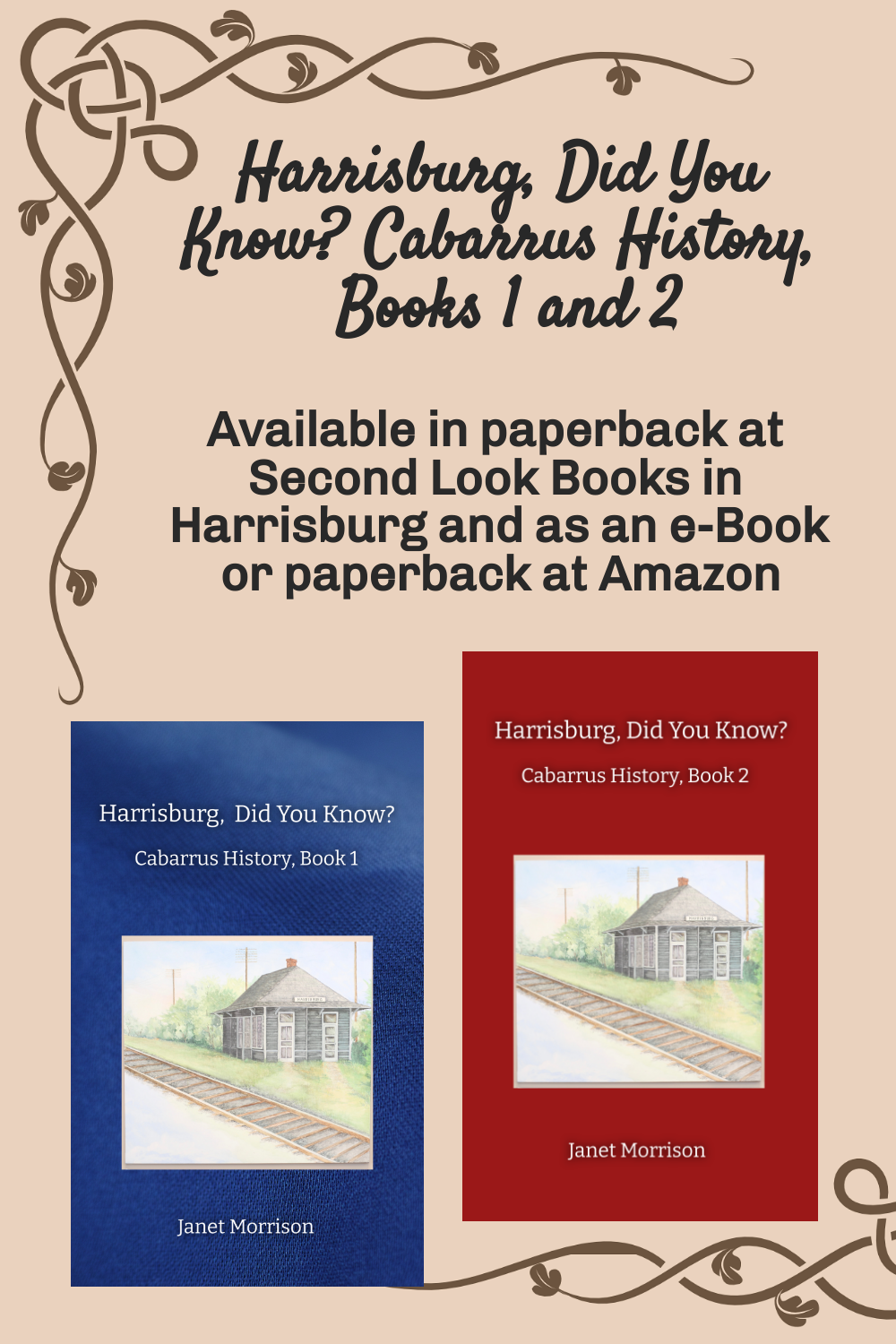
An infographic ad for Harrisburg, Did You Know? Cabarrus History, Books 1 and 2

Until my next blog post

I hope you have a good book to read.

I hope you get to spend quality time with friends and family.

Remember the people of Ukraine.

Janet

P.S. Please visit https://www.janetmorrisonbooks.com and subscribe to my e-Newsletter. Next issue due out the first week of January!

Did You Know Cabarrus County, NC Survived a Meteorite on Halloween 1849?

Can you imagine hearing and then seeing meteor blazing across the sky and then crashing through a tree before plunging several feet into the dirt? That’s what happened on Hiram Bost’s farm on October 31, 1849.

Photo by Juskteez Vu on Unsplash

I grew up in Cabarrus County, but I’d not heard of the meteorite until I happened upon a newspaper article about it while doing research on another topic for a local history column I was writing in 2009 for Harrisburg Horizons weekly newspaper. Last week while I was formatting those newspaper articles for two planned books in 2023, I thought the highlights of the seven-part series I wrote about Mr. Bost’s meteorite would make an interesting blog post on this Halloween.

Although the meteorite landed near Midland in Cabarrus County, it was mistakenly named “Monroe.” Meteorites are usually named for where they land. The town of Monroe is actually in the adjoining county and not where the 1849 meteorite crashed to the Earth.

I’ve never heard a meteor or seen one up close. The closest I’ve come is seeing an occasional “shooting star.” The witnesses of the 1849 meteorite described explosions and rumblings They saw a white-hot object in the sky even though it was broad daylight.

Word of the meteorite spread by the proverbial grapevine and in newspapers in Charlotte and Concord. When word reached the Charlotte Branch of the United States Mint, a Mint employee and a Charlotte doctor headed some 20 to 25 miles to the site by horse-drawn wagon.

Knowing he had an item of interest and unknown value on his hands, Mr. Bost displayed the meteorite on top of a pole for all to come and see. It was accompanied by a sign warning people not to touch or break the rock.

I was naïve enough to think that perhaps the Monroe meteorite had ended up intact at the North Carolina Museum of Natural History, but I soon found out that the meteorite has been chopped and sliced into countless pieces and the museum in Raleigh doesn’t even have a piece of it.

One thing led to another, as is always the case when I do historical research, and I went down the rabbit hole of searching for the locations that own part of the meteorite. What I discovered is that pieces and slivers of the meteorite are owned by universities, museums, The Vatican, and private companies and individuals around the world.

I learned that bits and pieces of the Monroe meteorite are for sale by rock and mineral dealers and are sometimes available through rock and mineral auctions. Those pieces and slivers are priced by the gram and aren’t cheap.

To learn more, be on the lookout for my book, Harrisburg, Did You Know? – Book 2 on Amazon in 2023.

I expect to publish Harrisburg, Did You Know? – Book 1 on Amazon in January 2023. I’ll give progress reports in future blog posts. Even if you don’t live in the Harrisburg, North Carolina area, I think you’ll find something of interest in both my local history books.

Since my last blog

I continue to write my first historical novel, The Heirloom.

I hired a company to completely redesign my outdated website, JanetMorrisonBooks.com. My writing is taking a new path and I need a new website to reflect that. With numerous decisions to be made and the holiday season approaching, it might be January before I can unveil the new site.

My sister and I continue to proofread Harrisburg, Did You Know?—Book 1. When I blogged last week, I thought the books would only be available for Kindle, but I now hope to also have them published in paperback.

A word about my blog

Last week’s blog post included a note about a change in my follower count on my blog and the reason I was given for the widget policy change. Apparently, I wasn’t the only blogger to complain, for this week the count once again includes the 1,000+ followers that were dropped last week. I’m happy again!

Until my next blog

I hope you have a good book to read.

Remember the brave people of Ukraine who face freezing to death this winter.

Janet

I love hearing authors speak!

I got to hear Mark de Castrique speak again last night. He’s not only a good writer, he’s an entertaining and informative speaker.

I mailed a query letter to StarDate magazine today. I would be very pleased if they publish my article about the 1849 “Monroe” meteorite that landed in Cabarrus County. Time will tell.

I continue to research literary agents.

Too much of a good thing

Our drought and heatwave broke around midnight last night.  After 18 consecutive days of 90 degrees or higher, it was in the pleasant 80s today.

With no rain in weeks, everything in the garden that the deer hadn’t eaten was burned up.  This is the first total garden failure I’ve had.  We caught up on rain today, though.  We had 2.25 inches between 12:15 and 3:00 a.m. and another 2.5 inches between 2:00 and 2:45 p.m. this afternoon.

I got the 2,500-word 1849 meteorite article drafted for The Old Farmer’s Almanac, but I need to do some editing before I pitch the idea to the almanac.

Tonight I proofread and submitted my seven-part “Did You Know?” newspaper series to the editor of Harrisburg Horizons weekly newspaper. 

I didn’t finish reading The Testament, by John Grisham for the Rocky River Readers Book Club, but I went to the discussion on Monday night. I want to finish it, even though I know the ending. I hate to leave a book unfinished.

I’m reading Life of Pi by Yann Martel for the Bookends Book Club.  I’m also reading Words That Hurt, Words That Heal:  How to Choose Words Wisely and Well, by Rabbi Joseph Telushkin.

A Day in the Life of a Freelance Writer

Making time to write has been a challenge this week.  I haven’t gotten enough sleep, a carpenter or painter has been here everyday, breathing paint fumes, poor air quality outdoors due to this heat wave….  It has been difficult to sit down at the computer and put any words “on paper.”

My goal for today is to take the research I did for a series of newspaper columns about an 1849 meteorite and write a 2,500-word piece to pitch to an almanac.

I entered the opening pages of my manuscript of The Spanish Coin in a writing contest this spring.  Two of the three critiques I received in return were disappointing.  It is taking me a while to get pysched up to work on that project again.

I’m currently reading The Testament, by John Grisham.  Other recent good reads:  The Help, by Kathryn Stockett (my new all-time favorite book!), The Postmistress, by Sarah Blake, several Jodi Picoult books, and Not My Daughter, by Barbara Delinsky.

It’s time for me to get to work on that meteorite piece.