
I usually wait until the first Monday of the next month to blog about books I read this month, but I’ve read so many good books in March I decided to split them up between today’s blog and my April 2, 2018 blog post.
The Great Alone, by Kristin Hannah
After reading Kristin Hannah’s best-selling novel, The Nightingale, last year, I eagerly awaited the release of The Great Alone. What a masterpiece! I don’t want to spoil the story for you if you haven’t read it.

I’ll just state the basic description – that it is the story of a troubled Vietnam War veteran and POW survivor who took his wife and daughter to Alaska to escape the craziness he saw in life in the lower 48 states.
Ill-prepared for life in the wilds of Alaska, things went from bad to worse for the family. Domestic abuse is a thread that weaves throughout the novel. Can love outlast the horrors this family lives with?
The Tuscan Child, by Rhys Bowen
This historical novel alternated between World War II and 1973. After the death of her father, 25-year-old Joanna travels from London to a remote village in Tuscany where her father’s fighter plane was shot down in 1944.

Since her father’s death, Joanna has found an undeliverable and returned-to-send letter he wrote to an Italian woman named Sofia. In the letter, he references “our beautiful baby boy” who is hidden away where no one but he and Sofia can find him.
Joanna had no knowledge of this woman named Sofia until discovering the letter in her father’s belongings after his death. Who was Sofia, and is “our beautiful baby boy” a half-brother Joanna knows nothing about?
White Chrysanthemum, by Mary Lynn Bracht
This historical novel was a difficult read for me because the subject matter was so bleak, violent, and sad; however, I’m glad I read it. I learned a great deal of history.
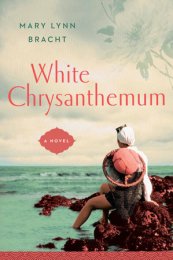
White Chrysanthemum is about man’s inhumanity to man – or more specifically, man’s inhumanity to woman. The novel was inspired by the plight of Korean girls and young women who were abducted by the occupying Japanese soldiers during World War II. The girls and young women were physically- and sexually-abused and were forced to be “comfort women” for the Japanese soldiers.
This is also a story of the human spirit and what it is able to endure due to the innate will to live. It is also about the love two sisters share for each other and how they long to be reunited.
It is not for the faint of heart, but I recommend it to anyone who wants to have a better understanding of the early- to mid-20th century history of Korean-Japanese relations. As recently as 2015, the treatment of Korean girls and women by Japanese soldiers from the late 1930s through the Second World War was being swept under the rug.
In 2015, the governments of Japan and South Korea agreed “to remove the Statue of Peace [in Seoul] and never speak of the ‘comfort women’ again” according to the timeline in the back of Mary Lynn Bracht’s book. Thanks to her novel, a whole new generation will learn about his piece of history.
The Nordic Theory of Everything: In Search of a Better Life, by Anu Partanen
I checked this book out because the title intrigued me. The author grew up in Finland but moved to the USA as a young adult. This book is her perspective on the social and governmental differences between the two countries.

The prologue was interesting in that Ms. Partanen expressed her surprise in finding that Americans are less free and independent than the people of her home country. Her opinion is that
- the fact that most Americans’ health care is dependent upon their employer, we in the USA are tied to our jobs;
- Americans are sometimes forced to stay in unhappy marriages because the income tax laws are written to reward couples filing jointly;
- the tax laws in America encourage young adults to depend upon their parents for paying for college and supporting them financially in other ways past the age of 18; and
- the policies of the US government saddle parents with too much expense in the raising of children and saddle too many middle-age adults with the financial burden of caring for their elderly parents.
Ms. Partanen boiled all this down to what she calls The Nordic Theory of Love.
My brief summary doesn’t do justice to this 450-page book, but maybe I have piqued your interest. I enjoyed a couple of days’ break from reading depressing World War II novels, but about halfway through Ms. Partanen’s book I decided I’d rather read fiction. Some short stories and novels were vying for my attention.
Since my last blog post
I’ve worked on letters to send to 40 bookstores to encourage them to place spring orders for my 2014 vintage postcard book, The Blue Ridge Mountains of North Carolina, I’ve done a lot of reading, and I’ve studied book marketing and writing in deep point-of-view.
Until my next blog post
If you haven’t already signed up for my sometime-in-the-future newsletters, please fill out the form below.
I hope you have a good book to read. I’m reading A Piece of the World, by Christina Baker Kline. Perhaps you’ll want to read one of the books I wrote about today.
If you’re a writer, I hope you have quality writing time.
Janet


