What I Read Last Month & a Hurricane Helene Update

I did more reading in September than this blog post will reflect, but there was only one book I read from cover-to-cover: White Robes and Broken Badges, by Joe Moore.

White Robes and Broken Badges, by Joe Moore

Photo of book cover for White Robes and Broken Badges by Joe Moore
White Robes and Broken Badges, by Joe Moore

This nonfiction book will stay in my mind forever. The author infiltrated the Ku Klux Klan (KKK) for the Federal Bureau of Investigation (FBI) not once but twice. He infiltrated it both times to a level never done before, gaining access to the top echelon in the organization.

I’ve never known many details about the workings of the KKK. Never needed to. Never wanted to. However, considering where society in America stands today, it seemed like a good time to get better educated about the threat the KKK holds.

This book sheds light on just how insidious the work of the KKK is and how many its members are employed as law enforcement officers in our country. It is widespread and probably even more of a problem than the FBI knows.

It was through the undercover work of “Joe Moore” that the FBI was alerted that the problem is greater than had been realized. Joe was not an FBI agent. He was recruited by them because of his skill set.

After infiltrating the organization the first time, Joe never imagined he would be called on to do it a second time. But he was so good at it, the FBI needed him. Joe and his wife and children sacrificed a lot for what he did. Ultimately, they lost their home, most of their earthly possessions, their family connections, and friends in a matter of several hours.

The book is chilling. I know of no better word to describe the effect it had on me. Chilling. The details should make every law-abiding citizen in the country – no matter your color, race, ethnicity, or nationality – shiver.

After reading this book, I now have a better understanding of why black people in the United States do not trust law enforcement officers. How can they, when they don’t know in a traffic stop whether they are being pulled over by an honest police officer or sheriff’s deputy or if they’re being pulled over by a member of the KKK who just doesn’t happen to be hiding under a white hood?

It has always seemed a great sign of cowardice that when members of the KKK do their dirty work, they hide in their white robes. If you’re doing something you shouldn’t be doing, though, I suppose you don’t want to reveal your identity.

These are misguided people, and as a Christian I am offended that they use the cross as their symbol. Jesus Christ died on a cross for me (and for them!), so how dare they desecrate that symbol of Christ’s great sacrifice!

I highly recommend this book. It is not a pleasant read, but how do we improve as a society if we bury our heads in the sand and don’t open ourselves up to what is going on not only in the shadows but also in broad daylight?

I learned about this book while listening to National Public Radio (NPR) in August (https://www.npr.org/2024/08/12/g-s1-16223/white-robes-and-broken-badges-exposes-the-inner-workings-of-the-ku-klux-klan)

Update on Hurricane Helene in Western North Carolina

I wish I could include photographs, but I don’t want to run the risk of sharing an image that is undocumented or not in the public domain. You can use some of the links below if you wish to see pictures.

Another reason I am not including photos is that I know from my own experience after Hurricane Hugo in 1989 that pictures don’t do a disaster justice. Unless you are in the middle of a natural disaster and destruction is all you can see, hear, smell, or touch in any direction, you can’t grasp the enormity of the situation.

I know that Hurricane Helene left a wide path of destruction in Florida, Georgia, South Carolina, Tennessee, and Virginia; however, I have lived in North Carolina all my life – four of my 71 years in the mountains. The mountains are near and dear to my heart. I will blog about North Carolina and leave it to people in those other states to blog about the conditions in their states.

A couple of my blog readers said they hoped I would continue to shine a light on the destruction caused by Hurricane Helene in the mountains of North Carolina on September 26.

I do not live in the disaster zone. I’m about 100 miles east of the mountains. We just had a lot of rain, some wind, and a lot of tree branches to pick up and deal with. That is ongoing, but that and our 13-hour power outage pale in comparison to what happened in our beautiful Appalachian Mountains.

Ten days after the storm, many areas of the mountains are still inaccessible. Damage assessments are still being made. Recovery will be measured in years, not months. Some locations were wiped off the map and will not be restored because the landscape has been changed completely and forever.

The United States Geological Survey has identified 244 landslides caused in the Southeast by Hurricane Helene. Most of those are in North Carolina. More landslides will, no doubt, occur in the coming weeks with additional rainfall and freezing conditions.

As of the data I found last night, the death toll in North Carolina so far was 115, with 72 of those being in Buncombe County. There are still people unaccounted for. Many communities still have no water or sewer service. Cell phone service was spotty before the storm and restoration has been slow.

Hundreds and hundreds of power poles and thousands of miles of overhead power lines are down. Thousands of people are homeless. You might grow weary of hearing about it, but many of the people of western North Carolina are in dire straits.

As always, though, the worst of nature brings out the best in most people. The outpouring of support has been amazing. Electrical workers have come from all over the country and from Canada. Four hundred nurses have arrived in Asheville from as far away as Alaska to pitch in and help local medical personnel who have worked around the clock since September 26 even though most of them have catastrophic damage at their own homes.

Pack mules are being utilized to haul water, non-perishable food, and other necessities into the steep and rugged terrain where vehicles cannot gain access.

Two interstate highways are closed. I-40 near the Tennessee state line will probably be closed for a year. Repairs to I-26 might allow it to reopen next March. Roads and bridges washed away, houses, cars, and businesses floated away, and overnight all the necessities most of us take for granted every day vanished.

The area of devastation in western North Carolina alone covers more than 600 square miles, and it is not flat land! Every mile of those 600 square miles is not devastated. The severity of destruction various from place to place as rain totals were, of course, higher in some places than in others. Also, some areas of the mountains received more rain than others in the days leading up to the arrival of Hurricane Helene. Elevations range from around 1,500 feet to more than 6,000 feet. The destruction is unprecedented. Since 1916, all floods in western and piedmont North Carolina have been measured against The Flood of 1916. Future floods will be measured against The Flood of 2024 because by all statistics it surpassed the one in 1916.

Classes at my alma mater, Appalachian State University in Boone, have been cancelled until at least October 16. (That’s three weeks of fall semester lost.) Students at Lees-McRea College in nearby Banner Elk were evacuated by air to Hickory. Classes have been cancelled at Western Carolina University in Cullowhee the University of North Carolina at Asheville, Montreat College, Warren-Wilson College, Mars Hill University, and numerous community colleges. Blue Ridge Community College in Flat Rock, NC is closed indefinitely. Some county school systems are unable to announce when they will reopen.

The beautiful Blue Ridge Parkway that I’ve waxed poetic about so many times is closed indefinitely. US-441/Newfound Gap Road through Great Smoky Mountains National Park has reopened; however, it was not designed to handle commercial traffic, so it is not an alternate to I-40 or I-26 for large trucks. Sadly, a few people decided that did not apply to them, so they attempted to drive on Newfound Gap Road. Two serious accidents resulted – one caused by a car hauler. The highway will be closed to all traffic from 10pm until 7:30 a.m. until further notice. (https://www.nps.gov/grsm/learn/news/update-on-us441-newfound-gap-road-overnight-closure.htm)

The images coming out of the mountains are gut-wrenching. The needs are great and will continue to be for a long, long time. I hesitate to start naming charities because there are hundreds of reputable ones that are on-site and providing remarkable goods and services. World Central Kitchen (https://wck.org/), the Cajun Navy from Louisiana, Mountain Mule Packer Ranch (https://www.mountainmulepackers.com/), the Red Cross, and Samaritan’s Purse are just a few.

The Manna Food Bank (https://www.mannafoodbank.org/) which serves the Asheville and surrounding areas lost their facility and its contents. Brother Wolf Animal Rescue (https://www.bwar.org/) was flooded out but the 150 animals they were housing on September 26 were rescued by volunteers. Organizations like food banks and animal rescues need to be rebuilt and aren’t necessarily eligible for government assistance. (I saw on the Brother Wolf Animal Rescue website last night that donations to that organization are currently being matched!)

The Appalachian State University Disaster Fund (https://www.appstate.edu/disaster-relief/) is another organization for you to consider. It has stepped up to assist students, staff, and faculty members who have lost their homes. The fund also provides much-needed counselling for those traumatized by the storm.

Atrium Medical Center in Charlotte has set up its mobile hospital in Tryon in Polk County. Many towns and counties across the state have sent teams of medical personnel and swift water rescue teams to assist with the aftermath of the storm. The National Guard and 1,000 active-duty personnel from Fort Liberty (formerly, Fort Bragg) were deployed and have been on the ground since weather allowed access. Numerous restaurants are giving out free meals as they are able to prepare food.

Having just visited Boone and West Jefferson on September 12-13 and having visited Hendersonville, Asheville, Bryson City, and Cherokee this summer, it is difficult to grasp the scope of the damage. I drove on the Blue Ridge Parkway from Asheville to its southern end at Great Smoky Mountains National Park in June. I drove from Hickory through Old Fort, Black Mountain, Asheville, and Canton and into Tennessee on I-40 the last week in August.

I always breathe a sigh of relief when I make it through that treacherous stretch of I-40 approaching Tennessee because rock slides are not unusual. To know that part of that interstate literally washed away 10 days ago is hard to get my head around, though.

Know that any support you can give to the people of western North Carolina is appreciated.

Since my last blog post

I was told (again) in a webinar last week that the purpose of a blog is to solve someone else’s problem. Until I figure out how to do that, I’ll just keep blogging like I have for the last 10+ years. As of last week, I have 1,200 subscribers to my blog, so maybe I’m doing all right. If you came to my blog today seeking a solution to a problem, you are probably disappointed.

On the other hand, if you were looking for a way to lend a little aid to people trying to rebuild their lives after Hurricane Helene, I hope one of the organizations I mentioned today struck a nerve with you.

Until my next blog post

I hope you have a good book to read, a roof over your head, enough food to eat, and clean water to drink.

If all you are hearing is that FEMA and all levels of government are failing to respond to those affected by Hurricane Helene, then you are listening to the wrong sources. More than a week of lies about this from the immediate-past-twice-impeached-34-times-indicted-president is wearing thin here in North Carolina. Please fact check your sources and get your news from a variety of reputable news media.

Hold your friends and family close, for we never know what tomorrow will bring.

Don’t forget the people of Ukraine or the people of western North Carolina.

Janet

Exploring Qualla Boundary

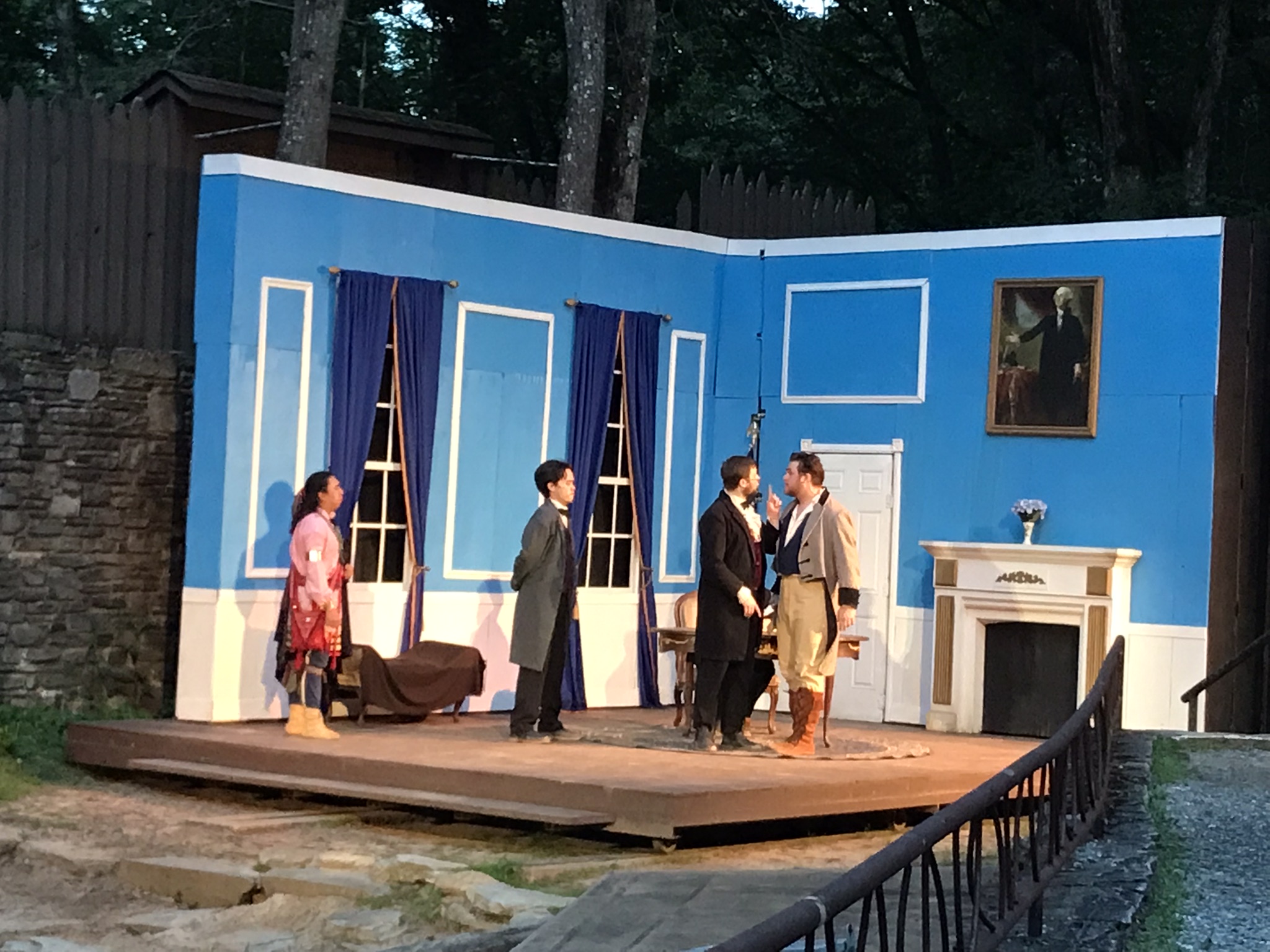
Several weeks ago, my sister and I spent several days in Cherokee, North Carolina. We have visited Cherokee many times, but I had never seen the “Unto These Hills” outdoor drama. Since the drama was rewritten a few years ago to give a truer presentation of the Cherokee Indian perspective on their history, I was eager to see it.

A leisurely drive on the Blue Ridge Parkway is always an activity we enjoy, so we got on the parkway on the southern edge of Asheville and took it to its end at Soco Gap. We went through 15 tunnels on that 80 or so southernmost miles of the Blue Ridge Parkway. Various wildflowers, including the Flame Azalea (or native/wild azalea) was at or just past its peak.

Flame Azalea along the Blue Ridge Parkway
National Park Service sign noting the highest elevation on the Blue Ridge Parkway Motor Road at 6,053 feet.

We had perfect weather all week, including the night we had tickets to see “Unto These Hills.” The acting was superb. It was amazing to see the history of the Cherokee people presented in two hours.

The play emphasized how the Cherokee and the European explorers, traders, and settlers had a congenial relationship in the beginning. It wasn’t until the Europeans started cheating the Cherokee and tricking them into poor decisions and hollow treaties that things deteriorated.

Another scene from “Unto These Hills”
A scene from a visit to the White House in the “Unto These Hills” outdoor drama

The last straw, of course, was when the United States forced the Cherokee to give up their beautiful and lush ancestral lands for what turned out to be a death march to the Indian Territory of present-day Oklahoma. They were promised a good life, but it was just another broken promise by the white man.

A scene from “Unto These Hills” outdoor drama in Cherokee, NC

The Cherokee people who refused to leave the Great Smoky Mountains hid in the hills. It is the descendants of those brave souls who now populate the Qualla Boundary and are officially known as the Eastern Band of the Cherokee Indians.

By visiting the Museum of the Cherokee Indian and the Oconaluftee Indian Village, you can learn a great deal about the Cherokee Indians’ rich history and traditions. For instance, they lived in houses, not teepees. They did not wear elaborate feather headdresses like the Plains Indians. Cherokee men back in the day were up to seven feet tall and the women averaged only a few inches shorter.

An example of a Cherokee house from an earlier century. (The cutaway is not a window; it is there to show the wall’s construction. Cherokee houses did not have windows because they were only used for sleeping. All their work was done outside.)
Weaving display at Oconaluftee Indian Village in Cherokee, NC
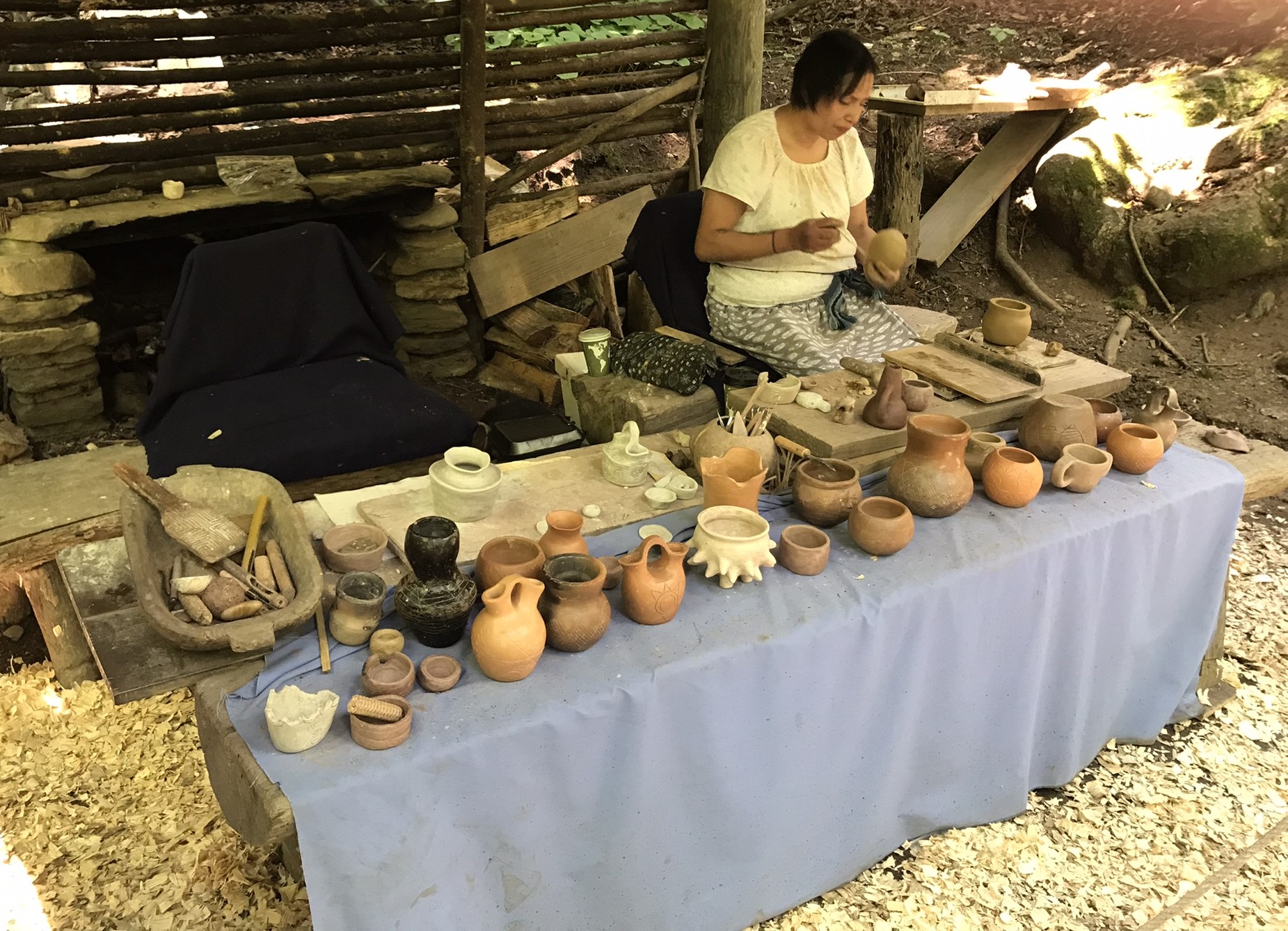
A pottery display and demonstration at Oconaluftee Indian Village in Cherokee, NC

Many Cherokee people continue to master the time-honored crafts of making clay pottery, intricate bead work, exquisite basketweaving, and wood carving. It takes weeks and sometimes months for the native plants and other natural resources for these items to be gathered and prepared, not to mention the intricate work to create the finished products. Those priceless items can be admired and purchased at the Qualla Arts and Crafts Mutual, Inc.

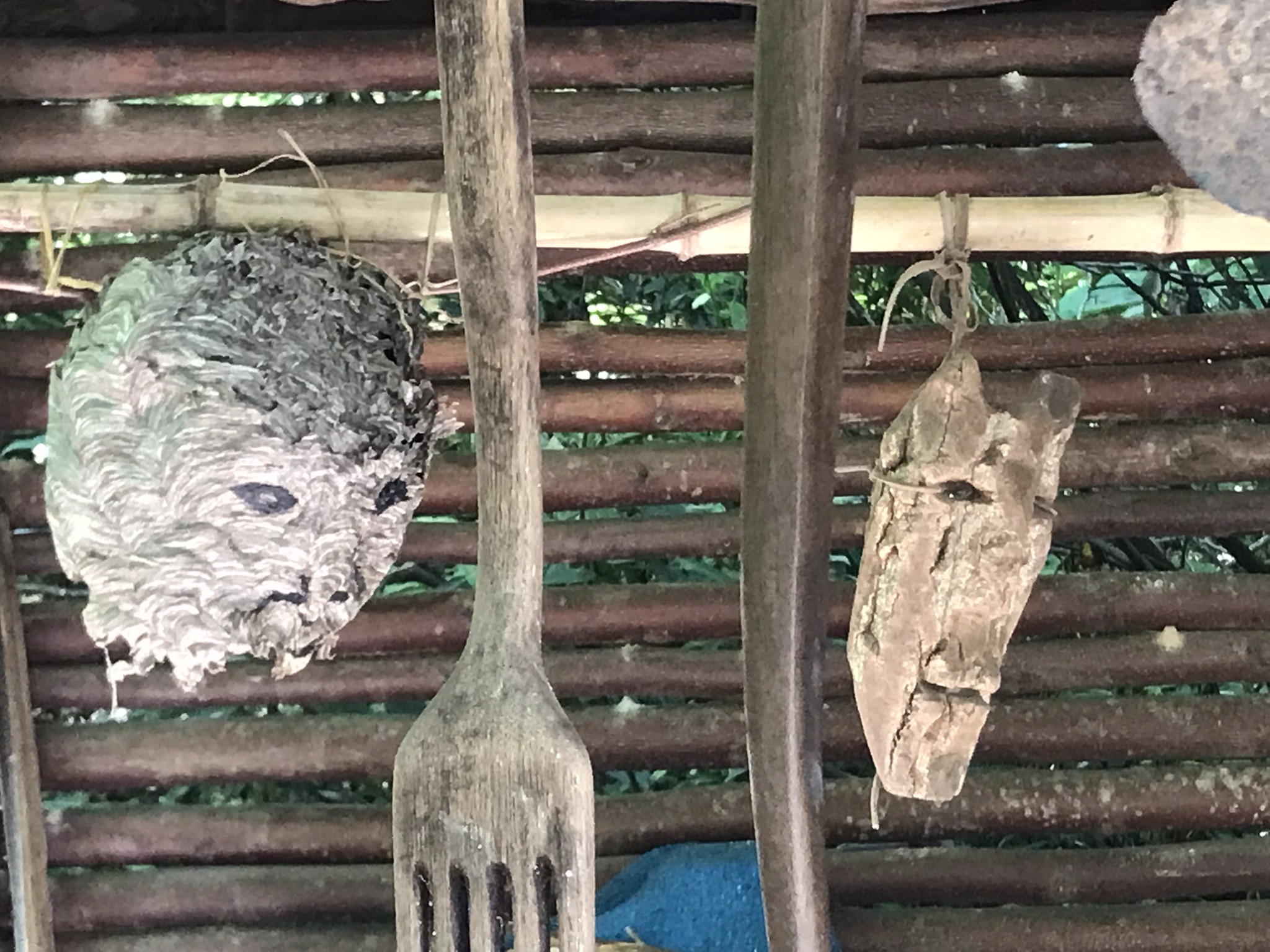
Cherokee ceremonial masks were made from various natural resources, including wood and even hornets’ nests (as seen on the left in the photo.)

Although some of the signage indicates otherwise, the Qualla Boundary is not a reservation. The Cherokee people own their land and the Qualla Boundary is held in trust for them by the United States Government.

The Cherokee not only had their own written language; they also had their own newspaper starting February 21, 1828. Although the United States Government tried to eradicate the Cherokee language and traditions, that policy failed. Today the Cherokee language is making a comeback. There is even a Cherokee immersion school in which only Cherokee is spoken.

On our recent visit, we used Cherokee as our base. One day we drove through the center of the Great Smoky Mountains National Park to and including Little River Road and Clingman’s Dome and back to Cherokee.

Another day we drove 10 miles to Bryson City, North Carolina and the Deep Creek entrance to the Great Smoky Mountains National Park. We hiked to three waterfalls we’d never seen before and enjoyed learning lots of facts about the park along the way to two of them with a park ranger.

When planning your trip, check online for the planned hikes and lectures offered by park rangers at the Oconaluftee Visitors Center near Cherokee, NC, the Sugarlands Visitors Center near Gatlinburg, Tennessee, Cades Cove near Townsend, Tennessee, and at the Deep Creek entrance to the park at Bryson City.

The Cherokee honor water and the residents and visitors alike are blessed to have the Oconaluftee River flowing right through the town of Cherokee. This shallow, wide, rocky river is the perfect place for tubing and splashing around in the water. I have memories of enjoying the river on my first trip to Cherokee when I was a young girl.

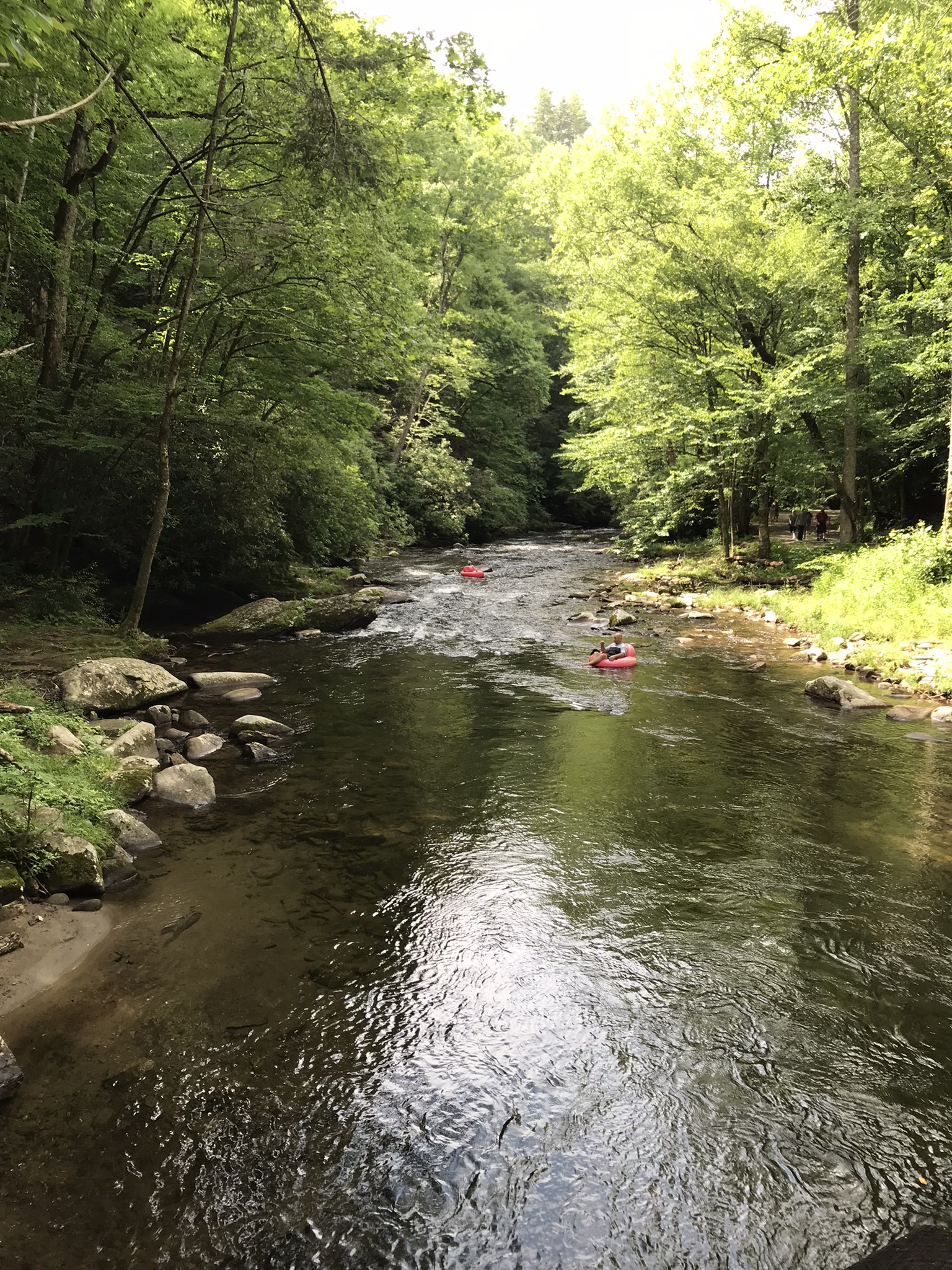
Deep Creek in the section of the national park is a popular creek for tubing. Many families were taking advantage of the creek for tubing on the very warm day we were there. If I were just younger and braver…. It looked like a lot of fun!

People tubing on Deep Creek near Bryson City, NC in Great Smoky Mountains National Park

All that hiking and tubing will make you hungry. My sister and I enjoyed the buffet at Granny’s Kitchen Restaurant on US-19 North going from Cherokee toward Maggie Valley. The wife in the couple who own and operate the restaurant is a Cherokee Indian. It is said if you want to find a good place to eat, look where the locals eat. This was certainly the case at Granny’s. (I am receiving no compensation for publicizing the restaurant. It is a good value and experience for the money. You will not leave hungry!)

People from all over the United States enjoy the Blue Ridge Parkway, the Qualla Boundary, and the Great Smoky Mountains National Park. We kept track of the different license plates we saw. When the trip was over, we had seen cars from 42 of the 50 states and several from Ontario, Canada.

Great Smoky Mountains National Park is the most-visited national park in the country. People are drawn to it by its beauty and biodiversity.

If you wish to learn more about Cherokee, the Great Smoky Mountains National Park, and the Blue Ridge Parkway, I recommend my vintage postcard book, The Blue Ridge Mountains of North Carolina. I packed as many facts and as much history into the book as Arcadia Publishing would allow. The book is available in paperback and e-Book from Amazon.


Since my last blog post

I continue to declutter by going through closets, old magazines, and boxes of memorabilia, photographs, newspaper clippings, and recipes. It is satisfying to look at what I’ve accomplished. My fiction writing has suffered for it, but this really needed to be done.


Until my next blog post

Keep reading and traveling every chance you get.

Visit your local public library, if you are fortunate enough to have one. If you haven’t visited it recently, you might be surprised to find some of the things it offers: Internet access, free access to software such as Ancestry.com, magazines you would like to read but cannot afford to subscribe to, music CDs, used books for sale, a magazine swap, ….

Remember the people of Ukraine.

Janet

19 Blue Ridge Mountains Trivia Answers

How many of the Blue Ridge Mountains trivia questions I asked in last week’s blog, https://janetswritingblog.com/2019/08/11/19-blue-ridge-mountains-trivia-questions/, were you able to answer?

#BlueRidgeMtnsOfNC #PostcardBook
The Blue Ridge Mountains of North Carolina by Janet Morrison

I indicated that all the answers could be found in the vintage postcard book I wrote, The Blue Ridge Mountains of North Carolina. These trivia questions (and the answers supplied in today’s blog post) are my way of celebrating the fifth anniversary of the publication of the book by Arcadia Publishing on August 25, 2014.

Here are the questions and answers

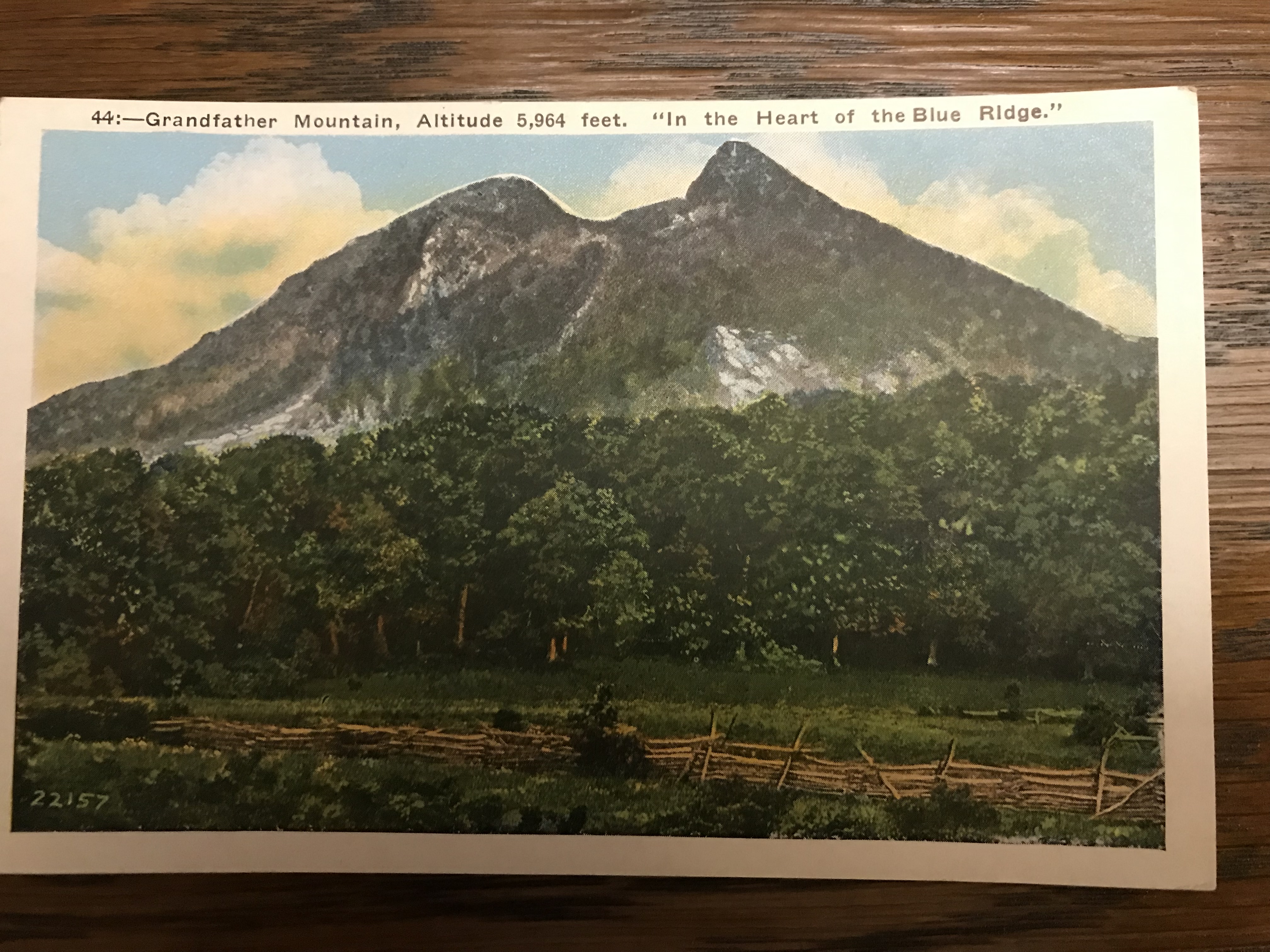
1.  Why was Grandfather Mountain named a member of the international network of Biosphere Reserves in 1992?  Because it supported 42 rare and endangered species. Just on that one mountain!

2. What does Linville Falls in North Carolina have in common with Niagara Falls?  They are both caprock waterfalls, meaning the top layer of rock is harder that the underlying stone. Erosion causes the waterfall to migrate upstream over time. It is believed that Linville Falls was once 12 miles downstream from its present location.

3.  How did Edwin Wiley Grove make his fortune which enabled him to build the Grove Park Inn in Ashevile, North Carolina?  He sold Grove’s Tasteless Chill Tonic.

4.  What part did the Civilian Conservation Corps (CCC) play in the construction of the Blue Ridge Parkway during The Great Depression?  The men who were members of the CCC assisted with the paving and landscaping of the Blue Ridge Parkway. What a magnificent gift they left us!

5.  When George W. Vanderbilt purchased Mt. Pisgah in 1897, what grand plan did the mountain become part of temporarily?  The 125,000-acre Biltmore Estate. (It’s no longer part of the estate.)

6.  What groups of people were housed at Assembly Inn in Montreat, North Carolina in 1942?  290 Japanese and German internees.

7.  Jerome Freeman bought 400 acres of land in Rutherford County, North Carolina that included the Chimney Rock around 1870 for $25. How much did the State of North Carolina pay for Chimney Rock Park in 2007?  $24 million.

8.  What new breed of hunting dog was developed by a German pioneer family in the late 1700s in the Plott Balsams subrange of the Blue Ridge Mountains?  The Plott Hound, which just happens to be the official State Dog of North Carolina.

9.  What is an early 20th century feat of engineering on the Newfound Gap Road in Great Smoky Mountains National Park?  The road crosses over itself. This example of a helix is called “The Loop.”

10.  How fast can a black bear run?   30 to 35 miles per hour.

11.  It is illegal in Great Smoky Mountains National Park to willfully get within how many feet of a black bear?  150 feet.

12.  What is the name of the 57,000 acres of land purchased by the Cherokee in the 1800s and held in trust by the United States Government?  Qualla Boundary

13.  Is Qualla Boundary technically a reservation? No, a reservation is land that the United States Government gives to an American Indian tribe. The Cherokees purchased their land.

14.  Did the Cherokee people lived in tipis in the 1700s and 1800s?  No, they lived in houses.

15.  What forest contains one of the largest groves of old-growth trees in the Eastern United States?  Joyce Kilmer Memorial Forest

16.  What hydroelectric dam was used in the 1993 Harrison Ford movie, The Fugitive?  The Cheoah Dam

17.  What is the tallest dam east of the Rocky Mountains in the United States?  Fontana Dam.

18.  One of the oldest postcards in my book is of Cullowhee Normal School in the mid- to late-1920s. What is the name of that school today?  Western Carolina University.

19.  Started in 1935, the Blue Ridge Parkway’s “missing link” was completed in 1987. What is the connecting one-fourth-mile long piece that filled the “missing link” called? The Linn Cove Viaduct.

How did you do?

How many of the 19 questions did you answer correctly? I hope you enjoyed trying to answer the questions and seeing the answers today. If you want to learn more about the mountains of North Carolina and eastern Tennessee, please ask for The Blue Ridge Mountains of North Carolina, by Janet Morrison, at your local bookstore, online at Amazon.com, or purchase it directly from the publisher at https://www.arcadiapublishing.com/. It’s available in paperback and as an ebook.

The contract I signed with Arcadia Publishing was for five years, so you’d better get a copy of the book while it’s still being published. I don’t know if my contract will be extended.

Since my last blog post

I’ve finally gotten into a rhythm for writing the scene outline according to C.S. Lakin’s template. It sounds backward to be writing the scene outline after writing the book, but the questions asked in the template, along with five questions I added after reading a couple of articles by Janice Hardy, are making every scene in the book stronger. It’s slow going, but well worth the time and effort.

Due to technical problems, I was unable to include images of any of the postcards from my book in today’s blog post.

Until my next blog post

If you’d like to follow me on Twitter, @janetmorrisonbk. If you’d like to follow my business page on Facebook, it’s Janet Morrison, Writer.

I hope you have a good book to read. I’m reading The Nickel Boys, by Colson Whitehead and still listening to Resistance Women, by Jennifer Chiaverini.

If you’re a writer, I hope you have quality writing time.

Thank you for taking the time to read my blog. You could have spent the last few minutes doing something else, but you chose to read my blog.

Let’s continue the conversation

Feel free to let me know in the comments section below or on Twitter or Facebook how you did on the trivia questions. If you have any other comments or questions for me about the Blue Ridge and Smoky Mountains, I’ll welcome and try to answer them.

Janet

19 Blue Ridge Mountains Trivia Questions

August 25, 2019 will mark the fifth anniversary of the publication of my vintage postcard book, The Blue Ridge Mountains of North Carolina. To mark this milestone, I’m testing your knowledge of some of the interesting facts I included in the book.

#BlueRidgeMtnsOfNC #PostcardBook
The Blue Ridge Mountains of North Carolina by Janet Morrison

The book covers the 23 westernmost counties in North Carolina and the three counties in eastern Tennessee in which a portion of the Great Smoky Mountains National Park is located. If you have the book, you have my permission to cheat. That’s only fair to those of you who purchased my book. I’ll ask a few questions. You’ll find the answers in my blog post on August 19, 2019.

Although most of the original postcards are in color, they appear in black and white in both of the book’s formats. I tried to include pictures of several of the postcards in today’s blog post, but due to technical problems I was only able to post one vintage postcard image.

Here are the questions:

1.  Why was Grandfather Mountain named a member of the international network of Biosphere Reserves in 1992?

#GrandfatherMtn #GrandfatherMountain
Grandfather Mountain, North Carolina

2. What does Linville Falls in North Carolina have in common with Niagara Falls?

3.  How did Edwin Wiley Grove make his fortune which enabled him to build the Grove Park Inn in Ashevile, North Carolina?

4.  What part did the Civilian Conservation Corps (CCC) play in the construction of the Blue Ridge Parkway during The Great Depression?

5.  When George W. Vanderbilt purchased Mt. Pisgah in 1897, what grand plan did the mountain become part of temporarily? 

6.  What groups of people were housed at Assembly Inn in Montreat, North Carolina in 1942?

7.  Jerome Freeman bought 400 acres of land in Rutherford County, North Carolina that included the Chimney Rock around 1870 for $25. How much did the State of North Carolina pay for Chimney Rock Park in 2007?

8.  What new breed of hunting dog was developed by a German pioneer family in the late 1700’s in the Plott Balsams subrange of the Blue Ridge Mountains?

9.  What is an early 20th century feat of engineering on the Newfound Gap Road in Great Smoky Mountains National Park?

10.  How fast can a black bear run?  

11.  It is illegal in Great Smoky Mountains National Park to willfully get within how many feet of a black bear?

12.  What is the name of the 57,000 acres of land purchased by the Cherokee in the 1800s and held in trust by the United States Government?

13.  Is Qualla Boundary technically a reservation?

14.  Did the Cherokee people lived in tipis?

15.  What forest contains one of the largest groves of old-growth trees in the Eastern United States? 

16.  What hydroelectric dam was used in the 1993 Harrison Ford movie, The Fugitive?

17.  What is the tallest dam east of the Rocky Mountains in the United States?

18.  One of the oldest postcards in my book is of Cullowhee Normal School in the mid- to late-1920s. What is the name of that school today?

19.  Started in 1935, the Blue Ridge Parkway’s “missing link” was completed in 1987. What is the connecting one-fourth-mile long piece that filled the “missing link” called?

In case you’d like to take the easy way out and find the answers to all these questions in one book, you may order The Blue Ridge Mountains of North Carolina, by Janet Morrison, in paperback or e-book from Amazon.com, request it at your local bookstore, or order it directly from https://www.arcadiapublishing.com/. Time is short. I’ll supply the answers in my blog post next Monday, August 19.

The contract I signed with Arcadia Publishing was for five years, so you’d better get a copy of the book while it’s still being published.

Since my last blog post

I discovered that the links that I had on my blog to my presence on several social media networks were not working properly, except for the one to my Pinterest account. Therefore, I removed the links to Facebook, Twitter, and LinkedIn. I’ll announce in a future blog post when those links are up and running again.

Until my next blog post

If you’d like to follow me on Twitter, @janetmorrisonbk. If you’d like to follow my business page on Facebook, it’s Janet Morrison, Writer. If you’d like to follow me on LinkedIn, go to https://www.linkedin.com/in/janet-morrison-writer.

I hope you have a good book to read. I’m reading Searching for Sylvie, by Jean Kwok.

If you’re a writer, I hope you have quality writing time.

Thank you for taking the time to read my blog. You could have spent the last few minutes doing something else, but you chose to read my blog.

Let’s continue the conversation

Please don’t include any of the trivia answers in your comments. If you want to indicate how many of them you think you know the answers to, you may indicate that number or the numbers of the questions you think you can answer.

Read my book or read my blog post next Monday for all the answers.

Janet

Change of Scenery Does the Heart Good

I got away this weekend to the Blue Ridge Mountains of North Carolina. It always does my heart good to drive on the Blue Ridge Parkway and be surrounded by forests and views across miles and miles of mountains.

A change in scenery and a change in altitude can clear the head and breathe new life into a person. A change in altitude can create a change in attitude. That’s what this weekend’s trip to Asheville did for me.

The bride’s bouquet

A special cousin of mine who lives in California got married in Asheville on Saturday. It was my first opportunity to meet her husband, and I feel very good about this match. The wedding was beautiful and the associated festivities were wonderful. It was an honor and privilege to witness Melissa and Marty’s exchanging of vows and their happiness and respect for one another.

Asheville is an eclectic city, rich in history and natural beauty. The change in scenery and altitude, along with the blessing of attending the wedding of two such special people, was just what I needed. Driving south on the Blue Ridge Parkway, and then taking US-276 by Looking Glass Falls was a perfect way to end the weekend.

I came home with my batteries recharged, ready to plunge back into my writing and playing the dulcimer.

Until my next blog post

I hope you have a good book to read. I’m reading Montauk, by Nicola Harrison.

If you’re a writer, I hope you have productive writing time and your projects are moving right along.

Thank you for reading my blog. You could have spent the last few minutes doing something else, but you chose to read my blog.

Let’s continue the conversation

What recharges your batteries and refreshes you for the task ahead?

Janet

Independent Bookstores are the Best!

If you haven’t visited an independent bookstore lately, do yourself a favor and look one up this week.

Foggy Pine Books

NC Mountains Oct. '18 003
Foggy Pine Books in Boone, NC

I had the pleasure of visiting Foggy Pine Books in Boone, North Carolina last week. It is the quintessential small town/college town independent bookstore. Located at 471 W. King Street in downtown Boone just a block or so from the campus of Appalachian State University, it has an excellent selection of books ranging from the classics to the current bestsellers. There are several cozy areas in the shop that invite customers to curl up in a comfortable chair with a good book.

My vintage postcard book, The Blue Ridge Mountains of North Carolina, was not among the handful of Arcadia Publishing books on the shelf; however, Christina promised to read my book and consider ordering it. Next time you’re in Boone, drop by Foggy Pine Books and ask for it by name.

Mary Ruthless purchased the bookstore in 2016 when the owner of the former Black Bear Books retired. It seems that Mary couldn’t stand the thought of Boone not having a bookstore. I’m so glad she rescued the shop. Foggy Pine Books is in a different location from where it started and is conveniently located on the main street with free parking at the side of the building.

In addition to buying a book, I purchased a couple of bookmarks at Foggy Pine Books. One bookmark is imprinted with the words, “She believed she could so she did.” I will explain the significance of those words to me in one of my blog posts in November.

Dan’l Boone Inn

A trip to Boone wouldn’t be complete without eating at Dan’l Boone Inn. Established in 1959, the restaurant is in what used to be the area’s hospital at the corner of King and Hardin Streets. The menu for lunch and dinner are the same, as is the price.

Fried chicken, country-style steak, mashed potatoes, gravy, green beans, slaw, corn, biscuits, and baked apples are served family style after you’ve eaten your tossed salad. What appears to be way more food than you can possibly eat soon disappears and you’re given extra napkins to wrap up the country ham biscuits to take with you.

The dessert choices were all tempting, but I opted for the chocolate cake. It was as delicious as the rest of the food. The country ham biscuits were my dinner that night. Two country ham biscuits were all I needed that night after such a big lunch.

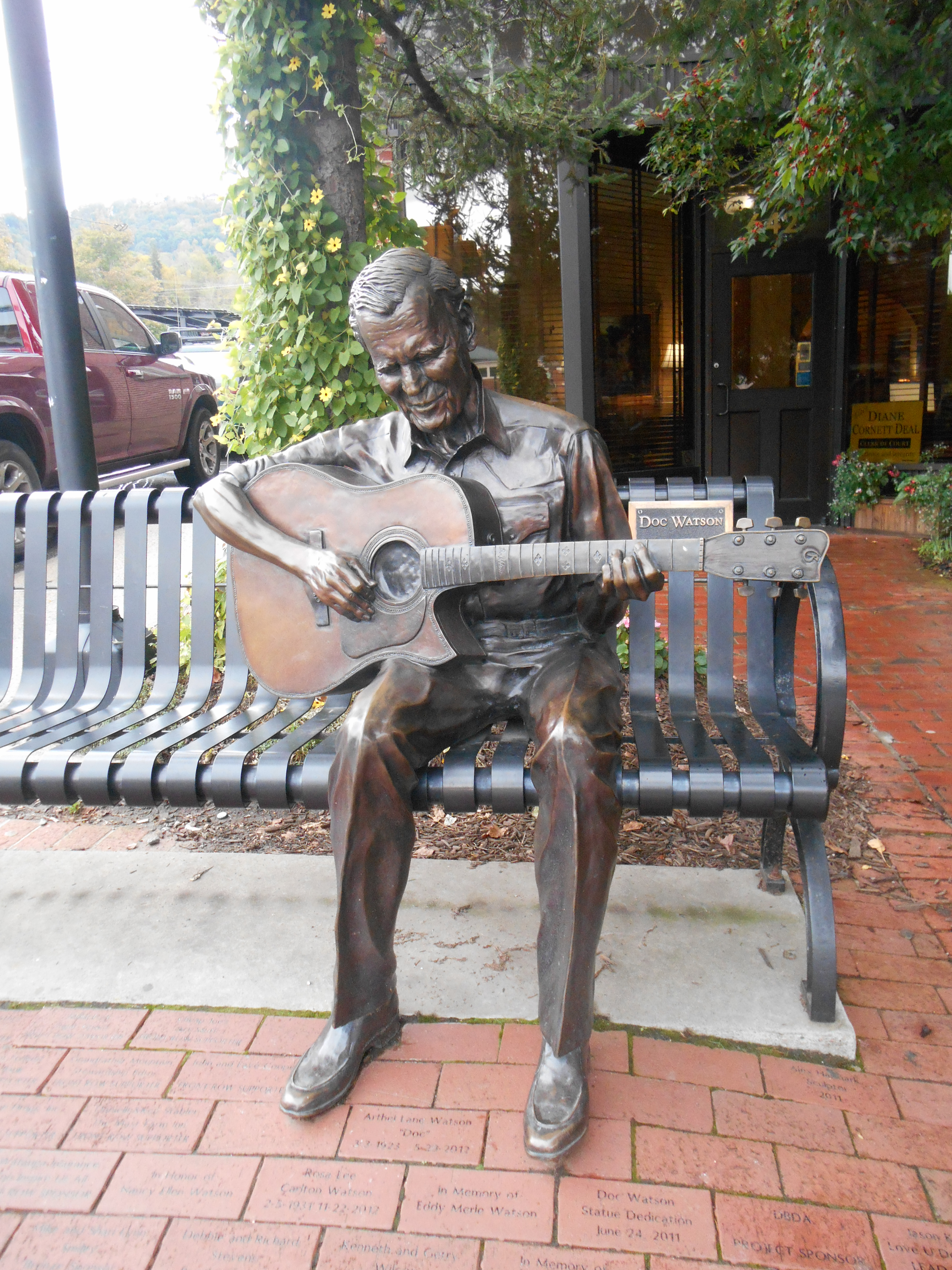
Tribute to Doc Watson

NC Mountains Oct. '18 005
Statue of the late Doc Watson, musician, in Boone, NC


I just had to take a picture of this statue of local legendary musician Doc Watson. He was from Deep Gap, which is a community a few miles east of Boone. He took blindness in stride and had a family and a successful career as a musician and singer. The statue is on King Street in downtown Boone.

Blue Ridge Parkway

Autumn temperatures arrived a few weeks late this year, so there wasn’t much fall color in the trees in Boone or on the Blue Ridge Parkway; however, after a side trip to Ashe County Cheese in West Jefferson, the two-day vacation in the mountains was made complete by a drive on the Blue Ridge Parkway. I love driving in the mountains, so a road trip on the Parkway is always relaxing. The day was crystal clear after rain the day before, so the views were spectacular.

NC Mountains Oct. '18 007
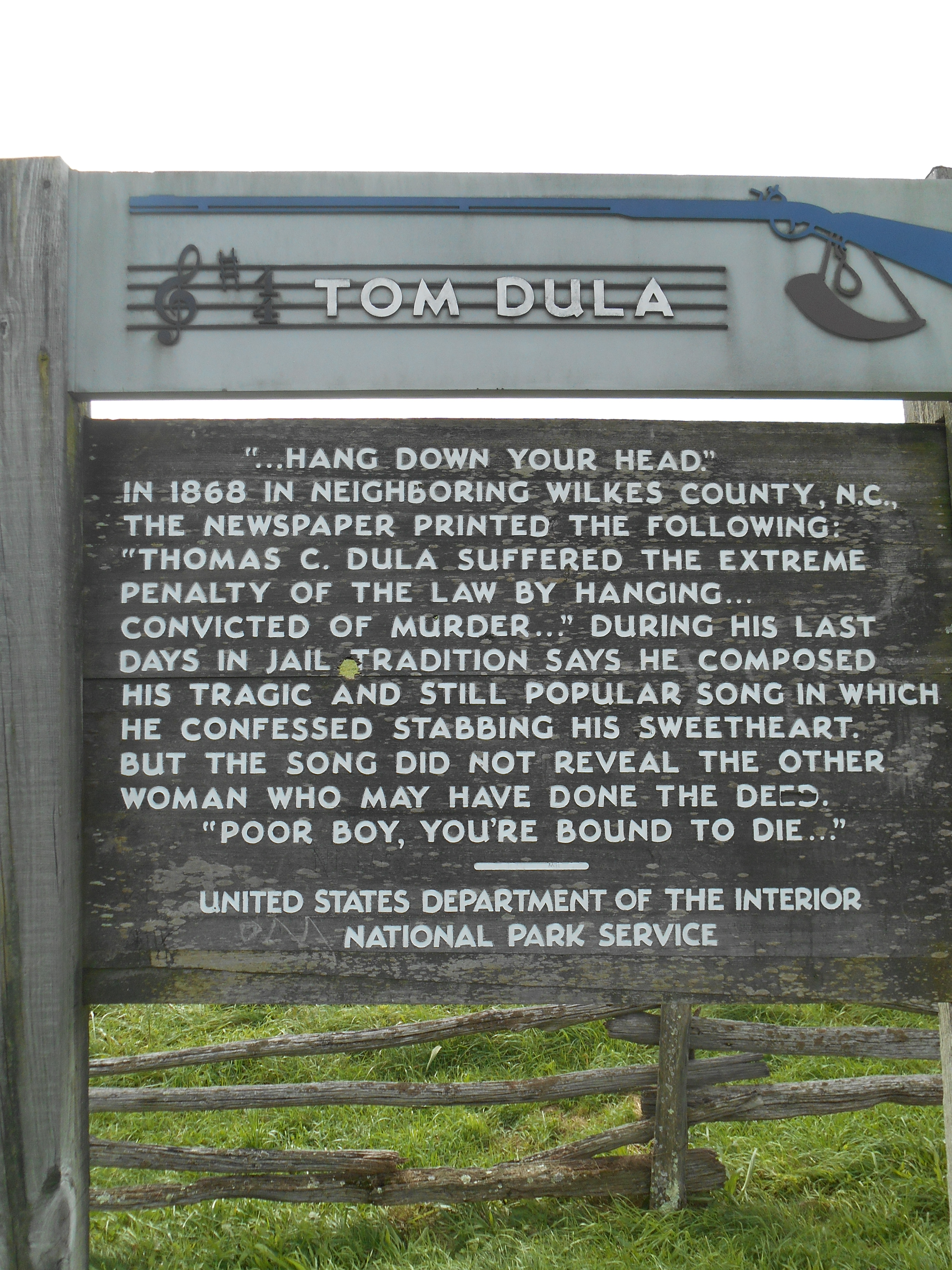
Sign at an overlook on the Blue Ridge Parkway

The sign gives an explanation of the legend of Tom Dula and is located at one of the overlooks on the Blue Ridge Parkway. This murder and love triangle in Wilkes County, North Carolina in the 1860s was made famous in the 1960s by a folk song recording by the Kingston Trio.

Until my next blog post

Don’t forget to visit an independent bookstore such as Foggy Pine Books in Boone, North Carolina as soon as you can.

NC Mountains Oct. '18 004
Foggy Pine Books, Boone, NC

I hope you have a good book to read. I’m finishing My Dear Hamilton: A Novel of Eliza Schuyler Hamilton, by Stephanie Dray and Laura Kamoie today.

If you’re a writer, I hope you have productive writing time.

Thank you for reading my blog. You could have spent the last few minutes doing something else, but you chose to read my blog. I appreciate it! I welcome your comments.

Let’s continue the conversation.

What’s your favorite independent bookstore? What is it about the atmosphere and feel of an independent bookstore that the big box stores can’t offer? Please share the names and locations of independent bookstores you have enjoyed visiting so the rest of us can patronize them.

Janet

Not one single sales gene!

Making “cold calls” at bookstores and other stores that might sell my book is not my idea of fun because I was born without one single sales gene. It is difficult for me to enter a store and introduce myself and my book. Perhaps it will get easier with practice. I am much happier at the keyboard writing. That’s probably true of most writers, but promoting one’s book is part of the job.

I told my friend, Kay, that I was not cut out for life in the fast lane. She didn’t miss a beat and came back with, “Maybe you should of thought about that before you wrote a book!”

If you’ve been following my blog over the last week, I don’t want to leave you with the impression that my book was on all the bookstore shelves in the mountains. I visited several bookstores that had not heard of my book, The Blue Ridge Mountains of North Carolina. That was not a surprise.

Eastern National operates the gift/book shop at the Folk Art Center on the Blue Ridge Parkway in Asheville. There were a couple of Arcadia Publishing books available there, but mine was not one of them. The cashier said they will “probably have it eventually.” He said it has to be approved for sale by the national office, the regional office, and then the local office. I’m hopeful my book will be for sale there by spring. Winter is a slow time for tourists on the Blue Ridge Parkway, so spring will be good.

The woman at Fountainhead Books in Hendersonville was not very encouraging, but gave me the owner’s business card and told me to have Arcadia contact the owner directly. I did that when I got home, and Arcadia is following up with Fountainhead.

The Fountainhead Bookstore in Hendersonville, NC.

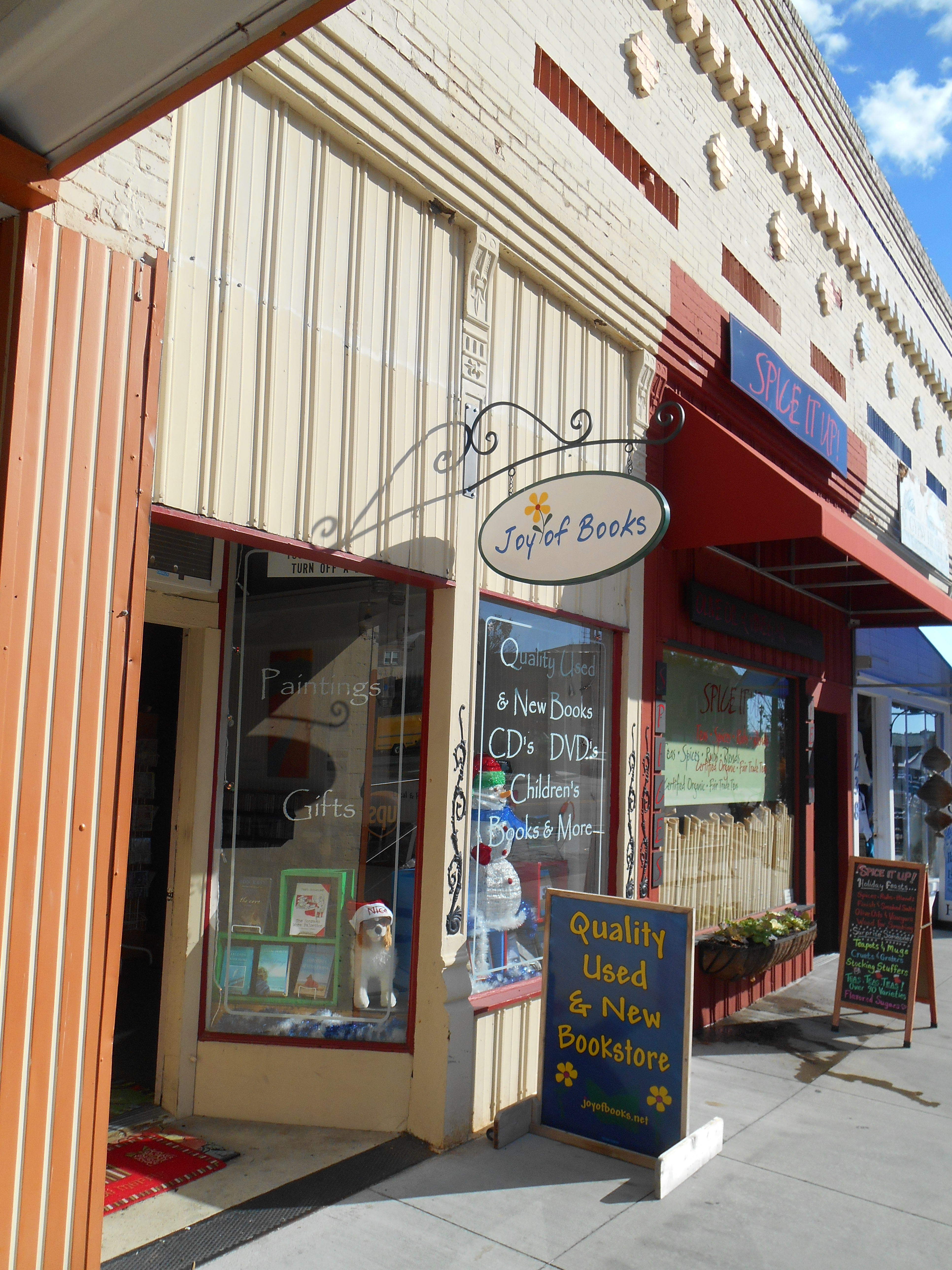
Joy of Books is the other bookstore in Hendersonville. The woman there was upbeat. She has never ordered books from Arcadia, but she has ordered from History Press and she knew that the two companies recently merged. I’m hopeful that she will order my book.

Joy of Books in Hendersonville, NC.

All the contacts I make while promoting The Blue Ridge Mountains of North Carolina will serve me well if I get to write additional vintage postcard books for Arcadia Publishing and when I get my historical novel published. The title I’ve given that 98,000-word manuscript is The Spanish Coin. Someday….

Blue Ridge Parkway Visitors Center

I visited the Blue Ridge Parkway Visitors Center near Asheville on Tuesday. How I have missed it for all these years is a mystery. I love driving on the Blue Ridge Parkway!

The visitors center cannot be seen from the road. It is located about five or six miles south of the Folk Art Center — one of my favorite places in the mountains — and adjacent to the parkway headquarters. The building is eco-friendly. It is difficult to tell in the photograph, but grass and weeds are growing on the sod roof! It reminded me of a storybook I had as a child that had a drawing of a house with a cow grazing on the roof. I want to return to the visitors center next summer and see what the roof looks like then.

Outside view of the Blue Ridge Parkway Visitors Center near Asheville.

Imagine my surprise when I walked into the bookstore/gift shop in the visitors center and found my book displayed on the shelf! I did not know the visitors center had my book in stock. Since there was only one copy, the employee said, “I guess the rest of the copies have sold.” I don’t know how many copies they started with or when they received the book. I hope they will restock it!

Janet with her book at the Blue Ridge Parkway Visitors Center near Asheville, NC.

I want to stop by the visitors center again on my next trip to Asheville. I was on a tight schedule on Tuesday and did not have time to look at anything but my book.