I write southern historical fiction, local history, and I've written a devotional book. The two novels I'm writing are set in Virginia and the Carolinas in the 1760s. My weekly blog started out to follow my journey as a writer and a reader, but in 2025 it has been greatly expanded to include current events and politics in the United States as I see our democracy under attack from within. The political science major in me cannot sit idly by and remain silent.
Since November 25, I’ve blogged once-a-week about one of the stories in my new book, Traveling Through History: A Collection of Historical Short Stories. The fifth story in the book is “From Scotland to America: A 1762 Immigration Story.”
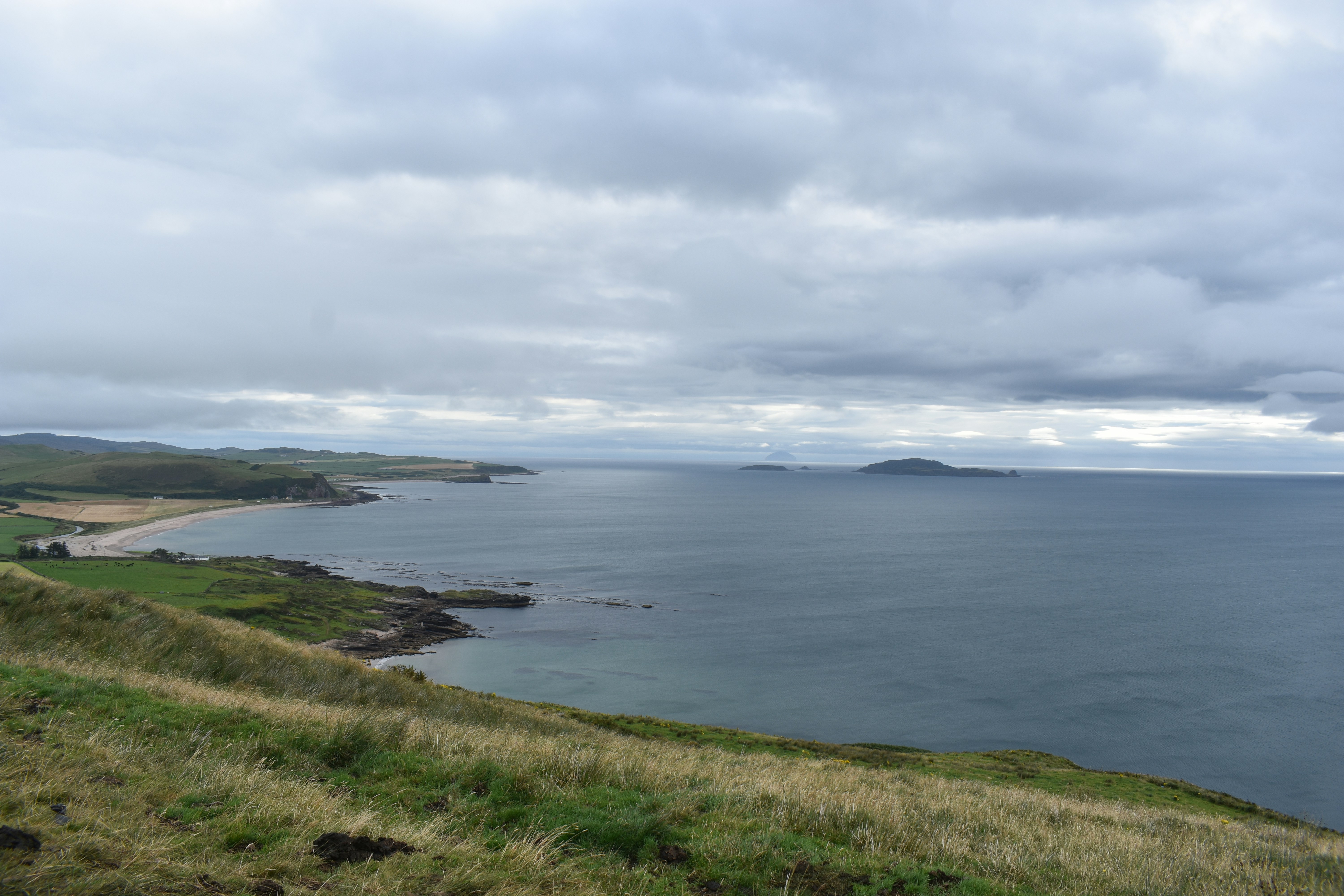
Somewhere on the Kintyre Peninsula of Scotland. Photo by Andrew Hall on Unsplash. (Andrew, we might be cousins!)
I know baptismal dates and marriage dates for my ancestors in Campbeltown and Southend, Scotland, but I don’t know when the three brothers set sail to America. I don’t know how long they lived in Pennsylvania before taking the Great Wagon Road south to the Rocky River Community in present-day Cabarrus County, North Carolina, but I had fun imagining their journey for this short story.
I’m privileged to live on a little piece of land that has passed down through seven generations to my sister and me from the 1760s. We’ve been to Scotland and visited the farms where they were tenants of the Duke of Argyll in the late 1600s and early 1700s. I feel a bond with them. Writing “From Scotland to America” was one small way for me to pay homage to them. I grew closer to them as I pondered their lives, what they saw, what they did, how they must have marveled at “the New World” and how they must have missed their homeland and living by the sea.
This story is entirely fiction except for their names, where they lived in Scotland, and from whom my great-great-great-great-grandfather purchased his first piece of land in North Carolina.
The three brothers came from a place where no common people owned their own land, so it must have been an unimaginable accomplishment to come to America and purchase land. That was something none of their ancestors could have done!
You can find the paperback at Second Look Books in Harrisburg, NC, or ask for it at your local independent bookstore. Bookstores can order it from IngramSpark.
Don’t forget to look for my other books, all available on Amazon: I Need The Light! 26 Weekly Devotionals to Help You Through Winter; I Need The Light! Companion Journal and Diary; The Aunts in the Kitchen: Southern Family Recipes (compiled along with my sister, Marie); Harrisburg, Did You Know? Cabarrus History, Book 1; and Harrisburg, Did You Know? Cabarrus History, Book 2.
The following genealogy books that my sister and I compiled are available through my website (https://www.janetmorrisonbooks.com): Descendants of John & Mary Morrison of Rocky River; Descendants of James & Jennet Morrison of Rocky River; and Descendants of Robert & Sarah Morrison of Rocky River.
By the way, don’t forget the people of Ukraine and their struggle to remain a free and independent nation.
I wish more emphasis had been put on Lewis & Clark’s Corps of Discovery when I was in school. Living in North Carolina, it just wasn’t taught much. I suppose in the Midwest and Great Plains states it was and is taught in detail.
Today marks the 218th anniversary of the conclusion of Meriwether Lewis and William Clark’s grand trek into the great unknown in search of the Northwest Passage.
I learned more about the Lewis & Clark Expedition from watching Ken Burns’ documentary film than I learned in school. Ken Burns has a gift for weaving story, quotes, and geographic images together in a comprehensive telling of particular times or events in American history.
The When and the Why
US President Thomas Jefferson is remembered for his curiosity. Since the 1400s, explorers had dreamed of finding Northwest Passage – a waterway across North America from the Atlantic to the Pacific. President Jefferson wanted the Pacific coast of North America to be found, and he was convinced that a group of explorers would find it if they could just cross the Mississippi River and follow the Missouri River across the lands included in the Louisiana Purchase.
Meriwether Lewis and William Clark led the group that was assembled to explore the region. It was a vast unknown to the European settlers. What the Corps of Discovery did was comparable to the space exploration of our time, except Lewis & Clark did not have computers to guide them. They really didn’t know what the terrain and weather would be like once they ventured very far beyond St. Louis.
In the spring of 1804, at the direction of President Jefferson, this band of intrepid explorers set out on a journey of unknown time and distance. (I guess it is sort of like the two astronauts who are going to be on the International Space Station for eight months instead of the originally planned eight days.)
How does one pack for such an adventure? What thoughts went through their minds as they headed west, not knowing if or when they would see their families again?
The Preparation
For starters, I will point out that the Corps of Discovery was made up of Lewis, Clark, and nearly four dozen men. As I recall, in school we were led to believe that it was just Messrs. Lewis and Clark and that they were joined by a Native American young woman, Sacagawea, somewhere along the way.
They spent the winter of 1803-1804 on the Illinois side of the Mississippi River in a collection of huts they built. It was called Camp Debois. Among the supplies they gathered in preparation for their journey were nearly two tons of flour, nearly two tons of salt pork, 50 pounds of coffee, and 100 gallons of whiskey.
Information was gathered from fur traders, and the men were drilled, for this was comparable to a military mission and a chain of command was integral if the expedition had any chance of being successful.
The How
They started out in a keelboat with two large canoes. Lewis was accompanied by a Newfoundland dog named Seaman who reportedly caught squirrels, beaver, and an antelope. They had been told they would encounter numerous nations of “savages” who would not welcome white men. The message they carried was that all the land within sight in all directions belonged to the United States of America.
Seaman proved his worth not only as hunting squirrels for the men to eat, but also as a guard dog. There were instances when Seaman scared off an angry buffalo and even kept grisly bears at bay.
On November 15, 1805, Lewis and Clark reached the Pacific Ocean at the mouth of the Columbia River in present-day Washington. That was one year, six months, and one days after they began their journey.
What they did not find
They did not find a waterway connecting the Atlantic and the Pacific.
What they found
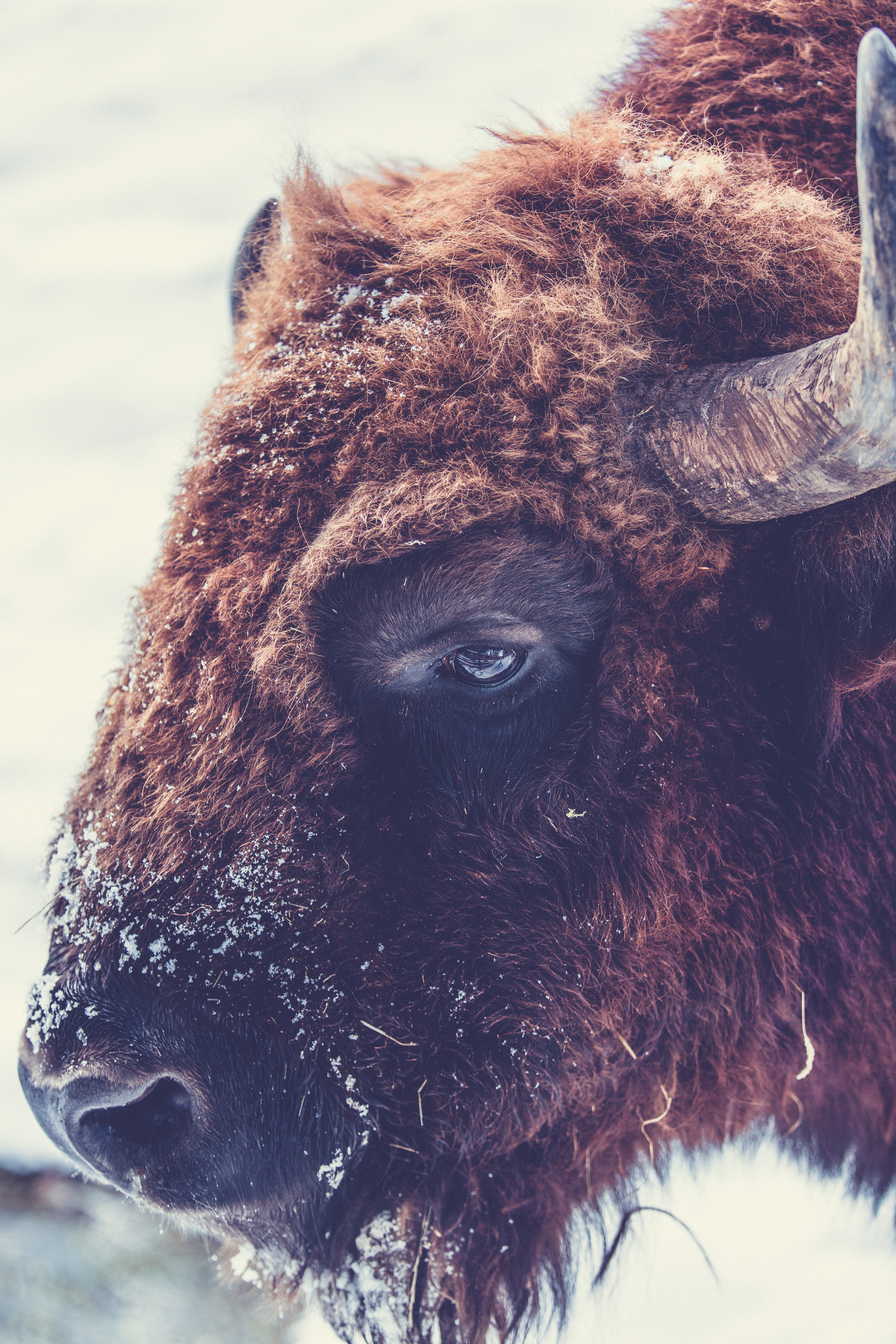
Photo by Markus Spiske on Unsplash
What they found was the Great Plains, the majestic Rocky Mountains, unknown plants and animals, and native peoples who were curious about them and not hostile as had been expected.
Photo by Aida L on Unsplash
They found the kindness of strangers.
Photo by Boston Public Library on Unsplash
They found a native woman named Sacagawea who would guide them and save their very lives.
They found a vast and wondrous land that none of them could have imagined.
The documentation they brought to President Jefferson
President Jefferson sent Lewis & Clark and their crew off with explicit instructions as to record keeping. Jefferson even devised a complicated code matrix they were to use if they needed to try to send secret messages back to Washington.
They were to record in great detail the geography; animals; soil; crops; natural plants; minerals; and human inhabitants and their languages, populations, food, clothing, religions, and their interest in commerce.
Journals were kept, along with meticulous records of what they saw that would be of scientific and future exploration benefit.
The completion of the expedition
The Corps of Discovery returned to St. Louis at noon on September 23, 1806. Lewis immediately wrote a long letter to President Jefferson informing him of their return and that they had indeed reached the Pacific Ocean, although not by water the entire way. Included in the letter was the news that instead of taking half a day to cross the western Continental Divide, it had involved crossing 60 miles of treacherous snow-covered mountains.
Since my last blog post
I had the privilege of telling the 37 members of the Leadership Cabarrus Class of 2025 about the history of Harrisburg last Tuesday. Organized by Rowan-Cabarrus Community College, it was an interesting group of people from various walks of life who are relative newcomers to Cabarrus County. I was allotted 20 minutes to give them the highlights of Harrisburg’s rich history.
I’m not much of a public speaker, but I went through my two local history books, Harrisburg, Did You Know? Cabarrus History, Books 1 and 2 and made notes from some of the highlights I thought would be of interest to the group. It was a congenial group and I enjoyed the experience. It had been a couple of years since I had spoken to a large group of people.
Until my next blog post
As always, I hope you have a good book to read.
Make time for friends and family.
Don’t forget the people of Ukraine, as another harsh winter is approaching.
Since I have published very little historical fiction, you probably haven’t read anything yet that was influenced or inspired by my genealogy; however, I hope to remedy that with the publication of a collection of my short stories in 2024.
I’ll give you an example. People often ask fiction writers where they get their ideas. The answers run the gamut, but I have drawn on research into my family history for at least one historical short story.
Many people like to brag about their Scottish ancestors living in castles. Folks, why would someone leave a castle in Scotland in the 1700s and come to America to start life over as a farmer? Just sayin.’
Eilean Donan Castle in Scotland (Photo credit: Nicholas Beel on Unsplash.com
I brag on most of my ancestors because they were farmers. They were farmers in Scotland and Ireland, and they bought land to farm when they got to America.
Photo Credit: Steven Weeks on Unsplash.com
After having grown up out in the country and worked a vegetable garden, I have immense respect and admiration for anyone who is able to support a family and make a living by farming – especially back in the days before tractors and other mass-produced farm equipment.
Today I’m blogging about one of my immigrant ancestors who inspired me to write a short story.
He left Ireland (we think) and came to Virginia in the early 1700s. He had obviously not lived in a castle. Doing research on him in coastal Virginia was an eye-opening adventure. By following all the government records I could find about him, I learned a great deal of early Virginia history.
His court records made the fact that in colonial Virginia there was no separation of church and state very real to me. When said ancestor found himself on the wrong side of the law, he was fined a certain poundage of tobacco (or “tobo”) to be paid to the Anglican church.
Photo Credit: Rusty Watson on Unsplash.com
I learned that tobacco was as good as money in colonial Virginia. My g-g-g-g-g-grandfather was on the wrong side of the law more than once, and he was always fined a certain number of pounds of tobacco.
Just so you’ll know, he wasn’t a terrible or dangerous person. He was fined for such offenses as playing cards on the Sabbath. You can read what I think will be an entertaining story about him in my (hopefully) upcoming book in 2024, Traveling through History: A Collection of Historical Short Stories.
You might want to subscribe to my every-other-month e-Newsletter so you can learn more about the research I do. One thing I love about writing historical fiction is the research it requires.
Visit my website, https://www.janetmorrisonbooks.com and click on the “Subscribe” button. You’ll immediately receive a free downloaded copy of my short story, “Slip Sliding Away” – a Southern historical short story set in the Appalachian Mountains in the 1870s.
Since my last blog post
Drumroll! Main Street Books in Davidson, North Carolina has accepted The Aunts in the Kitchen: Southern Family Recipes on consignment for the next six months. Marie and I are excited about this new opportunity.
I appreciate the comments some of you let after reading my blog last Monday about book banning – specifically, Sold, by Patricia McCormick. I’m glad I introduced the book to some of you.
In last Monday’s blog, I indicated that I had submitted a request to the Cabarrus County Public Library for Sold to be ordered. One of the librarians thanked me for bringing it to her attention. It seems that the system used to have a copy. After it was lost, they failed to order a replacement copy. That is now being rectified.
See? Sometimes all you need to do is ask your local library system to consider adding a book to the collection. In a time when too many people do nothing but criticize “the government” and express their disrespect for government employees, I’m giving a shout-out for the Cabarrus County Public Library System and its dedicated employees
Until my next blog post
I wish my fellow Americans a wonderful Thanksgiving holiday this week. It’s good that we set aside a day every year to stop and think about all we have to be thankful for.
I hope you have a good book and time to read it. If there’s a book you wish you can check out of your local public library but it’s not in the system, request that it be purchased. Your request might be turned down due to monetary restraints or another reason, but you won’t know until you try.
Remember the people of Ukraine and other parts of the world where innocent citizens are suffering due to the actions of dictators and terrorists.
I’m pleased to announce that not only did my second proof copy of Harrisburg, Did You Know? Cabarrus History, Book 2 arrive in a timely manner, but it was also in fairly good order!
The cover is now a reddish-brown instead of dark brown. (I don’t think I’ll try to self-publish any more books with a red cover! We all learn from our mistakes.)
There were still a few formatting errors that resulted from the last “chapter” (my research notes) being almost 30,000 words in length, but at least Carl Higgins’ World War II B-26 bomber was flying horizontally on page 467.
Although the manuscript was proofread and corrected several times, three typos got past me. I strive for perfection, but I’ve yet to see a perfectly printed book. I can live with three typos in a 536-page book.
Available on Amazon!
Harrisburg, Did You Know? Cabarrus History, Book 2 is now available in paperback and for Kindle from Amazon. Click on https://www.amazon.com/dp/B0BW2QMLHC/ for the paperback or click on https://www.amazon.com/dp/B0BXBQ1F79/ for the Kindle book. I shortened the Amazon URL so they wouldn’t look so intimidating. If they don’t work, just put the name of the book in a search on Amazon.
Available soon at Second Look Books!
The paperback book will be available in a few weeks at Second Look Books in Harrisburg.
The first issue of my newsletter!
Those of you who read my blog post last Monday and subscribed to my newsletter before March 1, received the first issue of the Janet Morrison Books Newsletter (clever name, eh?) on Friday. I hope you enjoyed the variety of information it contained.
If you’ve read my vintage postcard book, The Blue Ridge Mountains of North Carolina, you were able to answer the trivia question near the end of the newsletter.
Please subscribe to my newsletter & receive a free short story!
I’m working hard to get my writing career off the ground, so please subscribe to my newsletter. I plan to send out a newsletter every other month, so be sure and visit my website, https://www.janetmorrisonbooks.com and subscribe so you won’t miss another issue. You’ll also receive a downloadable copy of my short story, “Slip Sliding Away: A Southern Historical Short Story.”
Thanks for being on this journey with me!
All these recent accomplishments are the culmination of a lifetime of studying local history and learning how to research and document it and 22 years of studying the craft of writing.
It’s been a bumpy journey. Thank you for having faith in me and offering encouraging words along the way! I have some loyal lifelong friends and just as loyal friends I’ve made through my blog and Facebook. I value each and every one of you.
Buckle up! I’m just getting started!
I’m working on a family cookbook, more historical short stories, and an historical novel. With my two local history books and first short story published, I look forward to concentrating on my fiction writing.
Until my next blog post
I hope you have a good book (or historical short story!) to read.
Ms. Story hit on some important points and helped me not to feel quite so intimidated by the whole author platform thing. Her article touched on the “whys” and the “wherefores” of an author platform. It boils down to anything and everything you do to attract readers.
She talked about five ways an author’s platform can help your career. They all made sense. Then she listed 14 examples of things a writer can do to attract readers. I was happy to see “Blog” on the list, but the wheels fell off my wagon when I got to “YouTube site.” Yikes! Moving on down the list (because, after all, I can’t do all 14 of them) I came to “Newsletter.” I’ve toyed with that idea, but I haven’t attempted that avenue yet.
When my redesigned website gets up and running (soon!), I will start asking people to sign up for my email list/newsletter. More to come on that in the coming weeks.
Ms. Story also had “E-books” and “Social Media” on her list. I’ve mentioned my lack of comfort with social media in many blog posts. There’s certainly more work for me to do there.
On the E-book front, I’ve written a southern historical short story that I plan to give away as an e-book to everyone who signs up for my mailing list. Stay tuned for my announcement about that when my new website is ready.
Blog and Social Media: Is it Both or Either/Or?
Photo Credit: Elena Mozhvilo on unsplash.com
I recently listened to a Penny Sansevieri of https://www.amarketingexpert.com on this topic. It unburdened me! I learned that more and more authors don’t have a desire or the time to be on social media. Whew! What a relief! I’ve read and heard a thousand times that authors have to be active on social media.
I’ve tried to be active on Twitter. It’s just not my thing. It’s a chore. It’s something I have to put on my to-do list, but usually it gets pushed to another day. And Instagram? I created an account several years ago, but I’ve never used it. By that, I mean I’ve never logged in to my account a single time.
I enjoy putting things on Pinterest, but I’m more likely to pin a recipe than something writing-related. Last week I read a theory that Pinterest might be an author’s best friend when it comes to social media. I like Pinterest, so that was encouraging.
When Penny Sansevieri said I don’t have to do social media, I wanted to jump up and down. If I blog on a regular basis (check!), update my website (check! Being done!) and stay active on Pinterest (fairly easy!), all I need to add is a newsletter.
With that in mind, I looked back at the “Next Steps” section in my January 30, 2023 blog post. I was tempted to strike through numbers 5 and 6 (find out where my target reader hangs out and hang out there), but I’m pretty sure historical fiction fans hang out on Goodreads. I like Goodreads. I just need to get more serious about it.
My takeaways from the podcast were (1) Since I blog every week, I don’t have to have a presence on social media; (2) I need to upgrade my author website; (3) I must have a newsletter with updates on what I’m doing and teasers about what’s coming; (4) I need a magnet to attract people to my newsletter; (5) I must have information in the back of my books with links to my website, blog, and any social media I want to participate in; (6) I mustn’t overlook local events and local media; and (7) I need to engage with influencers.
Where do I go from here?
With the new advice from Penny Sansevieri’s podcast that I just need to choose those activities I’m comfortable with and focus on them, I don’t feel overwhelmed now. (Well, not completely overwhelmed.) I will stop feeling guilty for not Tweeting every day.
You wouldn’t believe how much weight just got taken off my shoulders!
Photo Credit: Jacob Kiesow on unsplash.com
I’ve Been Part Way Down That Road Before
I could be the poster child for how not to build an author’s platform. I’ve given half-hearted effort in the past to everything on Kimberly Grabas’ list I shared in m January 30, 2023 blog post. I’ve let excuses like lack of technical expertise derail my good intentions.
Reading the articles I referenced today and two weeks ago and listening to the podcast I mentioned were extremely helpful. Those actions, plus taking Tim Grahl’s “Launch a Bestseller” course, prompted me to make a plan and set goals and deadlines for myself.
It’s all paid off. I put my nose to the grindstone last fall and self-published a 500-page local history book in November. I’ll have a revamped website later this month. Then I’ll be able to start compiling a mailing list. I’ll give away an e-short story. I expect to have my second local history book available by the first of April.
Since my last blog post
I’m still dealing with the problems I blogged about last week, but I’m trying not to be as upset about them. Several of you have reached out to me about the issues with suggestions and empathy. Thanks to each of you!
My sister and I continue to proofread the manuscript for Harrisburg, Did You Know? Cabarrus History, Book 2.
Harrisburg, Did You Know? Cabarrus History, Book 1 continues to sell well at Second Look Books in Harrisburg and on Amazon.
The daffodils are blooming, so spring must be on the way!
Until my next log post
Thank you for dropping by my blog. I truly appreciate the time you took to read my post today. If you have friends who might enjoy it, please tell them about it.
I hope you have a good book to read. I’m listening to The Home for Unwanted Girls, by Joanna Goodman. I recommend it. It’s historical fiction based on a real life experience and is set in 1950s Quebec. Saskia Maarleveld is the reader on the book on CD. She does wonderful work! I’m beginning to seek out books she’s recorded.
Remember the suffering people in Ukraine, Turkey, and Syria.
Did you ever see the Sauline Players perform? Chances are you did if you went to school in the piedmont of North Carolina in the early- to mid-1900s.
As I write that, though, it occurs to me that I don’t know if they performed at the schools for black children. I hope they did, for their performances were a real treasure for those of us who lived in rural areas and didn’t have easy access to live theatrical performances.
Two of the 91 local history articles in my new book, Harrisburg, Did You Know? Cabarrus History, Book 1, are about the Sauline Players. I’ll share some highlights from those articles in today’s blog post.
When I researched the Sauline Players for Harrisburg Horizons newspaper in 2011, I was surprised to learn that the theatrical troupe was based in the small Gaston County town of Belmont, North Carolina. I have fond memories of their performances in the auditorium at Harrisburg High School in the early 1960s when I was in elementary school.
In 2010, I learned that Joseph Sauline was with another traveling acting troupe in Charlotte in the 1920s when that company went broke. Not to be outdone, Mr. Sauline stayed in the area and organized his own acting group — the Sauline Players.
An online search in 2010 led me to a Sauline Players listing on the acting resume of Ms. Joan McCrea. I was able to get in touch with her agent, who in turn gave Ms. McCrea my contact information. Imagine my surprise one day when I answered the phone and found actress Joan McCrea in Los Angeles on the other end of the line!
The ensuing correspondence with Ms. McCrea turned my single newspaper article about the Sauline Players into a two-part series.
If you want to know more about the Sauline Players and other local history articles I wrote for Harrisburg Horizons newspaper, look for my book, Harrisburg, Did You Know? Cabarrus History, Book 1.
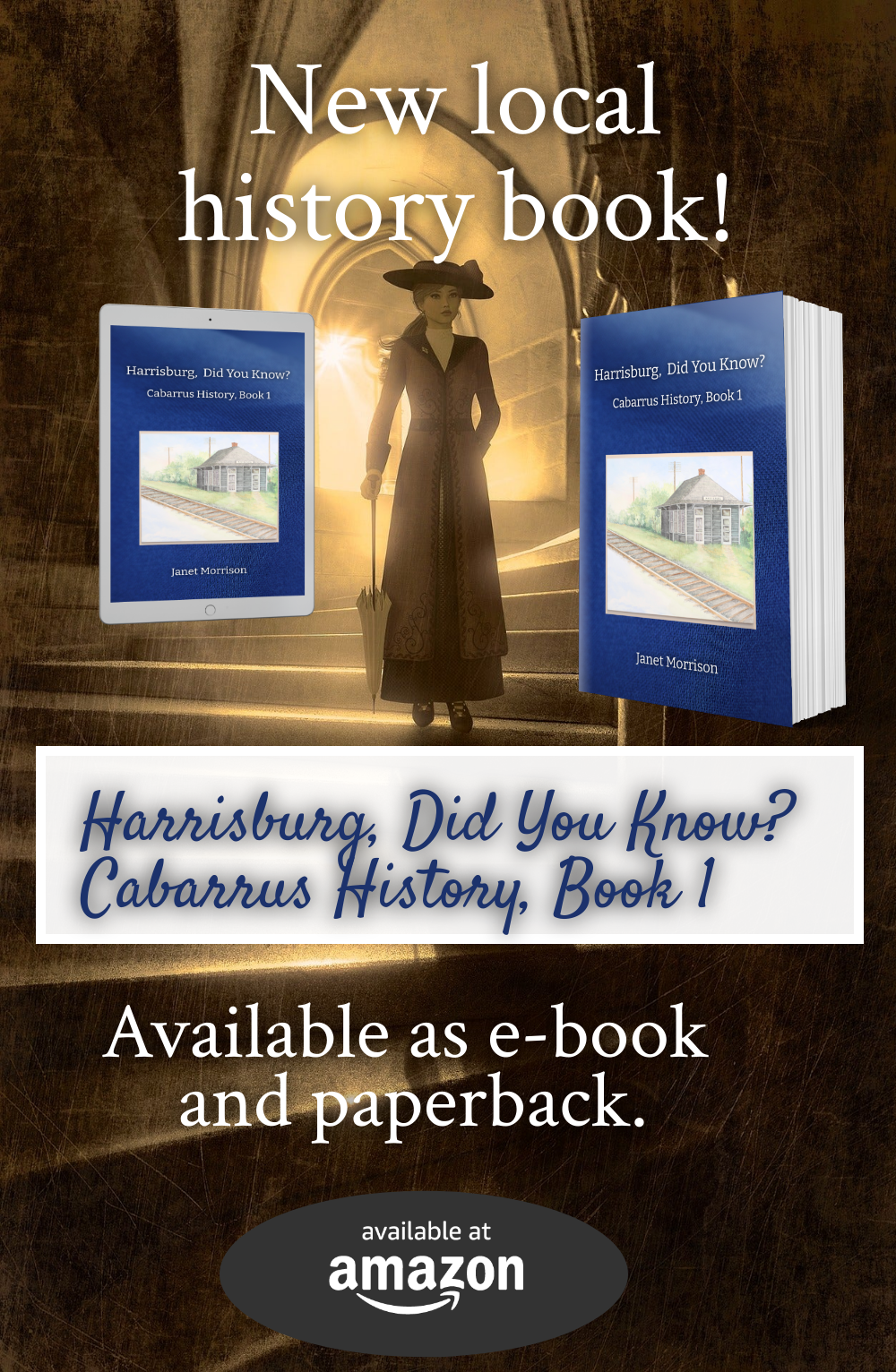
Harrisburg, Did You Know? Cabarrus History, Book 1, by Janet Morrison
Where to purchase Harrisburg, Did You Know? Cabarrus History, Book 1
Paperback available at Second Look Books, 4519 School House Commons, Harrisburg, NC
My book received a lot of positive and well-placed publicity last week. The proprietor of Second Look Books in Harrisburg tells me sales have been brisk.
I took a long enough break from formatting Harrisburg, Did You Know? Cabarrus History, Book 2 to design the cover for the paperback. Then, it was back to formatting. I’m pleased to have the cover designed so I could mark that task off my to-do list.
Until my next blog post
I hope you have a good book to read. I’m reading a couple of books now. It’ll be interesting to see how many I get read in January.
2022 has been a good year for me. Coming out of the worst days of the Covid 19 Pandemic has given me a chance to try to get back into my normal routine.
Being able to once again go out in public (except to medical facilities) without wearing an N-95 mask is a nice change from 2020 and 2021. It still feels odd to eat inside a restaurant or travel. All the things I used to take for granted are more appreciated now.
2022 was a year of accomplishment for me as I published Harrisburg, Did You Know? Cabarrus History, Book 1 the last week in November. It’s been exciting to see it well-received and appreciated.
Publishing the book gave me a sense of accomplishment I didn’t expect as I was able to format it and design the cover. I even learned how to make a QR Code that will take people to my website! I still have trouble remembering what the “Q” and the “R” stand for, but I’m making progress. Those are small technological accomplishments in the big scheme of things, but they are huge for me!
The formatting of Harrisburg, Did You Know? Cabarrus History, Book 2 is coming along nicely, so watch for it perhaps in February. I’m on my own schedule for that, so that lessens the pressure of meeting someone else’s deadline.
I hired a company to redesign my website. I’ve now seen the home page and the “about” page, so it’s coming together. I look forward to unveiling the new website in a few weeks. The URL will still be JanetMorrisonBooks.com.
I’ve made progress working on my family genealogy and putting the information in a software program that will allow me to easily share the information with others in the family. They might not appreciate it now, but I’d like to think they will later.
The decluttering I did early in the year is but a distant memory now. (Why did I keep this stuff?) My writing projects sidetracked me. I must make time for more decluttering in the new year.
I’ve read some good books this year, but my writing has derailed my reading list the last several months. Too many books, not enough time!
The historical short stories I’m writing have taken a back seat to the Harrisburg local history books, but I look forward to turning my attention back to them now that Book 1 is out. In fact, I edited one of my stories on Saturday.
The older I get, the more I realize I’m racing against the clock to get all my projects finished. Too many interests and projects, not enough time!
As you look back over 2022, I hope you remember the good times and all your blessings. I can’t forget the sad times or the difficult times but, when I stop and think, I know I’ve been truly blessed this year. I hope you feel the same way about 2022 as we prepare for a new year.
Until my next blog post
I hope you have a good book to read! I’m reading a book of poetry by Ray Griffin. The name of it is Threshold. I’ll write more about it in my next blog post.
It’s been an unusually cold past week here in the United States. I hope you’ve stayed safe and warm wherever you are.
Remember the cold and brave people of Ukraine.
I hope you’re having a nice holiday season, no matter your beliefs.
The encampment of the Continental Army at Valley Forge began 245 years ago today. We’re all familiar with the image of George Washington leading his troops across the frigid Delaware River. We know that it was a bitterly cold winter, but there are some interesting facts I hope to surprise you with today.
1,700 to 2,000 soldiers died of disease at the six-month encampment.
Food for the troops was scarce. The Oneida delegation, allies of the Patriots, arrived in May 1778 with white corn. Polly Cooper of the delegation instructed them on how to safely prepare the corn for consumption and stayed after most of her fellow Oneidans had left. She received a shawl from Martha Washington in thanks for her assistance.
In December it went down to 6 degrees F., 12 degrees F. in January, 12 degrees F. in February, and 8 degrees F. in March.
It was the last time United States soldiers served in a racially-integrated army until the Korean War in the 1950s.
The volunteer drill master was Baron von Steubon, a Prussian military commander. The Prussian military drills and tactics he taught the troops were used by the United States military for the next 30 years.
It is thought that 250 to 400 women were in the encampment, serving as cooks, nurses, laundresses, and menders of clothing.
Mary Ludwig Hayes, a.k.a., Molly Pitcher, was at Valley Forge with her husband. She is remembered for jumping into service to help load a cannon at the Battle of Monmouth Courthouse after her husband was wounded.
Hannah Till was an enslaved cook for George Washington at Valley Forge. She purchased her freedom a few years later and became a salaried cook.
We hear a lot about our “forefathers” but not enough about our “foremothers!”
Since my last blog post
Look who’s reading my book! He must have found it on Amazon or in Harrisburg, NC at Second Look Books or Gift Innovations! It’s in short supply in Harrisburg until I get my next shipment. If you prefer an e-book, remember it’s available for e-book and in paperback from Amazon.
Until my next blog post
I hope you have a wonderful Christmas or whatever holidays you are celebrating.
I hope you enjoy time with family and friends.
Remember the suffering people of Ukraine.
I’ll see you again here at my blog on December 26 – the last Monday in 2022!
On the first Monday of the month I usually blog about the books I read the previous month. There was a good reason that didn’t work out this month. My local history book, Harrisburg, Did You Know? Cabarrus History, Book 1, had been published and I couldn’t wait to announce it on my blog last week.
It was a good month for that to happen because I didn’t have any earth-shattering news about the books I read in November. Working toward getting several books published in the coming days and months left me little time to read.
Most of my reading time was spent on books about the craft of writing and history books I needed for research. Those aren’t necessarily the type books my blog readers want to know about.
Those books included Sketches of Virginia, by Henry Foote and Artisans of the North Carolina Backcountry, by Johanna Miller Lewis. The “Artisans” book was especially helpful as I worked on my novel.
I tried to read some fiction. It just didn’t work out well – partly because of my time constraints and partly because the books I chose didn’t grab my attention enough for me to make time for them.
I started reading Less is Lost, by Andrew Sean Greer. I really enjoyed his earlier book, Less. It was humorous. Less is Lost is probably humorous, too. I only got to page 12 in the large print edition. I’ll check it out again later.
I started reading The Unlikely Pilgrimage of Harold Fry, by Rachel Joyce. It is an odd story about a man who sets out one morning to walk to the mailbox. He’s worried about a former co-worker who has cancer and lives far away. Instead of stopping at the mailbox to mail a letter to her, he just keeps walking. I got to page 66 in the large print edition. He was still walking. I didn’t have time to read the next 381 pages to see if he made it to his destination.
I started listening to Mad Honey, by Jodi Picoult. After falling asleep too many times to count and having to re-listen to the first several discs, when I got to disc number four I seriously questioned why I was trying so hard. I don’t know if it was me or the book. It just didn’t work out. I’ve enjoyed other Jodi Picoult books I’ve read, but this one just didn’t work for me.
Until my next blog post
Harrisburg, Did You Know? Cabarrus History, Book 1 is available on Amazon in many countries. Here’s the link to it in the United States: https://www.amazon.com/dp/1888858044/ for e-book; https://www.amazon.com/dp/1888858044/ for paperback. (Thank you, Rebecca Cunningham for cluing me in that there’s a way to shorten those outrageously long URLs Amazon gives a book.! This looks much better. I hope the links work!)
In case you live in the Harrisburg area and prefer to purchase Harrisburg, Did You Know? Cabarrus History, Book 1 locally instead of ordering it online, it is now available in limited numbers in Harrisburg at Second Look Books at 4519 School House Commons and at Gift Innovations at 4555 NC Hwy. 49. I’m pleased to announce that those local small businesses will have my book!
I hope you have a good book to read. If it happens to be Harrisburg, Did You Know? Cabarrus History, Book 1, then all the better!
In my last two blog posts I’ve written about the books I read in March. Last Monday’s post was nearing 2,000 words, so I decided to save my comments about Reading Like a Writer: A Guide for People Who Love Books and for Those Who Want to Write Them, by Francine Prose, for today. I’ll just hit some of the highlights.
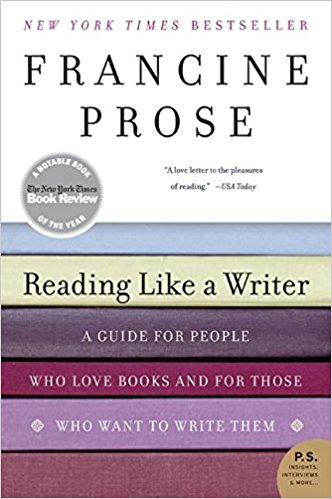
Reading Like a Writer, by Francine Prose
Chapter One: Close Reading
I read and took copious notes from the first four chapters of this book and perused the rest of it. As an aspiring author, I loved how the first chapter confirmed that I read like a writer. It’s called “close reading,” and it means reading every word for the pleasure of getting every phrase – being conscious of such things as style, sentence formation, and how the author creates characters.
Based on what Francine Prose wrote, I no longer need to apologize for reading slowly. I’m trying to hone my craft by reading published writers.
Chapter Two: Words
In the second chapter of Reading Like a Writer, the author recommends that you read slowly enough to read every word. She compares the language a writer uses to the way a composer uses notes and a painter uses paint.
To paraphrase Ms. Prose, reading to appreciate the writing is akin to not only admiring a beautiful painting from afar but also close up so you can see the brushstrokes.
I also appreciated Ms. Prose’s thoughts on the advice often given to writers, which is “Show, don’t tell.” Ms. Prose says this much-repeated advice confuses novice writers. I can vouch for that.
In editing my earlier manuscript for The Spanish Coin (before I started the complete rewrite), I took the “show, don’t tell” advice to the extreme. I was ruthless in cutting narrative, thinking I could best “show” through dialogue. It was all part of the learning process. Ms. Prose’s take on this is that showing is best done through “the energetic and specific use of language.”
Chapter Three: Sentences
If I had known I would someday want to be a writer, I would have paid more attention in the 8th grade when we had to diagram sentences. I wasn’t very good at it, and I really didn’t see the point.
I hadn’t thought about sentence diagramming in years until I got to the third chapter of Ms. Prose’s book. She wrote about the value of diagramming sentences, and what she said makes sense to me now.
She lamented the fact that students are no longer taught to diagram sentences. Her explanation that sentence diagramming provides for the accounting of every word and provides a way “to keep track of which phrase is modifying which noun” gave me a way of understanding the value of the exercise that I could not have appreciated as an eighth grader.
I probably couldn’t diagram a complex sentence today if my life depended on it, but Ms. Prose might just be onto something when she insinuates that having that skill would help a writer.
A word of warning, though, for those of you of “a certain age.” Reading the Huffington Post article, I soon felt like I’d entered a time warp. I don’t think our sentences had “complements” when I was in the 8th grade.
Chapter Four: Paragraphs
In the fourth chapter of the book, Ms. Prose quotes master short story writer, Isaac Babel:
“’The breaking up into paragraphs and the punctuation have to be done properly but only for the effect on the reader. A set of dead rules is no good. A new paragraph is a wonderful thing. It lets you quietly change the rhythm, and it can be like a flash of lightning that shows the same landscape from a different aspect.’” – Isaac Babel
In all the various English courses I have taken, I don’t recall any teacher or professor ever saying to break for a new paragraph “only for the effect on the reader.” I’m still letting that sink in. It’s refreshing and freeing to think about it. It is for the writer to determine which rules are dead as far as her editor is concerned.
Chapter Seven: Dialogue
Characters in a novel should “say what they mean, get to the point, avoid circumlocution and digression.”
Chapter Eight: Details
Another interesting observation Ms. Prose makes is about details and the truth. She observes that details persuade that the truth is being told.
She points out that a piece of clothing can speak volumes about a character’s circumstances.
Chapter Eleven: Reading for Courage
Continuing to fly in the face of common advice given to writers of fiction, Ms. Prose suggests that the trend in modern fiction that characters in a novel must be nice in order for the reader to identify with them is possibly not true.
She also says it’s not necessarily true that every loose end in a work of fiction needs to be tied up neatly by the end.
What a relief to read those last two theories! My characters don’t have to be nice in order for the reader to identify with them, and all the loose ends don’t have to be tied up at the end of the novel? This is in opposition to what I learned in fiction writing class back in 2001.
“Words,” by Dr. R. Brown McAlister
Chapter Two in Ms. Prose’s book brought to mind the title of the remarks made by one of the two guest speakers at my high school graduation. Dr. R. Brown McAllister, a beloved icon in Cabarrus County Schools at the time, had retired after many decades of teaching and working as a school administrator, and he had a dry but keen sense of humor. The printed program for the graduation ceremony listed “Words,” by Dr. R. Brown McAllister.
In his deadpan way, Dr. McAllister went to the podium and said something like, “I was asked to talk about words, so here I am.” That was in 1971 and I still don’t know to this day if he was asked to talk about words or to say a few words.
The more I attempt to be a writer and the more I read, the more I appreciate words.
Since my last blog post
I have made a social media plan and made an effort to do more on Twitter (@janetmorrisonbk), my writing-related boards on Pinterest (https://www.pinterest.com/janet5049), and my Janet Morrison, Writer page on Facebook. Implementing the plan will be a challenge but I’m told I must get my name out there if I hope to sell any copies of The Spanish Coin if and when it gets written and published.
I did not get much reading done last week, but I’m trying to learn that I can’t do everything I want to do. I can’t even do everything I need to do.
Until my next blog post
I hope you have a good book to read. I’ve just started reading Every Note Played, by Lisa Genova.
Every Note Played, by Lisa Genova
If you’re a writer, I hope you have quality writing time
If you haven’t signed up for my sometime-in-the-future newsletters, please do so by completing the form below.




















 Janet's Writing Blog