I write southern historical fiction, local history, and I've written a devotional book. The two novels I'm writing are set in Virginia and the Carolinas in the 1760s. My weekly blog started out to follow my journey as a writer and a reader, but in 2025 it has been greatly expanded to include current events and politics in the United States as I see our democracy under attack from within. The political science major in me cannot sit idly by and remain silent.
Today’s blog post is about the Lend-Lease Agreement of 1941. Unless you are a history nerd, this topic probably holds little interest; however, as a bit of a history and political science nerd, I thought it worthwhile to mark the 85th anniversary of the passage of that agreement.
I am of the belief that we are bound to repeat history if we do not learn from it. I don’t know how it is in public schools today, but I did not get to study post-American Civil War history until I went to college. Much of 20th century history I’ve learned on my own or learned by living through half of it.
What follows is probably the most simplified description you will ever read of how the United States tried to stay out of World War II.
1920s and 1930s
Throughout the “Roaring Twenties,” the United States was still in debt over World War I. As a result, Neutrality Acts were passed by Congress in 1935, 1936, and 1937. In a nutshell, those acts made it unlawful for Americans to sell or transport arms or materiel to nations at war.
“Cash and Carry”
Then came World War II. Watching the aggression of Germany, Italy, and Japan, in 1939, U.S. President Franklin D. Roosevelt proposed amending the Neutrality Acts and following a “cash and carry” policy in which other countries could purchase arms from the United States but the US would not supply military personnel.
When I finally got to study World War II, I was shocked to learn how slow the U.S. was to jump into the fray and come to the aide of Great Britain.
Photo by British Library on Unsplash
During the Battle of Britain, in September of 1940, Britain sent a delegation of researchers to the United States to share secret radar technology. Britain’s energy and money had to focus on the war but, since the United States wasn’t fighting, it could give attention to research and development.
“Arsenal of Democracy” and Isolationism
Three months later, British Prime Minister Winston Churchill sent Roosevelt a 15-page letter asking for the U.S. to help them. In one of his famous “fireside chats,” Roosevelt responded by announcing that the U.S. would be the “Arsenal of Democracy” and would sell arms to Britain and Canada.
Isolationists in the U.S. maintained that the war was a European problem and that the U.S. should stay out of it. Gradually, more Americans agreed that their country should do more to back Britain but keep our military out of the conflict.
This is a stark example of hindsight being better than foresight. No doubt, if the United States had known what lay ahead over the next five years, it would have acted earlier and more forcefully. Being protected by the Atlantic and Pacific Oceans, Americans were lulled into a false sense of security.
That false sense of security came back to bite us on December 7, 1941, (and again on September, 11, 2001) but I’m getting ahead of myself.
Lend-Lease Act of 1941
“An Act to Promote the Defense of the United States” was introduced and eventually enacted on March 11, 1941 in the “Lend-Lease Act.” That Act permitted the U.S. to supply the United Kingdom, the Soviet Union, France, the Republic of China, and other Allied nations with food, oil, and materiel, free of charge, for the duration of the war.
In March of 1941, the U.S. was still trying to stay out of the war militarily, but the Lend-Lease Act made it clear that the United States recognized that it was in its best interest to aide Britain because defending Britain was, in effect, defending the U.S.
Of course, we know now that nine months later, Japan attacked Pearl Harbor in Hawaii, thrusting the United States into the war in the Pacific. It would be January 26, 1942, before the first American troops would arrive in Great Britain.
The Lend-Lease Act of 1941 was strengthened by the Lend-Lease Act of February 23, 1942.
Lend-Lease officially ended on September 20, 1945. In that five-year period, $51 billion in supplies were shipped from the United States. That would be equivalent to approximately $700 billion in today’s dollars.
Janet
The government should be afraid of its citizens, not the other way around.
I had never heard of the “Bonus Army” or this incident until I stumbled across it while looking for blog topics I could write about on or near — their anniversary dates. This one belonged on yesterday’s blog but got crowded out by the 157th anniversary of the ratification of the 14th Amendment to the U.S. Constitution.
Since the “Bonus Army” needed its own day on my blog, that’s today’s topic.
Why the name “Bonus Army”
As the federal government is prone to do, it came up with a plan to reward individuals who served in the military during World War I but there was a catch. They couldn’t receive their “bonus” payment until 1945 – nearly 30 years after their combat service.
Established by Congress in 1924, the so-called “Tombstone Bonus” would be paid to World War I veterans in 1945 to thank them for their service.
It brings to mind the case of soldiers who were in the American Revolution in the 1770s but were not eligible for a pension until 1832 when most of them were dead.
There seems to be a pattern here.
But then came The Great Depression
The stock market crashed in 1929, and by 1932 things were not getting any better.
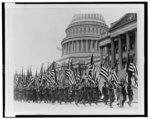
Desperate for financial relief, 400 World War I veterans gathered in Portland, Oregon. Led by veteran Walter M. Waters, on May 17, 1932, they left Portland on a donated train and traveled to Iowa, from where they had to walk and hitchhike the remaining 900 miles to Washington, D.C. to make politicians acknowledge their dire straits.
“Bonus Army” participants demonstrating in front of an empty U.S. Capitol in summer of 1932. (Photo from Library of Congress; taken by Underwood & Underwood)
Other veterans learned of the movement and headed to Washington, D.C. By June 1, 1932, there were 1,500 veterans in the nation’s capital to plead with Congress and President Herbert Hoover to find a way to give them their bonus checks early.
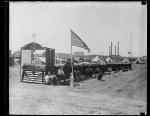
The veterans camped out in various locations across Washington, D.C. The Anacostia Flats site was the largest of their shanty towns at 30 acres. It gained the name “Camp Bartlett” because it was John H. Bartlett, the former Assistant Postmaster General and former Governor of New Hampshire who owned the land and let the veterans camp there.
Anacostia Flats encampment in Washington, D.C. in 1932. (Photo from Library of Congress, from the Harris & Ewing Collection)
On June 1, D.C. Police Superintendent Brigadier General Pelham D. Glassford asked Congress for $75,000 to feed the veterans, but the request was denied.
In mid-June, the U.S. House of Representatives approved the immediate payment of the bonus, but the U.S. Senate rejected it. President Hoover had said he would veto the bill if it passed in both chambers.
Photo taken in 1932 at one of the Bonus Army encampments in Washington, DC. (Photo from Library of Congress; taken by Harris & Ewing, photographer)
Veterans kept coming to Washington to plead their case. By the end of July, 1932, it was estimated that up to 20,000 of them had arrived.
It did not end well
In an action that rattles one’s nerves even to read about it 93 years later, on July 28, 1932, President Hoover ordered the U.S. Army and local police to remove all the protesting veterans from Washington.
General Douglas MacArthur led the mission. George S. Patton, whose name we all know from World War II, also participated. In an ironic turn of events, one of the veterans expelled from the nation’s capital by Patton was Joe Angelo, the soldier who saved Patton’s life in World War I.
Some 3,500 U.S. Army infantry and cavalry troops were called up to rid the city of the marchers. Of that number, 800 were actively used in the mission while the other 2,700 were held in reserve.
Violence ensued as the marchers resisted, but they were no match for the fire power of the U.S. Army. Five tanks manned by soldiers with machine guns, troops using tear gas and bayonets, and troops with torches setting fire to the encampments was more than the unarmed veterans could overcome.
Some of them thought they would be safe at Camp Bartlett, since it was on private land and the order to evacuate had only mentioned federal lands. They soon learned that Camp Bartlett was to be cleared also.
General MacArthur threatened to have a civilian bystander arrested for shouting, “The American flag means nothing to me after this!” at the troops.
One of the marchers, William Hashka of Chicago, was shot and killed near the U.S. Capitol.
Excuses and reactions
In a statement that sounds all too familiar to us in 2025, President Hoover claimed that many of the marchers were not veterans. He said they were Communists and criminals.
Falling in line with Hoover, MacArthur said only ten percent of the marchers were veterans.
Vice President Charles Curtis was heckled about the incident while making a speech in Las Vegas on July 29. He responded with, “You cowards, I’m not afraid of any of you.”
Police Superintendent Glassford said on July 29 that the use of federal troops had caused the trouble and that it could have been handled peacefully.
Does any of this sound familiar to you in 2025?
Some newspapers across the nation endorsed Hoover’s actions, while others called it “sheer stupidity.”
In 1936, the World War I veterans received their bonus, but it took Congress overriding President Franklin D. Roosevelt’s veto to accomplish it.
During World War II, in 1944, Congress passed the G.I. Bill to assist veterans.
Until my next blog post
I hope you have a good book to read.
Don’t forget the people of Ukraine and western North Carolina – or the starving children in Gaza.
Today’s topic is somewhat obscure and isn’t given much thought by the average citizen until it comes into play. When it needs to be put into action, it is of monumental importance.
The Presidential Succession Act of 1947 was signed into law by President Harry S. Truman on July 18, 1947. To fully appreciate US Presidential Succession, however, we need to first look at the United States Constitution and the Presidential Succession Acts prior to 1947. Later in this post, we’ll learn about what has happened on this matter since 1947.
My post today is longer than usual, but please read on. You might learn something. I did!
US Constitution, Article II, Section I, Clause 6
Photo by Brett Jordan on Unsplash
The vice president is designated as the first in the presidential line of succession by Clause 6 in Section I, Article II of the US Constitution. That is all many Americans know, since we’ve never lost a sitting president and sitting vice president at the same time… or lost a president who has assumed the office due to the death or incapacity of his predecessor.
Clause 6 also gives Congress the authority to provide for the line of succession after the vice president.
US Presidential Succession Act of 1792
The Presidential Succession Act of 1792 designated the US Senate president pro tempore as next in line after the vice president, followed by the Speaker of the House.
US Senate Practice in the 1800s
During most of the 19th century, the US Senate assumed it could elect a president pro tempore only during the absence of a vice president. With Congress only being in session approximately half the year at that time, concerns were raised over the high mortality rate of the era. What if the president and vice president both died or became incapacitated during Congress’ adjournment?
The solution was for the vice president to voluntarily exit the Senate chamber before the current session of Congress ended. While the vice president was out of the room, the Senate would elect a president pro tempore.
That scheme sort of worked for decades, but then vice presidents from the minority political party started fearing that in their absence from the Senate chamber, someone not from their political party might be elected. To remedy that, some vice presidents refused to leave the chamber while the vote was taken.
Congressional Action in 1886
Photo by Joshua Sukoff on Unsplash
No deed goes unpunished, and it seems that Congressional members are always looking for something they can change and take credit for. In 1886, Congress changed the presidential succession order after the vice president cabinet secretaries in the order in which their federal departments had been created.
No Act of Congress goes uncriticized. Proponents of the 1886 Act maintained that the office Senate pro tempore is filled based on parliamentary skills and not on the person’s executive skills.
The Death of President Franklin D. Roosevelt in 1945
Vice President Harry Truman was in House Speaker Sam Rayburn’s office enjoying a glass of bourbon when they received word that President Roosevelt had died and Truman was to take the oath of office for the Presidency as quickly as possible.
Mr. Truman was friends with Sam Rayburn and had a somewhat strained relationship with Senate President Pro Tempore Kenneth McKellar. It came as no surprise then when President Truman started campaigning for a change in presidential succession.
Arguing that Sam Rayburn had been chosen by his Congressional peers to be their leader in the office of Speaker of the House, Truman pushed for a change in the law.
This was completely political. Although Truman, Rayburn, and McKellar were all Democrats, Truman preferred Rayburn over McKellar and saw his chance to reinstate two elected officials in the line of succession after the vice president and before cabinet members. Cabinet members, of course, are not elected. They are nominated by the sitting US President and reflect the governing philosophy or the President.
The Presidential Succession Act of 1947
President Truman prevailed. The result was the Presidential Succession Act of 1947, which established the line of succession as the vice president, the Speaker of the House, the Senate President Pro Tempore, followed by the cabinet secretaries in the order in which their departments were created.
When House and Senate Leaders are in Opposition to the President
Of the 76 years since the Presidential Succession Act of 1947, the Speaker of the House has not been from the President’s political party 44 years. The President Pro Tempore of the Senate has not been from the President’s political party for 36 of those 76 years.
Photo by Andy Feliciotti on Unsplash
As we have witnessed in recent years, these situations can create stalemates in Congress when it comes to a US President being able to get his legislative issues passed into law. It boils down to the balance of power between the three branches of the federal government and the system of checks and balances. Sometimes it’s a good thing, and sometimes it’s a bad thing. It all depends on which political party or philosophy you align yourself with and how quickly you want to see the laws of the land changed.
The 25th Amendment to the US Constitution in 1967
Until the adoption of the 25th Amendment to the US Constitution in 1967, there was no way to replace a deceased, incapacitate, or resigned US vice president or one who had moved into the office of US president due to an unexpected vacancy in that office.
Prior to the 25th Amendment, therefore, the office of vice president remained vacant until the next presidential election. That meant the Speaker of the House was first in line if something happened to the president.
With the 25th Amendment in place when Vice President Spiro Agnew resigned, President Richard M. Nixon had the authority to nominate Gerald R. Ford on October 12, 1973. Mr. Ford was confirmed by Congress on December 6, 1973. It is ironic, then, that Gerald Ford became the president when Richard Nixon was forced to resign. I was majoring in political science in college at the time. It was a great time to participate in political debates. There was never a dull moment in poli sci class!
When Presidential Succession becomes a concern, it suddenly becomes a big concern
When President John F. Kennedy was assassinated in 1962, Vice President Lyndon B. Johnson became the President. Next in line for the office were 73-year-old Speaker of the House John W. McCormack and 86-year-old Senate President Pro Tempore Carl Hayden.
Photo by History in HD on Unsplash (I couldn’t help but notice there’s not a woman or a person of color in the entire photo. It’s an image that epitomizes government in the US in the early 1960s.)
Our current US president is 79 years old. He might run for reelection in 2024. Regardless of one’s political leanings, age is an issue. That said, though, I would be remiss if I didn’t point out that a 73-year-old and an 86-year-old in the year 1962 were definitely considered elderly. Seventy-three isn’t considered as old as it did in 1962 – and I’m not just saying that because I’m in my late 60s.
Spiro Agnew resigned as vice president in 1973. When that happened, Carl Albert was in line for the presidency. I’ve read that Mr. Albert had an alcohol problem and didn’t want to be president; however, when Gerald R. Ford became president less than a year later, Mr. Albert was still next in line. That was not a good situation for the country.
Think back to the beginning of the Covid-19 pandemic in 2020. “He who shall not be named” was the US president. He was hospitalized with Covid-19. What if he had died and Vice President Mike Pence had also succumbed to the virus? Speaker of the House Nancy Pelosi was next in line and from the other major political party. Even if you’re a Democrat, you must admit such a transition of power would have created political havoc in our country.
This possible scenario, along with the creation of the Department of Homeland Security in 2002 in response to the 9/11 terrorist attacks in 2001, raise the question of presidential succession anew. It has been suggested that the Secretary of Homeland Security should be elevated from last in the line of succession to a higher position in that line
What do you think?
Is it time for Congress to revisit the line of presidential succession?
I think it is, but members of Congress and the American public are too polarized in 2022 for anything of such importance to be considered. Everything today is decided along political party lines – even in the US Supreme Court and perhaps within the US Secret Service.
When the political pendulum swings back to a more moderate place of common sense and an adherence to the philosophy that all elected officials should only work for the common good, perhaps then the issue of Presidential Succession can be revisited.
Since my last blog post
My sister and I enjoyed an overnight trip to the Blue Ridge Mountains of North Carolina. (By the way, I wrote a vintage postcard book by that name a few years ago and it’s still available on Amazon and from Arcadia Publishing. You just might like to read it and see the postcards which all date prior to 1970, with most being from the 1940s and 1950s. Pardon the shameless plug for my book. I must blow my own horn.)
The Blue Ridge Mountains of North Carolina, by Janet Morrison
It poured rain on us most of the way to Boone on Sunday, and then dense fog set in and blocked our views along the Blue Ridge Parkway most of the way to Asheville. Even so, it was good to get away if just for a couple of days.
Upon returning home, I took the plunge and purchased access to Atticus writing software. I’ve started my first book on the platform, which formats one’s writing ready for electronic and print publication. That first book is tentatively called The Aunts in the Kitchen: Tried and True Recipes from the Aunts in Our Family.
I read a book that’s been on my “To Be Read” (TBR) list for several years. One down, 300+ books to go.
It’s been a good week.
Until my next blog post
I hope you have a good book or two to read. I’m listening to and reading books by some authors I’ve not read before.
Take time for family, friends, and a hobby.
Remember the four-year-old little girl in Ukraine who was pushing her baby stroller one minute and was killed by a Russian rocket the next; the surviving children in Uvalde and the parents who lost children in the domestic terrorist attack there; and the orphaned two-year-old boy, the partially-paralyzed little boy, and all the grieving and traumatized people in Highland Park. Unfortunately, the list could go on and on.









 Janet's Writing Blog