A War on Civil Rights

I didn’t want to post a blog on a Saturday, but here I am.

On Thursday, April 23, 2025, President Trump signed an Executive Order titled “Restoring Equality of Opportunity and Meritocracy.”

Under the guise of allegedly encouraging “meritocracy and a colorblind society, not race- or sex-based favoritism,” the order calls for an evaluation of all pending proceedings under the Equal Credit Opportunity Act (ECOA), which was passed in 1974 and was amended in 1976 to prevent lenders from discriminating against women based on marital status.

Only Congress can change the law, but an Executive Order muddies the water. If a lender chooses to follow the order, they can do so.

If a woman or a person of a racial minority thinks they have been discriminated against by a lender, they can file a complaint with the lender or thet can hire a lawyer and take their case to court. It could be years before the case is heard and settled. In the meantime, they did not get that credit card, or home improvement loan, or that loan that would have made it possible to buy a car or a home.

As reported by Newsweek, “The EO’s main target is the principle of disparate-impact liability, the idea that racism, sexism, or some other form of discrimination can occur without explicit intent. The President believes that disparate-impact liability is a key tool in a ‘pernicious movement’ that ‘endangers’ the U.S.’ foundational principle of ‘creating opportunity, encouraging achievement, and sustaining the American Dream.’”

In Trump’s mind, making sure that a dark-skinned person is not discriminated against equates with denying a white-skinned person being discriminated against. Or, the law making sure women are not discriminated against by financial lenders equates with denying men the opportunity to borrow money or get a credit card.

But that isn’t what it means at all!

Just because a woman gets approved for a loan does not mean that a man applying for a loan gets denied. There is enough pie for everyone who qualifies for a loan.

But this is all smoke and mirrors. Through Executive Order, Trump is putting dark-skinned people and women in their place. He is putting them at a disadvantage. He is denying them an equal opportunity to attain the American Dream.

That’s exactly what this is about. This is nothing but a white men’s backlash because some of them want to go back to “the good old days” when they didn’t have to compete with women or dark-skinned people. Some of them don’t want a level playing field.
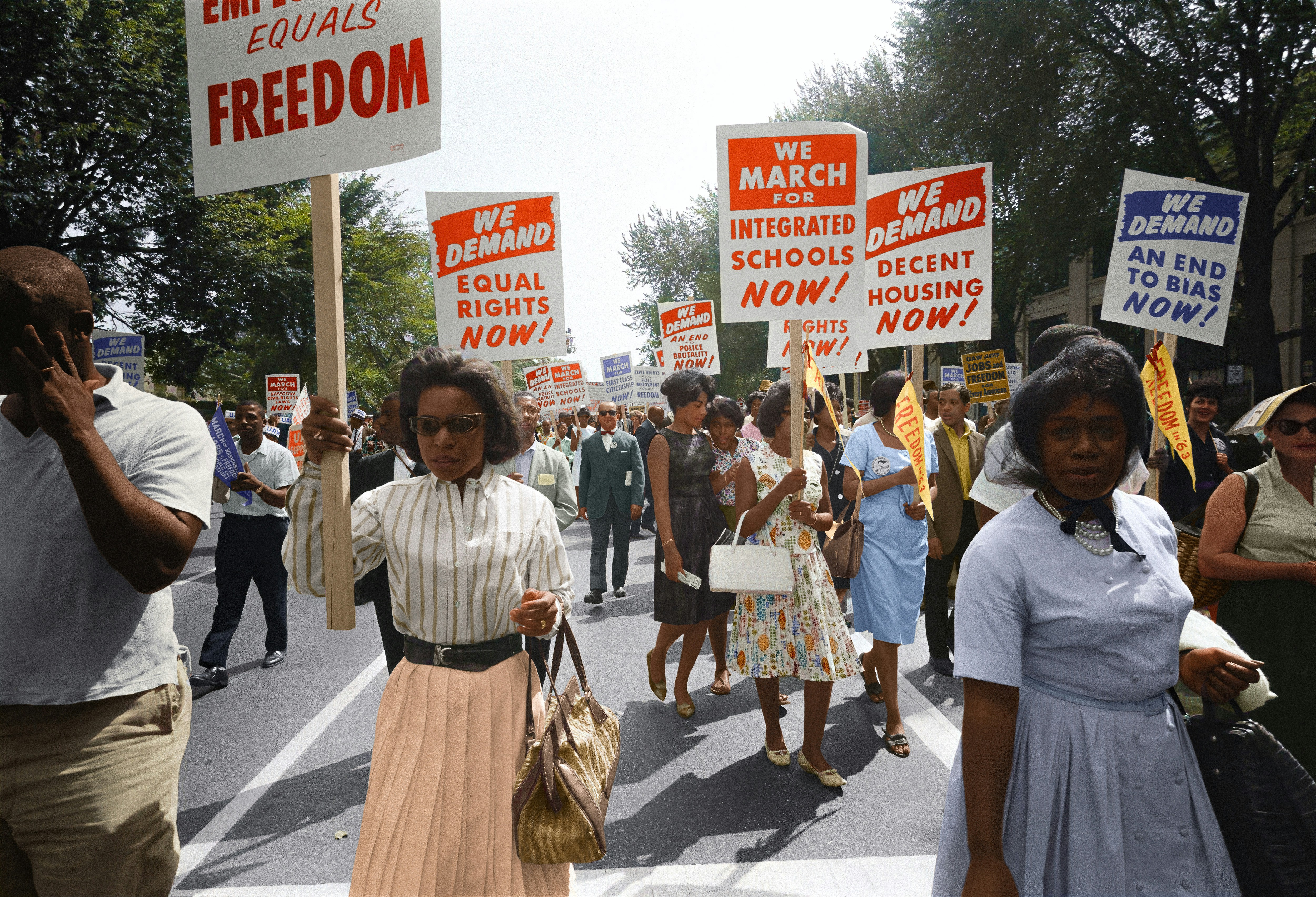
Photo by Unseen Histories on Unsplash

In case you are saying, “So what?”

In case any of this sounds all right or good to you, you are obviously not a woman “of a certain age” or a black person.

I am a white woman of a certain age, so I can and will speak to this. I grew up in the era in which women could not necessarily get credit or a loan without a man co-signing.

Women of a certain age know exactly what Trump’s end game is.

I was turned down for a credit card by a major gasoline company in the early 1970s, and the reason I was given was, “we don’t give credit cards to single women.” But who needs Exxon or Texaco? Amoco gave me a credit card and I was a loyal customer for years.

When I bought my first car (used) at the age of 22 in 1975 after earning a Bachelor’s degree, I was told by an agent for a nationally-recognized car insurance company that my rate for car insurance would be higher because I was a single woman. My father was with me, and this made him as mad as it did me. We stormed out of the insurance agent’s office. Rest assured, my father nor I ever considered doing business with Nationwide Insurance again.

I was interviewed for a job with the City of Charlotte in 1977 after I had earned a Master’s degree in public administration, and the interviewer said to me, “I don’t think a woman can handle this job.” My father had died. I was single. I was desperately looking for a job in my chosen field. Cities and counties weren’t exactly lining up to hire women for management positions. I didn’t want to burn my bridges, so I didn’t file a complaint.

I want women who came of age after the late 1970s to believe me when I say, “You don’t want to go back.”


Until my next blog post

Find time to read a good book and take a break from the chaos, but then come back and continue the fight for our democracy.

Remember the people of Ukraine, Myanmar, and western North Carolina.

Janet

#OnThisDay: Women’s Equality Day

“I don’t think a woman can handle this job.” That’s a direct quote from a job interview I had in a large city. It was an interview for a position in city government. At the time, I had a bachelor’s degree in political science and a master’s degree in public administration.

My father had just died, I was 24 years old, single, and desperate for a job. It was 1977.

If that happened today

If that happened today, I would come back at the older white male interviewer with a hundred reasons why not only could a woman handle the job but that I was the best-qualified person of any gender for the job.

If it happened today, I’d not only file a lawsuit, I would tell the interviewer it was beneath me to work for a city government that had such low regard for women.

But that was 1977. It was against the law under Title VII of the Civil Rights Act of 1964 to discriminate in the workplace on the basis of sex, but it was just the way things were and I was too young and desperate for a job to make a fuss about it. I didn’t want to get labeled as a trouble maker before I even started my career in government.

Today is Women’s Equality Day

The 19th Amendment to United States Constitution was passed by Congress on August 26, 1920. It gave women full and equal voting rights.

Women’s Equality Day was first celebrated in 1971 by a joint resolution of the US Senate and US House of Representatives. The resolution was sponsored by US Representative Bella Abzug, a Democrat from New York.

How you can celebrate Women’s Equality Day

Use #EqualityCantWait, #WomensEqualityDay, or related hashtags on social media networks.

Register to vote, if you haven’t already done so.

If there are American children and young people in your life, take time today to seriously speak with them about Women’s Equality Day. Ninety-nine years sounds like a long time to a young person, but try to help them see that in the big scheme of things it really wasn’t so long ago.

The way I would try to explain it to another person is to tell them that my mother was almost eight years old when women won the right to vote. My two grandmothers were 43 and 44 years old when they were allowed to vote for the first time.

Take time to read about one or more of the suffragists who risked their lives in and prior to 1920 in an effort to get the US Government to allow women to vote. Susan B. Anthony is perhaps the most famous suffragist. Others include Elizabeth Cady Stanton and Lucy Stone.

We’ve come a long way, but…

We’ve come a long way since 1920 when the 19th Amendment was passed by Congress, and since 1971 when Women’s Equality Day was first celebrated, and since 1977 when a city’s human resource official said that he didn’t think a woman could handle being that city’s assistant community development director; however, women still have so far to go in the workplace.

Melinda Gates has been vocal recently about the pay gap between men and women in the United States. Some of the statistics she has brought to light are staggering and extremely discouraging.

The World Economic Forum projects that, at the current rate of progress, it will take the United States of America 208 years to reach gender equality. Let that sink in. That’s the year 2227. That’s as long into the future as it has been since the year 1811.

#EqualityCantWait

Melinda Gates posted an EqualityCantWait.net video on LinkedIn on August 6, 2019. Here’s a link to her post on LinkedIn. It includes the five-minute video:  https://www.linkedin.com/pulse/heres-why-equality-cant-wait-melinda-gates/. ­­­­­­­­­­­­­­­­­­

What about my great nieces?

I have four intelligent great-nieces. They all excel in school. One of them will graduate from college next spring. Another one is a freshman in college. The other two are just several years younger. Their interests are diverse and I can’t wait to see what career paths they take. They can’t wait until the year 2227 to make the same salary as a man.

I don’t want anyone to dare to say to any one of them, “I don’t think a woman can handle this job.”  And I don’t want them to work their entire lives and not be paid exactly what their male counterparts are paid. My great-nieces cannot wait 208 years for the United States to reach gender pay equity.

Since my last blog post

I’ve continued to edit and tweak my novel manuscript as I use C.S. Lakin’s Scene Outline Template. I’m about halfway through this stage of the process.

Until my next blog post

I hope you have a good book to read. I’m reading Beneath the Tamarind Tree:  A Story of Courage, Family, and the Lost Girls of Boko Haram, by Isha Sesay.

If you’re a writer, I hope you have quality writing time and your projects are moving right along.

Thank you for reading my blog. You could have spent the last few minutes doing something else, but you chose to read my blog.

Let’s continue the conversation

Do you take your right to vote for granted?

Regardless of the country you live in, regardless of your gender, regardless of the color of your skin, regardless of your religion, regardless of your economic status – don’t EVER take your right to vote for granted.

No matter which of those categories you find yourself in, know that people sacrificed and risked their lives to give you the right to right. Many gave their lives in the pursuit of voting rights.

There are thousands of people around the world who still risk their lives to cast their vote. There are millions of people who would be willing to risk their lives just for the opportunity to vote.

Let the children and young people in your life know how important it is for them to register and vote as soon as the law allows them that right and responsibility.

Janet