Early X-ray and a Thimble

Did you know that a girl from the Rocky River community in Cabarrus County, North Carolina was the first person whose life was saved in the United States with the aid of the X-ray? Today’s blog post is an edited version of a local history newspaper column I wrote in 2006 for Harrisburg Horizons, a short-lived weekly newspaper. I usually blog about writing fiction, but this is an example of my nonfiction writing.

Discovery of the X-ray

Just three months after Wilhelm Conrad Roentgen of Bavaria discovered the X-ray, a scientist from Davidson, North Carolina used it in a Rocky River home to help save Ellen Harris’ life. It was a February day in 1896.

Dr. Henry Louis Smith of Davidson read about Roentgen’s discovery of the X-ray. He went to Dr. J.P. Munroe’s laboratory in the small medical school on the campus of Davidson College. The laboratory had the same equipment as that used by Mr. Roentgen.

Dr. Smith fired a bullet into the palm of a corpse’s hand. He then made a successful X-ray of the hand.

Ellen Harris Swallows Thimble

Soon thereafter, Mr. and Mrs. William Edwin Harris’ twelve-year-old daughter, Ellen, swallowed a tailor’s thimble. The open-ended thimble lodged in her throat and made it increasingly difficult for her to breathe or eat over the following days.

Tailor's Thimble
Tailor’s Thimble

Area physicians did not agree on a diagnosis. Three doctors thought she coughed up the thimble and damaged her throat in the process. One doctor speculated that the thimble hurt her throat as it passed to her stomach. Only one of the five doctors consulted thought the thimble was still in Ellen’s throat.

A man in Charlotte, the largest town in the area, told Dr. Smith about Ellen’s predicament. Dr. Smith asked the man to convey to Ellen’s parents his willingness to help them.

Ellen’s frantic father and mother believed that Dr. Smith could help their daughter. Mr. Harris traveled to Davidson in a wagon (a distance of about 30 miles — perhaps more in those days) and brought Dr. Smith and his X-ray equipment to his home near Rocky River Presbyterian Church on Rocky River Road.

Mr. and Mrs. Harris placed Ellen on a sheet fashioned into a hammock. Dr. Smith set up his crude X-ray apparatus. A large and heavy battery and induction coil powered the equipment.

According to a letter that Dr. Smith wrote to Dr. Robert M. Lafferty, he crouched on the floor under the girl. After an hour’s work with a fluoroscope, he got a fleeting glimpse of the thimble in the child’s windpipe. There was no lasting image on film like in X-rays today.

Dr. Smith returned to Davidson and the Harris family set out for a hospital in Charlotte. The doctors there refused to operate on Ellen. They wanted to see exactly where the thimble rested before they made an incision.

The Charlotte surgeons wired Dr. Smith their concerns. Surgery was Ellen’s only hope for survival. Without knowing the exact location of the thimble, though, the surgeons feared they would lose their patient on the operating table.

Dr. Smith immediately brought his X-ray equipment from Davidson to the hospital. Once more, the apparatus pinpointed the location of the thimble in Ellen’s trachea. The image paved the way for the operation.

The surgeons soon discovered that Ellen’s flesh partially grew over the rusting thimble. This made the thimble’s removal difficult and challenging. The arduous two-hour surgery saved Ellen’s life and put the Rocky River community on the medical history map!

My sources:

Early Medicine in Cabarrus, primary data collected by Eugenia W. Lore and edited by Jane Harris Nierenberg, 1990.  (Includes newspaper articles from The Concord Tribune, November 9, 1945, and December 10, 1945.)

Open the Gate and Roam Cabarrus With Us, by Adelaide and Eugenia Lore, 1971.

The Historic Architecture of Cabarrus County, North Carolina, by Peter R. Kaplan, 1981.

Hornets’ Nest:  The Story of Charlotte and Mecklenburg County, by LeGette Blythe and Charles R. Brockmann, 1961.

Until my next blog post

I hope you have a good book to read. (I finished Right Behind You, by Lisa Gardner and have started reading Chasing the North Star, by Robert Morgan.) If you are a writer, I hope you have quality writing time.

Janet

Save

Trains Crash in Harrisburg, 1897

My blog post on February 7, 2017 Two Lines I Like from a Margaret Maron Novel was about train whistles. I quoted a couple of lines from Long Upon the Land, by Margaret Maron and reminisced about train whistles in my hometown of Harrisburg, North Carolina. Today’s blog post is an edited version of a two-part article I wrote for my “Did You Know?” local history newspaper column in Harrisburg Horizons weekly newspaper on April 4 and April 13, 2007.

nc-transportation-museum-6-19-10-010
Steam locomotive at the NC Transportation Museum, Spencer, NC.

Head-On Collision!

Did you know that the Sunday morning tranquility in Harrisburg was shattered on April 11, 1897, by the head-on collision of two steam trains?

North-bound Southern “fast mail” train No. 36 had orders to wait at Harrisburg until 11:15 for the south-bound local passenger train No. 11. The passenger train from the nearby town of Concord was running behind schedule. As No. 36 approached Harrisburg, engineer W.B. Tunstall of Danville, Virginia, expected to see No. 11 sitting in the siding.

Seeing no waiting train, Tunstall steamed ahead at 45 miles per hour. By the time the No. 11 came into view, there was nothing Tunstall could do but apply the brakes and jump out of the locomotive.

Newspaper accounts indicate that some Harrisburg residents saw what was going to happen but were helpless to do anything. The crash was heard for miles around and was likened to “a sharp crack of thunder.”  The engine of No. 11 ran over the engine of No. 36. The boiler of No. 36 rested on the floor of No. 11’s postal car.

An express car of No. 36 derailed and landed 150 feet from the track. Another car, hauling strawberries and fresh vegetables, was torn to pieces. Produce was strewn over the area. Train parts were thrown as far as seventy-five yards away.

None of the 96 passengers on No. 36 were injured. They immediately exited the train to see what had happened and, subsequently, did what they could to help the injured train and postal employees.

Less than three minutes after the collision, with its headlight up in the telegraph wires, No. 11’s postal car burst into flames. If not for the quick action of one of the train’s postal clerks, John Hill Carter, both trains probably would have burned, but newspaper accounts do not tell how he extinguished the fire. Mr. Carter was praised for risking his life to put out the fire and save others.

Casualties

The accounts of the agony suffered by the employees who were killed or injured in the wreck are given in great detail in the newspaper accounts of the day. Some were pinned under the wreckage, while others were badly burned by the steam from the boilers. Passengers formed a bucket brigade to throw cold water on one of the trapped men to help relieve his suffering from the steam.

Capt. Tunstall was found unconscious and badly scalded on an embankment. The conductor of No. 11, James Lovell of Richmond, Virginia, was cut on the face. Fitzhugh Lee, a porter on No. 11, was pinned in from the knees down. William Clemmens of East Durham, North Carolina, and R.E. Gallagher, an express messenger, were also injured.

The impact itself and the resulting release of steam caused four deaths and a number of serious injuries.

Those who were killed in the wreck or died immediately after were as follows:  Postal clerk T. Clingman Benton of Monroe, NC and Charlotte; John or Titus Eudy of Forest Hills in Concord; No. 36 fireman Will Donaldson of Lynchburg, Virginia; and J.C. Kinney of Thomasville, NC. Capt. Kinney was badly scalded. It was thought that he also inhaled steam which caused internal misery.

First Responders and Thrill Seekers

News of the collision was immediately telegraphed to the train depot in Charlotte. In less than forty-five minutes, a rescue train was dispatched from that city. It transported a Dr. McCombs and Dr. E.M. Brevard. Cots were taken for transporting the wounded and dead to Charlotte. Mr. Eudy survived the crash but died en route to Charlotte.

The citizens of Harrisburg were praised in the newspaper accounts for helping to clear the wreckage. Engines pulled from both directions to clear the track. Debris removal continued through the night, while another work crew laid a temporary track around the wreck. That track was in place by that night when the No. 35 fast mail train gingerly made its way through Harrisburg.

On April 12, 1897, The Charlotte Observer reported that hundreds of thrill seekers “on wheels, horseback and in buggies were flying toward Harrisburg. At 2 o’clock a horse could not be had in any of the stables for love or money.”  Many other people gathered at the train depot in Charlotte to await the arrival of the rescue train at 4 p.m.

That same newspaper account reported that one of the No. 36 passengers, Charles Bitterman of New Orleans, belonged to “The Riverside Wheelmen” cyclist club and was on his way to a bicycle race in New York. The article stated that Bitterman belonged “to National Circuit and will be here later with the professional men.” (Cycling clubs were all the rage in America and Europe in the 1890s.)

As I edit this article in 2017, the at-grade railroad crossings in Harrisburg have been closed and replaced by bridges in order to make way for the new high-speed rail. I have crossed that railroad thousands of times, and after learning about the 1897 train wreck in 2007 I was often reminded of the gory details of that fateful day when mangled and splintered train cars, bodies, and fresh produce were scattered in the nearby fields. It must have been an awful sight along with the screams of the injured who were in agony.

The train wreck of 1897 was, no doubt, long-remembered by Harrisburg and surrounding residents. When I interviewed Harrisburg resident and retired railway employee Harry R. Higgins on January 21, 2007, he remembered that Floyd Smith often came to the train depot in Concord when Mr. Higgins worked there. Mr. Higgins heard him tell about a block office employee who let a train into a block by mistake when another train was coming. The man realized his mistake and left in guilt because he knew what was about to happen. Mr. Higgins did not know if this was referring to the 1897 wreck in Harrisburg or not.

At the end of my article I asked for anyone who knew of a first-hand written account or oral history of the accident to please share that information with me, but no one offered additional details.

My Stint as a Newspaper Columnist

I am glad I had the opportunity to write a local history column in Harrisburg Horizons for six years. It gave me a reason to visit many of the older members of the community and take notes about their memories. Local newspapers preserved on microfilm sometimes provided a topic for me. I found it surprising that I had never heard about this horrific steam train head-on collision until I stumbled upon it in the microfilmed newspaper records. Mr. Harry R. Higgins has died since I asked him about the train wreck. He followed in his father’s footsteps as a railroad employee.

A Call to Action

If you have an interest in the local history where you live, I hope you talk to the older residents and record their memories. This is especially important if you live in a rural area or a small town that has never had a newspaper. That was the case here in Harrisburg. The town did not have a newspaper until 2006 and, unfortunately, it ceased publication in 2012.

Until my next blog post

Until my next blog post, I hope you have a good book to read. If you are a writer, I hope you have productive writing time. Please help me get the word out about my writing and my blog by clicking on the social media icons below or by the old-fashioned way – word of mouth. I appreciate it!

Janet

Save

George Washington Ate Here

That’s quite a change from my usual blog post titles! My post a few days ago was rather “heavy” in that it was about the things I think I need to do this year to further my writing career. I’m glad that’s out of the way now, so I can get back to more interesting topics. Today I’m doing something I haven’t done before in my blog. I’m sharing a small sample of my writing.

Did You Know?

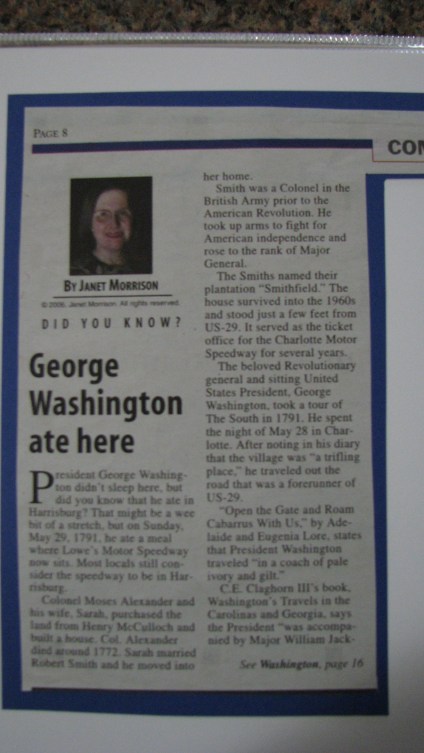
I wrote a local history column titled, “Did You Know?” in Harrisburg Horizons, a weekly newspaper here in Cabarrus County, North Carolina from May 2006 through December 2012. It was a perfect opportunity for me as it allowed me to do two of my favorite things:  historical research and writing. It was my first freelance writing job. I had complete control over when I worked on the column and what topics I chose. I had a deadline every two weeks, but the day-to-day freedom the work gave me was a perfect fit for me. Once-a-month in 2017 I plan to share one of my newspaper columns or an essay or short story I’ve written. Today’s offering is a slightly edited version of my May 31, 2006 newspaper column.

geo-washington-ate-here-005

George Washington Ate Here

President George Washington didn’t sleep here, but did you know that he ate in Harrisburg? That might be a wee bit of a stretch, but on Sunday, May 29, 1791, he ate a meal where Charlotte Motor Speedway now sits. Most locals still consider the speedway to be in Harrisburg, although it is now in the Concord city limits.

Colonel Moses Alexander and his wife, Sarah, purchased the land from Henry McCulloch and built a house. Col. Alexander died around 1772. Sarah married Robert Smith and he moved into her home.

Robert Smith was a Colonel in the British Army prior to the American Revolution. He took up arms to fight for American independence and rose to the rank of Major General.

The Smiths named their plantation “Smithfield.” The house survived into the 1960s and stood just a few feet from US-29. It served as the ticket office for the Charlotte Motor Speedway for several years.

The beloved Revolutionary general and sitting United States President, George Washington, took a tour of The South in 1791. As a result of that tour, there are numerous historical markers titled, “George Washington Slept Here.” There is no such roadside marker at the corner of US-29 and Morehead Road, but there should be one that says, “George Washington Ate Here.” President Washington spent the night of May 28, 1791 in Charlotte. After noting in his diary that the village was “a trifling place,” he traveled northeast out The Great Wagon Road which was a forerunner of US-29.

Open the Gate and Roam Cabarrus With Us,” by Adelaide and Eugenia Lore, states that President Washington traveled “in a coach of pale ivory and gilt.”

C.E. Claghorn III’s book, Washington’s Travels in the Carolinas and Georgia, says the President “was accompanied by Major William Jackson, five servants, two footmen, coachmen & postilion [guide], chariot & four horses, light baggage wagon drawn by two horses, four saddle horses plus one for himself.”

The green meadows and hardwood forests of our area probably reminded the President of his Virginia homeland. Our red clay rolling hills were in stark contrast to the sandy South Carolina Lowcountry he visited on his way to North Carolina.

Can you imagine how nervous Sarah Smith was on the days leading up to the President’s arrival? It would be interesting to know the menu she planned. Being late May, the summer staples of squash and beans were not in season.

Mrs. Smith’s spring garden possibly provided turnips, radishes, and an assortment of greens and herbs. No doubt a servant retrieved a well-cured country ham from the log smokehouse for the occasion. In my mind’s eye, I see a bowl of fresh wild strawberries on the dining table or perhaps strawberry shortcake with fresh cream drizzled on top for dessert.

I would have liked to have been privy to President Washington and Gen. Smith’s conversation. Perhaps the President “broke the ice” by asking Smith about the battles he participated in during the Revolution. They probably discussed political matters of the day such as the moving of the nation’s capital from New York City to Philadelphia the previous year.

After dining at “Smithfield,” President Washington returned to his coach and traveled to Colonel Martin Phifer’s “Red Hill” tavern near the Poplar Tent section of the county. He lodged at “Red Hill” that night before continuing on toward Salisbury at four o’clock the next morning.

Until my next blog post, I hope you have a good book to read. If you’re a writer, I hope you have quality writing time.  Feel free to Tweet about my blog or share it on other social media.

Janet

Sources I used as I researched this newspaper column’s subject:

Piedmont Neighbors:  Historical Sketches of Cabarrus, Stanly and Southern Rowan Counties, edited by Clarence D. Horton, Jr. and Kathryn L. Bridges.

Open the Gate and Roam Cabarrus With Us, by  Adelaide and Eugenia Lore, 1971.

The Historic Architecture of Cabarrus County, North Carolina, by Peter R. Kaplan, 1981.

A Light and Lively Look Back at Cabarrus County, North Carolina, by Helen Arthur-Cornett, 2004.

Washington’s Travels in the Carolinas and Georgia, by C.E. Claghorn III.

Save

Save

Save

Save

Save

Northern Colorado Writers Contest

I’ve entered another Northern Colorado Writers Contest. Last night I submitted an essay titled “George Govan, A Gentle Man” in the 2015 Northern Colorado Writers Personal Essay/Creative Nonfiction Contest. I reworked a piece I wrote about Mr. Govan before he died. That necessitated changing the tense in which it was originally written and gave me the advantage offered by the passage of time. Reflecting on the things I learned from Mr. Govan several years after his death afforded me the opportunity to realize the difference he made in my life and just how fortunate I was to have known him.

If not for my freelance writing job from 2006 through 2012, I probably never would have met Mr. Govan. I was under contract with a local weekly newspaper, Harrisburg Horizons, to write a local history column titled “Did You Know?” That work pushed me way out of my comfort zone and into the homes and lives of several elderly area residents. I visited Mr. Govan many times and never failed to learn something from him. As an elderly black man, his life experiences were much different from mine.

I’m glad I had the opportunity to know Mr. Govan. I must try to live in such a way that someone will say that about me someday.

The Sauline Players

One of the rewards for writing the “Did You Know?” local history column for Harrisburg Horizons newspaper from 2006 through 2012 is that people still tell me they miss it since the newspaper ceased publication. Another reward is that I occasionally receive an e-mail from a stranger asking a question or making a comment about one of my local history column topics.

My most recent such communication came from a woman who was looking for information about the Sauline Players and discovered that I had written about them for the newspaper. I shared my two-part series on the acting troupe with her and we corresponded for a couple of days to compare our memories. She recalled seeing them perform at Marion Junior High School and Glenwood High School in McDowell County, North Carolina in the 1950s, and I have fond memories of seeing them perform in the auditorium of Harrisburg High School in the 1960s.

It is gratifying when someone expresses that a newspaper column or short story I wrote has enlightened them or brought them joy. One of the beauties of the internet is that it makes serendipitous connections possible.

A local history talk

Yesterday my sister and I conducted our fourth (and last) Local and Rocky River Presbyterian Church History Talk and Tour. We had these monthly, September through November, skipped December, and then started again in January. Response has fluctuated. It was worth a try. I spent hours planning the topics. I had enough topics to last two or three years. No doubt, someone who has not attended any of the four talks so far will complain that we are discontinuing the programs. That’s human nature.

Yesterday’s topics were the Rev. Dr. John Makemie Wilson and the Rocky River Academy. Dr. Wilson was the pastor of Rocky River and Philadelphia Presbyterian Churches in Cabarrus and Mecklenburg Counties for 30 years in the early decades of the 19th century. He served as teacher at Rocky River Academy for much of that time. Completing their studies at Rocky River Academy prepared the students for entrance in the University of North Carolina at Chapel Hill. Twenty-five of the academy’s students went on to become Presbyterian ministers. One of them, the Rev. Dr. Robert Hall Morrison, was a founder and the first president of Davidson College.

The three-part series of local history columns I wrote about the Rocky River Academy for Harrisburg Horizons newspaper came in handy as I prepared for yesterday’s program.

Last night I spent some time editing the manuscript of my historical novel, The Spanish Coin, in preparation to submit it in a writing competition. More on that later.