“Bonus Army” Evicted from DC in 1932

I had never heard of the “Bonus Army” or this incident until I stumbled across it while looking for blog topics I could write about on or near — their anniversary dates. This one belonged on yesterday’s blog but got crowded out by the 157th anniversary of the ratification of the 14th Amendment to the U.S. Constitution.

Since the “Bonus Army” needed its own day on my blog, that’s today’s topic.


Why the name “Bonus Army”

As the federal government is prone to do, it came up with a plan to reward individuals who served in the military during World War I but there was a catch. They couldn’t receive their “bonus” payment until 1945 – nearly 30 years after their combat service.

Established by Congress in 1924, the so-called “Tombstone Bonus” would be paid to World War I veterans in 1945 to thank them for their service.

It brings to mind the case of soldiers who were in the American Revolution in the 1770s but were not eligible for a pension until 1832 when most of them were dead.

There seems to be a pattern here.


But then came The Great Depression

The stock market crashed in 1929, and by 1932 things were not getting any better.

Desperate for financial relief, 400 World War I veterans gathered in Portland, Oregon. Led by veteran Walter M. Waters, on May 17, 1932, they left Portland on a donated train and traveled to Iowa, from where they had to walk and hitchhike the remaining 900 miles to Washington, D.C. to make politicians acknowledge their dire straits.
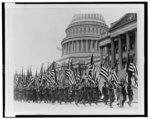
“Bonus Army” participants demonstrating in front of an empty U.S. Capitol in summer of 1932. (Photo from Library of Congress; taken by Underwood & Underwood)

Other veterans learned of the movement and headed to Washington, D.C. By June 1, 1932, there were 1,500 veterans in the nation’s capital to plead with Congress and President Herbert Hoover to find a way to give them their bonus checks early.

The veterans camped out in various locations across Washington, D.C. The Anacostia Flats site was the largest of their shanty towns at 30 acres. It gained the name “Camp Bartlett” because it was John H. Bartlett, the former Assistant Postmaster General and former Governor of New Hampshire who owned the land and let the veterans camp there.

Anacostia Flats encampment in Washington, D.C. in 1932. (Photo from Library of Congress, from the Harris & Ewing Collection)

On June 1, D.C. Police Superintendent Brigadier General Pelham D. Glassford asked Congress for $75,000 to feed the veterans, but the request was denied.

In mid-June, the U.S. House of Representatives approved the immediate payment of the bonus, but the U.S. Senate rejected it. President Hoover had said he would veto the bill if it passed in both chambers.
Photo taken in 1932 at one of the Bonus Army encampments in Washington, DC. (Photo from Library of Congress; taken by Harris & Ewing, photographer)

Veterans kept coming to Washington to plead their case. By the end of July, 1932, it was estimated that up to 20,000 of them had arrived.


It did not end well

In an action that rattles one’s nerves even to read about it 93 years later, on July 28, 1932, President Hoover ordered the U.S. Army and local police to remove all the protesting veterans from Washington.

General Douglas MacArthur led the mission. George S. Patton, whose name we all know from World War II, also participated. In an ironic turn of events, one of the veterans expelled from the nation’s capital by Patton was Joe Angelo, the soldier who saved Patton’s life in World War I.

Some 3,500 U.S. Army infantry and cavalry troops were called up to rid the city of the marchers. Of that number, 800 were actively used in the mission while the other 2,700 were held in reserve.

Violence ensued as the marchers resisted, but they were no match for the fire power of the U.S. Army. Five tanks manned by soldiers with machine guns, troops using tear gas and bayonets, and troops with torches setting fire to the encampments was more than the unarmed veterans could overcome.

Some of them thought they would be safe at Camp Bartlett, since it was on private land and the order to evacuate had only mentioned federal lands. They soon learned that Camp Bartlett was to be cleared also.

General MacArthur threatened to have a civilian bystander arrested for shouting, “The American flag means nothing to me after this!” at the troops.

One of the marchers, William Hashka of Chicago, was shot and killed near the U.S. Capitol.


Excuses and reactions

In a statement that sounds all too familiar to us in 2025, President Hoover claimed that many of the marchers were not veterans. He said they were Communists and criminals.

Falling in line with Hoover, MacArthur said only ten percent of the marchers were veterans.

Vice President Charles Curtis was heckled about the incident while making a speech in Las Vegas on July 29. He responded with, “You cowards, I’m not afraid of any of you.”

Police Superintendent Glassford said on July 29 that the use of federal troops had caused the trouble and that it could have been handled peacefully.

Does any of this sound familiar to you in 2025?

Some newspapers across the nation endorsed Hoover’s actions, while others called it “sheer stupidity.”

In 1936, the World War I veterans received their bonus, but it took Congress overriding President Franklin D. Roosevelt’s veto to accomplish it.

During World War II, in 1944, Congress passed the G.I. Bill to assist veterans.


Until my next blog post

I hope you have a good book to read.

Don’t forget the people of Ukraine and western North Carolina – or the starving children in Gaza.

Janet

#OnThisDay: 14th Amendment Ratified in 1868

Today is the anniversary date for two events that warrant our attention. The 14th Amendment to the U.S. Constitution was ratified on July 28, 1868 – 157 years ago today.

And on July 28, 1932, U.S. President Herbert Hoover ordered the U.S. Army to remove the protesting World War I veterans from Washington, D.C.

To give each of those events their due attention, I will blog about the 14th Amendment today, and I will blog about the “Bonus Army” tomorrow.


The 14th Amendment

The Preamble to the U.S. Constitution

Until the recent past, we never heard much about the 14th Amendment to the U.S. Constitution, and many of us would have been hard pressed to have told you what it was about without looking it up.

Now it is front and center and will be a major issue before the U.S. Supreme Court when they reconvene this fall.

The 14th Amendment is known as “The Birthright Amendment.” It came about immediately after the Civil War to extend citizenship to formerly enslaved individuals; however, the words “formerly enslaved,” “slave,” “slavery,” “Africa,” “African” or any other such qualifiers do not appear in the document.

The Trump Administration wants to abolish the 14th Amendment. Trump claims that it only applies to the people who were slaves prior to the Civil War. If successful in proving that before the U.S. Supreme Court, it will mean that the children of undocumented immigrants will no longer be awarded U.S. citizenship.

That is a major political and legal issue, so it will be incumbent upon the U.S. Supreme Court Justices to weigh all aspects of the matter carefully. Regardless of the Court’s ruling, a lot of people are going to be angry.

People who do not want citizenship to be automatically granted to a baby born on U.S. soil argue that other countries have no such law.

Background information about the 14th Amendment can still be found at https://www.archives.gov/milestone-documents/14th-amendment.

It’s not just Section 1 of the 14th Amendment that makes Trump uneasy. I imagine Section 3 makes him and some politicians nervous in light of the January 6, 2021, attempted coup.


The text of the 14th Amendment

AMENDMENT XIV

Section 1.
All persons born or naturalized in the United States, and subject to the jurisdiction thereof, are citizens of the United States and of the State wherein they reside. No State shall make or enforce any law which shall abridge the privileges or immunities of citizens of the United States; nor shall any State deprive any person of life, liberty, or property, without due process of law; nor deny to any person within its jurisdiction the equal protection of the laws.

Section 2.
Representatives shall be apportioned among the several States according to their respective numbers, counting the whole number of persons in each State, excluding Indians not taxed. But when the right to vote at any election for the choice of electors for President and Vice-President of the United States, Representatives in Congress, the Executive and Judicial officers of a State, or the members of the Legislature thereof, is denied to any of the male inhabitants of such State, being twenty-one years of age, and citizens of the United States, or in any way abridged, except for participation in rebellion, or other crime, the basis of representation therein shall be reduced in the proportion which the number of such male citizens shall bear to the whole number of male citizens twenty-one years of age in such State.

Section 3.
No person shall be a Senator or Representative in Congress, or elector of President and Vice-President, or hold any office, civil or military, under the United States, or under any State, who, having previously taken an oath, as a member of Congress, or as an officer of the United States, or as a member of any State legislature, or as an executive or judicial officer of any State, to support the Constitution of the United States, shall have engaged in insurrection or rebellion against the same, or given aid or comfort to the enemies thereof. But Congress may by a vote of two-thirds of each House, remove such disability.

Section 4.
The validity of the public debt of the United States, authorized by law, including debts incurred for payment of pensions and bounties for services in suppressing insurrection or rebellion, shall not be questioned. But neither the United States nor any State shall assume or pay any debt or obligation incurred in aid of insurrection or rebellion against the United States, or any claim for the loss or emancipation of any slave; but all such debts, obligations and claims shall be held illegal and void.

Section 5.
The Congress shall have power to enforce, by appropriate legislation, the provisions of this article.


Hurricane Helene Update

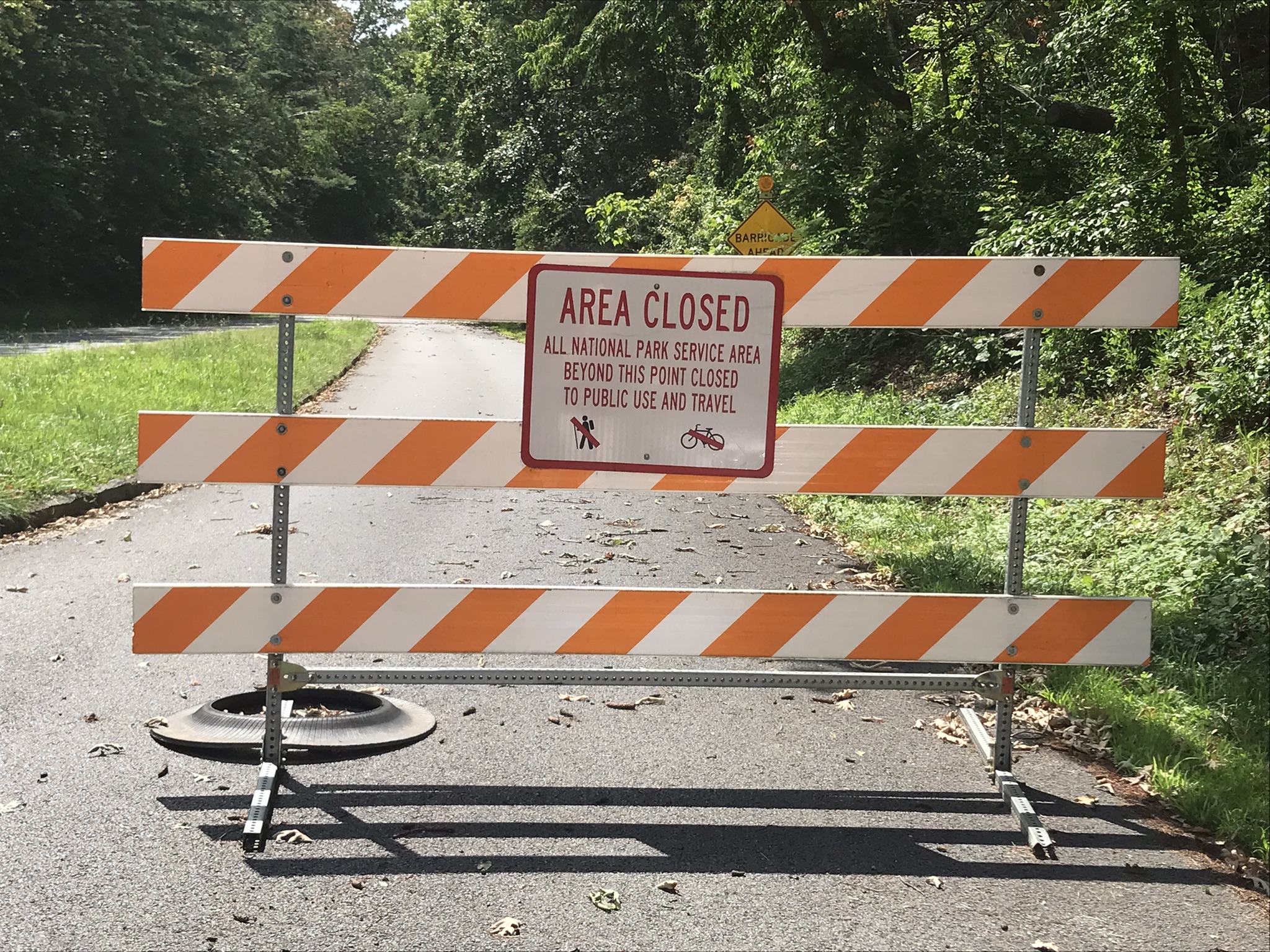
Sign blocking travel by car, bike, or on foot on National Park Service property on Blue Ridge Parkway at Asheville, NC, June 10, 2025
Barricade on Blue Ridge Parkway beside entrance to Folk Art Center at Asheville, June 10, 2025

12 more miles of the Blue Ridge Parkway in North Carolina have reopened from Milepost 305.2 near Beacon Heights and U.S. 221 to Milepost 317.5 at U.S. 221 near the Linville Falls community!

The Linville Falls spur road, campground, picnic area, and visitor center remain closed, due to hurricane damage.

There were at least 57 landslides across almost 200 miles of the Blue Ridge Parkway in North Carolina. Recovery has been broken down into three phases. The 12-mile opening last week is one of 12 projects included in Phase 1. When that phase is completed this fall, some 48 miles of the Parkway will have been restored.

Phase 2 includes the repair of 21 landslides in eight areas which are mostly located between Milepost 318.2 and Milepost 323.4, south of Linville Falls. It is hoped that Phase 2 will be completed by the fall of 2026.

Phase 3 is in the planning stage. During that phase, repairs will be made to 23 sites between Milepost 336.7 and 351.9, which lies between Little Switzerland and Mount Mitchell. There is no published timeline for the work to begin or be completed in Phase 3.

I have driven the entire 252 miles of the Blue Ridge Parkway in North Carolina many times and its 207 miles in Virginia at least once, but I doubt I will live to see it fully rebuilt.

If you are planning a trip to the Blue Ridge Parkway, you can find current information at https://www.nps.gov/blri/planyourvisit/helene-impacts-and-recovery.htm. Just be aware that most of it in North Carolina is still closed.

As of Friday, of the 1,457 roads that were closed in western North Carolina last September due to Hurricane Helene, all but 34 are now completely open, which is the same as the prior week’s report. The NC DOT reports 42 roads have partial access.

I-40 at the Tennessee line is still lust opened with a total of two lanes and a 35-m.p.h. speed limit. A report I heard on TV last week said it will take years to fully reconstruct the interstate highway.


Until my next blog post

Keep reading everything you want to read – and some things you don’t want to read but need to read.

Remember the people of Ukraine and western North Carolina and the children in Gaza who are starving to death through no fault of their own.

Janet