
Note: This will be my last blog post for a while. There are just more pressing tasks – like cutting down sweetgum sprouts — that need my attention. One of the joys of country living. They multiply like rabbits and grow as fast as kudzu.
I will sorely miss getting to work on my blog posts every day, but life changes as we grow older and energy is limited.
Today’s blog is about the Ground Observer Corps and what I learned about it when I was writing a local history column for Harrisburg Horizons newspaper.
The Ground Observer Corps was formed during World War II. One source I found indicated than more than 1.5 million civilians volunteered to man 14,000 observation posts in the coastal states of the United States. Another source reported 800,000 volunteers manned the eventual 16,000 observation posts.
There was a Ground Observer Corps post in the little town of Harrisburg, North Carolina, so I did some research about it in 2007 when I was writing a local history column for Harrisburg Horizons newspaper.
Keep in mind that radar detection of aircraft was low during the war, so human eyes on the skies was a way to try to keep our country safe from foreign bombers.
The program was ended by the Army Air Forces in 1944 but was formed again during the Korean War in the 1950s.
Public service announcements were used to recruit volunteers who were instructed to call their local Civil Defense office.
The Ground Observer Corps post in Harrisburg, NC was organized on July 14, 1955 through the Harrisburg Volunteer Fire Department. It was another civic service in which our local general practitioner, Dr. Nicholas “Nick” E. Lubchenko, played an important role.
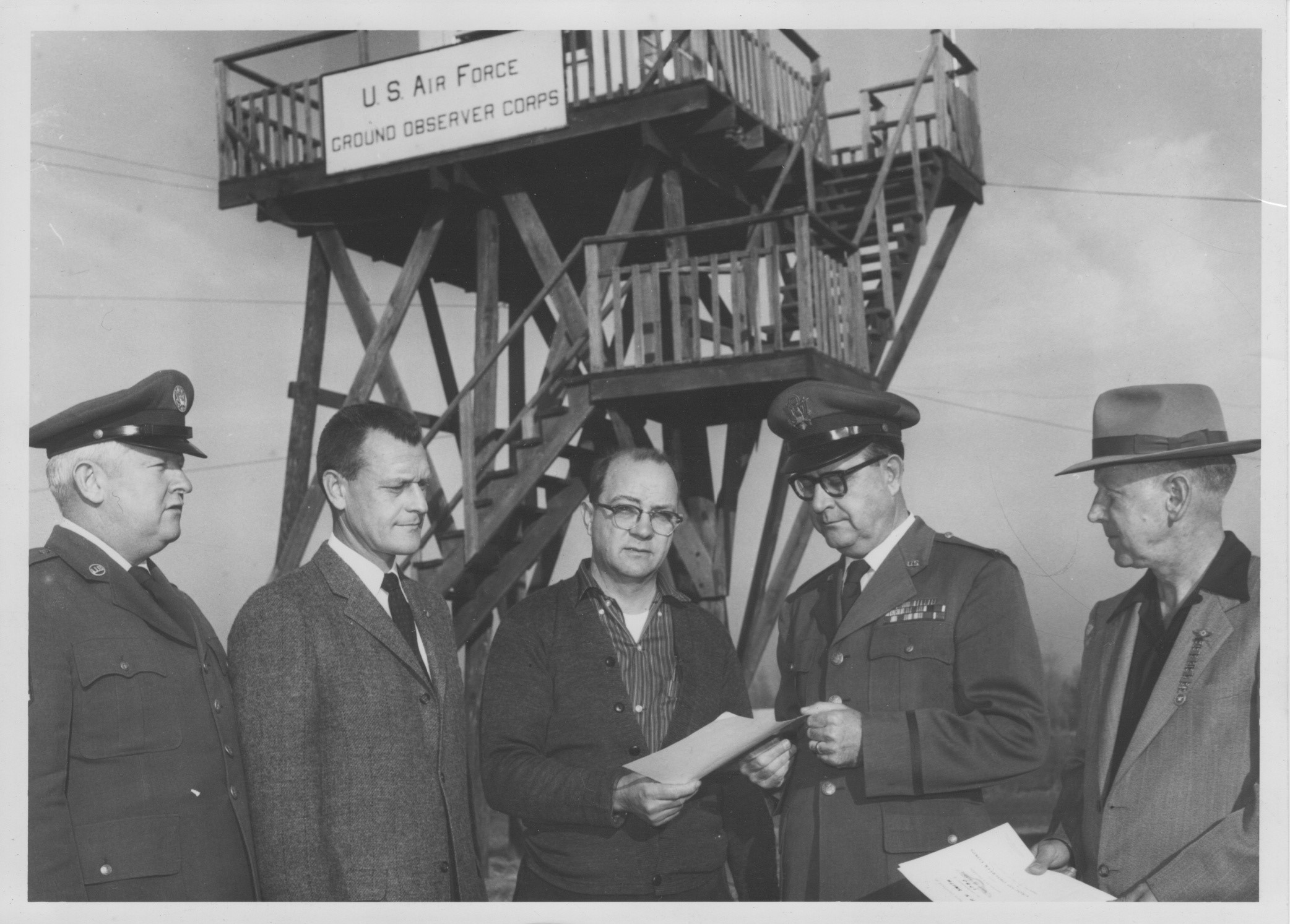
John David Blume, Sr. was the post supervisor. Plato “Pete” V. Smith was chief observer. Emmett C. Sapp, Jr. was assistant chief. Mr. Sapp’s extensive experience in an Aircraft Battalion in North Africa, Italy, and Germany during World War II made him well-qualified to assist in training the volunteers in Harrisburg.
Volunteers signed up for whatever hours they could be at the fire station. The post had to be manned 24-hours-a-day, seven days-a-week. This was quite an undertaking in a town of just 300 people!
The volunteers constructed an observation tower in 1957 to make observations easier and more efficient. Duke Power Company (now Duke Energy) donated utility poles to support the tower. Mr. Sapp remembered digging holes by hand for the poles to be anchored in. The tower was 15 to 20 feet tall (to the floor of the platform) and the platform was 20 feet square.
Mr. Sapp told me that almost everybody who lived in Harrisburg at the time – men and women – volunteered and played a part in the program. Although primarily concerned about an invasion by enemy aircraft, all plane sightings were reported. “We couldn’t take any chances,” Mr. Sapp said.
Radar detection of low-flying planes improved enough by the late 1950s that the Ground Observer Corps was no longer needed. It was deactivated on January 31, 1959.
If you’d like to read more about the Ground Observation Corps’ operations in Harrisburg, look for Harrisburg, Did You Know? Cabarrus History, Book 1 on Amazon and at Second Look Books in Harrisburg. The book is available in paperback and e-book.
Janet
All history is local, but no history is just local


