AI, Copyright Infringement, Trump, and Mark Twain

I would love to rant about the 90,000-square-foot $200 million gold ballroom that is to replace the East Wing of the White House beginning in September, but I won’t chase that rabbit today. I had already planned to write about artificial intelligence (AI) and copyright infringement today.

Photo by Igor Omilaev on Unsplash

I hate to have to “beat a dead horse,” as the saying goes, but AI is on my mind. I’m just a novice author, but this hits home.

What could Mark Twain possibly have to do with AI? Trust me. I’ll get to that.

You may have read my July 16, 2025, blog post, My soul is worth more than $205.

I’m just small potatoes in the big scheme of things in the publishing industry, but even some of the most famous authors are being taken advantage of my AI.


David Baldacci

I will mention David Baldacci as an example. Many of you are, no doubt, fans of his novels.

Baldacci has testified before a Congressional committee because even he has been victimized by AI.

You can tout the wonders and benefits of AI all day long, but when it steals your intellectual property, you might change your tune.

Baldacci said to that Congressional committee, “I truly felt like someone had backed up a truck to my imagination and stolen everything I’d ever created.”


Along comes the U.S. Department of Homeland Security

The Trump Administration has a long track record of using intellectual property without the creator’s permission. They use music without permission and First Lady Melania Trump gave a speech that was almost verbatim a speech First Lady Michelle Obama had given.

The latest incident occurred on July 1, 2025, when the U.S. Department of Homeland Security posted a painting by the late Christian artist, Thomas Kinkade on X without his estate’s permission.

The Kinkade Family Foundation has asked Homeland Security to take the image down from X.

Furthermore, his estate says, “At The Kinkade Family Foundation, we strongly condemn the sentiment expressed in the post and the deplorable actions that DHS continues to carry out,” Kinkade’s family wrote, “Like many of you, we were deeply troubled to see this image used to promote division and xenophobia associated with the ideals of DHS, as this is antithetical to our mission.”

When will the Trump Administration learn that everything in the world does not belong to them?


Pending AI Court Cases

As of July 25, 2025, there were 29 “literary works” ongoing cases before the federal courts. Other AI cases before the federal courts were 11 “visual works” cases, five “musical works” cases, three “sound recording” cases, one “audiovisual” case, and one “computer program” case about copyright infringement.


Wise words on the subject from Mark Twain

You might be asking, “How could Mark Twain have said anything about AI?”

Artificial Intelligence was pure science fiction in Mark Twain’s day – if it was even fanaticized at all, but he said something about a machine writing a story. It precisely captures my feelings about AI and literature.

Photo of Samuel Clemmons (a.k.a. Mark Twain) from Library of Congress

I just happened to be reading “How to Tell a Story,” by Mark Twain Tuesday afternoon. (Disclaimer: Mark Twain has been one of my favorite authors since I was in elementary school.)

The point of Twain’s essay is the oral telling of a story and not the writing of one, but I think his main point applies perfectly to the conflict in 2025 between the creative writing by a human and the collection of words generated by AI.

Twain begins this essay with the words, “I do not claim that I can tell a story as it ought to be told. I only claim to know how a story ought to be told, for I have been almost daily in the company of the most expert story-tellers for many years.”

He goes on to say that there are various kinds of stories but the only one that is difficult to write or tell is the humorous one. He maintains that, “The humorous story is American, the comic story is English, the witty story is French. The humorous story depends for its effect upon the manner of the telling; the comic story and the witty story upon the matter.”

Twain explains that the humorous story meanders before getting to the point and, in fact, might have no point other than to entertain. On the other hand, he says the comic and witty stories “must be brief and end with a point.”

He says, “The humorous story is strictly a work of art – high and delicate art – and only an artist can tell it; but no art is necessary in telling the comic and the witty story; anybody can do it. The art of telling a humorous story – understand, I mean by word of mouth, not print – was created in America, and has remained at home.”

I won’t go into Twain’s detailed description of how a humorous story is told, for that would take you down a rabbit hole and distract you from the point of my blog post.

Suffice it to say that Twain claims that an American storyteller meanders and gives the impression that he or she is not even aware that the story is funny, while the teller of the comic or witty story across the pond not only tells the audience in the beginning that they are going to tell a comic or witty story but also starts to laugh at the punch line before they even reach it. Twain says, “It is a pathetic thing to see.”

In “How to Tell a Story,” Twain relates a story about a wounded soldier. First, he presents it in the straight forward way the story teller in England, France, Germany, or Italy would tell it.

Then, he tells it like someone in America would tell it in a simple and innocent yet sincere way by going off track and possibly adding details that were not in the original or are not necessary to the story.

Twain says, “This is art and fine and beautiful, and only a master can compass it; but a machine could tell the other story.”


Until my next blog post

I hope you have a good book to read.

Remember the people of Ukraine, the starving children in Gaza, and the people in western North Carolina who are still recovering from Hurricane Helene.

Janet

Censorship and Reader Sensitivities

I try to plan my blog topics well in advance so I’ll have time to devote to writing each one. The fancy name for it is “editorial calendar.” Today was a day I had trouble settling on a topic. I’d made a list of possibilities, but none of them really grabbed me.

Another blogger came to my rescue on April 12, 2021. John W. Howell, an author of thriller novels, inspirational fiction, and family life fiction, wrote What to Do With Books That Are Insensitive to Social Norms | Story Empire (wordpress.com) and in it he referred to his March 24, 2021 blog post, Avoiding Insensitivity in Characters or Story | Story Empire (wordpress.com). Viola! I was inspired to write today’s post.

(Here’s a link to Mr. Howell’s Story Empire website and blog: https://storyempirecom.wordpress.com/.)

An Example of Book Censorship

Reading Mr. Howell’s blog posts got me thinking about book censorship and the closely-related topic of cultural appropriation and reader sensitivities.

The very idea of a book being censored or people demanding that certain books be banned from public libraries, school libraries, and bookstores really gets my ire up. Book censorship is a slippery slope. Images of book burnings in Nazi Germany come to mind.

#bookburning #censorship
Photo credit: Jonny Caspari on unsplash.com

The American Library Association’s (ALA) annual list of the top books requested for banning or restricted reading is fresh on my mind. Here’s the link to the ALA’s website where you can see the list: http://www.ala.org/advocacy/bbooks/. To Kill a Mockingbird, by Harper Lee is consistently on that list. It’s on the list the ALA published earlier this month. One reason given for its being requested for banning is that the lawyer who represents the black man in court is white. The story is set in Alabama in the 1930s, so it is true to the time and place that the lawyer and all the jurors would be white. Racial injustice is the core theme of the novel. The book was published in 1960, and little had changed by then.

I believe we can learn the lessons of history by reading good historical fiction. It’s one thing to read a list of laws governing people of color in the United States in the 1930s, but how better to illustrate and shine a bright light on the laws – written and unwritten – prior to the Civil Rights Act of 1965 than to bring them to life on the pages of a novel and the subsequent movie based on that book?

I’d no sooner had that thought than I found Jabari Asim’s article from July 17, 2015 on Publishers Weekly: https://www.publishersweekly.com/pw/by-topic/columns-and-blogs/soapbox/article/67521-rethinking-to-kill-a-mockingbird.html. (Please take time to read his entire piece after reading this blog post.)

Being a black man, Mr. Asim offers a different perspective than the one I can offer. His words made me stop and think. Perhaps I had read To Kill a Mockingbird with naive blue eyes. Mr. Asim is one of the most influential African American literary critics of this generation. If you’re not familiar with his work, please visit his website: https://jabariasim.org/about_jabari_asim/.

Among Mr. Asim’s sentences that made me reconsider my stance are the following: “Mockingbird, like Uncle Tom before it, often strikes me as a form of literary ointment for white guilt, meant to soothe outbreaks of conscience while dispelling perceptions of how pervasive white supremacy is. Its homespun patter and deep-fried homilies enable many readers to overlook its sketchily drawn black characters—little more than archetypes—and bask in the glow of Atticus Finch’s exemplary moral courage.”

Also, this: “Some days I can ignore Mockingbird’s mostly pedestrian prose and regard it as a cleverly subversive send-up of white racism, minus Mark Twain’s stylistic flair but dutifully echoing his irreverent tone.”

And this: “Other days I marvel at Mockingbird’s apparent prescience when, years before Fox News and talk radio, Atticus Finch says to his brother, ‘Why reasonable people go stark raving mad when anything involving a Negro comes up, is something I don’t pretend to understand.'” 

What is To Kill a Mockingbird‘s place, then? It’s likely to be debated for decades to come.

#ToKillaMockingbird #censorship
To Kill a Mockingbird, by Harper Lee

Self-censorship, Cultural Appropriation, and Reader Sensitivities

Being a writer can involve self-censorship, and there are degrees of that when it comes to reader sensitivities. I’m not a published novelist, but as I work on my historical novel I’m ever-cognizant of reader sensitivities.

Most of us practice self-censorship in our communications with others. Some people who should self-censor are sadly unaware. As a writer, I feel the need to self-sensor. I don’t use racial slurs in my speaking or thinking, but that doesn’t mean I won’t need to include one in my writing in order to be true to time and place. It doesn’t mean I condone the use of such words. My challenge in writing a novel presented from multiple points-of-view is having the audacity to put myself in the skin of a person of color – especially a person of color who is male and enslaved in the United States in the 18th century.

Doing so is somewhat akin to cultural appropriation, which is a dominant culture adopting a practice that is inherent in or associated with a minority culture. I’m not doing that in my novel, but I am attempting to write thoughts, emotions, and conversations of three people of color. I want to be aware of possible reader sensitivities, but I don’t want that awareness to fundamentally change my writer’s voice.

I’m writing a novel set in the North and South Carolina backcountry in 1769. It includes two black male slaves, one free black woman, a Frenchman, and a number of white Scottish and Irish settlers. I’ve been working on this novel for many years. If I were to look at my first draft, there would be many cringe-worthy words and scenes. I started out really over-doing writing accents phonetically. It was tedious to write, and I’ve since learned that it’s not appropriate. It can be degrading, and it can be exhausting for the reader.

I’ve grown as a person and as a writer since I started the book probably a decade ago. I’m striving to make the final product true to the time and place. I’ve done extensive research – even into the laws on the books in South Carolina in 1769 that governed the fabric of the clothing slaves were permitted to wear.

If and when my novel is published, I hope no one’s sensitivities will be offended, but that’s probably wishful thinking. I’m attempting to write a book that will be entertaining and educational. I hope it will be a book that will cause readers to put themselves in the skin of the various characters and come away with an appreciation of history.

An Earlier Blog Post about Cultural Appropriation in Writing

Author and administrator of the “Writers on the Path to a Page-Turner” Facebook group, Barbara Kyle, wrote the following: “The move to self-censorship for fear of ‘cultural appropriation’ is a sad state of affairs. Author Morgan Jones eloquently champions the opposite position: ‘Fiction remains the best means we have of finding connection where there seems to be none; and the novel, of all forms, encourages a search that’s deep and sustained. By reading (or writing) one, you’ve travelled somewhere else. You’ve moved, if only slightly, towards others. In a world that finds and increasingly exploits division and difference, this in an invaluable, precious exercise.”

I copied the above quote several years ago and taped it to the top of my computer monitor. In trying to find an online link for you, I was reminded that I used it in my August 27, 2018 blog post, Cultural Appropriation in Writing. Ms. Kyle shared (and I included in that 2018 blog post) this link to an October 1, 2016 article in The Guardian (https://www.theguardian.com/books/2016/oct/01/novelists-cultural-appropriation-literature-lionel-shriver.) Please go back and read my earlier blog post and click on the link to Mr. Shriver’s article in The Guardian.

Where do we go from here?

I think writers would do well to keep in mind the following question asked by John. W. Howell in his March 24, 2021 blog post referenced in my opening paragraph today: “Am I knowingly or unknowingly writing characters or a story which casts aspersions on anyone relative to their race, nationality, gender, sexual preference, religion, disabilities, or age?”

Mr. Howell goes on to say, “The key to the question is we may write something that we didn’t think would discriminate but did that exactly.” He also said, “The caution here is that if you are not part of a group you are writing about, be very diligent in your research. Some would say unless you are a part of a group, don’t write about them. I disagree since I do not want to believe that writers can only write what they know.”

#Censorship #readersensitivities
Gone With the Wind, by Margaret Mitchell

In his follow-up blog post on April 12, 2021 (also referenced above in my opening paragraph), Mr. Howell gave Gone with the Wind as an example of a book that could be criticized on several fronts due to its glorification of the Southern plantation. A little later in his blog post he said the following: “Maybe because I’m an author, I hate to see a book be declared undesirable, but it does seem that we should embrace a discussion of any book that is outside our social norms. Include in the discussion why a text no longer reflects current attitudes. If we were to discuss why certain depictions in a book are wrong, we all would better understand each other. Maybe, more importantly, we could learn more about what actions and depictions are especially hurtful.”

I agree with Mr. Howell on that. Let’s not ban books from our library and bookstore shelves. Let’s read and discuss them and, thereby, learn to do better.

Since my last blog post

I enjoyed all the beautiful azaleas in our yard. I don’t think they’ve ever been prettier. All good things must come to an end – or so “they” say. Wednesday afternoon brought snow 100 miles away in the North Carolina mountains, and Thursday and Friday mornings brought record-breaking below freezing low temperatures to my house. I hope this was winter’s last gasp.

Until my next blog post

I hope you have at least one good book to read this week. I have more books checked out from the library than I can possibly read. It’s a nice dilemma to have.

Enjoy a relaxing hobby.

Note: Tomorrow is National Tell a Story Day in the USA. Don’t tell a lie. Tell a story. Tell a young person about one of your good memories. It will give them something to remember you by.

Note: Ironically, Wednesday is the anniversary of author Harper Lee’s birth in 1926. Some literary critics say a person who writes just one novel (such as Harper Lee’s To Kill a Mockingbird) is not a great author. (I know, I know. Her unpublished manuscript for Go Set a Watchman was published in 2015, so she actually wrote two books.) My example is still valid. Ms. Lee died in 2016, and until 2015 she was known as an acclaimed author who wrote “only” one book. I’m not saying the historical novel I’m writing is a great novel, but it gives me hope to know that Harper Lee “only” got one novel published during her lifetime. If I only get one novel published, I’ll be more than happy.

Note: Watch out for May! It arrives on Saturday. May is “Get Caught Reading Month”. Start making your plans for getting caught.

Janet

#Idiom: As all get out

My first blog post about an idiom was on January 25, 2021. It was #Idioms: Reading the Riot Act. Today’s blog post is about the idiom “as all get out.” It’s an expression I don’t hear as much as I used to.

When was it first used?

Other people have researched this, and I’ll rely on their findings. It appears that the expression

“as get out” was first used by American writer Joseph C. Neal in his Character Sketches in 1838.

In that piece, he wrote, “We look as elegant and as beautiful as get out.”

“As get out” sounds odd today because we know the expression as “as all get out.” Without the “all,” it just sounds strange. Or, perhaps you’ve never heard the expression before, so it sounds strange to you either way.

What does it mean?

The idiom “as all get out” is used to describe something taken to it’s extreme.

When it became “as all get out”

Credit goes to American author Mark Twain for adding the word “all” to the expression. In the 38th chapter of Huckleberry Finn, Huck, Tom Sawyer, and Jim are working on a coat-of-arms. Tom says to Huck, “We got to dig in like all git-out.” Of course, Twain wrote in dialect in that novel.

It would be interesting to know if Twain coined the new phrase. Perhaps people were already saying, “All get out” and Twain just incorporated it into his writing in 1884.

Some examples of how the idiom is used

It was cold as all get out.

Photo credit: Kelly Sikkema on unsplash.com

The track stars ran fast as all get out.

Photo credit: Jonathan Chng on unsplash.com

The red velvet cake was good as all get out.

Photo credit: Estefania Escalante Fernandez on unsplash.com

As language loses its color

As I commented at the beginning of this blog post, I don’t hear “all get out” as much as I used to. I’m afraid English becomes a less colorful language as we lose such expressions. That’s why I chose “all get out” for my topic today.

Is “all get out” an expression you’re familiar with? Is it an idiom that’s used all across the United States? Have those of you who live in other English-speaking countries heard this expression?

Since my last blog post

It looks and feels more like spring by the day, but there’s a possible hard freeze in the weather prediction for later in the week. That will be a shame, since my peonies have sprouted and the blueberry bushes are in bloom. It’s my favorite time of the year.

I stirred up a bit of a hornet’s nest on Facebook by posting a meme I borrowed from someone else. It is about the gun problem we have here in the United States. Just by saying “gun problem,” I’ve probably offended some people. I don’t know what else to call it. One of my high school classmates and a fellow church member have responded by educating me about the intricacies of firearms and gun registration.

At first, I was taken aback and wished I hadn’t posted the meme, but as days passed and I reflected on the issue and got deeper into the discussion I was glad I’d done it. Without being my intention, it has turned into “that difficult conversation” Janet Givens’ Zoom discussion group is addressing this year in monthly meetings. The basis for our meetings is Ms. Givens’ book, LEAPFROG:  How to Hold a Civil Conversation in an Uncivil Era.

How do you have “that difficult conversation” with someone with whom your opinion or world view differs greatly? How do you have “that difficult conversation” with someone when you suddenly find yourself in the middle of a discussion that you and the other party or parties maybe weren’t in the best mood to have?

People rarely react to anything I put on Facebook, so it was shocking when this particular meme created as much discussion as it has continued to have since I posted it on Thursday. Lessons I’ve learned: Fact check memes before you post them, and don’t post anything controversial unless you’re ready to defend your viewpoint and calmly listen to the viewpoints of others.

I returned to church yesterday for the first time in 14 months. It felt great going back into the sanctuary in which I’ve worshipped my entire life and in which my ancestors have worshipped since 1861, and it brought tears to my eyes.

Until my next blog post

I hope you have at least one good book to read this week. As usual, I’m reading several at the same time. My mood and library due dates determine which one I pick up.

I hope you have time to follow your passion this week and spend some relaxing time on a hobby.

It’s now been more than two weeks since I got my second Covid-19 vaccination. I look forward to getting out in public more than I have in the last 14 months.

Note: Get ready for April. It’s D.E.A.R. Month (Drop Everything and Read Month), so let’s all give it our best shot starting on Thursday!

Janet

Happy Birthday, Mark Twain!

Today marks the 185th anniversary of the birth of Samuel Longhorn Clemens, who wrote under the pen name Mark Twain.

Mark Twain has been a favorite author of mine since my first introduction to Tom Sawyer and Huck Finn in elementary school. I loved the humor. I loved the honesty. I loved the way he wrote like people talked. Decades later, those are still the things I love about his writing. A Connecticut Yankee in King Arthur’s Court is another favorite novel of his.

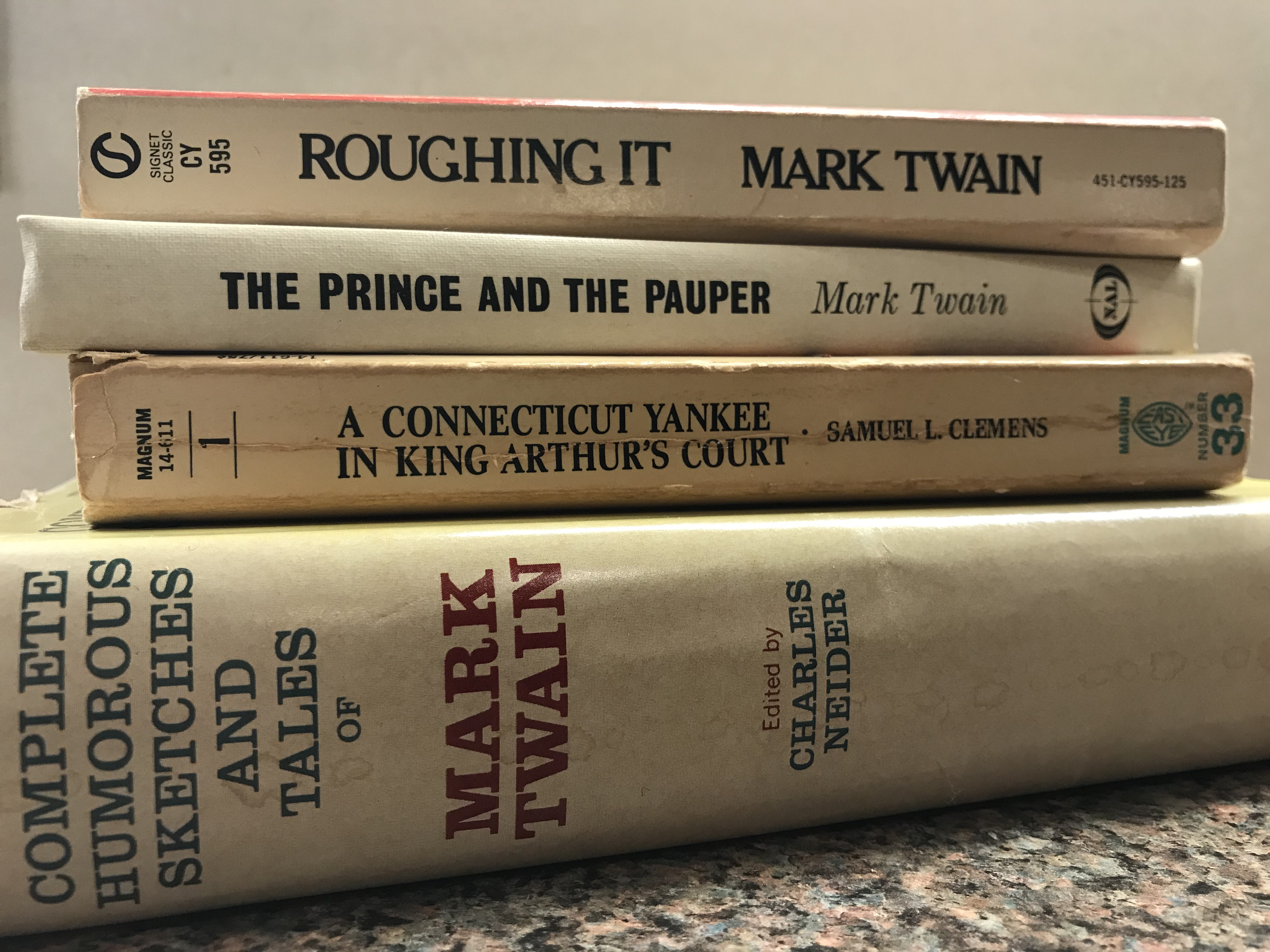
A selection of Mark Twain books

Years ago, I enjoyed how actor Hal Holbrook brought Mark Twain alive on the stage and TV. When vacationing in New York a few years ago, I enjoyed visiting Elmira, where Twain lived. There was a live portrayal of him there, which was excellent. I still have those memories and the plastic souvenir cup from my visit.

Perhaps even more than his novels, I like many of Mark Twain’s quotes. It was through his little snippets or sayings that his humor really came through. Here are a few of my favorites:

“It is better to keep your mouth closed and let people think you are a fool than to open it and remove all doubt.”

“The secret of getting ahead is getting started.”

“A man who carries a cat by the tail learns something he can learn in no other way.”

“If you tell the truth, you don’t have to remember anything.”

“A person who won’t read has no advantage over the person who can’t read.”

“Kindness is the language which the deaf can hear and the blind can see.”

“When your friends begin to flatter you on how young you look, it’s a sure sign you’re getting old.”

Since my last blog post

The Covid-19 pandemic has worsened here in the United States. I’m thankful for all the people who work in healthcare facilities and other essential workers who risk exposure to the virus every day so the rest of us can have the services we need. I’m fortunate that I can stay home most of the time.

I finished reading a splendid new historical novel by Vicki Lane. Get your hands on a copy of And the Crows Took Their Eyes. Don’t let the title scare you off, but be aware that the book is not about a pleasant subject. It is, however, masterfully written. It sheds light on a part of North Carolina history that has received too little attention in the history books. It brings to life the horrors of neighbors taking opposite sides in the American Civil War. I read it slowly and savored the writing. Look for more about this book in my blog post on December 7, 2020.

My sister and I had some productive time one day as we continued to proofread my manuscript for Harrisburg, Did You Know? Stay tuned for progress reports.

My root canal went well last Monday, and I was able to enjoy turkey, dressing, and gravy on Thanksgiving Day.

Until my next blog post

I hope you have a good book to read and a challenging one to write, if you’re a writer.

Be creative. Find what you’re passionate about and make time to do it. Find a way to make a living doing it. I wish I had.

Wear a mask.

Janet

#TwoForTuesday: Two Books that Make Me Smile

For today’s blog post, I’m going back 20 years to remember a delightful children’s book my sister and I enjoyed reading to one of our great-nieces when she was a little girl. That book is still being published, and I’m thrilled because it is a hilarious children’s book.

The reader and the child being read to get to make all sorts of pirate sounds. The book is How I Became a Pirate, by Melinda Long. In addition to a very entertaining narrative, the book has wonderful illustrations by Caldecott Honor illustrator David Shannon.

I was in Park Road Books in Charlotte, North Carolina last week and was thrilled to see this book on the shelf. It immediately brought a smile to my face and then the memories flooded in.

Shiver me timbers! Aargh! The illustrations will entertain a child (and an adult!) for hours. I have been unable to import a photo of the cover of How I Became a Pirate into today’s blog post. Technical difficulties. That’s too bad because seeing the cover would give you an idea of the illustrations within the book.

The Complete Humorous Sketches and Tales of Mark Twain, edited by Charles Neider

The Complete Humorous Sketches and Tales of Mark Twain, edited by Charles Neider

Another book that makes me smile is The Complete Humorous Sketches and Tales of Mark Twain, edited by Charles Neider. The copyright date on it is 1961, and that’s probably about when I received it as a gift. I just realized that was 58 years ago! I was eight years old and had apparently just discovered the humor of Mark Twain. I became a lifelong fan. From my lopsided signature on the flylead, I can tell I received it as I was learning to write cursive. Second grade.

Flipping through this collection of Mark Twain writings makes me smile because I was no innocent in 1961 and got to read the book for sheer enjoyment. I read this a mere 90 years or so after Mr. Twain wrote the pieces. That seemed like a million years to an eight-year-old, but not so long to me now.

Something else about the book made me smile today as I looked through it. We had a rule in our house:  you don’t write in a book and you don’t underline in a book. Books were sacred and to be damaged under no circumstances. (The same went for Daddy’s National Geographic magazines. No matter what the school assignment was, I knew not to cut pictures out of National Geographic. I doubt I could take a scissors to a National Geographic to this day. Some things are just beyond the pale.)

So what made me smile today as I went through the book? On page 43, beside the story title, “A Touching Story of George Washington’s Boyhood,” I had printed in very light lead pencil, “Satire?” I found the same marginal note on page 49 next to “Answers to Correspondents.” There it was again, minus the question mark, (I must have been gaining confidence in identifying satire) on pager 59 next to “A Page from a California Almanac.”

I guess I lost interest in satire on page 59 because I can find no more marginal notes in the book. Thank goodness I didn’t use it to practice diagramming sentences! Do student still have to do that?

The following entry in “Answers to Correspondents” made me laugh today because it brought back memories of those dreaded “word problems” we had to do in arithmetic. I believe that’s known as math today. Here’s the entry: “’Arithmeticus.’ Virginia, Nevada. – If it would take a cannon-ball 3 1/3 seconds to travel four miles, and 3 3/8 seconds to travel the next four, and 3 5/8 to travel the next four, and if its rate of progress continued to diminish in the same ratio, how long would it take it to go fifteen hundred million miles?” Twain’s answer:  “I don’t know.”

I can identify with that answer.

This is a 716-page book, plus appendix and index. I’m sure it was the first thick book I owned. I’m glad I still have this treasure from my childhood.

Until my next blog post

Thank you, Rae, of “Rae’s Reads and Reviews Blog” for this month’s #TwoForTuesday blog post prompts. Visit her blog, https://educatednegra.blog/2019/04/01/april-two-for-tuesday-prompts/.

Happy reading!

Let’s continue the conversation

In the comments section below, tell me about one or two books that make you smile.

Janet