I write southern historical fiction, local history, and I've written a devotional book. The two novels I'm writing are set in Virginia and the Carolinas in the 1760s. My weekly blog started out to follow my journey as a writer and a reader, but in 2025 it has been greatly expanded to include current events and politics in the United States as I see our democracy under attack from within. The political science major in me cannot sit idly by and remain silent.
This was not planned, but when I started to write this blog post I realized the event whose anniversary we mark today happened 200 years and one week after the historic petition I blogged about last Monday. It’s nice when serendipity happens.
Whereas last Monday’s blog post was about a petition written in 1775 as the American colonies were on the verge of war with Great Britain, today we jump forward to mark an historic joint space exploration venture between the United States and the Soviet Union.
Both events now seem like ancient history in light of where space exploration has taken us today, so it is sobering for me to realize the event I write about today happened a couple of months after I graduated from college. It seems like just yesterday! The passage of time is beyond my understanding.
What was the Apollo-Soyuz Test Project?
The Apollo-Soyuz Test Project was the first multinational space exploration project.
Photo by Jack Cohen on Unsplash
A little background
What made the Apollo-Soyuz Test Project particularly surprising and interesting was that the two participating countries – the United States and the Soviet Union – had been serious and unfriendly competitors in space travel since the late 1950s. The era was known as “the space race.” Each of the countries was determined to beat the other one in reaching every progression in space travel with the ultimate goal of putting a human being on the moon.
This is an over-simplification, but with the United States putting humans on the moon in 1969, the space race transitioned into a posture of sharing knowledge. It was an outgrowth of the “Détente” that started in 1969. Détente brought about more relaxed relations between the US and the Soviet Union.
Things get real in 1973
In the first half of 1973 the two countries announced the names of the astronauts and cosmonauts for the project as follows:
U.S. Commander Thomas P. Stafford
U.S. Command Module Pilot Vance D. Brand
U.S. Docking Module Pilot Donald K. “Deke” Slayton
US backup crew: Alan L. Bean, Ronald E. Evans, and Jack R. Lousma
Soviet Commander Aleksei A. Leonov
Soviet Flight Engineer Valeri N. Kubasov
Soviet backups: Anatoli V. Filipchenko and Nikolai N. Rukavishnikov
The crews trained together for the first time at NASA’s Johnson Space Center in Houston, Texas in July 1973.
Some details of the project
Soyuz
Launch: July 15, 1975, at 8:20 a.m. EDT Launch Site: Baikonur Cosmodrome, Kazakhstan Flight Crew: Alexey A. Leonov, Valery N. Kubasov Landing: July 21, 1975
Apollo
Launch: July 15, 1975, at 3:50 p.m. EDT Launch Site: Launch Complex 39, Kennedy Space Center, Florida Flight Crew: Thomas P. Stafford, Vance D. Brand, Donald K. Slayton Landing: July 24, 1975
Mission
Docking Time: July 17, 1975, at 12:12 p.m. EDT Undocking Time: July 19, 1975, at 11:26 a.m. EDT Total Duration of Joint Activities: 19 hours, 55 minutes Orbital Inclination: 51.8 degrees
Both spacecraft made orbital adjustments over the first two days to pave the way for the two vehicles to dock in space. People all over the world watched the docking at 12:12 p.m. Eastern Daylight Time, July 15, 1975. Hatches on both vehicles were opened at 3:17 p.m.
Celebratory handshakes and commemorative gifts were exchanged between the astronauts and cosmonauts. U.S. President Gerald Ford and Soviet Communist Party General Secretary Leonid Brezhnev called them to express their congratulations. The astronauts and cosmonauts shared a meal and the hatches were closed for the day.
The following day Brand joined Kubasov in the Soyuz and Leonov joined Stafford and Slayton in the Apollo spacecraft. TV interviews and tours were given, experiments were conducted, and lunch was eaten. Afterwards, Kubasov and Brand left the Soyuz and joined Slayton in the Apollo. Leonov and Stafford then spent time in the Soyuz.
By mid-afternoon the historic exchanges were completed, there was another round of handshakes and goodbyes were said.
At 8:02 a.m., July 19, 1975 the spacecraft were undocked.
Quoting from the NASA website: “As the Apollo capsule backed away, it blocked the sun from the Soyuz vehicle, creating the first human-made eclipse and enabling the cosmonauts to photograph the sun’s corona. The two spacecraft then docked once more, with final undocking at 11:26 a.m.
The end of the successful project
The Soviet cosmonauts continued to conduct life-science experiments for another day. The Soyuz 19 landed near its target on July 21, 1975. It was the first time a Soviet space mission launch and landing were televised.
The Apollo capsule remained in orbit with the astronauts carrying out space-science and Earth-observing experiments for five days after the undocking. It was the last planned ocean landing for U.S. human spaceflight. Splashdown occurred at 5:18 p.m., Eastern Daylight Time on July 24, 1975.
Until my next blog post
What happened on Saturday was an attack on democracy. Let’s hope this week is less eventful than the weekend.
August turned out to be one of those months when many books I’d been on the waitlist for at the public library all became available at the same time. I had to scramble to read and listen to so many books in a month. I guess it was a good thing August had 31 days.
Today’s blog post is about four of the eight books I read last month. I’ll blog about the other four next Monday.
The German Wife, by Kelly Rimmer
The basis of this novel is “Operation Paperclip,” although that secret US intelligence program isn’t mentioned by name until the author’s note at the end of the book.
I listened to this historical novel on CD. I almost gave up on it after the second of 11 discs because I felt like as soon as I became invested in Sofie’s story, I was yanked into Lizzie’s story. I found the random switching from Lizzie’s 1930s in the Dust Bowl days in Texas to Sofie’s 1950s in Huntsville, Alabama to Sofie’s 1930s in Berlin to Lizzie’s 1950s in Huntsville, Alabama more than a bit disorienting.
That said, a couple more discs into the book, I couldn’t stop listening.
One thread that runs throughout the novel is how people can justify their actions (or inactions) in the name of keeping themselves or their families safe. How many times in history and perhaps in our own lives does the excuse, “I was just following orders” come into play?
Another thread in the book is prejudice and discrimination. Family dynamics play heavily in the book. One of the characters is a World War II veteran suffering from what was then called battle fatigue but is now known as posttraumatic stress disorder. His sister, Lizzie, tries her best to help him, but in the process she enables him.
I found the book’s description of the horrors of the dust storms in the US during the 1930s to be so realistic that I felt like I was choking as Lizzie’s family tried in vain to keep the dust out of their house.
Sofie’s abiding friendship with Mayim, a Jewish woman, is a part of the story that will stay with me. It reminds us that there were Germans who were friends with Jews and whose hearts were broken by what the Nazis did to them. I’d like to think I wouldn’t have turned my back on Jewish friends – and Jewish strangers – if I’d been in Sofie’s place. But how easily humans can be brainwashed! We’re seeing it in our own country now.
The book shines a light on how German rocket scientists were brought to the United States after World War II to help develop NASA’s space program. I was aware of this, of course, but I’d never stopped to think about the interpersonal logistics of the Germans’ being accepted by the Americans so soon after the war. The fact that some of those German scientists had been complicit in Nazi war crimes was swept under the rug, as their pasts were erased by the US government to make it possible for them to work for the US space program.
In Ms. Rimmer’s author’s note at the end of the book, she explains how she, an Australian, learned about this piece of history in a roundabout way in a park in New South Wales. The fact that she learned about “Operation Paperclip” in 2019 and has already researched and written this novel, is amazing.
If you want to learn more about “Operation Paperclip” – the secret US intelligence program that brought more than 1,600 German scientists and engineers to America between 1945 and 1959 so they could work for the US government, do an online search for it and then follow up at your local public library.
The Lord is My Shepherd: Healing Wisdom of the Twenty-Third Psalm, by Harold S. Kushner
Many years ago I read Rabbi Harold S. Kushner’s book, When Bad Things Happen to Good People. Although Rabbi Kushner is Jewish and I’m a Christian, I found that book insightful and reassuring. It echoed many of my core beliefs. God didn’t promise us a carefree life. He promised to be with us.
When I found Rabbi Kushner’s book, The Lord is My Shepherd: Healing Wisdom of the Twenty-Third Psalm on CD for sale at a book sale at the public library, I was sad that it had been weeded from the collection. I had myself to blame, though. I’d never checked it out. Perhaps no one had checked it out in years and, therefore, it needed to be removed from the library shelf to make room for a new book. I was eager to read it, so I bought it – probably for fifty cents.
That was months ago, and I finally got around to listening to it. I enjoyed hearing the book read by the author. It was only four discs. I listened to the entire book over a two-day period.
In the book, Rabbi Kushner wrote about the Twenty-Third Psalm, line by line. He is a student of the Psalms and I appreciated his perspective. I like it when a Bible scholar tells me the nuances of the original Hebrew in which the Old Testament books were written. Rabbi Kushner did that numerous times throughout this book.
Being a Christian, I didn’t agree with what Rabbi Kushner had to say about the coming of the Messiah, but it was interesting to hear his Jewish perspective. Also, I believe that God created everything from nothing. Rabbi Kushner believes that everything already existed and God created order out of the chaos.
In The Lord is My Shepherd: Healing Wisdom of the Twenty-Third Psalm, Rabbi Kushner repeatedly revisits the theme that God doesn’t promise us a carefree life; He promises to be with us. On that, Rabbi Kushner and I agree.
Now that I’ve listened to this book, I plan to donate it to Goodwill where someone else can acquire it and ponder the Twenty-Third Psalm along with Rabbi Kushner.
Cold, Cold Bones, by Kathy Reichs
Cold, Cold Bones: A Temperance Brennan Novel, by Kathy Reichs
I really enjoyed listening to Cold, Cold Bones, by Kathy Reichs. It had the suspense we’ve come to expect in her novels with the added bonus of references to many locations in and around Charlotte.
Concord, the Appalachian Trail, and even Robeson County got mentioned. Of course, they were all mispronounced on the CD audio recording of the book, but that’s to be expected. I’m sure the reader wasn’t from North Carolina.
There were numerous clues given, and each one took me down another rabbit hole. All the time, though, I knew in the end Ms. Reichs would connect the dots and show how each thread came together.
The layers of this novel were revealed much like one peels layer after layer from an onion. Ms. Reichs certainly has pacing down pat. It kept me guessing who the chief villain was and what the common thread of each incident was until the very end.
This was a very entertaining read, and makes me eager to read another Kathy Reichs novel. The last novel of hers that I’d read was way back in May 2020. In my June 1, 2020 blog post, Books Read in May 2020, I wrote about her novel, A Conspiracy of Bones.
I don’t know why I waited two years to read another of her books. In case you aren’t familiar with Kathy Reichs, she is an adjunct professor of anthropology at the University of North Carolina at Charlotte. She is a highly-regarded forensic anthropologist who splits her time between Charlotte and Montreal. The television series, “Bones” was loosely-based on her life and ran for 11 seasons from 2005 until 2016.
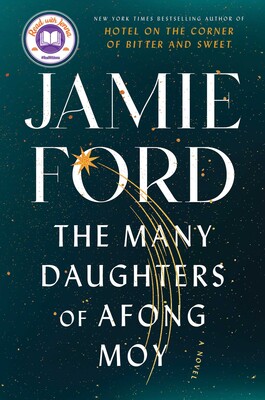
The Many Daughters of Afong Moy: A Novel, by Jamie Ford
The Many Daughters of Afong Moy, by Jamie Ford
I’ve enjoyed the other novels I’ve read by Jamie Ford, but I found this one difficult to follow. It’s received rave reviews. The writing is outstanding, but I found the jumping back and forth between centuries (past, present, and future) and the five points-of-view hard to follow.
I listened to nine of the 11 discs of this book on CD. I found the voice of one of the readers very irritating to my southern ears and the range in volume from soft to yelling was equally irritating to me as I have hearing loss and I was often listening to the book after I’d gone to bed.
All that said, the basis of the novel is a fascinating topic: epigenetics. It began with the first Chinese woman who came to America and how she became a spectacle due to her bound feet. She suffered physical and emotional pain as a result of this ancient Chinese tradition that crippled girls and women and kept them under the thumb of male society. The novel follows generations of her female descendants who carried her emotional scars.
Epigenetics is an interesting topic of study. There is debate about whether emotional traits and emotional traumas are passed from generation to generation through DNA or through a family’s traditions and oral history.
If you want to read my comments about one of Jamie Ford’s earlier books, Love and Other Consolation Prizes, go to my July 17, 2017 blog post, Reading South Africa and South Carolina Novels. I must have read Hotel on the Corner of Bitter and Sweet before I started blogging about the books I read. It was good, too.
It was the format and not the prose in which The Many Daughters of Afong Moy was presented that didn’t appeal to me. I’ll still look forward to Jamie Ford’s next novel.
Since my last blog post
It’s been a strange week with some unexpected tasks and distractions. I continue to read more than write because those library books are still piling up. It’s a nice problem to have and I’m grateful to live in a country and a region with such vast free public library resources.
The arrival of September was a rude awakening. How is it that summer flies by and winter drags on and on? My Seasonal Affective Disorder is already rearing its ugly head, so I must strive to get and keep a positive attitude.
Until my next blog post
I hope you have so many books at your fingertips that you can’t decide what to read next.
Life is short. Spend time with family and friends, and make time for a hobby.
Don’t forget the people of Ukraine, Uvalde, and Highland Park, etc