Blog topics keep dropping in my lap

One of these days I hope to be able to enjoy reading fiction again. I miss the days when I wanted to read every historical novel that was published. I can’t remember the last one I read. I’m pretty sure it was before Inauguration Day 2025.

I miss not having books I’ve read to blog about the first Monday of each month. I read parts of several books in August, but I didn’t finish reading any of them.

I settled down at the computer on Friday evening after supper to look for that afternoon’s weekly update on the status of road repairs in western North Carolina since Hurricane Helene a full eleven months ago. I can’t imagine the stress the people who live or work along some of those roads must be under at this point.

For eleven months, I have tried to give an update on Mondays of the progress being made in repairing western North Carolina since the hurricane. Roads are not the most important things being repaired or needing to be repaired. People lost family members, their homes, their businesses, their friends, their communities, and their sense of security. But I don’t know how to report on how those losses are being coped with or healed. I report the progress being made in rebuilding roads and highways because that is something tangible that I can find statistics about. I hope in some way it reminds people in other parts of the United States that just because Hurricane Helene is no longer in the headlines, it doesn’t mean it is over.

On Friday evening, I didn’t know what I was going to blog about today, but I knew I needed to include my weekly update about the roads. I sat down at the computer to get that part of today’s blog written.

But before I could put anything in the search engine, a disturbing piece of breaking news popped up. Although the announcement was put online shortly before 6:30 p.m., the national news channel I watched at 6:30 did not mention it. I guess it was more important to talk about this being Labor Day weekend and how that would specifically bring in lots of business for a particular convenience store chain on steroids.

The free publicity the network gave that convenience store chain was bizarre. It was the kind of story one would expect on “a slow day for news.” But we have not had “a slow day for news” in this country in eight months.

Instead of reporting on how busy the franchises in that convenience store chain would be over the long holiday weekend, I wish that network had reported on what the U.S. Supreme Court did on Friday.


National Institutes of Health

Photo of a woman in a white lab coat looking into a microscope.

The piece of news that was not reported is devastating to a lot of people. In a 5-4 vote, the U.S. Supreme Court ruled that the Trump Administration can indeed cut $783 million in National Institutes of Health grants connected to diversity programs. Thus, the injunction that a federal judge had put on the action has been lifted.

Too bad that 90,000-square foot ballroom that’s going to dwarf the White House isn’t in place. I’m sure lots of people in The White House would love to go dancing to celebrate this victory over medical research and diversity.


Voice of America

Photo of a silver microphone.
Photo by Jono Hirst on Unsplash

Another thing Trump could celebrate over the Labor Day weekend was the firing of more than 500 employees of Voice of America and its parent agency, the U.S. Agency for Global Media, on Friday night. It comes across as, “Happy Labor Day! You’re fired!”

Voice of America was founded by the United States in 1942 to combat Nazi propaganda. Every week for 83 years, it has delivered news to 420 million people in 63 languages in more than 100 countries.

But the Trump Administration does not see the need for it and has been working for eight months to destroy it. One of his Executive Orders in March placed more than 1,000 journalists on indefinite administrative leave.

Kari Lake, an Arizona politician, is tasked by Trump to dismantle Voice of America. She fired 500 contractors in May and tried to fire 600 federal employees in June.

Trump says the Voice of America is speaking for our adversaries and not for the American people. He has produced no evidence. By “our adversaries” does he mean North Korea, China, and Russia? Or does he mean his Democratic political adversaries? I tend to think he means the Democrats. He cannot tolerate people speaking the truth.


Some tariffs ruled illegal

Photo of letters on wooden blocks spelling out: USA Tarriffs.
Photo by Markus Winkler on Unsplash

A Federal Appeals Court has ruled that some of the tariffs ordered by the Trump Administration are illegal. We haven’t heard the last of this. Like a dog with a bone, Trump won’t let go without a fight.


Chicago prepares for Trump

Photo of a huge dome-like reflective sculpture in Chicago reflecting the sky and buildings
Photo by Sawyer Bengtson on Unsplash

The City of Chicago and the Governor of Illinois prepare for an invasion by Trump’s military this week. The mayor of Chicago vows to not roll over and play dead.

Mayor Brandon Johnson signed an order on Saturday stating that the Chicago police will not “collaborate with federal agents on joint law enforcement patrols, arrest operations, or other law enforcement duties including civil immigration enforcement.”

The mayor’s order “urges” federal officers in Chicago “to refrain from wearing masks, to wear and use body cameras and to identify themselves to members of the public with names and badge numbers.”

That is what local law enforcement officers do, so why shouldn’t federal officers be required to do the same? The argument that Trump’s thugs must wear masks because their lives are in danger doesn’t hold water. Every law enforcement officer’s life is in danger when they are on the job, but they don’t get to hide behind masks like Trump’s people or the Ku Klux Klan.


Hurricane Helene Update

As of Friday, of the 1,469 roads and highways that had to be closed in western North Carolina due to Hurricane Helene, 33 were still closed and 38 have partial access.

A temporary US-64/US-74 between Chimney Rock and Bat Cave opened last week.

Another section of the Blue Ridge Parkway reopened on Friday, meaning that the 85 miles from Asheville to the parkway’s southern terminus near Cherokee are now open! Work continues on various sections of the road north of Asheville.

It was announced last Thursday that the rebuilding of I-40 in the Pigeon River Gorge North Carolina at the Tennessee line is expected to be completed by the end of 2028. That’s not a typo. 2028.

The NC Department of Transportation is constructing a retaining wall along the Pigeon River below the highway, which will be 30 feet thick and 100 feet tall in some places.

A temporary wall now allows two lanes (one in each direction) to be open with a 35 mile-per-hour speed limit. Monitoring devices are in place to alert drivers to possible landslides.

The reconstruction of five miles of the interstate in the gorge is expected to cost $1.3 billion.


Great Smoky Mountains National Park Alert Update

US-441/Newfound Gap Road in the Tennessee side of Great Smoky Mountains National Park is expected to be repaired and reopened by September 30. Earlier estimates were in October. Heavy rainfall caused the undercutting a section of the road between Mile Marker 12 and Mile Mark 13 during flooding on August 2.


Hurricane Erin Update

NC-12 on the north end of Ocracoke Island, NC reopened last Monday and ferry service to Hatteras Island resumed. By the end of last week, what was left of Hurricane Erin was lashing the Butt of Lewis on the northern tip of the Isle of Lewis in the Outer Hebrides. Erin did not give up easily.


Too much news

In less than 24 hours from Friday night until midday on Saturday, I went from not knowing what I could blog about today to having an abundance of topics vying for my attention. I miss the good old days of 2024 when there wasn’t much news on weekends.

Janet

Alex Haley’s Birthday, 1921 – his influence on my writing

When I read Centennial, by James A. Michener, I remember thinking, I’d like to write a book like that someday! When I read Roots: The Saga of an American Family, by Alex Haley, I thought, I’d like to write a book like that someday!                                                                                                                                                                                                                                                                                                         

Photo of the cover of Roots: The Saga of an American Family, by Alex Haley
Roots: The Saga of an American Family, by Alex Haley

In 1996, my sister and I published three Morrison genealogy books. Talk about something being a labor of love! I have been interested in my family’s history all of my adult life, so I was drawn to Roots: The Saga of an American Family, by Alex Haley, for its writing and its sense of genealogy.

Alex Haley’s Life Before Roots

Today would have been Alex Haley’s 104th birthday.

Haley was born in Ithaca, New York. He lived in Henning, Tennessee, until the age of five, when his family moved back to Ithaca. His father was a professor of agriculture at Alabama A&M University. His mother was from Henning.

After two years of college, Alex Haley joined the U.S. Coast Guard. He had a 20-years career in that branch of the military. His reputation as a self-taught writer spread among his fellow service members. They often asked Haley to compose love letters for their sweethearts.

After retiring from the Coast Guard, Haley pursued life as a writer. He served as a senior editor for Reader’s Digest magazine. Throughout the 1960s, Haley conducted interviews with famous people for Playboy magazine. It was as a writer for Playboy that he interviewed Muhammad Ali; Sammy Davis, Jr.; Jim Brown; Johnny Carson; Quincy Jones; and Rev. Martin Luther King, Jr.

It was Haley who interviewed George Lincoln Rockwell for Playboy. Rockwell was the leader of the American Nazi Party, and he kept a gun on the table throughout Haley’s interview.

When Haley was writing an article about the Nation of Islam for Reader’s Digest, he met Malcolm X. The two met again was Haley interviewed him for Playboy. Haley’s first book was The Autobiography of Malcolm X, published in 1965.

Roots: The Saga of an American Family

Haley published Roots: The Saga of an American Family in 1976. It is a noel based on Haley’s genealogy. He traced his mother’s ancestry back to The Gambia. Haley was a seventh-generation descendant of Kunta Kinte, a young black man kidnapped in The Gambia in 1767 and brought to Maryland to be sold as a slave.

It took Haley 12 years to do the research for Roots: The Saga of an American Family. He traveled to The Gambia and heard stories of Kunta Kinte’s capture. He went to Annapolis, Maryland, and had the emotional experience of standing where his ancestor had been taken from a slave ship.

It is said that Haley enjoyed sitting at the Savoy (a bistro) in Rome to listen to the piano music and write Roots on a yellow legal tablet. A painting of Haley writing on his legal pad hangs at a special table at the Savoy in honor of the time he spent there and the great work of literature he partially wrote there.

The writing of Roots earned Haley a special Pulitzer Prize in 1977. That was the same year that ABC adapted the book into a miniseries that drew a record-breaking audience of 130 million viewers.

Misgivings about Haley’s research

Some genealogists have disputed Haley’s genealogical research and the validity of his story of Kunta Kinte.

Henry Louis Gates, Jr. is quoted as saying, “Most of us feel it’s highly unlikely that Alex actually found the village whence his ancestors sprang. Roots is a work of the imagination rather than strict historical scholarship.”

Plagiarism and Copyright Infringement

Sadly, Haley was successfully sued for plagiarism and copyright infringement by Harold Courlander. Courlander accused Haley of taking passages from his book, The African, and using them in Roots. The case was settled out of court in 1978 and Courlander was awarded $650,000. Haley’s biographer, Robert J. Norrell, maintains that Judge Robert Ward was hostile to Haley and did not think Haley was capable of writing Roots.

Posthumus novel

At the time of his death in 1992, Haley was writing a novel based on another branch of his family. At his request, David Stevens completed the novel, Alex Haley’s Queen, in 1993 and it was adapted as a television miniseries by that name.

Haley’s property

Haley lived on a farm at Clinton, Tennessee during his last years. After his death, the Children’s Defense Fund purchase the property and it is used as a national training center and retreat.

In conclusion

I had forgotten the controversies surrounding Alex Haley after his acclaim for Roots: The Saga of an American Family until I started doing research for writing this blog post.

Nevertheless, that does not change the fact that I was inspired by reading Roots and watching it’s TV adaptation. Along with James A. Michener’s Centennial, it was Roots that planted the seed in my head that I might write books someday.


Hurricane Helene Weekly Update

As of Friday, of the 1,457 roads that were closed in western North Carolina last September due to Hurricane Helene, 35 were closed, which is one more than the number reported the week before. The NC Department of Transportation reports 39 roads have just partial access, which is a decrease of one road since the previous Friday.


Great Smoky Mountains National Park Alert Update

On Saturday, August 2, US-441/Newfound Gap Road – the only road that crosses the entire Great Smoky Mountains National Park from Cherokee, North Carolina to Gatlinburg, Tennessee, was closed due to heavy rainfall causing the undercutting of a section of the road in Tennessee by Walker Prong Camp Creek between Mile Marker 12 and Mile Marker 13.

By the next day, a portion of Newfound Gap Road from near Cherokee, North Carolina into the park reopened; however, the National Park Service announced on Friday that the Tennessee portion of Newfound Gap Road will remain closed until early October so repairs can be made at the site of the washout/landslide.

The stated detour route is I-40, which is still just two lanes and 35 mph due to the massive damage done last September by Hurricane Helene.

This road closure in the most-visited park in the United States is yet another blow to the tourism-dependent economy of the southern Appalachian Mountains.

Janet

What I Read Last Month & a Hurricane Helene Update

I did more reading in September than this blog post will reflect, but there was only one book I read from cover-to-cover: White Robes and Broken Badges, by Joe Moore.

White Robes and Broken Badges, by Joe Moore

Photo of book cover for White Robes and Broken Badges by Joe Moore
White Robes and Broken Badges, by Joe Moore

This nonfiction book will stay in my mind forever. The author infiltrated the Ku Klux Klan (KKK) for the Federal Bureau of Investigation (FBI) not once but twice. He infiltrated it both times to a level never done before, gaining access to the top echelon in the organization.

I’ve never known many details about the workings of the KKK. Never needed to. Never wanted to. However, considering where society in America stands today, it seemed like a good time to get better educated about the threat the KKK holds.

This book sheds light on just how insidious the work of the KKK is and how many its members are employed as law enforcement officers in our country. It is widespread and probably even more of a problem than the FBI knows.

It was through the undercover work of “Joe Moore” that the FBI was alerted that the problem is greater than had been realized. Joe was not an FBI agent. He was recruited by them because of his skill set.

After infiltrating the organization the first time, Joe never imagined he would be called on to do it a second time. But he was so good at it, the FBI needed him. Joe and his wife and children sacrificed a lot for what he did. Ultimately, they lost their home, most of their earthly possessions, their family connections, and friends in a matter of several hours.

The book is chilling. I know of no better word to describe the effect it had on me. Chilling. The details should make every law-abiding citizen in the country – no matter your color, race, ethnicity, or nationality – shiver.

After reading this book, I now have a better understanding of why black people in the United States do not trust law enforcement officers. How can they, when they don’t know in a traffic stop whether they are being pulled over by an honest police officer or sheriff’s deputy or if they’re being pulled over by a member of the KKK who just doesn’t happen to be hiding under a white hood?

It has always seemed a great sign of cowardice that when members of the KKK do their dirty work, they hide in their white robes. If you’re doing something you shouldn’t be doing, though, I suppose you don’t want to reveal your identity.

These are misguided people, and as a Christian I am offended that they use the cross as their symbol. Jesus Christ died on a cross for me (and for them!), so how dare they desecrate that symbol of Christ’s great sacrifice!

I highly recommend this book. It is not a pleasant read, but how do we improve as a society if we bury our heads in the sand and don’t open ourselves up to what is going on not only in the shadows but also in broad daylight?

I learned about this book while listening to National Public Radio (NPR) in August (https://www.npr.org/2024/08/12/g-s1-16223/white-robes-and-broken-badges-exposes-the-inner-workings-of-the-ku-klux-klan)

Update on Hurricane Helene in Western North Carolina

I wish I could include photographs, but I don’t want to run the risk of sharing an image that is undocumented or not in the public domain. You can use some of the links below if you wish to see pictures.

Another reason I am not including photos is that I know from my own experience after Hurricane Hugo in 1989 that pictures don’t do a disaster justice. Unless you are in the middle of a natural disaster and destruction is all you can see, hear, smell, or touch in any direction, you can’t grasp the enormity of the situation.

I know that Hurricane Helene left a wide path of destruction in Florida, Georgia, South Carolina, Tennessee, and Virginia; however, I have lived in North Carolina all my life – four of my 71 years in the mountains. The mountains are near and dear to my heart. I will blog about North Carolina and leave it to people in those other states to blog about the conditions in their states.

A couple of my blog readers said they hoped I would continue to shine a light on the destruction caused by Hurricane Helene in the mountains of North Carolina on September 26.

I do not live in the disaster zone. I’m about 100 miles east of the mountains. We just had a lot of rain, some wind, and a lot of tree branches to pick up and deal with. That is ongoing, but that and our 13-hour power outage pale in comparison to what happened in our beautiful Appalachian Mountains.

Ten days after the storm, many areas of the mountains are still inaccessible. Damage assessments are still being made. Recovery will be measured in years, not months. Some locations were wiped off the map and will not be restored because the landscape has been changed completely and forever.

The United States Geological Survey has identified 244 landslides caused in the Southeast by Hurricane Helene. Most of those are in North Carolina. More landslides will, no doubt, occur in the coming weeks with additional rainfall and freezing conditions.

As of the data I found last night, the death toll in North Carolina so far was 115, with 72 of those being in Buncombe County. There are still people unaccounted for. Many communities still have no water or sewer service. Cell phone service was spotty before the storm and restoration has been slow.

Hundreds and hundreds of power poles and thousands of miles of overhead power lines are down. Thousands of people are homeless. You might grow weary of hearing about it, but many of the people of western North Carolina are in dire straits.

As always, though, the worst of nature brings out the best in most people. The outpouring of support has been amazing. Electrical workers have come from all over the country and from Canada. Four hundred nurses have arrived in Asheville from as far away as Alaska to pitch in and help local medical personnel who have worked around the clock since September 26 even though most of them have catastrophic damage at their own homes.

Pack mules are being utilized to haul water, non-perishable food, and other necessities into the steep and rugged terrain where vehicles cannot gain access.

Two interstate highways are closed. I-40 near the Tennessee state line will probably be closed for a year. Repairs to I-26 might allow it to reopen next March. Roads and bridges washed away, houses, cars, and businesses floated away, and overnight all the necessities most of us take for granted every day vanished.

The area of devastation in western North Carolina alone covers more than 600 square miles, and it is not flat land! Every mile of those 600 square miles is not devastated. The severity of destruction various from place to place as rain totals were, of course, higher in some places than in others. Also, some areas of the mountains received more rain than others in the days leading up to the arrival of Hurricane Helene. Elevations range from around 1,500 feet to more than 6,000 feet. The destruction is unprecedented. Since 1916, all floods in western and piedmont North Carolina have been measured against The Flood of 1916. Future floods will be measured against The Flood of 2024 because by all statistics it surpassed the one in 1916.

Classes at my alma mater, Appalachian State University in Boone, have been cancelled until at least October 16. (That’s three weeks of fall semester lost.) Students at Lees-McRea College in nearby Banner Elk were evacuated by air to Hickory. Classes have been cancelled at Western Carolina University in Cullowhee the University of North Carolina at Asheville, Montreat College, Warren-Wilson College, Mars Hill University, and numerous community colleges. Blue Ridge Community College in Flat Rock, NC is closed indefinitely. Some county school systems are unable to announce when they will reopen.

The beautiful Blue Ridge Parkway that I’ve waxed poetic about so many times is closed indefinitely. US-441/Newfound Gap Road through Great Smoky Mountains National Park has reopened; however, it was not designed to handle commercial traffic, so it is not an alternate to I-40 or I-26 for large trucks. Sadly, a few people decided that did not apply to them, so they attempted to drive on Newfound Gap Road. Two serious accidents resulted – one caused by a car hauler. The highway will be closed to all traffic from 10pm until 7:30 a.m. until further notice. (https://www.nps.gov/grsm/learn/news/update-on-us441-newfound-gap-road-overnight-closure.htm)

The images coming out of the mountains are gut-wrenching. The needs are great and will continue to be for a long, long time. I hesitate to start naming charities because there are hundreds of reputable ones that are on-site and providing remarkable goods and services. World Central Kitchen (https://wck.org/), the Cajun Navy from Louisiana, Mountain Mule Packer Ranch (https://www.mountainmulepackers.com/), the Red Cross, and Samaritan’s Purse are just a few.

The Manna Food Bank (https://www.mannafoodbank.org/) which serves the Asheville and surrounding areas lost their facility and its contents. Brother Wolf Animal Rescue (https://www.bwar.org/) was flooded out but the 150 animals they were housing on September 26 were rescued by volunteers. Organizations like food banks and animal rescues need to be rebuilt and aren’t necessarily eligible for government assistance. (I saw on the Brother Wolf Animal Rescue website last night that donations to that organization are currently being matched!)

The Appalachian State University Disaster Fund (https://www.appstate.edu/disaster-relief/) is another organization for you to consider. It has stepped up to assist students, staff, and faculty members who have lost their homes. The fund also provides much-needed counselling for those traumatized by the storm.

Atrium Medical Center in Charlotte has set up its mobile hospital in Tryon in Polk County. Many towns and counties across the state have sent teams of medical personnel and swift water rescue teams to assist with the aftermath of the storm. The National Guard and 1,000 active-duty personnel from Fort Liberty (formerly, Fort Bragg) were deployed and have been on the ground since weather allowed access. Numerous restaurants are giving out free meals as they are able to prepare food.

Having just visited Boone and West Jefferson on September 12-13 and having visited Hendersonville, Asheville, Bryson City, and Cherokee this summer, it is difficult to grasp the scope of the damage. I drove on the Blue Ridge Parkway from Asheville to its southern end at Great Smoky Mountains National Park in June. I drove from Hickory through Old Fort, Black Mountain, Asheville, and Canton and into Tennessee on I-40 the last week in August.

I always breathe a sigh of relief when I make it through that treacherous stretch of I-40 approaching Tennessee because rock slides are not unusual. To know that part of that interstate literally washed away 10 days ago is hard to get my head around, though.

Know that any support you can give to the people of western North Carolina is appreciated.

Since my last blog post

I was told (again) in a webinar last week that the purpose of a blog is to solve someone else’s problem. Until I figure out how to do that, I’ll just keep blogging like I have for the last 10+ years. As of last week, I have 1,200 subscribers to my blog, so maybe I’m doing all right. If you came to my blog today seeking a solution to a problem, you are probably disappointed.

On the other hand, if you were looking for a way to lend a little aid to people trying to rebuild their lives after Hurricane Helene, I hope one of the organizations I mentioned today struck a nerve with you.

Until my next blog post

I hope you have a good book to read, a roof over your head, enough food to eat, and clean water to drink.

If all you are hearing is that FEMA and all levels of government are failing to respond to those affected by Hurricane Helene, then you are listening to the wrong sources. More than a week of lies about this from the immediate-past-twice-impeached-34-times-indicted-president is wearing thin here in North Carolina. Please fact check your sources and get your news from a variety of reputable news media.

Hold your friends and family close, for we never know what tomorrow will bring.

Don’t forget the people of Ukraine or the people of western North Carolina.

Janet
Great Smoky Mountains, Revisited! (Part 2 of 2)

Today’s blog post is a continuation of my blog post last Monday, https://janetswritingblog.com/2019/10/21/great-smoky-mountains-revisited-part-1-of-2/. It is about my recent trip to Great Smoky Mountains National Park and is illustrated with pictures of several of the postcards included in my vintage postcard book, The Blue Ridge Mountains of North Carolina, and photographs I took on my trip in September.


Black Bears!

Here’s a picture of one of the many black bear postcards in my vintage postcard book, The Blue Ridge Mountains of North Carolina.

PHOTO OF LINEN-FINISH POSTCARD OF A BLACK BEAR IN GREAT SMOKY MOUNTAINS NATIONAL PARK

And here are pictures of the bears I saw on this trip to the Great Smoky Mountains. The first picture is of a black bear, probably about two years old, after it crossed the road in front of our car. It completely ignored us, which was fine with us! (All these bear photos were taken from inside our car and using the zoom feature on my cell phone camera. As I stated in last Monday’s blog post, it’s against the law to willingly get within 150 feet of an elk or black bear in Great Smoky Mountains National Park.)

#BlackBears in #GSMNP
BLACK BEAR, PERHAPS TWO YEARS OLD, PHOTOGRAPHED IN GREAT SMOKY MOUNTAINS, 2019
#blackbears in #GSMNP
WELL-CAMOUFLAGED FEMALE BLACK BEAR IN GREAT SMOKY MOUNTAINS NATIONAL PARK. HER TWO CUBS WERE IN THE BUSHES UP THE MOUNTAINSIDE.

If the car in front of us hadn’t stopped, we might have driven right by this mother bear and her two cubs. The mother was down in a ditch. After a couple of minutes, her two cubs came running down the hill. It was difficult to get good pictures due to the trees and undergrowth.


November 2016 Fire Damage

One of the iconic places in the park is Chimney Tops. I was sad to see that the late November 2016 wildfires had engulfed this double-peaked mountain in Swain County, North Carolina. The “up side” is that today the granite folds and rough edges of Chimney Tops are visible because the trees on the mountain were destroyed in the fires.

Here, I compare the photographs I took in September 2019 with a 1936 real photograph postcard I used in my vintage postcard book:

Chimney Tops in Great Smoky Mountains National Park
Picture of a 1936 real photograph postcard of “Newfound Gap Highway” and “Chimney Tops.”
#ChimneyTops #Wildfire damage from 2016 as photographed in 2019
Chimney Tops in Great Smoky Mountains National Park in September 2019, still recovering from 2016 wildfires.
Mountainside vegetation burned off this mountain in 2016 #wildfires.
This mountainside, scarred by the 2016 wildfires, now shows off the rough, rocky folds that trees hid before the fires.
Evidence of more 2016 fire damage in Great Smoky Mountains National Park.

Clouds in a Valley

Valley #cloud in #GSMNP
Cloud in a valley in Great Smoky Mountains National Park on September 15, 2019.

We were in the right place at the right time for this photo of white clouds down in a valley in the park.


Why are they called the Great Smoky Mountains?

As I stated in my book, “The Great Smoky Mountains are called “smoky” due to the fog that rises from the valleys and mountainsides.”

These mountains were suffering under drought conditions when I visited the park in September 2019. August, September, and early October were very dry. My sister and I couldn’t help but notice there was very little of the typical wisps of fog when we were there a month ago. In fact, we only saw a little of it on our last day in the park. Here’s a photograph I took, but it isn’t a good representation of the multitude of wisps of fog that gave this sub-range of the Appalachian Mountains their name.

How the Great Smoky Mountains got their name.
A fair, but not great, example of how the Great Smoky Mountains got their name. Photo taken in September 2019.

Summary

I hope you can hear the babbling brooks and smell the wildflowers of Great Smoky Mountains National Park sometime. It is truly a national treasure. In fact, it is a global treasure. I’m fortunate to live just a few hours from this national park.

Great Smoky Mountains National Park was designated a World Heritage Site in 1983.
We owe a debt of gratitude to the men who served in the Civilian Conservation Corps and helped build Great Smoky Mountains National Park.

Unlike many national parks in the United States, no admission fees are charged for entrance into the Great Smoky Mountains National Park. Many families were displaced when the park land was purchased. Before agreeing to sell their land to the U.S. Government, those families (most of whom were poor farmers) made the government agree that no admission to the park would ever be charged.


Since my last blog post

Since my last blog post, my sister and I spent several days on the coast of South Carolina. We enjoyed fresh seafood in Calabash, North Carolina.


Until my next blog post

I hope you have a good book to read. I’m reading The Beekeeper of Aleppo, by Christy Lefteri.

If you’re a writer, I hope you have quality writing time.

Thank you for reading my blog. You could have spent the last few minutes doing something else, but you chose to read my blog.


Let’s continue the conversation

Have you visited the Great Smoky Mountains? If so, what were your impressions of it? What was the highlight of your trip?


The Blue Ridge Mountains of North Carolina on the shelf at Lake Junaluska Bookstore.

As I stated in my blog post last Monday, https://janetswritingblog.com/2019/10/21/great-smoky-mountains-revisited-part-1-of-2/, I hate to “blow my own horn,” but I’d be remiss if I didn’t take this opportunity to tell you how you can have your own copy of my vintage postcard book, The Blue Ridge Mountains of North Carolina, published by Arcadia Publishing in 2014.

Don’t let the name fool you, it covers all the mountainous counties in western North Carolina and the three counties in eastern Tennessee that are partially in Great Smoky Mountains National Park.  Electronic and paperback copies are available from Amazon.com. Paperback copies are available from the publisher at https://www.arcadiapublishing.com/, at quality bookstores, or from me personally.

Janet

Great Smoky Mountains, Revisited (Part 1 of 2)

Sign on US-441/Newfound Gap Road to alert visitors that they are entering the national park.

Several weeks ago I took a vacation from blogging, writing, and all social media. It was wonderful! I hope you can try it sometime.

My sister and I spent a week in and around the Great Smoky Mountains National Park in Tennessee and North Carolina.

For seven days, I didn’t check my blog for comments. I didn’t text. I didn’t call anyone. I didn’t Tweet. It was fabulous!


“The Great Smoky Mountains lay in the middle of the Cherokee Indians’ territory in the mid-1600s when Spanish explorer Hernando de Soto arrived.”

page 69, The Blue Ridge Mountains of North Carolina, by Janet Morrison.
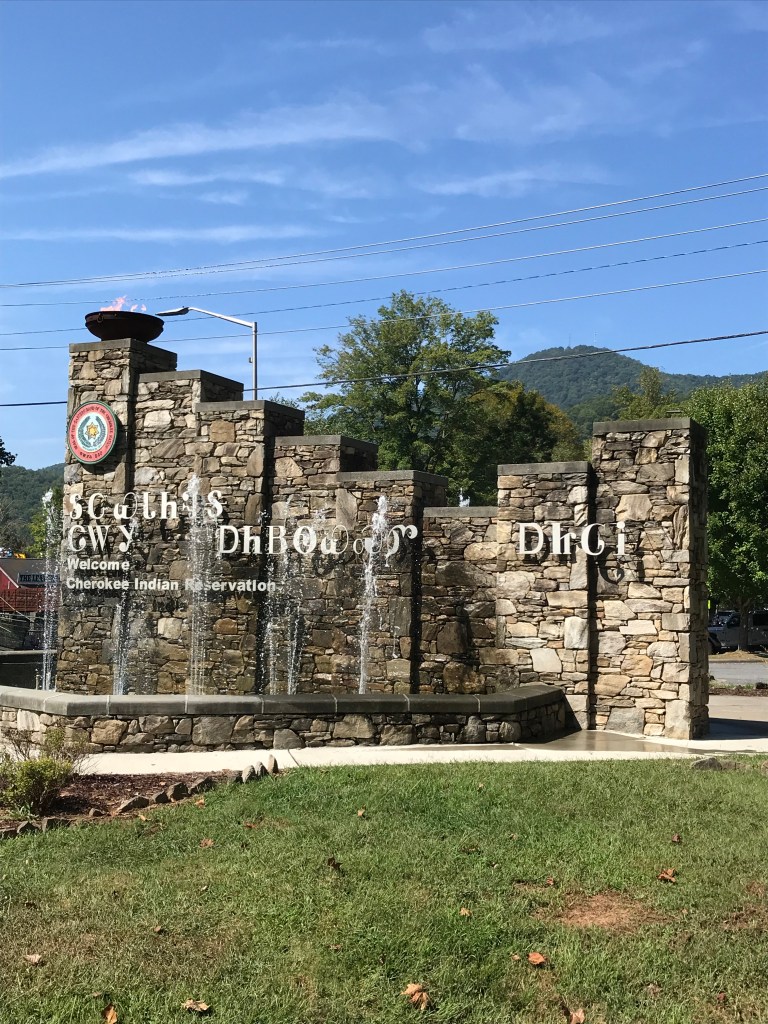
“Welcome to Cherokee Indian Reservation” sign in Cherokee and in English

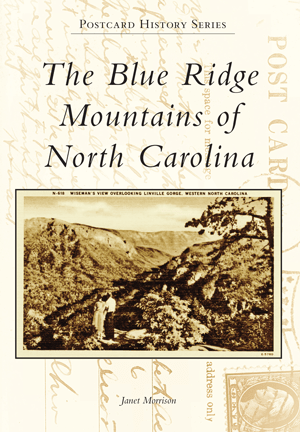
The Blue Ridge Mountains of North Carolina, by Janet Morrison

Since the park was included in my vintage postcard book, The Blue Ridge Mountains of North Carolina, I enjoy visiting the park to see what has changed and what has remained the same since my childhood and since my book’s publication in 2014.

Today and next Monday, I’ll share some highlights from my trip, including a few of the pictures I took. I’ll also include photographs of some of the vintage postcards from my book, which is pictured to the right.


Elk!

Elk were reintroduced into the Great Smoky Mountains in 2001 and 2002. I’d never seen an elk until this recent trip! What a thrill it was to see a herd of elk, including this buck, in the river that runs behind the Oconoluftee Visitor Center near the main North Carolina entrance to Great Smoky Mountains National Park just north of Cherokee, NC! This bull was a jaw-dropping sight as he surveyed his herd of female elk (cows) cooling off in this cool mountains stream. (It was late afternoon and in the mid-90s F.)

An elk bull in Great Smoky Mountains National Park

It is illegal to willingly get within 150 feet of an elk or black bear in Great Smoky Mountains National Park. Don’t worry, I was behind a fence that was guarded by a park ranger, and I used the zoom feature on my cell phone camera.

Sign reminding visitors that elk are back in the park.

For more information about the reintroduction of elk in Great Smoky Mountains National Park and the safeguards people should take when seeing them, go to https://www.nps.gov/grsm/learn/nature/elk.htm.


The Loop/Helix

One of the most famous construction features on US-441/Newfound Gap Road, which traverses Great Smoky Mountains National Park from one side to the other is “The Loop.” The highway tunnels under itself to form a helix.

Here are pictures of two of the three postcards of “The Loop” in my vintage postcard book.

This is a photo of a 1936 “real photograph postcard” of “The Loop” on Newfound Gap Road in Great Smoky Mountains National Park.
This is a photo of another 1936 “real photograph postcard” of “The Loop” on Newfound Gap Road in Great Smoky Mountains National Park.

The next two paragraphs are quotes from the captions I wrote for the three postcards on pages 80-81 of my book:

“Newfound Gap Road in Great Smoky Mountains National Park tunnels under itself, forming a helix. The design replaced two dangerous switchbacks on the old Tennessee Highway 71, which was built in the 1920.”

Signage to alert drivers that they are approaching “The Loop” on Newfound Gap Road in Great Smoky Mountains National Park

“These black-and-white glossy real-photo postcards were made in 1936. The Great Smoky National Park Roads & Bridges portion of the Historic American Engineering Record of the National Park Service gives many details about the Loop. Probably designed by Charles Peterson, the Loop was constructed in 1935 by C.Y. Thomason Company of Greenwood, South Carolina, at a cost of $77,644. Stone quarried nearby and reinforced concrete were used in the construction of the bridge portion, which is 95 feet long, 42 feet wide, and 21 feet high in the center of the arch.”

Since its construction in 1935, trees and other natural vegetation has been allowed to grow and flourish. I appreciate that; however, it makes it almost impossible now to fully see and admire this engineering feat. It might still be possible to see the entire Loop from Chimney Tops Mountain nearby, but it’s impossible to get a satisfactory photograph of it from ground level due to the trees. Therefore, I had to settle for the above picture of The Loop signage.

The first time I rode through The Loop was at the age of nine. It’s still a thrill, 57 years later!


Babbling Brooks

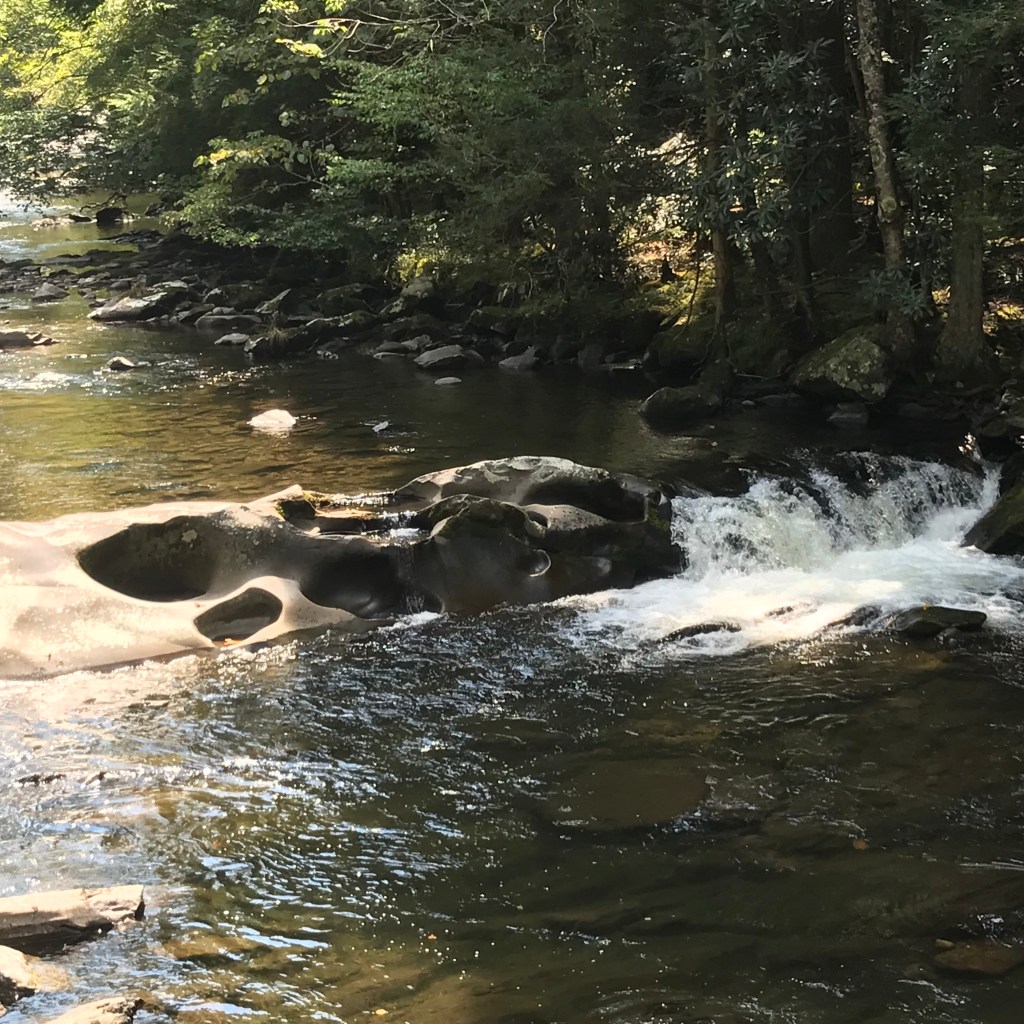
A stream in Great Smoky Mountains National Park

One of my favorite features in Great Smoky Mountains National Park is all the babbling brooks. Little River Road runs parallel to the Little River for many miles in the park between Sugarlands Visitor Center and Cades Cove. Little River and the other streams in the park are full of bounders and rocks of all sizes, indicating the history of these mountains from the Ice Age.

Another stream in Great Smoky Mountains National Park


Since my last blog post

It took much patience and persistence (and some grinding of my teeth), but I eventually worked out a new way of inserting photographs in my blog posts last Tuesday. What a relief, to be able to present today’s post and next Monday’s the way I had envisioned! I hope you enjoy the photographs today.

I had the opportunity to watch and listen to another free webinar about the craft of writing on Monday. It was about Author Accelerator’s “Inside Outline” tool. It piqued my interest. Of course, to use the tool I’d have to pay a fee, so I haven’t made that commitment. If you, like I, are learning to write a book, you might want to look into this tool at https://www.authoraccelerator.com/. The tool was developed by Jennie Nash.


Until my next blog post

I hope you have a good book to read. I’m reading The Ragged Edge of Night, by Olivia Hawker.

If you’re a writer, I hope you have productive writing time.

Thank you for reading my blog. You could have spent the last few minutes doing something else, but you chose to read my blog.

Watch for my blog post next Monday. It is a continuation of today’s post and will feature black bears, the double-peaked mountain called Chimney Tops, damage from the late November 2016 wildfires, babbling brooks, white clouds down in a valley one morning, and why the Great Smoky Mountains have that moniker.


A few words about my book

I hate to “blow my own horn.” I’d be remiss, though, if I didn’t take this opportunity to tell you how you can have your own copy of my vintage postcard book, The Blue Ridge Mountains of North Carolina, published by Arcadia Publishing in 2014.

Don’t let the name of the book fool you, it covers all the mountainous counties in western North Carolina and the three counties in eastern Tennessee that are partially in Great Smoky Mountains National Park.  Electronic and paperback copies are available from Amazon.com at https://www.amazon.com. Paperback copies are available from the publisher at https://www.arcadiapublishing.com/, at quality bookstores, or from me personally.


Let’s continue the conversation

Have you visited the Great Smoky Mountains? If so, what were your impressions of it? What was the highlight of your trip? Did you see any black bears? Did you see elk? Did you hike? Did you go camping? The recreational opportunities in the Great Smoky Mountains are unlimited! I’d love to hear about your experiences there.

Also, please let me know how you usually view my blog. Do you look at it on your desktop computer, on a tablet, or on your phone?

I’m trying to be more cognizant of the fact that a growing number of people are reading blogs on their phones. The layout of the blog translates differently on the various formats.

For instance, what looks good on a cell phone, doesn’t look quite as good on a desktop computer. Today’s blog post falls into that category. I’ve spent a lot of time on it, trying out “spacers” and “separators.” I’ve never used those tools before. Your patience is appreciated as I learn and experiment with some new blogging techniques.

Remember, I’m a writer — not a computer whiz. This is all part of my journey as a writer, which is what my blog is about.

Thank you for sharing my blog with your friends — in person and on social media!

Janet

19 Blue Ridge Mountains Trivia Answers

How many of the Blue Ridge Mountains trivia questions I asked in last week’s blog, https://janetswritingblog.com/2019/08/11/19-blue-ridge-mountains-trivia-questions/, were you able to answer?

#BlueRidgeMtnsOfNC #PostcardBook
The Blue Ridge Mountains of North Carolina by Janet Morrison

I indicated that all the answers could be found in the vintage postcard book I wrote, The Blue Ridge Mountains of North Carolina. These trivia questions (and the answers supplied in today’s blog post) are my way of celebrating the fifth anniversary of the publication of the book by Arcadia Publishing on August 25, 2014.

Here are the questions and answers

1.  Why was Grandfather Mountain named a member of the international network of Biosphere Reserves in 1992?  Because it supported 42 rare and endangered species. Just on that one mountain!

2. What does Linville Falls in North Carolina have in common with Niagara Falls?  They are both caprock waterfalls, meaning the top layer of rock is harder that the underlying stone. Erosion causes the waterfall to migrate upstream over time. It is believed that Linville Falls was once 12 miles downstream from its present location.

3.  How did Edwin Wiley Grove make his fortune which enabled him to build the Grove Park Inn in Ashevile, North Carolina?  He sold Grove’s Tasteless Chill Tonic.

4.  What part did the Civilian Conservation Corps (CCC) play in the construction of the Blue Ridge Parkway during The Great Depression?  The men who were members of the CCC assisted with the paving and landscaping of the Blue Ridge Parkway. What a magnificent gift they left us!

5.  When George W. Vanderbilt purchased Mt. Pisgah in 1897, what grand plan did the mountain become part of temporarily?  The 125,000-acre Biltmore Estate. (It’s no longer part of the estate.)

6.  What groups of people were housed at Assembly Inn in Montreat, North Carolina in 1942?  290 Japanese and German internees.

7.  Jerome Freeman bought 400 acres of land in Rutherford County, North Carolina that included the Chimney Rock around 1870 for $25. How much did the State of North Carolina pay for Chimney Rock Park in 2007?  $24 million.

8.  What new breed of hunting dog was developed by a German pioneer family in the late 1700s in the Plott Balsams subrange of the Blue Ridge Mountains?  The Plott Hound, which just happens to be the official State Dog of North Carolina.

9.  What is an early 20th century feat of engineering on the Newfound Gap Road in Great Smoky Mountains National Park?  The road crosses over itself. This example of a helix is called “The Loop.”

10.  How fast can a black bear run?   30 to 35 miles per hour.

11.  It is illegal in Great Smoky Mountains National Park to willfully get within how many feet of a black bear?  150 feet.

12.  What is the name of the 57,000 acres of land purchased by the Cherokee in the 1800s and held in trust by the United States Government?  Qualla Boundary

13.  Is Qualla Boundary technically a reservation? No, a reservation is land that the United States Government gives to an American Indian tribe. The Cherokees purchased their land.

14.  Did the Cherokee people lived in tipis in the 1700s and 1800s?  No, they lived in houses.

15.  What forest contains one of the largest groves of old-growth trees in the Eastern United States?  Joyce Kilmer Memorial Forest

16.  What hydroelectric dam was used in the 1993 Harrison Ford movie, The Fugitive?  The Cheoah Dam

17.  What is the tallest dam east of the Rocky Mountains in the United States?  Fontana Dam.

18.  One of the oldest postcards in my book is of Cullowhee Normal School in the mid- to late-1920s. What is the name of that school today?  Western Carolina University.

19.  Started in 1935, the Blue Ridge Parkway’s “missing link” was completed in 1987. What is the connecting one-fourth-mile long piece that filled the “missing link” called? The Linn Cove Viaduct.

How did you do?

How many of the 19 questions did you answer correctly? I hope you enjoyed trying to answer the questions and seeing the answers today. If you want to learn more about the mountains of North Carolina and eastern Tennessee, please ask for The Blue Ridge Mountains of North Carolina, by Janet Morrison, at your local bookstore, online at Amazon.com, or purchase it directly from the publisher at https://www.arcadiapublishing.com/. It’s available in paperback and as an ebook.

The contract I signed with Arcadia Publishing was for five years, so you’d better get a copy of the book while it’s still being published. I don’t know if my contract will be extended.

Since my last blog post

I’ve finally gotten into a rhythm for writing the scene outline according to C.S. Lakin’s template. It sounds backward to be writing the scene outline after writing the book, but the questions asked in the template, along with five questions I added after reading a couple of articles by Janice Hardy, are making every scene in the book stronger. It’s slow going, but well worth the time and effort.

Due to technical problems, I was unable to include images of any of the postcards from my book in today’s blog post.

Until my next blog post

If you’d like to follow me on Twitter, @janetmorrisonbk. If you’d like to follow my business page on Facebook, it’s Janet Morrison, Writer.

I hope you have a good book to read. I’m reading The Nickel Boys, by Colson Whitehead and still listening to Resistance Women, by Jennifer Chiaverini.

If you’re a writer, I hope you have quality writing time.

Thank you for taking the time to read my blog. You could have spent the last few minutes doing something else, but you chose to read my blog.

Let’s continue the conversation

Feel free to let me know in the comments section below or on Twitter or Facebook how you did on the trivia questions. If you have any other comments or questions for me about the Blue Ridge and Smoky Mountains, I’ll welcome and try to answer them.

Janet

19 Blue Ridge Mountains Trivia Questions

August 25, 2019 will mark the fifth anniversary of the publication of my vintage postcard book, The Blue Ridge Mountains of North Carolina. To mark this milestone, I’m testing your knowledge of some of the interesting facts I included in the book.

#BlueRidgeMtnsOfNC #PostcardBook
The Blue Ridge Mountains of North Carolina by Janet Morrison

The book covers the 23 westernmost counties in North Carolina and the three counties in eastern Tennessee in which a portion of the Great Smoky Mountains National Park is located. If you have the book, you have my permission to cheat. That’s only fair to those of you who purchased my book. I’ll ask a few questions. You’ll find the answers in my blog post on August 19, 2019.

Although most of the original postcards are in color, they appear in black and white in both of the book’s formats. I tried to include pictures of several of the postcards in today’s blog post, but due to technical problems I was only able to post one vintage postcard image.

Here are the questions:

1.  Why was Grandfather Mountain named a member of the international network of Biosphere Reserves in 1992?

#GrandfatherMtn #GrandfatherMountain
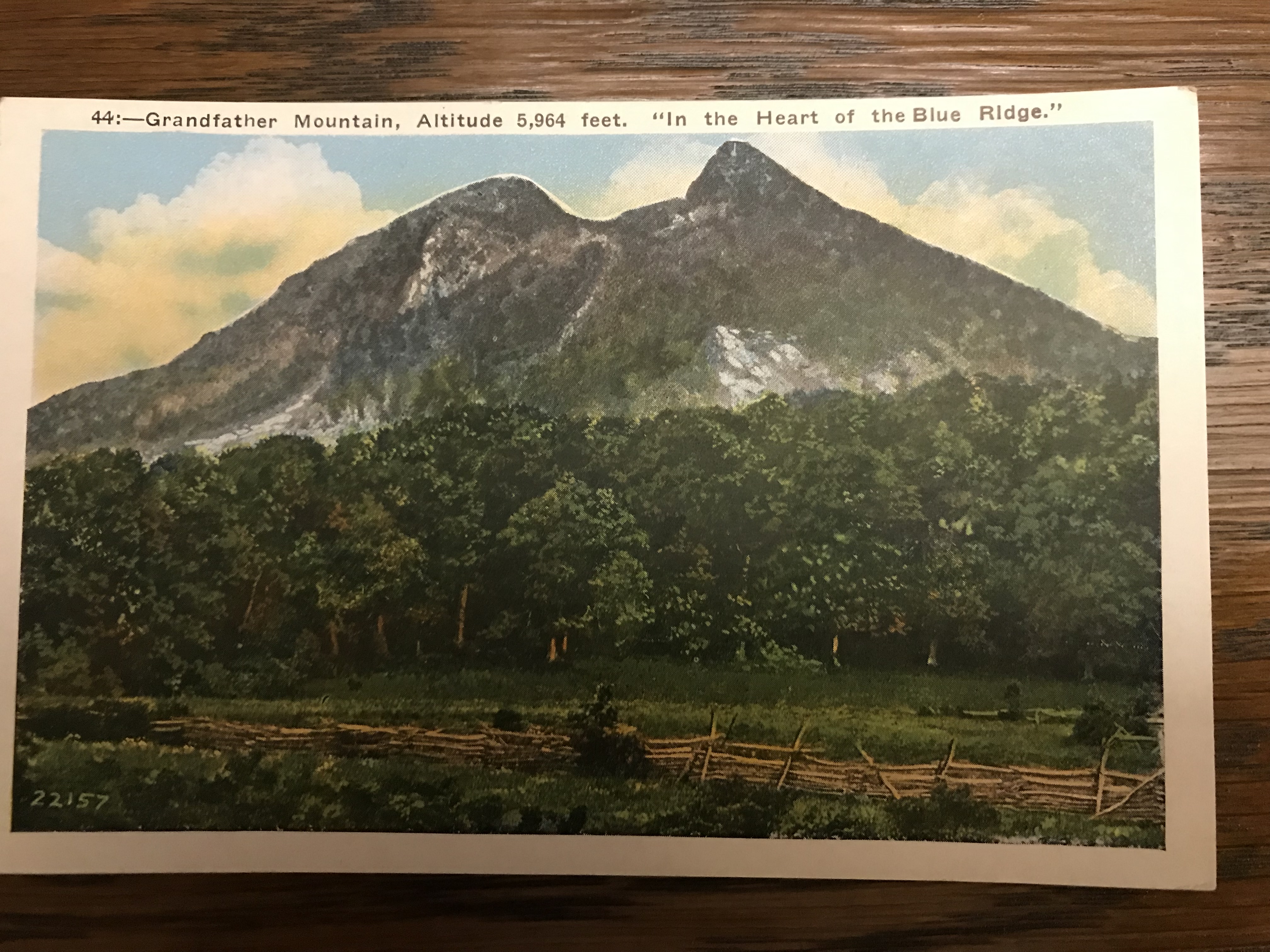
Grandfather Mountain, North Carolina

2. What does Linville Falls in North Carolina have in common with Niagara Falls?

3.  How did Edwin Wiley Grove make his fortune which enabled him to build the Grove Park Inn in Ashevile, North Carolina?

4.  What part did the Civilian Conservation Corps (CCC) play in the construction of the Blue Ridge Parkway during The Great Depression?

5.  When George W. Vanderbilt purchased Mt. Pisgah in 1897, what grand plan did the mountain become part of temporarily? 

6.  What groups of people were housed at Assembly Inn in Montreat, North Carolina in 1942?

7.  Jerome Freeman bought 400 acres of land in Rutherford County, North Carolina that included the Chimney Rock around 1870 for $25. How much did the State of North Carolina pay for Chimney Rock Park in 2007?

8.  What new breed of hunting dog was developed by a German pioneer family in the late 1700’s in the Plott Balsams subrange of the Blue Ridge Mountains?

9.  What is an early 20th century feat of engineering on the Newfound Gap Road in Great Smoky Mountains National Park?

10.  How fast can a black bear run?  

11.  It is illegal in Great Smoky Mountains National Park to willfully get within how many feet of a black bear?

12.  What is the name of the 57,000 acres of land purchased by the Cherokee in the 1800s and held in trust by the United States Government?

13.  Is Qualla Boundary technically a reservation?

14.  Did the Cherokee people lived in tipis?

15.  What forest contains one of the largest groves of old-growth trees in the Eastern United States? 

16.  What hydroelectric dam was used in the 1993 Harrison Ford movie, The Fugitive?

17.  What is the tallest dam east of the Rocky Mountains in the United States?

18.  One of the oldest postcards in my book is of Cullowhee Normal School in the mid- to late-1920s. What is the name of that school today?

19.  Started in 1935, the Blue Ridge Parkway’s “missing link” was completed in 1987. What is the connecting one-fourth-mile long piece that filled the “missing link” called?

In case you’d like to take the easy way out and find the answers to all these questions in one book, you may order The Blue Ridge Mountains of North Carolina, by Janet Morrison, in paperback or e-book from Amazon.com, request it at your local bookstore, or order it directly from https://www.arcadiapublishing.com/. Time is short. I’ll supply the answers in my blog post next Monday, August 19.

The contract I signed with Arcadia Publishing was for five years, so you’d better get a copy of the book while it’s still being published.

Since my last blog post

I discovered that the links that I had on my blog to my presence on several social media networks were not working properly, except for the one to my Pinterest account. Therefore, I removed the links to Facebook, Twitter, and LinkedIn. I’ll announce in a future blog post when those links are up and running again.

Until my next blog post

If you’d like to follow me on Twitter, @janetmorrisonbk. If you’d like to follow my business page on Facebook, it’s Janet Morrison, Writer. If you’d like to follow me on LinkedIn, go to https://www.linkedin.com/in/janet-morrison-writer.

I hope you have a good book to read. I’m reading Searching for Sylvie, by Jean Kwok.

If you’re a writer, I hope you have quality writing time.

Thank you for taking the time to read my blog. You could have spent the last few minutes doing something else, but you chose to read my blog.

Let’s continue the conversation

Please don’t include any of the trivia answers in your comments. If you want to indicate how many of them you think you know the answers to, you may indicate that number or the numbers of the questions you think you can answer.

Read my book or read my blog post next Monday for all the answers.

Janet