I write southern historical fiction, local history, and I've written a devotional book. The two novels I'm writing are set in Virginia and the Carolinas in the 1760s. My weekly blog started out to follow my journey as a writer and a reader, but in 2025 it has been greatly expanded to include current events and politics in the United States as I see our democracy under attack from within. The political science major in me cannot sit idly by and remain silent.
I didn’t want to post a blog on a Saturday, but here I am.
On Thursday, April 23, 2025, President Trump signed an Executive Order titled “Restoring Equality of Opportunity and Meritocracy.”
Under the guise of allegedly encouraging “meritocracy and a colorblind society, not race- or sex-based favoritism,” the order calls for an evaluation of all pending proceedings under the Equal Credit Opportunity Act (ECOA), which was passed in 1974 and was amended in 1976 to prevent lenders from discriminating against women based on marital status.
Only Congress can change the law, but an Executive Order muddies the water. If a lender chooses to follow the order, they can do so.
If a woman or a person of a racial minority thinks they have been discriminated against by a lender, they can file a complaint with the lender or thet can hire a lawyer and take their case to court. It could be years before the case is heard and settled. In the meantime, they did not get that credit card, or home improvement loan, or that loan that would have made it possible to buy a car or a home.
As reported by Newsweek, “The EO’s main target is the principle of disparate-impact liability, the idea that racism, sexism, or some other form of discrimination can occur without explicit intent. The President believes that disparate-impact liability is a key tool in a ‘pernicious movement’ that ‘endangers’ the U.S.’ foundational principle of ‘creating opportunity, encouraging achievement, and sustaining the American Dream.’”
In Trump’s mind, making sure that a dark-skinned person is not discriminated against equates with denying a white-skinned person being discriminated against. Or, the law making sure women are not discriminated against by financial lenders equates with denying men the opportunity to borrow money or get a credit card.
But that isn’t what it means at all!
Just because a woman gets approved for a loan does not mean that a man applying for a loan gets denied. There is enough pie for everyone who qualifies for a loan.
But this is all smoke and mirrors. Through Executive Order, Trump is putting dark-skinned people and women in their place. He is putting them at a disadvantage. He is denying them an equal opportunity to attain the American Dream.
That’s exactly what this is about. This is nothing but a white men’s backlash because some of them want to go back to “the good old days” when they didn’t have to compete with women or dark-skinned people. Some of them don’t want a level playing field.
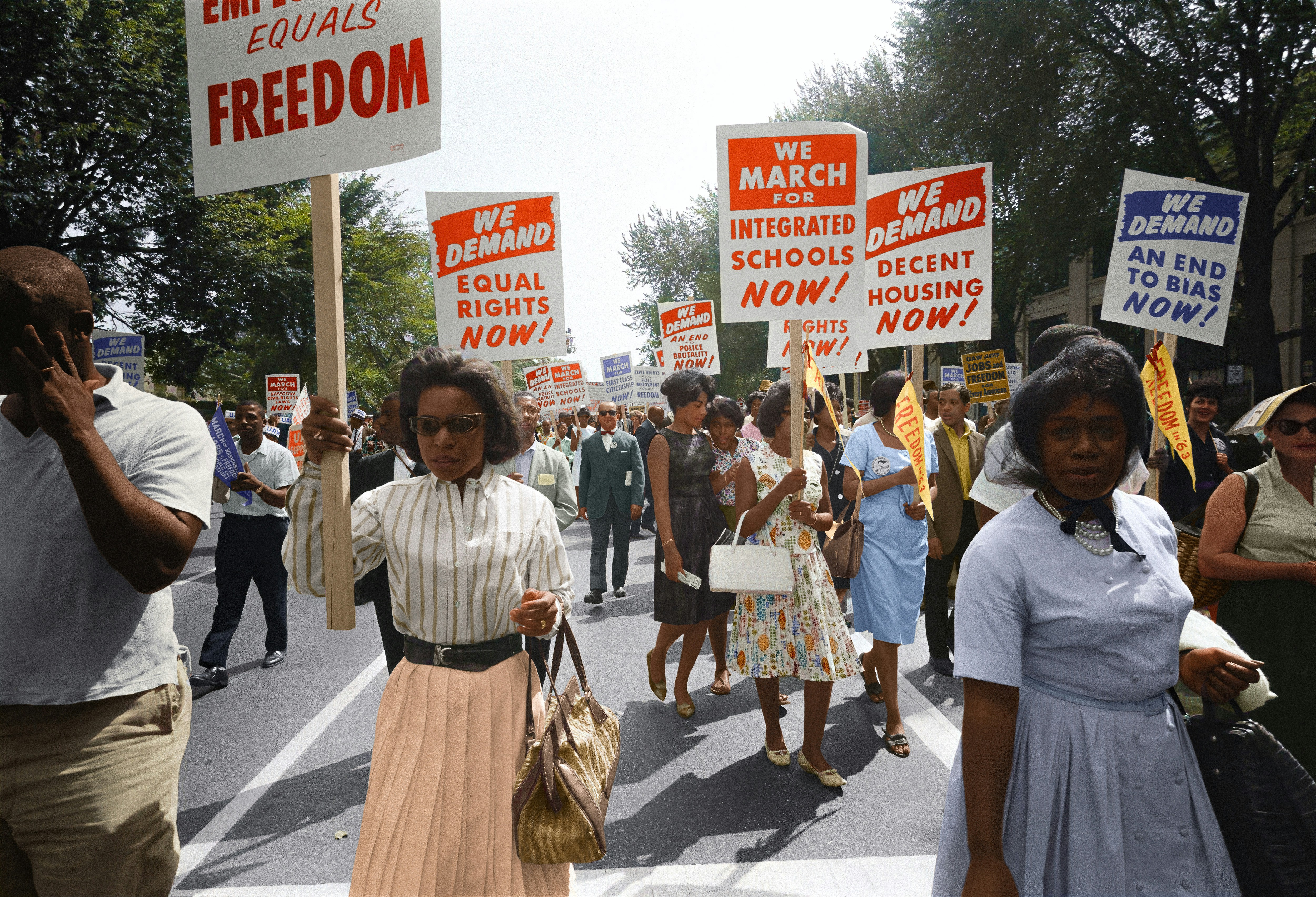
Photo by Unseen Histories on Unsplash
In case you are saying, “So what?”
In case any of this sounds all right or good to you, you are obviously not a woman “of a certain age” or a black person.
I am a white woman of a certain age, so I can and will speak to this. I grew up in the era in which women could not necessarily get credit or a loan without a man co-signing.
Women of a certain age know exactly what Trump’s end game is.
I was turned down for a credit card by a major gasoline company in the early 1970s, and the reason I was given was, “we don’t give credit cards to single women.” But who needs Exxon or Texaco? Amoco gave me a credit card and I was a loyal customer for years.
When I bought my first car (used) at the age of 22 in 1975 after earning a Bachelor’s degree, I was told by an agent for a nationally-recognized car insurance company that my rate for car insurance would be higher because I was a single woman. My father was with me, and this made him as mad as it did me. We stormed out of the insurance agent’s office. Rest assured, my father nor I ever considered doing business with Nationwide Insurance again.
I was interviewed for a job with the City of Charlotte in 1977 after I had earned a Master’s degree in public administration, and the interviewer said to me, “I don’t think a woman can handle this job.” My father had died. I was single. I was desperately looking for a job in my chosen field. Cities and counties weren’t exactly lining up to hire women for management positions. I didn’t want to burn my bridges, so I didn’t file a complaint.
I want women who came of age after the late 1970s to believe me when I say, “You don’t want to go back.”
Until my next blog post
Find time to read a good book and take a break from the chaos, but then come back and continue the fight for our democracy.
Remember the people of Ukraine, Myanmar, and western North Carolina.
I struggled to get any books read or listened to in October. It seems I spent too much time watching webinars about the craft of writing and picking up and burning the limbs that came down in our yard during Hurricane Helene.
We had no property damage, but when you live on several acres of big, old hardwood trees, this is a constant chore. Perhaps I need to add “Lumberjack” to my business card! (In case you’re wondering, I burned the limbs in a big, old, steel oil drum set on bricks on a crushed stone driveway, away from anything that could catch on fire.) Not exactly what I want to do with my time and energy, but….
The Three Books I Read Last Month:
Poster Girls, by Meredith Ritchie
Poster Girls, by Meredith Ritchie
This novel had special meaning to me because it is set in Charlotte during World War II. The specific setting is “The Shell Plant” – a 2,300-acre facility in south Charlotte where 75-millimeter anti-aircraft shells were assembled for the US. Navy around-the-clock from January 1943 until the end of the war.
The plant was operated by United States Rubber Company and employed 10,000 people. The book tells the story of the women who worked at the plant and how that was a huge cultural shift in the country during the war. Prior to the war, women were mostly relegated to jobs as nurses, secretaries, and teachers.
The book addresses the discrimination women employees face due to their gender, and how women can bond and work together against their common enemy: misogyny.
The book also addresses racial mores of the day, as it follows several black female workers and how they were treated by their white counterparts – both male and female. The black and white workers were segregated and the book explores what happens when attempts were made to break down racial barriers.
The book also addresses how these women, who had worked so hard on the home front to win the war while balancing raising children in the absence of husbands who were overseas for the duration of the war, had to adjust to the sudden post-war days when men returned from the military and women were no longer wanted or considered for work outside the home.
As a child in the 1950, I heard my parents make references to “the shell plant,” but I was too young to take an interest or ask questions about the facility. Not having lived through World War II, it all seemed like ancient history to me as a little child.
There has been a spate of World War II novels over the last few years and many readers are yearning for a new topic; however, I found this novel to be different from other war-era books because it explored some down-to-earth real issues women faced at that time.
Fire and Bones, by Kathy Reichs
Fire and Bones, by Kathy Reichs
This is the 23rd and latest novel in Kathy Reichs’ Temperance Brennan Series. I haven’t read all of them, but I have enjoyed the ones I’ve read.
Fire and Bones finds Tempe Brennan called away from her job at the Mecklenburg County Medical Examiner’s Office in Charlotte to help with an arson investigation in the Foggy Bottom section of Washington, DC. She stumbles upon a body in a burlap sack in the bowels of a burned building. As is prone to happen, she gets dragged more deeply into this investigation and a longer-than-anticipated absence from Charlotte than she wanted.
There is friction between Tempe and the DC police, and there is an awkward alliance formed between Tempe and a TV news anchor.
The references to Charlotte and this area were pluses for me. I think most people enjoy an occasional novel with locations with which they are familiar. It was coincidental that two of the three novels I read last month fell into that category.
Table for Two: Fictions, by Amor Towles
Table for Two: Fictions, by Amor Towles
I have enjoyed other books by Amor Towles, including A Gentleman in Moscow, so I looked forward to Table for Two – a book of short stories.
I made the mistake of trying to listen to Table for Two on CD. Since I don’t have consistent time in which to listen to a book, I found it difficult to keep up with which story I was listening to. This is not a reflection on the writing by any means. It is just my poor choice in how I chose to “read” the book.
I usually only get to listen to books now late at night when I’m tired, so I tend to drift off and miss key points. This is especially not ideal when listening to a recording of short stories. While I was distracted (or dozing off?) I sometimes found that I’d missed the end of one story and landed in the next story.
My favorite story in the collection was “The Ballad of Timothy Touchett.” I loved the humor and the fact that the main character was a writer trying to learn his craft. I could identify with that! The poor guy, though, gets sucked into a scheme of forging authors’ autographs.
I also enjoyed “Hasta Luego” in which a man finds himself befriending a stranger while stranded in a snowstorm. Things take a turn when he discovers his new friend has a drinking problem and the friend’s wife starts hounding him long-distance to do something about it.
“The Bootlegger” involves a couple attending a series of concerts and being stuck in seats next to a man who insists on illegally recording the performances.
“I Will Survive” was one of the weaker stories in the book. It is about a woman who is convinced her husband is having an affair. She recruits someone to follow him and report back to her. When the true is revealed, the story sort of fell flat for me.
I think I would get more out of “The DiDomenico Fragment” and “Eve in Hollywood” if I checked out the printed or Kindle book. I’ll get on the waitlist for one of those formats.
I’m pleased to be able to give a shorter hurricane recovery update today for western NC as we come up on the six-weeks anniversary of the storm.
Statistics: The death toll from Hurricane Helene in NC exceeds 100 now.
The estimated damage from Hurricane Helene in North Carolina is a staggering $53 billion.
Timber: I read that more than 800,000 acres of timberland in western NC sustained damage due to the 100-mph winds, torrential rain, and mudslides during the hurricane.
Roads: Interstates 26 and 40 are still closed near the TN line. Some 400 roads remain closed and 140 bridges are still in need of repairs or replacement.
Electricity: According to Duke Energy, “The remaining outages are largely concentrated in Bat Cave, Spindale, Lake Lure, Spruce Pine, Swannanoa, and other communities where there are broader recovery efforts due to catastrophic damage to buildings and infrastructure. We’re using helicopters and tracked vehicles to assist operations in the hardest-hit areas.” On the accompanying map, a strip from Hot Springs to Marshall was also shown as catastrophic damage.
Water system in Asheville: The City of Asheville is still under a Boil Water order. Water treatment and testing continue daily. Turbidity reports are moving in a positive direction. A Mama Bear and her cub took an interest in the treatment and testing activities at the North Fork Reservoir on Thursday.
Blue Ridge Parkway: There is no estimated reopening date for all of the beautiful parkway in North Carolina. Portions of it that are used by residents to get from one side to the other for work or school are receiving top priority in reopening efforts, so there are places where two-mile sections have reopened. Debris removal continues and much repaving is taking place. There are places where the roadbed itself is gone. If you’re planning a trip, visit https://www.nps.gov/blri/planyourvisit/roadclosures.htm is a great source for details of closures from milepost to milepost.
Public School Systems: Just to give you an idea about the recovery situation 39 days after Hurricane Helene hit western NC…
Avery County. Today and tomorrow are required teacher work days. School reopens for students on Wednesday on a two-hour delay with modified bus routes and pick-up/drop-off points.
All the affected counties continue to struggle with bus routes due to so many road closures.
Colleges and universities:
Lees-McRae College in Banner Elk: Classes will be conducted online through today.
Tourism: Towns are beginning to open back up to visitors, but many rural areas are still very much in recovery mode… and will be for months, if not years. Check reliable sources before making travel plans.
Until my next blog post
Pray for a violence-free Presidential Election Day in the US tomorrow.
I hope you have a good book to read.
Remember the people of Ukraine; western North Carolina; and Valencia, Spain. As western North Carolina slowly recovers from flooding, the Valencia region of Spain is in the early days of unimaginable flooding and destruction.





 Janet's Writing Blog