Books I Read in April 2024

As you will see from three of the four books I read last month, I chose to concentrate on my writing and historical research in April. Some of the following books might not pique your interest as a reader, but… you never know. I’ll start with the book that falls in a different category.


One Petal at a Time, by Joni Karen Caggiano
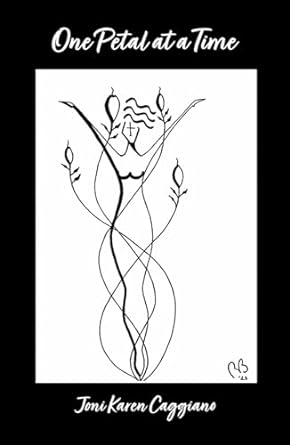
One Petal at a Time, by Joni Karen Caggiano

This is a book of poetry and prose written from the depths of pain and abuse. The writer bares her soul in her words earned from years of abuse by two alcoholic parents and further abuse from a male relative. It is difficult to read. I cannot identify with the horrors she writes about. I had a good life as a child and teen, and naively assumed everyone else lived in a calm, comfortable home with loving parents.

The silver lining in Ms. Caggiano’s book is that she eventually found love and has, as an adult, established a loving home for her own family. Others who have or are living in an abusive situation should find hope in Part 3 of this book and be inspired by her example, her statement of faith in God, and the fear that is no longer in her life. She is a retired nurse, a survivor, and an environmental advocate.

 The book cover and interior are masterfully illustrated with the exquisite art of Francisco Bravo Cabrera, who is also known as Bodo Vespaciano. Through black line art he captures the essence of Ms. Caggiano’s words.


Historic Shallow Ford in Yadkin Valley: Crossroads Between East and West, by Marcia D. Phillips

Historic Shallow Ford in Yadkin Valley: Crossroads Between East and West,
by Marcia D. Phillips

The Shallow Ford on the Yadkin River in North Carolina plays a role in the historical novel I’m writing, so imagine my excitement when I discovered this book. It was published in 2022 by The History Press.

The Shallow Ford was a natural crossing of the river and was used by thousands of pioneers traveling on the Great Wagon Road and by armies during the American Revolution and the American Civil War. It was, no doubt, used by native Americans for thousands of years before the era of European settlement.

If you are interested in how the piedmont section of North Carolina was settled, then this book is for you. It mentions the various roads and how roads sprang up from the Great Wagon Road to lead to other parts of the state and adjoining states for commerce.

I was most interested in the first sixty percent of the book for its research value for my writing; however, the entire book gives a detailed look at the settlement, cultural development, and industrial development of the Yadkin Valley, which is more of less the area of present-day Davie, Yadkin, and Rowan counties for the purposes of this book.

The Yadkin River is one of the major rivers in North Carolina. It drains the area from the Blue Ridge Mountains in the northwestern part of the state, through the lower piedmont – including where I live. At its confluence with the Uwharrie River it becomes the Pee Dee River, which is fed by the Rocky River and the Lumber River as it eventually flows into the Atlantic Ocean at Georgetown, South Carolina.

Written by “the keeper of the treasures in the Martin-Wall History Room at the Davie County Public Library,” the book is well-documented. In her work, Marcia D. Phillips had access to a wealth of local history sources as well as having the advantages of living in the area about which she wrote.

This book was a God-send for my research of the Shallow Ford of the Yadkin River.


 In the Hollow of Your Hand: Slave Lullabies, collected and sung by Alice McGill, pictures by Michael Cummings; musical accompaniment on enclosed CD by Nancy Krebs
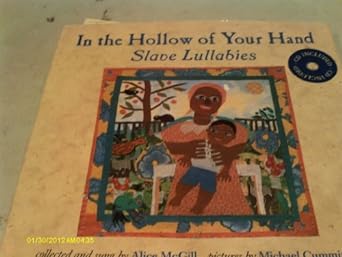
In the Hollow of Your Hand: Slave Lullabies,
collected by Alice McGill

This is a juvenile picture book that I happened upon at the public library in Charlotte while looking for documented American slavery songs as a part of my research for the historical novels I am writing.

Although it is classified as a Juvenile book, I thoroughly enjoyed it.

The fact that it includes a musical CD with the author giving some narrative and singing the songs that have been passed down through the generations of her North Carolina family is the icing on the cake!

The book and CD include thirteen lullabies endemic to the families of slaves. Each lullaby is beautifully illustrated in the African-American tradition by the artwork of Michael Cummings. The banjo having its roots in the Africans who were brought to the American colonies and states as slaves, it is fitting that Nancy Krebs accompanies Alice McGill’s singing by playing the banjo.

There is pain, sorrow, familial separation, the threat of being sold to another slaveholder, and even death in these lullabies. If not for writers like Alice McGill, these wonderful nuggets from American history would be lost forever.


Painting the Past: A Guide for Writing Historical Fiction, by Meredith Allard.

Painting the Past: A Guide for Writing Historical Fiction,
by Meredith Allard

My sister happened upon this book at the public library and brought it to my attention. It is a good book for someone beginning their journey as a writer of historical fiction and, at the same time, is a good book to remind a veteran historical fiction writer of why they do what they do.

Each chapter is introduced by a quote from a writer. I copied most of those quotes so I’ll have them as reminders when I question what I’m attempting to do as a writer.

The book talks about the joys and challenges faced by historical fiction writers, as well as our responsibilities. It addresses what constitutes historical fiction and how much leeway a writer has in sticking to the truth. A writer of historical fiction should always disclose what is fiction and what is fact.

The author talks about the importance of using trusted sources and how just because something is presented as a fact in a nonfiction book does not mean it is true. (That reminded me of something Sharyn McCrumb said in a speech I heard her make in Wilkes County, North Carolina many years ago. She said something like – and I must paraphrase here — some historical fiction is better-researched than some history books.)

The book addresses what historical fiction has in common with general fiction and how it differs. Lovers of historical fiction expect certain things in the novels they read, and it is incumbent upon the author to meet those expectations. If they don’t deliver, they lose all credibility.

I’ll close with a couple of quotes the author shared in her book. She quotes Guy Vanderhaeghe as follows: “History tells us what people do; historical fiction helps us imagine how they felt.”

And she quotes Isabel Allende as follows: “People have this nostalgic idea that the past was better, but the truth is most folks had very hard lives.”

Until my next blog post

I hope you always have a book that you can’t wait to get back to reading.

Appreciate friends and family.

Remember the people of Ukraine.

Janet

One Historical Fiction Misconception that Keeps You from Reading It

Not everyone wants to read historical fiction. I understand that. There are several fiction genres that I don’t enjoy, so I avoid them. There are too many books I want to read to take time to read genres that don’t appeal to me. For instance, horror.

I happen to like historical fiction, but there is one big misconception that might be keeping you from reading novels that fall in that category.

Okay, what is that misconception?

Since the word “fiction” is part of the name of the historical fiction genre, there is a misconception that novels in the genre are not historically accurate. If you read reputable historical fiction writers, you know that couldn’t be further from the truth.

The Ballad of Tom Dooley: A Ballad Novel, by Sharyn McCrumb

I had the privilege of hearing Sharyn McCrumb speak in conjunction with the publication of the ninth novel in her ballad series, The Ballad of Tom Dooley. Ms. McCrumb is a meticulous historical researcher. In her speech that day, she adamantly pointed out that some historical fiction books are better researched than history books.

That has really stayed with me more than a decade after hearing Ms. McCrumb speak.

When considering to read a historical novel, I suggest you turn to the back of the book and read the Author Notes. Very often there are several pages after the last chapter in the book in which the author explains her inspiration for the book and a bit of the research involved in writing the book.

The topic of literary license is often addressed in the Author Notes. Good historical fiction writers are transparent and quick to point out any instances in which they adjusted the time or place of an event to make the story flow more smoothly.

You might not be convinced yet to read historical fiction. You might think that just because historical novels contain conversations that cannot be documented, the book cannot be trusted as being true. If written by a conscientious writer, conversations and narrative in the novel will be true to the time and place to the best of the author’s ability. Keep in mind that it’s a work of fiction, and don’t get bent out of shape if some of the dialogue doesn’t ring true to you.

I write history and I write historical fiction. The research I do for the writing of historical fiction is just as detailed and important as the research I do for the writing of history.

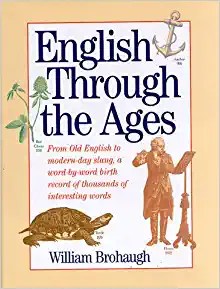
English Through the Ages, by William Brohaugh

You might be surprised to know that in the 1760s historical fiction I’m writing, I’m careful not to use words that were not in general use during that time. I keep English Through the Ages, by William Brohaugh within arm’s reach while I’m writing. Sometimes there is a perfect word I want a character to say but then I discover it wasn’t in general usage until later. I have to find another word.

And you thought I spent all my time just gazing out the window and eating bonbons!

Next week’s blog post topic

Next week I plan to blog about something that happened on October 31, 1849 in Cabarrus County, North Carolina. I wrote about it for a newspaper article a few years ago. I look forward to sharing a bit of that well-researched article with you on my blog.

Since my last blog

I’ve worked on my novel, The Heirloom, every day except yesterday. (I really try to set aside Sunday as a day of rest.) I feel great about how the manuscript is coming along. I’m really having fun with it, imagining myself on The Great Wagon Road in 1766.

I’ve made progress toward getting my website redesigned. I’m excited about that and will keep you posted.

I finished formatting Harrisburg, Did You Know?—Book 1 on Saturday. The proofreading will take another couple of weeks. By then, I hope to have a photograph to use for the cover. Everything seems to be falling in place within the publication schedule I set for myself. By this time next month, I hope to be close to it being available as an e-book.

A word about my blog

You might have noticed on my blog where it says “Join ___ other followers,” the number plummeted this week. I spent the better part of an hour in chat with WordPress tech support before they identified the cause.

The verdict was that the widget that enables me to show the number of followers on my blog changed last week without bloggers (or apparently tech support) being told.

On Wednesday it said, “Join 2,104 other followers,” but on Thursday night it said, “Join 988 other followers.” My heart sank! Tech support stayed on the case until it was determined that now the widget only displays the number of email and WordPress bloggers who follow me. It no longer includes the 1,000+ people who follow my blog on social media.

If you have a WordPress blog, did you notice this change?

Until my next blog

I hope you have a good book to read – and time to read it!

Remember the brave people of Ukraine.

Janet

“Not a rope . . . if drowning”

prayers-the-devil-answers-9781476772813_lg
Prayers the Devil Answers, A novel by Sharyn McCrumb

My blog post today takes a look at a line I like from a novel, Prayers the Devil Answers, by Sharyn McCrumb. Ms. McCrumb has mastered the art of capturing the independent spirit of the people of the southern Appalachian Mountains in the following sentence:

“Not a one of the folks from up there would ask for anything – not food if they were hungry, not a rope if they were drowning.”  From Prayers the Devil Answers, by Sharyn McCrumb.

How succinctly Ms. McCrumb gets to the core character of the people who live in those mountains and whose ancestors have lived there for up to 250 years! As a writer, I think anyone would be hard-pressed to state it any better.

What do you think?

Have a go at it. Try to write one sentence that sums up that southern Appalachian independent spirit.

Until my next blog post

I hope you have a good book to read. I just finished reading The Things We Keep, by Sally Hepworth and Fredrik Backman’s novella, And Every Morning the Way Home Gets Longer and Longer.

If you’re a writer, I hope you have productive writing time.

Janet

H is for Historical Fiction

This is the eighth day of the 2017 A to Z Blog Challenge, so I am writing a blog post that has something to do with the letter, “H.” I chose a topic I enjoy and one about which I try to learn more every day.

One of my dreams is to write a historical novel. The historian in me struggles with the fiction in historical fiction. The writer in me wishes I could run fast and loose with the facts.

Over the weekend, I did a lot of reading on the subject in preparation for writing today’s blog post. In the process, I found some information that shed more light on the historical event that serves as the basis for the novel manuscript I’ve been working on for the last decade or so.

The combination of the new information I found about that event when paired with some of the reading I did yesterday about the craft of writing historical fiction made my head spin. The combination of the two, in fact, has convinced me that I must start over writing my novel. Yes, you read that correctly. I must start over.

When I mapped out my topics for this A to Z Blog Challenge two or three weeks ago, I thought “H” was a no-brainer. I could write about historical fiction. Today’s post would be one of the easier ones of the 26 letters of the alphabet. That’s laughable now, except I don’t feel much like laughing.

I won’t see The Spanish Coin in print. Not in its present form. Probably not in any form or with that title. I will, however, be able to use parts of it and characters from it.

None of my research has been in vain. Nor has any of my writing. Any time spent writing is beneficial. Writing is an exercise of “muscles” in the brain. Like any other muscles in the body, if not used they weaken and eventually cease to work.

The bad news is that I have to start over. The good news is that I get to start over. Today I get a fresh start.

I’m certainly not the first writer who never got her first novel published. There are numerous stories about first manuscripts being lost. Some succumbed to fire, while others were mistakenly left on a train and were never seen again. Many first manuscripts get rejected so many times by publishers that the writer eventually puts it away and moves on to another novel. Most writers have had to start over. That is what I will do, and I believe the end product will be better than The Spanish Coin manuscript.

Historians, as a rule, look at historical fiction with disdain. I want to be a historical novelist whose work is respected even by historians. Something I learned from historical fiction author Sharyn McCrumb and from author James Alexander Thom is that historical fiction can be just as — or even more — accurate than a history textbook.

History contains many errors because each person sees the same incident differently or remembers it differently. History textbooks contain errors and are biased depending on the agenda of the writer(s), the publisher, or the state school board or local school’s decision makers selecting the curriculum. History books are usually written by someone on the winning side of a war. The viewpoint of the losing side is rarely given or, if it is, it is what the winner thinks the loser thought or believed.

James Alexander Thom quotes author Lucia Robson in his book, The Art and Craft of Writing Historical Fiction as he wrote the following:

“Lucia Robson’s facts can be trusted if, say, you’re a teacher assigning her novels as supplemental reading in a history class. ‘Researching as meticulously as a historian is not an obligation but a necessity,’ she tells me. ‘But I research differently from most historians. I’m look for details of daily life of the period that might not be important to someone tightly focused on certain events and individuals. Novelists do take conscious liberties by depicting not only what people did but trying to explain why they did it.’”

writing~~element3

Mr. Thom also wrote in that same book about writing historical fiction:

“To be really good historical novelists, though (and that’s what I want us to be), we have to take our obligation to historical truth just as seriously as the historians do theirs.”

He also wrote,

“But here’s the key:  Whether your historical story is ancient or recent history, what you want to do is re-create it in full – live, colorful, smelly, noisy, savory, painful, repugnant, scary, all the ways it actually was – and then set the reader down smack in the midst of it.”

Many years ago, I read Follow the River, by James Alexander Thom. His writing was so good that I felt like I was in the story. I felt like I was Mary Ingles, the main character.

If I’m going to write historical fiction, this is my challenge: Get all the facts right, as far as research makes that possible, and flavor the story with believable dialogue and enough authentic background to make my reader feel like he or she is there.

The story I want to write takes place in the Carolina backcountry in 1771. In order to take my reader there, I must go there. I must be there.

Until my next blog post

Please hang in there with me. I’ve always thought of my blog as a way to take readers along on my journey as a writer. The road is not straight. It contains many curves, hill, and potholes. Yesterday I ran up on an unexpected detour.

As a traveler, I don’t like detours. I’m the type person who drives other people crazy. I map out the entire trip in advance. I have a daily itinerary planned. I leave little time for serendipity. That’s the way I plan vacations and yet, when I look back on the best trips of my life, it is the ones that weren’t so rigidly planned that I enjoyed the most.

Fasten your seatbelts, because this writer’s journey just got a lot more exciting and uncertain!

Janet

Save