#OnThisDay: Various Events, including Black Sunday, 1935

I was determined to stick to my editorial calendar for my blog and my blog’s original objectives of sharing with you my journey as a writer and a reader. I hope to someday get back to writing historical fiction, so I want to demonstrate my knowledge of history through some of my blog posts.

As I edited today’s blog post on Saturday, though, today’s topic seemed unimportant. As learned that the Trump Administration declared 6,100 people dead who are still very much alive, I wondered if I should just delete today’s post.

I wondered what difference history makes in a world where the President of the United States through his appointees can declare people he doesn’t like to be dead.

But I had spent time doing some research, so here is the blog post I had scheduled months ago for today. Months ago, when life was simple. I just didn’t realize how simple and good things were a few months ago.

On April 14 in history

Many things of note have happened on April 14 throughout history. I’m listing a few of them in today’s blog post, and then I’ll concentrate on what’s known as “Black Sunday” from 1935.

Lincoln Assassination, 1865

Volumes (literally) have been written about US President Abraham Lincoln being shot in the head by John Wilkes Booth on April 14, 1865. There is nothing I can offer that you don’t already know.

RMS Titanic, 1912

The RMS Titanic hit an iceberg off Newfoundland at 11:40 pm on April 14, 1912, and sank a few hours later.

Bacteria that causes Typhus Fever was isolated, 1914

On April 14, 1914, Dr. Harry Plotz isolated the bacteria that causes Typhus at Mt. Sinai Hospital in New York City.


Black Sunday, 1935

“What was Black Sunday?” you may ask.

Was it a day when the stock market tanked? Was it a day like the day after Thanksgiving, which is now known in the US as Black Friday because it kicks off the Christmas shopping season?

No, Black Sunday in 1935 was the day when a “mountain of blackness” swept across the High Plains of Oklahoma and Texas and turned a beautiful spring afternoon into the blackness of the darkest night.
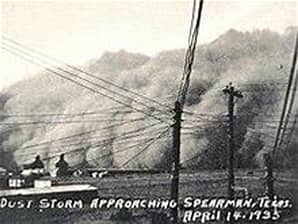
That’s not a mountain; that’s a wall of the approaching dust storm!

The Great Depression was dragging on and relentless drought pushed farmers and everyone to the breaking point. Farmers saw their top soil literally get blown away. Rain didn’t come, so there was no point planting another crop.

Here’s a quote from the National Weather Service website (https://www.weather.gov/oun/events-19350414) which was still accessible on Saturday. I hope it will still be there when I post this on Monday morning. The way US Government websites, webpages, and agencies keep disappearing, though, nothing can be counted on anymore.

“The wall of blowing sand and dust first blasted into the eastern Oklahoma panhandle and far northwestern Oklahoma around 4 PM. It raced to the south and southeast across the main body of Oklahoma that evening, accompanied by heavy blowing dust, winds of 40 MPH or more, and rapidly falling temperatures. But the worst conditions were in the Oklahoma and Texas panhandles, where the rolling mass raced more toward the south-southwest – accompanied by a massive wall of blowing dust that resembled a land-based tsunami. Winds in the panhandle reached upwards of 60 MPH, and for at least a brief time, the blackness was so complete that one could not see their own hand in front of their face. It struck Beaver around 4 PM, Boise City around 5:15 PM, and Amarillo at 7:20 PM.”

Black Sunday prompted the writing of songs and the day after “Black Sunday” the region began to be referred to as “The Dust Bowl.”

How The Dust Bowl Got its Name

Associated Press reporter Robert E. Geiger and his photographer Harry G. Eisenhard were in Oklahoma on April 14, 1935. The dust storm engulfed them six miles from Boise City. They had to wait it out for two hours before they could return to town.

Geiger penned an article for the Lubbock Evening Journal the next day. It opened with, “Residents of the southwestern dust bowl marked up another black duster today.”

Where did some of The Dust Bowl dust go?

Some of it quite literally ended up in Washington, DC in March 1935 while Hugh Hammon Bennett, one of President Franklin D. Roosevelt’s advisors was testifying before Congress to get some relief for the vast midsection of America that was in a dire situation. The sun was blotted out by dust from the Great Plains  during his testimony. He could have pointed out the window and pointed to it if there had been a window in the room. Before the end of 1935, Congress passed the Soil Conservation Act.

If you want to read an historical novel about The Dust Bowl…

Reading about Black Sunday reminded me of The Four Winds, a novel by Kristin Hannah. I wrote about reading it in March 2021 in my April 4, 2021 blog post, 6 Books I Read in March 2021.

And The Grapes of Wrath, by John Steinbeck, is a classic.


Hurricane Helene Update

As of Friday, 108 roads in North Carolina were still closed due to Hurricane Helene. That is a decrease of a whopping 31 roads since the Friday before! This count includes seven US highways, 12 state highways, and 99 state roads. Although technically “open” now, I-40 in Haywood County is still open for just one lane in both directions with a 35 mile-per-hour speed limit.

There are still no estimates of when all of the Blue Ridge Parkway will reopen.

I know it snowed in New York this weekend, but it is spring here in North Carolina. People are eager to visit our mountains again to support local small businesses and artisans. Check online sources for recovery efforts in the areas and towns you want to visit. For instance, the town of Chimney Rock is still closed, and Chimney Rock State Park is still closed.

The small businesses in our mountains desperately need our business, so please plan your getaways accordingly. Instead of packing your traditional picnic items, this is an important time to support locally-owned and -operated restaurants and food-producing companies.

Support the incredible western NC arts community. There are quilts and a multitude of fiber arts items made here, as well as pottery, glass-blown items, corn shuck dolls, jewelry, woodworking, etc.

There are also craft shops in many small towns and scattered across the mountains where you can find handmade items of high quality.

The Folk Art Center on the Blue Ridge Parkway at Asheville is a must-see gem if you are looking for items made by members of the Southern Highlands Craft Guild. It is located at Milepost 382. It can be reached via the Blue Ridge Parkway access from US-70 near the Asheville Veterans Administration Medical Center.

The Folk Art Center was opened in 1980 as a cooperative effort between the Guild, the National Park Service and the Appalachian Regional Commission. The center is open year-round except for Thanksgiving Day, Christmas Day, New Year’s Day, and times during a US Government shutdown when the US Congress is unable to pass a federal budget.

When planning your trip to the mountains (or to any part of North Carolina) this is a helpful website to visit so you can anticipate road closures: https://drivenc.gov/.


Until my next blog post

This is Holy Week in the Christian faith. Next Sunday is Easter. I saw an ad online for a wreath that was supposed “to make my Easter more meaningful.” The wreath was a red, white, and blue Bald Eagle configured into a circle. If someone thinks the Bald Eagle or the colors of the American flag have anything to do with the Resurrection of Jesus Christ, they have missed the entire point of Easter!

I hope you have a good book to read.

Keep friends and family close to your heart

Remember the people of Myanmar (because the US Government isn’t helping the earthquake victims!), Ukraine, and western North Carolina.

Janet

A Recent Attack on an Historical Novel

Here I go again, blogging about book banning. It’s too important to sweep under the rug.

Today’s blog post is longer than most of mine, but this is a topic that is near and dear to my heart. It is a topic that is indicative of the trouble our world is in today.

A small but vocal segment of our society believes it is wrong to teach young people about slavery, the Holocaust, or any part of history that makes them uneasy. They start by asking that books be removed from public school libraries and classrooms. They complain if certain books and plays written by Shakespeare are read in the classroom or assigned as required reading. Then they move on to public libraries. Then they start attacking authors and book publishers.

They believe that their freedom of speech trumps my freedom to read. They believe they have the right to deny you and me the right to read anything we want. Some of them don’t mind using violence to get their point across.

Photo by Kristina V on Unsplash

As I stated in an earlier blog post, they have the right to regulate what their own children read, but they don’t have the right to deny my great-nieces the right to read what they want and need to read.

Where does it end? Just look at 1930s Germany, if you want to know. Just look at countries where groups like the Taliban have gained political control.

It’s time for reasonable people to pay attention

I hear too many people say, “I never use the public library. I buy the books I want to read.” As a writer, I want people to purchase my books. I also want public libraries to purchase my books. But that’s not the point.

The point is that public libraries are integral to the very foundation of our country and our society. I read an article last week that quoted the American Library Association (ALA) as reporting that book challenging at public libraries in 2022 amounted to 16% of all book challenges in the United States, but in 2023 public libraries are receiving approximately 50% of the book challenges in the US.

Let that sink in. Also, let it sink in that the Proud Boys have disrupted reading hours at public libraries and librarians have received death threats. Is that what you want at your local public library?

Well-meaning, misguided people are taking away your right to read. Many of them are even doing it in the name of God. It makes them feel good to say that. It makes them feel good to say they’re doing it “to protect the children.”

I understand the need for age-appropriate books; however, today’s right-wing activists are hiding behind that political campaign sound bite and are using it to nitpick and challenge every book that comes down the pike. Their “holier than thou” attitude is wearing thin with me.

They’re on a mission to dumb us down, to dictate what we can and cannot have access to, to limit our intellectual potential. They are on a mission to erase the ugly and uncomfortable parts of our nation’s history.

Many historical novels have been challenged and banned in various places over the years, and it seems like all fiction is fair game for the book banners today. In my blog post today I highlight three historical novels that have been challenged and banned in various locations.

These three immediately came to mind

To Kill a Mockingbird, by Harper Lee
Beloved, by Toni Morrison
The Grapes of Wrath, by John Steinbeck

I have read each of those novels and not one of them warped my mind. Were you damaged by reading any of these novels? I doubt it. Were you moved to understand and see the world differently by reading these novels? Probably.

To Kill a Mockingbird teaches us about racial discrimination and injustice while also teaching us that Atticus Finch had integrity and maybe we should, too.

Beloved teaches us about the horrors of slavery and that the horrors did not end with the Civil War. It teaches us the lengths desperate people will go to prevent their children from being enslaved and living in horrible circumstances. That’s being demonstrated daily at the US-Mexican border.

The Grapes of Wrath teaches us what can happen after a decade of affluence and decadence and a time of drought as it illustrates a side of life during The Great Depression.

It’s one thing to read that thousands of people lost their farms and everything they had during the “Dust Bowl,” but it’s altogether different to read The Grapes of Wrath and live with the novel’s characters.

The Snow Forest, by Elizabeth Gilbert

In July of this year, an historical novel scheduled to be released in February 2024 was attacked on the author’s Goodreads account to the point that she chose to cancel its publication.

Elizabeth Gilbert, who wrote Eat, Pray, Love had written a novel set in Russia in the 1930s. With all the current interest in the war in Ukraine today, it would seem an opportune time to release a book set in 1930s Russia.

But author Elizabeth Gilbert learned that was not the case. She got so much blowback from her fans, that she pulled The Snow Forest even after some of her readers had pre-ordered the book. Her fans in Ukraine (or at least enough of them) said it was not the right time to release a book set in Russia. In response, the author suspended the publication of the book.

Author Alina Adams’s Thought on this

I read a blog post by author Alina Adams who was born in Odessa, Ukraine. Ms. Adams’ post maintains that historical fiction can make an important statement about the world and not just be a source of entertainment.

Ms. Adams wrote, “And as someone who loves to read historical fiction taking place all over the world in all sorts of different time periods, I am wary of a mindset which might lead to authors and publishers censoring themselves, shying away from setting stories in regions where there is ongoing political strife.”

In addition to specific examples of historical novels that have been challenged and banned, Ms. Adams’ blog post contained several succinct statements about the potential historical fiction holds, including the following: “Sometimes, historical fiction can tell a truth non-fiction isn’t equipped to deliver.” Also, “It doesn’t just make you think, it makes you feel. And it makes you empathize.”

My thoughts on this

Reading an historical novel might not change your political stance or religious beliefs but, if you give it a chance, it just might help you see the other side of an issue.

It might at least help you realize that people with views that oppose yours are not necessarily your enemies. They just might be human beings with a different perspective and life experience.

Please take a couple of minutes to read Alina Adams’ complete blog post from July 27, 2023 on M.K. Tod’s blog, A Writer of History: Why Historical Fiction Must Keep Tackling Controversial Topics | A Writer of History.

A quote from author Barbara Kyle

I printed this quote from Barbara Kyle and have it taped to my computer:

“The move to self-censorship for fear of ‘cultural appropriation’ is a sad state of affairs. Author Morgan Jones eloquently champions the opposite position: ‘Fiction remains the best means we have of finding connection where there seems to be none; and the novel, of all forms, encourages a search that’s deep and sustained. By reading (or writing) one, you’ve travelled somewhere else. You’ve moved, if only slightly, toward others. In a world that finds and increasingly exploits division and difference, this is an invaluable, precious exercise.”

Since my last blog post

Marie and I finished proofreading and creating the cover for our upcoming cookbook, The Aunts in the Kitchen: Southern Family Recipes. We submitted it to Amazon on Friday and requested a proof copy. It should arrive this week and, if we are pleased with it, we’ll give Amazon the go ahead to publish it. Look for an update and perhaps a cover reveal in next Monday’s blog post.

Until my next blog post

Be aware of what is going on in your community and state related to book challenges and book bannings. Speak up for books. Speak up for the freedom to read. Speak up for public libraries and librarians.

Have you ordered my American Revolution e-ghost story?  “Ghost of the Battle of Guilford Courthouse: An American Revolutionary War Ghost Story” is available from Amazon, along with my other books: https://www.amazon.com/dp/B0CH7JCP11/. It’s only available as an e-Booklet.

“Ghost of the Battle of Guilford Courthouse: An American Revolutionary War Ghost Story,” by Janet Morrison

If you don’t have a good book to read, visit your local public library. Or, from the comfort of your home, go to its website and search for books you would like to read or subjects you want to learn more about. You will be amazed at what is available at your fingertips!

Take time for friends and family.

Thank you for taking time to read this long blog post.

Remember the people of Ukraine, Maui, Libya,….

Janet