A “rocky” start for Charlotte Motor Speedway in 1960

When I wrote local history articles for a newspaper a few years ago, I wrote one about the building of the Charlotte Motor Speedway and another one about the first NASCAR World 600 which was run in 1960.     

It was a big deal in my childhood when the speedway was built way out in the country, miles from Charlotte. It’s not out in the country any more, due to residential and business development encroaching from all sides. Numerous NASCAR racing teams built their offices and shops in the area.

The Charlotte Motor Speedway complex of today dwarfs the original track and grandstands. The racing industry continues to be an important component of the local economy. There will be three races held here this weekend: a 200-mile race on Friday, a 300-mile race on Saturday, and a 600-mile race on Sunday. The 600-mile race on Sunday is the longest race in the NASCAR circuit. It is a 1.5-mile oval track.
Photo by Frank Albrecht on Unsplash

It seems a waste, when people are struggling to pay for gasoline for their cars so they can commute to work, but it is what it is… and voicing concerns about an obscene waste of fuel for a motorsport is frowned upon in these parts.

History of the property

The location of the speedway holds a lot of history. It was built on the former plantation of Col. Moses Alexander. George Washington stopped by Col Alexander’s home on May 29, 1791, for a meal during his post-Revolutionary War tour of The South.

The area is known for having a lot of boulders. It is on the edge of a 22-mile syenite or ring dike. A syenite or ring dike/dyke is a circular dike around a volcano.

I am no expert on volcanoes, but what I have pieced together is that ring dikes form when there is no longer liquid holding the volcano up. The volcano collapses. When magma squeezes up in the cracks and faults in the collapsing volcano, ring dikes form.

It is an interesting geologic formation. In my research for writing the three-part series “Our 22-Mile Ring Dike” for the newspaper, I learned that there are also ring dikes in the White Mountains in New Hampshire, as well as in Africa, Australia, Scotland, and Scandinavia.

What is left inside the ring dike is a sunken area that resembles a bowl. There are places along the edge of the ring dike here where you can see long distances – more than 20 miles, while line-of-sight is limited within the “bowl.” Our ring dike was studied by U.S. Geological geologists Harry E. LeGrand and Henry Bell III in 1966.

Back to the speedway’s construction…

I mention the boulders and the ring dike because this became quite a problem when construction of the speedway was attempted. Anyone familiar with the community could have told them they were going to run into a lot of rocks and a lot of boulders.

The frustrated contractor, W. Owen Flowe, was quoted in the news media as saying, “You could have blindfolded me and dropped me in the mountains of Buncombe County and I could have picked an easier spot to build a race track.”

As if digging into tons of rocks was not enough to slow down construction, it snowed every Wednesday in March in 1960. The 19 inches of snow and additional rainfall made for a soupy construction site.

With the first World 600 race scheduled for Memorial Day weekend in May, the construction delays created headaches for everyone involved.

With the asphalt track not poured and the concrete grandstands not completed, on May 19, it was announced that the May 29 race had been postponed until June 19, 1960.

Fast-Forward to the 1960 World 600

Portions of the asphalt track broke down during qualifying, resulting in repairs being made right up until the night before the June 19, 1960 race. Most drivers sustained broken or cracked windshields while trying to qualify for the race. At least five race cars were outfitted with sheet metal to protect oil pans and gas tanks from flying rocks.

The original grandstands were built to accommodate 32,000 spectators, with room for 8,000 more in the infield. That first World 600 saw $107,775 awarded to the winners and top drivers. The winner, Joe Lee Johnson, took home $25,640 plus $480 for leading 48 laps.

Fast-Forward to the 2026 Coca-Cola 600

The annual 600-mile race is now sponsored by Coca-Cola, so it is the Coca-Cola 600.

It is highly unlikely that the asphalt track will fail or there will be flying rocks encountered during the race.

The 600-mile race draws 100,000 to 120,000 on-site spectators now in addition to a television audience of several million. There will be fans in attendance from all over the world.

The total purse for the 2026 Coca-Cola 600 is $13,855,363. The winner will take home $200,000 to $250,000. When I looked into it, I discovered that the $25,640 won by Joe Lee Johnson in 1960 would be the equivalent of more than $256,000 today.

Want to know more?

Harrisburg, Did You Know? Cabarrus History, Book 1 includes my articles about the Charlotte Motor Speedway and the 1960 World 600 NASCAR race, along with 89 other local history newspaper columns I wrote from 2006 through September 2009.

Harrisburg, Did You Know? Cabarrus History, Book 1, by Janet Morrison

Harrisburg, Did You Know? Cabarrus History, Book 2 includes my three articles about the 22-mile ring dike in Cabarrus County, NC along with the other 81 newspaper columns I wrote from October 2009 through December 2012. Book 2 also includes my research notes on topics I did not get to write about when the newspaper suddenly ceased publication.

Harrisburg, Did You Know? Cabarrus History, Book 2, by Janet Morrison

My books are available in paperback and e-book from Amazon and are also available in paperback at Second Look Books in Harrisburg, NC.

Janet

All history is local, but no history is just local

The Coming of the Railroad in 1854

I wrote a local history column for Harrisburg Horizons newspaper from May 2006 through December 2012. Before you residents of Harrisburg, Pennsylvania get too excited, I will clarify that this free weekly newspaper existed in Harrisburg, North Carolina.

Of the 175 newspaper columns I wrote, six were a series of articles I wrote about “The Coming of the Railroad.” This is an important local topic for without the North Carolina Railroad there would be no Town of Harrisburg, NC today.

It’s hard to imagine the town without a railroad today, even though in an effort to establish “high-speed” rail between Charlotte and Raleigh, the at-grade railroad crossings in Harrisburg were replaced with bridges in 2013. That’s a story for another day.

Imagine a rural farming community in 1854, about halfway between Charlotte and Concord. Was everyone excited about the coming of the railroad? Farmers were probably not happy about the piercing whistles of the steam engines scaring their livestock, but they were possibly pacified by the fact that the depot planned for the community would give them a convenient way to sell their agricultural products.

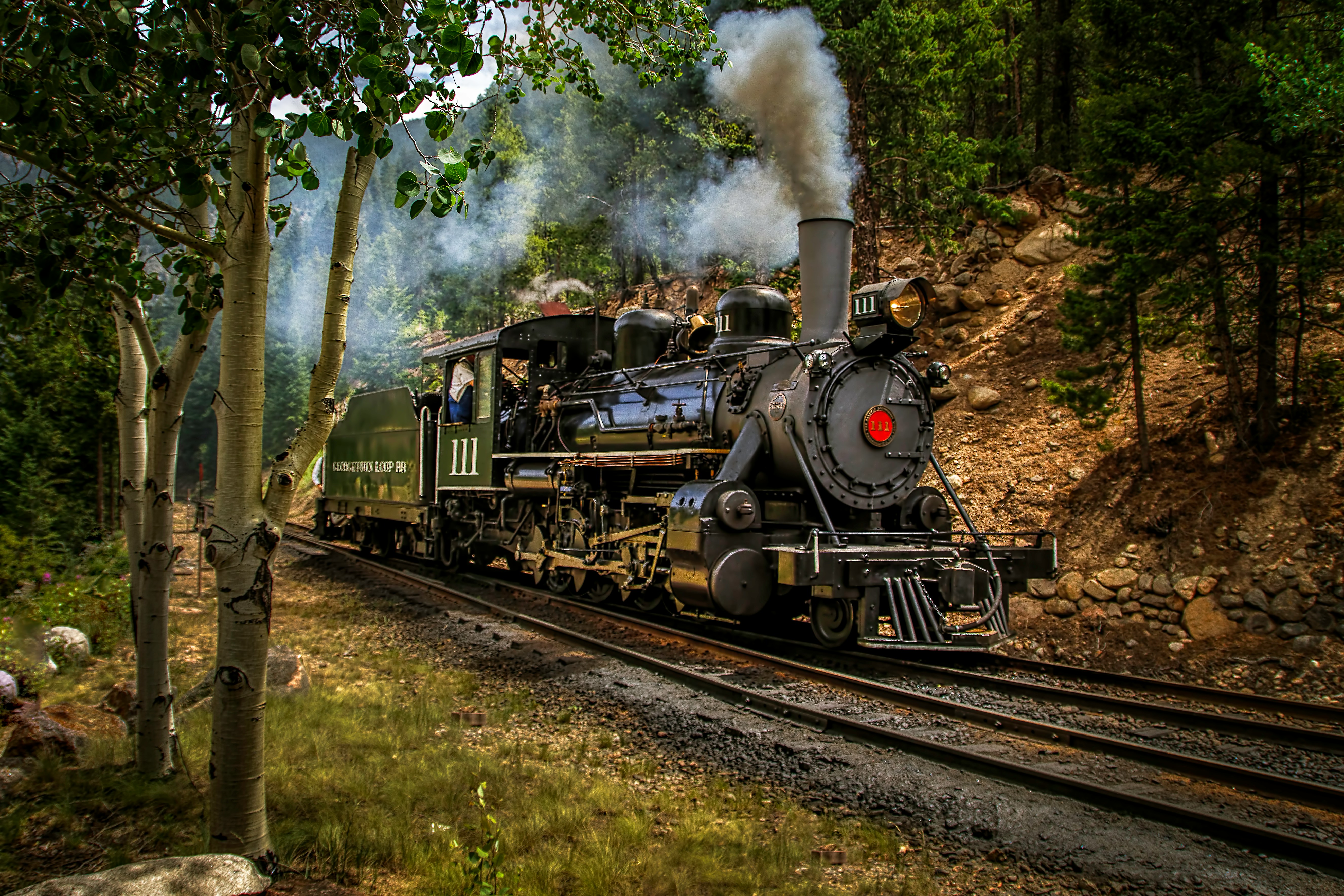
Photo of a steam train
Photo by Claud Richmond on Unsplash. (NOT a photo of a Harrisburg, NC steam train.)

Prior to the coming of the railroad, it is said that it sometimes cost a farmer half his profits to transport his produce to market by wagon. Poor roads and distances to markets prohibited the transporting of perishables very far.

Although Charlotte has a population of a million people now, in 1854 it had a whopping 1,000. The State of North Carolina decided it would be good for the economy to construct a railroad from Goldsboro, in the eastern part of the state, to Charlotte in the southern piedmont.

The State sold bonds in New York City to finance the project. Ten thousand shares were sold at $100 each.

Goldsboro was chosen because it had rail service to the port at Wilmington, NC. A railroad from the south to Charlotte and one from the north to Danville, Virginia, which threatened to extend a line to Charlotte, would surely mean that goods from western North Carolina would be shipped to Virginia or to the port at Charleston, South Carolina.

It was understood from the beginning that much of the construction labor for the project would be undertaken by slaves of property owners living along the rail right-of-way. Some of the slave owners were paid on a yearly basis for supplying their slaves for the project.

I found it interesting that wrought iron T-rails manufactured in Wales were used in the initial construction of the 223-mile-long railroad. The rails weighed 60 pounds per yard and were brought in through the port at Charleston.

In the early 1850s, a steam locomotive needed on average a cord of wood (that’s a stack of wood eight feet long, four feet wide, and four feet high) and 1,000 gallons of water for every twenty-five miles. A tender could carry that much wood and water. That is what dictated the approximate distances between some train stations.

That’s how the little farming community of Harrisburg, North Carolina got a train depot and the designation as Harris Depot on maps.

If you are interested in learning more about the North Carolina Railroad and the ways the coming of the railroad and depot changed life in a farming community in the early 1850s, look for my book, Harrisburg, Did You Know? Cabarrus History, Books 1 and 2. Book 1 contains the first 94 local history articles I wrote, including the series about the railroad. Book 2 contains the other 84 local history articles I wrote, including more articles that reference the railroad.

Topics in the two books include such things as the blowing up of the King’s gun powder in 1771, a minuteman in the American Revolution, President George Washington’s 1791 visit, the 22-mile ring dyke the town sits in, general stores, family-owned groceries stores, education in the 1800s and three Rosenwald Schools, how the town got phone service and electricity, our Ukrainian doctor (Nicholas E. Lubchenko) who escaped from the Russian Army, the cotton economy of the area until the mid-20th century, Hurricane Hugo in 1989, floods, earthquakes, the building of roads and bridges, the changes necessitated by the high-speed rail project, mail service from the 1800s until the early 21st century, the construction of the Charlotte Motor Speedway and the running of the first World 600 NASCAR race in 1960… and much more.

Here are the links for purchasing the books on Amazon:

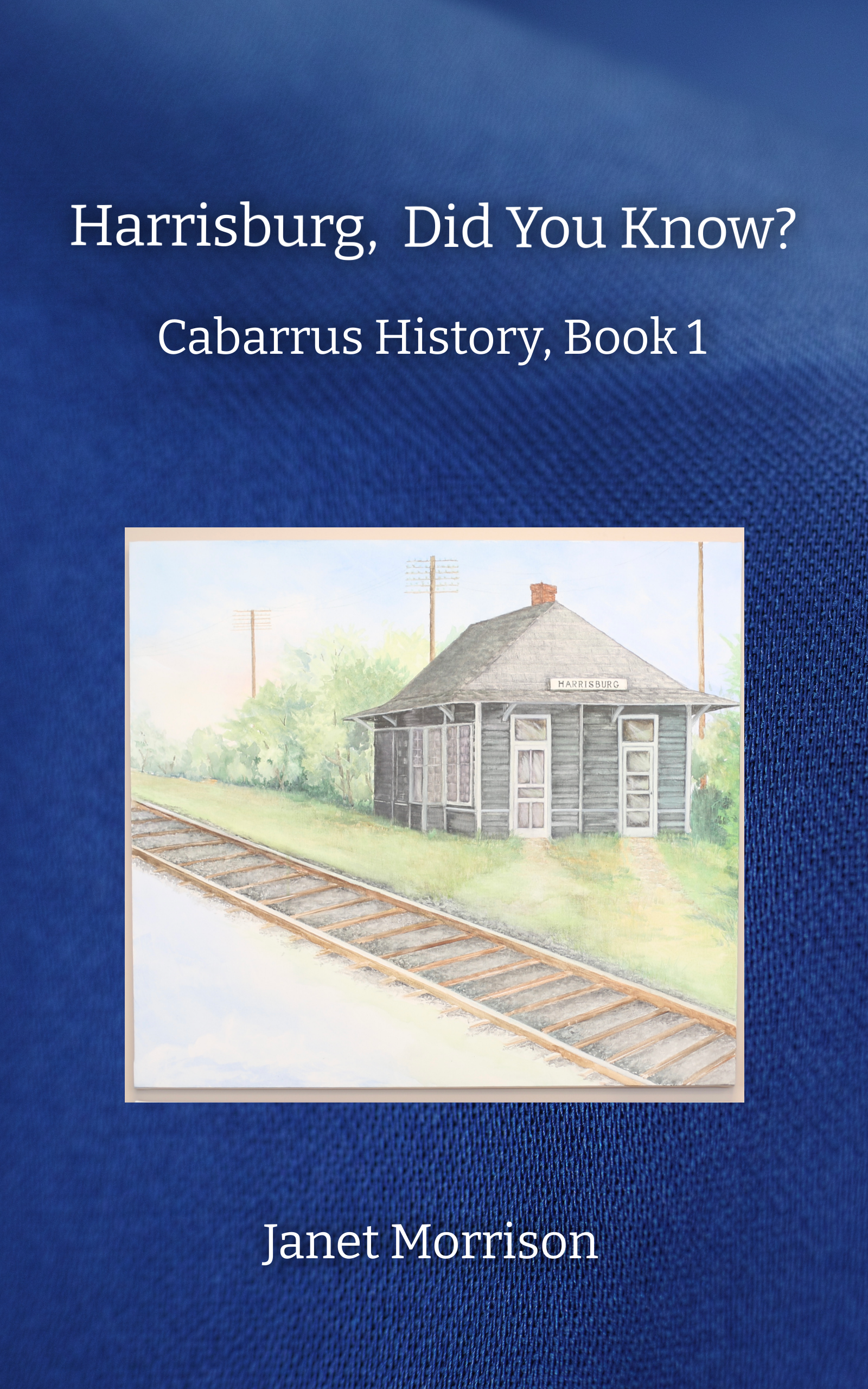
Photo of the front cover of Harrisburg, Did You Know? Cabarrus History, Book 1, by Janet Morrison
Harrisburg, Did You Know? Cabarrus History, Book 1,
by Janet Morrison

Book 1, in paperback: https://www.amazon.com/Harrisburg-Did-You-Know-Cabarrus/dp/1888858044/

Book 1, in e-book: https://www.amazon.com/Harrisburg-Did-You-Know-Cabarrus-ebook/dp/B0BNK84LK1/

Photo of front cover of Harrisburg, Did You Know? Cabarrus History, Book 2, by Janet Morrison
Harrisburg, Did You Know? Cabarrus History, Book 2,
by Janet Morrison

Book 2, in paperback: https://www.amazon.com/Harrisburg-Did-You-Know-Cabarrus/dp/B0BW2QMLHC/

Book 2, in e-book: https://www.amazon.com/Harrisburg-Did-You-Know-Cabarrus-ebook/dp/B0BXBQ1F79/

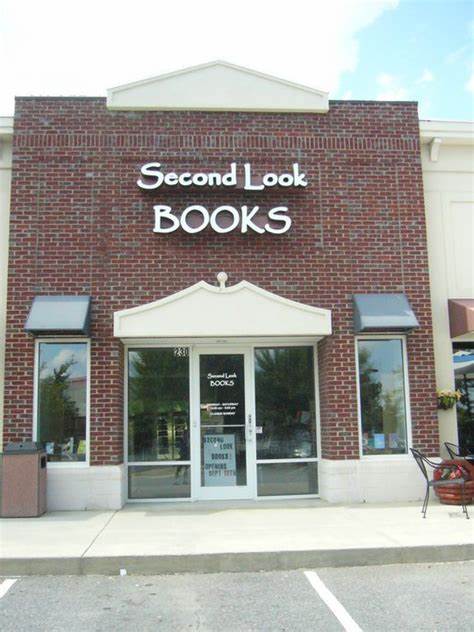
If you live in the Harrisburg, NC area, you can find the books in paperback, Tuesday through Saturday, at Second Look Books, 4519 School House Commons.

I hope my blog post today whetted your appetite for reading more about the history of our little town of 20,000 now. I imagine many of our local stories are similar to ones in your town’s history.

Janet

The government should be afraid of its citizens, not the other way around.

Meet & Greet at Second Look Books, April 15th

What?        Author Meet & Greet

Where?      Second Look Books, 4519 School House Commons in Harrisburg

When?       Saturday, April 15, 2023

What Time?         2:00 – 4:00 p.m.

Second Look Books, 4519 School House Commons, Harrisburg, NC

Copies of Harrisburg, Did You Know? Cabarrus History, Book 1 and Book 2 have arrived and been autographed.

Photocopies of my 11×14-inch “Harrisburg in the 1900s” two-map sets have been made.

Business cards and bookmarks are printed.

Saturday, April 15 is the big day for my Meet & Greet at Second Look Books in Harrisburg, North Carolina! I’ll be there from 2:00 p.m. until 4:00 p.m.

Please drop by, even if you’ve already purchased both books.

The bookmarks and Harrisburg maps are free while supplies last.

What maps?

I drew the maps based on detailed memories that Mr. Ira Lee Taylor shared with me while I was writing the “Did You Know? local history column for Harrisburg Horizons newspaper (2006-2012.)

One map covers from along NC-49 to Back Creek. The other map covers from Back Creek to Reedy Creek and where McKee Creek flows into Reedy Creek.

Mr. Taylor told me where such things as the telephone switchboard, spoke factory, two cotton gins, railroad houses, corn fields, cotton fields, and livery stable were in the early 1900s.

He told me where the various stores and post offices were. Being the town’s only mail carrier for several decades, he knew where everybody lived, so I included much of that information The map show where the roads were (and were not) before the coming of the high-speed rail.

In case you arrived in Harrisburg after the two-story red brick old Harrisburg School was torn down, this set of maps will show you the layout of the school grounds. The school property is where School House Commons Shopping Center is now.

The maps also show the locations of the Oak Grove Rosenwald School and the Bellefonte Rosenwald School that you read about in Harrisburg, Did You Know? Cabarrus History, Book 1.

Some things you’ll learn about in my two books

There are stories of local heroism from 1771 and the detailed memories of a World War II US Army veteran who told me about his training for D-Day through to the end of the war.

There are stories about the original Hickory Ridge School, which was a one-room school on Hickory Ridge Road.

There are stories about the Rosenwald Schools that served the black students in the early 1900s.

There are stories about the man from Russia (actually, Ukraine) who settled in Harrisburg in the 1920s to practice medicine until his death in 1960. He was a country doctor who made house calls

There are stories about the construction of the Charlotte Motor Speedway and the first World 600 Race when the track was in such bad shape that chunks of asphalt broke the windshields out of some of the race cars.

There is information about the 22-mile syenite ring-dike that Harrisburg sits in. It’s what remains of an ancient volcano.

Until my next blog post

Remember the people of Ukraine – where Dr. Nicholas E. Lubchenko was born and lived until young adulthood.

I hope to see you on Saturday!

In case you don’t have a good book to read, please consider purchasing my local history books. They’re available in paperback at Second Look Books. They’re also available in paperback and for Kindle from Amazon.

Even if you don’t live or have never lived in Harrisburg, North Carolina, I think you’ll find some interesting stories that you can probably relate to if you are of a certain age. And if you a child, teen, or young adult I think you’ll find it interesting to read about how life used to be in our sleepy little farm village of a couple hundred people in the early 1900s that has grown to nearly 20,000 people in 2023.

What?        Author Meet & Greet

Where?      Second Look Books, 4519 School House Commons in Harrisburg

When?       Saturday, April 15, 2023

What Time?         2:00 – 4:00 p.m.

I hope to see you there!

Janet