Did you meet your 2016 reading challenge?

Did you participate in a 2016 reading challenge and, if so, did you meet the challenge?

I blogged on March 11, 2016 and June 24, 2016 (How’s that 2016 reading challenge working for you?) that I was participating in the 2016 reading challenge offered by the Mint Hill Branch of the Charlotte-Mecklenburg Public Library. I had high hopes of reading books in at least 12 of the 19 categories. Unfortunately, I only read books in the following nine categories:

  1. Book published in 2015: The Bookseller, by Cynthia Swanson
  2. Book with a number in title: Tricky Twenty-Two, by Janet Evanovich
  3. Nonfiction book: No Better Friend: One Man, One Dog, and Their Extraordinary Story of Courage and Survival in World War II, by Robert Weintraub
  4. Book with a color in title: Gray Mountain, by John Grisham
  5. A humorous book: Miss Julia Delivers the Goods, by Ann B. Ross
  6. Book with a one-word title: Damaged, by Lisa Scottoline
  7. Mystery or thriller: Don’t Go, by Lisa Scottoline
  8. Book that might scare you: The Woman in Cabin 10, by Ruth Ware
  9. Book written by an author with my initials: Ruin Falls, by Jenny Milchman

I also read 36% of a 2015 Pulitzer Prize winner by Anthony Doerr, All the Light We Cannot See, before it had to be returned to the public library. I’m back on the wait list for it, so I hope to finish reading it in 2017. What was the book I read in 2016 that I still think about? No Better Friend: One Man, One Dog, and Their Extraordinary Story of Courage and Survival in World War II, by Robert Weintraub. I highly recommend it.

My personal reading goal for 2016 was to read 52 books. I read 31 books which, ironically, is the same number I read in 2015. My next blog post in a few days will be about the three books I’ve read so far in December.

I look forward to reading many interesting and entertaining books in 2017. If you missed my December 27, 2016 blog post, it was about the 2017 reading challenge I designed for myself. Feel free to adopt it or write your own challenge.

Until my next blog post, I hope you have a good book to read. If you’re a writer, I hope you have productive writing time.

Janet

Want a reading challenge for 2017?

Throughout 2016 I’ve enjoyed participating in the reading challenge issued by the Mint Hill Branch of the Charlotte-Mecklenburg Public Library. The year is quickly drawing to a close. I have not yet fully met the challenge, but I have four days left.

img086

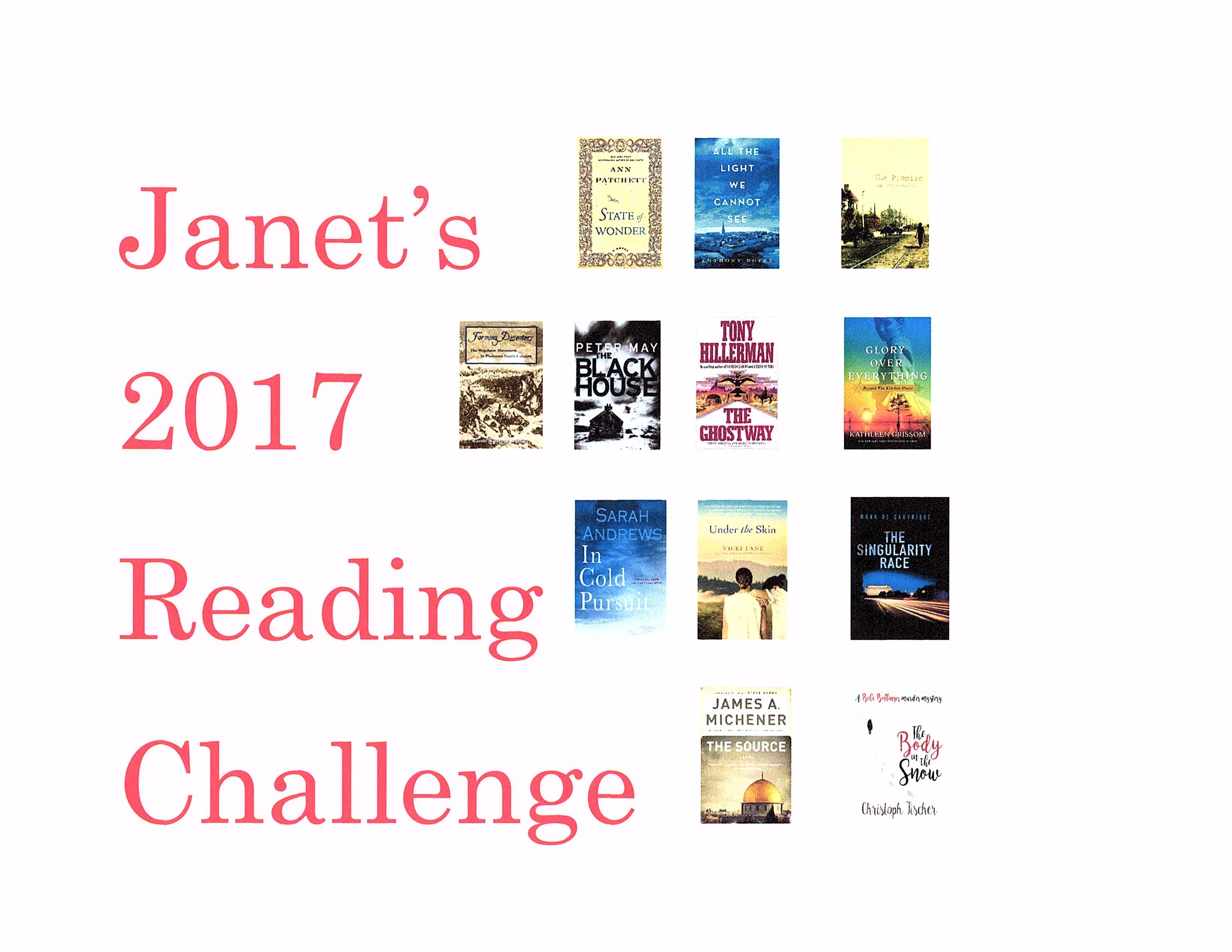
I designed the following reading challenge for 2017:

  1. A book of poetry
  2. A Sci-Fi book
  3. A nonfiction book
  4. Books by 12 authors I’ve never read
  5. A novel set in each of the seven continents
  6. A novel by a North Carolina author
  7. A novel set in North Carolina
  8. Re-read a favorite book
  9. A book written in the 1700s
  10. A book written in the 1800s
  11. A book written in the 1900s
  12. A biography, autobiography, or memoir
  13. A book about a religion other than my own
  14. A book that might change my mind
  15. A book just for fun
  16. A book that will teach me a new skill
  17. A book that was originally written in a language other than English
  18. A book written in Spanish (a language I haven’t studied since 1973)
  19. A book published in 1953 (the year I was born)
  20. A book that is the first in a series I haven’t read any of before
  21. The second book in a series of which I’ve read the first book
  22. A book written by an author I’ve met
  23. A book of short stories
  24. A book published in 2017
  25. A book about the craft of writing historical fiction
  26. A Nobel Prize winner
  27. A political thriller
  28. A sequel to a book I’ve read

 2017 – My Goal and Objective

I used to set a goal of reading a book every week, but in 2017 I’m going for quality and variety instead of volume. My goal isn’t to check off every category. My reading goal is to expand into areas and subjects I might not normally consider. My personal objective in 2017 is to become less judgmental. I think reaching my reading challenge goal will enable me to accomplish my objective. It will, no doubt, be an objective I will never fully attain. I am a work in progress.

Join me for the 2017 reading challenge I’ve planned or design one of your own.  Tell your friends about my blog and my reading challenge. Let’s get some conversations going about the books we’re all reading!

Everyone in the world does not have equal access to books so, now more than ever, it is incumbent upon those of us blessed to live in free societies and those of us blessed to live in countries with free public libraries and/or the financial means to have access to books to make the most of that privilege.

Until my next blog post, I hope you have a good book to read. If you’re a writer, I hope you have productive writing time.

Janet
Save

Save

How important is a novel’s ending?

How important is a novel’s ending? Just as important as the “hook” at the beginning.

Once a month I write about the first line in a different novel. I must admit that I have worked harder on, done more “how to” reading about, and lost more sleep over the opening scene in my manuscript for The Spanish Coin than I have for the ending.

A good beginning “hooks” the reader’s attention and draws him into the story. A good ending leaves the reader satisfied and, hopefully, exhausted. A good ending makes the reader contact the author and ask, “You are writing a sequel, aren’t you?” The ending of a novel should either tie up all the loose ends for your main characters or cause the reader to wonder what happened to those characters later. Did they find justice, acceptance, love, or whatever they were seeking? The reader should still think about those characters weeks after reading the book. How many of us thought about Scout in To Kill a Mockingbird years later and wondered how her life turned out? Like it or not, we got our answer in 2015 when the long lost Go Set a Watchman manuscript by Harper Lee was discovered and published.

As with the writing of the other parts of a piece of fiction, there are rules to guide an author in crafting the ending.

  • Don’t introduce new characters
  • Do increase the suspense
  • Do surprise the reader, but do it in a way in which he can think back to foreshadowing earlier in the book
  • Know the ending before you write the beginning

The rule I listed last is one I need to keep in mind when I write my next book. I did not know about that rule when I started writing The Spanish Coin. I didn’t have a clue how that story was going to end. In fact, it made me exceedingly sad to see how the story unfolded. I had become quite fond of the character who turned out to be the villain.

Until my next blog post, I hope you have a good book to read and, if you’re a writer, I hope you have productive writing time.

Janet


A Quote from an Author — Lee Smith

I try to blog a quote from an author once a month. Today’s quote is taken from Lee Smith’s autobiographical book, Dimestore:  A Writer’s Life:

“For a writer cannot pick her material any more than she can pick her parents; her material is given to her by circumstances of her birth, by how she first hears language.” — Lee Smith

Dimestore: A Writer's Life

While working to identify my author brand recently, I came to appreciate that quote from Lee Smith even more than when I first read it and was immediately prompted to write it down in my writer’s notebook.

I invite you to follow my blog and to follow me on social media by using the icons to the right. I welcome you to share this blog post by clicking on the social media icons below.

Until my next blog post, I hope you have a good book to read and, if you’re a writer, I hope you have productive writing time.

Janet

First Line of a Novel

Once a month I blog about the first line in a novel. I started doing that when I thought the first line was the “hook.” I’ve learned that the hook can entail the first paragraph or even the first page of a novel, but I plan to continue to blog about the first line only.

The Risen

The Risen, by Ron Rash

“From the beginning, Ligeia’s ability to appear and disappear seemed magical.” – From The Risen, by Ron Rash.

When I read that sentence for the first time, I had no way of knowing who Ligeia was or that it foreshadowed many appearances and disappearances throughout the book. The line was very clever on Mr. Rash’s part.

The Risen is a coming of age story of two brothers who grew up in Sylva, North Carolina in the Appalachian Mountains and the secret one kept from the other for decades. I don’t want to spoil the story for you, so I’ll just leave it at that. If you haven’t given this North Carolina author a try, please do so.

If you like my blog, I hope you will tell your friends and follow me on social media in addition to following Janet’s Writing Blog.

Until my next blog post in a few days, I wish you a good book to read and, if you’re a writer, I hope you have productive writing time.

Janet

Save

11 More Things I’ve Learned about Twitter

Tweet!
Tweet! @JanetMorrisonbk.com

On July 22, 2016 I blogged “10 Things I’ve Learned about Twitter.” Since then, I’ve learned 11 more things.

  1. Twitter should come with an owner’s manual or a teenager to teach those of us in our 60s how to use it.
  2. I’d still rather be working on my southern historical novel than writing Tweets.
  3. Twitter continues to be maddening and takes more of my time than I want to give it.
  4. Some days it seems like Twitter is really just a contest to see who can accumulate the most followers.
  5. I grow weary of trying to improve my follower : follow ratio.
  6. There are some things I’d like to Tweet about but I have to be conscious of my author brand.
  7. The older I get, the more I believe I must show my authentic self if I’m going to project my true brand. (Yes, #7 conflicts with #6.)
  8. It’s amazing how many followers from Australia I can pick up by Tweeting in the middle of the night in the USA.
  9. I recently read that you have to manually cut and paste another person’s Tweet in order to retweet it – as well as adding “RT” and the original Tweet author’s username. Who knew? I thought that’s what the “ReTweet” button was for. Hence, the importance of #1 above.
  10. I’d been on Twitter for months when I learned that you need a “header image” as well as a profile picture. How are you supposed to know that since. . . well, please refer to #1 above.
  11. Any link you paste into the Tweet box is automatically shortened to 19 characters. I would have known this months ago if. . . well, please refer to #1 above.

Thank you for taking time to read my blog. If you like it, please share it by clicking on the social media buttons below. I invite you to follow me on social media by clicking on the icons to the right.

Until my next blog post in a few days, I hope you have a good book to read. If you are a writer, I hope you have productive writing time.

Janet

Save

Save

Save

Save

A Line I Like from a Novel

Once in a while, I come across a line that I especially like in a novel I’m reading. I like to showcase one of those sentences in a blog post once-a-month. It’s my way of illustrating how good writing doesn’t just happen. Sometimes my attention is grabbed by a phrase or just a word in a sentence. When this happens, I make a note of it in my writer’s notebook.

Redemption Road, by John Hart

“Tapping on the door, Elizabeth waited as fabric whispered behind the screen, and her mother appeared.” — Redemption Road, from John Hart

My “Take” on this line

It wouldn’t have occurred to me to write “as fabric whispered behind the screen,” but the phrase John Hart crafted paints an audible picture. I know exactly what Elizabeth heard as she waited after tapping the door.

What you can do

If you like what you read on my blog, I invite you to follow it by clicking on one of the “follow” buttons at the top of the right side of this page. I also welcome your comments. If you would like to follow me on Facebook, please search for Janet Morrison, Writer. To follow me on Twitter and Pinterest, please click on those social media icons to the right.

Until my next blog, I hope you have a good book to read. If you are a writer, I hope you have productive writing time.

Janet

What I read in November

Book Pages, Book, Old, Read, Paper

I read three novels in November. The first one was The One Man, by Andrew Gross. Some of you are probably familiar with some of the thrillers he wrote with James Patterson, but I was not aware of his writing. I can’t remember how I heard about The One Man, but the premise intrigued me. I look forward to reading more of Mr. Gross’s books.

The One Man, by Andrew Gross

The One Man is a gripping historical thriller. I’m drawn to historical fiction, but most of the historical novels I’ve read do not fall into the category of thriller. The One Man is a real page turner. It is set during World War II as Hitler’s Germany and the Allies were both trying to develop a bomb the likes of which the world had never seen.

The premise of the book is that only two men in the world know how to separate Uranium-235 from Uranium-238. One of the men is German. The other one is a Jewish physicist being held in the Auschwitz concentration camp. He is “the one man” the United States needs if the Allies are to win the war. But how could the United States possibly get anyone out of Auschwitz? They needed to find “the one man” who could pull it off. If you want to go on this nail-biting ride, I recommend you read The One Man. In case you enjoy audio books, this one has excellent reviews as the narrator is Edoardo Ballerini.

Ruin Falls, by Jenny Milchman

I read Ruin Falls primarily to fulfill a category on the 2016 Mint Hill Public Library 2016 Reading Challenge. Having enjoyed reading Jenny Milchman’s Under the Cover of Snow several years ago, I selected another book by her in the category, “read something by an author who has the same initials as you.” In Ruin Falls, two children of a couple mysteriously disappear in the middle of the night from their hotel room. Were they kidnapped or did they runaway? Ms. Milchman weaves a story that points out how our lives can be ruined by things that happen to us and how we don’t know other people as well as we think. The title is a bit of a play on words leading up to a suspenseful encounter at a waterfall called Ruin Falls.

The Risin, by Ron Rash

The Risin, by Ron Rash was the other novel I read in November is a coming of age book. It follows the lives of two brothers from Sylva, North Carolina. Sylva is a small town in the Appalachian Mountains and just a few miles from Western Carolina University where Ron Rash teaches. One brother is a well-respected neurosurgeon, while the other one is a ne’er-do-well. One of them has a closely guarded secret from their teen years in Sylva in the 1970s – a secret kept from the other brother for decades.

In closing

If you like the information I share in my blog, please share it and your comments on social media. You’ll find the icons below. If you’d like to receive an e-mail every time I publish a new blog post, please supply your e-mail address in the upper right sidebar or by clicking on the “Follow” button if you are a blogger on WordPress.

Until my next blog post in a few days, I hope you have a good book to read. If you are a writer, I hope you also have some quality writing time.

Janet

My “Sound Bite” and My Author Brand Story

Those of you follow my blog are probably growing weary of reading about author brand. I feel your pain! After today’s post, I look forward to blogging about other topics. Thank you for bearing with me as I went through this necessary journey and soul searching in preparation for what I hope will be the publication of my first novel in the next couple of years.

A Reductive Phrase or Sound Bites

On her company’s website, http://www.bluemooncommunications.com, Theresa Meyers defines a sound bite as “a reductive phrase that encapsulates more than the words contained in the phrase.”

She says an author must “boil down” his or her message points to “a one liner that will be used in every interview, every speech, every talk you give.”

I needed to ask myself why I write southern historical fiction. It’s what I’m naturally drawn to. It’s like all my life experiences have pointed me in this direction. But Ms. Meyers nudged me to go three more steps. I had to verbalize why people read southern historical fiction, what makes it sell, and why people seem to be gravitating toward it. As if that weren’t enough, the task was to come up with one phrase or sentence that would answer all of those questions.

My thought process as I pondered those three questions:  I think people read southern historical fiction, buy southern historical fiction, and gravitate toward it because The South is a state of mind. It is a place and feeling that its children cannot easily define or explain. It is unique due to its history. It is at once looked down upon and held in a place of fascination by the rest of the country. It is a place that one cannot begin to understand without having lived there, or perhaps without having been born there. It is probably the most misunderstood place on earth.

My conclusion, in one sentence or phrase:  Southern Historical Fiction touches the heart.

My Author Brand Story

If the following five paragraphs might sound like I’m bragging, that’s not my intention. It is my understanding that an author brand story is a writer’s statement of what qualifies him or her to write what they write. The next five paragraphs are my author brand story.

My 40 years of tracing my various family lines back to the colonial days in North Carolina, South Carolina, and Virginia as well as collateral family lines back to the pioneer days in Tennessee, Alabama, and Mississippi has served to reinforce and strengthen my knowledge of and history of The South (i.e., the southeastern states in the United States of America.)

I have done extensive local history and church history research and writing. Sometimes I think I was born in the wrong era. I identify with people who lived through the American Revolution, though I doubt if I would have had the physical fortitude to survive that period in our nation’s history. My studies have given me a profound appreciation for the hardships endured and sacrifices made by that generation of Americans that laid the foundation for the country and freedoms we enjoy today. Their blood runs through my veins and the red clay soil of the North Carolina piedmont is in my soul.

I am detail-oriented. Living my entire life in North Carolina and most of my life on land that has been in my family since the mid-18th century gives me a strong sense of place.

Having lost my first and second careers due to my health, I need to prove to myself and others that I can still contribute to society. I have been a writer all my life – just an unpublished one until recently.

My background, education, and desire to write historical fiction make me uniquely qualified to pen southern historical novels.

If you like my blog, please tell others about it. You may use the social media icons below.

Until my next blog post, I hope you have a good book to read and, if you’re a writer, I hope you have productive writing time. Thank you for coming along on my journey as an aspiring novelist.

Janet