A Lost Art

How many of us take the time or even think about handwriting a letter today? It has been so long since I handwrote more than a brief thank-you note, I honestly cannot remember. It is easier to text, email, or type a letter on the computer and print it.

I mentioned in my July e-newsletter that I have been decluttering. I have attempted this chore many times in the past with limited success; however, I am on a tear this time.

I should have taken “before” and “after” pictures. I should have weighed how much stuff I donated to the thrift shop. I should have weighed the two recycle bins that were so heavy with paper and magazines that I could scarcely push them out to the road for pick up. I should have weighed the countless bags of trash. I shredded old documents until I thought our paper shredder would start to smoke.

My parents were in college when The Great Depression began. They had to make their way in this world on little money and no luxuries. Their background meant they instilled in me the value of a dollar and one should never throw away anything because “you might need it or be able to use it later.”

I am once again living in the house they built in 1960, so there are many boxes and closet shelves to go through now.

It is a freeing experience to unburden oneself from the accumulation of stuff. As I blogged about on July 1, 2024 ( Books read in June 2024), I was inspired by reading Stop Buying Bins & Other Blunt but Practical Advice from a Home Organizer, by Bonnie Borromeo Tomlinson.

I’m not saying this is the end-all be-all book about decluttering, downsizing, or rightsizing. All I know is that it was the right book for me at the right time.

One unexpected benefit or result of my current decluttering binge was the rediscovery of handwritten letters. If you have lost a parent and had a good relationship with that person, you have probably felt that tug on your heart when you come across something in their handwriting.

Photo by Aaron Burden on Unsplash

Perhaps you found a recipe your mother wrote on an index card or scrap of paper. Perhaps it was nothing more than your father’s signature on a document. My father was a structural steel draftsman, so he usually printed. I can readily recognize his precise printing, whether it be on a blueprint or genealogy notes he made, but it is special when I find his signature because it, of course, is in cursive.

In going through decades of stuff this summer, I have come across birthday cards signed by my parents, various aunts and uncles, and dear childhood friends who are no longer with us. Some have brought a lump to my throat and a sting to my eyes as tears begin to form. Those cards are set aside and not yet tossed in the trash or recycle bin. Someday that’s where they’ll land, but not today.

The lost art I referenced in today’s blog title is the handwritten letter. I have found many of the letters my mother wrote to me while I was away in college and in my early 20s when I found employment several hours from home. I was struck by the contrast between that time in the 1970s and early 1980s as compared to today.

Today parents text or call their children who are in college or have otherwise left home and struck out to make their way in the world. They think nothing of making that phone call or sending that text. When I was in college and during my young adult years it was expensive to call “long distance.” You had to have a very good reason for calling home when I was in college.

There was one telephone on the wall in the hallway in my freshman dorm. I knew if I received a call from my parents, it was probably to relay bad news or something that couldn’t wait two or three days for them to tell me in a letter. And there were no long conversations because every minute cost money.

I am so glad that’s the way it was because it means today I can reread all those letters my mother wrote. Today’s college students and young adults will not have such tangible memorabilia.

Several years ago, my sister and I helped a friend organize in archival binders and archival sleeves the letters he and his wife wrote to one another while he was in the military service as a fighter pilot in World War II and the Korean War. He will turn 100 years old in October. He calls occasionally to thank us again for what we did. He lives alone and the days and nights are lonely. He says he finds great comfort and joy in opening those binders and reading those letters.

We have photocopies of portions of letters one of our great-grandfathers wrote to his parents and sister while he was serving in the military during the American Civil War. How valuable those letters are to us!

While going through a box of papers last week, I came across a typewritten letter from my eldest first cousin from some 30 years ago. She was much older than I. In that letter, she shared some recollections of her mother’s. (Her mother was my father’s eldest sister and was 14 years older than he.) I had forgotten about the letter, so it was new and fresh as I read it last week.

From the letter I learned that my grandmother won prizes for her jams, jellies, canned fruits, eggs, and Rhode Island chickens. Since my grandmother died 23 years before I was born, I never knew her. However, that one sentence in my cousin’s letter gave me a beautiful glimpse into my grandmother’s life that I would not have known otherwise.

It is nice today that we can call a friend or relative and hear their voice, but in the process of making our communications so easy and instant we have lost the art of letter writing.

Do you still write letters to loved ones and friends who live faraway? Do you still have letters you have received?

For now, I’m holding on to those letters from my mother. The day might come when I’m ready to part with them, but today is not that day.

Until my next blog post

Is there someone who would appreciate a hand-written note or letter from you this week?

I will continue to go through boxes and closets and the basement. This decluttering/rightsizing thing isn’t a sprint; it’s a marathon. I have only just begun!

I hope to get back to work on my Seasonal Affective Disorder devotional book this week.

I hope you have a good book to read.

Don’t forgot the people of Ukraine.

Janet

Exploring Qualla Boundary

Several weeks ago, my sister and I spent several days in Cherokee, North Carolina. We have visited Cherokee many times, but I had never seen the “Unto These Hills” outdoor drama. Since the drama was rewritten a few years ago to give a truer presentation of the Cherokee Indian perspective on their history, I was eager to see it.

A leisurely drive on the Blue Ridge Parkway is always an activity we enjoy, so we got on the parkway on the southern edge of Asheville and took it to its end at Soco Gap. We went through 15 tunnels on that 80 or so southernmost miles of the Blue Ridge Parkway. Various wildflowers, including the Flame Azalea (or native/wild azalea) was at or just past its peak.

Flame Azalea along the Blue Ridge Parkway
National Park Service sign noting the highest elevation on the Blue Ridge Parkway Motor Road at 6,053 feet.

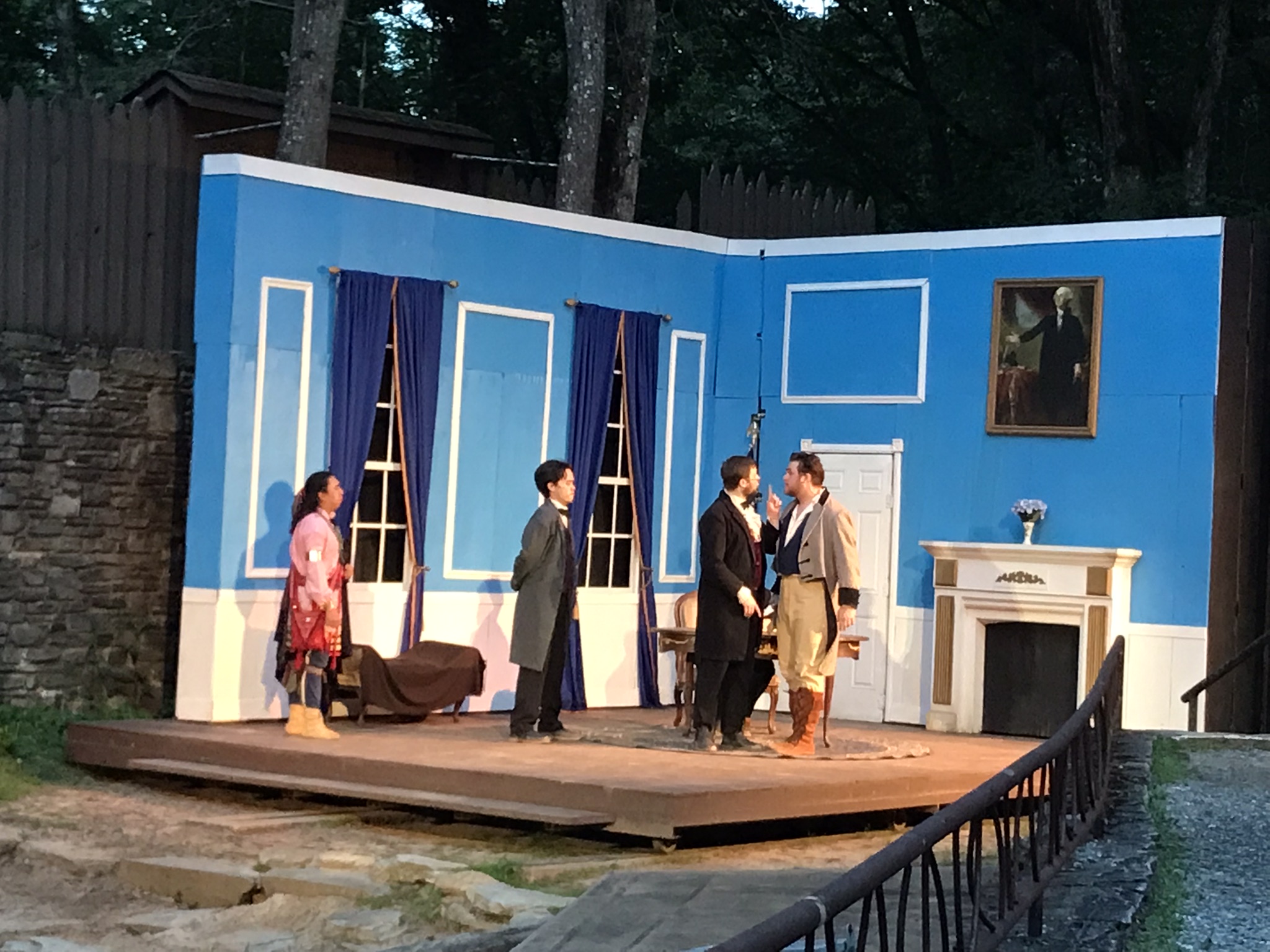
We had perfect weather all week, including the night we had tickets to see “Unto These Hills.” The acting was superb. It was amazing to see the history of the Cherokee people presented in two hours.

The play emphasized how the Cherokee and the European explorers, traders, and settlers had a congenial relationship in the beginning. It wasn’t until the Europeans started cheating the Cherokee and tricking them into poor decisions and hollow treaties that things deteriorated.

Another scene from “Unto These Hills”
A scene from a visit to the White House in the “Unto These Hills” outdoor drama

The last straw, of course, was when the United States forced the Cherokee to give up their beautiful and lush ancestral lands for what turned out to be a death march to the Indian Territory of present-day Oklahoma. They were promised a good life, but it was just another broken promise by the white man.

A scene from “Unto These Hills” outdoor drama in Cherokee, NC

The Cherokee people who refused to leave the Great Smoky Mountains hid in the hills. It is the descendants of those brave souls who now populate the Qualla Boundary and are officially known as the Eastern Band of the Cherokee Indians.

By visiting the Museum of the Cherokee Indian and the Oconaluftee Indian Village, you can learn a great deal about the Cherokee Indians’ rich history and traditions. For instance, they lived in houses, not teepees. They did not wear elaborate feather headdresses like the Plains Indians. Cherokee men back in the day were up to seven feet tall and the women averaged only a few inches shorter.

An example of a Cherokee house from an earlier century. (The cutaway is not a window; it is there to show the wall’s construction. Cherokee houses did not have windows because they were only used for sleeping. All their work was done outside.)
Weaving display at Oconaluftee Indian Village in Cherokee, NC
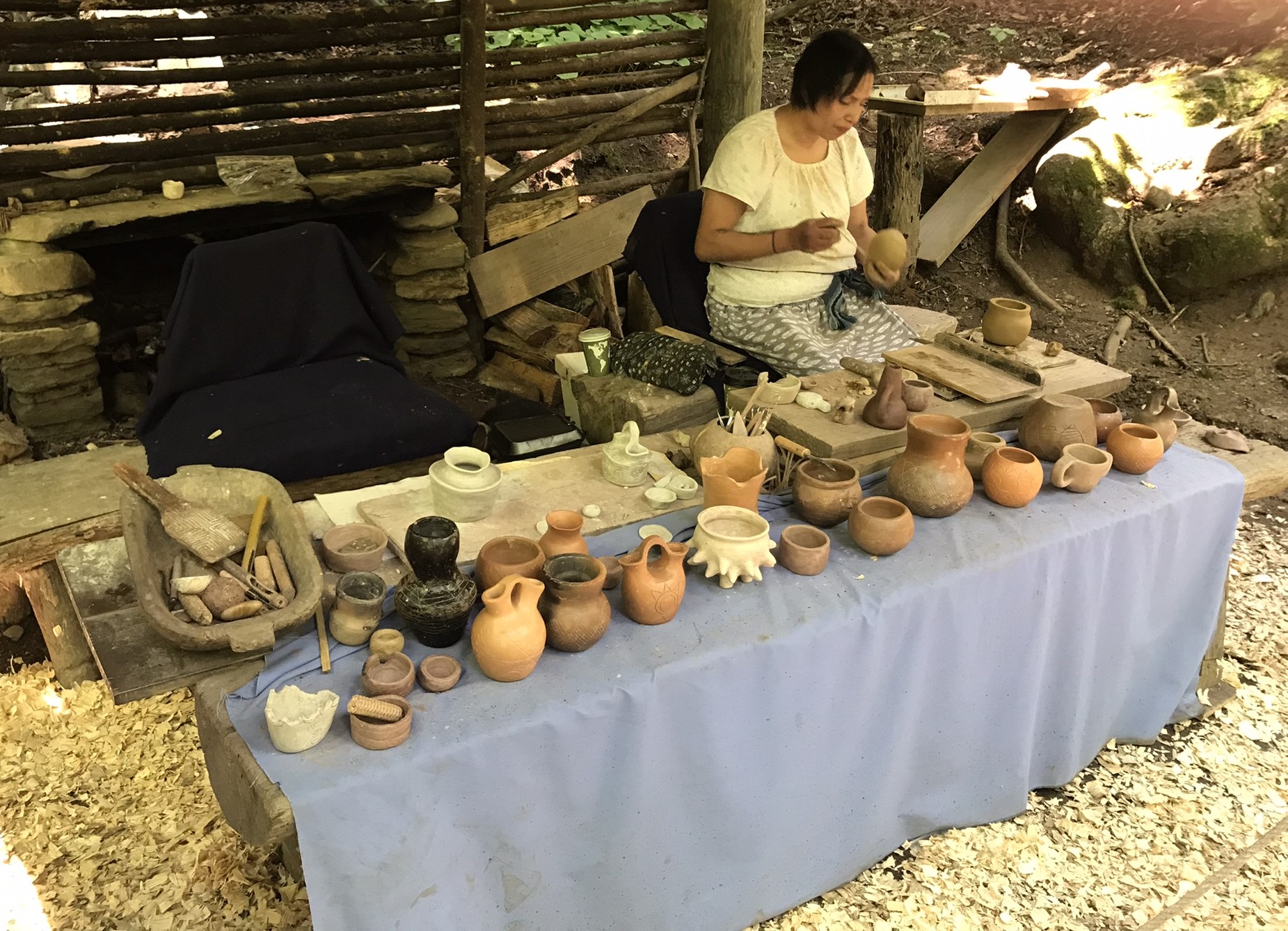
A pottery display and demonstration at Oconaluftee Indian Village in Cherokee, NC

Many Cherokee people continue to master the time-honored crafts of making clay pottery, intricate bead work, exquisite basketweaving, and wood carving. It takes weeks and sometimes months for the native plants and other natural resources for these items to be gathered and prepared, not to mention the intricate work to create the finished products. Those priceless items can be admired and purchased at the Qualla Arts and Crafts Mutual, Inc.

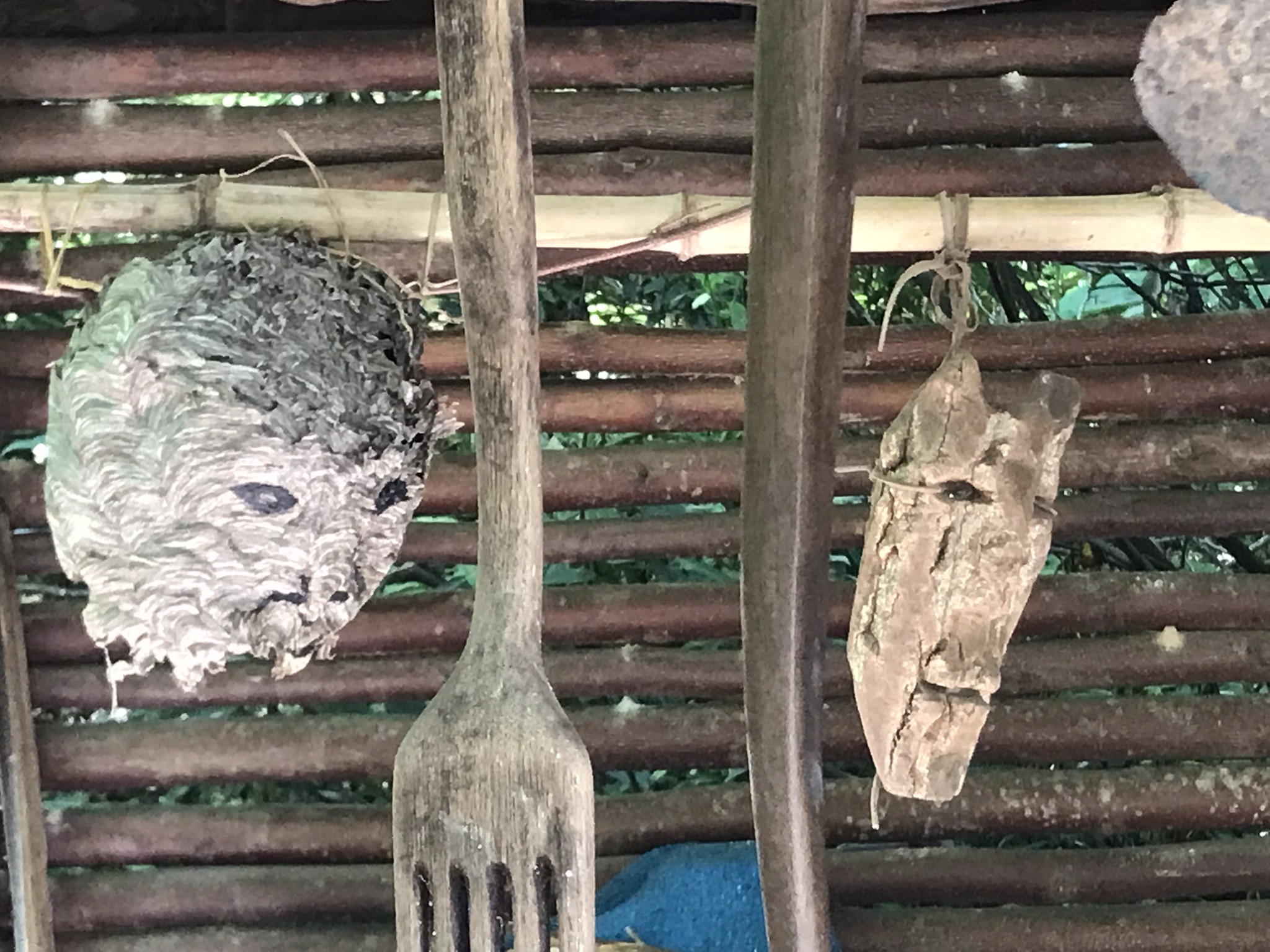
Cherokee ceremonial masks were made from various natural resources, including wood and even hornets’ nests (as seen on the left in the photo.)

Although some of the signage indicates otherwise, the Qualla Boundary is not a reservation. The Cherokee people own their land and the Qualla Boundary is held in trust for them by the United States Government.

The Cherokee not only had their own written language; they also had their own newspaper starting February 21, 1828. Although the United States Government tried to eradicate the Cherokee language and traditions, that policy failed. Today the Cherokee language is making a comeback. There is even a Cherokee immersion school in which only Cherokee is spoken.

On our recent visit, we used Cherokee as our base. One day we drove through the center of the Great Smoky Mountains National Park to and including Little River Road and Clingman’s Dome and back to Cherokee.

Another day we drove 10 miles to Bryson City, North Carolina and the Deep Creek entrance to the Great Smoky Mountains National Park. We hiked to three waterfalls we’d never seen before and enjoyed learning lots of facts about the park along the way to two of them with a park ranger.

When planning your trip, check online for the planned hikes and lectures offered by park rangers at the Oconaluftee Visitors Center near Cherokee, NC, the Sugarlands Visitors Center near Gatlinburg, Tennessee, Cades Cove near Townsend, Tennessee, and at the Deep Creek entrance to the park at Bryson City.

The Cherokee honor water and the residents and visitors alike are blessed to have the Oconaluftee River flowing right through the town of Cherokee. This shallow, wide, rocky river is the perfect place for tubing and splashing around in the water. I have memories of enjoying the river on my first trip to Cherokee when I was a young girl.

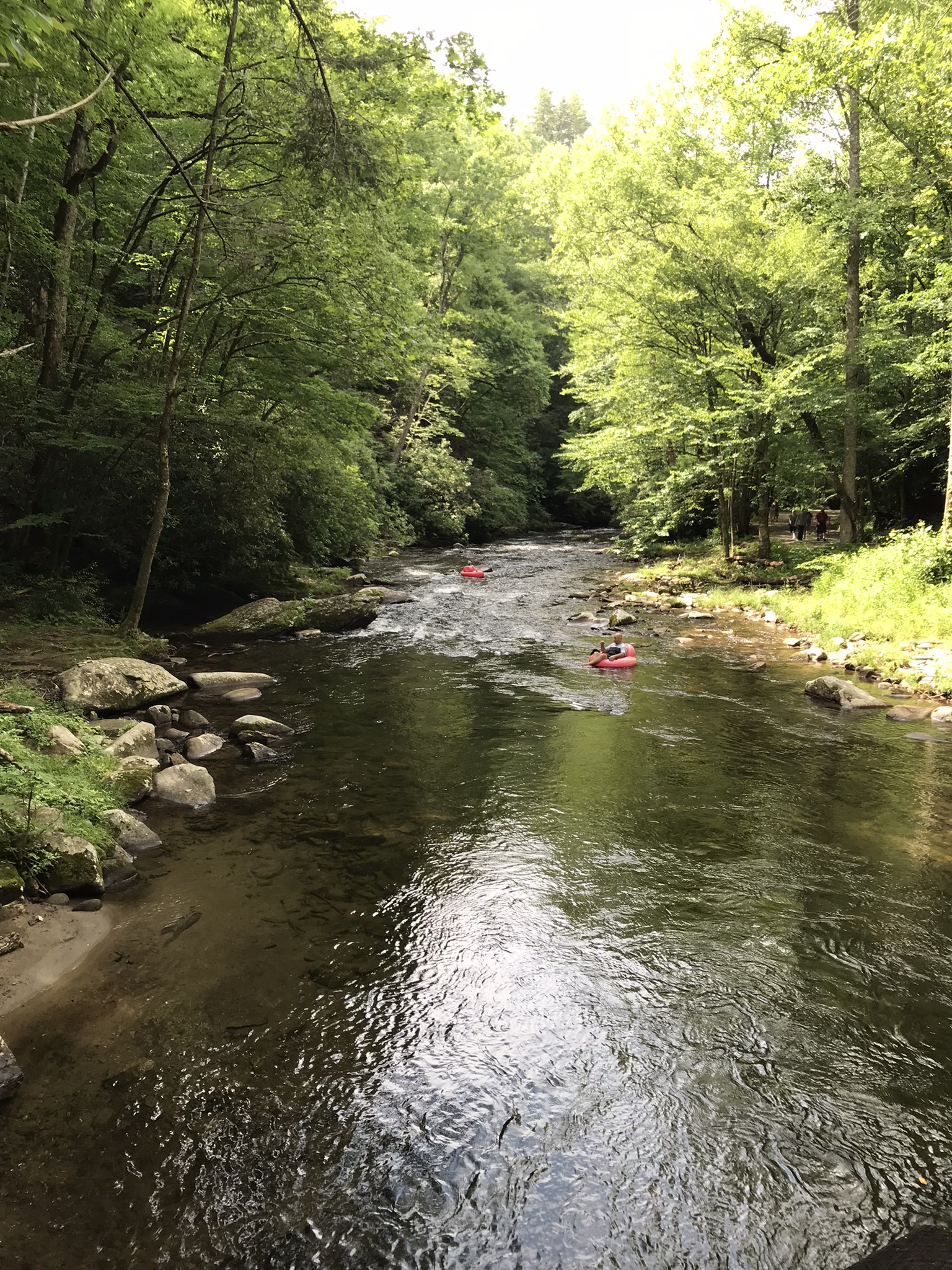
Deep Creek in the section of the national park is a popular creek for tubing. Many families were taking advantage of the creek for tubing on the very warm day we were there. If I were just younger and braver…. It looked like a lot of fun!

People tubing on Deep Creek near Bryson City, NC in Great Smoky Mountains National Park

All that hiking and tubing will make you hungry. My sister and I enjoyed the buffet at Granny’s Kitchen Restaurant on US-19 North going from Cherokee toward Maggie Valley. The wife in the couple who own and operate the restaurant is a Cherokee Indian. It is said if you want to find a good place to eat, look where the locals eat. This was certainly the case at Granny’s. (I am receiving no compensation for publicizing the restaurant. It is a good value and experience for the money. You will not leave hungry!)

People from all over the United States enjoy the Blue Ridge Parkway, the Qualla Boundary, and the Great Smoky Mountains National Park. We kept track of the different license plates we saw. When the trip was over, we had seen cars from 42 of the 50 states and several from Ontario, Canada.

Great Smoky Mountains National Park is the most-visited national park in the country. People are drawn to it by its beauty and biodiversity.

If you wish to learn more about Cherokee, the Great Smoky Mountains National Park, and the Blue Ridge Parkway, I recommend my vintage postcard book, The Blue Ridge Mountains of North Carolina. I packed as many facts and as much history into the book as Arcadia Publishing would allow. The book is available in paperback and e-Book from Amazon.


Since my last blog post

I continue to declutter by going through closets, old magazines, and boxes of memorabilia, photographs, newspaper clippings, and recipes. It is satisfying to look at what I’ve accomplished. My fiction writing has suffered for it, but this really needed to be done.


Until my next blog post

Keep reading and traveling every chance you get.

Visit your local public library, if you are fortunate enough to have one. If you haven’t visited it recently, you might be surprised to find some of the things it offers: Internet access, free access to software such as Ancestry.com, magazines you would like to read but cannot afford to subscribe to, music CDs, used books for sale, a magazine swap, ….

Remember the people of Ukraine.

Janet

#OnThisDay: Apollo-Soyuz Test Project, 1975

This was not planned, but when I started to write this blog post I realized the event whose anniversary we mark today happened 200 years and one week after the historic petition I blogged about last Monday. It’s nice when serendipity happens.

Whereas last Monday’s blog post was about a petition written in 1775 as the American colonies were on the verge of war with Great Britain, today we jump forward to mark an historic joint space exploration venture between the United States and the Soviet Union.

Both events now seem like ancient history in light of where space exploration has taken us today, so it is sobering for me to realize the event I write about today happened a couple of months after I graduated from college. It seems like just yesterday! The passage of time is beyond my understanding.


What was the Apollo-Soyuz Test Project?

The Apollo-Soyuz Test Project was the first multinational space exploration project.


Photo of the night sky filled with stars
Photo by Jack Cohen
on Unsplash

A little background

What made the Apollo-Soyuz Test Project particularly surprising and interesting was that the two participating countries – the United States and the Soviet Union – had been serious and unfriendly competitors in space travel since the late 1950s. The era was known as “the space race.” Each of the countries was determined to beat the other one in reaching every progression in space travel with the ultimate goal of putting a human being on the moon.

This is an over-simplification, but with the United States putting humans on the moon in 1969, the space race transitioned into a posture of sharing knowledge. It was an outgrowth of the “Détente” that started in 1969. Détente brought about more relaxed relations between the US and the Soviet Union.


Things get real in 1973

In the first half of 1973 the two countries announced the names of the astronauts and cosmonauts for the project as follows:

U.S. Commander Thomas P. Stafford

U.S. Command Module Pilot Vance D. Brand

U.S. Docking Module Pilot Donald K. “Deke” Slayton

US backup crew:  Alan L. Bean, Ronald E. Evans, and Jack R. Lousma

Soviet Commander Aleksei A. Leonov

Soviet Flight Engineer Valeri N. Kubasov

Soviet backups: Anatoli V. Filipchenko and Nikolai N. Rukavishnikov

The crews trained together for the first time at NASA’s Johnson Space Center in Houston, Texas in July 1973.

Some details of the project


Soyuz

Launch: July 15, 1975, at 8:20 a.m. EDT
Launch Site: Baikonur Cosmodrome, Kazakhstan
Flight Crew: Alexey A. Leonov, Valery N. Kubasov
Landing: July 21, 1975

Apollo

Launch: July 15, 1975, at 3:50 p.m. EDT
Launch Site: Launch Complex 39, Kennedy Space Center, Florida
Flight Crew: Thomas P. Stafford, Vance D. Brand, Donald K. Slayton
Landing: July 24, 1975

Mission

Docking Time: July 17, 1975, at 12:12 p.m. EDT
Undocking Time: July 19, 1975, at 11:26 a.m. EDT
Total Duration of Joint Activities: 19 hours, 55 minutes
Orbital Inclination: 51.8 degrees

(Source: The Apollo-Soyuz Mission – NASA)

Both spacecraft made orbital adjustments over the first two days to pave the way for the two vehicles to dock in space. People all over the world watched the docking at 12:12 p.m. Eastern Daylight Time, July 15, 1975. Hatches on both vehicles were opened at 3:17 p.m.

Celebratory handshakes and commemorative gifts were exchanged between the astronauts and cosmonauts. U.S. President Gerald Ford and Soviet Communist Party General Secretary Leonid Brezhnev called them to express their congratulations. The astronauts and cosmonauts shared a meal and the hatches were closed for the day.

The following day Brand joined Kubasov in the Soyuz and Leonov joined Stafford and Slayton in the Apollo spacecraft. TV interviews and tours were given, experiments were conducted, and lunch was eaten. Afterwards, Kubasov and Brand left the Soyuz and joined Slayton in the Apollo. Leonov and Stafford then spent time in the Soyuz.

By mid-afternoon the historic exchanges were completed, there was another round of handshakes and goodbyes were said.

At 8:02 a.m., July 19, 1975 the spacecraft were undocked.

Quoting from the NASA website: “As the Apollo capsule backed away, it blocked the sun from the Soyuz vehicle, creating the first human-made eclipse and enabling the cosmonauts to photograph the sun’s corona. The two spacecraft then docked once more, with final undocking at 11:26 a.m.


The end of the successful project

The Soviet cosmonauts continued to conduct life-science experiments for another day. The Soyuz 19 landed near its target on July 21, 1975. It was the first time a Soviet space mission launch and landing were televised.

The Apollo capsule remained in orbit with the astronauts carrying out space-science and Earth-observing experiments for five days after the undocking. It was the last planned ocean landing for U.S. human spaceflight. Splashdown occurred at 5:18 p.m., Eastern Daylight Time on July 24, 1975.


Until my next blog post

What happened on Saturday was an attack on democracy. Let’s hope this week is less eventful than the weekend.

I hope you have a good book to read.

Enjoy some time with your friends and family.

Don’t forget the people of Ukraine.

Janet
#OnThisDay: Olive Branch Petition, 1775

On July 8, 1775, the Second Continental Congress adopted the so-called Olive Branch Petition as sort of a last-ditch effort to avoid war with Great Britain. It was written by John Dickinson of Pennsylvania. He hoped against hope that America would not break with its mother country.

Photo by Shahan Khan on Unsplash

The petition’s words were couched in language meant to convince King George III that the colonies did not want to break away but that Britain’s actions had forced her “still faithful Colonists” to arm themselves in self-defense. It mentions the “distress” the very thought of such a break was causing the colonists.

The petition ended with, “That your Majesty may enjoy long and prosperous reign, and that your descendants may govern your Dominions with honour to themselves and happiness to their subjects, is our sincere prayer.”

Photo by Donovan Reeves on Unsplash

This was just a scant three months after American militiamen had fought British troops at Lexington and Concord, Massachusetts. Colonists’ beef was primarily with Parliament. There was still hope among same of them that King George surely wanted only the best for his subjects – even those across the Atlantic.

On September 8, 1775, Richard Penn and Authur Lee, representing the Continental Congress, traveled to England to present the petition to King George III. But King George refused to accept the petition.

Photo by Mark Stuckey on Unsplash

When word came to the colonies that the king had refused to even receive the petition, the tide turned and the colonists realized the king did not have their best interest at heart.

Photo by Rusty Watson on Unsplash

The rest, as they say, is history.

Until my next blog post

I hope you are reading a good book.

Remember the people of Ukraine.

Janet
Books read in June 2024

The first Monday of July is here, so my blog today is about some of the books I read in June. It’s hard to realize 2024 is half over.


Being Henry: The Fonz… and Beyond, by Henry Winkler

Being Henry: The Fonz…and Beyond, by Henry Winkler

I began June by listening to Being Henry: The Fonz… and Beyond. It was enlightening and enjoyable, partly because it was read by the author, Henry Winkler. I hadn’t known anything about Henry Winkler’s childhood or how much out of his comfort zone his portrayal of Fonzie was on the TV sitcom “Happy Days.”

In the book you learn how Henry Winkler went to great lengths to try to keep his character from overshadowing Ron Howard. The show had been created to feature Ron Howard, but the public became enamored with “The Fonz.”

The book takes you on Henry Winkler’s journey as an actor and shines a light on how he met his wife of nearly 50 years. He tells of his struggles to break into acting and how he landed the part of Fonzie on “Happy Days.” He is painfully honest about the support he did not receive from his parents.

Henry Winkler describes himself as a shy and private person, which tells us what a good actor he was in his portrayal of Fonzie!


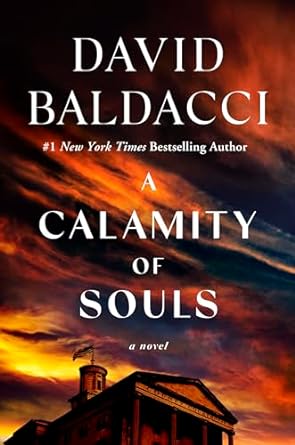
A Calamity of Souls, by David Baldacci

A Calamity of Souls,
by David Baldacci

I will start out by saying that I highly recommend this book. Stop reading right now and get on the waitlist for it at your local public library.

This is a book that Baldacci worked on for a decade. It was a story he was compelled to write. It is a novel about race relations in the United States in 1968. It is not set in the Deep South. That would have been too easy. Instead, Baldacci did the difficult thing. He set this novel in his home state of Virginia.

A well-known formerly affluent white couple are murdered in their home. When a black man who works for them is found by sheriff deputies in the house with their bodies, it appears to be an open and shut case.

Not so fast! There are twists and turns and family secrets in this story. The tension builds and builds until the killer’s identity is revealed.

This is a novel you won’t want to put down once you start reading it. If I didn’t have several hundred books on my To-Be-Read List, I would probably read it again just to study the clues and red herrings.


The Berlin Airlift: The Cold War Mission to Save a City, by John Tusa and Ann Tusa

The Berlin Airlift: The Cold War Mission to Save a City,
by John Tusa and Ann Tusa

This was one of the books I skimmed through as I did research about the Berlin Airlift so I could blog about its 76th anniversary last Monday. The book goes into detail about the airlift, in case you want to know more than I was able to condense into 1,000 words for my purposes. In case you missed last Monday’s blog, here’s the link:#OnThisDay: Berlin Airlift, 1948.


Stop Buying Bins & Other Blunt but Practical Advice from a Home Organizer, by Bonnie Borromeo Tomlinson

Stop Buying Bins & other blunt but practical advice from a home organizer,
by Bonnie Borromeo Tomlinson

As I age and am very much in fear of leaving a bunch of clutter for my heirs to have to deal with some day, I discovered this book. It struck a nerve with me and prompted me to pull out every article of clothing I own. Some garments went in the trash – where they should have gone long ago. I’m talking about 30-year-old tee shirts that had holes in them. Not a good look for me even when doing yardwork!  Nearly half the garments were donated to a thrift shop. I have lost about 16 pounds in the last year, so many of the things did not fit and I don’t want to grow back into them!

A major point in the book is that you must know why you are decluttering or downsizing, and you must have the right mindset. For several reasons, the time was right for me to do some major downsizing.

The book drives home the point that you don’t have to keep everything just because you kept it in the first place. It says you don’t have to keep things passed down to you just because they remind you of that person. Keep the memory, but don’t necessarily keep the item unless it brings you joy.

The book says if you don’t value something enough to display it, then get rid of it. Someone else might enjoy having it.

A local library had a craft swap last week. It was time for me to get rid of most of my cross-stitch supplies and books. I can’t see well enough now to do much small needlework.

Now that I have my clothes and craft items under better control than they have been in years, I’m ready to tackle my “stuff” in general, one room at a time.

There is a chapter about helping an aging parent downsize. There’s a chapter about parting with those adorable pictures your children colored. There’s a chapter about how to go about clearing out a house after a death, even if you live a long way from the house you’re having to clean out.

The book was well worth the $3.99 I spent for the Kindle version.


Until my next blog post

I wish my fellow-Americans a safe and happy Independence Day on Thursday!

I hope you are reading a good book.

Don’t forget the people of Ukraine.

Janet