The Importance of Marbury v. Madison Today

This is a timely anniversary date that landed in my lap!

The US Supreme Court heard the arguments for the Marbury v. Madison case on February 11, 1803, and handed down its decision 222 years ago today on February 24, 1803. That’s a quick turn around compared to today’s Supreme Court!

A photo of the US Supreme Court building.
The US Supreme Court Building.
(Photo by Tim Mossholder on Unsplash.)

It isn’t often that one hears a reference made to this US Supreme Court case, but a news commentator on TV mentioned it just 11 days ago and another one mentioned it four or five days ago. I chose Marbury v. Madison for today’s blog post when I created my 2025 editorial calendar last year. Talk about serendipity! Little did I know last fall what a place we would be politically today.

In a nutshell, Marbury v. Madison established the right of the courts to determine constitutionality of the actions of the Executive and Legislative branches of government in the United States.

The three branches of the federal government are equal; however, the Judicial branch has the authority to rein in the other two branches when they take actions deemed to be in conflict with the United States Constitution.

Photo of a top spinning in perfect balance.
And image of what balance looks like. (Photo by Christophe Hautier
on Unsplash.)

Until January 20, 2025, I took Marbury v. Madison for granted. I will never take it for granted again.

When I started writing today’s post a week ago, I copied what the National Archives website said about Marbury v. Madison and saved it as a Word document in case the National Archives website disappeared. (The USAID website disappeared for a while before being moved to the US State Department website. Incidentally, as I wrote this paragraph on Friday afternoon, a judge ruled that the Trump Administration can proceed to dismantle USAID.) Trump fired the National Archivist about 10 days ago. We historians fear that he or Elon will torch the National Archives. That’s one way to erase history, but I digress. (It is a real fear, though.)

Back to Marbury v. Madison

Quoting the National Archives website (https://www.archives.gov/milestone-documents/marbury-v-madison) because I cannot state the case’s background any better: “In 1801, outgoing President John Adams had issued William Marbury a commission as justice of the peace — but the new Secretary of State, James Madison, refused to deliver it. Marbury then sued to obtain it. With his decision in Marbury v. Madison, Chief Justice John Marshall established the principle of judicial review, an important addition to the system of “checks and balances” created to prevent any one branch of the Federal Government from becoming too powerful.”
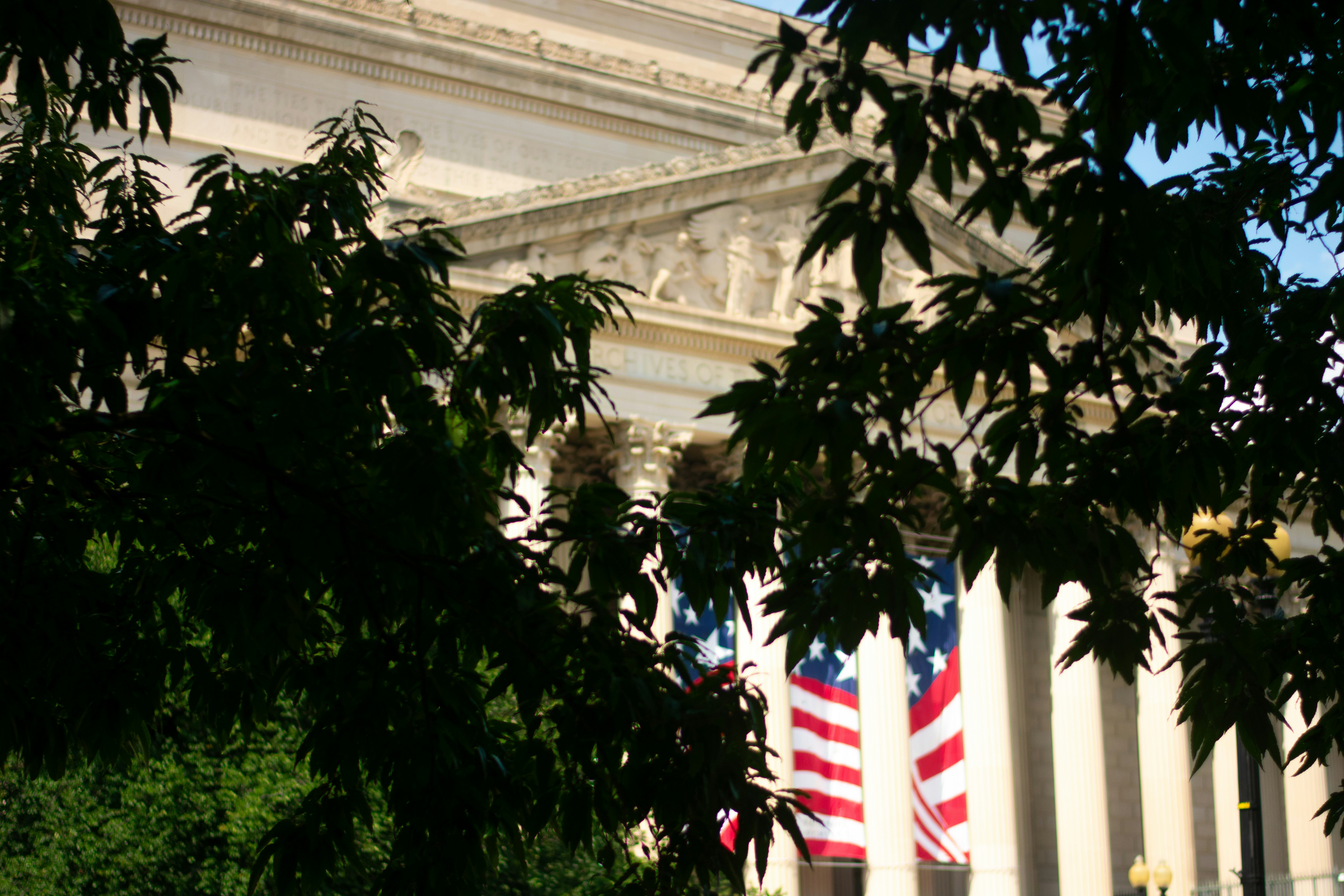
Photo of the National Archives building in Washington, DC
US National Archives, Washington, DC. (Photo by Juliana Uribbe on Unsplash.)

Also, quoting from the National Archives website: “‘A Law repugnant to the Constitution is void.’ With these words written by Chief Justice Marshall, the Supreme Court for the first time declared unconstitutional a law passed by Congress and signed by the President.”

I think some folks living and working on Pennsylvania Avenue in Washington, D.C. need to read up on this. We now have a US President who wrote on social media nine days ago, “He who saves his Country does not violate any Law.” It’s up for debate whether he is doing anything to save our country, but the frightening thing is that he has put in writing that he is above the law.

He also said that when it comes to agencies of the Executive Branch only he and the US Attorney General can interpret laws. That might be in conflict with the principle established by Marbury v. Madison.

It is the US Supreme Court that will ultimately decide if the US President does anything that is unconstitutional.

The US Constitution gave the President the power to veto an act of Congress and appoint federal judges with the advice and consent of the US Senate, and it gave Congress the power to impeach the President or a judge. The powers of the Supreme Court were not spelled out in such detail. When Marbury v. Madison came along in 1803, Chief Justice Marshall – who strongly believed that the Supreme Court was equal in power to the Executive and Legislative branches – led the court in seizing the opportunity to establish the principle of Judicial Review.

The US Supreme Court’s authority to declare federal or state laws unconstitutional has never been seriously challenged. I hope that will still be true in 2029.

In case you’re wondering what happened to William Marbury…

With the decision made in the Marbury v. Madison case, the Secretary of State was directed to deliver to William Marbury his commission as a justice of the peace for the county of Washington, in the District of Columbia.

In the big scheme of things, I wonder if the parties involved in this case had any idea going into it that it was destined to be a landmark decision.

In conclusion

I still have freedom of speech and I will continue to use my blog as a platform to share my opinions and my research into the US. Constitution. Those of you who have been reading my blog for more than 10 years know that is nothing new. I just feel more compelled now to blog about the US Constitution.

The words of the preamble to the US Constitution with a slightly blurred image of the American flag in the background.
Preamble to the Constitution of the United States of America

My college major was political science, and I regret that I only took one Constitutional Law course. In fact, I was so intimidated by the subject that I procrastinated taking the required course until my final quarter. (The university was on the quarter system then instead of the semester system.)

As it turned out, the course was fascinating and I wished I’d taken it earlier so I would have had time to take more constitutional law courses. I readily admit that one constitutional law course does not a constitutional law expert make, but I’m trying to shine a light on the document.


Hurricane Helene Update

As of Friday, 155 roads in North Carolina are still closed due to Hurricane Helene, including Interstate 40 near the Tennessee line. That is a decrease of 14 in the last week, inspite of snow and some sub-zero wind chills. This week’s count consists of 1 interstate highway (I-40), 11 US highways, 17 state highways, and 126 state roads. (To give some perspective, it has now been five months since the hurricane.)

I failed to report in last Monday’s blog post that Eric Church’s foundation, Chief
Cares, has purchased land in Avery County, NC and hopes to place 40 modular homes to house families that lost their homes due to Hurricane Helene. A road must be built and water and sewer lines installed. Church and his foundation hope to secure land in adjoining counties so they can provide more housing for hurricane victims. Church and fellow-country music singer Luke Combs organized and spearheaded a concert at Bank of America Stadium in Charlotte last October to raise money for hurricane relief.

The work of Brother Wolf Animal Rescue and The 21st Century Packhorse Librarian continue and will appreciate your support for the foreseeable future.

Jake Jarvis of Precision Grading in Saluda continues to work in the area every day free-of-charge with his heavy earth-moving equipment. He has built bridges, reconstructed driveways and private roads, and excavated places for homes to be rebuilt. The last couple of weeks have been challenging due to ice, snow, and high winds.


Until my next blog post

I hope you have a good book to read. Next Monday I plan to blog about the books I’ve read in February.

Value your freedoms, family, and friends.

Remember the people of Ukraine and western North Carolina.

Janet

The Amazing Dr. Nicholas E. Lubchenko

Plan A:  The Ida Nicholson

I wanted to blog about the sinking of the Ida Nicholson, a schooner that sank off Ocracoke Island, North Carolina in 1870, but I was unable to find sufficient information about the incident. It was hauling 101,600 of the one million bricks needed for the construction of the Hatteras Lighthouse when it went down in a gale in the infamous “Graveyard of the Atlantic.” The entire cargo was lost.


Plan B: My chance to introduce you to Dr. Nicholas E. Lubchenko

The amazing Dr. Nicholas E. Lubchenko was a topic I kept on the backburner to use when I didn’t have another blog subject calling my name. Today is that day!

In case you’ve wondered why I end my blog posts by asking you to remember the people of Ukraine, in addition to my heartfelt belief that Ukraine deserves to remain an independent nation, it is my small way of honoring the memory of a country doctor who served so many in my community for decades, regardless of their ability to pay the small fee he charged.

A black and white photo of Dr. Nicholas E. Lubchenko
Dr. Nicholas E. Lubchenko

Those are Dr. Lubchenko’s people in Ukraine, and they yearn to remain a free nation not under the thumb of Vladimir Putin.


Dr. Lubchenko’s Early Years, Military, and Medical School

Nicholas E. Lubchenko was born in Bulai, Zerkov, near Kiev, Russia (now, Ukraine) in 1882. One of ten children of a leather worker, he graduated from an agricultural college in Kharkov. Kharkov, Ukraine is familiar to us now since Russia’s invasion of Ukraine and the ongoing war.

By 1906, Lubchenko was in the Russian army. His dream was to get to America, which he called “the greatest country in the world.” He concluded that if he did not escape from the army, he would never make it to America.

Quoting from my book, Harrisburg, Did You Know? Cabarrus History, Book 1: “One day in 1906, while still in the arm, he walked out of Russia and crossed into Austria, with a ‘samovar (a Russian urn with a spigot made for boiling water for tea) under his arm and one change of clothing.’ He could speak French and German but not English.

“He got a job working on a ship bound for New Orleans. After he arrived in America in November of 1906, an eastern Louisiana family helped him until he saved enough money to travel to South Carolina where his brother, Alexis, lived.”

He worked on a cotton farm in Ridgeway, South Carolina, saved his money, and after five years was able to borrow money to attend the North Carolina Medical College in Charlotte, NC. He had $69 when he arrived in Charlotte.

He put himself through medical school by working for various doctors in his spare time. During World War I, the North Carolina and Virginia Medical Schools had to merge due to the economy, so Lubchenko moved to Richmond, Virginia, and graduated in 1915.


Dr. Lubchenko’s Medical Career

Dr. Lubchenko served as a medical officer in the Merchant Marine on a transport ship in World War I and then started his medical practice in Newell, NC. He married a nurse from Cabarrus County, NC.

During the 1918-1919 Spanish Influenza Epidemic, Dr. Lubchenko made house calls from morning and into the night.

Dr. Lubchenko became a naturalized American citizen on April 2, 1923. He moved his family to Anson County, NC, but then they moved to Harrisburg and he resumed serving the people of eastern Mecklenburg County and western Cabarrus County.

He tried unsuccessfully to enlist in the US Army when World War II started, but age and the vital medical service he was rendering in the Harrisburg area prevented that. It is said that he stayed angry about that for a long time.

Dr. Lubchenko operated his medical practice out of his home in Harrisburg, NC, but the majority of his work was probably done through house calls. He practiced medicine in Harrisburg until his death in 1960.


Dr. Lubchenko, the Humanitarian

In a 1989 newspaper interview, one of the Lubchenkos’ daughters said he did not send bills to his patients. As stated in my book, “She quoted him as saying, ‘If they don’t want to pay, they won’t. If they do, they will, and if they want to pay and couldn’t, it would embarrass them.’” A 1944 ledger indicates that his usual charge for services was $3.00.

In addition to being a physician around the clock, 365 days a year, Dr. Lubchenko loved his adopted community and worked  to make life better for the residents. Harrisburg was a small community of just 300 people in 1950, but Dr. Lubchenko wanted the best for the wider community.

He donated the land for and was the driving force in establishing the Harrisburg Volunteer Fire Department in 1954. It was the first volunteer fire department in Cabarrus County and served a wide area. For instance, we lived five miles from Harrisburg, but my father was a charter member of the fire department.

In 1955, Dr. Lubchenko helped organize a post of the Ground Observer Corps in Harrisburg. These were the days of the Cold War before radar was in place to detect enemy aircraft.


Reflections

As a child, I was scared of Dr. Lubchenko. I could not understand his heavy Russian accent and he was somewhat gruff. It was only as an adult, many years after his death, that I gained a true appreciation for him.

Although Harrisburg started growing rapidly a few years after Dr. Lubchenko’s death, it would be 30 years before the town had another doctor. His death left a great void in the wider Harrisburg community.

You can read all about Dr. Lubchenko, his medical practice, his house, the Harrisburg Volunteer Fire Department, the Ground Observer Corps, and many other aspects of local history in Harrisburg, Did You Know? Cabarrus History, Book 1. The book is available in paperback at Second Look Books in Harrisburg and in paperback and as an e-book from Amazon.com. (By the way, Harrisburg, Did You Know? Cabarrus History, Book 2 is also available.)


Hurricane Helene Update

As of Friday, 169 roads in North Carolina are still closed due to Hurricane Helene, including Interstate 40 near the Tennessee line. That count consists of 1 interstate, 11 US highways, 20 state highways, and 137 state roads. That’s a decrease of two roads over the report two weeks ago. More heavy rain, wind, and icy conditions hit over the weekend with more of the same predicted for midweek. Repairs are made slow under such conditions.

There has been some good news about I-40. It is thought that by March 1 one lane of I-40 in both directions will open. The speed limit will be 40 mph on that stretch just east of the TN-NC line. I have not read whether commercial vehicles will be allowed, but my hunch is that they won’t.

News about the Blue Ridge Parkway in North Carolina is not good. The flooding and wind from Hurricane Helene last September caused 48 landslides in one 38-mile section of the parkway. There are no estimates for when those 38 miles will be completely rebuilt or if all of it can even be rebuilt. That section between Asheville and Linville will not reopen in 2025.


Until my next blog post

I believe most people want to see a peaceful end to the war in Ukraine, but I don’t want Ukraine to have to do all the compromising.

I hope you have a good book to read.

Remember the people of Ukraine and western North Carolina.

Janet
25th Amendment Ratified, 1967

Is that date correct? Yes, it was 1967. Since this is the US Constitutional Amendment about presidential succession, it begs the question, “What procedure was in place before February 10, 1967?”

The words of the preamble to the US Constitution with a slightly blurred image of the American flag in the background.
Preamble to the Constitution of the United States of America

Prior to Enactment of the 25th Amendment

Prior to the enactment of the 25th Amendment, it was up to each presidential administration to set its own plan to deal with presidential and vice-presidential vacancies.

Yikes! Can you imagine that today?

It would be disastrous today and it was not good in 1841 when President William Harrison died in office. Harrison’s cabinet gave Vice President John Tyler the title “Vice President Acting President.” Tyler moved into the White House, assumed all presidential powers, and gave an inaugural address, all before being confirmed by Congress.

And we all know how in 1919 First Lady Edith Wilson and her husband’s doctor, Cary Grayson, banded together to keep President Woodrow Wilson’s massive stroke a secret.

After his mild stroke, President Dwight D. Eisenhower wrote Vice President Richard M. Nixon a letter with instructions on what to do if he became incapacitated. He gave Nixon the authority to determine when and if that incapacity began.

Again, yikes! All that was needed was a power-hungry vice president put in charge of determining when the president should no longer serve!

Nixon did step in as acting president when Eisenhower had a heart attack in 1955 and in 1956 when he had surgery. Nixon was not sworn in as president either time.

Part of the time in our history, the Speaker of the House was considered to be next in line after the Vice President, while in other times in our history the President Pro Tempore of the Senate was considered to be next in line after the Vice President. It wasn’t always clear.


What brought things to a head

As you might guess, the assassination of President John F. Kennedy in 1963 put more focus on presidential succession. What if Vice President Lyndon B. Johnson had also been severely wounded or killed that day?

There was no protocol in place to handle such a situation.


A Constitutional Amendment was needed

On January 1, 1965, joint resolutions were introduced in the House of Representatives and in the Senate recommending a succession amendment. Both chambers approved their versions by April.

A committee was created to iron out differences in the two bills, and the joint resolution was passed by Congress on July 6, 1965. It was sent to the states for ratification, and that requirement was met on February 10, 1967.

The 25th Amendment was signed into law by President Johnson on February 23, 1967.


The text of the 25th Amendment

In case you’ve never read it or want to refresh your memory, here is the text of the amendment:

Section 1

“In case of the removal of the President from office or of his death or resignation, the Vice President shall become President.

Section 2

“Whenever there is a vacancy in the office of the Vice President, the President shall nominate a Vice President who shall take office upon confirmation by a majority vote of both Houses of Congress.

Section 3

“Whenever the President transmits to the President pro tempore of the Senate and the Speaker of the House of Representatives his written declaration that he is unable to discharge the powers and duties of his office, and until he transmits to them a written declaration to the contrary, such powers and duties shall be discharged by the Vice President as Acting President.

Section 4

“Whenever the Vice President and a majority of either the principal officers of the executive departments or of such other body as Congress may by law provide, transmit to the President pro tempore of the Senate and the Speaker of the House of Representatives their written declaration that the President is unable to discharge the powers and duties of his office, the Vice President shall immediately assume the powers and duties of the office as Acting President.

“Thereafter, when the President transmits to the President pro tempore of the Senate and the Speaker of the House of Representatives his written declaration that no inability exists, he shall resume the powers and duties of his office unless the Vice President and a majority of either the principal officers of the executive department or of such other body as Congress may by law provide, transmit within four days to the President pro tempore of the Senate and the Speaker of the House of Representatives their written declaration that the President is unable to discharge the powers and duties of his office. Thereupon Congress shall decide the issue, assembling within forty-eight hours for that purpose if not in session. If the Congress, within twenty-one days after receipt of the latter written declaration, or, if Congress is not in session, within twenty-one days after Congress is required to assemble, determines by two-thirds vote of both Houses that the President is unable to discharge the powers and duties of his office, the Vice President shall continue to discharge the same as Acting President; otherwise, the President shall resume the powers and duties of his office.”


What the 25th Amendment accomplished

Section 1 was already the law.

Section 2 of the 25th Amendment finally addressed how a new Vice President would be chosen in the event the elected Vice President had stepped in as President.

Sections 3 and 4 of the amendment spell out the nitty-gritty of how a case of a President’s incapacitation shall be handled, including a time frame.


The Presidential Succession Act of 1947

The Presidential Succession Act of 1947 set the order in which elected officials and cabinet members would be in line for the presidency. It was decided that the cabinet members should be in the order in which their position was created. As new cabinet departments are created, they are added to the list. (And as existing federal departments are eliminated by Elon Musk… they will disappear from the list and from our lives.) There were just 11 cabinet departments in 1947 when The Presidential Succession Act was adopted.

This might be good for members of Congress to keep in mind when holding confirmation hearings for cabinet appointees.

The full order of presidential succession is as follows:

1. Vice President

2. Speak of the House

3. President Pro Tempore of the Senate

4. Secretary of State

5. Secretary of the Treasury

6. Secretary of Defense

7. Attorney General

8. Secretary of the Interior

9. Secretary of Agriculture

10. Secretary of Commerce

11. Secretary of Labor

12.Secretary of Health and Human Services

13. Secretary of Housing and Urban Development

14. Secretary of Transportation

15. Secretary of Energy

16. Secretary of Education

17. Secretary of Veterans Affairs

18. Secretary of Homeland Security


Until my next blog post

Thank you for reading my blog. I hope you occasionally find it helpful, educational, or entertaining.

I hope you have a good book to read.

Remember the people of Ukraine, western North Carolina, and California.

Janet

Books Read in January and Hurricane Helene Update

January turned out to be a good reading month for me, and I have much to report on Hurricane Helene recovery in western North Carolina. I’ll jump right in and tell you about some of the books I read.


The Frozen River, by Ariel Lawhon

Photo of front cover of the book The Frozen River, by Ariel Lawhon.
The Frozen River,
by Ariel Lawhon

My sister recommended that I read this historical novel. Finally, when it was chosen as the January read for the book club we’re in, I checked it out. I immediately fell in love with the way Ariel Lawhon writes.

The novel is set in Maine in the 1700s. The story switches from one decade to another, not necessarily in chronological order. That’s not my favorite way to read a story, but this one worked better for me than others I’ve read.

The story is inspired by Martha Ballard, a real-life midwife in Maine at that time. As Lawhon explains in her author’s notes at the back of the book, she did take creative license in some areas to make it a more manageable story. That said, the book is well-researched and in the author notes Lawhon explains why the book sometimes deviates from the facts. After all,… it is fiction!

The novel includes murder, rape, attempted rape, young love, vengeance, lying, under-handed business dealings, the unique lifestyle along a river that freezes over in winter, and the birth of numerous babies. There is conflict between Martha Ballard and a young, inexperienced physician who moves to the town. There are court cases, and there are judges of questionable character. There is a lot going on in this novel!

As an aspiring novelist, I plan to read The Frozen River again just to study how it is written.

I highly recommend The Frozen River to anyone who likes to read historical fiction set in 18th century America.


The Lion Women of Tehran, by Marjan Kamali

Photo of front cover of book, The Lion Women of Tehran, by Marjan Kamali
The Lion Women of Tehran,
by Marjan Kamali

This novel follows the friendship of two people through the 1950s, 1960s, and 1970s against the backdrop of what was happening in Iran. Iran went from being under the rule of the Shah to being under the rule of the Ayatollah Ruhollah Khomeini.

For those of you who might not have lived through those three decades… It was under the Ayatollah Ruhollah Khomeini that women lost all their rights. The radical Islamic view that women are put on earth for one purpose – to wait on and obey men and bear their children – is what Iran has turned into. They are not to be seen. It wasn’t enough that they had to wear the hijab in public. As of a couple of weeks ago, windows in their homes through which it would be possible for a man to see them were outlawed. Let that sink in!

Back to the novel… In The Lion Women of Tehran, we see two young girls become friends although Ellie is from a privileged family and Homa is from a poor family. Ellie, in fact, defies her mother’s wishes that she not befriend someone from the poor part of town.

Ellie and Homa share their dreams of attending college and becoming professionals in a modern Iran. Homa even aspires to get a law degree and someday be a judge. This is a reasonable aspiration for a girl in Iran at that time. Girls are seeing women have jobs they\ had been excluded from until the somewhat enlightened time of the early 1960s.

The book follows the ups and downs of Ellie and Homa’s friendship and the challenges of the cultural and governmental restrictions on women and free speech.

Spoiler Alert: When the novel comes to an end, one of the two – women now – has escaped to the United States. The aspiring lawyer has been raped in prison for protesting injustice and she reaches out to her now-estranged friend in America to help her get her teenaged daughter out of Iran.

The Lion Women of Tehran had an especially chilling affect on me because I was reading during the first week of Trump’s second administration when we were witnessing what it looks like when a country’s leader daily pushes the limits of the power of the office he or she holds – even in a democracy.  

This is the second novel I’ve read by Marjan Kamali. In October 2019, I read The Stationery Shop. (See my November 4, 2019 blog post, A New Favorite Novel? in which I told how impressed I was with Marjan Kamali’s writing.)


How to Stand Up to a Dictator, by Maria Reesa

Photo of the front cover of the book, How to Stand Up to a Dictator: The Fight for Our Future, by Maria Reesa
How to Stand Up to a Dictator: The Fight for Our Future, by Maria Reesa

I wish I could take credit for reading I Was Anastasia and How to Stand Up to a Dictator in the same month, but I was at the mercy of the waitlists at the public library. Sometimes things just fall into place through no effort of our own!

After hearing Maria Reesa interviewed on NPR and learning that she had written a book, I immediately got on the waitlist for it at the public library.

Maria Reesa is from The Philippines. She was awarded The Nobel Peace Prize in 2021 for her courageous work at a journalist.

In her book, How to Stand Up to a Dictator, Reesa writes from her own experience. She was arrested for reporting the truth – a truth that ex-President Rodrigo Duterte of The Philippines did not want people to know.

Meticulously written, the book points out how in many ways what happens in politics in The Philippines eventually happens in politics in the United States. That was a revelation for me, but the examples she gave painted a compelling picture.

Near the end of the book, Reesa gives the 10-Point Plan to Address the Information Crisis that she and fellow-2021 Nobel Peace Prize recipient Dmitry Muratov presented at the Freedom of Expression Conference, Nobel Peace Center, Oslo, Norway, on September 2, 2022.

In a nutshell, points 1-3 call on transparency and a consideration for human rights by tech companies, right to privacy of citizens to be beefed up, and public condemnation of attacks on journalists.

Points 4 through 9 are directed at the European Union, and point 10 calls on the United Nations to “Create a special Envoy of the UN Secretary-General focused on the Safety of Journalists (SESJ) who would challenge the current status quo and finally raise the cost of crimes against journalists.”

Reesa calls on young people to put their phones down and focus on the people they love. She writes, “You find meaning by choosing where to spend your precious time.” We can all benefit by taking that to heart. She told a high school audience that they can’t find meaning on social media.

She writes about how social media can easily be hijacked by individuals and elected officials with ill intent, and how misinformation spreads like wildfire while fact-checking and retractions never spread as quickly or easily as lies.

Reesa says if the rest of the world wants to know what unbridled social media will do to their country, all they need to do is look at what happened in The Philippines.

In 2012, Reesa cofounded a digital only news website in the Philippines called Rappler. Rappler has exposed corruption and manipulation in government and in technology companies.

She warns, “the Philippines is ground zero for the terrible effects that social media can have on a nation’s institutions, its culture, and the minds of its populace. Every development that happens in my country eventually happens in the rest of the world – if not tomorrow, then a year or two later.”

She goes on to say, “This book is my attempt to show you that the absence of rule of law in the virtual world is devastating.” She warns us, “Don’t become a Monster to Fight a Monster. Embrace Your Fear.”


Blogging for Authors, by Barb Drozdowich

Photo of front cover of the book Blogging for Authors, by Barb Drozdowich
Blogging for Authors,
by Barb Drozdowich

Reading this book made me aware of some ways I’m falling down on the job when it comes to my blog. The author says that an author’s blog is “… by far the most important method of communicating with your readers.” She also says, “… you want readers to be able to Google the genre they read and find your site in a search.”

Since I write local history and historical fiction, there’s a slim-to-none chance someone will find my blog by typing either of those topics in a search engine. Just for fun, I tried.

I have tried to blog about historical events to convey my lifelong foundation in the study of history and my ability to do historical research. I’ve blogged about the craft of writing as I continue to learn more about it every day. I hope I’ve been successful, but now I might need to consider how to express how those things are converging in my effort to write my first historical novel. Stay tuned!


Hurricane Helene Update

As of Friday, 171 roads in North Carolina are still closed due to Hurricane Helene, including Interstate 40 near the Tennessee line, but that’s a decrease of 12 since the Friday before. That count consists of one interstate, 12 US, 19 state highways, and 139 state roads. There is no estimate for when the Blue Ridge Parkway in North Carolina will be fully reopened.

WLOS in Asheville reported that the Biltmore Estate donated at least 40 hotel rooms of furniture to the Habitat for Humanity Restore to resell. All proceeds from items sold at a Habitat for Humanity Restore, of course, funds new home construction.

WLOS is also reporting a new partnership in Haywood County between Mountain Project and Habitat for Humanity as others to build 10 homes specifically for families impacted by Hurricane Helene.

Verizon has partnered with ForgiveCo, a public benefit corporation, to pay off $10 million in debts owed by 6,500 people in the 39 North Carolina counties impacted by Hurricane Helene. A Verizon spokesperson said the company thought they needed to do more than restore customers’ telephone service. The debt forgiveness recipients were randomly selected.

The newspaper in Boone, The Watauga Democrat, reported that NC Gov. Josh Stein announced a joint $30 million small business grant program with Dogwood Health Trust to support small businesses affected by Hurricane Helene.

Businesses with annual revenue up to $2.5 million are eligible for grants up to $50,000 from the Western North Carolina Small Business Initiative Grant Program. Dogwood Health Trust, a private foundation, created the Western North Carolina Small Business Initiative last fall in response to the Hurricane Helene disaster.

Businesses in the 28 counties and the Eastern Band of Cherokee Indians covered by President Biden’s federal disaster declaration or in Dogwood Health Trust’s 18-county footprint and that meet revenue requirements are eligible to apply for a grant.

Governor Stein announced that the State of North Carolina is awarding $3 million to Baptists on Mission and $3 million to Habitat for Humanity NC for their housing repair initiatives in the western part of the state.

Photo of a man using a power saw to cut a piece of lumber
Photo by Greyson Joralemon on Unsplash

The Boone newspaper reported stated: “In the wake of Helene, impacted businesses lost $13 billion in revenue. These grants will help businesses make payroll, pay operating expenses, and stabilize the local economy as tourism slowly ramps up again.”

The work of Brother Wolf Animal Rescue and The 21st Century Packhorse Librarian continue and will appreciate your support for the foreseeable future.

Jake Jarvis of Precision Grading in Saluda continues to work in the area every day free-of-charge with his heavy earth-moving equipment. He has built bridges, reconstructed driveways and private roads, and excavated places for homes to be rebuilt.

It is said that no good deed goes unpunished. After doing what he thought was due diligence, Mr. Jarvis was scammed out of $77,000 he paid for a bulldozer in Texas. He wanted a larger bulldozer so he could help more people. A friend of his has set up a GiveSendGo fundraiser to help Mr. Jarvis replace the money he pulled out of savings for the bulldozer which never was delivered.


Until my next blog post

I hope you have a good book to read. If you’re a fan of historical fiction, I highly recommend The Frozen River. If you are concerned about the role of social media in our world and particularly in our politics, I highly recommend How to Stand Up to a Dictator.

It has been a tough week since last Monday’s blog post. The airplane and helicopter collision in Washington, DC; the Medivac plane crash in Philadelphia; wildfires in some of the Hurricane Helene-ravaged parts of western North Carolina;….

Remember the people of Ukraine and all the places where people are suffering through no fault of their own.

Janet