Too Busy Playing Golf and Banning Books

I look back fondly on “the good old days” when I wrote a weekly blog. I hoped to limit myself to just two posts this week, but things quickly got out of hand.

In case you’ve missed a post, this week I’ve blogged about the three books I read last month, and Harriet Tubman and slavery being temporarily scrubbed from the “Underground Railroad” webpage of the National Park Service. Some 130,000 government webpages have gone dark since January 20, 2025. Sort of a digital book burning, don’t you think?

Tomorrow’s blog post will be about a variety of things going on in the Trump Administration along with an update on the status of Mr. Abrego Garcia. On Friday I plan an open letter to Trump supporters.

Last week, the No Dollars for Dictators Act before the US Senate got almost no attention. That and the hypocrisy of the Party of Family Values (i.e., Republican Party) in the US House of Representatives begged for a blog post. Those are the two items I started with for today’s post, but it grew in direct proportion to the news coming out of Washington. In fact, I’ve split it between today and tomorrow.

Today’s post underwent a lot of additions and editing. I hope I caught all my typos and grammatical errors.


What’s going on?

We’ve all been distracted by wildfires, tornadoes, floods, volcano eruptions, earthquakes, tariffs, massive federal employee firings, and massive layoffs in the automobile and related industries. It’s impossible to catch all the news, so in my blog today and tomorrow I will mention a few that I have heard or read about.

The massive tariffs on 185 countries took effect at 12:01 a.m. Thursday, April 3 and by Friday afternoon, April 4 the President was on his way to a four-day golf weekend in Florida where he miraculously won his own tournament. (You know how you have to let a toddler win a game so they won’t cry? Just sayin’.)

His golf game prevented his being able to go to Dover Air Force Base in Delaware on Friday to accept the bodies of the four US soldiers from Camp Stewart, Georgia, who died in Lithuania. We all have our priorities. Thank you, Lithuania, for the respectful ceremony you had to send the soldiers’ bodies home. That’s the way dead soldiers should be honored.

On March 26, Trump called himself “the fertilization president” (which was beyond creepy!) but on April 2 he cut all the funding for the Department of Health and Human Resources office that monitors the success rates at the in vitro fertilization (IVF) clinics across the nation. Patients considering IVF used to find such information helpful in selecting a clinic… back in the day… you know, back in March, 2025.

We’re left to wonder if Trump (a) was just saying what his audience wanted to hear on March 26, or (b) he still doesn’t know what IVF is, or (c) he already knew the office was going to be shut down a week later, or (d) he didn’t and still doesn’t care. Based on his track record, my hunch is that all those scenarios are true.

The US eventually sent three people to Myanmar to help with earthquake recovery. They worked for a company under contract with the government. They’ve already been fired and the contract cancelled.
And the little bit of food aid the US State Department originally said they would keep giving after USAID was trashed? They’ve already pulled the plug on that.

On Air Force on this past Sunday, Trump was asked about sending US-born prisoners to prisons in other countries. He told reporters that he is open to the idea. In fact, he said, “I love that.” He also said that the tariffs were “going very well.” It makes you wonder where he gets his information. Perhaps from all the “yes men” who surrounded him.

The Harriet Tubman/Underground Railroad webpage I wrote about yesterday has been restored, but most of the 130,000 government web pages that have gone dark under the Trump Administration have not been restored, and there’s no reason to think they will be. This amounts to a digital book burning.

The Defense Department removed the Holocaust remembrance pages from its website in the name of “Diversity, Equity, and Inclusion.” History is being erased before our very eyes, folks.

Maya Angelou’s autobiography, I Know Why the Caged Bird Sings and books about the Holocaust, histories of feminism, civil rights, and racism were among 381 titles removed from the Nimitz Library at the  U.S. Naval Academy last week.

A few of the other books on the list:

  • Tears We Cannot Stop: A Sermon to White America, by Eric Michael Dyson
  • The Difference: How the Power of Diversity Creates Better Groups, Firms, Schools, and Societies, by Scott E. Page
  • No Common Ground: Confederate Monuments and the Ongoing for Social Justice, by Karen L. Cox
  • Colorization: One Hundred Years of Black Films in a White World, by Wil Havgood
  • How to Be an Antiracist, by Ibram X. Kendi

I read No Common Ground: Confederate Monuments and the Ongoing for Social Justice, by Karen L. Cox in July 2021 an wrote about it in my August 2, 2021, blog post, 2 Books about Racial Injustice. I was literally reading the book as a statue of Robert E. Lee sitting on his horse, Traveler, was being taken down in Richmond, Virginia, so it was a hot topic.

In No Common Ground, Dr.Karen L. Cox writes about the history of the Confederate statues, and I came to understand that they weren’t erected to honor the Confederate soldiers and officers as much as they were built out of a place of hate. Please take time to read my takeaways from reading the book four years ago.

The author, Karen L. Cox, is a professor emerita of history at the University of North Carolina at Charlotte where she taught from 2002 until 2024. She is currently writing a book about the Great Migration, the Black press, and early Chicago jazz through the tragic Rhythm Club fire, which took the lives of more than 200 African Americans in Natchez, Mississippi in 1940. It will probably be banned by the Trump Administration, too.

I listened to How to Be an Antiracist, by Ibram X. Kendi in June 2020 and wrote about in in my July 20, 2020 blog post, Three Books Read in June 2020. I invite you to read that blog post. I started my comments saying, “There are many eye-opening things to take from Ibram X. Kendi’s book, How to Be An Antiracist, but the most important lesson I learned from reading it is the difference being “not racist” and “antiracist.” I’ve been guilty of saying, “I’m not a racist.” It’s possible I’ve even said, although I hope I haven’t, “I’m not a racist, but….” “But” says, “Oh yes you are!”

In the words of Mr. Kendi in his book, “What’s the problem with being ‘not racist?’ It is a claim that signifies neutrality…. The opposite of racist isn’t not racist it is antiracist.”

I’ve read I Know Why the Caged Bird Sings, by Maya Angelou, and I thought I’d read Tears We Cannot Stop: A Sermon to White America, by Eric Michael Dyson. I haven’t found Mr. Dyson’s book on my list of books read or in my old blog posts, so maybe I meant to read it but never got around to it.

The US Naval Academy is essentially the midshipmen’s university, so what university would ban books? The Trump Administration has a basic lack of understanding of the purpose of higher education. Midshipmen should have easy access to any book they want to read! After all, they are 18 to 22 years old and can make their own decisions about many things, including which books to read.

I cannot understand why anyone thinks books should be banned from the Nimitz Library.


To my Republican friends and relatives who voted for Trump, “Is this what you thought you were voting for?”

I sincerely hope this level of cruelty isn’t what you wanted. If it is, I had no idea how miserable your life was.


The No Dollars for Dictators Act

As the stock market continued to be in free fall due to the tariff announcement, the US Senate had important business to tend to: “The No Dollars for Dictators Act.” It was introduced by Senator John Kennedy (R-LA) and co-sponsored by Senators Rick Scott (R-FL), Marsha Blackburn (R-TN), Jim Justice (R-WV), John Barrasso (R-WY), and Chuck Grassley (R-IA).

Senator Scott was quoted as saying, “The No Dollars for Dictators Act will protect U.S. tax dollars from fueling the evils of dictators or terrorists who seek to destroy our way of life.” It wasn’t voted on.

Supposedly aimed at China, Iran, Venezuela, Russia, and Syria, it begs the question, “Why isn’t Donald Trump’s name on that list?” He’s doing more to “destroy our way of life” than any of the countries on the list.

Just wondering….


A Proposal to Allow New Parents to Vote by Proxy in the US House

And while we’re talking about the US Congress… As of April 1, we know that it was quite all right for old white men in the US House of Representatives to vote in absentia during the Covid-19 pandemic, but female members of the House cannot vote in absentia the day after they’ve had a baby.

Speaker of the House Mike Johnson suddenly sent the House members home on April 1 to block a vote that would allow US Representatives (male or female) to vote by proxy for up to three months after the birth of a child.

The House did not meet for the rest of the week because Johnson was afraid the bill might be brought to a vote.

A strange compromise has been reached between Johnson and Representative Anna Paulina Luna, who was pushing for the right to vote by proxy. Luna announced the compromise on Sunday, April 6.

This is how CBS News reported the “deal” reached by the two: “a deal to use vote pairing – an agreement between an absent member and a member who is physically present and plans to vote on the opposite side of the question, effectively canceling out the vote. The present member casts their vote, then withdraws it and announces that they have paired with the absent member. The vote is not included in the vote total, but their positions are published in the Congressional Record.”

WHAT?

It sounds to me like not only does the new parent’s vote now not count, but a Representative on the opposite side of an issue must also, in effect, forfeit their vote. Having their positions recorded in the Congressional Record means very little. Every word uttered on the floor of Congress is recorded and published daily in the Congressional Record, but no one reads it.

Am I missing something? This sounds convoluted to me and the end result is that the new parent essentially still doesn’t get to vote. And the wording is troubling. The new parent has to find someone who “plans” to vote in the opposite way. It sounds like they aren’t bound by their “plans.”

What about the logistics? What if that new parent is in labor or their spouse is in labor?. That time isn’t conducive for the Representative or the spouse to be calling around to find a Representative on the opposite side of the issue who is amenable to forfeiting their vote.

Surely, this could have been handled better! Let’s be honest. All that was wanted was for a nursing mother to be able to cast her vote from home instead of bringing her infant with her to the floor of Congress so she could cast a vote. That’s really what this boils down to, but most of the men in Congress would rather that she just stay home and keep her mouth shut. They don’t want her in Congress. Period.


Mid-Term Elections Reminder

Here’s a reminder for US Representatives and voters:  Mid-term elections are scheduled for November 3, 2026, and all 435 seats in the House of Representatives will be up for grabs!

Some voters are paying attention. Many members of Congress and some members of the media like to say that only people “who live inside the Beltway” around Washington, DC ever pay attention or care what’s happening there. They might be surprised 19 months from now just how much we have seen, heard, and remember.

Millions of Americans took to the streets in non-violent protests on April 5. There is a ray of hope!


Until my next blog post tomorrow

I hope you have a good book to read.

Pay attention.

Remember the people of Kentucky, Myanmar, Thailand, Ukraine, and western North Carolina.

Janet

They’ve gone too far, Harriet Tubman!

NOTE: At 2 a.m., just three hours before this blog post was scheduled to be published, I learned that the Harriet Tubman/Underground Railroad webpage on the National Park Service website had been restored! Rather than cancel today’s blog post, I will go forward with it because the only thing that has changed is that for whatever reason that one webpage has been restored.

Nothing else has changed, though. The Trump Administration continues to recklessly… and intentionally… try to erase and destroy American history and democracy. Whether they justify it under the guise of getting rid of “waste and fraud” or eliminating “Diversity, Equity, and Inclusion” it is all part of this sham racist and misogynist Administration.

What has taken place regarding Harriet Tubman and the Underground Railroad since January 20, 2025, is a prime example of the incompetence and insidious hate held by members of the Trump Administration.

It offends me when I hear people say that all government employees are corrupt and incompetent. That is the mantra of the Trump Administration. Trump and the people in his inner circle despise federal employees. They are perfectly happy to collect government paychecks and benefits, but no one else working in the government deserves anything but ridicule. Think about that for a minute.

If you want to see corruption and incompetence, you need look no further than the Trump Administration. It is made up entirely of businessmen. Businessmen are never corrupt or incompetent, are they? But evidence to the contrary lies in the fact that almost on a daily basis since January 20 this Administration has made an announcement then had to retract it, has fired federal employees and then had to try to re-hire them, has erased information from a website and then had to restore it. Not to mention high level national security people conducting business on a less-than-secure app, first denying it, then halfway owning up to it, then proclaiming it was no big thing.

The Administration’s total disregard for truth, transparency, and the rule of law and never taking responsibility for mistakes is on display daily for all to see.

It astounds me how the businessmen who are running the federal government have a total lack of knowledge of what government’s purpose is. They only think in terms of profit and loss, but that’s not what government is about. Government is about serving the people, and that’s why Trump and the people in his Administration have it all wrong. Serving the people is a foreign term for them. They only think in terms of making money from the people, and running over anyone who gets in their way. What a pathetic way to see the world!

They delight in firing employees willy-nilly. There’s no rhyme or reason to it. They don’t consider what anyone’s job is. They don’t consider anyone’s expertise. They just conduct wholesale firings.

Hours or days later, when someone has the courage to point out to them that some of those employees helped planes land safely, or some of them were conducting research into cancer treatments or possible cures, or some of them risk their lives to fight wildfires… then a handful of them might be re-hired. That is, if they can locate them, because in the name of anti-waste, anti-fraud, anti-diversity, anti-equity, and anti-inclusion, they erased all the fired employees’ contact information.

I guess that’s the business mentality. After all, more than one person said to me before Trump ran for office the first time, “We need a businessman in the White House.” And that’s supposedly what we got.


What follows is my original blog post scheduled for April 8, 2025:

Until around 9:30 Sunday night, I planned not to blog again about politics until Thursday. That’s when I learned that sometime between January 21 and March 19, 2025, the National Park Service removed all references to Harriett Tubman from its “Underground Railroad” webpage.

Yes, THAT Harriet Tubman! The Harriet Tubman who was the most famous “conductor” on the Underground Railroad.

That’s the Harriet Tubman whose image appeared on a 13-cent first-class postage stamp in the United States in 1978. If you weren’t born until the 1990s, you probably can’t truly appreciate how difficult it was to get the United States to honor a non-white person on a postage stamp. She was the first woman of color (almost any color!) whose image was chosen for a US postage stamp. (Here’s a list of them, if you are interested in digging deeper into that aspect of American history: https://about.usps.com/who/profile/history/african-american-stamp-subjects.htm.)

If you don’t know what the Underground Railroad was, please look it up somewhere while you still can. It was not an actual railroad, but it operated like one in many ways except in secret.

Apparently, the “Underground Railroad” webpage’s lead story until the Trump Administration decided to erase all history except that of white men!

Not only did they remove Harriet Tubman and her photograph, they removed references to “enslaved” people and the Fugitive Slave Act of 1850.

Harriet Tubman, enslaved people, and the Fugitive Slave Act of 1850 have been replaced on the webpage with… and you aren’t going to believe this… or I guess you will if you are a person of color or a female… “Black/White Cooperation.”

The webpage used to (until a matter of weeks ago) open with FACTS about slavery, how slaves struggled to gain their freedom, how the Underground Railroad came about after the Fugitive Slave Act of 1850.

Now, the page’s first two paragraphs emphasize “American ideals of liberty and freedom” and slavery isn’t mentioned.

There is a separate National Park Service webpage dedicated to Harriet Tubman. It has not been removed… yet.

The name “Harriet Tubman” is was synonymous with “Underground Railroad.” Her name will continue to be synonymous with the Underground Railroad until her name is wiped from the entire internet and all books about her or the Underground Railroad are destroyed… and after that, her name will still be whispered and kept alive through oral history.

The Trump Administration has also targeted the National Museum of African American History and Culture and the Smithsonian American Art Museum for having exhibits and using language he doesn’t like… or someone has told him he shouldn’t like. After all, we all know what a limited vocabulary he has.

The Administration continues to threaten universities, libraries, museums under the guise of Diversity, Equity, and Inclusion (DEI), but if Trump and his minions were truthful they would just admit that they are racists, bigots, and mysogenists. We all know, though, the truth is not in them. They are small, fearful, hateful bullies.

I believe God is weeping. He gave us freewill, but it must grieve him to see what so many Americans have done with that freedom and responsibility.


In case you can’t see the forest for the trees…

Before you jump on me for making a mountain out of mole hill… for getting all bent out of shape over “just” the removal of Harriet Tubman, the Underground Railroad, and slavery from a US Government webpage, I’m worried about the big picture. Yes, I’m upset over those specific things being scrubbed from a government webpage, but I’m more concerned over what this portends.

I’m 72 years old and I NEVER thought the United States Government would erase our history. It has taken hundreds of years for indigenous peoples and Americans of African descent to get their stories – their history – in the history books. All that progress is under siege and threatened today.


Where do we go from here?

It falls on each of us to learn as much history as we can… while we still can… and commit it to memory so we can tell future generations the truth.

It falls on us to protest any way we can. It you are fortunate enough to be represented on any level of government by someone not affiliated with the Republican Party, call them, write them, encourage them, support them in their efforts to stop this madness.

If you are represented by Republican politicians, your have your work cut out for you. They have been advised not to hold town hall meetings. I know from experience that when you write them (letters or email) if you get a response it might not be on the topic you wrote them about.

The response you receive will quickly descend into a regurgitation of the usual Republican talking points singing the praises of Trump and how we all need to just be patient because great wealth is going to come to each of us and it is coming quickly.

On the other hand, we’re told it might take years for us to realize that prosperity because it took decades of our allies taking advantage of us to get us in the dire economic situation we were put in by the Democrats.

In other words, if we live long enough, this great American nightmare might end.

Make a sign and join a non-violent protest. Respond to hecklers with “Bless your heart!”

We must follow the example set by the Rev. Dr. Martin Luther King and protest peacefully. Only the other side storms Capitol buildings and attacks police officers.

If need be, we can protest and wait patiently to vote in the mid-term election on November 3, 2026, when every one of the 435 seats in the US House of Representatives will be up for election and 33 US Senate seats will be up for election.


One thing I hope to live to hear

I hope to live long enough to hear a sane future US President speak the words that President Gerald Ford uttered to the nation after President Nixon was forced to leave the White House in shame: 

“My fellow Americans, our long national nightmare is over. Our Constitution works; our great Republic is a government of laws and not of men. Here the people rule. But there is a higher Power, by whatever name we honor Him, who ordains not only righteousness but love, not only justice but mercy. As we bind up the internal wounds of Watergate, more painful and more poisonous than those of foreign wars, let us restore the golden rule to our political process, and let brotherly love purge our hearts of suspicion and of hate.” ~ newly-sworn in US President Gerald R. Ford, nationally televised from the East Room of the White House on August 9, 1974.

I heard President Ford say those words, and I desperately want to hear a future US President say them, substituting “the Trump Administration” for “Watergate.”


Until my next blog post, probably tomorrow

I hope you have a book or something to give you a few minutes respite from what’s happening.

Janet

Words Trump wants federal agencies to “limit or avoid”

Find a comfortable chair. This is another long blog post.

I’ve been mulling over today’s topic for several weeks. It’s one thing to erase history – and the Trump Administration seems to be doing an admirable job, if that’s what you want done.

And some people do want that done. As I voiced my displeasure with everything the Trump Administration has done in two short months a classmate, whom I’ve known for 65 years, told me “it’s a beautiful thing to watch.” His comment made me nauseous.

Photo of a taxidermied elephant on display at the Smithsonian Institution in Washington, DC
A taxidermied elephant on display at the Smithsonian Institution, Washington, DC.
Photo by J. Amill Santiago on Unsplash

Several days ago, the Trump Administration (or should I say, Regime?) attacked the Smithsonian Institution and National Park Service. Both were targeted for having “divisive” and “anti-American” exhibits. “Divisive” and “anti-American” can be translated to mean that they have some exhibits about people of color and women of any color. It’s feeling more and more like 1931 in Germany around here.

I have a hunch the elephant pictured above that is displayed at the Smithsonian Institution will be safe, though, since the elephant is the mascot of the Republican Party.

Equally troubling to me as erasing history is the Trump Administration’s efforts to limit or perhaps erase perfectly good words from our vocabulary.

Photo of a pencil with an eraser on the end
Photo by Kim Leary on Unsplash

People are disappearing, history is disappearing, and words are disappearing. Our allies are disappearing, and who can blame them?

Several weeks ago, a list of words was cobbled together that the Trump Regime wants US Government agencies to “limit or avoid.” The White House denies issuing a list, but they have left government agencies to use some of their own judgment in erasing specific words from their documents and websites. It seems that the hints they’ve been given are fairly loud as they are supposed to use Trump’s too-numerous-to-mention Executive Orders as their guide.

This is rich, coming from a President who has difficulty speaking in complete sentence. (Before you jump on me… I’m not being disrespectful; there is proof all over TV, video and audio clips, the internet, and the printed word.)

You can’t make this stuff up.

In case you missed it here is the list of 298 words and combinations of words that The New York Times published on March 4, 2025, that US Government agencies are supposed to “limit or avoid”:

  • accessible
  • activism
  • activists
  • advocacy
  • advocate
  • advocates
  • affirming care
  • all-inclusive
  • allyship
  • anti-racism
  • antiracist
  • assigned at birth
  • assigned female at birth
  • assigned male at birth
  • at risk
  • barrier
  • barriers
  • belong
  • bias
  • biased
  • biased toward
  • biases
  • biases towards
  • biologically female
  • biologically male
  • BIPOC
  • Black
  • breastfeed + people
  • breastfeed + person
  • chestfeed + people
  • chestfeed + person
  • clean energy
  • climate crisis
  • climate science
  • commercial sex worker
  • community diversity
  • community equity
  • confirmation bias
  • cultural competence
  • cultural differences
  • cultural heritage
  • cultural sensitivity
  • culturally appropriate
  • culturally responsive
  • DEI
  • DEIA
  • DEIAB
  • DEIJ
  • disabilities
  • disability
  • discriminated
  • discrimination
  • discriminatory
  • disparity
  • diverse
  • diverse backgrounds
  • diverse communities
  • diverse community
  • diverse group
  • diverse groups
  • diversified
  • diversify
  • diversifying
  • diversity
  • enhance the diversity
  • enhancing diversity
  • environmental quality
  • equal opportunity
  • equality
  • equitable
  • equitableness
  • equity
  • ethnicity
  • excluded
  • exclusion
  • expression
  • female
  • females
  • feminism
  • fostering inclusivity
  • GBV
  • gender
  • gender based
  • gender based violence
  • gender diversity
  • gender identity
  • gender ideology
  • gender-affirming care
  • genders
  • Gulf of Mexico
  • hate speech
  • health disparity
  • health equity
  • hispanic minority
  • historically
  • identity
  • immigrants
  • implicit bias
  • implicit biases
  • inclusion
  • inclusive
  • inclusive leadership
  • inclusiveness
  • inclusivity
  • increase diversity
  • increase the diversity
  • indigenous community
  • inequalities
  • inequality
  • inequitable
  • inequities
  • inequity
  • injustice
  • institutional
  • intersectional
  • intersectionality
  • key groups
  • key people
  • key populations
  • Latinx
  • LGBT
  • LGBTQ
  • marginalize
  • marginalized
  • men who have sex with men
  • mental health
  • minorities
  • minority
  • most risk
  • MSM
  • multicultural
  • Mx
  • Native American
  • non-binary
  • nonbinary
  • oppression
  • oppressive
  • orientation
  • people + uterus
  • people-centered care
  • person-centered
  • person-centered care
  • polarization
  • political
  • pollution
  • pregnant people
  • pregnant person
  • pregnant persons
  • prejudice
  • privilege
  • privileges
  • promote diversity
  • promoting diversity
  • pronoun
  • pronouns
  • prostitute
  • race
  • race and ethnicity
  • racial
  • racial diversity
  • racial identity
  • racial inequality
  • racial justice
  • racially
  • racism
  • segregation
  • sense of belonging
  • sex
  • sexual preferences
  • sexuality
  • social justice
  • sociocultural
  • socioeconomic
  • status
  • stereotype
  • stereotypes
  • systemic
  • systemically
  • they/them
  • trans
  • transgender
  • transsexual
  • trauma
  • traumatic
  • tribal
  • unconscious bias
  • underappreciated
  • underprivileged
  • underrepresentation
  • underrepresented
  • underserved
  • undervalued
  • victim
  • victims
  • vulnerable populations
  • women
  • women and underrepresented

Some of my thoughts on the subject

I considered using bold font to highlight my favorites/most angering/most ridiculous words on the list, but that would have been all 298 of them.

As a writer, words are my life. Words help me communicate. I’ll bet they help you, too. Without words, our communications would be extremely limited.

I haven’t read how Trump intends to enforce this or what punishments will be meted out to offenders. And who comes next? Writers? Reporters? Universities? Teachers?

Depending on your background, gender, or ethnicity, there are probably particular words on the list that strike a nerve with you.

Here are 51 that set me off

“Black” (capitalized) — I have Black friends. I don’t see anything wrong with the word “Black.” In fact, my great-grandmother’s surname was Black. My sister and I mentioned her in one of the Morrison genealogy books we published in 1996. I hope the Trump Administration will not ban our book, but we’re on a slippery slope when we start outlawing words.

“female,” “females,” “women,” and “biologically female”– Hmmm. Now those are intriguing words to put on a government’s “limit or avoid” list. I couldn’t help but notice that “male,” “males,” and “men” are not on the list, but “biologically male” is. Surely, it was an oversight on the part of the “biologically male” person who obviously wrote the list to not include “male,” “males,” and “men” on the list.

“mental health” – I have some relatives who struggle with mental health. I’m not sure what to do with this word combination now. Does the Trump Administration think by not using the words “mental health,” mental health issues will no longer exist? How wonderful it would be if we could just use a word and make a whole category of illness disappear!

“belong” – My mind jumped back to a trip to Scotland where I learned that there instead of saying, “She’s Campbeltown,” the locals would say, “She belongs to Campbeltown.” Since the plural form of the word isn’t on the list, maybe that use of it would be legal. Otherwise, Scots might want to think twice before visiting America. Oh… my bad…. They’ve all taken America off their bucket lists since January 20.

“pronoun” and “pronouns” – This is going to be challenging for English teachers, but it will simplify diagramming sentences.

“sex” and “chestfeed” – I don’t know what to say about these. I don’t want my blog to be flagged as obscene, but is “chestfeed” really a word? Is it actually a thing we need to be concerned about?

“systematically” – What?

“orientation” – I guess there will be no more orientation meetings for new government employees or college freshmen at schools that receive federal funds.

“trauma” – Some hospitals are qualified trauma centers, but I guess they won’t be much longer. Heaven forbid if they receive any federal funds.

Photo of a poster with words like trauma, PTSD, and anger on it
Photo by Susan Wilkinson on Unsplash

“environmental quality” – You’ve got to be kidding, Trump! Just because you don’t want the citizens of the United States to have “environmental quality” doesn’t mean that the citizens of the United States don’t want “environmental quality.” Just because you want to drink contaminated water and breathe polluted air, Mr. Trump, doesn’t me the rest of us do. You can’t just outlaw the words “environmental quality” and make the whole concept of a healthy environment go away.

“disability,” and “disabilities,” – I shudder to think what will soon become of the Americans with Disabilities Act. It is that act that requires handicapped bathroom stalls, automatic doors to permit easy ingress and egress at government buildings, hotel rooms with bathrooms accessible to people in wheelchairs, etc. Need I keep going?

That leads me to “barrier” and “barriers” – which I think must be on the list because the Americans with Disabilities Act tries to prevent physical movement and communication barriers from remaining in place that make it difficult for blind, deaf, and people restricted to wheelchairs to do what they need to do. Have you ever wondered why you didn’t see many (or any?) ramps into public buildings in the 1950s, but now you do? They didn’t just happen. It wasn’t because architects started adding them out of the goodness of their hearts.

Photo of a really long staircase
Photo by Joseph Akbrud on Unsplash

“race,” “racial,” “ethnicity,” and “gender” – The folks who create US Passports better get busy figuring out how to get around those questions.

“historically” – I assume this is targeting “Historically Black Colleges and Universities.” Take out the words “historically” and “Black” and it is going to be difficult to know which “colleges and universities” one is talking about. Oh… my bad… that’s the point!

“discriminated,” “discrimination,” and “discriminatory” – Are we no longer allowed to talk about or file lawsuits regarding discrimination? This is appalling!

“minority” – Lucky for the US Congress that this list, at least for now, only applies to the agencies in the Executive Branch of the government because, otherwise, they would have to come up with a new term for “Minority Whip” and “Minority Leader” in their official titles.

“expression” – Wipe that silly expression off your face!

“identity” – Seems like a legitimate word to me.

“prejudice” – Since we still have a US Department of Justice, so to speak, I guess the lawyers are going to have to find a new way to label the rulings on certain lawsuits. You see, the term “without prejudice” is a legal phrase. It is used by judges to indicate that a case can be revisited or that the verdict is not final.

I noticed it’s acceptable to use the word “racist,” but it’s not okay to use the words “anti-racist” or “anti-racism.” Interesting.

“Native American” – I think it should be left up to the indigenous peoples of America to tell the rest of us what they want to be called. I don’t think that she be left up to Donald Trump. When I was doing the research to write my vintage postcard book, The Blue Ridge Mountains of North Carolina, I learned that the Cherokee Indians in the Qualla Boundary in North Carolina prefer to be called Indians. The official name of the tribe there is Eastern Band of Cherokee Indians.

“tribal” is also on the list. That’s unfortunate because some tribes, such as the Eastern Band of Cherokee Indians have tribal courthouses and tribal councils. Please don’t tell them they can no longer use the word “tribal.” The US Government has already taken too much from them.

“bias,” “biased,” “biased toward,” “biases,” and “biases towards” are all on the list. I agree with “biases towards” being on the list because “towards” is incorrect grammar in the United States. I have a problem with the other four, though.

“allyship” – I must admit that was a new word for me. I looked it up and discovered that it refers to those of us in relatively advantaged groups who intentionally support or advocate for disadvantaged people. I hope I’m guilty of having done “allyship” in the past, and I hope I will continue to be guilty of it in the future! As a Christian, I am called on to do that.

That leads me to “advocacy,” “advocate,” and “advocates.” – Now that’s just sad. When you are in the hospital or a nursing home, you need an “advocate” to look out for your best interests. That can be a relative or a social worker or… hut oh….

My doctor says if I have osteopenia and I don’t exercise and eat a calcium-rich diet, I am “at risk” of developing osteoporosis. I assume the Department of Health and Human Resources can no longer “advocate” for “at risk” conditions and illnesses. That’s the least of our worries, though, with RFK, Jr. in charge of that department.

“equality,” “equity,” “inequalities,” “inequality,” “inequitable,” “inequities,” and “inequity” – Does anyone else see a blatant pattern here?

I noticed the word “justice” does not appear on the list. That’s nice, because that word is used in the Preamble of the US Constitution. Whew! That was a close call!

You know the words to the Preamble, don’t you, Mr. Trump?

“We the People of the United States, in Order to form a more perfect Union, establish Justice, insure domestic Tranquility, provide for the common defence, promote the general Welfare, and secure the Blessings of Liberty to ourselves and our Posterity, do ordain and establish this Constitution for the United States of America.”

I thought about highlighting my “favorite” words on the list, but before I knew it I had pulled out 50 of them. I’ll just leave it at that for today, but my new purpose in life is to make sure I use at least one word on the list every week in my blog. Heck, I might use more than one.

Some of my comments about specific words on the list were tongue-in-cheek, but I assure you that I take this very seriously.

In essence, Trump’s putting out the word that federal government agencies can read his myriad Executive Orders and surmise the words they need to “limit or avoid” pretty much makes their use on government documents and websites illegal.

No, there is no enacted law prohibiting the use of these words. However, one definition of “illegal” is “not sanctioned by official rules.” (Merriam-Webster’s Collegiate Dictionary, Tenth Edition, 2001.)

How do you ban books in the 21st century?

You make your citizens afraid to use words on an ever-growing list.

Just when you think things can’t get worse

PEN Americais a nonprofit organization that works to defend free expression in the United States and around the world through the advancement of literature and human rights. On March 21, 2025, the organization published a growing list of words being singled out by the Trump Administration as words Trumps doesn’t want us to use.

My blog post on Wednesday, April 2, 2025, will list the words identified by PEN America that did not appear on the March 4, 2025, New York Times list.

Arlington National Cemetery

With so much going on, and a couple of long blog posts in March, I waited until today to mention how the US Department of Defense is erasing history specifically on the Arlington National Cemetery website. US history seems to be in Trump’s cross-hairs.

Photo of rows and rows of white grave markers in Arlington National Cemetery
Photo by Janne Simoes on Unsplash

Under the heading, “Arlington National Cemetery removed links to webpages about Black, Hispanic and female veterans,” Snopes.com (published March 14, 2025; updated March 15, 2025) verified that the following links had been removed from the Arlington National Cemetery website:

          African American History, removed from the Notable Graves subsection;

          Hispanic American History, removed from the Notable Graves subsection;

          Women’s History, removed from the Notable Graves subsection;

          African American History, removed from the Themes drop-down menu of the Education section; and

          Civil War, removed from the Themes drop-down menu of the Education section.

This should be no surprise, since Trump has called veterans suckers and losers.

Until my next blog post

What are your “favorite” words on the list of 298 words I shared today?

I hope you have a good book to read.

Nurture your friendships and relatives.

Remember the people of Myanmar, Thailand, Ukraine, and western North Carolina.

Janet

Striving for a More Perfect USA

The idea of forming “a more perfect Union” dates back to the formative years of the United States of America. The words can be found in the preamble to the US Constitution:

“We the People of the United States, in Order to form a more perfect Union, establish Justice, insure domestic Tranquility, provide for the common defence, promote the general Welfare, and secure the Blessings of Liberty to ourselves and our Posterity, do ordain and establish this Constitution for the United States of America.”

This introduction to the US Constitution sets the bar high. Sometimes we get it right. More often than not, we fall short.

The tragic events of last week tempt us to throw up our hands and give up on working toward “a more perfect Union,” but that’s not who we are. I believe most Americans will continue to strive for a more perfect nation.

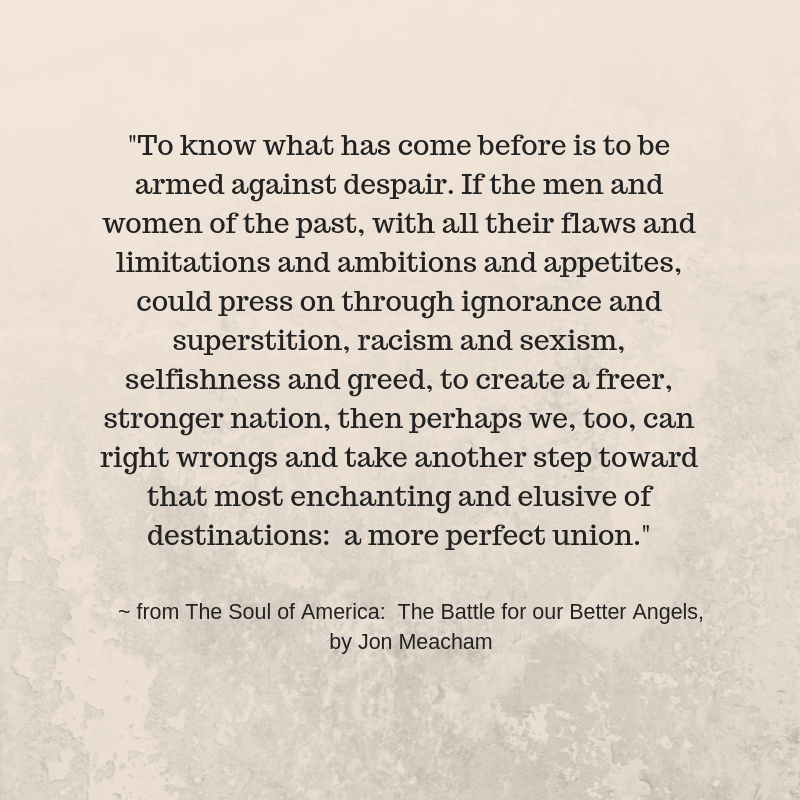
In light of the hate crimes and acts of terrorism and political violence last week in the United States of America, I offer the following quote from The Soul of America:  The Battle for our Better Angels, by Jon Meacham:

A More Perfect USA
Quote from The Soul of America: The Battle for our Better Angels, by Jon Meacham


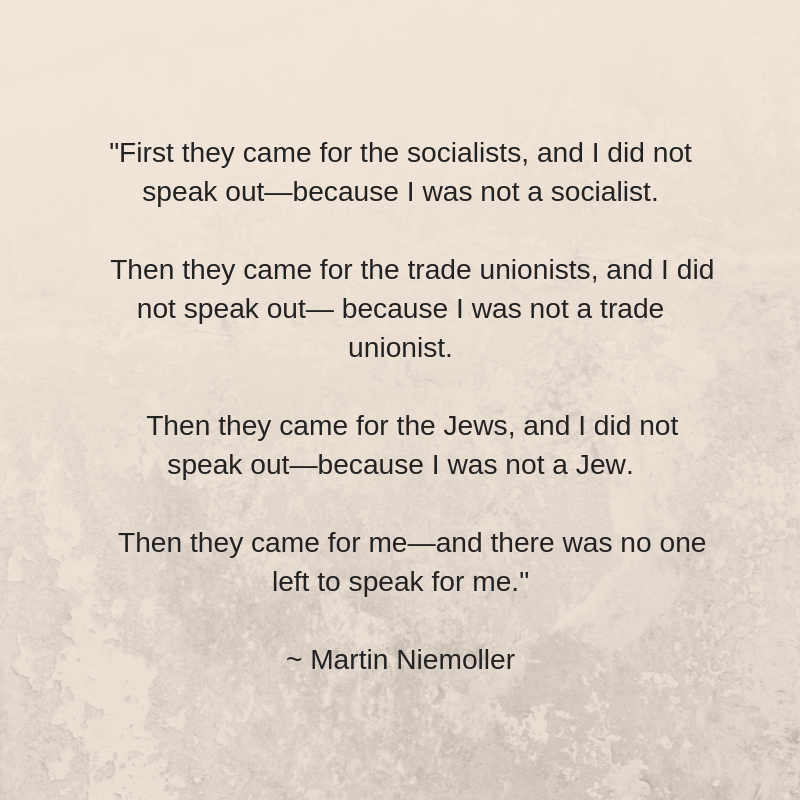
I also share the following famous words of Martin Niemoller:

First they came for the socialists, and I did not speak out—because I was not a socialist. Then they came for the trade unionists, and I did not speak out— because I was not a trade
Quote from Martin Niemoller


Until my next blog post

I hope you have a good book to read. I’m reading A Spark of Light, by Jodi Picoult.

If you’re a writer, I hope you have quality writing time.

Thank you for reading my blog. You could have spent the last few minutes doing something else, but you chose to read my blog. I appreciate it! I welcome your comments.

Let’s continue the conversation.

What is it going to take to stop the hate crimes and political violence in the United States of America? What can we do as individuals wherever we live to make the world a kinder place?

Perhaps we could start by living the 39th verse of the 22nd chapter of The Gospel of Matthew as it is translated in the Contemporary English Version of the Bible:

The second most important commandment is like this one. And it is, “Love others as much as you love yourself.”

Many of the people who read my blog are not Christians — and that is one of the unexpected joys this blog has given me — but I hope we can all strive to adopt the above words of Jesus in our everyday lives and work for peace in our families, neighborhoods, cities, and nations.

And we can’t wait until they come for us, because by then there will be no one left to speak up.

Janet

Race in America, and The Dry Grass of August

Today’s blog post highlights the first paragraph of The Dry Grass of August, Anna Jean Mayhew’s debut novel. That paragraph is a great hook, for it draws you in and conveys that there’s bound to be a good story in the coming pages. Here it is:

“In August of 1954, we took our first trip without Daddy, and Stell got to use the driver’s license she’d had such a fit about. It was just a little card saying she was Estelle Annette Watts, that she was white, with hazel eyes and brown hair. But her having a license made that trip different from any others, because if she hadn’t had it, we never would have been stuck in Sally’s Motel Park in Claxton, Georgia, where we went to buy fruitcakes and had a wreck instead. And Mary would still be with us.” ~ Anna Jean Mayhew in The Dry Grass of August

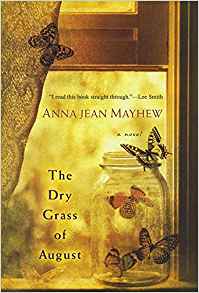
DryGrass
The Dry Grass of August, by Anna Jean Mayhew

The Dry Grass of August is a novel that takes you to the American South in the days of  lawfully-mandated racial segregation. It is written from the point-of-view of a 13-year-old white girl from Charlotte, North Carolina. It sheds light on how it was in the 1950s for a black maid, Mary Luther, traveling from North Carolina to Florida with her white employer, Mrs. Watts, and the four Watts children. Mary couldn’t eat in restaurants, couldn’t sleep in motels, and couldn’t use public bathrooms because they were the legal domain of white people.

Mary Luther is in constant but often subtle danger. She was, no doubt, apprehensive and in danger even when the members of the white family she was riding with were unaware. That unawareness is today referred to as “white privilege.” When one lives his entire life as a member of the predominant and ruling race, he enjoys privileges and advantages of which he isn’t even conscious.

The Watts children witness things along the way to Florida that open their eyes to how differently whites and blacks are treated in the United States. They cannot return home to Charlotte unchanged.

In light of the August 12, 2017 violence

I chose the opening paragraph of The Dry Grass of August as my blog topic for today many weeks ago. When I selected it and put it on my blog schedule, I had no idea I would be writing it in the aftermath of the tragedy in Virginia of last weekend. I did not anticipate writing a 1,000-word blog post around that paragraph.

Although published in 2011, The Dry Grass of August speaks to us today as, in light of the murder of Heather Heyer and other violence in Charlottesville, Virginia on August 12, 2017, Americans are having a conversation like never before about race relations. That conversation is long overdue and painful. It will not and cannot be a short conversation.

For all the progress that has been made between the races in my 64 years, it is abhorrent and repulsive to me that in 2017 there are Ku Klux Klan members, white supremacists, and Neo-Nazis not only living among us but being emboldened by the words, actions, and inactions of President Donald J. Trump. It is Mr. Trump’s lack of moral leadership that has added fuel to the fire and given bigots a green light to publicly spew their hate.

I had hoped to keep politics out of my blog, but I cannot remain silent. This is bigger than politics. This is morals and humanity and freedom. Freedom to live without fear. My blog is not a huge platform, but it does give me an avenue through which to speak. My blog has 1,300 followers from all over the world. I don’t want my blog followers in other countries to think Americans are vicious and at each other’s throats. That is not who we are.

Whereas the people who doggedly hung onto the myth that white people were a superior race used to cowardly hide their faces and identities under white hoods and robes, they now demonstrate and march with torches in regular street clothes. When they marched in Charlottesville last weekend, some of them were outfitted with helmets and shields, making it difficult for the anti-Nazi protesters to tell the difference between police officers and the white supremacists.

There is no room in the United States of America for Neo-Nazis and other hate mongers. The good citizens of this country cannot allow the current occupant of the White House to lead us down this destructive road by his lame condemnation of evil and his attempt to equate the people carrying Nazi flags with the people who were there to protest their hateful agenda.

Three of the founding pillars of the United States are freedom of speech, freedom of religion, and freedom to assemble. I’m glad I live in a country where people can voice their opinions; however, no American has the constitutional right to threaten, terrorize, or murder other people simply because of the color of their skin or the way they choose to worship God.

The United States is in a watershed moment. We will come out a better people on the other side of the current self-examination and soul searching because we are a good and decent people. We are not who Mr. Trump would try to make you think we are. We are so much better than that.

Until my next blog post

I hope you have a good book to read. If you’re a writer, I hope you have a good book to read while you write your next good book.

Janet


Thoughts on the US Constitution

As a political science major in college, I was required to take at least one Constitutional Law course. Intimidated by the prospect of taking a law class, I put off taking Constitutional Law until my last quarter before graduation. Much to my surprise, I thoroughly enjoyed the class (except for the copious amount of reading it required) and 41 years later I still remember some of the Supreme Court cases we studied. That class, more than any other, opened my eyes to the nuances of how the US Constitution governs everything from voting rights to the classification of tomatoes as a fruit or as a vegetable in light of the Tariff Act of 1883.The current US election season and, more specifically, the present civil unrest here in Charlotte have brought the Constitution and certain our constitutional rights to mind.

constitution_pg1of4_ac
First page of the US Constitution

2016 US Presidential Election

The US Presidential campaigns this year have made me uneasy about the interpretation of the US Constitution. One political party has taken fear mongering to a new level. We in “battleground states” are bombarded by endless TV ads telling us if the other major party’s candidate is elected, she will abolish the Second Amendment. In a nutshell, that amendment assures our right to “keep and bear arms.”

US Constitution,  First Amendment

The same political party dealing in the fear mongering over the Second Amendment holds the First Amendment in contempt. The First Amendment is near and dear to my heart. It guarantees freedom of religion, freedom of speech, freedom to peaceably assemble, and freedom to  redress of grievances. The 19th Amendment, which gave women the right to vote in 1919, runs a very close second!)

US Constitution, Second Amendment

The Second Amendment gives the US Government the right to establish a military and confirms the right of a citizen to “bear arms.” I understand and appreciate the thinking behind the Second Amendment, but I believe one side of the 2016 Presidential campaign has championed it to the exclusion of the other amendments. The baseless fear mongering that, if elected, the other major party’s candidate will “take away all your guns” has reached a fever pitch. Personally, I’m more concerned that the candidate championing the Second Amendment does not see the value of the First Amendment. I believe it is the First Amendment that makes America, America. It is our rights guaranteed by the First Amendment for which citizens of many other countries envy Americans.

Protests this week in Charlotte

The riots that took place in Charlotte on Tuesday and Wednesday nights and the peaceful protests last night prompt me to reflect on the First Amendment. Rioting and destruction of property cannot be tolerated, but the right of citizens to peacefully assemble and protest must be protected. Peaceful protests can shine a spotlight on an issue and bring it to the forefront of public discussion. The prime example that comes to mind is the Civil Rights Movement of the 1960s led by the late Rev. Dr. Martin Luther King.

The protests this week in Charlotte were the result of the death of a man at the hands of the police. The protests in Charlotte have resulted in a national discussion of race relations, the inordinate number of African-American men who have been shot by police in our country, and the distrust of police held by people of color. If any good can come out of what has transpired in Charlotte this week, perhaps it will be a more open and honest conversation in America about the racial prejudices and biases most people in our country hold to varying degrees. It is through frank public discourse that we will better understand and respect one another. I pray that something good will come out of this violent, angry, and sad week. In the meantime, I anxiously await what the darkness of tonight will bring to the streets of Charlotte.

In conclusion

The US Constitution is a living, breathing document. It has been amended 27 times as our society continually reinvents itself. It is the bedrock of our government and is constantly up for debate by citizens and, ultimately, by the US Supreme Court.

The primary purpose of my blog is to shed light on my life as a writer, and I have avoided political content until today. Inasmuch as the 2016 federal and state elections just might be the most important elections of my life, I felt compelled today to post my thoughts about certain aspects of the US Constitution.

Until my next blog post in a few days, I hope you have a good book to read and productive writing time.

Janet

Divisiveness in the USA

I had planned to blog today about 10 things I learned while researching my vintage postcard book, The Blue Ridge Mountains of North Carolina, but it seemed petty for me to write about my book on this day after several instances of senseless murder in our country this week.

On the heels of white police officers killing black men in Louisiana and Minnesota, last night during a peaceful protest in Dallas, Texas, one or more snipers took that opportunity to murder five police officers and injure seven other officers.

The man in Louisiana was killed by the police while he was pinned down on the ground. The man in Minnesota was killed as he reached for his wallet after being ordered by the police officer to produce his identification. In each case, the victim was black and the police officers were white. These are two in a growing number of such incidents that have led many people to believe there is a pattern of racial profiling taking place within our law enforcement agencies.

In America, we pride ourselves as being “a melting pot,” but various issues are dividing us. Race. Ethnicity. Politics. Religion. Gender. Interpretation of the 2nd Amendment of the US Constitution. Class. The Haves and the Have-Nots. Equal pay and equal opportunities for men and women in the work place. The list could go on.

It all boils down to fear.

Too many of our citizens fear anyone who doesn’t look like they do. Too many of our citizens fear people who choose not to worship like they do. Too many of our citizens fear people who are more liberal or more conservative in their political views than they are. Too many of our citizens fear people whose sexual orientation does not fit the norm. Too many of our citizens believe that those of us who believe the 2nd Amendment does not guarantee one’s right to own assault weapons want to take away their constitutional right “to bear arms.” When did we become a fearful people?

Too many of our citizens hate people who identify with a different political party. Part of the beauty of our system of political parties is that we have been able to differ in our views on issues but we agreed to agreeably disagree. That’s the way it was until just a few years ago. We now have political campaigns from the local to the national level in which it is acceptable to attack our opponents and their families in ways that degrade us all.

Somewhere along the way we lost our tolerance. Somewhere along the way it became acceptable to hate the people with whom we have a difference of opinion. Somewhere along the way human life lost its value. Somewhere along the way it became acceptable to shoot and kill anyone with whom one differs.

It is time – no, it is past time – for reconciliation in our country. It is time for us to celebrate our differences and respect one another. It is time for us to recognize that we have more in common than we don’t have in common. It is time for healing. It is time for honest dialogue. It is time for us to get to know one another so we can stop being afraid of each other.

Enough is enough! That’s not who we are! We are better than that!