I write southern historical fiction, local history, and I've written a devotional book. The two novels I'm writing are set in Virginia and the Carolinas in the 1760s. My weekly blog started out to follow my journey as a writer and a reader, but in 2025 it has been greatly expanded to include current events and politics in the United States as I see our democracy under attack from within. The political science major in me cannot sit idly by and remain silent.
Once-a-week, since November 25, I have blogged about a different story from my new book, Traveling Through History: A Collection of Historical Short Stories.
The sixth story in the book is “Whom Can We Trust? A Mecklenburg Declaration of Independence Short Story.”
Tradition tells us that Archibald and Maggie Sellers McCurdy built their log cabin in what is now Cabarrus County, North Carolina, in 1773. At that time, Cabarrus had not yet been formed out of the eastern part of old Mecklenburg County. Their house was on the National Register of Historic Places until vandals burned it down a few years ago. Sadly, I never did see the house, but I have seen photographs of it and detailed floor plans and exterior drawings have been preserved.
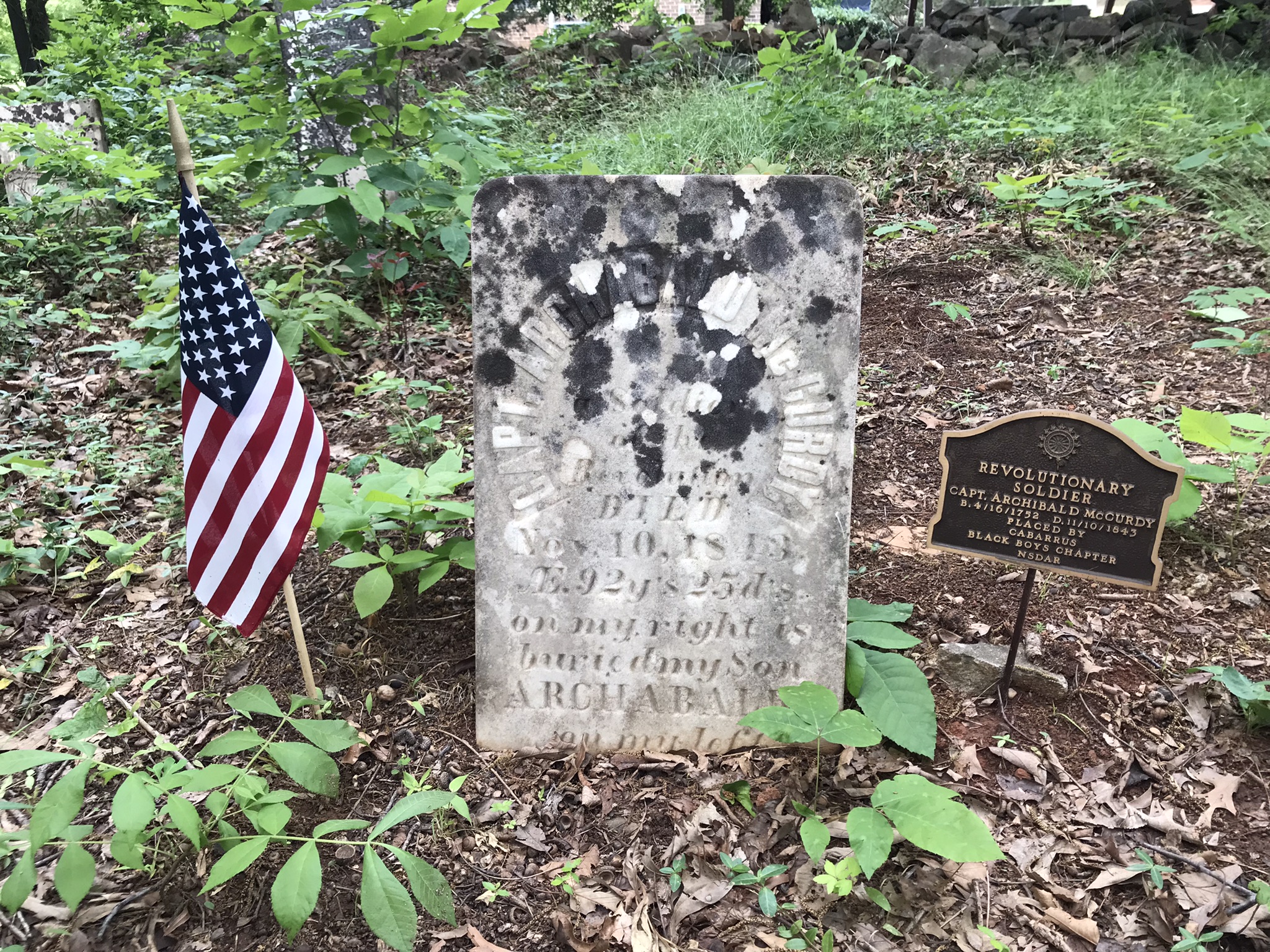
Archibald McCurdy’s gravestone at Spears Graveyard of Rocky Ri er Presbyterian Church, Cabarrus County, North Carolina
Those drawings and photographs made it easy for me to imagine the McCurdys’ lives. Theirs are names I’ve heard all my life. Archibald was a foot solider in the militia during the Revolutionary War. Maggie was a patriot in her own right, as she earned the name “She-Devil” by the British and Tories. I explain a couple of her feats in the Author’s Note at the end of “Whom Can We Trust?”
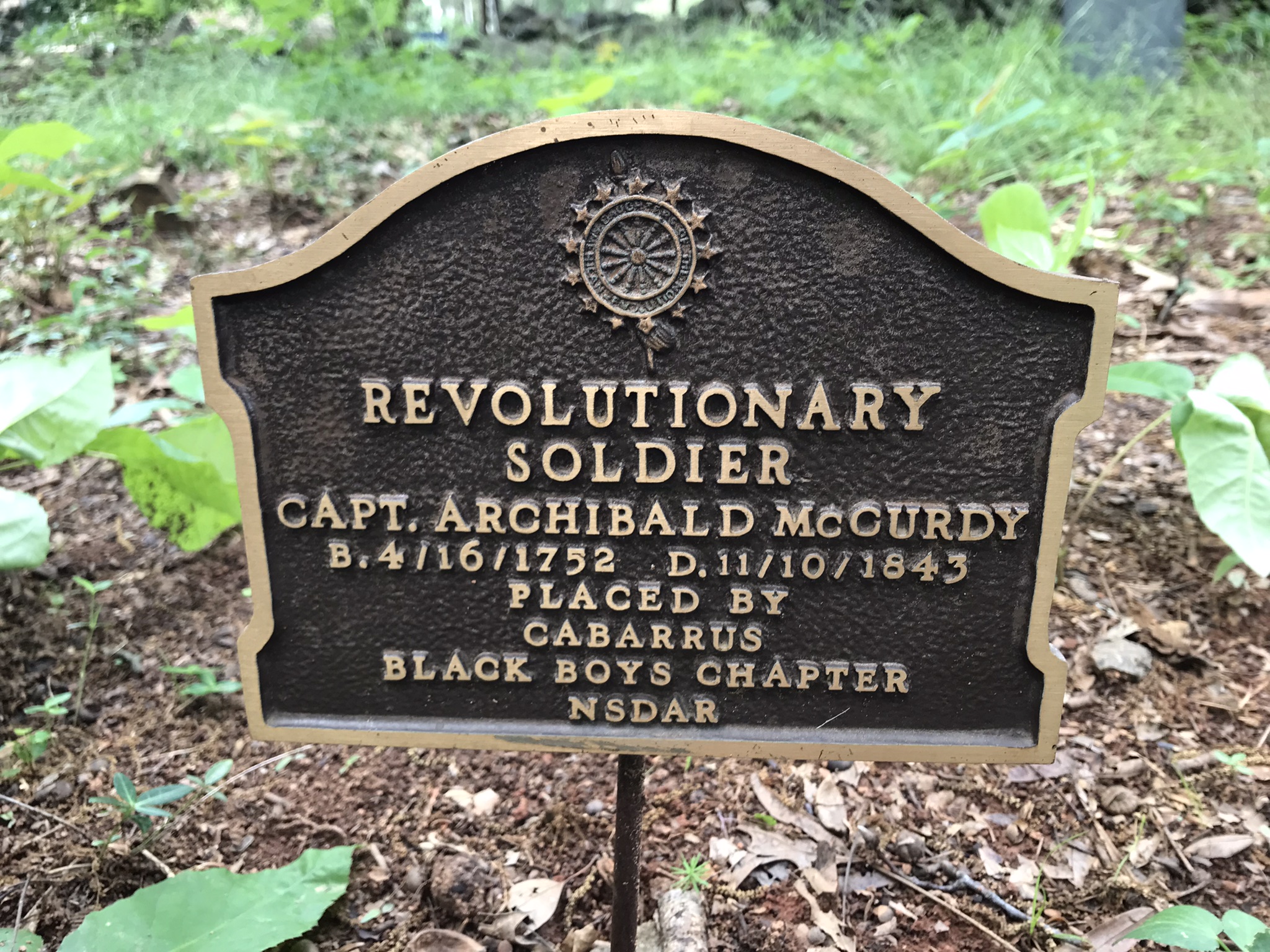
Marker placed at Archibald McCurdy’s grave by the Daughters of the American Revolution
The story is set in May 1775 at the time of the signing of the Mecklenburg Declaration of Independence. I was inspired by a story I’ve heard all my life about what Archibald McCurdy did on the day that document was signed.
You can find the paperback at Second Look Books in Harrisburg, NC, or ask for it at your local independent bookstore. Bookstores can order it from IngramSpark.
When late October rolls around, I think of my great-great-great-great-grandfather’s estate sale held on October 29, 1777.
I knew nothing about it until a few years ago, but what a treasure trove of information his estate papers held! If you aren’t interested in history or your ancestors, you probably won’t read this post. That’s all right. Perhaps a few of you will be curious enough to keep reading.
I have a special bond with my fourth-great grandfather because I live on a little sliver of the land he purchased when he got to North Carolina from Scotland in the 1760s. I walk on the same dirt he walked on. I see some of the species of wild animals he saw. I cross the same creeks he crossed. I belong to the same church he belonged to. His blood flows in my veins.
John Morison (he wrote his name with one “r”) was baptized in the Lowland Church of Scotland in Campbeltown on the Kintyre Peninsula in 1726. He and his two younger brothers came to Pennsylvania for an unknown length of time before purchasing land and settling in North Carolina in the 1760s.
John wrote his will on August 30, 1777, “being very sick & weak in body, though in perfect mind & memory.” In his will, he outlined provisions for his pregnant wife, their eight living children, and their unborn child. In less than a week, John was dead.
Although he had left such things as land, livestock, money, some farm implements, and saddles to his wife and children and the spouses of his eldest daughters, there were things that needed to be settled up through an estate sale.
Defying the fact that John’s estate sale was held in the middle of the American Revolutionary War, all the little scraps of paper and receipts from the settling of his estate survived and are preserved at the State Archives of North Carolina.
Along with all those tiny pieces of paper which indicate everything from the purchase of “burial liquor” to the educating of his children, are page after page of the record of his October 29, 1777, estate sale.
It amazes me that when combined, John’s will and estate sale tell us everything the man owned. Being the first person in his family’s history to own a piece of land, it is astounding!
He wasn’t a man of great wealth, compared to the aristocracy, but to have come from where he came from I believe he did quite well for himself and his family. He would, no doubt be amazed to know that some of his 7th-great-grandchildren now reside on some of the land he purchased in the 1760s and 1770s.
I promised you a blog post about his estate sale, so let’s get to it.
The sale
Robert Harris, Jr. served as clerk. Mr. Harris had beautiful penmanship and was meticulous in his duties that day. He wrote down every item, who bought it, and how many pounds, pence, or shillings they paid.
Photo by Sam Carter on Unsplash
Items sold at the estate sale included eight horses; 19 sheep; 25 head of cattle; 17 hogs and a parcel of pigs; three hives of bees; 17 geese and ganders; 25 pounds of wool; a parcel of books; a great coat; two straight coats and jackets; one pair of blue britches; a pair of old buckskin britches; and a fur hat. (Oh, how I’d love to know the titles of that “parcel of books!”)
Photo by Claudia Wolff on Unsplash
Photo by Sies Kranen on Unsplash
Also, four saddles; five bells and collars; five other collars; six bridles; two sets of horse gears; an “M” branding iron; three augurs; a drawing knife; nailing and stone hammers; a broadax; three weeding hoes; two maulrings; a wedge; a clivish; a sprouting hoe; a mattock; two falling axes; three spinning wheels; two horse trees and hangings; a cutting knife and stone; a sythe and cradle; four sickles; a flax brake; a pair of wool cards; and a pair of cotton cards.
Photo by chris robert on Unsplash
Also, barrels for flour, rice, beef, and salt; a tapper vessel; two cedar churns; oak and walnut chests; two smoothing irons; a looking glass; one whiskey keg; and various other tools, household items, and pieces of furniture.
Other items included 6.5 pounds of iron and 14.5 pounds of steel. Steel as we know it today had not yet been developed. In 1777, steel was the name for sharpening rods used to sharpen knives and other cutting edges.
Half a wagon?
The most puzzling record in John Morrison’s estate papers is that John Springs bought half a wagon and half the wagon implements. Since no one bought the other half, it has been speculated that Mr. Springs knew that John’s wife, Mary, needed the use of the wagon but also needed the proceeds from the sale of the wagon and implements. After all, Mary was a widow with seven children still at home and a baby on the way. Perhaps Mr. Springs made a verbal agreement to let Mary Morrison keep the wagon even though he paid half the value of the wagon at the estate sale.
Another possibility is that John Morrison had bought the wagon and implements from John Springs but had only paid half the bill at the time of his death. Mr. Springs, instead of saddling Mary Morrison with the additional debt of the unpaid balance chose to simply pay her husband’s estate the half that John still owed. When Mary Morrison died in 1781, there is no mention of a wagon in her will or her estate sale.
Lots of ammunition!
Other intriguing items sold at John Morrison’s estate sale were the 17 pounds of gun powder and 55.5 pounds of lead. That’s more gun powder and lead than a farmer needed. So why did John Morrison have so much of both?
John wrote his will on August 30, 1777. By September 3, he was dead. It is speculated that he was stockpiling munitions for the patriots’ cause in the American Revolution and that he was shot by Tories, but we will never know for certain.
For today’s blog post, I’m taking advantage of a local history column I wrote for Harrisburg Horizons newspaper on August 23, 2006.
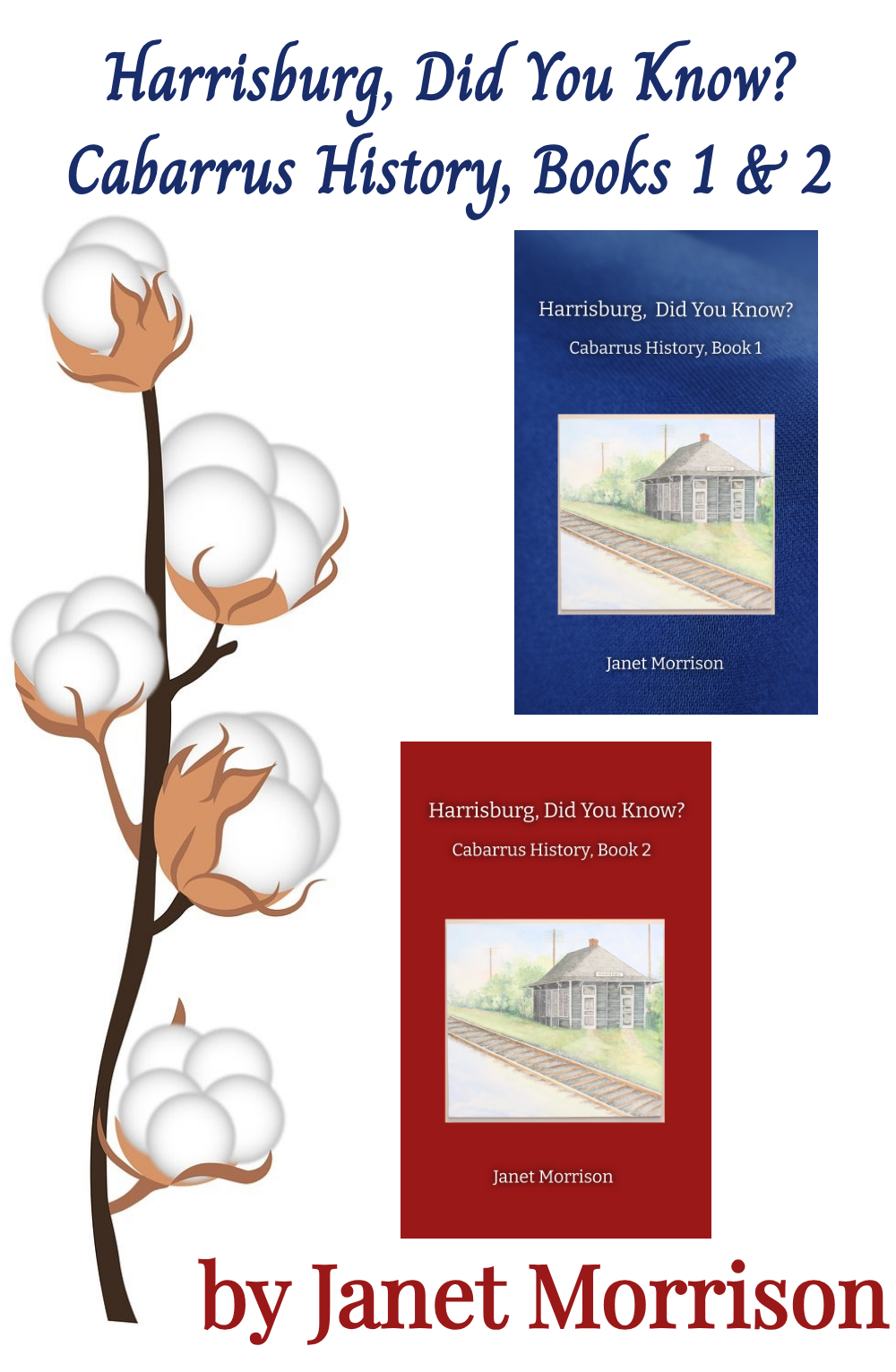
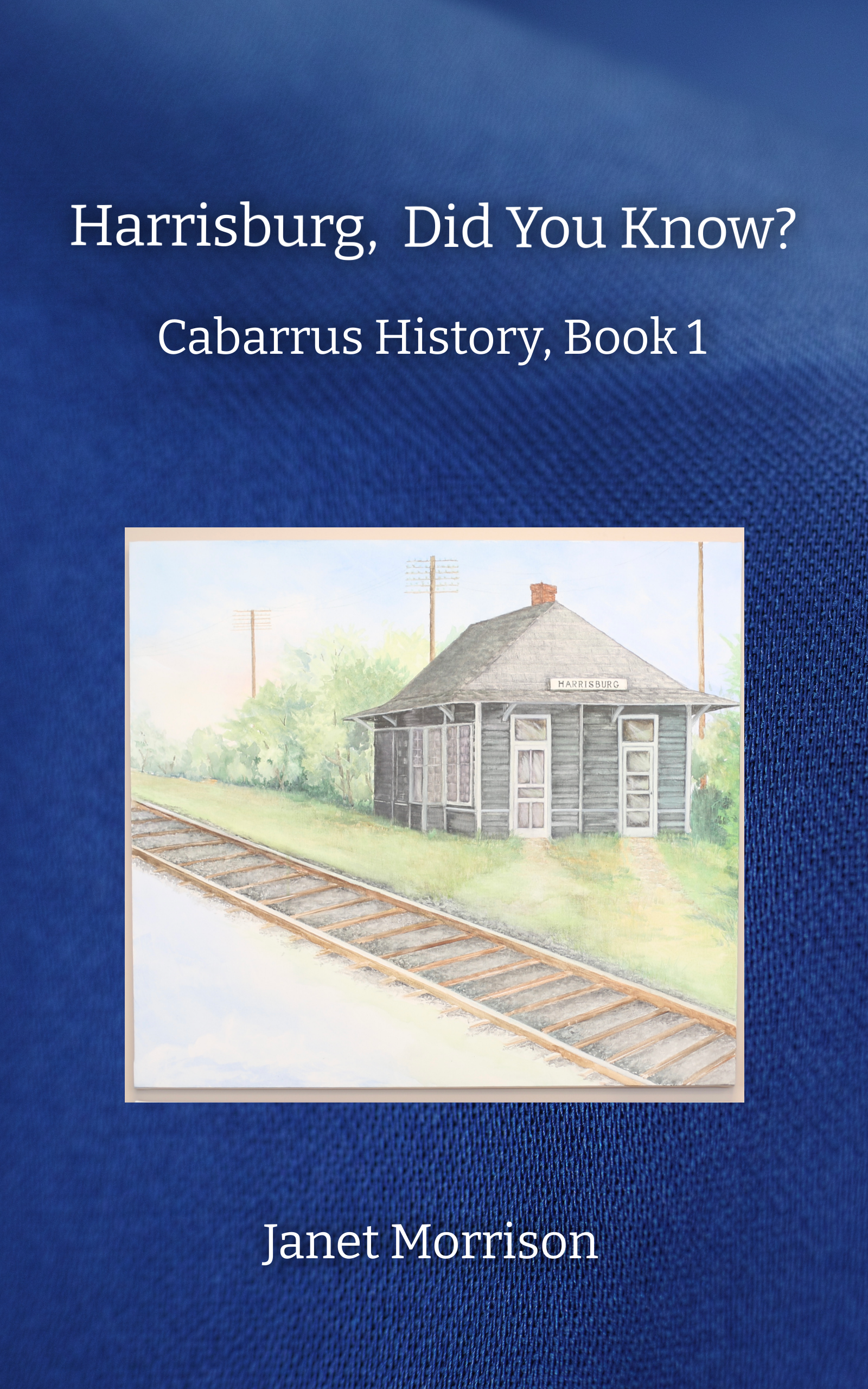
If you enjoy this post, you might enjoy the books in which I published the local history column articles I wrote from 2006 through 2012, Harrisburg, Did You Know? Cabarrus History, Book 1 and Harrisburg, Did You Know? Cabarrus History, Book 2. The story I’m sharing today is found in Book 1.
Harrisburg, Did You Know? Cabarrus History, Book 1, by Janet Morrison
Harrisburg, Did You Know? Cabarrus History, Book 2, by Janet Morrison
The articles I wrote for the newspaper came primarily from the history of Township One in Cabarrus County, North Carolina, but many topics would be of general interest to anyone who enjoys reading about history. They are specific to Cabarrus County, yet many of them are indicative of life in rural and small-town America since the 1700s.
My books are available at Second Look Books in Harrisburg, NC and on Amazon.
Sit back, and prepare to be transported to a simpler time in the 1870s.
“Pioneer Mills: No Place For a Preacher’s Son”
Did you know that there is a written account of a child’s memories of the Harrisburg area in the 1870s?
The Rev. Joseph B. Mack came from Charleston, South Carolina in 1871 to be the pastor of Rocky River Presbyterian Church. When he and his family arrived, the manse the congregation was building for his family to live in was not completed.
Church member Robert Harvey Morrison moved his own family into a tenant house and gave the new minister’s family his home in the Pioneer Mills community. Pioneer Mills was a gold-mining boom town in the early- to mid-19th century. It was apparently still a rip-roarin’ place in 1871.
Robert Harvey Morrison House
A special homecoming was held at the church on August 12, 1912. Rev. Mack’s son, Dr. William Mack, was unable to attend. He sent his regrets from New York and put some of his childhood memories on paper. Fortunately for us, his letter to homecoming master of ceremonies Mr. Morrison Caldwell was printed in the Concord newspapers the following week.
Dr. Mack wrote, “My first Rocky River recollection is getting off the train at Harris Depot and going in the dark to the home of Uncle Solomon Harris.” I don’t believe Dr. Mack was related to Mr. Harris. This was probably a term of endearment and respect.
He continued, “There we met Ed and ‘Little Jim’ (to distinguish him from ‘Big Jim,’ the son of Mr. McKamie Harris.) Uncle Solomon had the biggest fire-place I ever saw; it seemed as big as a barn door.
“Shortly afterwards we went to Pioneer Mills…. There… was the old Gold mine, Barnhardt’s store and McAnulty’s shoemaker shop…. While there I decided to become either a merchant or shoemaker, for Barnhardt’s store and McAnulty’s shop kindled young ambitions; better to ‘keep store’ or ‘mend shoes,’ than as a preacher’s son to be moving around from place to place.
“But Pioneer Mills was ‘no place for a preacher’s son.’ Soon we moved again; this time to the brand new brick parsonage, close by the church. We used to go to church in a big closed carriage drawn by two mules; now, every Sunday, we walked to church, going down a steep hill, across a branch, and through the grove to the famous old house of worship.”
Dr. Mack’s letter also read, “Those were happy years; happy in springtime with its apple blossoms, song birds, morning-glories and Tish McKinley’s Sassafras tea; happy in the summertime with its blackberries and plums, its bob-whites in the wheat fields, its lightning and thunder storms, its bare-footed boys and girls, and its bitter quinine to keep off third-day chills; happy in the autumntime, with its white fields of unpicked cotton and its beautiful trees with leaves of myriad hues; and happy in the wintertime, with its snows, its big hickory back-logs, its boys in boots red-topped and toes brass-tipped, its red-cheeked girls in wraps and ‘choke rags,’ and its Christmas Holidays and turkeys.”
Dr. Mack’s colorful memories paint an idyllic picture of life in Township #1 in the early 1870s. Will the children of 2006 have equally as wonderful memories?
(Published in Harrisburg Horizons newspaper, August 23, 2006.)
Resources: The Presbyterian Congregation on Rocky River, by Thomas Hugh Spence, Jr., 1954; The Concord Daily Tribune, August 16, 1912; and The Concord Times, August 19, 1912.
Hurricane Helene Update
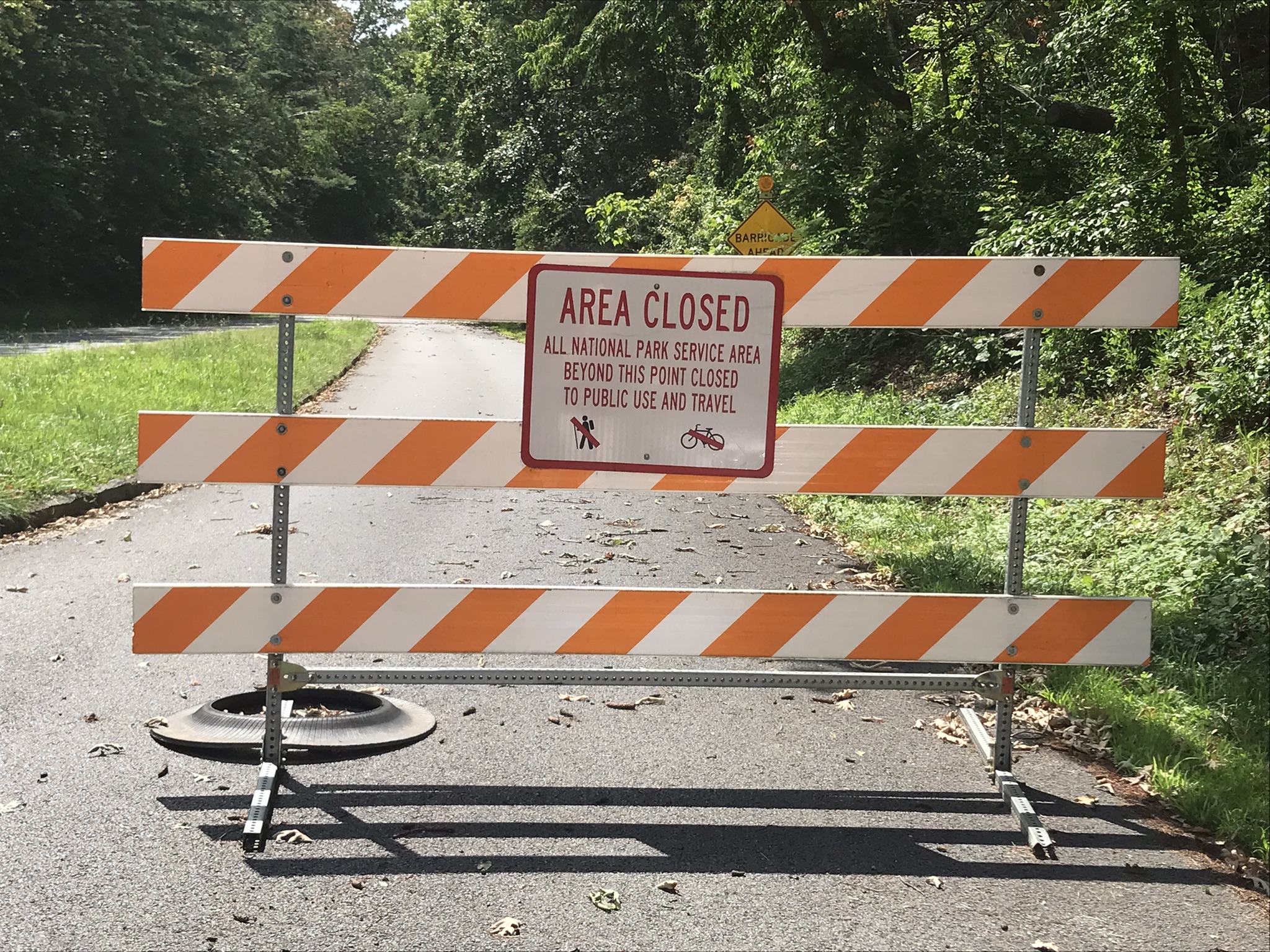
As of Friday, of the 1,468 road closures in North Carolina due to Hurricane Helene last September, 33 are still closed and 39 have partial access. Interstate 40 near the Tennessee line will be limited to one lane traffic in each direction with a 35 mile-per-hour speed limit for the foreseeable future.
On a happy note, on Friday, a 38-mile stretch of the Blue Ridge Parkway opened from Asheville to Graveyard Fields and Mount Pisgah! This is south of Asheville.
Hurricane Erin
On the other end of the state, Hurricane Erin skirted the Outer Banks of North Carolina last week, dumping tons of sand and water on NC Highway 12. NC-12 is the only highway connecting Hatteras Island to the islands to the north. Crews are working to reopen the highway as soon as possible as the summer tourist season is winding down.
Today is the 250th anniversary of the signing of the Mecklenburg Declaration of Independence in Mecklenburg County, North Carolina. It predated the national Declaration of Independence by more than a year.
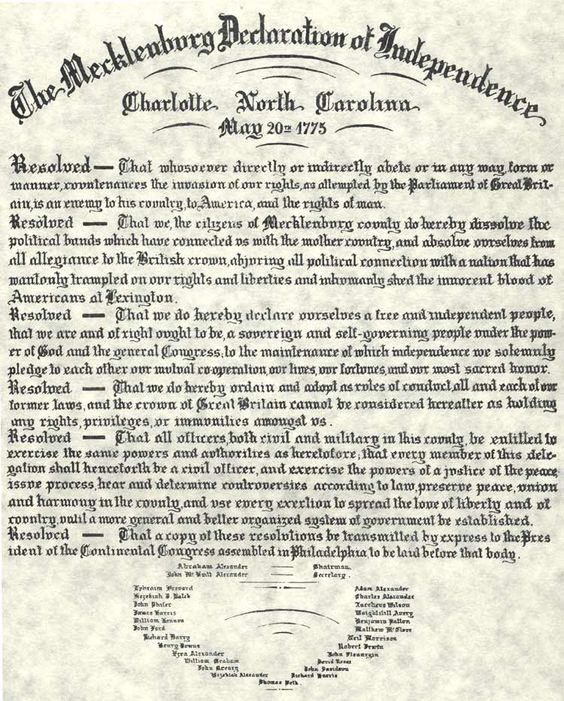
A recreation of the Mecklenburg Declaration of Independence.
In case it sounds familiar, I have blogged about the Mecklenburg Declaration of Independence on or near May 20th several times in the more than ten years I’ve been blogging.
My immigrant ancestors were among the Scottish Presbyterian pioneers who settled old Mecklenburg County, North Carolina. Years of discontent in the American colonies were piled on top of the anti-British Crown feelings they brought with them across the Atlantic.
Weary of unfair taxes imposed by the Crown and the discrimination they were subjected to as Presbyterians slowly brought the settlers to the boiling point. An example of the persecution these Presbyterians felt were the Vestry and Marriage Acts of 1769. Those acts fined Presbyterian ministers who dared to conduct marriage ceremonies. Only Anglican marriages were recognized by the government.
On May 20, 1775, the citizens of Mecklenburg County, North Carolina declared themselves to be free and independent of the rule of Great Britain. It was a sober and sobering declaration not entered into lightly. Those American patriots meant business, and they knew the risks they were taking.
Archibald McCurdy, an elder in Rocky River Presbyterian Church, heard the document read from the steps of the log courthouse in Charlotte. When he got home, he and his wife, Maggie, listed everyone they knew of who could be trusted in the coming fight for American independence.
No original copies of the Mecklenburg Declaration of Independence survive today. The local copy was lost in a house fire at the home of one of the signers. The copy taken to the Continental Congress in Philadelphia by Captain James Jack on horseback was also lost. Later, signers of the document recreated it from memory.
Nevertheless, those of us who were raised on stories of the Mecklenburg Declaration of Independence and the brave souls who risked their lives to sign it know that the document was real. The blood of the American patriots still flows in our veins and their spirit of freedom still beats in our hearts.
Hurricane Helene Update
As of last Friday, 54 roads in North Carolina were still closed due to Hurricane Helene. That count included five US highways, four state highways, and 45 state roads. That’s a decrease of one state highway and one state road since the week before.
Until my next blog post
I hope you have a good book to read.
Remember the people of Ukraine and western North Carolina. Their situations are quite different, but the people in both places are stressed and weary.
I wanted to blog about the sinking of the Ida Nicholson, a schooner that sank off Ocracoke Island, North Carolina in 1870, but I was unable to find sufficient information about the incident. It was hauling 101,600 of the one million bricks needed for the construction of the Hatteras Lighthouse when it went down in a gale in the infamous “Graveyard of the Atlantic.” The entire cargo was lost.
Plan B: My chance to introduce you to Dr. Nicholas E. Lubchenko
The amazing Dr. Nicholas E. Lubchenko was a topic I kept on the backburner to use when I didn’t have another blog subject calling my name. Today is that day!
In case you’ve wondered why I end my blog posts by asking you to remember the people of Ukraine, in addition to my heartfelt belief that Ukraine deserves to remain an independent nation, it is my small way of honoring the memory of a country doctor who served so many in my community for decades, regardless of their ability to pay the small fee he charged.
Dr. Nicholas E. Lubchenko
Those are Dr. Lubchenko’s people in Ukraine, and they yearn to remain a free nation not under the thumb of Vladimir Putin.
Dr. Lubchenko’s Early Years, Military, and Medical School
Nicholas E. Lubchenko was born in Bulai, Zerkov, near Kiev, Russia (now, Ukraine) in 1882. One of ten children of a leather worker, he graduated from an agricultural college in Kharkov. Kharkov, Ukraine is familiar to us now since Russia’s invasion of Ukraine and the ongoing war.
By 1906, Lubchenko was in the Russian army. His dream was to get to America, which he called “the greatest country in the world.” He concluded that if he did not escape from the army, he would never make it to America.
Quoting from my book, Harrisburg, Did You Know? Cabarrus History, Book 1: “One day in 1906, while still in the arm, he walked out of Russia and crossed into Austria, with a ‘samovar (a Russian urn with a spigot made for boiling water for tea) under his arm and one change of clothing.’ He could speak French and German but not English.
“He got a job working on a ship bound for New Orleans. After he arrived in America in November of 1906, an eastern Louisiana family helped him until he saved enough money to travel to South Carolina where his brother, Alexis, lived.”
He worked on a cotton farm in Ridgeway, South Carolina, saved his money, and after five years was able to borrow money to attend the North Carolina Medical College in Charlotte, NC. He had $69 when he arrived in Charlotte.
He put himself through medical school by working for various doctors in his spare time. During World War I, the North Carolina and Virginia Medical Schools had to merge due to the economy, so Lubchenko moved to Richmond, Virginia, and graduated in 1915.
Dr. Lubchenko’s Medical Career
Dr. Lubchenko served as a medical officer in the Merchant Marine on a transport ship in World War I and then started his medical practice in Newell, NC. He married a nurse from Cabarrus County, NC.
During the 1918-1919 Spanish Influenza Epidemic, Dr. Lubchenko made house calls from morning and into the night.
Dr. Lubchenko became a naturalized American citizen on April 2, 1923. He moved his family to Anson County, NC, but then they moved to Harrisburg and he resumed serving the people of eastern Mecklenburg County and western Cabarrus County.
He tried unsuccessfully to enlist in the US Army when World War II started, but age and the vital medical service he was rendering in the Harrisburg area prevented that. It is said that he stayed angry about that for a long time.
Dr. Lubchenko operated his medical practice out of his home in Harrisburg, NC, but the majority of his work was probably done through house calls. He practiced medicine in Harrisburg until his death in 1960.
Dr. Lubchenko, the Humanitarian
In a 1989 newspaper interview, one of the Lubchenkos’ daughters said he did not send bills to his patients. As stated in my book, “She quoted him as saying, ‘If they don’t want to pay, they won’t. If they do, they will, and if they want to pay and couldn’t, it would embarrass them.’” A 1944 ledger indicates that his usual charge for services was $3.00.
In addition to being a physician around the clock, 365 days a year, Dr. Lubchenko loved his adopted community and worked to make life better for the residents. Harrisburg was a small community of just 300 people in 1950, but Dr. Lubchenko wanted the best for the wider community.
He donated the land for and was the driving force in establishing the Harrisburg Volunteer Fire Department in 1954. It was the first volunteer fire department in Cabarrus County and served a wide area. For instance, we lived five miles from Harrisburg, but my father was a charter member of the fire department.
In 1955, Dr. Lubchenko helped organize a post of the Ground Observer Corps in Harrisburg. These were the days of the Cold War before radar was in place to detect enemy aircraft.
Reflections
As a child, I was scared of Dr. Lubchenko. I could not understand his heavy Russian accent and he was somewhat gruff. It was only as an adult, many years after his death, that I gained a true appreciation for him.
Although Harrisburg started growing rapidly a few years after Dr. Lubchenko’s death, it would be 30 years before the town had another doctor. His death left a great void in the wider Harrisburg community.
You can read all about Dr. Lubchenko, his medical practice, his house, the Harrisburg Volunteer Fire Department, the Ground Observer Corps, and many other aspects of local history in Harrisburg, Did You Know? Cabarrus History, Book 1. The book is available in paperback at Second Look Books in Harrisburg and in paperback and as an e-book from Amazon.com. (By the way, Harrisburg, Did You Know? Cabarrus History, Book 2 is also available.)
Hurricane Helene Update
As of Friday, 169roads in North Carolina are still closed due to Hurricane Helene, including Interstate 40 near the Tennessee line. That count consists of 1 interstate, 11 US highways, 20 state highways, and 137 state roads. That’s a decrease of two roads over the report two weeks ago. More heavy rain, wind, and icy conditions hit over the weekend with more of the same predicted for midweek. Repairs are made slow under such conditions.
There has been some good news about I-40. It is thought that by March 1 one lane of I-40 in both directions will open. The speed limit will be 40 mph on that stretch just east of the TN-NC line. I have not read whether commercial vehicles will be allowed, but my hunch is that they won’t.
News about the Blue Ridge Parkway in North Carolina is not good. The flooding and wind from Hurricane Helene last September caused 48 landslides in one 38-mile section of the parkway. There are no estimates for when those 38 miles will be completely rebuilt or if all of it can even be rebuilt. That section between Asheville and Linville will not reopen in 2025.
Until my next blog post
I believe most people want to see a peaceful end to the war in Ukraine, but I don’t want Ukraine to have to do all the compromising.
I hope you have a good book to read.
Remember the people of Ukraine and western North Carolina.
Now that I have your attention… today’s blog post is about ancient history. This is one of the topics I wrote about in Harrisburg, Did You Know? Cabarrus History, Book 2.
Photo by guille pozzi on Unsplash
Harrisburg, North Carolina sits inside a 22-mile syenite or ring dike. One can get a feel for it from several high points in the area, such as when traveling south from Concord on US-29 near the intersection with Union Cemetery Road. It’s like looking across a gigantic bowl.
Another possible place from which to catch a glimpse of the “bowl” is on NC-49 southbound after you pass Old Charlotte Road. The Charlotte downtown skyline is visible briefly from that location as well as the one referenced above on US-29.
Harrisburg, Did You Know? Cabarrus History, Book 2, by Janet Morrison

What, you may ask, is a syenite or ring dike? I’m no expert on volcanology, but my understanding is that it is a circular dike around a volcano.
According to 2001 Encyclopedia of Earthquakes and Volcanoes, by David Ritchie and Alexander E. Gates, Ph.D.:
“If magma is removed from the magma chamber beneath a volcano, it can undergo caldera collapse. The volcano and the area around it collapse because they are no longer being held up by the liquid. A series of concentric faults and cracks develop around the collapsing volcano. As they do, magma will squeeze up around the cracks and faults forming ring dikes.”
I’ll take their word for it.
In 1966, U.S. Geological Survey geologist Harry E. LeGrand and Henry Bell III led a scientific excursion in Cabarrus County to study our ring dike and other interesting rock and mineral deposits in the county.
You might be able to access a pdf of “Guidebook of Excursion in Cabarrus County, North Carolina, October 22-23,1966” by going to https://www.carolinageologicalsociety.org. Search for “1960s Field Trip Guidebooks” and then scroll down to find that particular guidebook.
The Harrisburg area has experienced a population explosion since 1966. The landmarks noted in the 1966 guidebook are either gone or more difficult to locate today. The concentric rings that were reportedly visible from the air in 1960 by R.G. Ray might not still be intact.
If you’d like to know more about this topic, the 1849 meteorite; Harrisburg’s first organized housing and business development of 100 years ago; the Morrison-Sims Store and Old Post Office; the flood of 1886, the Piedmont Area Development Association (P.A.D.A) of the 1960s; earthquakes that have been felt here; McCachren’s Store; Rocky River bridges in the 1870s; the Sauline Players; a tribute to George L. Govan; Rocky River Academy; the Rocky River Presbyterian Church’s fourth sanctuary which was completed in 1861; a 1777 estate sale; Hugh Smith Pharr and his mill; a 1907 attempted train robbery; 1816 – the year without a summer;
Also: items such as milk, apples, and dry cleaning that were all delivered to homes in the mid-1900s; Blume’s Store; high-speed trains; the boundaries of Township 1; early Harrisburg education; Pharr Grist Mill on Back Creek; how electricity came to Harrisburg; a 1912 church homecoming; Pioneer Mills Gold Mine and Community; a fellow named Collett Leventhorpe; a 1911-1912 debating society; and the tenth anniversary of the Harrisburg Branch of the Cabarrus County Public Library system… please purchase Harrisburg, Did You Know? Cabarrus History, Book 2.
The book also contains nearly 150 pages of my research notes on subjects I didn’t get to write about when I wrote a local history newspaper column from 2006-2012.
Harrisburg, Did You Know? Cabarrus History, Book 1 and Book 2 are available in paperback at Second Look Books, 4519 School House Commons in Harrisburg, NC.
Second Look Books, 4519 School House Commons, Harrisburg, NC
Even though we can’t show you an original copy of this declaration, it is written on our hearts as the descendants of those who whole-heartedly supported it as they prepared for the inevitable war against King George III of Great Britain.
The Americans’ beef wasn’t with the people of Great Britain – many of them were their relatives and friends – their beef was with the King – and they knew their friends and relatives back in Scotland were secretly wishing them well for they were also under the thumb of the King.
The year was 1775. The date was May 20.
The people of Mecklenburg County in the backcountry of North Carolina had had all they could take of King George and the oppressive laws and taxes he and the British Parliament continued to impose on the American colonists. After all, the reason most of them had left Europe was to escape monarchs who had little or no regard for their subjects.
The years leading up to May 20, 1775 had been tense. On May 2, 1771 a group of Mecklenburg County residents had taken matters into their own hands and blown up a shipment of munitions King Charles had ordered to be transported from Charleston, South Carolina to Rowan and Orange counties in North Carolina to put down The Regulator Movement.
The perpetrators of that gunpowder plot had been declared traitors and were still being hunted down by the Royal Government authorities when the county militias sent representatives to a convention in Charlotte to debate political conditions. The result was the writing of the Mecklenburg Declaration of Independence more than a year before the more famous one was written in Philadelphia.
The document set out the citizens’ grievances and declared themselves free and independent of Great Britain. Sadly, the original copy of the declaration was lost in a fire at the home of John McKnitt Alexander on April 6, 1800. The Declaration was reconstructed from the memories of those who had written it and signed it.
A recreation of the Mecklenburg Declaration of Independence.
There are Mecklenburg Declaration of Independence doubters today, but I have no doubt that it existed. It was followed just 11 days later by the Mecklenburg Resolves, which was a similar document.
Captain Archibald McCurdy of the Rocky River Presbyterian Church area of old Mecklenburg County that is present-day Cabarrus County, stood at the Mecklenburg County log courthouse steps and heard the Declaration read. He went home and told his wife, Maggie, they needed to make a list of the people they knew they could trust. There were a few Loyalists in the area.
Whatever you’re doing this Saturday, May 20, take a moment to reflect on what the brave people of Mecklenburg County, North Carolina did 248 years ago. If you live in the United States of America, ponder the stand they took on that day. The King proclaimed them to be in a state of rebellion, and the men who signed the document risked their very lives by proclaiming they were free.
Since my last blog post
Spring is finally in full force here in North Carolina. All I have to do is put a hanging basket of pretty flowers on a hook on the side porch and I can count on “Mama Bird” – a Carolina Wren – to build a nest in it. She’s done is for decades.
Having bronchitis and no set schedule allowed me time to do some reading last week. I have some interesting books to tell you about in my May 22 and June 5 blog posts.
I continue to remind folks on Facebook to purchase my local history books. I’m trying not to be a nuisance.
Until my next blog post
I hope you have a good book to read, including Harrisburg, Did You Know? Cabarrus History, Books 1 and 2, as well as The Blue Ridge Mountains of North Carolina.
Don’t forget to visit my website (https://www.janetmorrisonbooks.com) and subscribe to my newsletter. I have special plans for May 20 and I can’t wait to tell you all about them in my July newsletter!
Make time for family and friends.
Remember the people of Ukraine.
Happy Mecklenburg Declaration of Independence Day on Saturday!
Where? Second Look Books, 4519 School House Commons in Harrisburg
When? Saturday, April 15, 2023
What Time? 2:00 – 4:00 p.m.
Second Look Books, 4519 School House Commons, Harrisburg, NC
Copies of Harrisburg, Did You Know? Cabarrus History, Book 1 and Book 2 have arrived and been autographed.
Photocopies of my 11×14-inch “Harrisburg in the 1900s” two-map sets have been made.
Business cards and bookmarks are printed.
Saturday, April 15 is the big day for my Meet & Greet at Second Look Books in Harrisburg, North Carolina! I’ll be there from 2:00 p.m. until 4:00 p.m.
Please drop by, even if you’ve already purchased both books.
The bookmarks and Harrisburg maps are free while supplies last.
What maps?
I drew the maps based on detailed memories that Mr. Ira Lee Taylor shared with me while I was writing the “Did You Know? local history column for Harrisburg Horizons newspaper (2006-2012.)
One map covers from along NC-49 to Back Creek. The other map covers from Back Creek to Reedy Creek and where McKee Creek flows into Reedy Creek.
Mr. Taylor told me where such things as the telephone switchboard, spoke factory, two cotton gins, railroad houses, corn fields, cotton fields, and livery stable were in the early 1900s.
He told me where the various stores and post offices were. Being the town’s only mail carrier for several decades, he knew where everybody lived, so I included much of that information The map show where the roads were (and were not) before the coming of the high-speed rail.
In case you arrived in Harrisburg after the two-story red brick old Harrisburg School was torn down, this set of maps will show you the layout of the school grounds. The school property is where School House Commons Shopping Center is now.
The maps also show the locations of the Oak Grove Rosenwald School and the Bellefonte Rosenwald School that you read about in Harrisburg, Did You Know? Cabarrus History, Book 1.
Some things you’ll learn about in my two books
There are stories of local heroism from 1771 and the detailed memories of a World War II US Army veteran who told me about his training for D-Day through to the end of the war.
There are stories about the original Hickory Ridge School, which was a one-room school on Hickory Ridge Road.
There are stories about the Rosenwald Schools that served the black students in the early 1900s.
There are stories about the man from Russia (actually, Ukraine) who settled in Harrisburg in the 1920s to practice medicine until his death in 1960. He was a country doctor who made house calls
There are stories about the construction of the Charlotte Motor Speedway and the first World 600 Race when the track was in such bad shape that chunks of asphalt broke the windshields out of some of the race cars.
There is information about the 22-mile syenite ring-dike that Harrisburg sits in. It’s what remains of an ancient volcano.
Until my next blog post
Remember the people of Ukraine – where Dr. Nicholas E. Lubchenko was born and lived until young adulthood.
I hope to see you on Saturday!
In case you don’t have a good book to read, please consider purchasing my local history books. They’re available in paperback at Second Look Books. They’re also available in paperback and for Kindle from Amazon.
Even if you don’t live or have never lived in Harrisburg, North Carolina, I think you’ll find some interesting stories that you can probably relate to if you are of a certain age. And if you a child, teen, or young adult I think you’ll find it interesting to read about how life used to be in our sleepy little farm village of a couple hundred people in the early 1900s that has grown to nearly 20,000 people in 2023.
What? Author Meet & Greet
Where? Second Look Books, 4519 School House Commons in Harrisburg
Did you ever see the Sauline Players perform? Chances are you did if you went to school in the piedmont of North Carolina in the early- to mid-1900s.
As I write that, though, it occurs to me that I don’t know if they performed at the schools for black children. I hope they did, for their performances were a real treasure for those of us who lived in rural areas and didn’t have easy access to live theatrical performances.
Two of the 91 local history articles in my new book, Harrisburg, Did You Know? Cabarrus History, Book 1, are about the Sauline Players. I’ll share some highlights from those articles in today’s blog post.
When I researched the Sauline Players for Harrisburg Horizons newspaper in 2011, I was surprised to learn that the theatrical troupe was based in the small Gaston County town of Belmont, North Carolina. I have fond memories of their performances in the auditorium at Harrisburg High School in the early 1960s when I was in elementary school.
In 2010, I learned that Joseph Sauline was with another traveling acting troupe in Charlotte in the 1920s when that company went broke. Not to be outdone, Mr. Sauline stayed in the area and organized his own acting group — the Sauline Players.
An online search in 2010 led me to a Sauline Players listing on the acting resume of Ms. Joan McCrea. I was able to get in touch with her agent, who in turn gave Ms. McCrea my contact information. Imagine my surprise one day when I answered the phone and found actress Joan McCrea in Los Angeles on the other end of the line!
The ensuing correspondence with Ms. McCrea turned my single newspaper article about the Sauline Players into a two-part series.
If you want to know more about the Sauline Players and other local history articles I wrote for Harrisburg Horizons newspaper, look for my book, Harrisburg, Did You Know? Cabarrus History, Book 1.
Harrisburg, Did You Know? Cabarrus History, Book 1, by Janet Morrison

Where to purchase Harrisburg, Did You Know? Cabarrus History, Book 1
Paperback available at Second Look Books, 4519 School House Commons, Harrisburg, NC
My book received a lot of positive and well-placed publicity last week. The proprietor of Second Look Books in Harrisburg tells me sales have been brisk.
I took a long enough break from formatting Harrisburg, Did You Know? Cabarrus History, Book 2 to design the cover for the paperback. Then, it was back to formatting. I’m pleased to have the cover designed so I could mark that task off my to-do list.
Until my next blog post
I hope you have a good book to read. I’m reading a couple of books now. It’ll be interesting to see how many I get read in January.
On the first Monday of the month I usually blog about the books I read the previous month. There was a good reason that didn’t work out this month. My local history book, Harrisburg, Did You Know? Cabarrus History, Book 1, had been published and I couldn’t wait to announce it on my blog last week.
It was a good month for that to happen because I didn’t have any earth-shattering news about the books I read in November. Working toward getting several books published in the coming days and months left me little time to read.
Most of my reading time was spent on books about the craft of writing and history books I needed for research. Those aren’t necessarily the type books my blog readers want to know about.
Those books included Sketches of Virginia, by Henry Foote and Artisans of the North Carolina Backcountry, by Johanna Miller Lewis. The “Artisans” book was especially helpful as I worked on my novel.
I tried to read some fiction. It just didn’t work out well – partly because of my time constraints and partly because the books I chose didn’t grab my attention enough for me to make time for them.
I started reading Less is Lost, by Andrew Sean Greer. I really enjoyed his earlier book, Less. It was humorous. Less is Lost is probably humorous, too. I only got to page 12 in the large print edition. I’ll check it out again later.
I started reading The Unlikely Pilgrimage of Harold Fry, by Rachel Joyce. It is an odd story about a man who sets out one morning to walk to the mailbox. He’s worried about a former co-worker who has cancer and lives far away. Instead of stopping at the mailbox to mail a letter to her, he just keeps walking. I got to page 66 in the large print edition. He was still walking. I didn’t have time to read the next 381 pages to see if he made it to his destination.
I started listening to Mad Honey, by Jodi Picoult. After falling asleep too many times to count and having to re-listen to the first several discs, when I got to disc number four I seriously questioned why I was trying so hard. I don’t know if it was me or the book. It just didn’t work out. I’ve enjoyed other Jodi Picoult books I’ve read, but this one just didn’t work for me.
Until my next blog post
Harrisburg, Did You Know? Cabarrus History, Book 1 is available on Amazon in many countries. Here’s the link to it in the United States: https://www.amazon.com/dp/1888858044/ for e-book; https://www.amazon.com/dp/1888858044/ for paperback. (Thank you, Rebecca Cunningham for cluing me in that there’s a way to shorten those outrageously long URLs Amazon gives a book.! This looks much better. I hope the links work!)
In case you live in the Harrisburg area and prefer to purchase Harrisburg, Did You Know? Cabarrus History, Book 1 locally instead of ordering it online, it is now available in limited numbers in Harrisburg at Second Look Books at 4519 School House Commons and at Gift Innovations at 4555 NC Hwy. 49. I’m pleased to announce that those local small businesses will have my book!
I hope you have a good book to read. If it happens to be Harrisburg, Did You Know? Cabarrus History, Book 1, then all the better!