I write southern historical fiction, local history, and I've written a devotional book. The two novels I'm writing are set in Virginia and the Carolinas in the 1760s. My weekly blog started out to follow my journey as a writer and a reader, but in 2025 it has been greatly expanded to include current events and politics in the United States as I see our democracy under attack from within. The political science major in me cannot sit idly by and remain silent.
In yesterday’s blog post, I wrote about the passage of the 15th Amendment to the U.S. Constitution in 1870. It, on paper at least, gave black men in our country the right to vote.
Of course, voting was just one of the ways that people of color were discriminated against in the United States. Today’s post looks at a very important and impactful way in which one man set out to try to level the playing field when it came to education.
Julius Rosenwald was the president of Sears, Roebuck, and Company. Mr. Rosenwald, a white man of the Jewish faith, read Booker T. Washington’s autobiography, Up From Slavery, in 1910. The book opened Rosenwald’s eyes to the inequities between the education of white children and black children.
Rosenwald got involved financially and served on the Tuskegee Institute Board of Directors. In 1912, Rosenwald gave $25,000 to Tuskegee to help it build private schools for black children across the nation. Rosenwald gave his permission for $2,500 of that gift to be used to build five public schools for black children near Tuskegee, Alabama.
The idea and project grew perhaps beyond the two men’s imaginations or expectations. Over the next 30 years, 4,977 Rosenwald Schools, 217 homes for teachers, and 163 shop buildings were built in 15 states.
There were 787 Rosenwald schools built in North Carolina, which was more than in any other state. Eleven of them were here in Cabarrus County. Three of them were in the Harrisburg section of the county, and it is those schools – Bellefonte, Morehead, and Oak Grove – that I focused on in my three-part newspaper series in 2006, which I later published in Harrisburg, Did You Know? Cabarrus History, Book 1. I do not have a photograph of any of those schools.
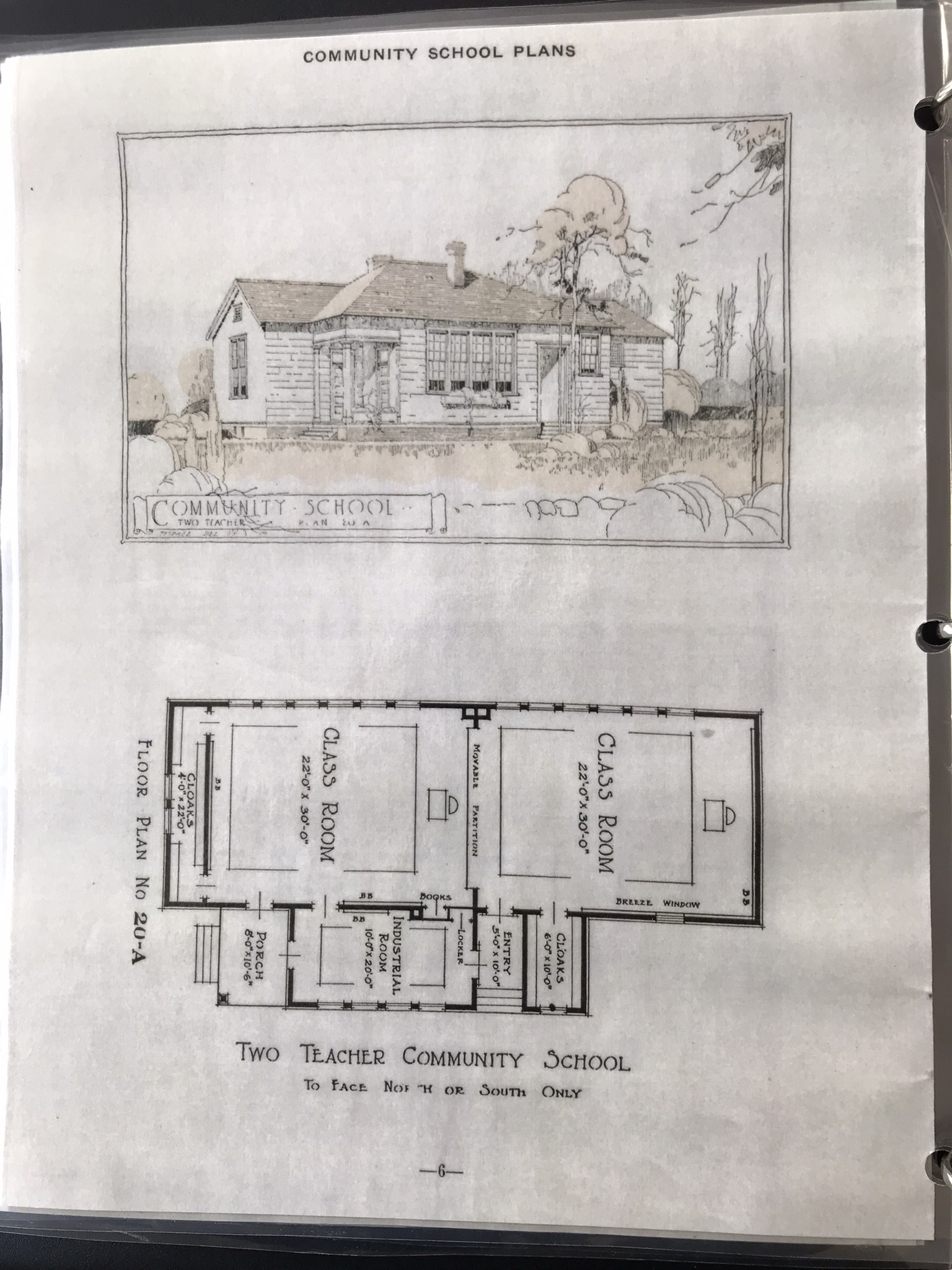
I drove by the Bellefonte Rosenwald School many times, but I did not know it was a Rosenwald School. In fact, I had not heard of Rosenwald Schools until about 20 years ago. I did not know Bellefonte was a Rosenwald School until after it had been burned down for practice by the fire department. That whole story is a sad situation. People making those decisions had no idea the value of the building. I think the architect’s sketch and floor diagram below are the plans used in the construction of the Bellefonte Rosenwald School.
Possible design of the Bellefonte Rosenwald School at Harrisburg, NC.
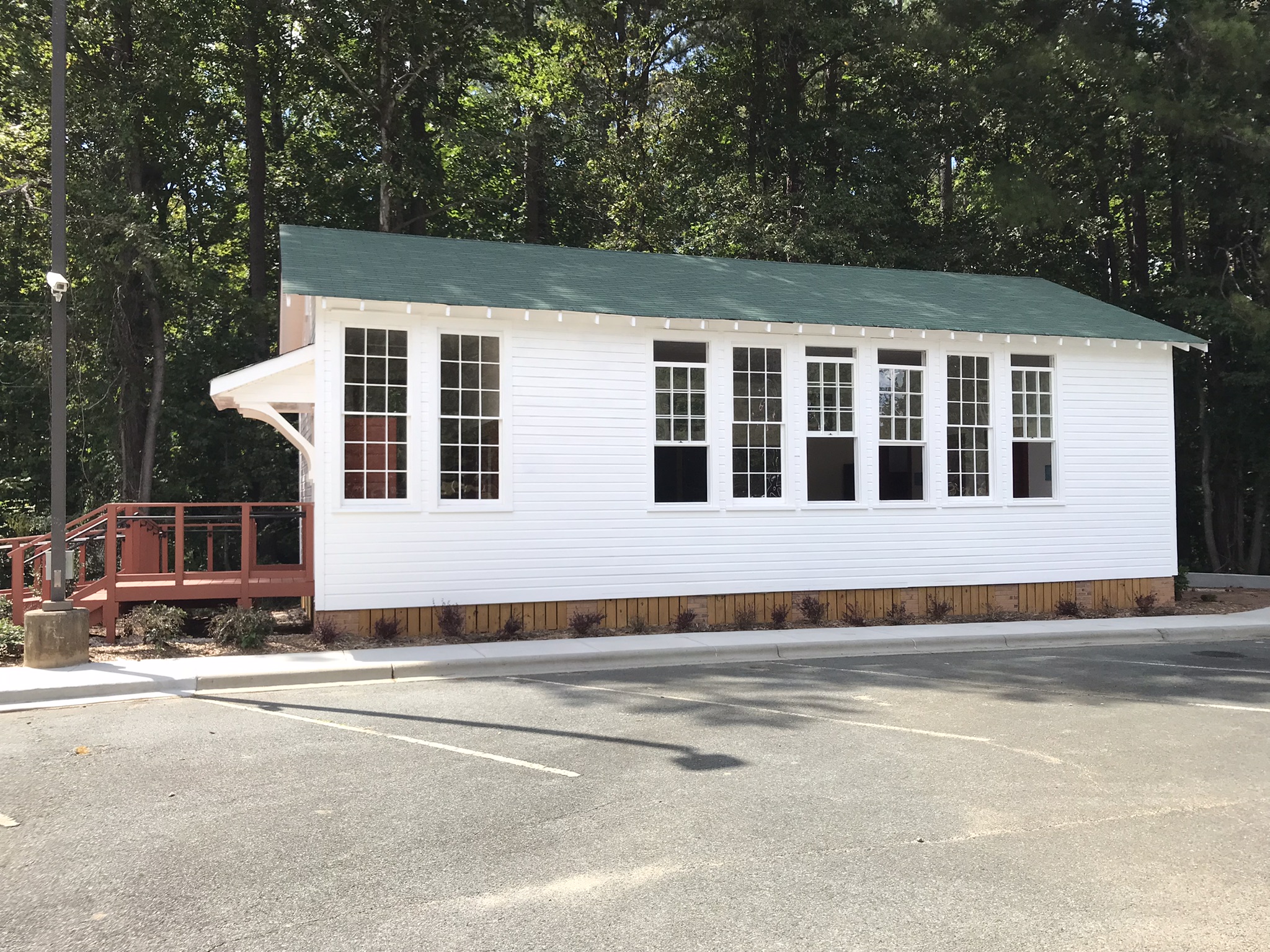
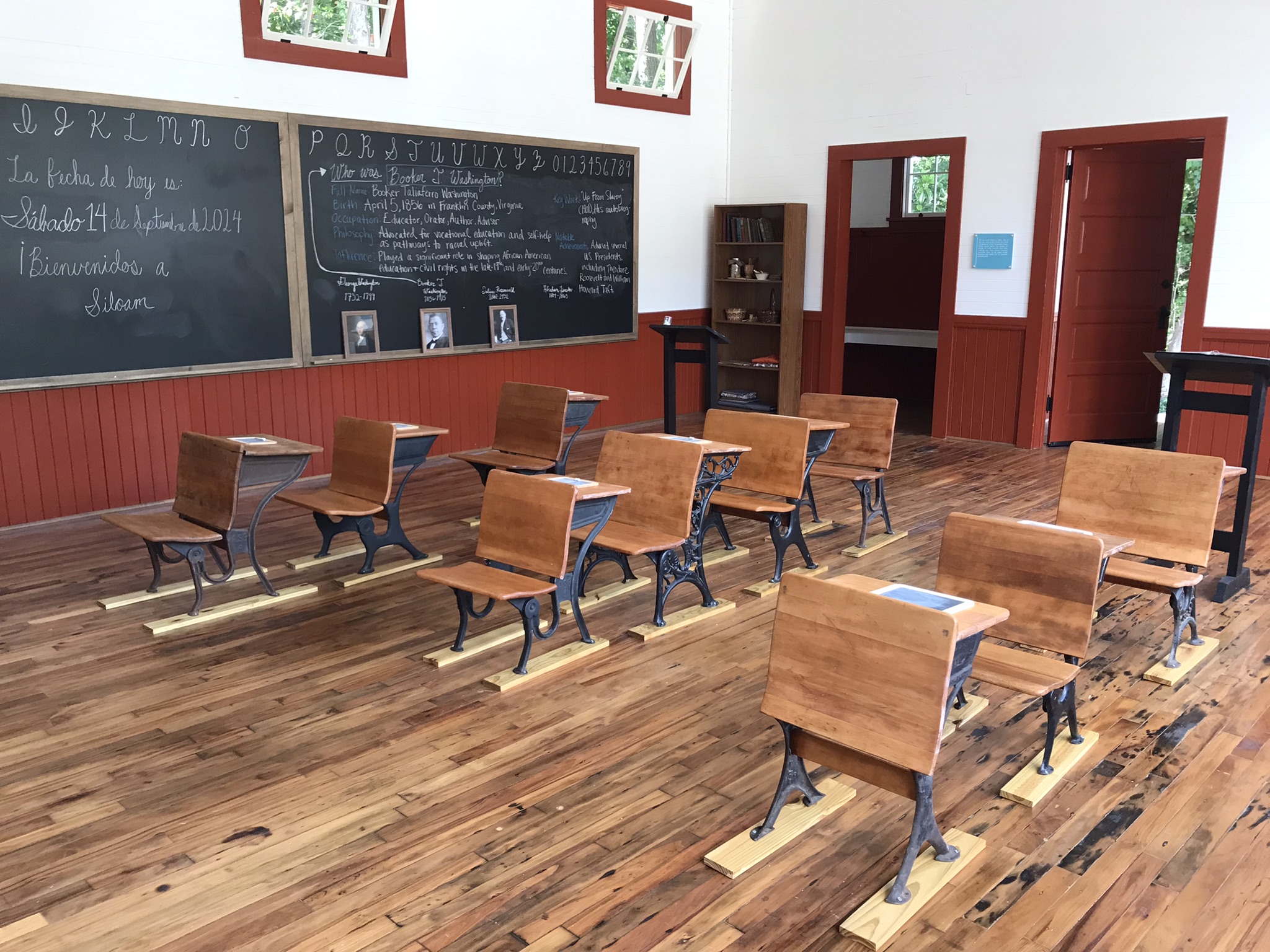
The Bellefonte Rosenwald School had two classrooms, whereas some of the schools had just one classroom. In 2023, the abandoned one-classroom Siloam (or Salome) Rosenwald School was moved from its original location in eastern Mecklenburg County, NC to the campus of the Charlotte Museum of History. It was restored and I took the photographs below in September 2024. (The museum’s website identifies it as Siloam School, but it was originally located on Salome School Road.)
Restored Siloam Rosenwald School moved to campus of Charlotte History Museum and restored in 2024
Classroom in restored Siloam Rosenwald School in Charlotte, NC, 2024
In 2006, I had the privilege of interviewing two women and one man, all in their 90s at the time, who had attended the three Rosenwald Schools in Harrisburg, NC. It was wonderful – and heartbreaking – to hear some of their memories of those days of racial segregation in our schools. I’m glad I talked to them when I did, for they are gone now. Much of their oral history would be gone with them, if I had not taken copious notes and published their memories.
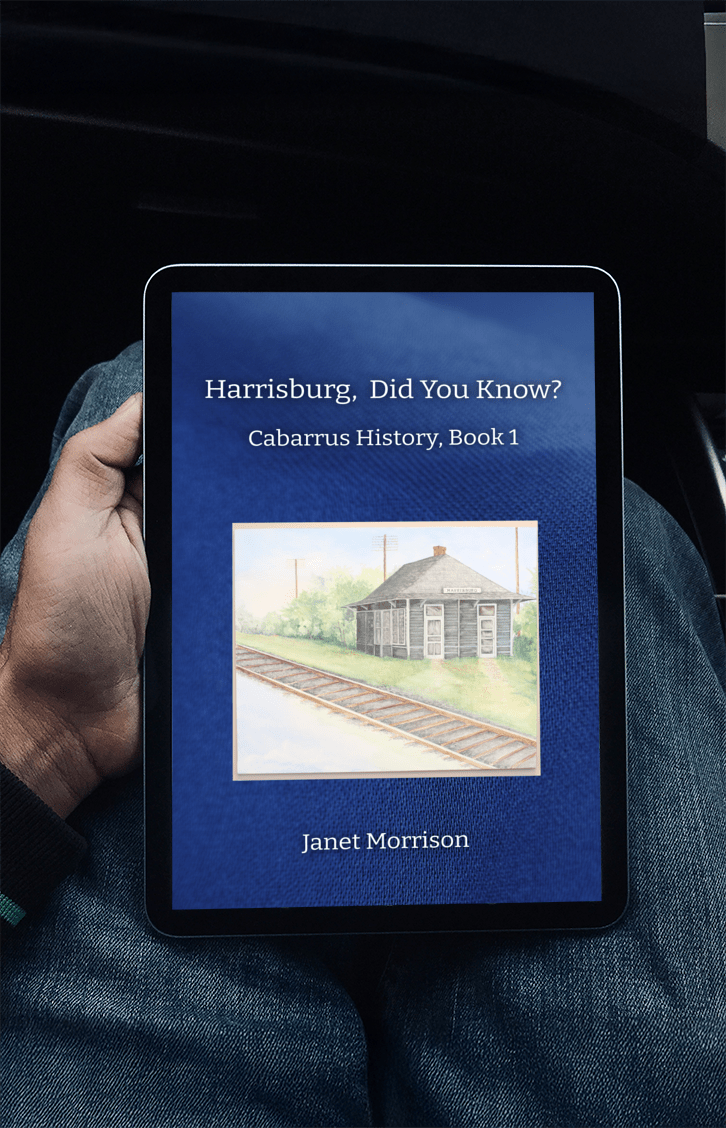
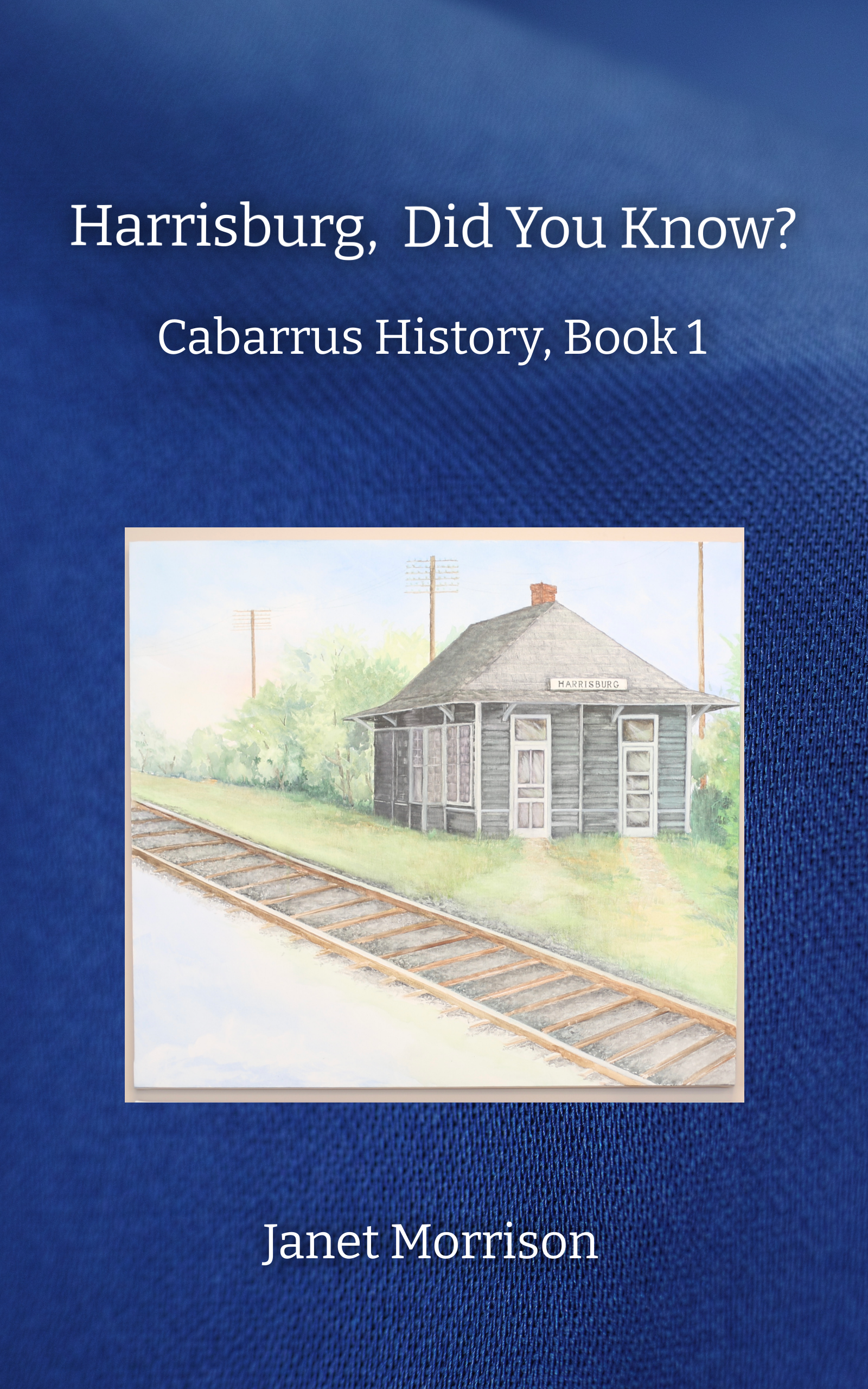
Harrisburg, Did You Know? Cabarrus History, Book 1, by Janet Morrison
If you would like to read more about Rosenwald Schools in general, including how they were funded and supported by their communities, along with some details about the three located in the Harrisburg section of Cabarrus County, North Carolina, look for Harrisburg, Did You Know? Cabarrus History, Book 1 on Amazon in paperback and e-book and at Second Look Books in Harrisburg in paperback.
Janet
All history is local, but no history is just local.
Last Tuesday, I blogged about the coming of the railroad to Harrisburg, North Carolina in 1854 (The Coming of the Railroad in 1854). After receiving several nice comments about the post, I decided to proceed with my plan to blog once-a-week about other topics I covered in my two books, Harrisburg, Did You Know? Cabarrus History, Book 1 and Harrisburg, Did You Know? Cabarrus History, Book 2.
One of my blogger friends who lives hundreds of miles from where I wrote my local history articles caught on to something I was hoping to convey: All history is local, but no history is just local.
The information contained in my two local history books does not just apply to Township One in Cabarrus County, North Carolina. Harrisburg and Township One have much local history that also applies to every small town in the United States.
Every town – big or small – in the United States started as just a collection of homes and perhaps a dirt crossroads. Roads expanded, railroads were built, family-owned grocery stores opened, electricity and telephone service eventually came. Even as Harrisburg’s history is unique to Harrisburg, it holds nuggets of the history and growing pains experienced by every town.
With that in mind, I hope a wider audience will get interested in my two history books. They are available in paperback and as e-book on Amazon and in paperback at Second Look Books in Harrisburg.
In 2009, I wrote a six-part series about “The Cotton Economy” for Harrisburg Horizons newspaper. Today’s blog post will hit on some of the details in those articles, for Cabarrus County, North Carolina was very much a cotton economy in much of the 20th century until textile mills moved to other countries.
Those six articles are in Harrisburg, Did You Know? Cabarrus History, Book 1.
Seventy years ago, most of the fields around Harrisburg, North Carolina were planted in cotton. Today, there is not a single cotton field in Cabarrus County, as far as I know.
As late as the 1960s some Harrisburg school children had to miss school for two or three weeks every fall because their families depended on them to pick cotton.
Eli Whitney invented the cotton gin, but that piece of machinery turned out to be a double-edged sword. The increase in cotton production the gin sparked in the 19th century resulted in an increase in the slave trade.
By 1850 the United States produced three-fifths of the world’s cotton. Unfortunately for the South, where the cotton was grown, most of it was shipped to New England or to England to be milled into fabric.
If you are of a certain age, you may remember buying towels and sheets manufactured by Cannon Mills. Headquartered in Kannapolis, NC by the mid-1910s the company was the largest towel manufacturer in the world, and in the 1960s was the world’s largest manufacturer of household textiles. Cannon had mills all over Cabarrus and other piedmont North Carolina towns.
For decades textile mills were the biggest employer in Cabarrus County. But Cannon Mills is no more. I see some “Cannon Mills” labels in some textile products today, but those manufactured in the 21st century were not made by the Cannon Mills I’m talking about.
The Cannon Mills I’m talking about was purchased by Fieldcrest in 1986 and then by Pillowtex in 1997. Over the years, the textile mills in Cabarrus County employed fewer and fewer people due to mechanization and manufacturing moving to other countries.
If memory serves me correctly, I believe at one time there were more than 20,000 people employed in the mills in Cabarrus County. When the 7,650 people who permanently lost their jobs when Pillowtex declared bankruptcy and ceased operations on July 30, 2003, it was the largest permanent lay-off in North Carolina history.
The first cotton mill built in Cabarrus County was not built by the Cannon family. It was the Locke Mill, which still stands at the corner of Church Street and McGill Avenue in Concord, NC. It was converted into condominiums around the turn of the present century.
As I told in Part I of my newspaper series, building that first mill was a formidable and risky undertaking. The spinning frames were shipped from Fishkill, New York by sea to Georgetown, South Carolina. From there, up the Pee Dee River to Cheraw, SC, and from Cheraw to Concord by six-horse wagons
The engine that ran the steam-powered plant was shipped by sea to Wilmington, NC and up the Cape Fear River to Fayetteville, NC. From there it was transported by horse and wagon. Locke Mill began operations in 1840.
As stated in Part I in my series, “When the 1850 US Census was taken, Concord Manufacturing Company reported that its steam-powered cotton factory employed 15 males and 55 females. The males were paid an average of $12.47 per month and the females were paid an average of $4.91 per month.”
But I have gotten way ahead of myself. Most of what I included in my six newspaper articles revolves around the little cotton gins that sprang up around Harrisburg in the 1800s.
By 1850, there was a water-powered cotton gin on McKee Creek here in Township One. It was located where present-day Peach Orchard Road crosses the creek and where there is now a plan to build a couple hundred houses. That is also where Robert and William Morrison’s grist mill was in the late 1700s and early 1800s.
Samuel Wilson’s cotton gin on McKee Creek was no small operation, even though that creek is too small to hardly be noticed today. According to the 1850 US Census, Mr. Wilson reported having processed 24,000 pounds of seed cotton valued at $30,000 the previous year.
To put that in perspective, that $30,000 would be well more than $1 million today!
Wilson’s cotton gin employed four men who were paid an average of $15 per month. The gin produced 1,080 bales of ginned cotton.
While some cotton gins were water-driven, others were powered by horses.
In his 1948 paper, “Some Sketches of Rocky River Church and Vicinity,” William Eugene Alexander explained how a horse-powered cotton gin worked. Quoting Mr. Alexander in part from my book, “ʻIt took four horses, hitched two abreast, and it took two boys to drive them…. There were no lint condensers to the gins, but the lint was blown out into the lint room like a snowstorm and a hand would gather it up in a basket and carry it to the cotton press in the gin yard, where it was baled.’” (Incidentally, it was late in the 20th century before “brown lung” was recognized as a disease caused by breathing cotton dust into one’s lungs.)
Mr. Alexander’s explanation continued, “ʻThe press was constructed with a large wooden screw pin, 10 or 12 inches in diameter. This press was probably 18 or 20 feet high, and was manipulated by means of long levers, to which a mule or horse was hitched for power.’”
This blog post is getting too long, so I will just mention some of the other cotton economy things I wrote about in the other five “installments” – all of which are found in Harrisburg, Did You Know? Cabarrus History, Book 1.
Harrisburg, Did You Know? Cabarrus History, Book 1, by Janet Morrison
As is prone to happen from time-to-time in industry, friction developed between the cotton farmers and the owners of the cotton mills. Farmers struggled to get a fair price for their cotton. The Cotton States and International Exposition was held in Atlanta, Georgia in 1895. Special train fares were advertised in the newspapers for farmers wanting to attend the Exposition. Among those farmers was one of my great-grandfathers.
There was a case of suspected suicide in 1907 by a 13-year-old Harrisburg girl who worked in a cotton mill. In my research, I found a newspaper article from Durham, NC from 1899 in which it was reported that several mills there had adopted a policy of not hiring children under 12 years old.
In my research, I also found a deed of trust at the courthouse giving the details of the purchase of machinery in 1901 for the construction of a steam-powered cotton gin near the railroad tracks by Harrisburg Improvement Company. Until electricity came into the village years later, that gin ran on steam power generated by an old locomotive steam boiler.
Have I whetted your appetite to want to read more? Look for my books on Amazon and at Second Look Books!
Janet
“All history is local, but no history is just local.” ~ Janet Morrison
I wrote a local history column for Harrisburg Horizons newspaper from May 2006 through December 2012. Before you residents of Harrisburg, Pennsylvania get too excited, I will clarify that this free weekly newspaper existed in Harrisburg, North Carolina.
Of the 175 newspaper columns I wrote, six were a series of articles I wrote about “The Coming of the Railroad.” This is an important local topic for without the North Carolina Railroad there would be no Town of Harrisburg, NC today.
It’s hard to imagine the town without a railroad today, even though in an effort to establish “high-speed” rail between Charlotte and Raleigh, the at-grade railroad crossings in Harrisburg were replaced with bridges in 2013. That’s a story for another day.
Imagine a rural farming community in 1854, about halfway between Charlotte and Concord. Was everyone excited about the coming of the railroad? Farmers were probably not happy about the piercing whistles of the steam engines scaring their livestock, but they were possibly pacified by the fact that the depot planned for the community would give them a convenient way to sell their agricultural products.
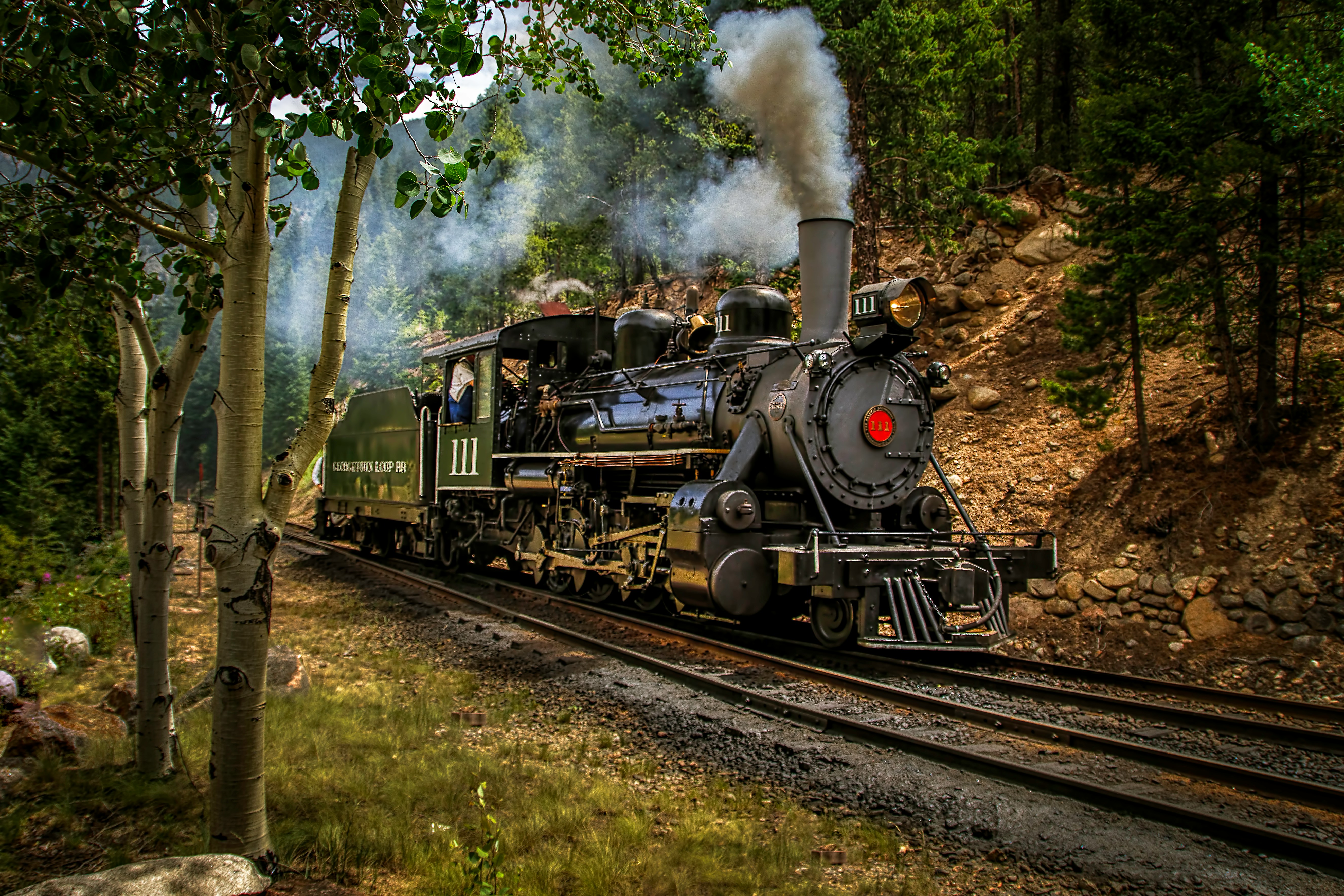
Photo by Claud Richmond on Unsplash. (NOT a photo of a Harrisburg, NC steam train.)
Prior to the coming of the railroad, it is said that it sometimes cost a farmer half his profits to transport his produce to market by wagon. Poor roads and distances to markets prohibited the transporting of perishables very far.
Although Charlotte has a population of a million people now, in 1854 it had a whopping 1,000. The State of North Carolina decided it would be good for the economy to construct a railroad from Goldsboro, in the eastern part of the state, to Charlotte in the southern piedmont.
The State sold bonds in New York City to finance the project. Ten thousand shares were sold at $100 each.
Goldsboro was chosen because it had rail service to the port at Wilmington, NC. A railroad from the south to Charlotte and one from the north to Danville, Virginia, which threatened to extend a line to Charlotte, would surely mean that goods from western North Carolina would be shipped to Virginia or to the port at Charleston, South Carolina.
It was understood from the beginning that much of the construction labor for the project would be undertaken by slaves of property owners living along the rail right-of-way. Some of the slave owners were paid on a yearly basis for supplying their slaves for the project.
I found it interesting that wrought iron T-rails manufactured in Wales were used in the initial construction of the 223-mile-long railroad. The rails weighed 60 pounds per yard and were brought in through the port at Charleston.
In the early 1850s, a steam locomotive needed on average a cord of wood (that’s a stack of wood eight feet long, four feet wide, and four feet high) and 1,000 gallons of water for every twenty-five miles. A tender could carry that much wood and water. That is what dictated the approximate distances between some train stations.
That’s how the little farming community of Harrisburg, North Carolina got a train depot and the designation as Harris Depot on maps.
If you are interested in learning more about the North Carolina Railroad and the ways the coming of the railroad and depot changed life in a farming community in the early 1850s, look for my book, Harrisburg, Did You Know? Cabarrus History, Books 1 and 2. Book 1 contains the first 94 local history articles I wrote, including the series about the railroad. Book 2 contains the other 84 local history articles I wrote, including more articles that reference the railroad.
Topics in the two books include such things as the blowing up of the King’s gun powder in 1771, a minuteman in the American Revolution, President George Washington’s 1791 visit, the 22-mile ring dyke the town sits in, general stores, family-owned groceries stores, education in the 1800s and three Rosenwald Schools, how the town got phone service and electricity, our Ukrainian doctor (Nicholas E. Lubchenko) who escaped from the Russian Army, the cotton economy of the area until the mid-20th century, Hurricane Hugo in 1989, floods, earthquakes, the building of roads and bridges, the changes necessitated by the high-speed rail project, mail service from the 1800s until the early 21st century, the construction of the Charlotte Motor Speedway and the running of the first World 600 NASCAR race in 1960… and much more.
Here are the links for purchasing the books on Amazon:
Harrisburg, Did You Know? Cabarrus History, Book 1, by Janet Morrison
If you live in the Harrisburg, NC area, you can find the books in paperback, Tuesday through Saturday, at Second Look Books, 4519 School House Commons.
I hope my blog post today whetted your appetite for reading more about the history of our little town of 20,000 now. I imagine many of our local stories are similar to ones in your town’s history.
Janet
The government should be afraid of its citizens, not the other way around.
For today’s blog post, I’m taking advantage of a local history column I wrote for Harrisburg Horizons newspaper on August 23, 2006.
If you enjoy this post, you might enjoy the books in which I published the local history column articles I wrote from 2006 through 2012, Harrisburg, Did You Know? Cabarrus History, Book 1 and Harrisburg, Did You Know? Cabarrus History, Book 2. The story I’m sharing today is found in Book 1.
Harrisburg, Did You Know? Cabarrus History, Book 1, by Janet Morrison
Harrisburg, Did You Know? Cabarrus History, Book 2, by Janet Morrison
The articles I wrote for the newspaper came primarily from the history of Township One in Cabarrus County, North Carolina, but many topics would be of general interest to anyone who enjoys reading about history. They are specific to Cabarrus County, yet many of them are indicative of life in rural and small-town America since the 1700s.
My books are available at Second Look Books in Harrisburg, NC and on Amazon.
Sit back, and prepare to be transported to a simpler time in the 1870s.
“Pioneer Mills: No Place For a Preacher’s Son”
Did you know that there is a written account of a child’s memories of the Harrisburg area in the 1870s?
The Rev. Joseph B. Mack came from Charleston, South Carolina in 1871 to be the pastor of Rocky River Presbyterian Church. When he and his family arrived, the manse the congregation was building for his family to live in was not completed.
Church member Robert Harvey Morrison moved his own family into a tenant house and gave the new minister’s family his home in the Pioneer Mills community. Pioneer Mills was a gold-mining boom town in the early- to mid-19th century. It was apparently still a rip-roarin’ place in 1871.
Robert Harvey Morrison House
A special homecoming was held at the church on August 12, 1912. Rev. Mack’s son, Dr. William Mack, was unable to attend. He sent his regrets from New York and put some of his childhood memories on paper. Fortunately for us, his letter to homecoming master of ceremonies Mr. Morrison Caldwell was printed in the Concord newspapers the following week.
Dr. Mack wrote, “My first Rocky River recollection is getting off the train at Harris Depot and going in the dark to the home of Uncle Solomon Harris.” I don’t believe Dr. Mack was related to Mr. Harris. This was probably a term of endearment and respect.
He continued, “There we met Ed and ‘Little Jim’ (to distinguish him from ‘Big Jim,’ the son of Mr. McKamie Harris.) Uncle Solomon had the biggest fire-place I ever saw; it seemed as big as a barn door.
“Shortly afterwards we went to Pioneer Mills…. There… was the old Gold mine, Barnhardt’s store and McAnulty’s shoemaker shop…. While there I decided to become either a merchant or shoemaker, for Barnhardt’s store and McAnulty’s shop kindled young ambitions; better to ‘keep store’ or ‘mend shoes,’ than as a preacher’s son to be moving around from place to place.
“But Pioneer Mills was ‘no place for a preacher’s son.’ Soon we moved again; this time to the brand new brick parsonage, close by the church. We used to go to church in a big closed carriage drawn by two mules; now, every Sunday, we walked to church, going down a steep hill, across a branch, and through the grove to the famous old house of worship.”
Dr. Mack’s letter also read, “Those were happy years; happy in springtime with its apple blossoms, song birds, morning-glories and Tish McKinley’s Sassafras tea; happy in the summertime with its blackberries and plums, its bob-whites in the wheat fields, its lightning and thunder storms, its bare-footed boys and girls, and its bitter quinine to keep off third-day chills; happy in the autumntime, with its white fields of unpicked cotton and its beautiful trees with leaves of myriad hues; and happy in the wintertime, with its snows, its big hickory back-logs, its boys in boots red-topped and toes brass-tipped, its red-cheeked girls in wraps and ‘choke rags,’ and its Christmas Holidays and turkeys.”
Dr. Mack’s colorful memories paint an idyllic picture of life in Township #1 in the early 1870s. Will the children of 2006 have equally as wonderful memories?
(Published in Harrisburg Horizons newspaper, August 23, 2006.)
Resources: The Presbyterian Congregation on Rocky River, by Thomas Hugh Spence, Jr., 1954; The Concord Daily Tribune, August 16, 1912; and The Concord Times, August 19, 1912.
Hurricane Helene Update
As of Friday, of the 1,468 road closures in North Carolina due to Hurricane Helene last September, 33 are still closed and 39 have partial access. Interstate 40 near the Tennessee line will be limited to one lane traffic in each direction with a 35 mile-per-hour speed limit for the foreseeable future.
On a happy note, on Friday, a 38-mile stretch of the Blue Ridge Parkway opened from Asheville to Graveyard Fields and Mount Pisgah! This is south of Asheville.
Hurricane Erin
On the other end of the state, Hurricane Erin skirted the Outer Banks of North Carolina last week, dumping tons of sand and water on NC Highway 12. NC-12 is the only highway connecting Hatteras Island to the islands to the north. Crews are working to reopen the highway as soon as possible as the summer tourist season is winding down.
Mr. Ira Lee Taylor of Harrisburg, North Carolina, was an unassuming man. I grew up knowing him as my mailman and the father of a friend at school. It wasn’t until 2006, when I started writing a local history column for Harrisburg Horizons newspaper that I learned from another local World War II U.S. Army veteran that Mr. Taylor took part in the invasion of Normandy on D-Day.
That invasion took place 81 years ago today. Very few veterans are still here to tell their stories. Interviewing Mr. Taylor a number of times in the six years I wrote for the newspaper was one of the privileges of my life.
Instead of June 6, 1944, only being a date in a history book, it became a day of incredible heroism and sacrifice as I heard Mr. Taylor’s vivid memories of that day, the training in preparation for it, and the other battles he was in throughout the war in Europe.
Mr. Taylor served in the U.S. Army’s 4th Division. The entire 4th Division left New York City on four ships on January 19, 1944. About passing the Statue of Liberty, he said, “That was a beautiful thing. We said, ‘We don’t know whether we’ll ever see you again or not.’” Many of them never did.
More than one hundred other ships joined the 4th Division over the next three days. The Liberty Ships were carrying ammunition, food, and other supplies. He said the ships would scatter during the day, but at night they would close in almost touching each other. It took eleven days for them to cross the Atlantic and arrive in Liverpool, England.
They were transported by train from there to Devonshire, England, where they trained for the invasion of Normandy which was occupied and heavily fortified by the Germans.
He talked about how they meticulously prepared their trucks and other equipment so they would be sea worthy. They practiced loading everything up and going to the port of Plymouth. From there, they would sail down the English Channel to a place that was set up to look like “Utah Beach” in Normandy where they would train for the invasion.
Each time they set out, they didn’t know whether it was the real thing or another practice run. Of course, they did not know exactly what they were training for.
After months of planning and incredible secrecy, the invasion was scheduled for June 5, 1944. General Dwight D. Eisenhower knew he had a small window of opportunity before the moon would begin to wane.
No, June 5 is not a typo. That was set as the day for the invasion. The night before, Mr. Taylor said the troops were briefed. They were told, “The 4th Division will make the landing on D-Day. We’re sacrificing the 4th Division to make that landing. We anticipate eighty percent casualties. You’ll pass two islands in the Channel on the way – one’s Guernsey and the other one’s Jersey. You might hear some shooting and all, but don’t worry about it. That doesn’t concern you at all. Two other outfits are taking care of that.”
“The morning of June 5, the gate was locked with an MP guarding it. They wouldn’t let us out, and the boys started singing, ‘Don’t Fence Me In,’” Mr. Taylor said with a chuckle. But then the mood turned somber and they knew this was it.
Mr. Taylor’s outfit set out late on the evening of June 4. They got halfway across the English Channel and a huge storm came up. General Eisenhower was forced to call off the mission, but the invasion had to take place no later than June 6.
So Mr. Taylor’s outfit loaded up again on the night of June 5 before dark. He was on one of 499 ships that took part in the invasion.
Patton’s 3rd Division, the 90th Division, and the 4th Division were all lined up, but the 4th went out first because it was to hit the beach in the first wave.
If you’ve seen the movie, “Saving Private Ryan” or some war documentaries, you might have an inkling of an idea what the invasion was like, but I don’t think any of us can really grasp the horror of it. One thing a film doesn’t give you is the smell, but Mr. Taylor talked about the smell.
He talked about how special troops sneaked onto the Normandy coast before daybreak on June 6 and disarmed many of the mines on the beaches, right under the noses of the German soldiers. At the same time, glider troops were silently landing inland carrying tanks and infantrymen. The 82nd and 101st Airborne dropped ten miles inland, behind enemy lines.
Mr. Taylor talked about the four hundred light and heavy bombers that flew over them until six o’clock in the morning.
The 4th Division missed its target by about a mile, but started landing on Utah Beach at 6:30 a.m. on June 6, 1944.
Mr. Taylor talked about the mines and the iron crosses all over the beach as the Germans anticipated an invasion, the 50-caliber machine guns, the wounded soldiers being taken back to the Landing Ship, Tank (LST) he was on. It carried twenty tanks and 200 troops and doubled as a hospital.
Mr. Taylor was in many battles, including the Battle of the Bulge and the Battle of Huertgen Forest. He had majored in Forestry at North Carolina State University at Raleigh, so he had a particular appreciation for the Huertgen Forest of fir and pine trees, but it was there that the 4th Division lost half of its men and the forest was shattered in the fighting.
Mr. Ira Lee Taylor with his World War II medals, February 24, 2007.
Needless to say, Mr. Taylor felt fortunate to survive the war. He came home, married his sweetheart, and got a job at the post office. Somehow, he put the horrors he had witnessed behind him, but in his later years he wanted to share his story. And I’m a better person for having interviewed him.
If you are interested in reading all of Mr. Taylor’s stories, my five-part newspaper series can be found in Harrisburg, Did You Know? Cabarrus History, Book 1, which is available in paperback at Second Look Books in Harrisburg and in paperback and e-book from Amazon (https://www.amazon.com/Harrisburg-Did-You-Know-Cabarrus-ebook/dp/B0BNK84LK1/). That book contains the first 91 articles I wrote for the newspaper.
Until my next blog post
Take some time today to think about the men who took part in the D-Day invasion. We owe them a debt of gratitude that we can never repay.
Now that I have your attention… today’s blog post is about ancient history. This is one of the topics I wrote about in Harrisburg, Did You Know? Cabarrus History, Book 2.
Photo by guille pozzi on Unsplash
Harrisburg, North Carolina sits inside a 22-mile syenite or ring dike. One can get a feel for it from several high points in the area, such as when traveling south from Concord on US-29 near the intersection with Union Cemetery Road. It’s like looking across a gigantic bowl.
Another possible place from which to catch a glimpse of the “bowl” is on NC-49 southbound after you pass Old Charlotte Road. The Charlotte downtown skyline is visible briefly from that location as well as the one referenced above on US-29.
Harrisburg, Did You Know? Cabarrus History, Book 2, by Janet Morrison
What, you may ask, is a syenite or ring dike? I’m no expert on volcanology, but my understanding is that it is a circular dike around a volcano.
According to 2001 Encyclopedia of Earthquakes and Volcanoes, by David Ritchie and Alexander E. Gates, Ph.D.:
“If magma is removed from the magma chamber beneath a volcano, it can undergo caldera collapse. The volcano and the area around it collapse because they are no longer being held up by the liquid. A series of concentric faults and cracks develop around the collapsing volcano. As they do, magma will squeeze up around the cracks and faults forming ring dikes.”
I’ll take their word for it.
In 1966, U.S. Geological Survey geologist Harry E. LeGrand and Henry Bell III led a scientific excursion in Cabarrus County to study our ring dike and other interesting rock and mineral deposits in the county.
You might be able to access a pdf of “Guidebook of Excursion in Cabarrus County, North Carolina, October 22-23,1966” by going to https://www.carolinageologicalsociety.org. Search for “1960s Field Trip Guidebooks” and then scroll down to find that particular guidebook.
The Harrisburg area has experienced a population explosion since 1966. The landmarks noted in the 1966 guidebook are either gone or more difficult to locate today. The concentric rings that were reportedly visible from the air in 1960 by R.G. Ray might not still be intact.
If you’d like to know more about this topic, the 1849 meteorite; Harrisburg’s first organized housing and business development of 100 years ago; the Morrison-Sims Store and Old Post Office; the flood of 1886, the Piedmont Area Development Association (P.A.D.A) of the 1960s; earthquakes that have been felt here; McCachren’s Store; Rocky River bridges in the 1870s; the Sauline Players; a tribute to George L. Govan; Rocky River Academy; the Rocky River Presbyterian Church’s fourth sanctuary which was completed in 1861; a 1777 estate sale; Hugh Smith Pharr and his mill; a 1907 attempted train robbery; 1816 – the year without a summer;
Also: items such as milk, apples, and dry cleaning that were all delivered to homes in the mid-1900s; Blume’s Store; high-speed trains; the boundaries of Township 1; early Harrisburg education; Pharr Grist Mill on Back Creek; how electricity came to Harrisburg; a 1912 church homecoming; Pioneer Mills Gold Mine and Community; a fellow named Collett Leventhorpe; a 1911-1912 debating society; and the tenth anniversary of the Harrisburg Branch of the Cabarrus County Public Library system… please purchase Harrisburg, Did You Know? Cabarrus History, Book 2.
The book also contains nearly 150 pages of my research notes on subjects I didn’t get to write about when I wrote a local history newspaper column from 2006-2012.
Harrisburg, Did You Know? Cabarrus History, Book 1 and Book 2 are available in paperback at Second Look Books, 4519 School House Commons in Harrisburg, NC.
Second Look Books, 4519 School House Commons, Harrisburg, NC
Where? Second Look Books, 4519 School House Commons in Harrisburg
When? Saturday, April 15, 2023
What Time? 2:00 – 4:00 p.m.
Second Look Books, 4519 School House Commons, Harrisburg, NC
Copies of Harrisburg, Did You Know? Cabarrus History, Book 1 and Book 2 have arrived and been autographed.
Photocopies of my 11×14-inch “Harrisburg in the 1900s” two-map sets have been made.
Business cards and bookmarks are printed.
Saturday, April 15 is the big day for my Meet & Greet at Second Look Books in Harrisburg, North Carolina! I’ll be there from 2:00 p.m. until 4:00 p.m.
Please drop by, even if you’ve already purchased both books.
The bookmarks and Harrisburg maps are free while supplies last.
What maps?
I drew the maps based on detailed memories that Mr. Ira Lee Taylor shared with me while I was writing the “Did You Know? local history column for Harrisburg Horizons newspaper (2006-2012.)
One map covers from along NC-49 to Back Creek. The other map covers from Back Creek to Reedy Creek and where McKee Creek flows into Reedy Creek.
Mr. Taylor told me where such things as the telephone switchboard, spoke factory, two cotton gins, railroad houses, corn fields, cotton fields, and livery stable were in the early 1900s.
He told me where the various stores and post offices were. Being the town’s only mail carrier for several decades, he knew where everybody lived, so I included much of that information The map show where the roads were (and were not) before the coming of the high-speed rail.
In case you arrived in Harrisburg after the two-story red brick old Harrisburg School was torn down, this set of maps will show you the layout of the school grounds. The school property is where School House Commons Shopping Center is now.
The maps also show the locations of the Oak Grove Rosenwald School and the Bellefonte Rosenwald School that you read about in Harrisburg, Did You Know? Cabarrus History, Book 1.
Some things you’ll learn about in my two books
There are stories of local heroism from 1771 and the detailed memories of a World War II US Army veteran who told me about his training for D-Day through to the end of the war.
There are stories about the original Hickory Ridge School, which was a one-room school on Hickory Ridge Road.
There are stories about the Rosenwald Schools that served the black students in the early 1900s.
There are stories about the man from Russia (actually, Ukraine) who settled in Harrisburg in the 1920s to practice medicine until his death in 1960. He was a country doctor who made house calls
There are stories about the construction of the Charlotte Motor Speedway and the first World 600 Race when the track was in such bad shape that chunks of asphalt broke the windshields out of some of the race cars.
There is information about the 22-mile syenite ring-dike that Harrisburg sits in. It’s what remains of an ancient volcano.
Until my next blog post
Remember the people of Ukraine – where Dr. Nicholas E. Lubchenko was born and lived until young adulthood.
I hope to see you on Saturday!
In case you don’t have a good book to read, please consider purchasing my local history books. They’re available in paperback at Second Look Books. They’re also available in paperback and for Kindle from Amazon.
Even if you don’t live or have never lived in Harrisburg, North Carolina, I think you’ll find some interesting stories that you can probably relate to if you are of a certain age. And if you a child, teen, or young adult I think you’ll find it interesting to read about how life used to be in our sleepy little farm village of a couple hundred people in the early 1900s that has grown to nearly 20,000 people in 2023.
What? Author Meet & Greet
Where? Second Look Books, 4519 School House Commons in Harrisburg
The first documented gold discovery in the United States was here in present-day Cabarrus County, North Carolina in 1799. The discovery by a little boy playing in Little Meadow Creek led to gold fever in the area. Numerous gold mines were dug and mined to various levels of success.
In fact, there was enough gold found in the southern piedmont of North Carolina that a branch of the United States Mint was built in Charlotte in 1836 and 1837. It opened for the production of gold coins in 1837.
A trip to the National Archives at Atlanta (which is in the Atlanta suburb of Morrow, Georgia) a few years ago gave me the opportunity to look at ledger books from the Mint in Charlotte. Within those pages I recognized names from my community.
Register of Gold – Branch Mint – Charlotte
I’m blogging about some of that information today to give you an example of the type of documented local history I included in Harrisburg, Did You Know? Cabarrus History, Book 2. Although the book (and Harrisburg, Did You Know? Cabarrus History, Book 1) concentrate on Harrisburg, both books do include articles about other communities in Township One.
One of the communities rich in history in the township is Pioneer Mills. Little more than a quiet crossroads now, it was a center of activity in the mid-1800s after the discovery of gold and the opening of Pioneer Mills Gold Mine.
I recognized names such as John C. Barnhardt from the Pioneer Mills community as taking 123 ounces of amalgam to the Charlotte Mint on August 31, 1843, for which he was paid $2,340.33. That was no small sum of money in 1843!
Robert Harvey Morrison, on whose land the Pioneer Mills Gold Mine was located, was paid more than $4,000 for the gold bars and amalgam he took to the Mint from late in 1846 into early 1850.
Other names I recognized in the Mint ledgers included two other Barnhardts, Robert R. King, three men with the surname Treloar, and R.B. Northrop.
Comparing US Census records, Charlotte Mint records, and various years of Branson Business Directories helped me get a better idea of what the Pioneer Mills Community must have looked like 150 to 180 years ago. There was a general store, a dry goods store, a blacksmith, a school, and a post office, In 1869, Pioneer Mills Community had three physicians.
Gold mining brought people from Canada, Great Britain, and New York to Pioneer Mills. Gold mining, no doubt, brought some undesirable people into the community, which led the wife of the pastor of Rocky River Presbyterian Church to say in the early 1870s that Pioneer Mills “is no place for a preacher’s son!”
If you’d like to read more about the history and people of Cabarrus County, North Carolina, you might enjoy Harrisburg, Did You Know? Cabarrus History, Books 1 and 2. They are available in paperback at Second Look Books in Harrisburg and in paperback and for Kindle from Amazon.
By the way, you can visit the research room at the National Archives at Atlanta (in Morrow, Georgia) by appointment only. Visit the website for more information: https://www.archives.gov/atlanta.
Until my next blog post
I hope you have a good book to read.
I hope you spend time with family and good friends.
And, as always, remember the people of Ukraine and count your blessings.
Did you ever see the Sauline Players perform? Chances are you did if you went to school in the piedmont of North Carolina in the early- to mid-1900s.
As I write that, though, it occurs to me that I don’t know if they performed at the schools for black children. I hope they did, for their performances were a real treasure for those of us who lived in rural areas and didn’t have easy access to live theatrical performances.
Two of the 91 local history articles in my new book, Harrisburg, Did You Know? Cabarrus History, Book 1, are about the Sauline Players. I’ll share some highlights from those articles in today’s blog post.
When I researched the Sauline Players for Harrisburg Horizons newspaper in 2011, I was surprised to learn that the theatrical troupe was based in the small Gaston County town of Belmont, North Carolina. I have fond memories of their performances in the auditorium at Harrisburg High School in the early 1960s when I was in elementary school.
In 2010, I learned that Joseph Sauline was with another traveling acting troupe in Charlotte in the 1920s when that company went broke. Not to be outdone, Mr. Sauline stayed in the area and organized his own acting group — the Sauline Players.
An online search in 2010 led me to a Sauline Players listing on the acting resume of Ms. Joan McCrea. I was able to get in touch with her agent, who in turn gave Ms. McCrea my contact information. Imagine my surprise one day when I answered the phone and found actress Joan McCrea in Los Angeles on the other end of the line!
The ensuing correspondence with Ms. McCrea turned my single newspaper article about the Sauline Players into a two-part series.
If you want to know more about the Sauline Players and other local history articles I wrote for Harrisburg Horizons newspaper, look for my book, Harrisburg, Did You Know? Cabarrus History, Book 1.
Harrisburg, Did You Know? Cabarrus History, Book 1, by Janet Morrison
Where to purchase Harrisburg, Did You Know? Cabarrus History, Book 1
Paperback available at Second Look Books, 4519 School House Commons, Harrisburg, NC
My book received a lot of positive and well-placed publicity last week. The proprietor of Second Look Books in Harrisburg tells me sales have been brisk.
I took a long enough break from formatting Harrisburg, Did You Know? Cabarrus History, Book 2 to design the cover for the paperback. Then, it was back to formatting. I’m pleased to have the cover designed so I could mark that task off my to-do list.
Until my next blog post
I hope you have a good book to read. I’m reading a couple of books now. It’ll be interesting to see how many I get read in January.
On the first Monday of the month I usually blog about the books I read the previous month. There was a good reason that didn’t work out this month. My local history book, Harrisburg, Did You Know? Cabarrus History, Book 1, had been published and I couldn’t wait to announce it on my blog last week.
It was a good month for that to happen because I didn’t have any earth-shattering news about the books I read in November. Working toward getting several books published in the coming days and months left me little time to read.
Most of my reading time was spent on books about the craft of writing and history books I needed for research. Those aren’t necessarily the type books my blog readers want to know about.
Those books included Sketches of Virginia, by Henry Foote and Artisans of the North Carolina Backcountry, by Johanna Miller Lewis. The “Artisans” book was especially helpful as I worked on my novel.
I tried to read some fiction. It just didn’t work out well – partly because of my time constraints and partly because the books I chose didn’t grab my attention enough for me to make time for them.
I started reading Less is Lost, by Andrew Sean Greer. I really enjoyed his earlier book, Less. It was humorous. Less is Lost is probably humorous, too. I only got to page 12 in the large print edition. I’ll check it out again later.
I started reading The Unlikely Pilgrimage of Harold Fry, by Rachel Joyce. It is an odd story about a man who sets out one morning to walk to the mailbox. He’s worried about a former co-worker who has cancer and lives far away. Instead of stopping at the mailbox to mail a letter to her, he just keeps walking. I got to page 66 in the large print edition. He was still walking. I didn’t have time to read the next 381 pages to see if he made it to his destination.
I started listening to Mad Honey, by Jodi Picoult. After falling asleep too many times to count and having to re-listen to the first several discs, when I got to disc number four I seriously questioned why I was trying so hard. I don’t know if it was me or the book. It just didn’t work out. I’ve enjoyed other Jodi Picoult books I’ve read, but this one just didn’t work for me.
Until my next blog post
Harrisburg, Did You Know? Cabarrus History, Book 1 is available on Amazon in many countries. Here’s the link to it in the United States: https://www.amazon.com/dp/1888858044/ for e-book; https://www.amazon.com/dp/1888858044/ for paperback. (Thank you, Rebecca Cunningham for cluing me in that there’s a way to shorten those outrageously long URLs Amazon gives a book.! This looks much better. I hope the links work!)
In case you live in the Harrisburg area and prefer to purchase Harrisburg, Did You Know? Cabarrus History, Book 1 locally instead of ordering it online, it is now available in limited numbers in Harrisburg at Second Look Books at 4519 School House Commons and at Gift Innovations at 4555 NC Hwy. 49. I’m pleased to announce that those local small businesses will have my book!
I hope you have a good book to read. If it happens to be Harrisburg, Did You Know? Cabarrus History, Book 1, then all the better!











 Janet's Writing Blog