I write southern historical fiction, local history, and I've written a devotional book. The two novels I'm writing are set in Virginia and the Carolinas in the 1760s. My weekly blog started out to follow my journey as a writer and a reader, but in 2025 it has been greatly expanded to include current events and politics in the United States as I see our democracy under attack from within. The political science major in me cannot sit idly by and remain silent.
With a possible major ice storm predicted here on January 24 and 25, and the accompanying possibility of power outages stretching into the week of January 26, I am scheduling this blog post on Thursday, January 22, to be published on January 27. Our power lines are not underground here, so ice storms wreak havoc with our electricity.
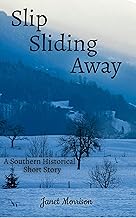
This post is about the ninth story in my historical fiction book, Traveling Through History: A Collection of Historical Short Stories. “Slip Sliding Away: A Southern Appalachian Short Story,” transports the reader to 1875 and an isolated cove in the southern Appalachian Mountains.
I originally wrote this story in the early 2000s. In fact, it was my first historical short story. It has gone through many revisions (and, hopefully, improvements!) since then. It is the story I offer as a free e-download on my website (https://www.janetmorrisonbooks.com) for subscribers to my e-newsletter. If you wish, you may do that to get a free for my fiction writing style.
In “Slip Sliding Away,” Hannah Johnson’s husband, Daniel, has seriously injured himself. A late spring blizzard sets in. Hannah retrieves an envelope of powder from her box of private treasures in the corner cupboard. She adds small amounts of the powder to her suffering husband’s tea as the night passes and she has no way to call for help.
Is she using the precious powder to ease his pain?
And what part does Daniel’s brother, James, play in this story? In fact, all of Daniel’s brothers play a part in this story as it progresses. Therein lies some humor in this otherwise serious subject matter.
You will have to read the story to find out about the powder and Daniel’s ragtag brothers.
How to get a copy of “Slip Sliding Away”
“Slip Sliding Away” is available as a standalone short story on Amazon. It is available in paperback and e-book on Amazon.
“Slip Sliding Away,” by Janet Morrison
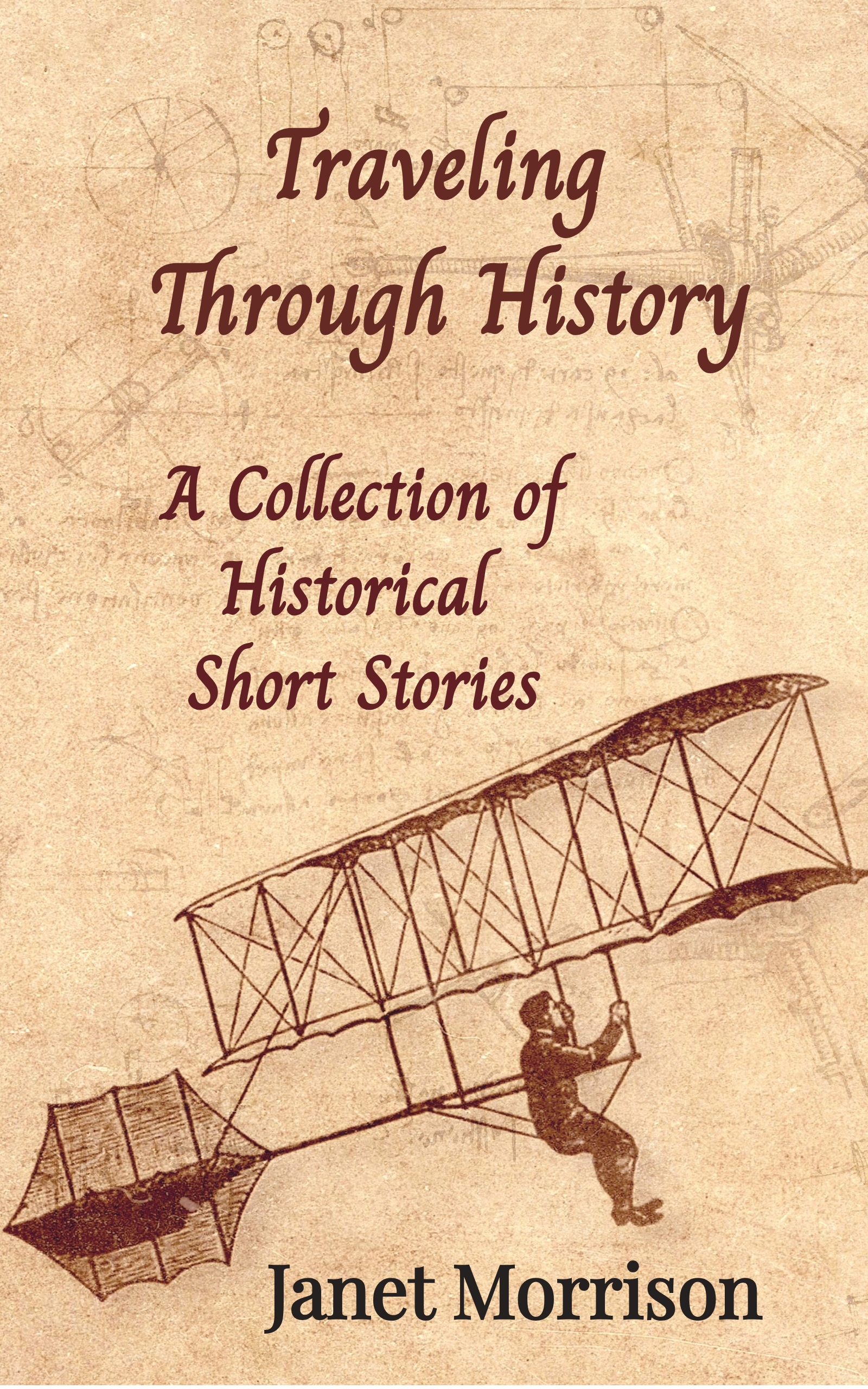
Of course, I would be thrilled for you to purchase my book, Traveling Through History: A Collection of Historical Short Stories. “Slip Sliding Away: A Southern Appalachian Short Story” is one of more than a dozen stories in the book.
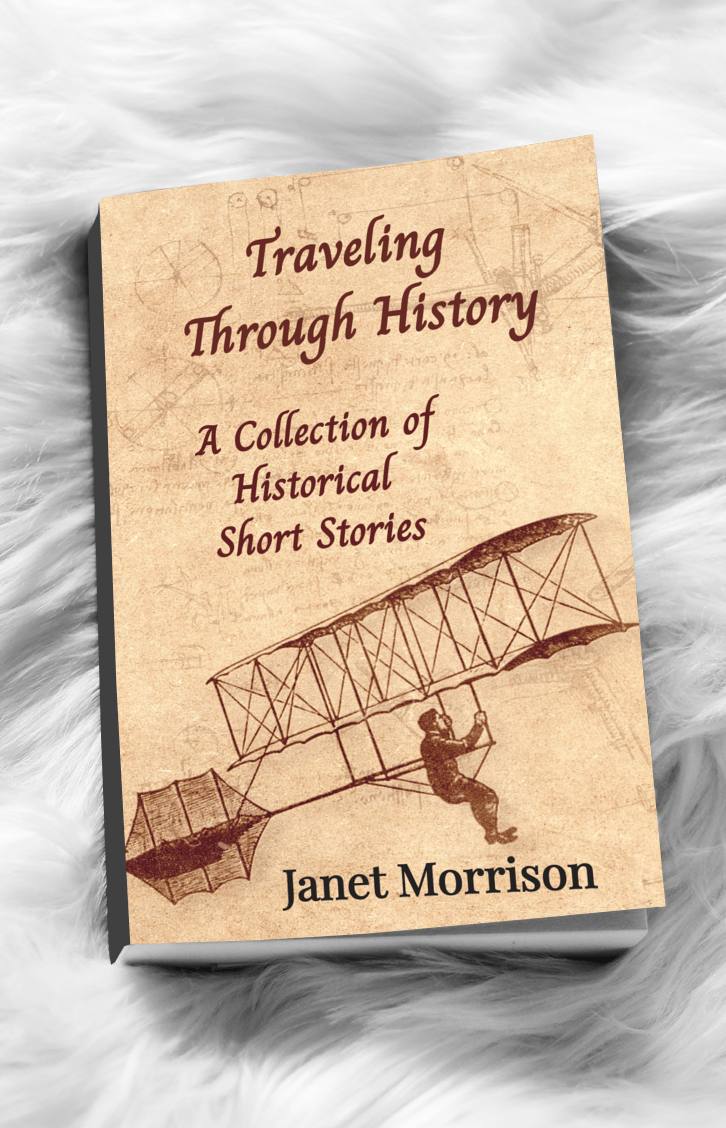
Traveling Through History: A Collection of Historical Short Stories, by Janet Morrison
It is available in Harrisburg, North Carolina at Second Look Books, or you can order it from any independent bookstore in the U.S. by visiting my website (https://janetmorrisonbooks.com) and clicking on the Bookshop.org button. (Full disclosure, as an affiliate of Bookshop.org, I will receive a commission from any books you order through Bookshop.org by going through my website.)
If you enjoy my books, please leave a brief review on such online sites as Amazon and Goodreads.
Janet
The government should be afraid of its citizens, not the other way around.
As I write this on the night of January 20, 2026, Trump is on his way to the World Economic Forum in Davos, Switzerland. (In fact, news came in as I wrote this that Air Force One had been turned around due to an electrical problem. Trump will be moved to a back-up plane.)
This gathering includes many NATO countries – the very NATO countries he threatened with tariffs this week. He will, no doubt, attempt to dazzle them with his perception of the current economy of the United States. Those of us who live here, know better. The picture he painted today in his news conference was far-removed from reality. He will embarrass us in Davos. He would embarrass himself, but that is not possible.
The next couple of days will not go well. Trump never comes across as Presidential here at home or on the world stage. Will he further insult our allies at this forum? Probably. That’s all he knows to do. At the very least, he will probably make fun of French President Emmanuel Macron’s eye condition. Trump has a record of belittling people with medical problems.
In today’s news conference, he finally feigned regret that an ICE agent shot and killed Renee Nicole Good in Minneapolis. Did you hear why he pretended regret today? Because someone told him that Ms. Good’s father was a Trump supporter.
I cannot remain silent as I see my government attack the least of these among us. As a Christian, it is my responsibility to speak up for the people who have no voice or whose voices are being ignored. As the President claims ICE agents are only going after “the worst of the worst,” my eyes and ears know better.
American citizens are being accosted and detained. One has already been killed on a street in Minneapolis. My government has not come after me yet, but if I wait until it does, there will be no one left to speak up for me.
Without further adieu, here is my planned blog post for today
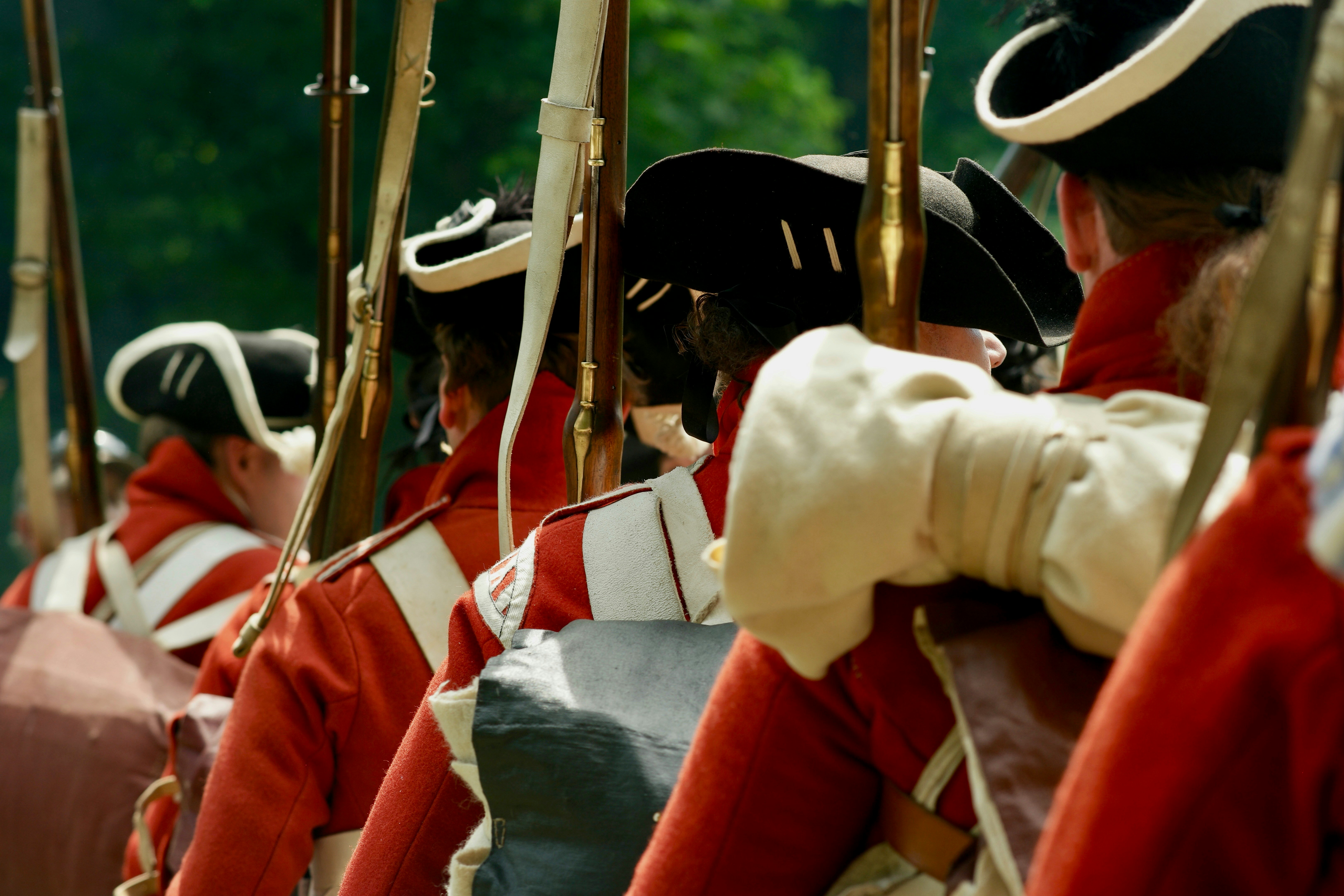
Today’s post is about the eighth story in my short story book. “A Letter from Sharpsburg,” is a fictitious letter from an imaginary Confederate soldier who had fought in the Battle of Sharpsburg in Maryland during the American Civil War.
Photo by John Kostyk on Unsplash
As I explain in the book, it was general practice for the Union to name battles in the Civil War for a nearby physical feature, such as a creek. It was the practice of the Confederacy to name battles for the nearest town. This has led to confusion for more than 160 years.
This battle took place along Antietam Creek, near the town of Sharpsburg. Therefore, the Union called it the Battle of Antietam and the South called it the Battle of Sharpsburg.
Another example is the First and Second Battles of Bull Run (Union name) being called the First and Second Battles of Manasses in the South. It seems to me that we studied the Civil War almost every year in elementary school, but I don’t recall ever being told how or why the North and the South had different names for the same battles. Knowing the reason behind this practice would have been helpful.
I patterned this fictitious letter after letters one of my great-grandfathers wrote to his parents and sister during the Civil War. It was common in that day for a soldier to begin a letter with the words, “I seat myself and take pen in hand to write you a few lines.”
I chose this battle because more Americans were killed on the battlefield that day than on any other day in American military history. It is said that 2,100 Union soldiers and 1,550 Confederate soldiers lost their lives on September 17, 1862 near Sharpsburg, Maryland. Nearly 10,000 Union soldiers were wounded and more than 7,700 Confederate soldiers were wounded there that day.
In my book, I included author’s notes, questions for consideration, and a bibliography of the sources I used in writing “A Letter from Sharpsburg.”
You can find the paperback at Second Look Books in Harrisburg, NC, or ask for it at your local independent bookstore. Bookstores can order it from IngramSpark. It is supposed to be available at Barnes & Noble, but I’ve been told it is not necessarily in stock in the brick-and-mortar stores.
If you purchase my book and enjoy it, please give it a rating on Amazon and write a brief review of it for that site or Goodreads.com. Also, recommend it to your friends!
Word of mouth publicity is the best! Thank you!
Keeping me honest
My readers continue to try to keep me honest, which is my goal as a writer of historical fiction. Facts matter to me. Facts form the basis for my writing.
I mentioned in an earlier blog post that it had been brought to my attention that I have the wrong date in my book for the Battle of Kings Mountain. Yesterday, a friend clued me in that in “Ghost of the Battle of Guilford Courthouse: An American Revolutionary War Ghost Story,” I have someone calling 911 to report an incident to the police in 1963.
Unfortunately, 911 emergency service did not come into being until 1968. In my flimsy defense, I will point out that I originally had the story set in 1973. When I changed it to 1963, I failed to catch my 911 error.
I appreciate my historical errors being brought to my attention. This will help keep me on my toes as I write my novel. If you find another historical error in my book, please let me know.
Janet
The government should be afraid of its citizens, not the other way around.
Once-a-week since November 25, 2025, I have blogged about a different story in my new book, Traveling Through History: A Collection of Historical Short Stories. Today’s post is about the seventh story in the book in which my great-great-great-great-grandfather, John Calvin McElwee, tells his granddaughter (my great-great-grandmother) about his experience the day that the Revolutionary War came to his family’s doorstep.
The Battle of Kings Mountain took place near the border of North and South Carolina on October 7, 1780. Hearing the first shots of the battle fired, John, his father, and one of his brothers ran from their house to join the battle. John was just 15 years old.
John, his brother, and their father are not listed in all accounts of the Battle of Kings Mountain, since they were not members of an organized military company that took part in the battle; however, they are mentioned in various publications.
It was fun to imagine my great-great-grandmother as a little girl sitting on her grandfather’s lap as he told her about his work as a weaver and what happened the day of the battle.
The McElwee’s house was on land that became part of Kings Mountain National Military Park and, therefore, the U.S. Department of the Interior had a draftsman measure and draw the house in detail. Having that information made the house come alive for me and made it easy for me to visualize how the family lived. Unfortunately, the house was demolished around 1934 when the land was acquired by the U.S. Government for the park.
How fortunate I am to have access to drawings and floor plans for my McElwee ancestors’ house from the mid-1700s!
This story is more creative nonfiction than short story. I could have created conflict within the family to make it more of a historical short story, but I chose not to embellish the facts of the family in that way. I hope you will enjoy it anyway.
You can find the paperback at Second Look Books in Harrisburg, NC, or ask for it at your local independent bookstore. Bookstores can order it from IngramSpark.
If you purchase my book and enjoy it, please give it a rating on Amazon and write a brief review of it for that site or Goodreads.com. Also, recommend it to your friends!
Word of mouth publicity is the best! Thank you!
Hurricane Helene Recovery Update
As of January 2, 2026, the North Carolina Department of Transportation has reopened 90% of the roads damaged by Hurricane Helene in September 2024. Some 270 bridges and 870 culverts have been repairs or replaced. Twenty-four roads in the state remain closed due to the hurricane and, of course, I-40 in the Pigeon River Gorge near the Tennessee line is still just one lane in each direction and a 35 mile-per-hour speed limit for months, if not years, to come.
The total monetary cost of damages is estimated by the NC Department of Transportation to be $4.9 billion. The State of North Carolina has spent $2.7 billion so far and has been reimbursed $411.46 million by the federal government.
Once-a-week, since November 25, I have blogged about a different story from my new book, Traveling Through History: A Collection of Historical Short Stories.
The sixth story in the book is “Whom Can We Trust? A Mecklenburg Declaration of Independence Short Story.”
Tradition tells us that Archibald and Maggie Sellers McCurdy built their log cabin in what is now Cabarrus County, North Carolina, in 1773. At that time, Cabarrus had not yet been formed out of the eastern part of old Mecklenburg County. Their house was on the National Register of Historic Places until vandals burned it down a few years ago. Sadly, I never did see the house, but I have seen photographs of it and detailed floor plans and exterior drawings have been preserved.
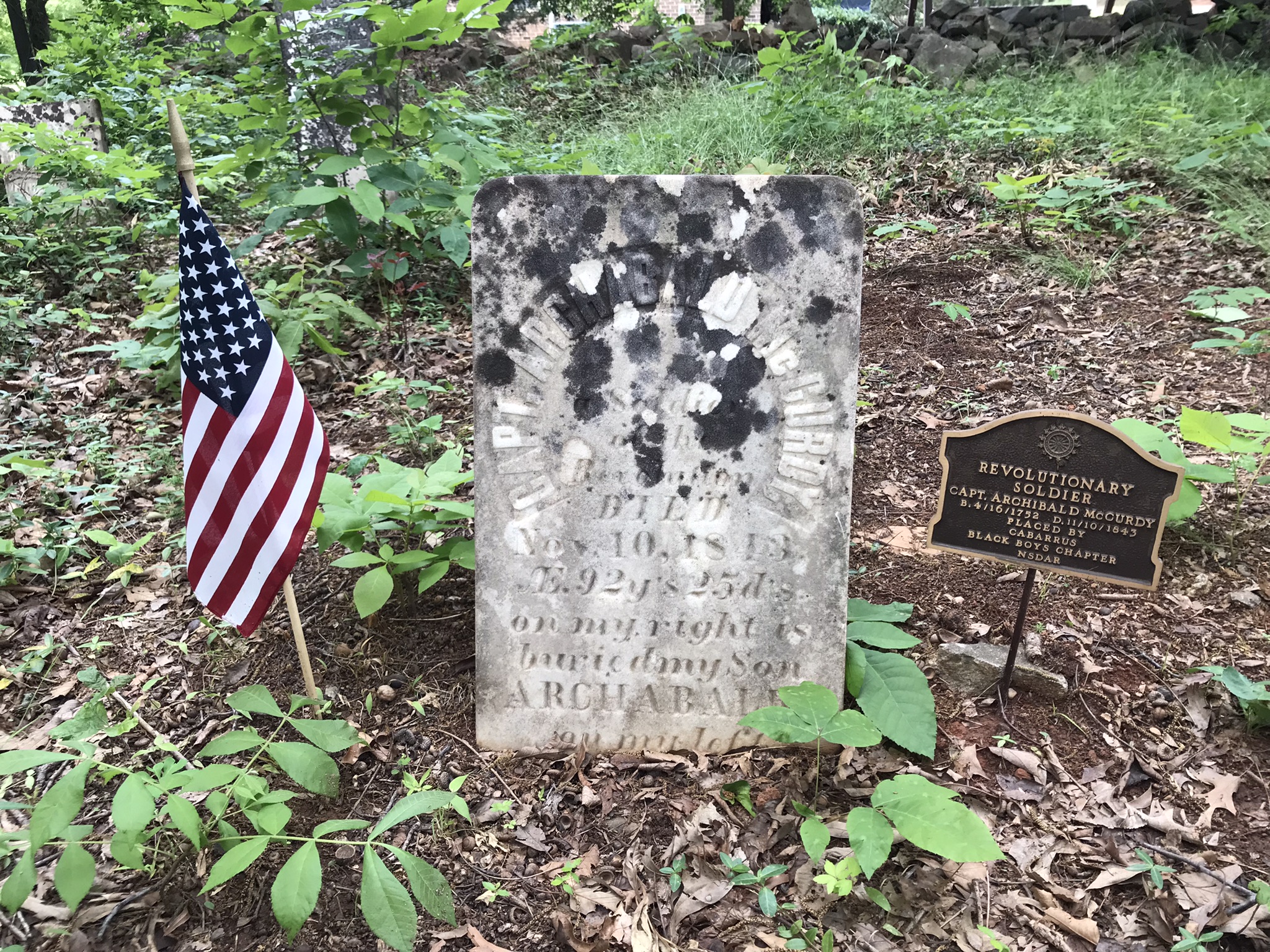
Archibald McCurdy’s gravestone at Spears Graveyard of Rocky Ri er Presbyterian Church, Cabarrus County, North Carolina
Those drawings and photographs made it easy for me to imagine the McCurdys’ lives. Theirs are names I’ve heard all my life. Archibald was a foot solider in the militia during the Revolutionary War. Maggie was a patriot in her own right, as she earned the name “She-Devil” by the British and Tories. I explain a couple of her feats in the Author’s Note at the end of “Whom Can We Trust?”
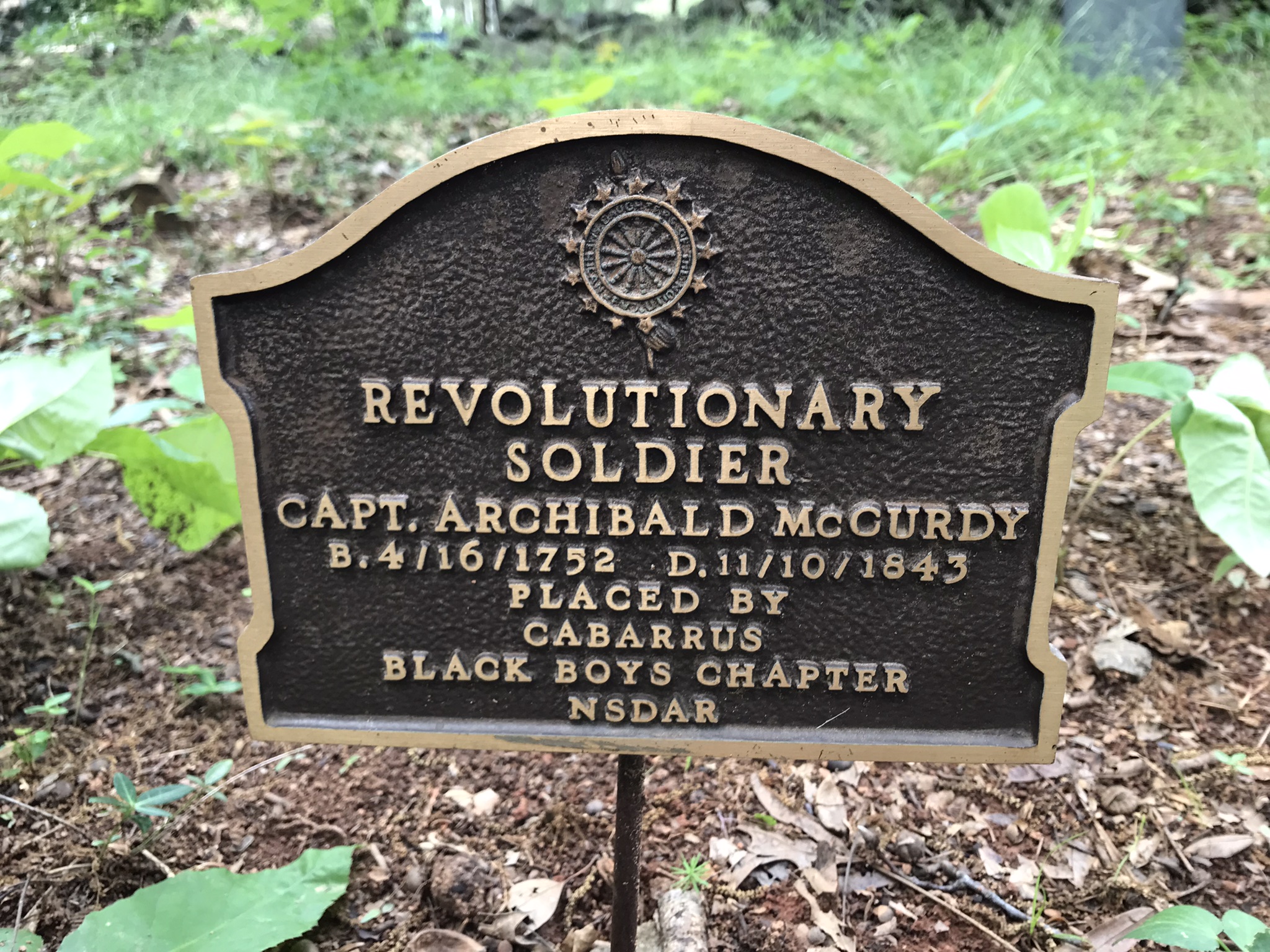
Marker placed at Archibald McCurdy’s grave by the Daughters of the American Revolution
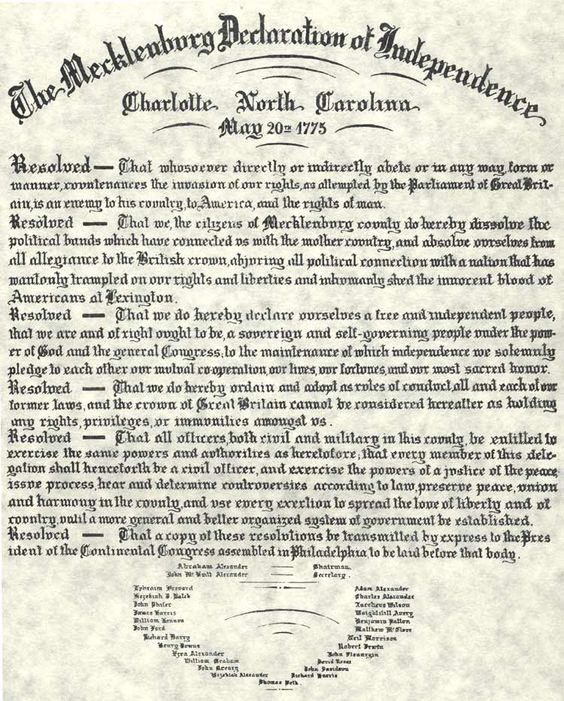
The story is set in May 1775 at the time of the signing of the Mecklenburg Declaration of Independence. I was inspired by a story I’ve heard all my life about what Archibald McCurdy did on the day that document was signed.
You can find the paperback at Second Look Books in Harrisburg, NC, or ask for it at your local independent bookstore. Bookstores can order it from IngramSpark.
Since November 25, I’ve blogged once-a-week about one of the stories in my new book, Traveling Through History: A Collection of Historical Short Stories. The fifth story in the book is “From Scotland to America: A 1762 Immigration Story.”
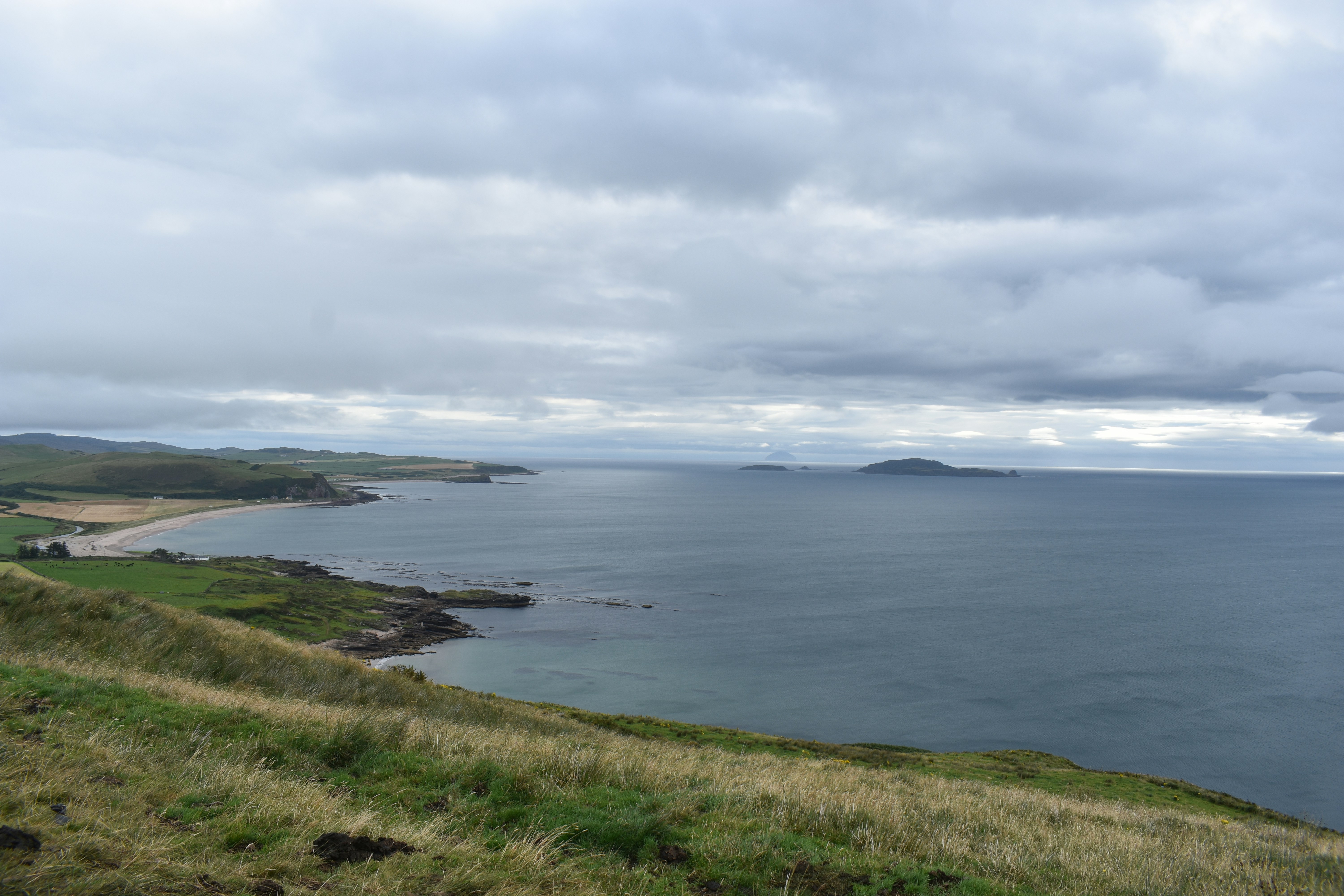
Somewhere on the Kintyre Peninsula of Scotland. Photo by Andrew Hall on Unsplash. (Andrew, we might be cousins!)
I know baptismal dates and marriage dates for my ancestors in Campbeltown and Southend, Scotland, but I don’t know when the three brothers set sail to America. I don’t know how long they lived in Pennsylvania before taking the Great Wagon Road south to the Rocky River Community in present-day Cabarrus County, North Carolina, but I had fun imagining their journey for this short story.
I’m privileged to live on a little piece of land that has passed down through seven generations to my sister and me from the 1760s. We’ve been to Scotland and visited the farms where they were tenants of the Duke of Argyll in the late 1600s and early 1700s. I feel a bond with them. Writing “From Scotland to America” was one small way for me to pay homage to them. I grew closer to them as I pondered their lives, what they saw, what they did, how they must have marveled at “the New World” and how they must have missed their homeland and living by the sea.
This story is entirely fiction except for their names, where they lived in Scotland, and from whom my great-great-great-great-grandfather purchased his first piece of land in North Carolina.
The three brothers came from a place where no common people owned their own land, so it must have been an unimaginable accomplishment to come to America and purchase land. That was something none of their ancestors could have done!
You can find the paperback at Second Look Books in Harrisburg, NC, or ask for it at your local independent bookstore. Bookstores can order it from IngramSpark.
Don’t forget to look for my other books, all available on Amazon: I Need The Light! 26 Weekly Devotionals to Help You Through Winter; I Need The Light! Companion Journal and Diary; The Aunts in the Kitchen: Southern Family Recipes (compiled along with my sister, Marie); Harrisburg, Did You Know? Cabarrus History, Book 1; and Harrisburg, Did You Know? Cabarrus History, Book 2.
The following genealogy books that my sister and I compiled are available through my website (https://www.janetmorrisonbooks.com): Descendants of John & Mary Morrison of Rocky River; Descendants of James & Jennet Morrison of Rocky River; and Descendants of Robert & Sarah Morrison of Rocky River.
By the way, don’t forget the people of Ukraine and their struggle to remain a free and independent nation.
The fictional character I’m introducing to you today is George. He is a slave in South Carolina in the mid-1700s in the third story in Traveling Through History: A Collection of Historical Short Stories, “To Run of Not to Run.”
When you meet George, he is a young boy. He and his father, who was born in Senegal, have just been sold and are being taken from Camden to the Waxhaws.
Photo by Asso Myron on Unsplash
Here’s an excerpt from when George and his father are in the back of a wagon being taken to their new living situation in the Waxhaws:
“George sensed his father was tiring of his questions, so he shut his eyes tight and tried to turn off his mind. But the harder he tried not to think, the more questions flooded his head. The ones that kept crowding out all the others were ones he knew not to ask because he was afraid his papa did not know the answers. When will we see Mama again? When are we going to be free?“
You will follow George as he has a lot to learn and grows up fast. His new master’s son is about his age. Therein forms a dynamic that will ultimately be further developed in the historical novels I am planning and writing.
Remember George. He is a character who grew out of my imagination and has never let me go. I don’t think he will let you forget him either.
Getting into the skin, brain, and soul of a young boy with black skin who is living as a slave in America in the mid-1700s allowed me to stretch my imagination in ways that my other fictional characters did not.
Where to purchase Traveling Through History: A Collection of Historical Short Stories
You can find my new short story collection on Amazon in e-book and paperback. You can find the paperback at Second Look Books in Harrisburg, NC, or ask for it at your local independent bookstore.
Hurricane Helene Recovery Update
I haven’t offered a Hurricane Helene recovery update since my November 3 blog post.
As of Friday, December 5, 25 roads in North Carolina were still closed due to Hurricane Helene’s wind, flooding, and landslides on September 26, 2024. That is a decrease of six roads since a month ago. There are three U.S. highways, two State highways, and 20 state roads closed more than 14 months after the hurricane.
In Tennessee… as of Tuesday, December 2, U.S. 321in Elk Mills, in the Watauga Lake area, is officially reopened since being heavily damaged by the hurricane.
Sections of the Blue Ridge Parkway in North Carolina will remain closed until at least next fall, and I-40 at the Tennessee line will continue to be just two lanes at 35 miles-per-hour for a couple more years while five miles of the highway are being rebuilt in the Pigeon River Gorge.
The following success story was cut and pasted from a U.S. Forest Service – National Forests in North Carolina Facebook post on December 3, 2025: “Two decades ago, after Hurricane Frances and Ivan, our ecosystems team saw how erosion could unravel an entire ecosystem. Brady Dodd, hydrologist for the National Forests in North Carolina, developed and executed a plan to reshape eroded riverbanks, plant riparian flood resistant species and add erosion prevention structures. After Helene arrived, the banks held, and the water ran clear due to the work that had been done years prior. This story serves as a model to our forests as we continue to build resilience into each of our Helene recovery projects.”
We’ve gone from fall leaf season to snow ski season in western North Carolina since my last update. Be aware that you might run into a detour, and you can’t drive the full length of the Blue Ridge Parkway.
If you visit, please drop by Blue Ridge Books in Waynesville and Highland Books in Brevard. Tell them I sent you. They sell my books!
Francisco Bravo Cabrera graciously featured me and my new book, Traveling Through History: A Collection of Historical Short Stories on his e-zine in Spain (LatinosUSA (English Edition/Masticadores) this morning at 8:00 a.m. Madrid Time!
Francisco Bravo Cabrera is a bit of a Renaissance man. He is an artist, a poet, a writer, and a musician. He is based in Valencia, Spain, but has also lived in Miami, Florida. His blog, JaZzArt en Valencia, can be found at https://paintinginvalencia.com/, and his work can also be found on https://www.fineartamerica.com.
I cut and pasted Francisco’s magazine article about my new book below, but two of the photographs did not copy. Here’s the link, if you want to see the original for yourself: https://latinosenglishedition.wordpress.com/?p=8436.
New Historical Fiction by Janet Morrison (Editor Francisco Bravo Cabrera)
(Photo: Janet Morrison/provided by Janet Morrison)
As a big fan of history and novels, there is no genre that fascinates me more than «historical fiction,» therefore I would like to feature today a historical fiction writer from North Carolina (US), Janet Morrison, who has just released a new book, Traveling Through History: A Collection of Historical Short Stories. I am sure it can easily be found in Amazon or in your neighbourhood book store.
I have asked Janet to bring us a synopsis of the 13 stories included in the book. And although she thought it a bit tricky, I think she has covered them in a concise way.
Traveling Through History: A Collection of Historical Short Stories, by Janet Morrison, will transport you from 17th century Scotland to 20th century America! The more than one dozen short stories are set in Scotland, Pennsylvania, Maryland, Virginia, North Carolina, and South Carolina.
Each story includes author’s notes, so you will learn what inspired the story, how the story is based in history but is a work of fiction.
There are stories set in Colonial America and the American Revolutionary War Era. One story is the fictitious letter an American Civil War soldier wrote to his parents. Another story follows a slave who contemplates escaping. A couple of the stories are set in the southern Appalachian Mountains – one during a blizzard in the 1870s and involves a dog and a bear during The Great Depression. There is one ghost story. In another story, a girl in foster care discovers the dignity a suitcase can bring. The final story in the book is told by an old farmhouse that remembers the family it sheltered in the 1800s.
+++
Janet Morrison’s educational background is in political science and history. She has worked as a local government administrator, a travel agent, and a newspaper columnist. She enjoys writing historical fiction and local history at her home in North Carolina. Her vintage postcard book, The Blue Ridge Mountains of North Carolina was published in 2015. Since then, she has published two local history books, a devotional book, and a cookbook. Janet uses her blog, https://www.janetswritingblog. com, as a platform to write about the books she reads, events in history, and politics. The most rewarding thing about her blog is that it has made it possible for her to make friends around the world. When she has spare time, she loves researching her genealogy and learning to play the dulcimer. Be sure to visit https://www. janetmorrisonbooks.com to learn more about her books and to subscribe to her newsletter.
+++++
I would like to thank Janet so much for her participation in today’s episode and to remind her that she is welcome here any time. I am sure that we will all enjoy reading this historical fiction book as well as the other books she has written.
AND
If you are a writer, a poet or an artist (in any of the arts) and would like to appear in our magazine LatinosUSA (English Edition), please contact me, Francisco Bravo Cabrera, editor: ArribaPamplona@gmail.com
Today I am introducing you to the main character in “You Couldn’t Help But Like Bob,” the second story in my new book, Traveling Through History: A Collection of Historical Short Stories.
Genealogy has been a hobby of mine since I was a young adult. Robert Dooling is the most colorful of my ancestors that I have found so far. He immigrated from Ireland to America in the early 1700s and settled in Virginia.
Some people would be embarrassed at discovering one of their great-great-great-great-great-grandfathers was on the wrong side of the law in Colonial Virginia, but that just made Robert Dooling that much more interesting to me. To my way of thinking, that’s a lot better than just knowing an ancestor’s birth and death dates.
I devoured the colonial court records, eagerly searching for every tidbit or reference to Robert. As far as I know, he never did anything too serious. Perhaps his worst offence was “abusing” a Justice of the Peace. (I’m not clear on what constituted “abusing” a Justice of the Peace in Tappahannock, Virginia in the early 18th century.
I had fun creating a fictional story about this man I only know on paper, but his blood runs through my veins and I’m grateful to know more about him than just his name.
Here are the opening lines in the story:
“You couldn’t help but like Bob. Unless he owed you money. Unless you were a Justice of the Peace in Essex County, Virginia in the early 1700s.
“Even so, you just couldn’t help but like Bob.
“To say Bob was irritating would be an understatement, but you couldn’t stay made at him for long. Unless he owned you money or tobacco. Unless you were a Justice of the Peace, tired of seeing him dragged into your court room.”
I hope you will enjoy reading the story as much as I enjoyed writing it.
After you read “You Couldn’t Help But Like Bob” in Traveling Through History: A Collection of Historical Short Stories, you’ll know more about him. I hope you will like him, too!