I write southern historical fiction, local history, and I've written a devotional book. The two novels I'm writing are set in Virginia and the Carolinas in the 1760s. My weekly blog started out to follow my journey as a writer and a reader, but in 2025 it has been greatly expanded to include current events and politics in the United States as I see our democracy under attack from within. The political science major in me cannot sit idly by and remain silent.
Although I usually blog on Mondays, due to a live-streamed event I will tell you about in a few paragraphs, I am publishing this week’s blog today.
The Edmund Fitzgerald
I have always loved a variety of music, but one of my favorite genres is ballads. When I think of ballads, the first one that comes to mind is “The Wreck of the Edmund Fitzgerald” which was given to us so beautifully by the late Gordon Lightfoot.
Yesterday marked the 49th anniversary of the loss of that ship on Lake Superior. I have never seen Lake Superior, so it is difficult for me to grasp its size. When measured by surface area, it is the largest freshwater lake in the world. By volume, it ranks third in the world. Its surface area is comparable to that of Austria or the State of South Carolina. Whoa!
Now that I have a better understanding of the size of Lake Superior…
The 729-foot Edmund Fitzgerald sailed from Superior, Wisconsin, headed for Detroit, Michigan. It carried 26,116 tons of taconite pellets to supply steel mills.
On November 10, 1975, the ship was driven 530 feet to the bottom of Lake Superior by 90 mile-per-hour winds and 30-foot seas. All 29 crew members perished.
The ship’s 200-pound bronze bell was retrieved on July 4, 1995. It holds a place of honor in the Great Lakes Shipwrecks Museum – Whitefish Point, Paradise, Michigan.
Why I chose to post this today
The Great Lakes Shipwrecks Museum holds a ceremony annually on November 10 to honor the memory of the 29 men who perished in the sinking of the Edmund Fitzgerald. The ceremony today is not open to the public; however, it will be live streamed at 7:00 p.m. EST on Facebook Live and YouTube. For links to those venues, visit https://shipwreckmuseum.com/edmund-fitzgerald/.
That website includes a beautiful photograph of the ship, but I did not have permission to include it in this blog post.
Hurricane Helene Update on Western North Carolina
I live 100 miles east of the hardest hit areas, but as a North Carolinian I feel compelled to use my platform to remind the world that western NC is still dealing with Hurricane Helene. Just to give you an idea about the recovery situation 46 days after the storm hit western NC…
Roads: Interstate 40 is still closed near the TN line. As of Friday, of the 1,329 roads that were closed in September due to Hurricane Helene, 293 remain closed and an additional 95 have partial access.
Electricity: Duke Energy and other electric utility companies and co-ops are working diligently to get power restored to the most remote/rugged areas.
Water system in Asheville: The City of Asheville Water Resources serves about 160,000 people in Buncombe and Henderson counties. They are still under a Boil Water order. Water treatment and testing continue daily. Imagine being without potable tap water for drinking, cooking, bathing, washing clothes, etc. since September 26!
Blue Ridge Parkway: An 11-mile stretch of the Blue Ridge Parkway has opened near Asheville after the removal of 350,000 cubic feet of storm debris! Another way of looking at that figure is to imagine almost 150 shipping containers being filled. That section of the parkway goes from the NC Arboretum to the Folk Art Center. Giving the public access to the Folk Art Center is a huge step forward as artisans of numerous crafts from throughout the Appalachian Mountains display and offer their artistry for sale there. If you’re planning a trip, visit https://www.nps.gov/blri/planyourvisit/roadclosures.htm. It is a great source for details of closures from milepost to milepost. As the fall tourist season winds down, there is still no estimated date for all the parkway in NC to be reopened.
Public School Systems: All the affected counties continue to struggle with bus routes due to so many road closures.
Tourism: Towns are opening back up to visitors, but many rural areas are still very much in recovery mode… and will be for months, if not years. Check reliable sources before making travel plans.
Until my next blog post
I hope you have a good book to read.
Value the time you have with friends and family.
If you haven’t subscribed to my newsletter yet, please do by visiting https://www.janetmorrisonbooks.com and clicking on the “Subscribe” button. You will receive a free downloadable copy of my historical short story, “Slip Sliding Away” and my e-newsletter. I’m starting a new, shortened e-newsletter format on Tuesday, November 12. Sign up today so you won’t miss out!
Remember the people of Ukraine; western NC; Valencia, Spain; and all the areas affected by the numerous wildfires in the United States.
Lots of Americans have Statue of Liberty stories. It was a welcome sight for many immigrants coming into the port at New York City. It was a welcome sight for one of my first cousins when he came home from serving in the US Army in Europe during World War II. And it was a thrill when I saw it from a Staten Island Ferry back in the mid-1980s.
The statue was being restored and prepared for its centennial when I saw it from afar. It was closed to visitors and completely encased in scaffolding. I could barely tell Lady Liberty was in there, yet it was still a thrill to see this national landmark and prized gift from the people of France.
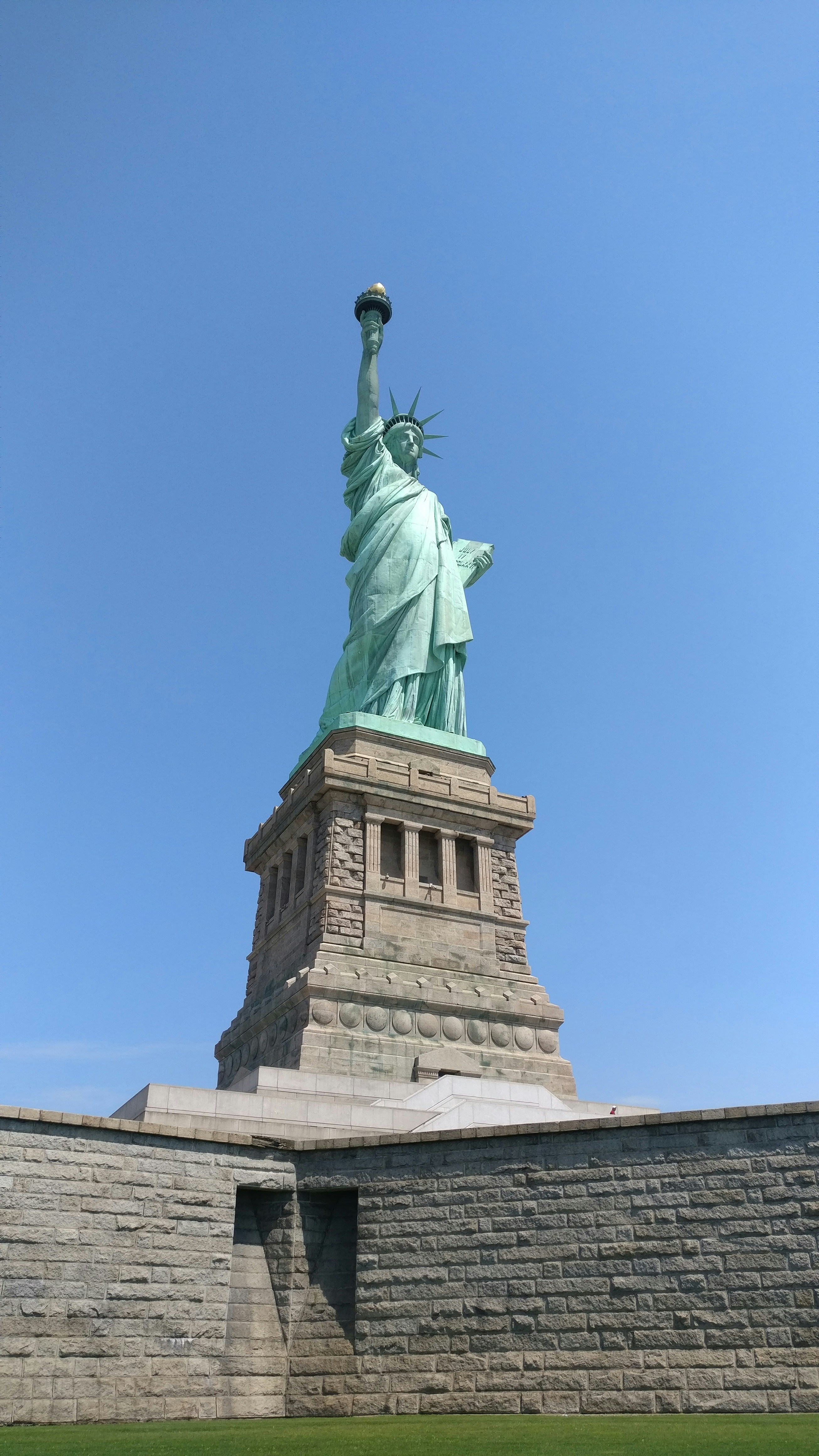
The Statue of Liberty was dedicated by President Grover Cleveland 138 years ago today. Imagine the excitement on that day and the days leading up to the event as people watched the progression of the construction process!
Never having seen it close up, it’s difficult for me to grasp the size of the 151-foot- tall statue. I read that the American people paid for the granite foundation and pedestal, while the people of France paid for the statue itself.
Photo by Vinayak Sharma on Unsplash
The statue was sculpted by a Frenchman, Frederic Auguste Bartholdi, who consulted with Gustave Eiffel about structural issues.
In doing research for this blog post I also learned that William Tecumseh Sherman of American Civil War fame (though more infamous here in The South!) selected the site for the statue.
The statue is made of copper sheeting over an iron framework. The flame of the torch held by Lady Liberty is coated in gold leaf. The seven spikes on her crown represent the seven seas and seven continents. The tablet she holds represents knowledge and is inscribed with the date of our country’s Declaration of Independence.
The Statue of Liberty is an international symbol of liberty and the freedoms we enjoy as citizens of the United States of America.
Hurricane Helene Update on Western North Carolina
I hoped today’s update would be shorter than the previous ones I’ve given, but there is a lot to report. If your time and interest are limited, please take advantage of the headings in bold print. Much of today’s update is positive, while some of it is daunting.
Governor Roy Cooper announced that first responders and others have come from 39 states to help with rescue and recovery efforts in western NC! Thank you to each of you!
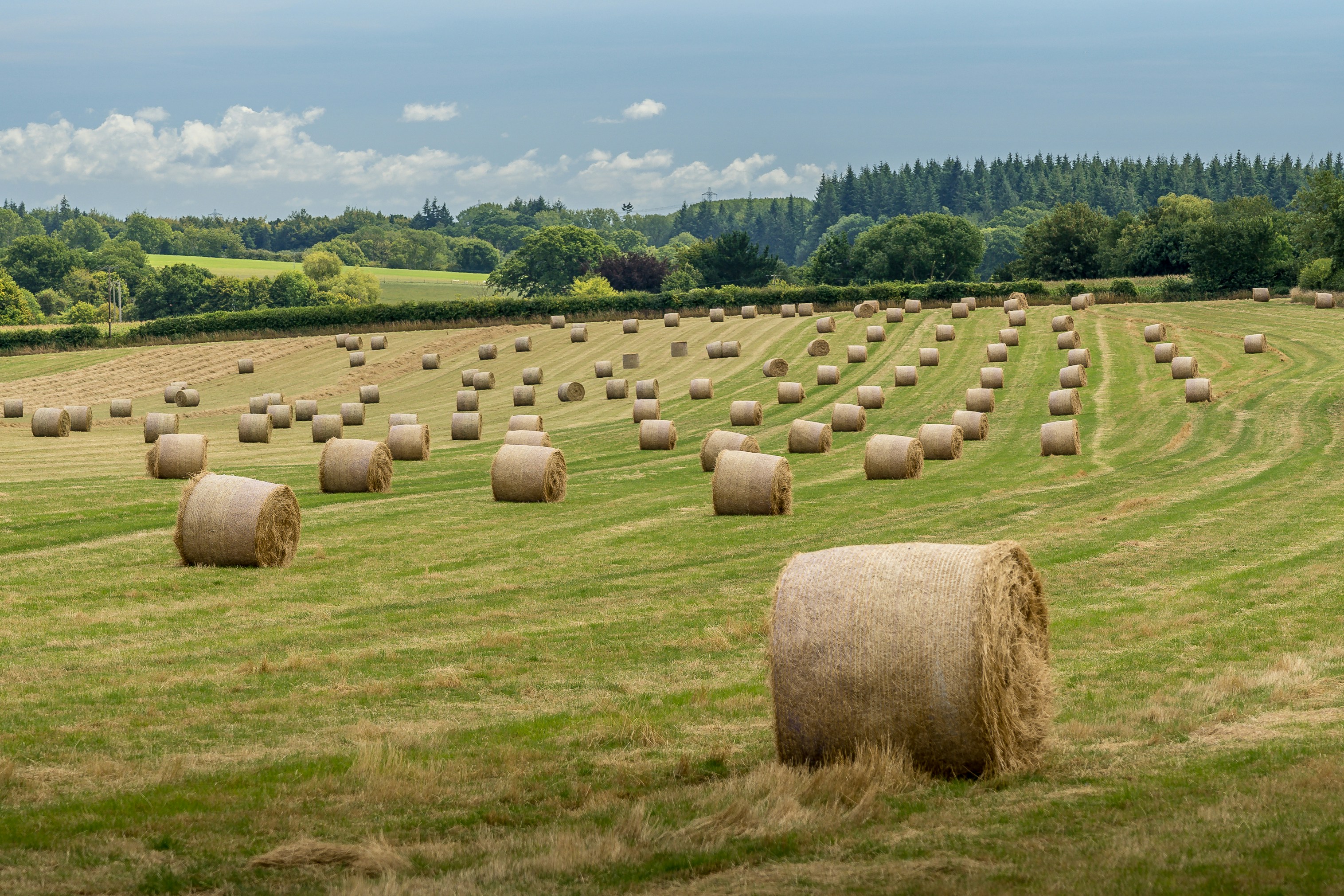
Hay bales: Last week I reported on hay bales coming from farmers in Ohio and Pennsylvania. Add Kentucky to that list… and no doubt other states I just didn’t hear about. I read a report online from the newspaper in Boone that more than 50 tractor trailer loads of hay bales came to Watauga County from Ohio! They also brought feed for various farm animals, tarps, baby supplies, and posts and barbed wire for fencing.
Photo by Nick Fewings on Unsplash
I read a report from Haywood County, about 100 miles south of Watauga, on smokymountainnews.com,. That county’s Agricultural Extension Office knew hay was coming and worked out the logistics of storage and distribution. The agent there said some farmers lost more than 300 bales in the flood.
Farmers helping farmers…. It’s what they do!
Precision Grading: I’ve been following a small grading company, Precision Grading, in Saluda, NC on Facebook, and I’m just blown away by what this man is doing. He has worked free-of-charge with his bulldozer and backhoe 12 hours a day since the storm to help individuals with debris pickup on their land, cutting new driveways for them, and literally cleaning out the Green River.
If you’ve ever driven I-26 between Asheville, NC and Greenville, SC, you probably remember the section that traverses the Green River Gorge. The bridge is so high, you can’t see the river below. There are runaway truck ramps along the southbound lanes. That area is more isolated than Asheville, Chimney Rock, and Bat Cave, so it is not getting any media attention. This man is not charging anyone for his work, except for the occasional job that insurance is paying for. He says the work is gut wrenching because everything he pulls out of the river was someone’s car, house, or prized possession.
If you would like to support Jake Jarvis’ work, you can send a check to Precision Grading, 99 Polaris Drive, Saluda, NC 28773. He did not want to take donations but finally concluded that donations will enable him to do more work for people in need without charging them. Fuel and maintenance on his heavy equipment is not cheap. I do not know him personally, so do your own research about him.
It is heart-warming, especially in today’s political environment to see that a disaster brings out the best in most people.
Brother Wolf Animal Rescue is still accepting monetary donations to enable the 501(c)3 nonprofit organization to rebuild on higher ground in Asheville. They lost all physical assets in the flood. Here’s the link to their website (https://www.bwar.org/) where you can donate and read about their work. There’s a touching story about Gandolf, a dog rescued from the flood waters.
Statistics: The death toll from Hurricane Helene in NC now stands at 98.
The estimated damage from Hurricane Helene in North Carolina is a staggering $53 billion.
Roads: The storm severely impacted approximately 5,000 miles of state-maintained roads in western North Carolina. Interstates 26 and 40 are still closed near the TN line. A total of 404 roads remain closed.
Electricity: I’ve seen videos online of power poles being brought in by helicopter to places inaccessible by vehicle. One Duke Energy representative said the helicopters make it possible to set a pole in an hour instead of what would be a 10-hour job. The terrain is challenging under the best circumstances, so the helicopters have been a game changer.
Water system in Asheville: My sister learned from a friend there last week that they can flush toilets now, which is a huge milestone for the residents. Here’s the link to an informative briefing by City of Asheville Water Resources on October 25: https://www.youtube.com/watch?v=e6EH3zKjaGE). You’ll learn in this 6.5-minute briefing how the Hurricane Helene flood catastrophe could have been “exponentially worse” if the government had not put in an auxiliary/emergency spillway as a safeguard less than four years ago!
Blue Ridge Parkway: There is no estimated reopening date for the beautiful parkway. Portions of it that are used by residents to get from one side to the other for work or school are receiving top priority in reopening efforts. A 20-mile stretch near Grandfather Mountain opened last Wednesday. The other 250 miles in NC remain closed.
Public School Systems: Just to give you an idea about the recovery situation 32 days after Hurricane Helene hit western NC…
Avery County. Schools are scheduled to reopen on November 6.
Ashe County. Schools are scheduled to reopen on tomorrow.
Buncombe County. Schools reopened on Friday.
Watauga County. Schools reopened on Thursday.
With so many roads still closed, the school systems have had to scramble to work out bus routes and designated pick-up and drop-off locations.
Colleges and universities:
Asheville-Buncombe Technical Community College: Classes resume today because the campus now has power, non-potable water, and internet.
Lees-McRae College in Banner Elk: Classes will be conducted online through November 4.
Warren Wilson College: In-person classes resume today. Still under a boil water order, the college has secured potable water for meal preparation from their food provider.
IV Bag Manufacturer: Through the US Department of Health and Human Services, President Biden invoked the Defense Production Act so Baxter International will have priority access to specific material needed so it can get back to production. One production line is scheduled to start operations this week.
World Central Kitchen (WCK) is still serving the people in western NC and eastern TN. First Lady Dr. Jill Biden volunteered at their walk-up meal, fruit, and water distribution site in Asheville on Friday. According to the WCK website (https://www.worldcentralkitchen.org/en-us/news/jill-biden-visits-wck-asheville-north-carolina) , since the September 25 flood, “With 84 restaurant partners in North Carolina and Tennessee, we’ve served 979,976 meals to date in the southeastern US. Given the ongoing challenges with water access, we’ve also channeled our efforts to distribute more than 768,000 gallons of potable water in North Carolina alone…. In areas like Swannanoa, Hendersonville, Burnsville, Marshall, Yancey County, and more, power and water restoration is slowest, and we expect our support to be needed there for longer.”
Fundraising Concert
Ironically, the “Concert for Carolina” at Bank of America Stadium in Charlotte on Saturday started at 7pm after a two-hour rain and lightning delay… the first rain the area has had since Hurricane Helene in September. I got to watch the live stream and heard/saw portions of it mixed in with a lot of buffering. It was the best concert ever!
Organized by Luke Combs and Eric Church, all artists (including the Avett Brothers, James Taylor, Keith Urban, Sheryl Crow, Billy Strings, Scottie McCreery, Chase Rice, and Parmalee) donated their time and talents so all proceeds and donations could go to help specific organizations in western North Carolina.
The concert raised $24,513,185, included $1 million donated by Dolly Parton. A surprise during the concert was when Nicole Kidman joined her husband on stage and announced that it was his birthday. Then, Eric Church led the 82,000 people in attendance in singing “Happy Birthday to You” to Keith Urban.
Tourism: I found a list online last Thursday of 10 towns in western NC that were still “closed to visitors” and four towns (including Asheville) that were “open with limitations.” Towns are beginning to open back up to visitors, but many rural areas are still very much in recovery mode… and will be for months, if not years. Check reliable sources before making travel plans.
Maybe next Monday’s update will be shorter!
Until my next blog post
Don’t forget to sign up for my e-Newsletter by visiting https://janetmorrisonbooks.com/ and clicking in “Subscribe.” You’ll receive a free downloadable copy of my “Slip Sliding Away” short story. My next e-Newsletter will be sent to you during the first full week of November. Teaser: My “field trip” report this time is Boone’s Cave Park on the Yadkin River.
I hope you have a good book to read. I have several I’m trying to finish by Thursday, so I can blog about them next Monday.
Remember the people of Ukraine and Western North Carolina.
I wish more emphasis had been put on Lewis & Clark’s Corps of Discovery when I was in school. Living in North Carolina, it just wasn’t taught much. I suppose in the Midwest and Great Plains states it was and is taught in detail.
Today marks the 218th anniversary of the conclusion of Meriwether Lewis and William Clark’s grand trek into the great unknown in search of the Northwest Passage.
I learned more about the Lewis & Clark Expedition from watching Ken Burns’ documentary film than I learned in school. Ken Burns has a gift for weaving story, quotes, and geographic images together in a comprehensive telling of particular times or events in American history.
The When and the Why
US President Thomas Jefferson is remembered for his curiosity. Since the 1400s, explorers had dreamed of finding Northwest Passage – a waterway across North America from the Atlantic to the Pacific. President Jefferson wanted the Pacific coast of North America to be found, and he was convinced that a group of explorers would find it if they could just cross the Mississippi River and follow the Missouri River across the lands included in the Louisiana Purchase.
Meriwether Lewis and William Clark led the group that was assembled to explore the region. It was a vast unknown to the European settlers. What the Corps of Discovery did was comparable to the space exploration of our time, except Lewis & Clark did not have computers to guide them. They really didn’t know what the terrain and weather would be like once they ventured very far beyond St. Louis.
In the spring of 1804, at the direction of President Jefferson, this band of intrepid explorers set out on a journey of unknown time and distance. (I guess it is sort of like the two astronauts who are going to be on the International Space Station for eight months instead of the originally planned eight days.)
How does one pack for such an adventure? What thoughts went through their minds as they headed west, not knowing if or when they would see their families again?
The Preparation
For starters, I will point out that the Corps of Discovery was made up of Lewis, Clark, and nearly four dozen men. As I recall, in school we were led to believe that it was just Messrs. Lewis and Clark and that they were joined by a Native American young woman, Sacagawea, somewhere along the way.
They spent the winter of 1803-1804 on the Illinois side of the Mississippi River in a collection of huts they built. It was called Camp Debois. Among the supplies they gathered in preparation for their journey were nearly two tons of flour, nearly two tons of salt pork, 50 pounds of coffee, and 100 gallons of whiskey.
Information was gathered from fur traders, and the men were drilled, for this was comparable to a military mission and a chain of command was integral if the expedition had any chance of being successful.
The How
They started out in a keelboat with two large canoes. Lewis was accompanied by a Newfoundland dog named Seaman who reportedly caught squirrels, beaver, and an antelope. They had been told they would encounter numerous nations of “savages” who would not welcome white men. The message they carried was that all the land within sight in all directions belonged to the United States of America.
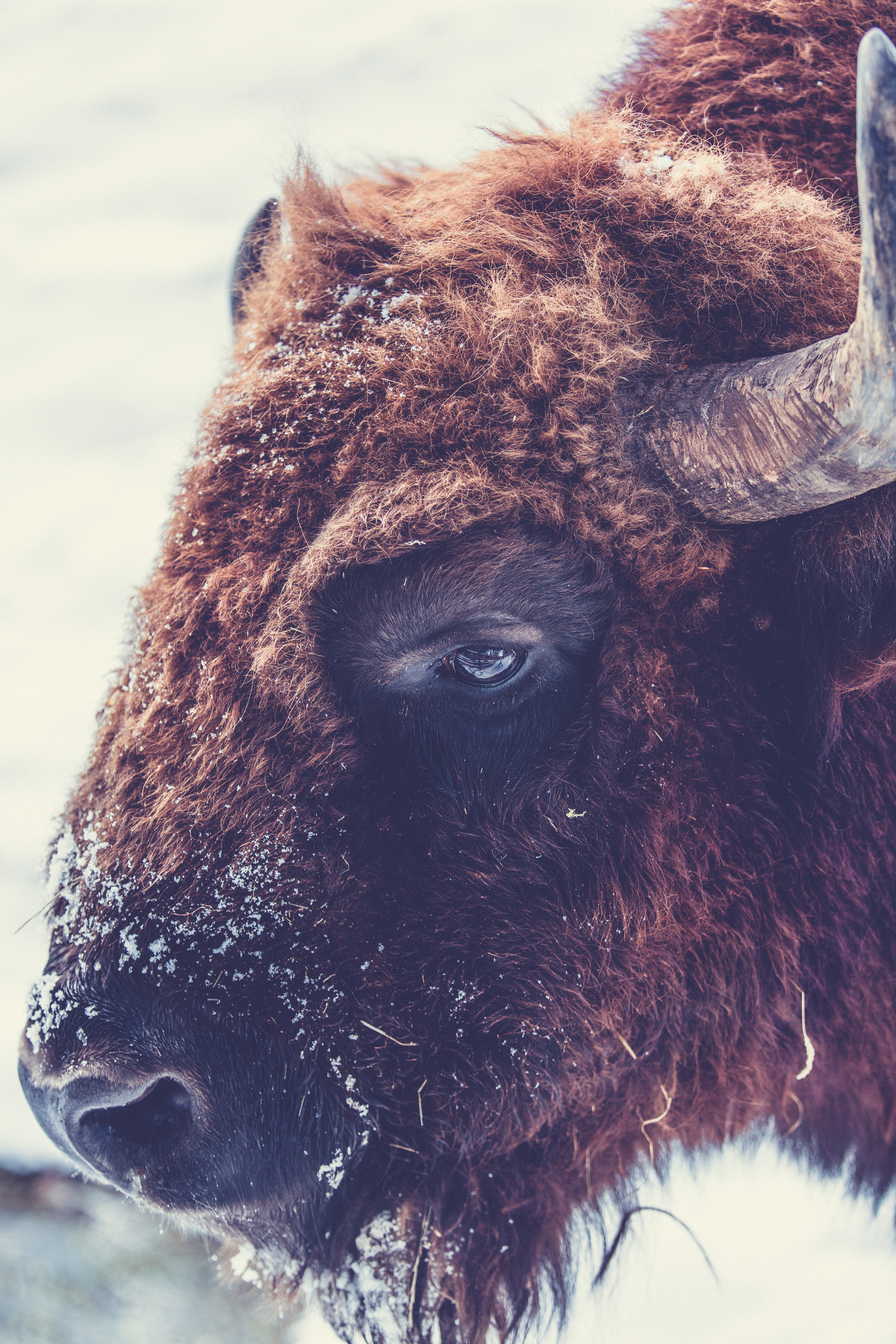
Seaman proved his worth not only as hunting squirrels for the men to eat, but also as a guard dog. There were instances when Seaman scared off an angry buffalo and even kept grisly bears at bay.
On November 15, 1805, Lewis and Clark reached the Pacific Ocean at the mouth of the Columbia River in present-day Washington. That was one year, six months, and one days after they began their journey.
What they did not find
They did not find a waterway connecting the Atlantic and the Pacific.
What they found
Photo by Markus Spiske on Unsplash
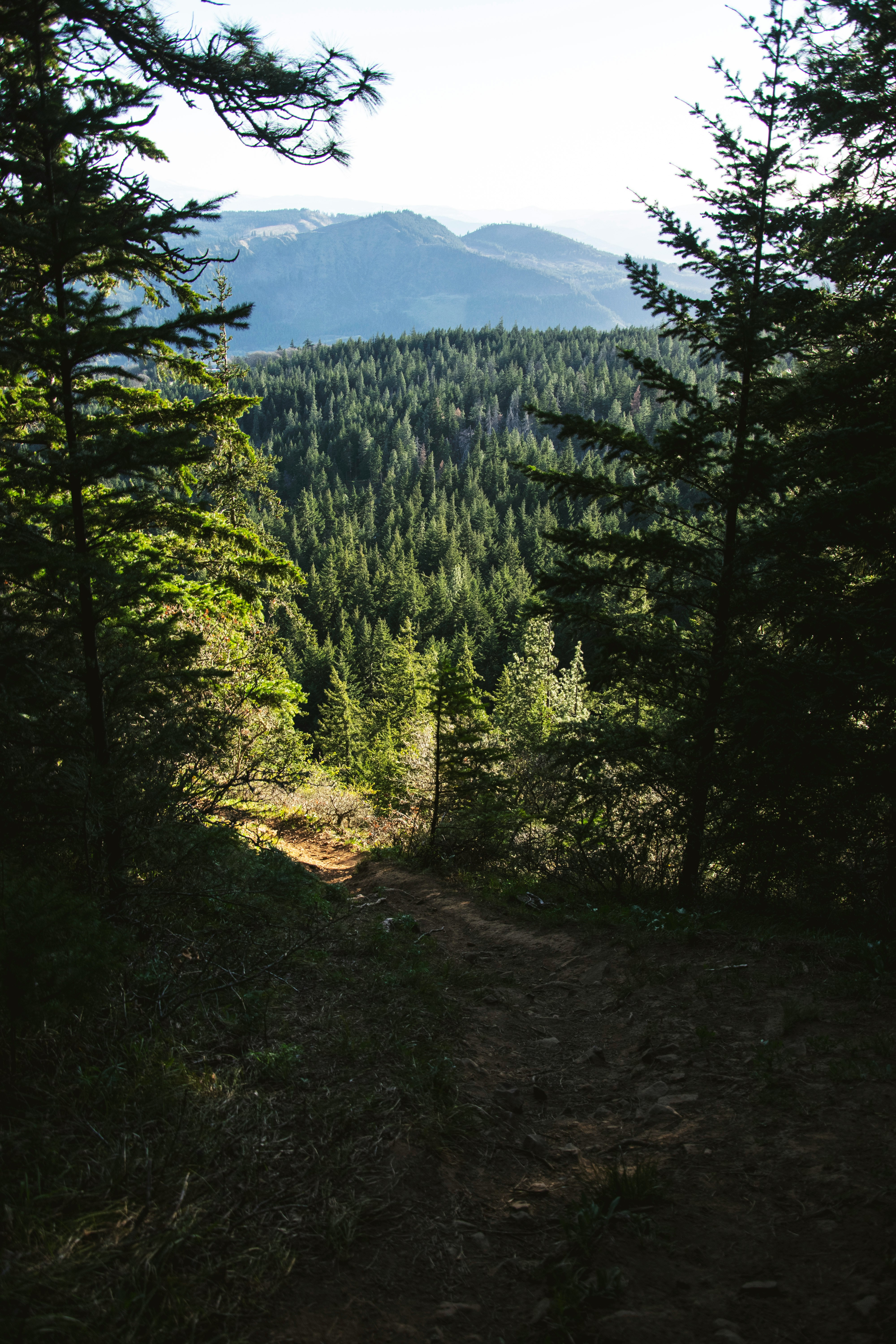
What they found was the Great Plains, the majestic Rocky Mountains, unknown plants and animals, and native peoples who were curious about them and not hostile as had been expected.
Photo by Aida L on Unsplash
They found the kindness of strangers.
Photo by Boston Public Library on Unsplash
They found a native woman named Sacagawea who would guide them and save their very lives.
They found a vast and wondrous land that none of them could have imagined.
The documentation they brought to President Jefferson
President Jefferson sent Lewis & Clark and their crew off with explicit instructions as to record keeping. Jefferson even devised a complicated code matrix they were to use if they needed to try to send secret messages back to Washington.
They were to record in great detail the geography; animals; soil; crops; natural plants; minerals; and human inhabitants and their languages, populations, food, clothing, religions, and their interest in commerce.
Journals were kept, along with meticulous records of what they saw that would be of scientific and future exploration benefit.
The completion of the expedition
The Corps of Discovery returned to St. Louis at noon on September 23, 1806. Lewis immediately wrote a long letter to President Jefferson informing him of their return and that they had indeed reached the Pacific Ocean, although not by water the entire way. Included in the letter was the news that instead of taking half a day to cross the western Continental Divide, it had involved crossing 60 miles of treacherous snow-covered mountains.
Since my last blog post
I had the privilege of telling the 37 members of the Leadership Cabarrus Class of 2025 about the history of Harrisburg last Tuesday. Organized by Rowan-Cabarrus Community College, it was an interesting group of people from various walks of life who are relative newcomers to Cabarrus County. I was allotted 20 minutes to give them the highlights of Harrisburg’s rich history.
I’m not much of a public speaker, but I went through my two local history books, Harrisburg, Did You Know? Cabarrus History, Books 1 and 2 and made notes from some of the highlights I thought would be of interest to the group. It was a congenial group and I enjoyed the experience. It had been a couple of years since I had spoken to a large group of people.
Until my next blog post
As always, I hope you have a good book to read.
Make time for friends and family.
Don’t forget the people of Ukraine, as another harsh winter is approaching.
When I think of the Civil Rights Act, I think of the one in 1964, but it was in 1957 that the first major civil rights bill was passed by Congress since the Reconstruction Era following the American Civil War.
The Civil Rights Act of 1957 went into effect 67 years ago today on September 9, 1957.
Photo by Unseen Histories on Unsplash
What it did, in a nutshell
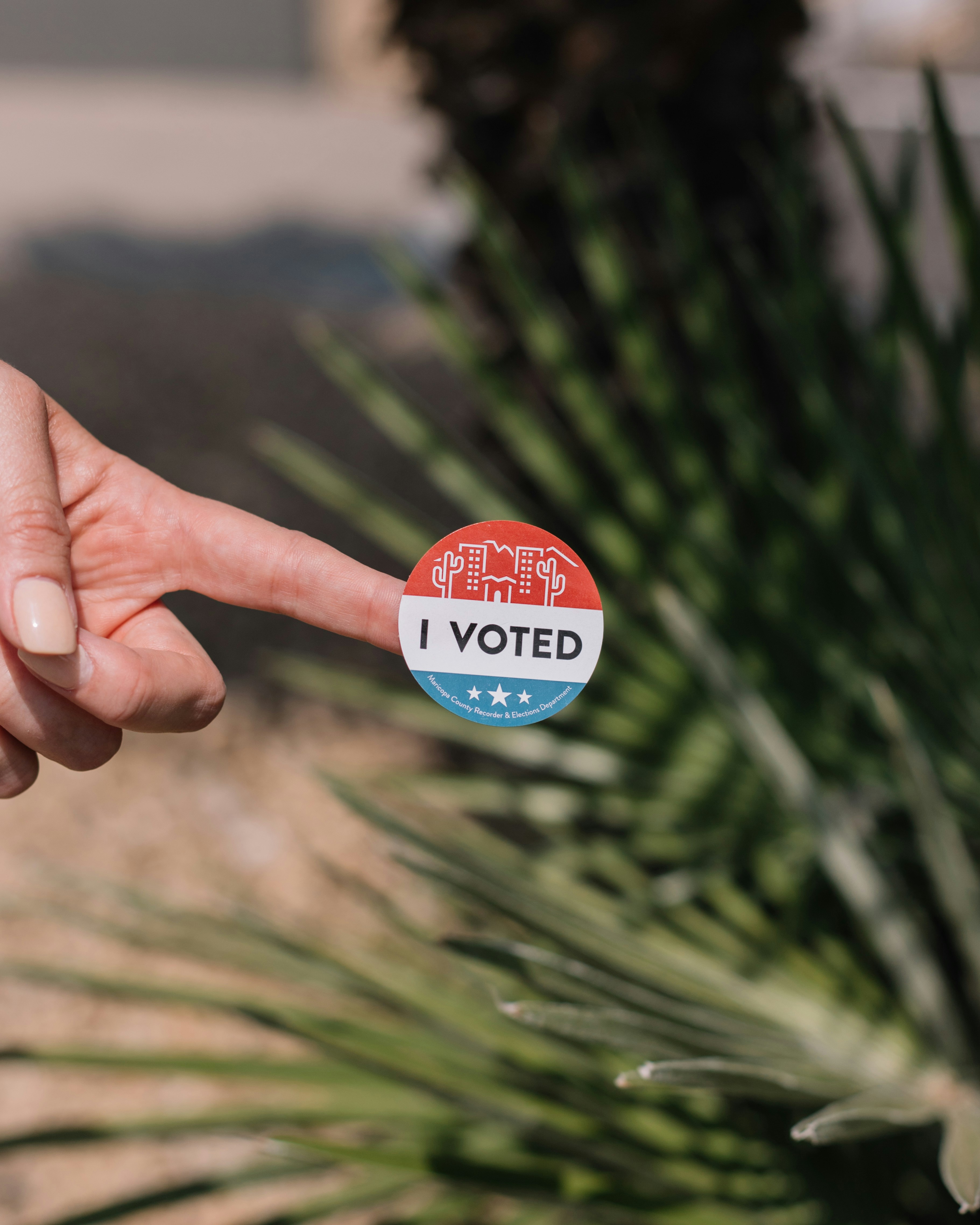
It made it a federal crime to try to prevent someone from voting.
It created the Civil Rights Commission in the Executive Branch of the U.S. Government.
It created the Civil Rights Division of the U.S. Department of Justice.
What led up to this Act
In 1954, the United States Supreme Court ruled in Brown v. Board of Education that racial segregation was illegal in public schools. Change was slow to come.
Nine black students volunteered to desegregate the all-white Central High School in Little Rock, Arkansas. They were met with the National Guard, which had been called out by Governor Orval Faubus, and an angry mob. Two weeks later the nine students, who became known as the Little Rock Nine, tried again to gain entrance to the school. They were able to enter the school but had to be removed for their safety.
U.S. President Dwight D. Eisenhower ordered federal troop to escort the nine students to and from class at the school. The publicity of the troubles at Little Rock helped bring the issue of racial desegregation and voting rights to a head.
President Eisenhower pressured Congress to enact civil rights legislation. The result was the Civil Rights Act of 1957.
The wheels of justice turn slowly
We all know that deep-rooted cultural and racial prejudices are slow to change. It would be the late 1960s before true racial desegregation would be accomplished across the United States. For example, the county in which I live in North Carolina instituted voluntary school desegregation in 1965. The following school year, it was mandatory.
And it was, no doubt, that long before all black citizens felt safe to go their polling places to cast their ballots. I can’t help but think some of them do not yet feel completely safe.
And in 2024, a presidential election year, there are still threats – spoken and unspoken — and insidious state laws making it more difficult for citizens to vote when we should be making it easier. The false accusations of voter fraud have resulted in many state legislatures enacting numerous new restrictions to allegedly fix a problem that does not exist.
The 19th Amendment: The right of citizens of the United States to vote shall not be denied or abridged by the United States or by any State on account of sex.
Congress shall have power to enforce this article by appropriate legislation.
It was 104 years ago today that women in the United States finally got the right to vote. The year 1920 might seem like ancient history to some of you, but I always think of it in terms of my mother having her eighth birthday that autumn.
Early- to mid-1800s
Women getting the right to vote came after a long, hard fight. In the early- and mid-1800s, women advocated for the abolition of slavery. Their speeches evolved into words in support of women’s suffrage. Two such women, Elizabeth Cady Stanton and Lucretia Mott, organized a women’s suffrage convention in Seneca Falls, New York in 1848.
Sojourner Truth and Sarah Redmond, two former slaves – who could not vote because of their race and their gender – organized women’s suffrage conventions. Slowly, it was becoming more of a public issue of discussion.
Post American Civil War/Reconstruction Era
The State of Michigan allowed women to vote in school board elections after the Civil War.
With the passage of Reconstruction Era U.S Constitutional Amendments granting black men the right to vote came contentious political and public discourse because it brought to the forefront that women still could not vote. As a result of their disfavor with women still not being granted the right to vote, Susan B. Anthony and Elizabeth Cady Stanton left the American Equal Rights Association (AERA), which they had founded in 1866, and formed the National Woman Suffrage Association (NWSA) in 1869. Later that year, women who thought it more plausible to push for women’s suffrage by getting it adopted state-by-state formed the American Women Suffrage Association.
The Territory of Wyoming (it was not yet a state) granted women full voting rights in 1869. The Territory of Utah followed Wyoming in 1870, but Congress took that right away in 1887.
Photo by Joshua Sukoff on Unsplash
Virginia Minor of Missouri, after being denied the right to vote in 1872, took her complaint to the U.S. Supreme Court. Minor maintained that the 14th Amendment gave her the right to vote because it stated that “no State shall make or enforce any law which shall abridge the privileges or immunities of citizens of the United States.”
In a classic example of the high court going by the “letter of the law” instead of taking a more pragmatic stance, the Court, in its majority decision in Minor v Happersett, said that the right to vote was not a necessary privilege of citizenship because it was not a right included when the U.S. Constitution was ratified in 1788.
The “bottom line” of this decision was that states did indeed have the authority to deny women the right to vote. Let that sink in for a few minutes.
Late 1800s
In 1878 and again in 1887, there were efforts in Congress to introduce a women’s suffrage amendment, but they failed.
The AERA and NWSA merged in 1890, but some of the leaders worked to exclude black women from participating in events. In 1896, the black women formed the National Association of Colored Women to advocate for women’s voting rights along with other issues that were important to women of color.
Photo by Unseen Histories on Unsplash
In 1896, the Constitution of the State of Utah once again gave female citizens the right to vote.
1910s
By 1916, 11 western states had granted women the right to vote, but petitions to Congress and litigation in federal courts repeatedly came up short. In the election in Montana that year, Jeannette Rankin was elected to Congress. She was the first women elected to the U.S. House of Representatives.
The joint resolution to propose a women’s suffrage amendment (See the 1878 and 1887 references above) was reintroduced in the U.S. House of Representatives in 1917 – thirty years after it had last been shot down. Proponents of states’ rights argued that the passage of such an Amendment would interfere with each state’s authority to dictate the composition of its electorate and that it would also disrupt the traditional family. Some lawmakers opposed it because they feared it would give black women the right to vote.
(Does anything about the states’ rights argument sound familiar? The current U.S. Supreme Court in 2023 conveniently decided to give states the authority to pass laws about women’s health.)
Photo by Library of Congress on Unsplash
The opposition was narrowly defeated as a two-thirds majority voted to pass the proposed Amendment on January 10, 1918. The Senate debated the joint resolution for months with many of the same arguments that had been overcome in the House. President Woodrow Wilson spoke in favor of the Amendment on October 31, 1918, citing the contributions women had made on the home front during World War I.
The following day, the resolution was defeated in the Senate. It failed again in the Senate on February 10, 1919. But President Wilson called a special session of Congress in May 1919. The House passed the 19th Amendment on May 21, 1919, and it was approved by the Senate on June 4, 1919.
During World War I, some of the views of gender roles in the country began to change as women took on many of the jobs that had earlier been considered men’s work. The 19th Amendment was proposed in Congress in June 1919.
August 26, 1920
It took 14 months for a three-fourths majority of states to accept the 19th Amendment. It was ratified on August 18, 1920 and on August 26, 1920, U.S. Secretary of State Bainbridge Colby certified that the Amendment had been ratified.
Photo by Element5 Digital on Unsplash
Obstacles such as poll taxes and literacy tests continued to prevent many black women and other females of color from voting until the 24th Amendment was ratified in 1964 and enforced by the Voting Rights Act in 1965.
Since my last blog post
I’ve been reading several books, pushing myself to do some yard work, and watching some online videos about the craft of writing. I’m motivated to get back to work on my novel!
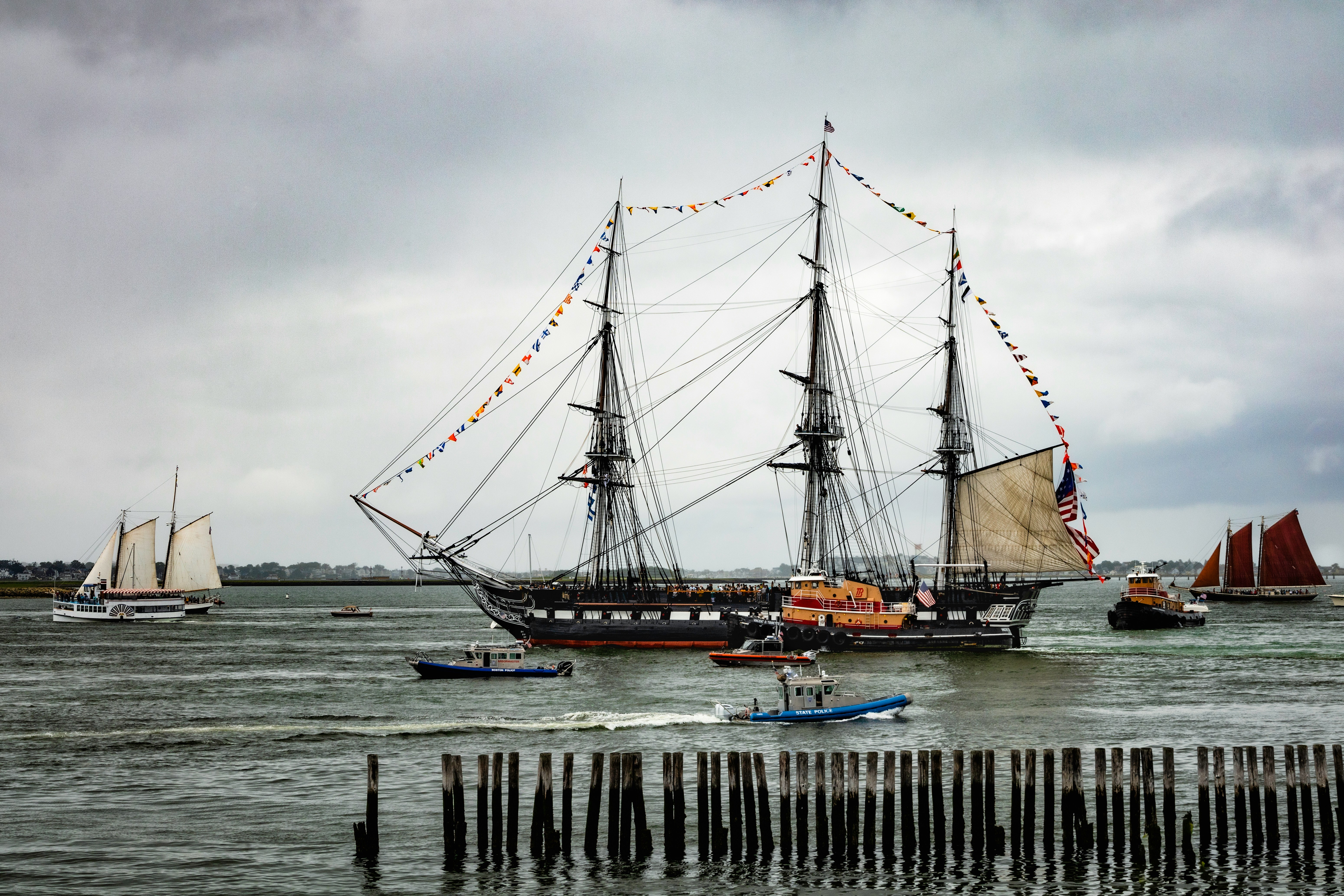
Have you ever been to Boston Harbor to see the USS Constitution? It is the world’s oldest warship that is still afloat and can operate under its own power.
The USS Constitution Photo by Catherine Kerr on Unsplash
One of six ships commissioned in 1794 by the United States, it was built in Boston in 1797. The three-masted wooden war ship was nicknamed “Old Ironsides.”
Why did I blog about the USS Constitution today?
Today is the 212th anniversary of the first time the USS Constitution engaged in battle against a British warship. That ship was the HMS Guerriere.
I few of the facts grabbed my attention, though. I had no idea how large the USS Constitution is. It boggles my mind to think of some of the ship’s statistics considering it was built in the late 18th century.
For instance, it is 305 feet long! That’s a little more than the length of an American football field. Its main mast is now 172 feet tall. It has 48 sails, which is equal to an acre of canvas.
The USS Constitution with Boston in the background. Photo by David Trinks on Unsplash
In 1812, the crew of the USS Constitution was more than 405 sailors and marines. What surprised me the most, though, was that today it has a crew of three officers and more than 85 enlisted U.S. Navy men and women.
Since my last blog post
We continue to have a lot of rain in the southern piedmont of North Carolina. We have a rain gauge in our yard. From July 12 through August 12 we had a little more than 16 inches of rain! We have some beautiful green moss and a variety of colorful mushrooms in our yard. I wish we could send some of this rain to put out some wild fires in the western states.
School started in the county in which I live last Tuesday, which served as a rude awakening for me that the summer months are flying by much faster than I would like.
Until my next blog post
I hope you are reading a good book that you’re eager to get back to when you finish reading my blog post.
Spend time with friends and family.
Remember the people of Ukraine.
If you’ve ever visited the USS Constitution, I’d love to hear what your memories are. What about it impressed or surprised you the most?
I could not get excited about writing about the August 12, 1898 US annexation of Hawaii for today’s blog post. (I could get excited about Hawaii’s statehood, which happened in my childhood, but its annexation as a territory? Not so much.)
I couldn’t muster the energy to do enough research to write 500 or 1,000 words about the annexation of Hawaii, and I doubted if my blog readers were interested enough to read about it. (If I’m wrong, feel free to look it up.)
In the big scheme of things, the events of the week of August 6-15, 1945 were more momentous than what happened about Hawaii in 1898.
It occurred to me that the 79th anniversaries of the bombing of Hiroshima on August 6, the bombing of Nagasaki on August 9, and the surrender of Japan on August 15, 1945 have barely been mentioned in the United States this week.
The famous bomb dome in Hiroshima.
Photo by Griffin Quinn on Unsplash
I watch some programming on a TV station in Tokyo. The news and other programming are available via the public TV system here in metro Charlotte. The dates of the atomic bombs are marked in Japan with solemn government-sponsored gatherings and, no doubt, by many private gatherings and individuals.
The horror is remembered by the Japanese people, but the overriding theme of the coverage I have seen over the last week is peace. The Japanese people know first-hand the horrors of nuclear war, and they are adamant that such weapons should never be used again.
Nagasaki Atomic Bomb Museum
Photo by Roméo A. on Unsplash
The dropping of those atomic bombs were horrific events in which hundreds of thousands of innocent people were killed, maimed, severely burned, orphaned, or doomed for various health maladies for the rest of their lives.
It has been said that those bombs resulted in the almost immediate surrender of Japan, thus ending World War II and ultimately saving more lives than they took. I guess we will never know the truth of that reasoning and justification.
I imagine the people who are old enough to remember the events of that week – whether they live in Japan, the United States, or other countries involved in the war in the Pacific Theater — are puzzled over the fact that the world is taking little notice of this week’s 79th anniversaries.
Photo by Sunguk Kim on Unsplash
I suppose there will come a time when September 11 will be just another day in the United States. The Americans who were young children or who were born after September 11, 2001, cannot possibly think of that day the way it is forever etched in my memory.
Life goes on. Events are forgotten. To those of us born after 1945, that year seems like ancient history. That’s just human nature. I was born in the United States in 1953, so I grew up with no concept of what life was like during World War II. But that does not excuse me if I don’t stop and think about the events of 79 years ago.
I owe it to my parents, my aunts and uncles, and even my oldest first cousins – all of whom are dead – to remember the sacrifices they made during World War II, their military service, their work to help build military planes, and their courage to hold things together on the home front – all while not knowing when or how the war would end and not knowing which of their loved ones or friends would not come home.
Since my blog post last Monday
I am feeling better than when I penned my August 5 blog post. I was discouraged by an illness which has taken much from me. However, I have been bolstered by the outpouring of concern I have received from many of my readers. Each day has been better than the one before. I’ve even been able to listen to an entire novel and enjoy it!
Thank you for your support and encouraging words. I always come out of these slumps and return to my “normal,” but each time I experience a relapse I can’t help but wonder if I will come out of it.
Since my last blog post
I hope you got a chance to read my reblogging on Friday of a blog post about Elizabeth Graffreau’s new book, Simple Pleasures: Haiku from the Place Just Right. It was my first attempt at reblogging.
Until my next blog post
Take a few minutes to think about the events of this week in 1945. Let’s continue to give diplomacy and peace a chance.
Peace Memorial Park in Hiroshima
Photo by sabari nathan on Unsplash
I hope you have a good book to read. I am easing back into reading this month, for which I am grateful.
This was not planned, but when I started to write this blog post I realized the event whose anniversary we mark today happened 200 years and one week after the historic petition I blogged about last Monday. It’s nice when serendipity happens.
Whereas last Monday’s blog post was about a petition written in 1775 as the American colonies were on the verge of war with Great Britain, today we jump forward to mark an historic joint space exploration venture between the United States and the Soviet Union.
Both events now seem like ancient history in light of where space exploration has taken us today, so it is sobering for me to realize the event I write about today happened a couple of months after I graduated from college. It seems like just yesterday! The passage of time is beyond my understanding.
What was the Apollo-Soyuz Test Project?
The Apollo-Soyuz Test Project was the first multinational space exploration project.
Photo by Jack Cohen on Unsplash
A little background
What made the Apollo-Soyuz Test Project particularly surprising and interesting was that the two participating countries – the United States and the Soviet Union – had been serious and unfriendly competitors in space travel since the late 1950s. The era was known as “the space race.” Each of the countries was determined to beat the other one in reaching every progression in space travel with the ultimate goal of putting a human being on the moon.
This is an over-simplification, but with the United States putting humans on the moon in 1969, the space race transitioned into a posture of sharing knowledge. It was an outgrowth of the “Détente” that started in 1969. Détente brought about more relaxed relations between the US and the Soviet Union.
Things get real in 1973
In the first half of 1973 the two countries announced the names of the astronauts and cosmonauts for the project as follows:
U.S. Commander Thomas P. Stafford
U.S. Command Module Pilot Vance D. Brand
U.S. Docking Module Pilot Donald K. “Deke” Slayton
US backup crew: Alan L. Bean, Ronald E. Evans, and Jack R. Lousma
Soviet Commander Aleksei A. Leonov
Soviet Flight Engineer Valeri N. Kubasov
Soviet backups: Anatoli V. Filipchenko and Nikolai N. Rukavishnikov
The crews trained together for the first time at NASA’s Johnson Space Center in Houston, Texas in July 1973.
Some details of the project
Soyuz
Launch: July 15, 1975, at 8:20 a.m. EDT Launch Site: Baikonur Cosmodrome, Kazakhstan Flight Crew: Alexey A. Leonov, Valery N. Kubasov Landing: July 21, 1975
Apollo
Launch: July 15, 1975, at 3:50 p.m. EDT Launch Site: Launch Complex 39, Kennedy Space Center, Florida Flight Crew: Thomas P. Stafford, Vance D. Brand, Donald K. Slayton Landing: July 24, 1975
Mission
Docking Time: July 17, 1975, at 12:12 p.m. EDT Undocking Time: July 19, 1975, at 11:26 a.m. EDT Total Duration of Joint Activities: 19 hours, 55 minutes Orbital Inclination: 51.8 degrees
Both spacecraft made orbital adjustments over the first two days to pave the way for the two vehicles to dock in space. People all over the world watched the docking at 12:12 p.m. Eastern Daylight Time, July 15, 1975. Hatches on both vehicles were opened at 3:17 p.m.
Celebratory handshakes and commemorative gifts were exchanged between the astronauts and cosmonauts. U.S. President Gerald Ford and Soviet Communist Party General Secretary Leonid Brezhnev called them to express their congratulations. The astronauts and cosmonauts shared a meal and the hatches were closed for the day.
The following day Brand joined Kubasov in the Soyuz and Leonov joined Stafford and Slayton in the Apollo spacecraft. TV interviews and tours were given, experiments were conducted, and lunch was eaten. Afterwards, Kubasov and Brand left the Soyuz and joined Slayton in the Apollo. Leonov and Stafford then spent time in the Soyuz.
By mid-afternoon the historic exchanges were completed, there was another round of handshakes and goodbyes were said.
At 8:02 a.m., July 19, 1975 the spacecraft were undocked.
Quoting from the NASA website: “As the Apollo capsule backed away, it blocked the sun from the Soyuz vehicle, creating the first human-made eclipse and enabling the cosmonauts to photograph the sun’s corona. The two spacecraft then docked once more, with final undocking at 11:26 a.m.
The end of the successful project
The Soviet cosmonauts continued to conduct life-science experiments for another day. The Soyuz 19 landed near its target on July 21, 1975. It was the first time a Soviet space mission launch and landing were televised.
The Apollo capsule remained in orbit with the astronauts carrying out space-science and Earth-observing experiments for five days after the undocking. It was the last planned ocean landing for U.S. human spaceflight. Splashdown occurred at 5:18 p.m., Eastern Daylight Time on July 24, 1975.
Until my next blog post
What happened on Saturday was an attack on democracy. Let’s hope this week is less eventful than the weekend.
On July 8, 1775, the Second Continental Congress adopted the so-called Olive Branch Petition as sort of a last-ditch effort to avoid war with Great Britain. It was written by John Dickinson of Pennsylvania. He hoped against hope that America would not break with its mother country.
Photo by Shahan Khan on Unsplash
The petition’s words were couched in language meant to convince King George III that the colonies did not want to break away but that Britain’s actions had forced her “still faithful Colonists” to arm themselves in self-defense. It mentions the “distress” the very thought of such a break was causing the colonists.
The petition ended with, “That your Majesty may enjoy long and prosperous reign, and that your descendants may govern your Dominions with honour to themselves and happiness to their subjects, is our sincere prayer.”
Photo by Donovan Reeves on Unsplash
This was just a scant three months after American militiamen had fought British troops at Lexington and Concord, Massachusetts. Colonists’ beef was primarily with Parliament. There was still hope among same of them that King George surely wanted only the best for his subjects – even those across the Atlantic.
On September 8, 1775, Richard Penn and Authur Lee, representing the Continental Congress, traveled to England to present the petition to King George III. But King George refused to accept the petition.
Photo by Mark Stuckey on Unsplash
When word came to the colonies that the king had refused to even receive the petition, the tide turned and the colonists realized the king did not have their best interest at heart.
When I read that today was the 76th anniversary of the Berlin Airlift, I must admit my mind was a little short on details. One of the perks of writing this blog is that I get to study events in history and then share what I have learned.
Three of my last four blog posts have been light-hearted as I regaled you with details of my recent trip to the Outer Banks of North Carolina. It was a fun trip and I enjoyed sharing my memories and photographs with you; however, it is time for me to return to real life with my blog and other aspects of my life.
I learned a lot about the Berlin Airlift so I could blog about it today. If you, like me, were born after 1948, you maybe never studied mid-20th century history when you were in school.
Background
At the Potsdam Conference at the end of World War II, it was agreed that Germany would be divided into four parts for the country’s transition into a post-war economy and government. The United States, Great Britain, France, and the Soviet Union were designated to occupy the four sectors. The city of Berlin, which sits in the center of Germany, was also divided into four sectors with the same plan for occupation.
The Russian sector covered the eastern half of Berlin and the other three countries split up the western half.
Under the plan, it was the responsibility of the Allied countries to support the German people in their designated sectors with food, medical supplies, and fuel until Germany could recover from its defeat in the war.
Berlin was in the middle of the Soviet-controlled sector of the country. In hindsight it is easy for me to see that this situation had trouble written all over it, but I must be reminded that the Soviet Union, France, Great Britain, and the United States were allies in World War II. That is difficult to get my mind around, since I grew up during the so-called “Cold War” of the 1950s and 1960s.
The straw that broke the camel’s back
The United States, Great Britain, and France introduced a new currency – the Deutschmark – in an effort to revive the German economy. The Soviet Union balked at the proposal because it wanted to continue to bring Germany to its knees.
In response to the monetary proposal made by the Western Allies, the Soviet Union imposed a blockade of Berlin on June 24, 1948 after giving the Western Allies just 24 hours’ notice.
It was on that day, 76 years ago today, that the roads and waterways into Berlin were closed to American, British, and French access.
The Soviets wanted to starve West Berliners and through the very threat of starvation wanted to force West Berliners into coming across to the Soviet side.
Photo by Marisol Benitez on Unsplash.
The blockade meant that the Western Allies could no longer bring supplies in via roads or the rivers. For a while, East and West Berliners could freely move from one sector to another. Many of them needed to travel into the opposing sector for jobs.
But in October 1948 new regulations prohibited free movement. Seventy-one roadblocks were set up and everyone wishing to cross into or out of the Soviet-occupied sector was searched.
The solution
The solution to the Soviet-imposed blockade was the Berlin Airlift. The Germans called it Luftbrücke which translates into English as “airbridge.”
I have found conflicting statistics about the Berlin Airlift, which lasted until the blockade was lifted on May 12, 1949. Allied planes were constantly landing around-the-clock at airfields in Berlin. One source said it was every three minutes, and another source said at its busiest a plane was landing every 45 seconds.
Photo by Christina Sicoli on Unsplash
It was described as a constant noise, but it was a noise that reminded Berliners that they had not been abandoned by the United States, Great Britain, or France when the Soviet Union left them out to dry. They were not at the mercy of the Soviet Union.
It is said that the airlift brought more than food, medical supplies, and fuel into Berlin. Perhaps most importantly, it brought Berliners hope. The Berliners did not just sit idly by waiting for help. More than 10,000 of them worked at the airfields in various support positions to keep the airlift running as smoothly as possible.
The North Atlantic Treaty Organization (NATO) was created on April 4, 1949, which sent a strong message to the Soviet Union and, no doubt, prompted an end to the blockade five weeks later.
After the Berlin Airlift
West Germany was established as a democratic state two weeks after the end of the Berlin Airlift. Soon thereafter, East Germany was created.
For those of you too young to remember and who have not studied post-World War II world history, West Germany continued to exist as a free country and East Germany existed as a communist country until the reunification of Germany on October 3, 1990.
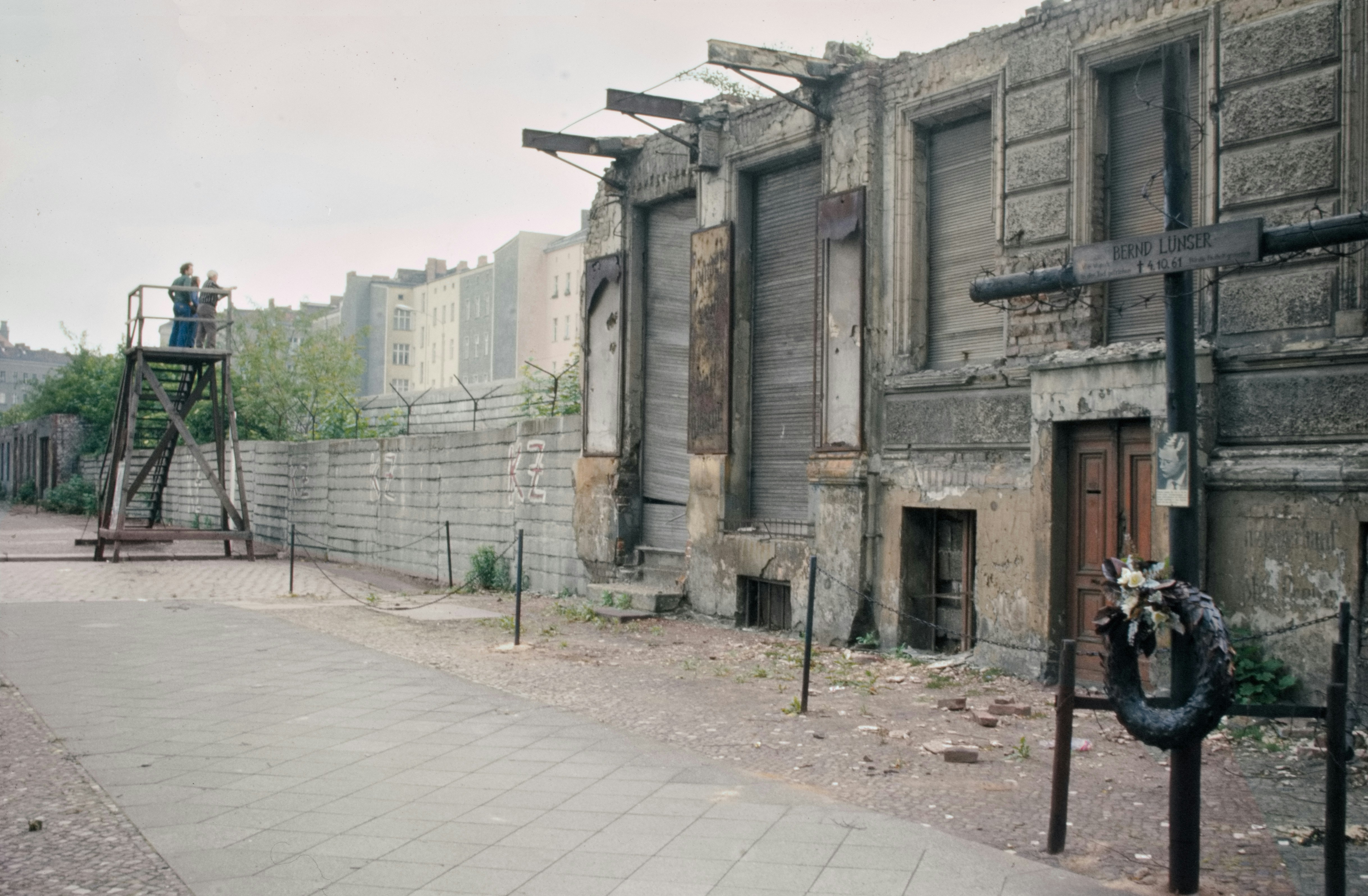
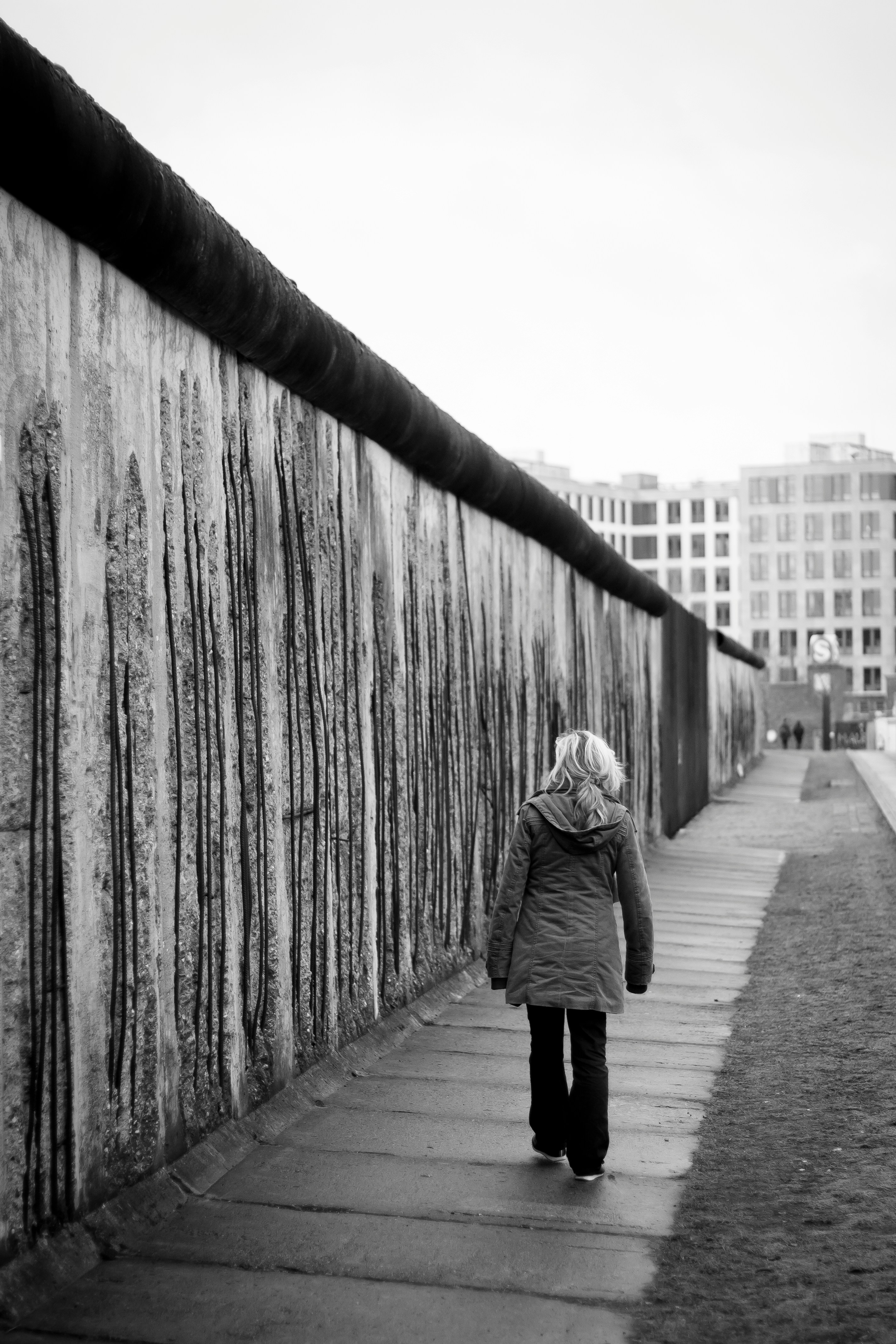
East Germany had to put a stop to East Germans fleeing to West Berlin. The Berlin Wall went up literally overnight on August 12, 1961 and encircled West Berlin until 1989. Overnight tens of thousands of West Berliners lost their jobs in East Berlin because the wall could not be crossed.
A small section of the Berlin Wall. Photo by Immo Wegmann on Unsplash.
The Berlin Wall was a series of concentric barriers – a concrete wall with guard towers, anti-vehicle trenches, beds of nails and barbed wire. It was rare for anyone to successfully cross the wall. At least 171 people were killed trying to escape East Berlin.
The Berlin Wall. Photo by Tomas Val on Unsplash.
The tearing down of the Berlin Wall
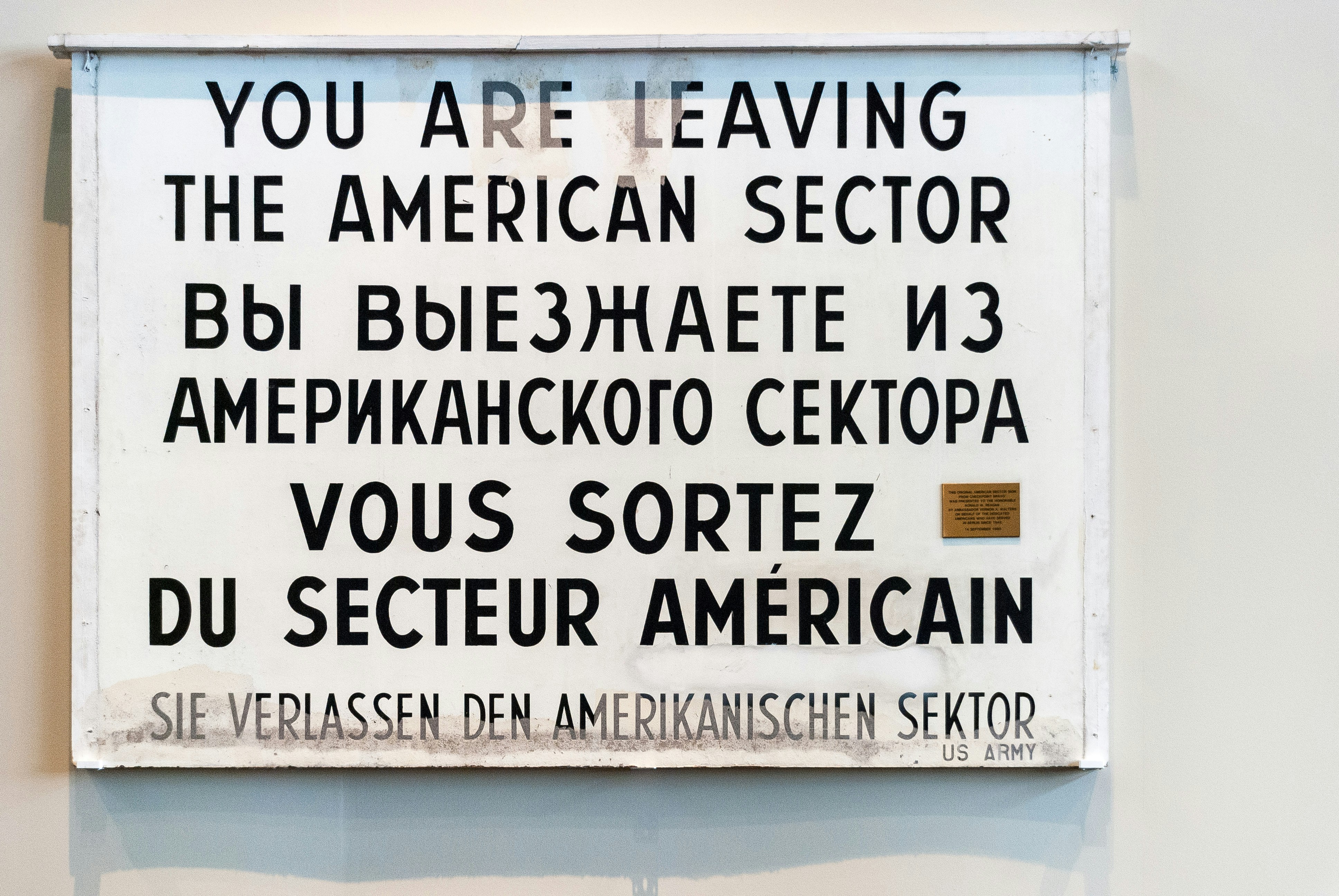
Sign at “Checkpoint Charlie” in Berlin. Photo by Etienne Girardet on Unsplash.
On November 9, 1989 the East German Community Party announced new policies regarding border crossings and the gates were opened.
People took picks and hammers and started tearing down the concrete wall. Bulldozers pushed down sections of the wall until it was gone.
After 44 years, Berlin once again became one city. And Germany was finally once again one sovereign country.
In conclusion
This is a condensed version of what happened and all sources do not agree on every date. If you wish to do your own research, there are many books that offer the details and idiosyncrasies of the airlift. Check the public library and the internet for a list of reputable sources.
Until my next blog post
Thank you for taking the time to read my blog today.
My next blog post will be on July 1. June just flew by!
I hope you have a good book to read – one that you don’t want to put down!