I write southern historical fiction, local history, and I've written a devotional book. The two novels I'm writing are set in Virginia and the Carolinas in the 1760s. My weekly blog started out to follow my journey as a writer and a reader, but in 2025 it has been greatly expanded to include current events and politics in the United States as I see our democracy under attack from within. The political science major in me cannot sit idly by and remain silent.
Before daylight on Wednesday, April 18, 1906, the northern coast of California, including the city of San Francisco, was rocked by an earthquake of historic proportions. In retrospect, it was estimated to have been on the magnitude of 7.9.
The earthquake and its resulting fires destroyed 500 city blocks – approximately 28,000 buildings. The fires burned for three days and intensified the citizens’ fears and anxiety.
Photo credit: Christopher Burns on unsplash.com
Some 200,000 people – half of the city’s population at the time – were left homeless. Although usually referred to as “the Great San Francisco Earthquake,” it also resulted in widespread damage in northern California, including San Jose and Oakland.
Cooking food inside standing houses was outlawed immediately after the earthquake in the government’s efforts to minimize additional fires. “Bread lines” were established to distribute food to the homeless and whatever food preparation that was possible was done in the streets.
According to the United States Geological Survey website, (https://earthquake.usgs.gov/earthquakes/events/1906calif/18april/) 296 miles (477 kilometers) of the San Andreas fault ruptured. The quake was felt from southern Oregon to south of Los Angeles and as far east as central Nevada. Much was learned from this earthquake, but it would be a half-century later before plate tectonics as a field of study would shed more light on exactly what processes were at play to produce the event.
The USGS website contains a drop-down menu through which you can access many more details about this earthquake, including comparisons with the October 17, 1989 quake that struck the San Francisco area just 26 minutes before Game 3 of the World Series was set to begin at Candlestick Park. It was measured at 6.9 on the Richter Scale.
Earth tremors and earthquakes of low magnitude are a daily occurrence in San Francisco. That is something I can’t imagine, since I’ve only felt two earthquakes in my life.
While doing the research for today’s blog post, I remembered reading The Nature of Fragile Things, by Susan Meissner in April 2021. It’s a novel based on the 1906 San Francisco Earthquake. You might like to read what I had to say about that book in my May 3, 2021 blog post, 5 Historical Novels I Read in April 2021.
Since my last blog post
Jennie Nash’s book, Blueprint for a Book: Build You Novel from the Inside Out, is helping me outline The Heirloom. Ms. Nash’s “inside outline” helps me remember there must be a reaction to every event and internal reactions are what pull readers into a story.
I continue not to be at my best physically, but I’m constantly thinking about the plotline for The Heirloom and how I can make it better.
I’ve had two relatively close encounters with Three Mile Island. Both were unexpected.
While on vacation in the Pennsylvania Dutch Country in the early 1980s, my sister and I sought out a unique restaurant, Alfred’s Victorian Restaurant, for dinner one night in Middletown. It was only upon arriving that we realized that Middletown was actually the location of the Three Mile Island Nuclear Power Plant. We joked about glowing in the dark later that evening, but I know it’s really not a laughing matter.
On a later trip to work on our family’s genealogy, my sister and I flew into the airport in Harrisburg, Pennsylvania. On our approach, the plane banked so close to the cooling towers of the power plant, I swear I could have reached out and touched them if the windows had been open!
In retrospect, it’s astounding that a commercial jet was allowed to fly so close to a nuclear power plant, but that was well before 9/11. Maybe it wasn’t supposed to do that.
What happened at Three Mile Island?
Can it be 43 years since this happened? I’m feeling older by the day!
A pressure valve in the Unit-2 nuclear reactor at Three Mile Island near Middletown, Pennsylvania failed to close at 4:00 a.m., March 28, 1979. The result was the worst nuclear power generating facility disaster up until that time.
This cooling malfunction caused part of the core of Unit-2 to melt. The reactor was destroyed, but there were no injuries. A small amount of radioactive gas was released two days after the accident, but it wasn’t enough to cause any adverse health problems.
Personnel operating the facility were unable to tell where the malfunction was in the beginning, which contributed to the emergency. As a result of what happened at Three Mile Island, a raft of changes were made in operating procedures, training, emergency response planning, and other aspects of nuclear power production required by the United States Nuclear Regulatory Commission (NRC).
According to the NRC, “A combination of equipment malfunctions, design-related problems and worker errors led to the TMI-2’s partial meltdown and very small off-site releases of radioactivity.”
The other nuclear reactor, Unit 1, was shut down on September 20, 2019. The dismantling of the facility and clean-up is estimated to take 60 years and cost more than $1 billion.
The good news?
Many problems were identified due to the accident at Three Mile Island. The resulting regulatory changes have made nuclear power production in the United States and other countries much safer.
Since my last blog post
I continued to work on that old cemetery project I’ve mentioned in a couple of recent blog posts. It’s troubling how much damage the elements have done to some of the grave stones since I took photographs of them in 2006. I continue to try to decipher some of the inscriptions.
I’ve started working my way through Blueprint for a Book: Build Your Novel from the Inside Out, by Jennie Nash as I continue to work out the plot for The Heirloom.
Until my next blog post
I hope you have a good book to read. I’m reading parts of several.
Watch and listen to the news and read news articles from reputable sources. Stay informed about current events.
Sometimes it angers me that the history classes I sat through as a child and teen didn’t include little bits of information like I’m sharing with you today. Instead of memorizing names of general and battles and dates, how much more interesting class would have been if we’d been told stories like this one.
Knowing this story could have served as an example to students of how history can turn on a dime. I’d like to think students learned that last week when Russia invaded Ukraine without provocation.
The incident I write about today brings to mind the following for each of us to think about: If not for ___(you fill in the blank)____, then ___(you fill in the blank)____ wouldn’t have happened OR would have happened.
The 1840s USS Princeton
I don’t recall ever hearing about the USS Princeton until recently, and I wouldn’t have heard of it then if I hadn’t been looking for a topic for #OnThisDay for my blog.
There have been a series of US Naval vessels christened with the name USS Princeton. The one I write about today, as you can see from my blog post title, was the one built in the early 1840s. It was a state-of-the-art warship powered by coal-produced steam. It was built in Philadelphia and was best-known for its two 12-inch cannons/carronades, called “The Oregon” and “The Peacemaker.”
“The Oregon” was of revolutionary design, made of wrought iron, and manufactured in England. It was designed by John Ericsson, a Swede who later designed the Monitor of American Civil War fame.
“The Peacemaker” was manufactured in New York under the partial supervision of Captain Robert Stockton, a political supporter of US President John Tyler. It’s thought that it was believed and claimed to be comparable to “The Oregon,” but there were design differences and short cuts were taken in The Peacemaker’s testing. This was a recipe for disaster, and that’s what happened on the Potomac River on February 28, 1844.
Let’s set the stage
The state of politics in the United States in 1844 contributed to the inevitable disaster. William Henry Harrison was elected US President in 1840, but he died in 1841 only a month after his inauguration. John Tyler being the US Vice President, assumed the office of President. It was the first time in American history that a president died in office and was replaced by the vice president. Tyler had been a Democrat, but he was elected as a Whig. Soon after he assumed office, he openly disagreed with the Whig Party over economic policy, and the Whigs kicked him out of the party. The Democrats didn’t want him back, so he became a US President without a political party.
Tyler wanted to be reelected President in the 1844 election. He thought by running on a promise to annex the Republic of Texas into the United States would win him the election. Mexico and Great Britain opposed the idea.
To ward off foreign opposition to that annexation, Tyler ordered the construction of the USS Princeton. Most warships in the world at that time were sailing ships or steamships with fuel limitations. The USS Princeton was designed with a collapsible smokestack, allowing it to also navigate as a sailing ship. A hybrid in the 1840s! It’s engine and propeller system were below the water line, making it less vulnerable to enemy attack than ships propelled by paddlewheel.
Back on the scene to partially supervised the construction of the warship, Captain Stockton bragged about the ship’s prowess, calling it “invincible.” He thought by bringing the ship to Washington, DC and entertaining politicians, he’d get the money to build more ships.
What happened on February 28, 1844
An afternoon excursion from Washington, DC on the Potomac River was planned for February 28, 1844. President Tyler (who had no Vice-President), members of Congress along with their wives, and some Cabinet members were wined and dined on the ship and were scheduled to witness the fire power of the ship during three demonstrations.
It was Stockton’s decision to fire “The Peacemaker” for all three demonstrations. After two successful firings, a third was launched in honor of George Washington. On that third firing, “The Peacemaker” exploded, sending its parts – some weighing in excess of a ton – flying across the deck. Eight people were killed and more than two dozen were injured.
Secretary of State Abel Upshur and Secretary of the Navy Thomas Gilmer were killed. If President Tyler had not been unexpectedly detained on the stairs below deck, he undoubtedly would have been standing with them.
The hole in the US Constitution
What happened in US Presidential succession in the 1840s should have been remedied posthaste. It was the first time a Vice President had to step up and into the Presidency due to the death of a President; however, we know from history it was not the last time.
It would be 1967, four years after the assassination of President John F. Kennedy, before the Twenty-Fifth Amendment to the US Constitution would provide a process through which a Vice President would be replaced in the event of the vacancy of that office.
If President Tyler had been killed in the explosion on the Princeton, the president pro tem of the US Senate, Willie Mangum – a North Carolinian who had been one of the founders of the Whig Party – would have become US President. Among other things, Mangum was an avowed opponent of the annexation of the Republic of Texas.
This fact alone brings us back to the fill-in-the-blanks line from the third paragraph of this blog post: If not for ___(you fill in the blank)____, then ___(you fill in the blank)____ wouldn’t have happened OR would have happened.
If you’d like to learn more
If you want to learn more about the USS Princeton of 1844, I recommend https://historynewsnetwork.org/article/181834, by Stan Haynes, published on November 21, 2021. Also, https://military-history.fandom.com/wiki/USS_Princeton_(1843). I drew information from both of these online resources which include more detail than I shared in my post today. In addition, I understand that Stan Haynes has written a historical novel, And Tyler No More, which includes this tragic incident.
Since my last blog post
Our world has changed forever. NATO is being tested like no other time since its inception. No one knows what the future holds for Ukraine, Europe, and the rest of the world. I believe in His perfect wisdom, God doesn’t allow us to know the future.
Until my next blog post
I hope you have a good book to read and time for a creative outlet.
It’s been an unsettling week in our world since last Monday, to say the least. No one knows what this week holds. My heart goes out to the people of Ukraine who are suffering so. May the world continue to condemn Vladimir Putin for his unprovoked invasion of Ukraine.
Robert Burns was born on January 25, 1759 in Ayrshire, Scotland.
A friend of mine from Campbeltown, Scotland, asked me if I liked to read the poems of Robert Burns. I had to admit that I couldn’t understand most of them.
Although written in English, and I’m an English speaker, the English Robert Burns used in the second half of the eighteenth century in Scotland was a far cry from the English I use and speak as an American in 2022.
I love to hear the soft, lilting tongue of Lowland Scots spoken. It’s lovely. It’s, no doubt, the way my Morrison ancestors spoke, for they were lowlanders and not Gaelic-speaking highlanders.
It’s lovely to hear a Scottish accent, whether highlander or lowlander; however, the heavier the accent, the harder it is to understand some words. In addition to that, the Scots have words for things that we don’t use in America.
When it comes to reading something written in Scots, some words just don’t translate well to my ears. That brings me back to Robert Burns.
Photo credit: Gary Ellis on unsplash.com
“Auld Lang Syne”
The most famous poem associated with by Robert Burns is, no doubt, the one that’s sung on New Year’s Eve. The words of “Auld Lang Syne.” The Scottish pronunciation is ‘o:l(d) lan’ səin. I must admit, this doesn’t help me at all. My source was quick to point out that we should note that Syne is pronounced like an s and not like a z. The rough translation is Long, long ago; or old long time; or good old time.
It seems that it’s an ancient song and in 1788 Robert Burns was the first person to write down the words. That was when he submitted the words to the Scots Musical Museum.
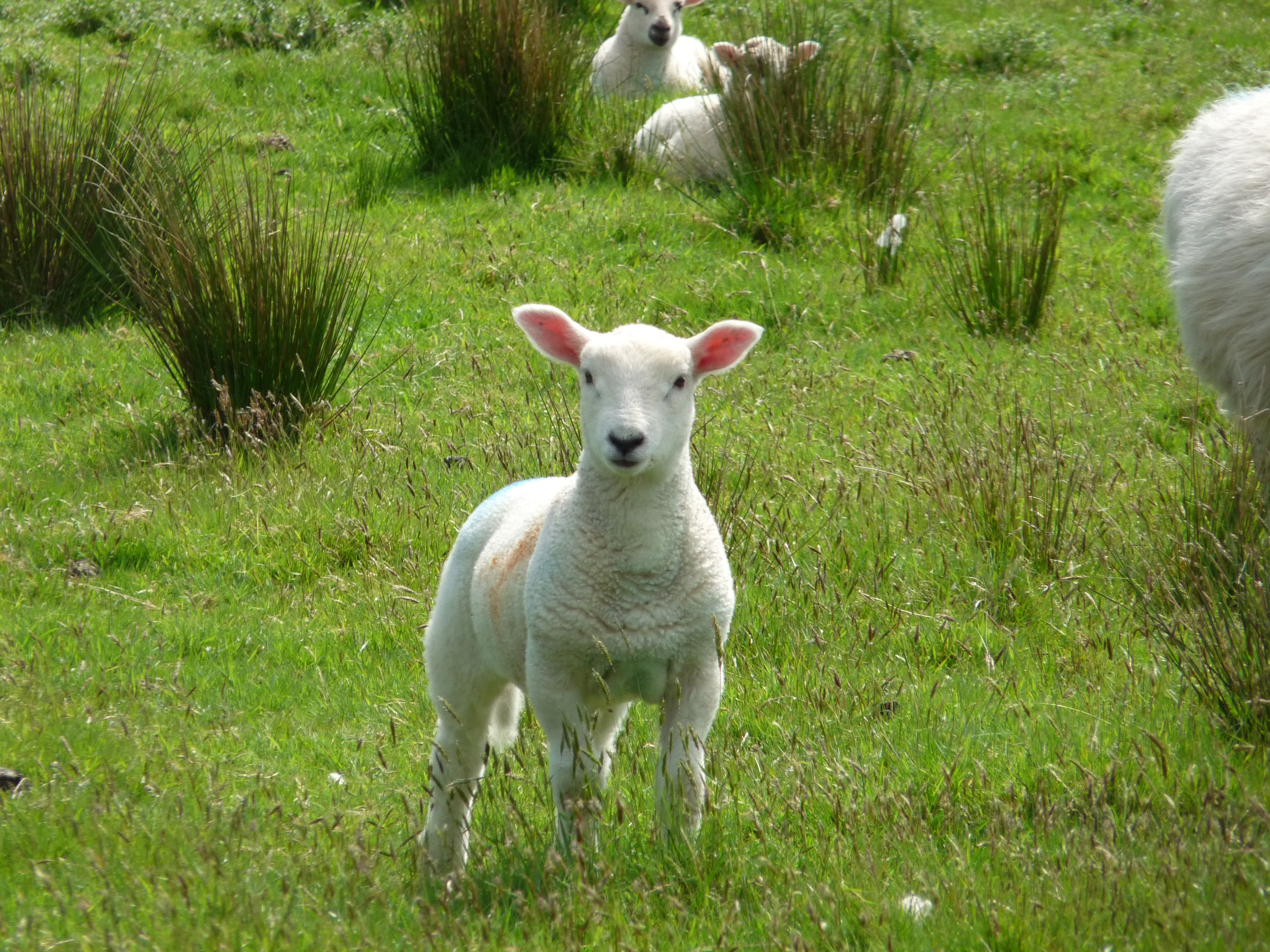
Scottish Lamb. Photo credit: Gibbon Fitzgibbon on unsplash.com
A modern translation of “Auld Lang Syne”:
Should old acquaintance be forgot,
And never brought to mind?
Should old acquaintance be forgot,
And long, long ago.
Chorus
And for long, long ago, my dear
For long, long ago,
We’ll take a cup of kindness yet,
For long, long ago.
And surely you’ll buy your pint-jug!
And surely I’ll buy mine!
And we’ll take a cup of kindness yet,
For long, long ago.
Chorus
We two have run about the hills
And pulled the daisies fine;
But we’ve wandered manys the weary foot
Since long, long ago.
Chorus
We two have paddled in the stream,
From morning sun till dine;
But seas between us broad have roared
Since long, long ago.
Chorus
And there’s a hand, my trusty friend!
And give us a hand of yours!
And we’ll take a deep draught of good-will
For long, long ago.
Chorus
Oh, My Love is Like a Red, Red Rose
Photo credit: Serafima Lazarenko
“Oh, My Love is Like a Red, Red Rose” is my favorite Robert Burns poem – partly because it’s more understandable than most of his – and because the sentiment is beautiful. Here are the words:
O my Luve is like a red, red rose
That’s newly sprung in June;
O my Luve is like the melody
That’s sweetly played in tune.
So fair art thou, my bonnie lass,
So deep in luve am I;
And I will luve thee still, my dear,
Till a’ the seas gang dry.
Till a’ the seas gang dry, my dear,
And the rocks melt wi’ the sun;
I will love thee still my dear,
While the sands o’ life shall run.
And fare thee weel, my only luve!
And fare thee weel awhile!
And I will come again, my luve,
Though it were ten thousand mile.
You can find it sung by various artists on YouTube.
Happy 263rd Birthday, Robert Burns
Scottish Bagpiper. Photo credit: Lynda Hinton on unsplash.com
It’s a tradition that many Scottish organizations, such as the Robert Burns Society, celebrate the bard’s birthday with a fancy dinner. This involves a bagpiper “piping in” the traditional Scottish dish, haggis. I’ve never been to one of those dinners.
When I visited Scotland, I was determined to have as many Scottish experiences as possible. I ate haggis. Now I can say, “I’m a haggis eater,” which you’re supposed to say with a deep voice and much gusto.
I’ve eaten haggis. I don’t have to do that again, if you get my drift.
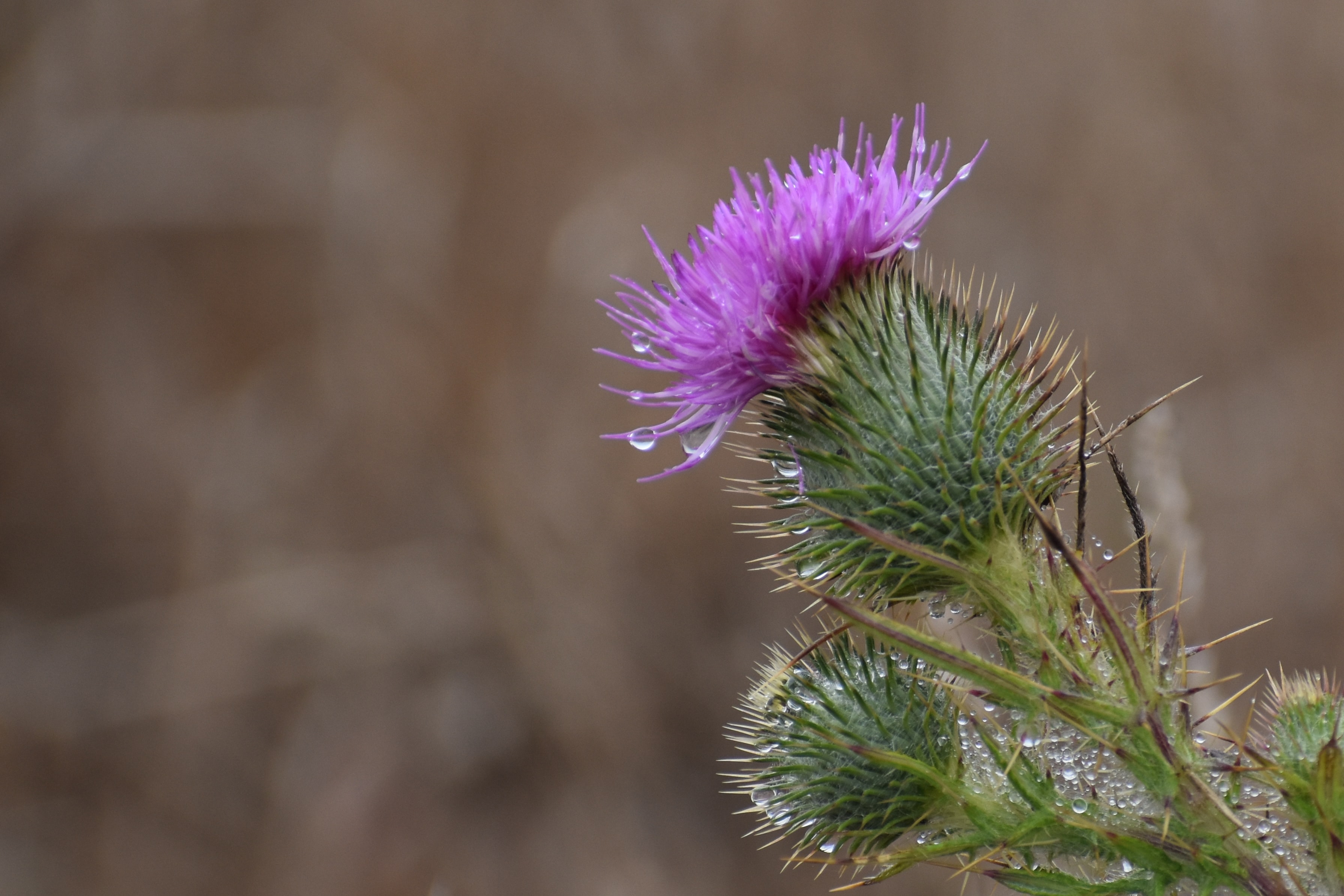
Thistle. Photo credit: Elisa Stone on unsplash.com
Since my last blog post
A blogger friend of mine, Francisco Bravo Cabrera, is a man of many talents. He paints, he writes poetry, he makes music, he puts together extraordinary art history videos, and he shares his talents on his blog. Here’s the link to one of his recent posts: https://paintinginvalencia.wordpress.com/2022/01/16/jazzart-phase-iii/.
Since I blogged last Monday, I learned that he has launched a new endeavor by joining Fine Art America. Here’s a link to Francis’ Fine Art America page where you can view and purchase examples of his digital art on a vast variety of items ranging from wall canvas to notecards: Francisco Bravo Cabrera Art | Fine Art America. Best of luck with this new opportunity, Francis!
I started writing the scenic plot outline for what I want to be “Book One” in my planned novel series. The scene-by-scene “outline” now stands at more than 3,700 words. I’m considering the working title, The Heirloom. The manuscript I’ve been blogging about for years with the working title of either The Doubloon or The Spanish Coin will be “Book Two.”
My blog post last week was “liked” and commented on by an honest-to-gosh published novelist, D. Wallace Peach. Her comment made my day and encouraged me that I’m on the right track with novel structure. Thank you, Diana!
My decluttering project at home continues. I went through bags, drawers, and boxes of old craft supplies. It felt good to discard dried-up fabric paint, craft glue, and sundry supplies I know I’ll never use. Usable items I’m no longer interested in or motivated to use will be donated to several people and a re-sell organization. The process freed up a drawer in a chest of drawers, making room for more things I probably should throw away or donate.
I worked on my next three blog posts.
I also did some reading. I gave When Ghosts Come Home, by Wiley Cash, another chance and loved it. More on that in my February 7, 2022 blog post.
Oh – and I actually got to spend some time on genealogy, one of my most rewarding hobbies.
In spite of some health concerns within my family, the Covid-19 pandemic, natural disasters, and the threat of war in eastern Europe, I had a good week. For me, 2022 is getting off to a productive start.
Until my next blog post
I hope you have a good book to read and a hobby to enjoy.
Stay safe and well, and let me know what you’ve been doing.
Janet
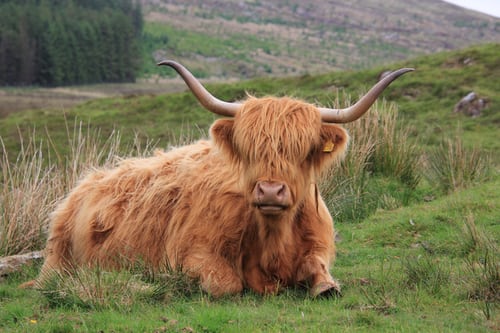
Highland “Coo.” Photo credit: James Toose on unsplash.com
For those of us who were alive at the time, it just doesn’t seem possible that President John F. Kennedy was assassinated 58 years ago today. If you were at least six or seven years old on that day, it’s probably a day you’ll never forget.
US President John F. Kennedy; Photo credit: history in hd on unsplash.com
It was one of those life experiences like September 11, 2001. I’ll always remember where I was and what I was doing when I heard the news of that attack. My parents’ generation always remembered where they were and what they were doing when the news came over the radio that Pearl Harbor had been bombed on December 7, 1941.
I was in the fifth grade when President Kennedy was assassinated. It was a normal day at school. It was the Friday before Thanksgiving, so I’m sure I was counting the days until that holiday because it would mean a four-day weekend. I was a good student, but it’s no secret that I didn’t like school.
Shortly after one o’clock that Wednesday afternoon, the principal came to the door and motioned for my teacher, Miss Judy Ford. The school building was built in the mid-1920s and there was no intercom. There was no way for a general announcement to be made to all the classes, so the principal went from room-to-room to tell each teacher that President Kennedy had been shot and skilled and school would be dismissed a few minutes later.
At the time, I thought Miss Ford was old. We all did. She broke her foot playing basketball that year, and we all were aghast! She was 24 years old. What was she doing playing basketball?
Now, when I think back on that day, I wonder what had prepared that young, second- or third-year teacher to come back into the classroom and tell a bunch of 10-year-olds that the president of the United States had been killed. Nothing like this had happened in our lifetime. Nothing like this had happened in her lifetime.
As I recall, silent tears ran down her cheeks and she calmly told us the bare facts. We got our personal things together, and in a few minutes the bell rang signaling that school was dismissed. I rode the school bus home.
As I recall, some students seemed happy. They were probably just happy to get to go home early, but some of the children were possibly happy because they’d heard their parents said unsupportive things about the president. I think most of us were confused. We didn’t understand the gravity of what had happened, and we weren’t sure how we were supposed to react. Having seen my teacher in tears, though, had indicated to me that this was pretty serious.
My mother had the TV on when I got home from school. Our family watched the coverage that evening. Since Vice President Lyndon Baines Johnson was from Texas, he and his wife had accompanied the President and First Lady to Dallas. As Jacqueline Kennedy stoically stood by, Johnson was sworn in as President on Air Force One.
Even on our black and white TV we could tell that Mrs. Kennedy’s suit (described as being pink) was stained with her husband’s blood. We watched TV the following days as Walter Cronkite kept us informed, but I still didn’t grasp what had happened.
Lee Harvey Oswald was arrested for the murder. Then, on Sunday afternoon, Jack Ruby shot Oswald at close range and killed him. It was a bizarre sequence of events that was witnessed live on black and white TV.
President Kennedy’s funeral procession was like nothing I’d seen before. His coffin was carried in a wagon pulled by horses. His young wife and children even younger than I stood as it passed and little “John-John” saluted. He was far too young to understand what had happened.
Somehow, it was through the black-and-white TV coverage of President Kennedy’s inauguration and funeral that impressed on my mind the importance, sacredness, and fragility of our government. I still remember seeing out-going President Dwight Eisenhower and in-coming President Kennedy dressed in their top hats for JFK’s inauguration in 1961 and the solemn pageantry of his funeral in 1963.
Since my last blog post
I’ve had a productive writing week. I’ve concentrated on deep point-of-view in my novel manuscript. I did some historical research about legal procedures in South Carolina in 1769, and I revisited the location in which most of my novel is set in Lancaster County, South Carolina.
I needed to get a feel for the common trees and their state of autumn color in mid-November. Even though the setting is only an hour from where I live, I found a couple of interesting differences between my location and the area around Old Waxhaw Presbyterian Church.
Until my next blog post
I hope you have a good book to read. Four books I had been on the waitlist for at the public library all came in this week. I’d rather spend my time writing this week, but I must make time for some reading.
Thursday is Thanksgiving Day here in the United States. I wish my American readers a nice holiday. It’s a good time to stop and count our blessings.
It’s been four weeks since my last #OnThisDay blog post. Today’s might not be the most exciting topic for you, but I think it’s important for Americans to be reminded about the early days of our democracy. The historian in me just can’t help myself.
The Articles of Confederation document was the forerunner of the U.S. Constitution.
Photo credit: Anthony Garand on unsplash.com (Preamble of the US Constitution)
On November 15, 1777, the Continental Congress adopted the Articles of Confederation. It was that document that established the name of our country as the United States of America. It served as the defacto constitution of the nation throughout the Revolutionary War.
I reread the Articles of Confederation last week. It had been quite a while since I’d read the document.
Still stinging from oppressive British rule, the frames of the Articles of Confederation were hesitant to create a strong federal government. Much power was retained by the individual states. States’ rights have been a bone of contention throughout the history of the U.S. and still is today. It seems like every week the legislature of at least one state in the union is testing the waters and “pushing the envelope” to see just how far they can go without being reined in by the U.S. Supreme Court. The major issues today that fall in that category are abortion rights, gun rights, and Covid-19 vaccination mandates.
There were weaknesses in the Articles of Confederation. The document did not give the U.S. the authority to issue a national currency. Hence, the various states printed their own money. It makes my head spin to think what our country would be like today if that hadn’t been corrected.
Another weakness in the document was the absence of authority of the national government to levy taxes. Some people probably think things should have stayed that way, but just think how many things we would not have today if not for federal taxes. The “common treasury” was to be supported by the states, with each state contributing an amount based on the value of the land in that state.
Of all the language in the document, the wording in Article III stood out for me. Specifically, the words, “firm league of friendship.” That phrase sounds quaint to our 21st century ears.
Article III states the following: “The said states hereby severally enter into a firm league of friendship with each other, for their common defence [sic], the security of their Liberties, and their mutual and general welfare, binding themselves to assist each other, against all force offered to, or attacks made upon them or any of them, on account of religion, sovereignty, trade, or any other pretence [sic] whatever.”
Article IV went on to state that citizens of any state had the freedom to travel to and from any other state. Of course, slaves were not considered citizens, so they were not afforded that right.
Just as details of how a democratic government operates today takes a long time and much gnashing of teeth, so it was with the Articles of Confederation. The debate leading up to the adoption of the document lasted 16 months.
The Articles of Confederation served the United States of America until March 4, 1789, when it was replaced by the U.S. Constitution. The Constitution is a living, breathing document. It is continually up for interpretation and has been amended 27 times. No doubt, it will be amended many more times.
Since my last blog post
We had spectacular autumn weather last week in North Carolina! Wednesday was a crystal clear, unseasonably warm day. I took a break from raking dead, brown leaves to walk around our yard with my cell. I couldn’t stop taking pictures as I happened on one gorgeous tree after another.
I concluded that I live in paradise. I started with one of my favorite trees. It’s a maple that my father and I found as a sprout in our woods in the fall of 1965. It wasn’t much taller than I was, but it was decked out in beautiful orange leaves. The maples in our yard were yellow in the fall, and I wanted an orange one.
Daddy marked the location of the sprout and returned later to dig it up. We planted it in front of our house, and there it proudly stands today, much taller than the house. This fall, it’s orange at top and the rest of it is yellow.
Maple Tree
I’m blessed to once again live in that house. We’re blessed with a wonderful variety of trees, including pine, cedar, maple, hickory, several varieties of oak, holly, mulberry, poplar, ash, dogwood, sweet gum, persimmon, and black walnut.
Hickory Tree
Dogwood Tree
Cedar Tree
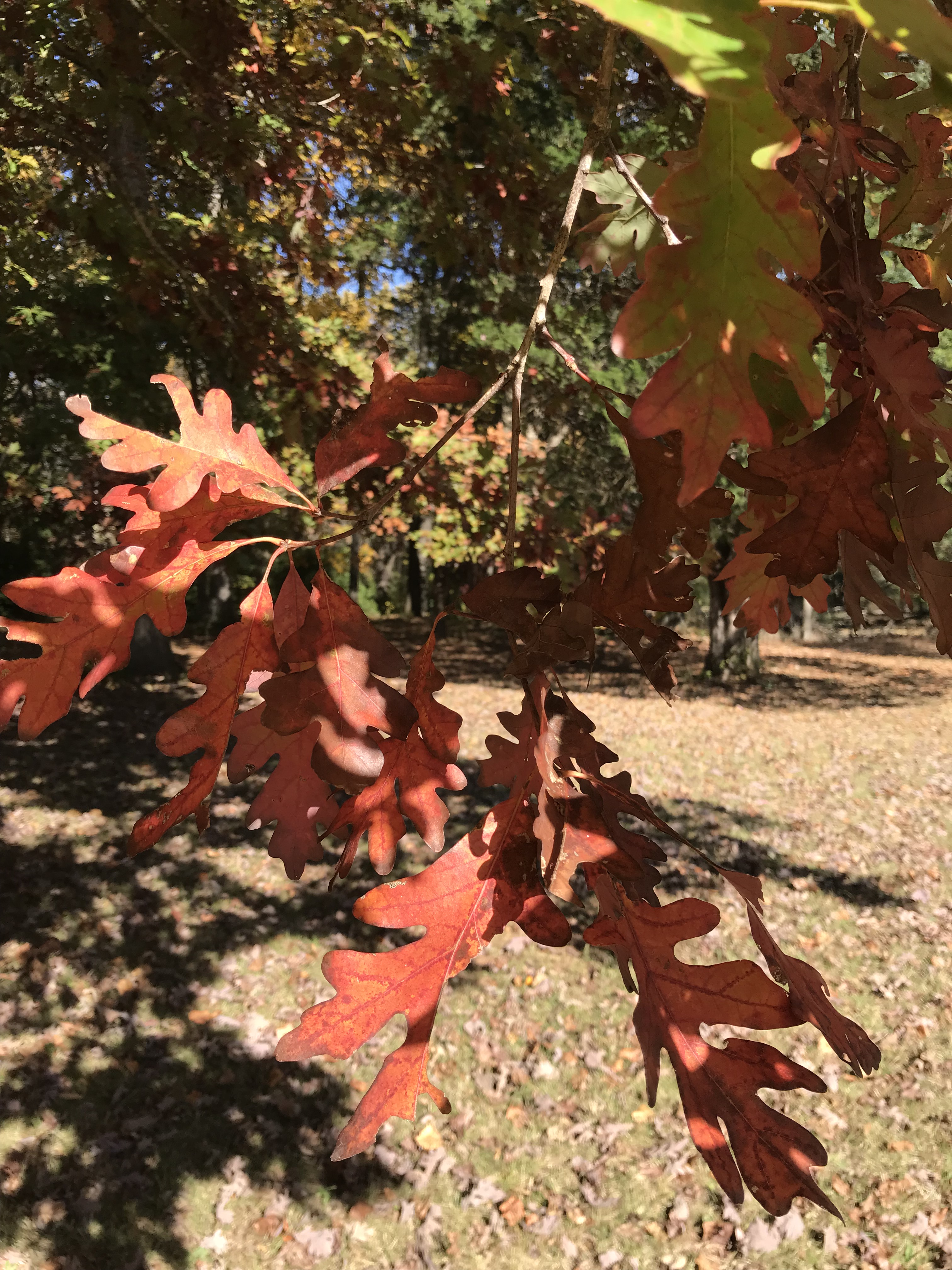
Oak Leaves
Sweet Gum Tree Leaves trying to decide whether to turn red or yellow
Dealing with the leaves in the fall after the red, yellows, golds, and oranges have faded and the spent leaves have dropped to the ground is quite a chore. I tend to dread autumn because of the multitude of leaves that must be raked, blown, carried off, or mulched with the tractor, but this year I’ve chosen to enjoy the riot of color in our yard every day. It won’t last much longer.
This tree is pretty, but I don’t know what it is! Can anyone help me?
When not outside, I worked on my novel. I’m putting into practice some of the things I recently learned in the online writing course I’ve mentioned in earlier blog posts. It feels good to be revising, editing, and improving my novel.
The thought of Russia selling Alaska to the United States in 1867 – or any other time – makes my head spin. My first thought was, I bet the Russians are still kicking themselves over this! That led to me look up the origins of the idiom to kick oneself.
According to my handy reference book, The American Heritage Dictionary of Idioms, by Christine Ammer, this idiom, which means to berate or reproach oneself, dates back to the late 1800s. One wonders if the expression was coined by the Russians after selling Alaska to the United States, but I guess not.
Back to Russia Selling Alaska to the US
Back to the topic of today’s blog post… I remember reading about something called “Seward’s Folly” in a lower grades’ history book, but if given only seconds to come up with the answer I’d be hard pressed to recall that it refers to U.S. Secretary of State William Seward negotiating the transaction.
Many Americans thought it foolish to purchase Alaska for the exorbitant price of $7.2 million, or around two cents per acre. That converts to a mere $120 million or so in 2021.
Photo credit: Hari Nandakumar on unsplash.com
Putting the event in historical context, though, it makes sense that people were up in arms over the federal government spending $7.2 million for a place a world away. It was a place virtually no one in the nation expected to visit. To a great extent, that still holds true today.
A four-year civil war had taken a terrible toll on the nation. The Confederate states were being brought back into the fold of the United States, although there were deep-seated hatreds on both sides of that conflict – so deeply ingrained that remnants of those feelings still exist 160 years later.
In 1867, just two years after the end of that war, the federal government pays more than $7 million for a vast wilderness at the top of the world. No wonder it seemed like folly to the average American.
Photo credit: Deon Van Zyl on unsplash.com
All that taken into account, today Alaska seems like a bargain any way you look at it. It’s one of the places I’d like to visit, but that’s highly unlikely now. The photographs of the landscape and the wildlife are breathtaking.
Just think: 663,267 square miles. Denali and other National Parks. National forests. Wildlife refuges. Fishing. Glaciers. Whales. It’s one-fifth the size of the rest of the United States put together.
Alaskan Salmon, for crying out loud! It’s delicious and so nutritious.
Photo credit: Peter Hansen on unsplash.com
Alaska became a US territory on May 11, 1912 and was admitted as the 49th state in the Union on January 3, 1959.
Fifteen percent of Alaska’s population is indigenous. Nearly two dozen native languages are spoken in Alaska. No other US state is so rich in natural beauty, wildlife, natural resources, and human history.
Thank you, William Seward!
Since my last blog post
I continue with the eight-week online writing course. A couple more weeks to go.
We had beautiful days in the mid- and high-80s last week. It was probably summer’s last gasp. I’ll miss the warm weather. The weather last week was perfect for taking care of some yardwork. It’s time to get the yard ready for the coming winter.
Until my next blog post
I hope you have a good book to read. My reading for pleasure lately has been almost nil.
I look forward to getting my Covid-19 Moderna booster shot soon.
The American Civil War began on April 12, 1861, when southerners fired on Fort Sumter, South Carolina. Fort Sumter was, of course, a United States military fort on the coast of South Carolina.
Photo credit: Michelle Burdick on unsplash.com
The American Civil War was the culmination of the falling apart of a nation.
Confederate Gen. Robert E. Lee surrendered his troops to US Gen. U.S. Grant at Appomattox Court House, Virginia, on April 9, 1865, but fighting continued for a while west of the Mississippi River. U.S President Andrew Johnson declared the war over in all states but Texas on April 2, 1866. After accepting the new state constitution for Texas, President Johnson officially declared the insurrection over on August 20, 1866.
Death toll
The exact number of deaths in the American Civil War is unknown, but it seems to be agreed upon that it was at least 620,000 and as high as 750,000.
Local losses
In 1999, I compiled a booklet, “Rocky River Presbyterian Church and the War Between the States,” about how the American Civil War affected Rocky River Presbyterian Church in Cabarrus County, North Carolina. Established in 1751, in 1860 the congregation had 616 members. 440 of them were White and 176 of them were Black. The congregation lost 72 men in the Civil War. Their average age was 28. The youngest was 16 and the oldest was 44. Of the 72 who died, 52 died between January 1862 and November 1863. I’ve tried to imagine what an emotional impact that had on this farming community, but I can’t.
Rocky River Presbyterian Church, Cabarrus County, North Carolina
I researched each of the 72 men and boys in published genealogies, church records, census records, etc. in an effort to put names and real people on the statistics. Some families were hit especially hard, losing several sons.
Another local loss
In addition to the numerical and economic loss those 72 men and boys cost the congregation, the war resulted in a radical and racial change in the church’s make up. In 2004, I compiled another booklet, “Slaves and Free Blacks Known to be Associated with Rocky River Presbyterian Church Prior to 1870.” My purpose was to compile in one document all known records about the slaves and free Blacks who were communing and/or baptized members of the congregation from the earliest extant church records (1835) through 1870.
Photo credit: US Library of Congress, via unsplash.com.
I was astounded when the project was finished to find that I had a list of 917 slaves and 11 free Blacks. In addition to the church membership rolls and Session disciplinary trial minutes, I searched the 1860 and 1863 Cabarrus County Tax Assessment Lists – which listed every slave living in the county at those times—and the US Census records for Cabarrus County from 1870 and 1880. (By the way, the county tax assessment lists recorded not only the names of each slave under his or her master’s name, but also included each slave’s age, physical condition, and value. They are sobering documents.)
In 1867, present-day Bellefonte Presbyterian Church was formed by former Black members of Rocky River. The White pastor of Rocky River, being a product of the place and time, was hurt when the Black members of his congregation chose to go two or three miles up the road to establish their own church. Unfortunately, he saw them as children who didn’t know what they were doing. He didn’t understand why they didn’t want to stay at Rocky River and continue to sit in the balcony while the White members sat downstairs on the main floor of the sanctuary. No wonder they left! That’s easy for us to see today.
How racism continues to this day
Southerners tend to romanticize about the Civil War, but I doubt there was anything romantic about it at the time. The wives, mothers, sisters, and younger brothers were left behind to try to farm the best they could, not knowing when or if their loved ones would come home. I would not have wanted to be alive during that time.
All four of my great-grandfathers and one of my great-great-grandfathers fought on the losing side in the American Civil War. They were farmers in North Carolina. They did not own slaves. In trying to put myself in their places in that place and time, I can’t help but think they didn’t have much choice in joining the North Carolina Troops when the war began.
Lee Dulin, home from the Civil War
One was a boy of 16, no doubt out on a bit of an adventure with his neighborhood friends in the same company. He wrote letters to his parents and sister asking them to send him socks. One was in the 1st NC Cavalry and survived a severe head wound at Gettysburg that left him with headaches and a convulsive disorder for the rest of his life. One had restricted use of one of his arms for the rest of his life due to injuries sustained in the Seven Days Battle of Richmond. One was in Charleston at the end of the war and walked the 200 miles home. One of my great-great-grandfathers was a man in his early 50s – much too old to go off to war, but that’s what he did. It’s hard to find the romance in any of that. They came home defeated, with perhaps a little worthless Confederate currency, only to have to go back to eking out a living by farming in a broken economy.
They were not the ones who built monuments to Confederate leaders. They did not raise the Confederate battle flag by their houses to show their Southern pride. They just went back to the hard-working lives they’d known since birth and tried to live out their lives as law-abiding American citizens.
I don’t know what any of those five ancestors of mine thought about race. I can’t sit in judgment of any of my ancestors any more than I can take credit for anything good they accomplished in their lives. Each of us is accountable for our own ideas, beliefs, and actions.
Where do we go from here?
Until Americans have an honest discussion about slavery and the ramifications of it… until people across the country study the facts and recognize that slavery existed in some northern states… until people across the country realize that northern states benefitted from the slavery in the South because the slaves picked the cotton that was sent to northern textile mills to be turned into fabric for people there to sell and wear at a low cost due to slavery… until people across the country accept each other and fight for all citizens to have the same rights and chances to excel… until as individuals we admit our prejudices and have the courage to speak up when we see racial injustice… I’m afraid the American Civil War will never be over.
Photo credit: Nathan Dumlao on unsplash.com
My heart sinks at the sight of the Confederate battle flag because, to people of color, it is a symbol of hate. I didn’t see it that way when I was growing up because I was White, but I do now. When you know better, you should do better.
As Americans, it’s easy for us to sit back, protected by the Atlantic Ocean on the east and the Pacific Ocean to the west and criticize the Arabs and Jews in Israel holding grudges over wrongs committed centuries ago, but many Americans are unwilling to forgive and forget when it comes to our own Civil War after 160 years. We can’t see the plank in our own eye because we’re concentrating on the speck in someone else’s eye.
Photo by Luke Michael on Unsplash.com
Since my last blog post
We finally got to bring our diabetic dog home from the hospital last Thursday. He was hospitalized for eight days with bronchial pneumonia. We’re so thankful for the good care he received at CARE (Charlotte Animal Referral & Emergency) once again.
Until my next blog post
Continue to celebrate D.E.A.R. (Drop Everything And Read) Month. I hope you have at least one good book to read this week.
Make time for a hobby.
Note: The two booklets I referenced in today’s blog, “Rocky River Presbyterian Church and the War Between the States” and “Slaves and Free Blacks Known to be Associated with Rocky River Presbyterian Church Prior to 1870,” are available through http://www.JanetMorrisonBooks.com. Click on “Rocky River Presbyterian Church Booklets.”
If you’ve visited my blog today expecting to find out what books I read last month, please forgive me. I felt compelled to write about an event in American history today. I’ll share with you my thoughts about the books I read in February in my blog posts on March 8 and 15.
#OnThisDay
It was 240 years ago today that the Articles of Confederation were ratified by the State of Maryland – the last of the 13 states to ratify the document, making it the law of the land.
As a writer and reader of historical fiction and nonfiction, I need to keep in mind what the federal government could and could not do before 1789. Today’s blog post is a “crash course” about the Articles of Confederation. I hope it will be a painless way to refresh your memory about the document and some of the reasons it had to be replaced by the US Constitution.
What were the Articles of Confederation?
The Articles of Confederation were spelled out in a five-page document that served as a constitution for the former American colonies after they won independence from Great Britain in the American Revolutionary War. It took the Continental Congress 16 months to draw up the document. The document was adopted on November 15, 1777, in York, Pennsylvania. York was serving as the temporary capital of the new country.
The Articles of Confederation loosely held the 13 states together. It mandated a single house in Congress, and each state had one vote. The Articles gave Congress authority over foreign affairs, the power to raise a national army, and the power to declare war and declare peace; however, the Articles did not give the Congress the power to levy taxes.
How durable were the Articles of Confederation?
It didn’t take long for people to identify problems with the Articles of Confederation.
Not wanting to risk being accused of “taxation without representation” the framers of the Article of Confederation gave states the authority to impose taxes but they did not give that authority to the United States government. Having hindsight, we can see today that such a setup was unsustainable, and it’s difficult for me to see how the framers couldn’t anticipate that. Since the new nation was in debt at the end of the American Revolution, it was difficult to raise funds to pay off that indebtedness without the power to impose taxes.
Another problem with the Articles of Confederation was that each state could issue their own currency. Imagine if that were the case today!
Photo credit: Alexander Schimmeck on unsplash.com
The Articles of Confederation failed to create a sense of nation. With a weak central government, allegiances were often more to one’s state than to the country. Indeed, that mindset continued in some ranks and contributed to the formation of the Confederate States of America and the outbreak of the American Civil War. Robert E. Lee’s almost blind allegiance to the State of Virginia comes to mind.
The US Constitution
Seeing the problems with the Articles of Confederation, the US Constitution was drawn up. It replaced the Articles of Confederation on March 4, 1789. For more information about the creation of the US Constitution, please see my May 25, 2020 blog post, #OnThisDay: 1787 US Constitutional Convention.
Photo credit: Anthony Garand on unsplash.com
Since my last blog post
I’ve enjoyed reading some books that I’ll blog about later. After having trouble concentrating on anything in January, it’s been gratifying to once again enjoy reading.
Until my next blog post
I hope you have a good book to read and quality writing time if you’re a writer, blogger, or like to journal just for your own edification. Writing is therapeutic.
I hope you have time to enjoy a favorite hobby.
Keep wearing that facemask out of respect for others.
Here I am, with another little history lesson. I hope I’m not losing my audience. My blog is about my journey as a writer. I write history and historical fiction, so continuing to study history and sharing some of what I learn is an integral part of my blog.
Last week I admitted how little I knew about the Spanish-American War. In today’s blog, I’ll admit how little I knew, or at least remembered, about the Florida Purchase. If history could be taught in story form instead of lists of battles and dates, I think we’d all retain more of it later in life.
As you read my post, I want you to think about what the map of the United States would look like today if not for this 1819 treaty.
In case you’re ever on “Jeopardy!”
The Adams-Onis Treaty was negotiated and signed by U.S. Secretary of State John Quincy Adams on February 22, 1819. That’s 202 years ago today. Luis de Onis, the 1809-1819 Spanish Envoy to the United States, negotiated and signed for Spain; hence, the name Adams-Onis Treaty. It’s also known as the Florida Purchase Treaty, the Treaty of 1819, and the Trans-Continental Treaty.
What the treaty accomplished
The United States was still in its infancy as a nation in 1819. It had won two major wars against Great Britain, but it was just 40 years old. The map of the United States was still in flux. In fact, it still is with the possibility of the District of Columbia and Puerto Rico possibly gaining statehood status. In 1819, the vast West was still occupied by native peoples and enormous herds of bison and other native animals.
Under this treaty, Spain gave up its claim to the Florida peninsula as well as the panhandle of Florida, the coastal lands of Alabama and Mississippi, and part of Louisiana. The United States temporarily gave up Texas. The boundaries of the Louisiana Purchase were more accurately defined, and the boundary between Spanish Mexico and the United States was settled. Spain relinquished its claim to the lands north of the 42nd parallel known as the Oregon Territory. (The 42nd parallel later formed the northern boundaries of California, Nevada, and Utah.)
What if…?
When I’m writing fiction, I often ask myself, “What if…?” Asking myself that questions leads to plot twists in my fiction, but it can lead to some fascinating theories of how history could have turned out differently if certain events had not happened. I touched on this question in last week’s blog post, #OnThisDay: Remember the Maine! What you might not know, when I asked how history would have unfolded if the Americans had known that the sinking of the Maine was an internal accident and not an act of war by Spain.
Imagine how the United States would look today if the Adams-Onis Florida Purchase Treaty hadn’t been signed and ratified.
There would be no Disney World or Cape Canaveral. Or, if there were, they’d be in Spanish Florida.
Photo credit: Justin Novello on unsplash.com
There would be no white sandy Gulf of Mexico beaches in the United States.
There would be nowhere in the southeast for people from the cold northern states to retire to or spend their winters.
The 55th Super Bowl wouldn’t have been held in Tampa, Florida earlier this month.
There would be no American Floridians creeping along at a snail’s pace on the curvy mountain roads in western North Carolina because they’re terrified of curves and hills. They’d be Spanish Floridians.
All jokes aside, we’d be importing lots of vegetables and citrus fruits from Spain because that’s who would still own what we know now as the state of Florida. And perhaps Spain would still control the Oregon Territory. The map of the United States would look quite different than it does today. Our history would be quite different, and we would lack many of the natural and cultural resources we enjoy today that make our country what it is.
I have given a simplified description of the Adams-Onis Florida Purchase Treaty in this blog post, but on this 202nd anniversary of its signing, I believe we Americans can be glad it was negotiated and signed.
Since my last blog post
I’ve been reading, writing, and enjoying both. The part of North Carolina I live in, dodged the snow and ice that much of the U.S. has been dealing with. The people of Texas and other areas without electricity and safe drinking water are in my prayers. Mississippi was hit hard, too, but hasn’t received much national publicity.
The first crocus of the year opened near our side porch and the daffodils are coming up. I look forward to spring with great anticipation.
Until my next blog post
I hope you have a good book to read. I’m reading Soroosh, a new novel by Laleh Chini, and listening to The Unwilling, by John Hart.
Find time for your favorite pastime.
Even if you won’t wear a mask to protect yourself, please wear one out of respect for others. We’re all in this Covid-19 pandemic together and it will take all of us working together to get out of it faster.
Note to my neighbors and friends in Canada (including author Laleh Chini): This is “Freedom to Read Week” in your country.