I write southern historical fiction, local history, and I've written a devotional book. The two novels I'm writing are set in Virginia and the Carolinas in the 1760s. My weekly blog started out to follow my journey as a writer and a reader, but in 2025 it has been greatly expanded to include current events and politics in the United States as I see our democracy under attack from within. The political science major in me cannot sit idly by and remain silent.
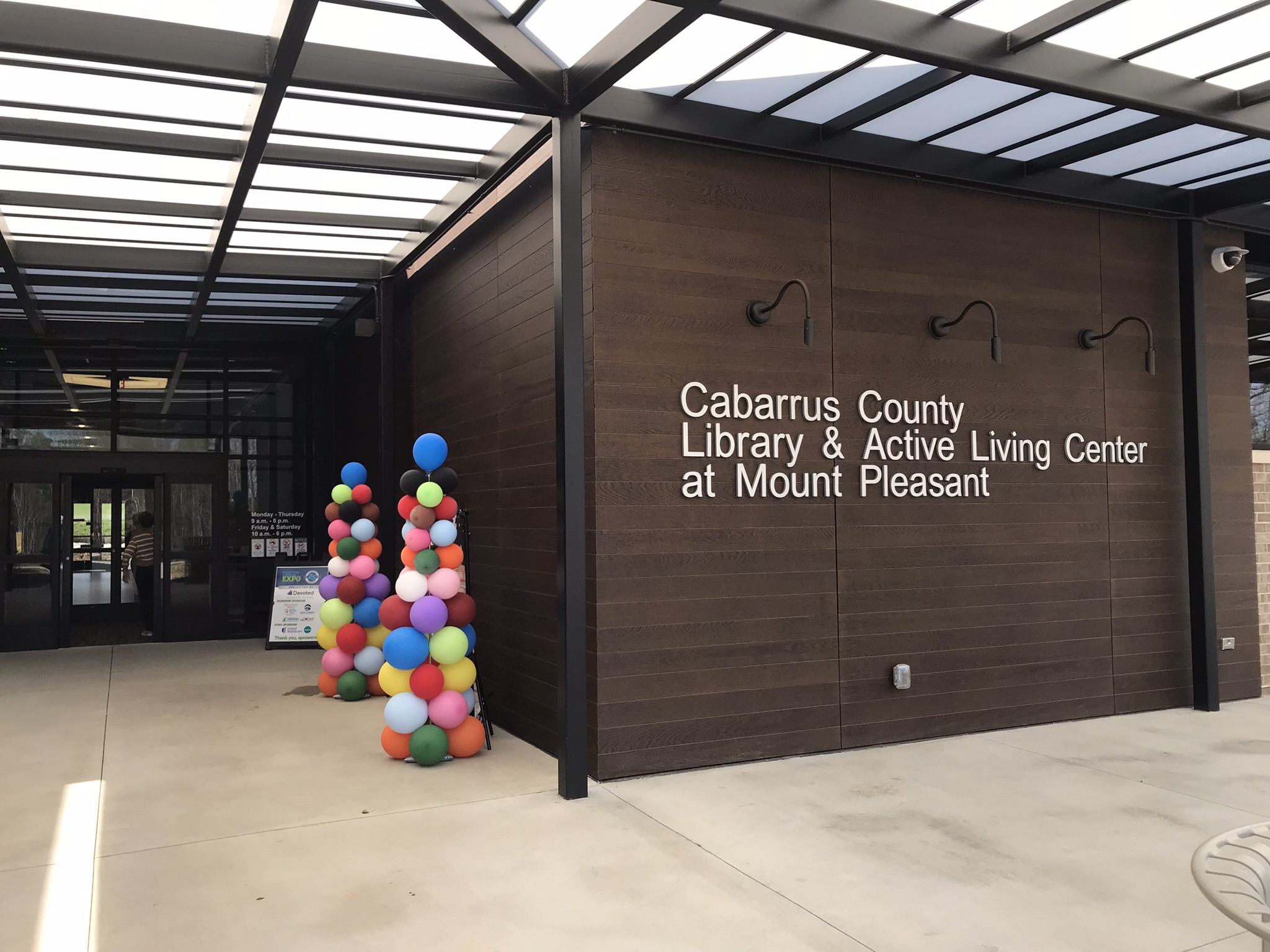
I had two delightful experiences last Thursday at the first day of the second annual Mt. Pleasant Literary Festival in Mt. Pleasant, North Carolina. The public library staff and The Friends of the Mt. Pleasant Library are real go-getters!
Mt. Pleasant is a quiet little town, more of a village than a town originally settled by German immigrants in the mid-1700s. It is in eastern Cabarrus County.
The Bernheim Literary Society (named for the literary society for the students of Mont Amoena Female Academy, located in Mt. Pleasant from 1859 until 1927), The Friends of the Mt. Pleasant Library, the Cabarrus Arts Council, and individual and commercial sponsors make this annual literary festival possible for the public – free of charge.
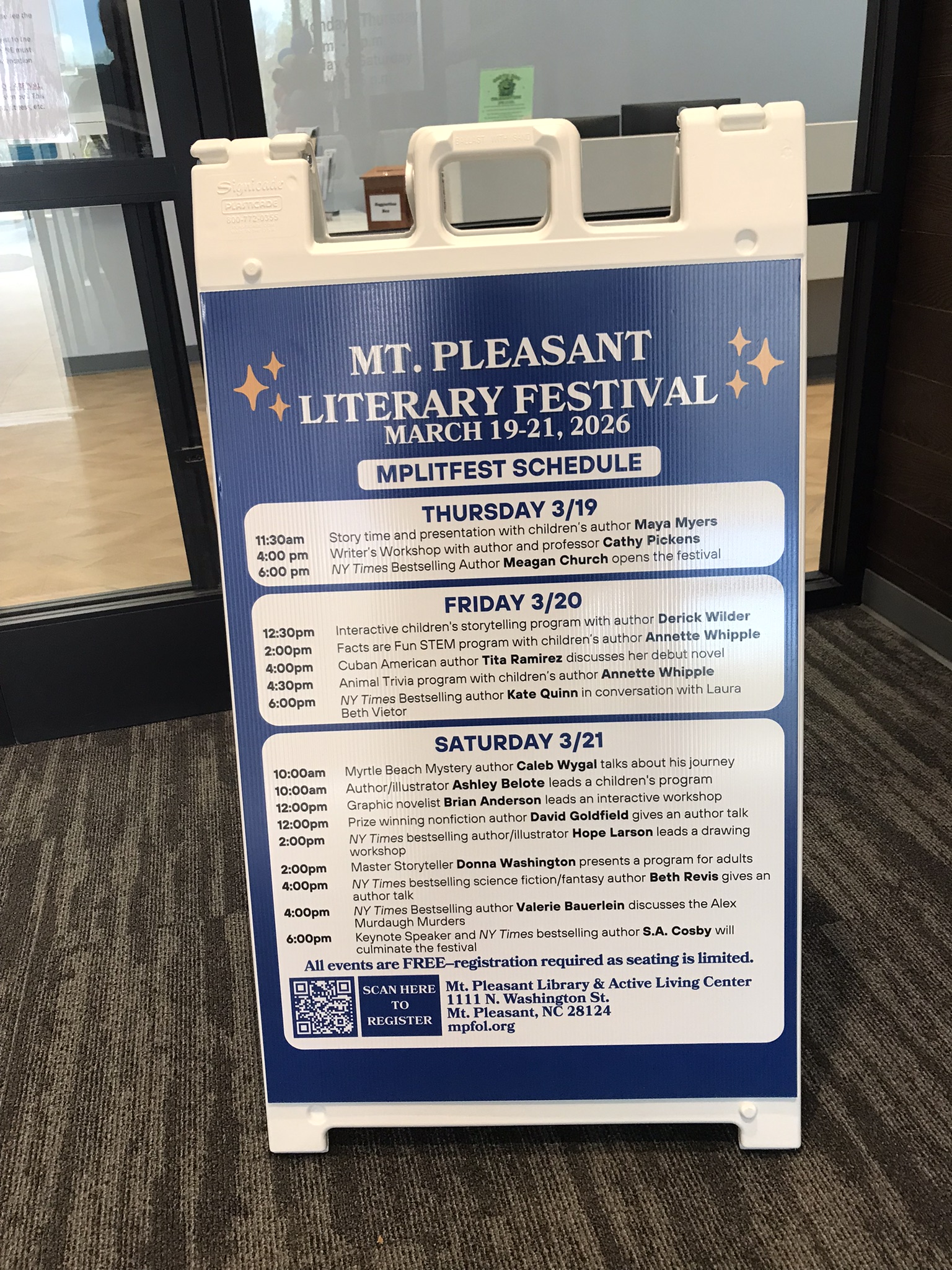
Schedule for the 3-Day event
This second annual event attracted such authors as Kate Quinn and Meagan Church! I understand some authors have already been signed on for next year’s festival. I can’t wait to find out who’s coming!
I was too late registering for Kate Quinn’s presentation. Lesson learned for future festivals!
The first event I attended on Thursday was a 90-minute Writer’s Workshop with author and professor Cathy Pickens. She has an impressive history as a lawyer, a professor, and a writer, so I was privileged to have the opportunity to finally attend one of her workshops.
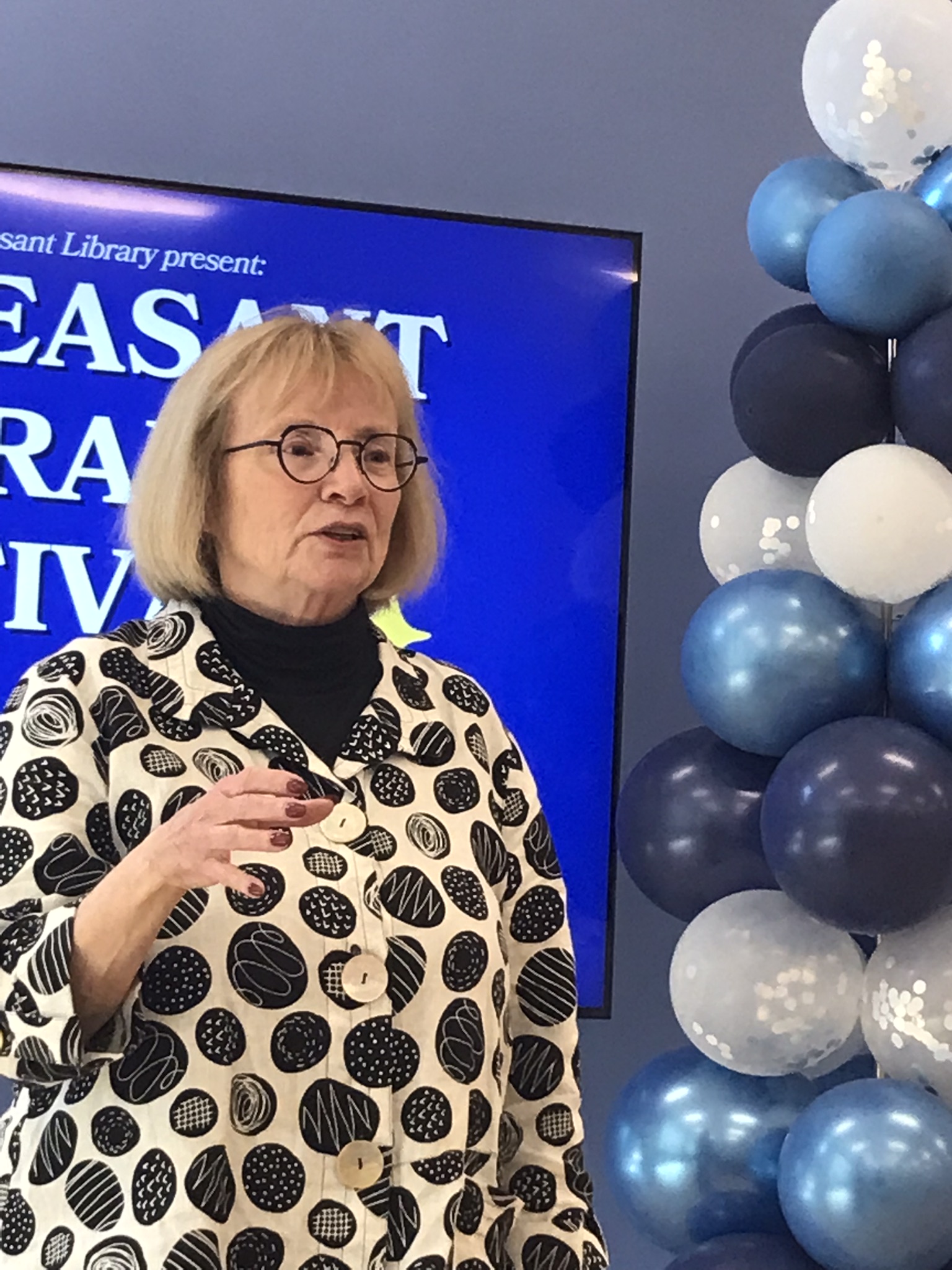
Cathy Pickens, teaching a Writer’s Workshop at the Mt. Pleasant Literary Festival, March 19, 2026
She led us through a systematic series of writing prompts to help us clarify the roots of our creativity and why we want to write what we want to write.
Workshop attendees were in various stages along our writing journeys. The first thing she had us write about was our “pinprick.” What was the pinprick that set in motion my desire to write the story I want to write? I knew immediately what the pinprick was for the series of historical novels I’m writing. It was a banjo from Africa.
(That’s all I will tell you about that banjo for now. You will need to continue to read my blog posts and subscribe to my e-newsletter if you want to find out later just how that came about. It seemingly came “out of the blue,” but maybe it is deeply connected to the historical fiction I want to write.)
Back to the workshop… I was able to quickly write an entire page about that banjo as my inspiration or “pinprick” as she called it.
Ms. Pickens talked about how it was sometime between the ages of eight and eleven that something happened that influenced the paths our lives take. Whether or not we are aware of it at the time, something happened that set us on a path to writing. Our worldview begins to shift, and you start to try to figure out what you want to be when you grow up. She asked us to write down everything we could remember from those years of our life.
I was surprised at how many things I remember and in minute detail and how each of those incidents made me feel. As I wrote, it became clear to me that my lifelong interest in the colonial era of United States history and what unbeknownst to me put me on the path to majoring in political science and minoring in history in college started when I was in Miss Judy Ford’s fourth grade class at Harrisburg School in Harrisburg, North Carolina.
Miss Ford made Jamestown and Colonial Williamsburg come alive to us, although we lived a long way from those places and had no hopes of visiting them in the foreseeable future. I’ll never forget that Colby Cochran’s father, Dan, built a pillory for the class so we could in some small way experience what that public form of punishment and humiliation was like for our nation’s colonial ancestors.
As you can see, Ms. Pickens’ questions and writing prompts triggered a flood of memories for me and helped me piece together why in later life I want to write historical fiction.
She talked about how creative young children are, but usually when we are in our teens peer pressure kicks in and most of us begin to stifle our creativity. We’re told to pursue occupations or fields of study to lead us to a way to make a living.
Being a writer is not the occupation one should choose in order to make a living!
CREATE! by Cathy Pickens
Ms. Pickens talked about the writing process. Different participants in the workshop shared what their process is. She asked us what holds us back in our writing. (No one was pressured to voice their answers to any of her questions; it was a very relaxed and welcoming atmosphere.)
Ms. Pickens recommended that we set a goal to write a certain length of time or a certain number of words each day. Even if it’s only 15 minutes, slow and steady seemed to be her advice.
I recently revealed in my February 27, 2026 blog post (My new discovery: I’m a binge writer!) that I’d had the epiphany that I am a binge writer when it comes to my novel(s). I find it easy to work on a blog post or two each day, but when it comes to writing fiction I have not been able to discipline myself to write every day of the week.
Ms. Pickens advised us to be very specific in categorizing what we are writing. She pointed out that the Library of Congress categorizes books in more specific details than the Dewey Decimal System. She suggested that we look inside the front covers of books in the genre in which we write to familiarize ourselves with how the Library of Congress labels books.
She suggested that instead of asking a writer, “How long did it take you to get your book published?” a better question is, “How long did it take you to get your book publishable?”
The road to traditional publishing is typically years and years long.
Ms. Pickens ended by saying that the secret to success is discipline – time, place, and goal. To read more about Cathy Pickens, visit her website, https://cathypickens.com/. She has written a Blue Ridge Mountains series of cosy mysteries, a book of Charleston mysteries, nine true crime books, and CREATE! — a book for writers.
Tune in tomorrow for my blog post about author Meagan Church’s presentation.
Janet
The government should be afraid of its citizens, not the other way around.
I’ve had a net loss of three of my 1,297 blog subscribers in the last two weeks. I don’t know why, but I have a hunch it is because I have either stepped on some toes with my criticisms of Trump, or perhaps the individuals who hit the “unsubscribe” button just did not want to read about Trump anymore.
I understand, if they left for either reason. If I thought Donald Trump hung the moon and the stars and was sent by God to save the United States, I wouldn’t want to read my blog either.
Photo by Kaitlyn Baker on Unsplash
If I’m on the verge of a nervous breakdown because of the rapid dismantling of democracy in the United States, I wouldn’t want to read my blog either.
I get it.
I don’t want to write about the Trump Administration every day. That’s why I took a break from it last week. I only blogged twice.
That break freed up time for me to work on the companion journal/diary I’m creating to go along with my I Need The Light! devotional book.
I Need The Light! 26 Weekly Devotionals to Help You Through Winter, by Janet Morrison
It gave me time to edit most of the historical short stories I plan to publish as a collection later this year.
Photo by Aaron Burden on Unsplash
I needed to take time to do those things for my mental and physical well-being. I hope to have more weeks in which I only blog a couple of times.
When I started blogging more than a decade ago, I was encouraged over every subscriber milestone. The numbers are not that important to me now, but I noticed I was on the verge of having 1,400 subscribers. Then, my numbers started going down. I needed to evaluate the situation and determine if I was doing something wrong.
I concluded that after a decade I have started fearlessly speaking my mind. Perhaps some of my subscribers liked the old me – the me who just blogged once-a-week about the craft of writing or the books I read. The old me struggled to think of something to blog about once-a-week.
But that’s not me anymore. I’m older, but not necessarily wiser. I’m in a place in my life’s journey where I am no longer afraid that I will offend someone who sees politics or other major issues differently than I do.
I am no longer afraid that if I blog about politics I will alienate someone who would have otherwise purchased one of my books.
I blog because it has become part of my identity. I blog because I am deeply concerned about what is happening to and in the government of the United States. I cannot turn my back on my political science degrees and my sense of patriotism.
But most of all, I blog because I thoroughly enjoy forming online relationships with other bloggers and subscribers. Readers and subscribers will come and go. Perhaps I’m finally finding my voice and my niche, and I no longer attempt to reach the masses.
What I write about will not and cannot appeal to everyone. That is a good lesson for me to remember when I publish a book!
Photo by Luis Morera on Unsplash
In conclusion, it’s not really about the numbers. It’s about the relationships I have made and will continue to make through my blog. If my subscribers dwindle down to 100, it won’t bother me now because I have come to understand that it’s just about the relationships and exchange of ideas.
I considered saving today’s topic for my July 7 planned blog post about the books I am reading in June, but I decided it deserved its own post.
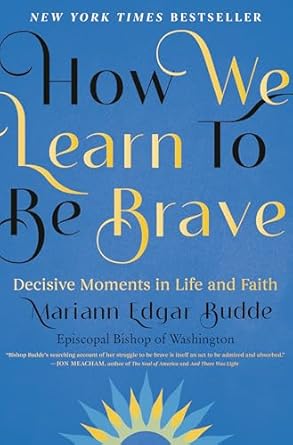
Last week, I read the fourth chapter in How We Learn to Be Brave: Decisive Moments in Life and Faith, by Mariann Edgar Budde.
How We Learn To Be Brave, by Mariann Edgar Budde
If the author’s name sounds familiar, it is because she is the Bishop of the Episcopal Diocese of Washington, D.C. and the Washington National Cathedral. She spoke boldly in the worship service on President Trump’s Inauguration Day in January 2025, and was sharply criticized by Trump for her courage.
My sister read this book and encouraged me to at least read the fourth chapter before she returned it to the public library. She said it reminded her of me and some of my life experiences. I took time to read that 34-page chapter titled, “Accepting What You Do Not Choose.”
My story (well, part of it)
At the age of 25 I accepted the fact that I had a medical problem that was incurable but could be treated with a series of surgeries. It meant that I would never have a chance to have children. Less than ten years later I accepted the fact that I had chronic fatigue syndrome and fibromyalgia, neither of which can be cured and treatment of the symptoms is poor at best.
What I was able to accept has astounded my sister. She knows better than anyone else how much physical pain I tolerate and the fatigue that makes it difficult for me to get up and face each day. She says she has asked God, “Why Janet?” but I just find that odd because I have never asked God, “Why me?”
I admit that when I get frustrated over the memory problems that accompany chronic fatigue syndrome that cause me to make mistakes and have to repeat various tasks, I do sometimes ask God why life has to be so hard.
But I’ve never asked God why I had endometriosis, a ten-pound ovarian cyst, fibroid tumors, chronic fatigue syndrome, fibromyalgia, chronic corneal erosion, and so forth. Why would I do that? Stuff happens. God never promised us that life would be a bed of roses. He promised He would always be with us. Diseases happen. Accidents happen. No one has a perfect life, so why would I expect my life to be perfect?
My father was my example
My example was my father. He was just 61 years old when he was diagnosed with multiple myeloma. I had just started my sophomore year in college. He lived for almost five more years. The chemotherapy acted like fertilizer on his cataracts and he went blind. Blindness was harder for him to accept than his cancer because there was nothing he could do to fight blindness.
He insisted on having cataract surgery against his doctors’ recommendations, but it was unsuccessful. But in those five years of sickness and eventual legal blindness, I never once heard my father ask, “Why me?” That just was not the way he approached his medical diagnoses. He continued to work every day until his eyesight made it impossible for him to drive.
What Bishop Budd’s 4th chapter had to say
I read the fourth chapter in Bishop Budde’s book, and it was comforting. She writes from a place of physical pain that I did not know she had. The book gave me some things to think about. It is always helpful to listen to another person’s perspective.
Budde writes several pages about the Rev. Dr. Martin Luther King and how he accepted the life he was dealt. She writes about acting from a place of love and putting the other person ahead of ourselves. Instead of being like the Levite and the priest in the story of the Good Samaritan, we should strive to be like the Good Samaritan.
The Levite and the priest in the story saw the man who needed help, but they were afraid of what could happen to them if they stopped to help the man. But if we try to adopt the mindset of the Good Samaritan, when we see someone who needs help or an injustice, we should ask ourselves, “What will happen to them if I don’t act?”
That is the question I have asked myself daily since January 20, 2025. What will happen to my country, to my great-nieces, to their future children, if I don’t act?
With Episcopal Bishop Michael Curry’s words in mind from Prince Harry and Meghan Markle’s wedding ceremony, Budde writes, “When we choose love in response to what we wish we could change but can’t; when we choose love as our response to the world as it is, not as what we wish it were; when we choose love over denial, or anger, or cynicism and withdrawal, we share in God’s redeeming of our world. It doesn’t make the work any easier, but it gives our efforts a sense of purpose that can carry us through. Through our imperfect efforts, God’s grace shines through us in ways we may never know or fully understand.”
Budde closes the fourth chapter with the following words:
“Our lives are full of unforeseen choices, struggles, and callings. Sometimes we can overcome these obstacles, and sometimes we must make peace with them…. Accepting what we did not choose involves a leap of faith that God is present and at work in ways that we cannot comprehend…. This kind of acceptance is not passive or fatalistic, but rather a courageous choice at a decisive moment to embrace the places we are broken as an integral part of a courageous life.”
I didn’t feel courageous at age 24 but maybe I am at 72
I don’t consider that I was courageous in accepting my physical limitations. It never occurred to me that I had a choice, so what would have been the point of fighting or lashing out at God about them?
Another participant in a Chronic Fatigue Syndrome support group in the 1980s who every month angrily said, “I refuse to be sick! I’m not going to put up with this. The rest of you can be sick if you want to, but I refuse.” I don’t know what became of her. I hope she was able to find a place of acceptance and contentment.
There was another participant in the support group who presented herself as a wealthy middle-age woman who enjoyed playing tennis every day. She could no longer play tennis and it crushed her spirit. She committed suicide.
I did not choose to have Chronic Fatigue Syndrome since April 26, 1987, but here I am.
On the other hand, I did not choose to have Donald Trump as my President, and it is taking a degree of courage for me to express my concerns in my blog. I don’t personally know but a few of the people who read my blog. WordPress tells me that people in 81 countries have read my blog just in 2025. People who may wish me harm for my opinions might read my blog. A few trolls have read it and left unpleasant comments.
I’m happy to engage in a “conversation” about the topics in my blog, but when a comment turns into a personal attack or accusations about my credibility or motives, I draw the line and I delete them. I do not owe my time and limited energy to someone who merely wants to pick a fight.
The bottom line
“The bottom line” is that we do not choose many of the things that happen to us, but we can always choose how we react to them. Our experiences make us who we are. If I had not had some medical problems, I would not be the person I am today.
We can look for constructive and creative things to do when we have physical or career setbacks. If I had not been forced to give up my chosen career due to my health at the age of 34, I might not have taken a writing course at the age of 48.
If I had not taken that writing course, I would not have had the confidence to write a local history column for the newspaper at the age of 53 to 59. If I had not taken that writing course, I would not have started a blog at the age of 60.
If I had not written 175 local history articles for the newspaper, I wouldn’t have been able to self-publish them in two books (Harrisburg, Did You Know? Cabarrus History, Books 1 and 2). If I hadn’t wanted to publish those articles in book form, I wouldn’t have learned how to format a book on the computer so I could self-publish on Kindle Direct Publishing.
If I had not taken that writing course or published those two history books, I would not have published two short stories on Amazon… or a cookbook with my sister in 2023.
If I had not taken that writing course, I would not be writing an historical novel now at the age of 72.
If I had not had Chronic Fatigue Syndrome, Fibromyalgia, and Seasonal Affective Disorder and learned how to write and self-publish, I would not have just finished writing a devotional book. I hope to publish I Need The Light in August, so stay tuned!
God did not wish for me to have any of my physical maladies, but he gave me the Holy Spirit. The Holy Spirit gives me the gumption to get up every day (although some days I don’t get up until the afternoon) and to seek God’s will in my life.
It is through The Trinity — God, Jesus Christ, and the Holy Spirit — that I have the energy and creative motivation many days to read, write, interact with the friends I’ve made around the world through my blog, sometimes dabble in genealogy, and occasionally keep learning to play the dulcimer – a musical instrument I took up in middle age.
It is through The Trinity that I was given an interest in history and political science. It is those lifelong interests that compel me to pay attention to current events. The current events in my country are sources of much stress and concern.
I see the democracy in which I have thrived all my life under attack now from within. My government is turning against its citizens and the things we value. I did not vote for any of this, but the situation is the one I’ve been dealt.
It is up to me how I react.
Some days I wish I could just turn off the news. Some days I wish I could listen to the news and then just go about my business and not be concerned. Lots of people seem to be able to do that. I am not one of them. (I am simultaneously envious of them and frustrated with them!)
The reelection of Donald Trump has upended my little weekly blog (and, therefore, my life) into an almost daily report (some say “rant”) about the dismantling of our democracy. Nothing about 2025 is what I had planned for myself, but life happens.
Now you see
So now, 1,900 words later, you see why I decided to give the fourth chapter of Bishop Mariann Edgar Budde’s book, How We Learn to Be Brave: Decisive Moments in Life and Faith, its own blog post.
Some of you might think my life is too much of an open book. I get it. Some people don’t want anyone to know they have medical problems. I don’t share that information about myself to get your sympathy. That’s not what this is about. But perhaps someone else with health problems at a young age (or at any age) can take some measure of encouragement from my blog today or from the devotional book I will blog more about later.
It’s all about faith and where we get out courage to keep putting one foot in front the other. It’s about how we react to whatever comes our way.
What are your priorities?
What creative and constructive ways have you found to express yourself and react to the life you have been given?
It’s never too late to find your voice.
It has been my experience that when life circumstances close a door, God always opens a window… or even a bigger door.
Until my next blog post
Keep reading and paying attention to what’s happening in your country and the world. Being a citizen is not a spectator sport!
Remember the brave people of Ukraine, and don’t forget the people in western North Carolina who are still recovering from last September’s hurricane and record-setting flooding and landslides… as well as a new flood and landslide two days ago just over in Tennessee which has closed I-40 to all traffic (again) for a couple of weeks.
I have followed John Pavlovitz’s blog for years. He is a pastor whose church left him. Notice my phrasing. In these times of evangelicals blurring the lines between church and state and morphing into what resembles a political party, Mr. Pavlovitz found himself out of step with his congregation.
Mr. Pavlovitz now writes on Substack. Like me, he is worried about the state of things in America and is baffled over how people who profess to be Christians think all the chaos, name-calling, lying, and destruction of our democracy that have taken place since January 20 are just fine. They say they would vote for it again, if given the opportunity.
On April 25, Mr. Pavlovitz wrote an excellent piece on Substack titled, “Do You Miss Who You Were Before All This? I Do.” Reading that article prompted me to write today’s blog post.
I wanted to address this on April 26 or April 28, 29, or 30, or May 1, 2, or 6, but I had already started writing my posts for those days. I was just trying to keep up with all the craziness going on in the US Government, so I had to plug today’s topic into my first available day… Friday, May 9.
Mr. Pavlovitz wrote eloquently in his April 25 piece about how he misses his former self. He realizes he has been dealing with the growing intolerance for others in our society and in our world for a decade now.
He misses his former self who laughed more easily, who naively thought most people around him had the same worldview, who more easily gave people the benefit of the doubt than he does today.
I can identify with everything he said, and I miss my former self. In fact, I miss the person I was before November 5, 2024.
The me I was before the election was a hopeful me. That me thought that surely there were enough good people in America that Donald Trump would not be reelected.
As the election results came in on the night of November 5, I realized how I had misjudged my fellow Americans.
The night that Donald Trump defeated Hillary Clinton in November 2016 was a huge disappointment.
The night Donald Trump defeated Kamala Harris was a gut punch.
In the ensuing weeks, I tried to convince myself that even though the next four years would be bad, we would weather the storm. America was strong. Ultimately, good would prevail.
Then Inauguration Day came and whiplash set in. The Project 2025 playbook we had been warned about, was put into place at warp speed.
I have lost some things, like my sense of humor, joy to greet each new day, anticipating that day will be a good one.
But I have learned a lot about myself.
I have learned that I can speak up for democracy when it is no longer a safe thing to do.
I can speak out against injustice.
Photo by Juliana Romão on Unsplash
I can put myself out there on the internet with my blog and say things that I know some people won’t like. Some of those people are my friends, relatives, and fellow church members.
I have found what I am willing to fight for. It was easy to be patriotic my first 72 years. It is not so easy now to be patriotic in America if you love democracy. The MAGA people have blurred the meaning of patriotism. In their eyes, if you don’t blindly and angrily support Trump, you are not patriotic. It is not so easy when you know that speaking up against the United States President can land you in harm’s way.
The MAGA people have blurred what it means to be a Christian. They seem to have a convoluted belief that God favors America and God wants America to be rich and turn its back on poor people here at home and around the world. They seem to believe that God wants America to wield such a fierce and powerful military that the rest of the world will cower in fear. The fact that they conflate that worldview with believing in Jesus Christ just doesn’t add up in my mind.
Coming to grips with this new Christian Nationalism movement is the most frightening part of our current situation in the United States. So many people who profess faith in Jesus Christ appear to have lost sight of his teachings. Instead of clinging to “Love thy neighbor,” they cling to “An eye for an eye.” Or, at best, they only consider people who are just like they are as their neighbors.
I am momentarily encouraged when I hear things like a US District Court for the District of Columbia granting a temporary restraining order to block Trump’s dismantling of the Institute of Museums and Library Services.
I am momentarily encouraged when I hear that the Voice of America shutdown is moving its way through the court system.
I am temporarily encouraged when I hear that there was enough public outcry and pressure put on by a journalist that the Guatemalan woman who was eight months pregnant and walked through an Arizona desert for two days with just one bottle of water is going to get a chance to tell a judge why she sought safety in the United States because she was scared to remain in Guatemala. If not for the press, though, she would have been deported as soon as her baby was born.
I cringe when Trump says the press is “the enemy of the people.”
It should not take a judge or a reporter to stop the injustices. The injustices should not be happening, but they are happening in such numbers and with such rapidity that there’s no way for the judiciary or the press to catch them all.
When I ask, “How are you?” please don’t say, “Fine.” If you are truly “Fine” right now in America, you’re obviously not paying attention.
Until my next blog post
I hope you have a nice, relaxing weekend.
I hope you have a good book to read.
Remember the people of Ukraine and western North Carolina.
When I started Janet’s Writing Blog more than a decade ago, I didn’t know what I was doing. I had not read many blogs, but I thought I was ready to jump in and write my own after being prompted by my niece’s husband. Craig is much more tech savvy than I. He designed my website as it served me well for 20 years. His interests, time, and business responsibilities changed over the years, so in January 2023 my website was redesigned by Carolina Custom Designs.
My blog floundered for several years in the beginning as I tried to find my niche. I played around with how often to blog and how long a blog post should be. Things have gone more smoothly since I settled on posting every Monday.
Photo by Kaitlyn Baker on Unsplash
I have slowly realized the potential my blog. In fact, I know I haven’t yet fully understood its potential.
It astounds me that people all over the world read my blog! In January 2024, for example, people in 36 countries read my blog.
I’m fortunate to live in the United States of America where I have freedom of speech and freedom to read anything I want.
I don’t want to run out of subject matter. I usually plan my blog post topics as much as a year in advance, but this year my editorial calendar just isn’t coming together like it has in the past.
Should I make some changes in my blog?
Last year was a busy year of getting my website redesigned; starting a newsletter in March; offering a free downloadable copy of my short story, “Slip Sliding Away” to everyone who subscribes to my newsletter; publishing a local history book, Harrisburg, Did You Know? Cabarrus History, Book 2; publishing my first ghost story, “Ghost of the Battle of Guilford Courthouse: An American Revolutionary War Ghost Story”; and, with my sister, Marie, published a cookbook, The Aunts in the Kitchen: Southern Family Recipes.
With all I had going on, I failed to keep expanding my editorial calendar. Having Covid in December, a health scare of a different nature at the same time which lapped over into January, and intermittent internet and telephone service for two weeks after a January 9 storm, I was in a mental fog until the first week in March. I do have the next four weekly blog posts planned and partially written; however, some weeks in the rest of 2024 need to be fleshed out.
More than 1,100 “follow” my blog, but most of them probably don’t read it every week. I try to keep in mind that although I have some loyal readers every week, there is always the chance (and hope!) that this will be the week when someone reads my blog for the first time. What can I write this week that will please my regular readers but also grab the attention of a first-time reader so much that they become a subscriber?
I don’t want to bore my loyal readers with references to my books, short stories, and website; however, I want that new reader to be aware of what I’ve written. It is a delicate balancing act.
What Ryan Lanz says a blogger should do
A list I keep in front of me as I plan my blog topics is Ryan Lanz’s “22 Ways to Impress a First-Time Blog Reader With Any Post.” Lanz sets the bar high! I don’t have Mr. Lanz’s permission to quote his list, but I’ll throw out several items on the list to give you an idea of what a blogger is challenged to do with every post:
“Tell them something they don’t know.”
“Tell them something they DO know.”
“Help them solve a problem.”
It only gets more challenging as you read the other 19 items on his list! The one that always trips me up is number 3. I have a feeling in my more than 13 years of blogging, I have probably never solved anyone’s problem! I just don’t see that as my responsibility.
My plan
The first months in a calendar year tend to prompt us into new beginnings and reflection. That’s what I will continue to do over the coming weeks, and I hope I’ll find enough topics of interest to keep blogging every Monday for the foreseeable future.
Stay tuned. Next week I will blog about the books I read in April.
Until my next blog post
I hope you have a good book to read.
If you are a blogger, you can probably identify with today’s post.
Don’t forget the people of Ukraine.
Remember to subscribe to my e-newsletter before the May issue if you want to learn about an on-going archaeological dig in North Carolina! Just visit https://www.janetmorrisonbooks.com and click on “Subscribe.” My thank-you gift to you is a downloadable copy of my historical short story, “Slip Sliding Away.”
I read a thought-provoking blog post on January 22, 2020 – yes, nearly two years ago! I made a note about it in case I wanted to write about it in a future blog post.
That blog post was written by Cristian Mihai for his Art of Blogging blog. The name of the post was “Blogging Mindset – You Are a Blogstar.”
Photo credit: Davide Cantelli on upsplash.com
In the blog post, Cristian Mihai compared the blogosphere to the number of stars in our galaxy. He recommended that I, as a blogger, try to be the sun so I won’t be overlooked like the other billions of stars.
Photo credit: Klemen Vrankar on unsplash.com
Instead of emphasizing the need to get more followers than other bloggers, in this particular post Mr. Mihai wrote: “And yes, it takes back-breaking amounts of work to stand out, to be relevant to your readers, but if you turn yourself into a sun, no matter how small your audience is, you’ll find out that the benefits of blogging are more numerous than you ever thought possible.”
Speaking for myself, I want to attract blog followers who will also want to purchase my novel when I get it published. The trick is to find a balance between my journey as a writer, my lifelong interest in American history, my love of reading, and my long-range goal of providing you with historical fiction you love to read.
It’s a winding path. The path has been fraught with detours and incidents that appeared to be deadends.
Experts in blogging tell us that a blogger needs to solve a problem for the reader. In his August 12, 2019 blog post, “Blogging is All About Problem Solving,” Christian Mihai stated, “Now, what problems are you solving by blogging? That’s a serious question, and you should think about it, because your success depends on what you answer.”
This question has buzzed around my head for more than two years. I’m just trying to write a good historical novel, so how will tales of my journey solve anyone’s problems?
The best answer I’ve been able to come up with is this:
While I try to write the best historical novel you’ve ever read that’s populated by unforgettable characters — each playing their part in a story that will linger in your head long after you’ve finished reading it – I must convey to you through my blog posts that I have writing skills that are worthy of your time and hard-earned money, and that I know the history of a time and place so well that I can transport you there with my words.
No pressure there!
My Conclusion
I appreciate each and every one of you who have stuck with me since I started my blog June 24, 2010. I have my nephew-in-law to thank for setting up the website (http://janetmorrisonbooks.com) through which my sister and I publicize and sell our three Morrison genealogy books. Shortly after designing our website, he told me I should blog. The idea had never occurred to me.
When I started my blog, I didn’t know what I was doing. Some days, I still feel like that, but this is my 548th blog post. My posts were erratic in the beginning. I tried many different schedules. I settled on posting every Monday morning beginning June 26, 2017. That has worked well for me, but I wonder if I need to adjust that schedule again.
I keep promising you a novel. Hold on tight. The road will continue to be bumpy, but I believe there is light (and a novel) at the end of the tunnel.
I’ve concluded that, in light of Christian Mihai’s blog post referenced in the beginning of this blog post, I’m a star and not a sun.
Every minute of every day, 4,000 blog posts are published. There are more than 570 million active blogs in the world today. I don’t know how many suns there are in that 570 million, but I don’t expect Janet’s Writing Blog to ever qualify as a sun. For the time being, I’m happy to just be a star in the blogosphere.
Since my last blog post
Since last Monday, I’ve read Three Sisters, by Heather Morris, and The City of Mist, a collection of 11 short stories by Carlos Ruiz Zafón. I’ve also read How to Write Winning Short Stories, by Nancy Sakaduski and How to Write a Series: A Guide to Series Types and Structure Plus Troubleshooting Tips and Marketing Tactics, by Sara Rosett.
I continue to work on my novel. Do I dare consider it might be the first book in a series? If that’s a possibility, it will influence some of the details and plot lines it. Part of me thinks it’s presumptuous of me to think in terms of a series when it has taken me more than a decade to write the first book and it’s still in the editing stage.
Until my next blog post
In case you want to check out Cristian Mihai’s blog, you can reach it through his website: https://cristianmihai.net/. He’s been a full-time blogger for nine years.
I hope you have a good book to read and find fulfillment in your activities.
For those of us who are Christians, this is the Advent Season. I wish you joy, hope, and peace in the days leading up to Christmas Day.
Let’s continue the conversation
What do you look for in a blog? What do you look for in MY blog? I really need to know. What do you like about my blog? Do you wish I’d write more posts about a particular topic? Do you want me to continue my occasional “#OnThisDay” posts? Are you sick and tired of hearing about the novel I’m writing?
Two days ago, we marked the 20th anniversary of the September 11, 2001 major terrorist attacks on the United States.
Photo credit: Jack Cohen on unsplash.com
It was on September 11, 2001 that we Americans lost our innocence. It was the day we learned that the Atlantic and Pacific Oceans could not protect us. We learned that we were naïve and vulnerable. Our lives changed forever.
There have been numerous shows on TV over the last week in remembrance of 9/11 as it is called in the U.S. It has been gut-wrenching to watch the sights and sounds of that day in New York City, the countryside in Pennsylvania, and the Pentagon in Washington, DC over and over again. Every photograph puts me right back in that day.
The days just before 9/11
We’d had a busy and beautiful weekend. We celebrated the 250th anniversary of the founding of our church with a play and Dinner in the Grove. Descendants of all our former pastors had been invited for the weekend of festivities and had come from several states. I had written the play that was performed on Saturday afternoon.
Our oldest living former pastor, who was in his 90s, came from Virginia to preach the sermon on Sunday morning. Several hundred people enjoyed Dinner in the Grove after the Sunday morning worship service.
Before leaving with his grandson that afternoon, that old pastor insisted on making the trek to the spring between the church and the manse to take one last drink of cool water from the spring he’d last visited more than 60 years before. I held my breath as his grandson held him by his belt as the old man bent down double to get his mouth to the water flowing out of the pipe coming from the springhouse.
It was a glorious weekend!
Our brother and sister-in-law were here from Georgia for the festivities and were staying for a few days. I was tired on Sunday night, so I didn’t set the alarm to get up at any certain time for the morning of 9/11. I planned to sleep until I woke up – whatever the time. I had no plans for that day.
9/11
I was sound asleep when my sister woke me up saying, “The World Trade Center is on fire!” I struggled out of bed and went to the family room where she and my brother and sister-in-law were watching the ABC TV network.
My brother and I stood in the middle of the room, watching in horror as the fire consumed the top floors of one of the twin towers when an airliner came out of nowhere and plunged into the other tower. My brother and I looked at each other, and I said, “That was no accident.”
I knew instantly that life had just changed forever, but I didn’t really know the depths of those changes for a long time.
Within a few minutes, we knew another plane had been hijacked and forced to crash in Pennsylvania. Yet another hijacked plane crashed into the Pentagon.
My immediate reactions were digestive problems all that day. My stomach was in knots. What was going to happen next?
The aftermath
All air traffic over the United States was grounded as quickly as possible. Planes were ordered to land at the nearest airport. People ended up not where they had intended to go. Some of the people who had traveled more than 1,000 miles to participate in the celebration at our church had to rent cars and drive home because they didn’t know when they’d be able to get on a plane to fly home. Did they even want to get on another plane with such uncertainty about how and why the hijackings on 9/11 had taken place? I wouldn’t have wanted to.
It was reported on TV that 25,000 body bags had been ordered to recover the bodies of the people killed at the World Trade Center. It was a number I couldn’t get my head around. But what was even more difficult to comprehend as the day went by was that there weren’t going to be many bodies. Nothing remained except dust.
People posted photographs of their loved ones who had been in one of the towers that morning. We saw the pictures on TV. People frantically hoped their relatives and friends had escaped the buildings. Maybe they were injured and had amnesia. Maybe they were unconscious and unidentified in a hospital. People held out hope against all odds. But most of them had to accept that the person they loved so much had not survived.
The remains are still being analyzed 20 years later. In fact, the remains of one of the victims was identified just last week through DNA testing. Many families are still waiting for that official report.
I didn’t personally know anyone who was in the World Trade Center that day, but in the days and weeks after the tragedy we were told the stories of the special lives the victims had led. We learned of their small or unborn children who suddenly became orphans that morning. We learned of the young widows and widowers whose hearts had been torn out with the death of their spouses. Lives that held so much promise. So much intellect and talent wiped out in the blink of an eye.
For weeks after 9/11, we watched on TV as the rubble was removed. One thing I remember is that there was nothing to laugh about for months. The late-night TV talk shows that had depended on making fun of politicians or events in the news no longer had anything to poke fun at. And if they had dared, their disrespect would not have been gladly received by their audiences. It just didn’t seem appropriate to laugh about anything for months following 9/11. That made a lasting impression on me.
Peter Jennings stayed on the air for hours and what turned out to be days on end to inform us about what was happening.
For a long time after that, we knew if regular programming was interrupted for a special report, it probably wasn’t going to be good news. It was something that affected everyone, and it made me hold my breath in anticipation. It was before “breaking news” became something said on cable news every 15 minutes that usually turns out to be something you heard yesterday. And it wasn’t a high-speed chase 3,000 miles away involving a sports celebrity.
There were countless stories of heroism. Not just the first responders, but everyday people. For instance, the people on the plane headed for the White House or US Capitol. Passengers overtook the hijackers and forced the plane down in a field in Pennsylvania to save further devastation and death in Washington, DC. I was prompted to wonder what I would do in such a situation. Would I cower in fear or demonstrate bravery?
It seems quaint now, but in the months and possibly several years following 9/11, all Americans pulled together. All our little differences were forgotten. We were one country. We all rallied under our beautiful flag. We were kind to one another. The exception was that Americans of the Muslim faith were all suspect. They were vilified by some people. That was a sad result of the attack and it has persisted for 20 years.
The entire world came to our aid with moral support and tears. In our “hour of need,” other countries put their arms around us and held us up.
It was a time like no other I experienced before or since.
The mere mention of 9/11 brings to my mind images of those burning buildings, collapsed buildings, dazed survivors running for their lives, first responders rushing toward and into the towers, smoke settling over and shrouding Manhattan, the hole in the ground in Pennsylvania, the ugly hole gouged out of the Pentagon, employees fleeing the White House which was possibly the intended target of the plane that crashed in Pennsylvania. I can’t erase those images. Maybe I’m not supposed to be able to forget. I should never forget those who died that day – the sacrifices they made and the sacrifices their families made.
I now understand why my parents forever remembered Pearl Harbor on December 7 and why my great-grandfather always noted the anniversary of the Battle of Richmond in his daybooks.
The two books are The Immoral Majority: Why Evangelicals Chose Political Power over Christian Values, by Ben Howe and LEAPFROG: How to hold a civil conversation in an uncivil era, by Janet Givens, M.A.
I read Ben Howe’s book first. It addressed something that has dumbfounded me: How can Christians come down on opposite ends of the spectrum about Donald Trump? How do many evangelicals continue to support him when his speech, Tweets, and actions are in total contrast to the teachings of Jesus Christ?
I took copious notes while reading The Immoral Majority and thought I’d write a blog post about it. Then, I read LEAPFROG, by Janet Givens. I was immediately struck by how the two books could work together. This is probably the longest blog post I’ve written. If the topic interests you, I hope you’ll have time to read it.
The Immoral Majority: Why Evangelicals Chose Political Power over Christian Values, by Ben Howe
The Immoral Moral Majority: Why Evangelicals Chose Political Power over Christian Values, by Ben Howe
In the introduction to this nonfiction book author Ben Howe relates a story from 2012 when the Chick-Fil-A restaurant chain came under attack for its charitable foundation’s support of several organizations the Huffington Post labeled as anti-gay. Mr. Howe and a gay friend set out to make a video to show that Chick-Fil-A was a good company that did not discriminate against anyone due to their sexual orientation.
About the same time, a man in another state went to a Chick-Fil-A restaurant with video camera in hand to prove that Chick-Fil-A was a horrible company. A video he made of an exchange with the employee at the drive-through window went viral. Ben Howe more or less led a campaign to give that man “what he deserved.” The result of the campaign resulted in the man losing his job and having trouble finding employment for years to come.
In telling that story, Mr. Howe concludes: “It’s not really whether the punishment fits the crime; it’s more about the decisions of those who react to the crime and whether they are carrying out justice or simply joining the wrongdoer in being wrong.”
He asks the reader to imagine what happens when you put millions of self-righteous people together. An echo chamber develops.
“This is a book about what happens when the people who believe they have the moral high ground find themselves on the low road.” ~ Ben Howe
Feeling under attack, evangelical Christians in the United States had to decide whether to cling unflinchingly to Biblical principles or to act “according to Christ’s example.” As a group, they clung to principles and turned their backs on Christ’s example. The result was the election of Donald Trump in 2016.
Mr. Howe theorizes that the shift started with Jerry Falwell, Jr.’s January 2016 endorsement of Trump for US president. Although a few evangelical leaders spoke out against Trump, Falwell held sway over the majority. Just as Jerry Falwell, Sr. had helped launch the “Moral Majority” movement in 1980, his son was instrumental in urging evangelical Christians to support Trump in 2016.
The difference was, in 1980 Christians were encouraged to influence politics, but in 2016 Christians were, in Mr. Howe’s words, “being forcefully changed by politics.” In his campaign, Trump played on people’s fears. He told Christians they were being persecuted by the government and the Internal Revenue Service, and he promised to put an end to it.
People like Dr. Ben Carson maintained that Trump was a chess pawn in God’s hands and we needed faith that God knew what He was doing. Franklin Graham also took the pragmatic approach, saying God had always used imperfect people to work out His plans.
Trump campaigned as the one and only person who could save America. He mocked (and continues to mock) people who follow Christ’s admonition that we should pray for our enemies. By offering such counter-Christian ideas, Trump was able to win the U.S. presidency via the Electoral College, even though he did not win the popular vote.
In his book, Mr. Howe presents a chronology of how the old “Moral Majority” lost their way and set their sights on the political power Trump promised them instead of the power, grace, and eternal life Jesus Christ promised them. They somehow – which still puzzles me – fell for Trump’s showmanship and voted for him by the millions. He was that new shiny object that sounded so appealing to so many.
Mr. Howe says the real shift happened on June 20, 2016 when Trump “held a meeting with a thousand value-centric conservative leaders.” Endorsed at the meeting by such respected Christian leaders as Mike Huckabee, Dr. Ben Carson, and Dr. James Dobson, Trump was able to silence his evangelical naysayers and capture the hearts and minds of enough Christians to put himself in the White House.
The irony is that Hillary Clinton, Trump’s opponent in the 2016 presidential race, was and is a practicing Methodist. Trump supporters somehow believed that Trump was elected because God is in power; however, the same people believed the world would end if Clinton were elected. I can’t get my head around their belief that the all-powerful God would delight in Trump’s election but that same God would be held powerless if Hillary Clinton were elected.
All this and I’ve only touched on the introduction and first chapter of Mr. Howe’s book. I admit that I just skimmed through the rest of the book.
In subsequent chapters Mr. Howe writes about such topics as how Trump has been compared to King Cyrus of Persia in the 6th century B.C; people who criticized President Trump’s character; the influence of social media in the vitriol in today’s politics; the belief of many Trump supporters that you’re either pro-choice or you’re pro-Trump – there’s no middle ground; political correctness; desire for revenge; racism and the perception of racism; us against them; abortion; gun policy; defense of the indefensible; excusing the inexcusable; separation of church and state; and choosing between immoralities/the lesser of two evils.
On page 161, Mr. Howe states: “By directly defying their stated desire, ignoring the character of Donald Trump, and creating a ‘Christian’ culture that has become divisively self-interested and bitterly self-righteous, these leaders have taught their flocks to value the things of the world, rather than the things of Christ.”
And on page 205: “There simply is no pulling of a lever in a voting booth that will deny God His purpose when He pursues it, nor is there any pulling of the lever that will earn His allegiance to your ‘side.’”
Mr. Howe concludes that God will accomplish His plan regardless of who the U.S. president is. I agree.
“If you wish to be all that Donald Trump and his ilk are not, then the greatest service you could do for the world is to love them despite themselves. Love doesn’t require agreement. It doesn’t require compromise. It doesn’t require surrender or shedding of values. It only and ever required the simple truth that we are stuck together. And if things are going to get better, you cannot wait for others to do it first.” ~ Ben Howe
In the current political climate in the United States, the loudest voices to the “far right” seem to think, “If you don’t agree with me politically, you have no right to live.” This must stop!
LEAPFROG: How to hold a civil conversation in an uncivil era, by Janet Givens, M.A.
LEAPFROG: How to hold a civil conversation in an uncivil era, by Janet Givens, M.A.
“If it is our desire to live in a civil society, we must be willing to engage in a dialogue with those with whom we disagree.” ~ Janet Givens, M.A.
Ms. Givens titled her book LEAPFROG — an acronym of four verbs, Listen, Empathize, Assess, and Paraphrase that help us listen, while the nouns Facts, Respect, Observation, and Gratitude “guide us as we present our ideas in a way that will increase the likelihood that we will also be heard.”
Ms. Givens dedicated a chapter to each of the four verbs and four nouns. In a nutshell, here are snippets from the chapters about Assess, Facts, and Respect:
Assess – Ms. Given wrote, “Assess, as I’m using it here, simply means ‘pause and think’ while you ask yourself, “Is this a conversation I am able to have at this time?’ This is more important than you realize.” Are you and the other party coming to the conversation with curiosity and compassion?
Facts – Ms. Givens wrote, “… since understanding is our goal, we must ignore facts. For now. They have their place in any conversation, of course, but first, receptivity, a willingness to hear them, must exist. On both sides.” She gives “a question to ponder before moving on” at the end of each chapter. At the end of the chapter about facts she wrote: “Think back to your last political conversation. Or, your last Town Hall meeting. Or, your last family feast that ended badly. What went wrong?”
Respect – I love Ms. Givens’ chapter about respect. She wrote, “When we forget our common humanity, we create a chasm between us that is hard to bridge. Respect serves as a bridge to cross that chasm,” while “blame lets us abdicate responsibility for our discomfort by putting it on the other.” We’re all biased, whether we realize it or not.
In conclusion, Ms. Givens wrote about human beings’ need for social interaction. She calls difference “the source of all creativity. Indeed, think of difference as the beginning of all learning, Then, consider a disagreement as a difference of opinion that creates an enlightening and stimulating mystery, one which can be solved, together.”
She then lists her concerns about where our society is heading if we continue to be at such odds politically like we have not been since the American Civil War.
Ms. Givens asks many questions for our consideration throughout the book and at the end of her book. I think most people would benefit from reading LEAPFROG: How to hold a civil conversation in an uncivil era. I’ve just hit a few high points in my blog post. For more information about Ms. Givens’ work or to contact her, go to https://janetgivens.com/.
How the two books helped me
I approached The Immoral Moral Majority: Why Evangelicals Chose Political Power over Christian Values, by Ben Howe with the following mindset: I’m a Christian, a member of the Presbyterian Church (USA), and I have been guilty of being critical of Christians who continue to support Donald Trump. I wanted the book to explain their rationale to me. I’m still trying to understand it.
While I was still contemplating the theories, Mr. Howe gave in his book, I read LEAPFROG: How to hold a civil conversation in an uncivil era, by Janet Givens, M.A., and it really opened my eyes and made me evaluate my opinions.
It helped me see that I tend to listen to the cable news channels I agree with. When I read or listen to “the other side” I approach them with a biased ear and eye. Ms. Givens’ book helped me acknowledge my biases. Overcoming those biases is a work in progress.
If you disagree with my politics, that is your right. I respect your right to disagree; I just don’t understand it. As an American and a Presbyterian I will defend your right to believe what you believe and vote as you feel led to vote. That doesn’t mean I understand how you got there. When the Trump presidency is over, I hope we, as Americans, will once again be able to agreeably disagree.
In the current political climate in the United States, the loudest voices to the “far right” seem to think, “If you don’t agree with me politically, you have no right to live.” This must stop!
I still haven’t had that difficult conversation with anyone whose political views are far from mine, but I will read and re-read Ms. Givens’ book so I’ll be better-equipped to Listen, Empathize, Assess, and Paraphrase when that opportunity presents itself. I’ll have that conversation someday, when the other person and I are ready to approach it with Facts, Respect, Observation, and Gratitude.
Since my last blog post
Due to the COVID-19 pandemic, my next appointment with my orthopedic doctor has been rescheduled for a week later, which means I’ll have 13 weeks without putting any weight on my right leg instead of 12. I’m disappointed but that’s a small price for me to pay.
Until my next blog post
Please rest your eyes. If you read this lengthy blog post of mine today, you need to rest your eyes.
I hope you have a good book to read.
I hope you have some creative time.
I hope you stay safe and well. It has been a year like most of us have never seen before and it will, no doubt, continue to be so. I hope you will find something positive to do as we all journey through this pandemic.
Let’s continue the conversation
Have you read either of these two books? How did they affect you? Have you acknowledged your biases? Have you had that difficult conversation with someone? How did it go? Has the COVID-19 pandemic changed your thinking about politics and your fellow citizens whose views are very different from yours?
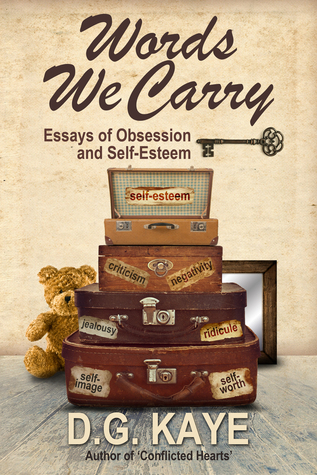
I happened upon a book of essays by D.G. Kaye. I wasn’t familiar with her body of work, but I found her honesty and writing style to be appealing.
Words We Carry: Essays of Obsession and Self-Esteem, by D.G. Kaye
The full title of the book is Words We Carry: Essays of Obsession and Self-Esteem. The subtitle alone wouldn’t have prompted me to give the book a chance, but the main title intrigued me.
I was reminded of the Tim O’Brien book, The Things They Carried about the things the US soldiers carried with them in the Vietnam War. Although vastly different in setting, Mr. O’Brien’s collection of short stories and Ms. Kaye’s collection of essays lead you into an examination of the experiences you carry throughout your life.
Reading this book triggered some long-buried memories and brought me to some unexpected realizations.
In the “Vanity: Where Does it Begin?” section of Words We Carry, Ms. Kaye’s following words resonated with me and made me stop and contemplate how some events and physical conditions in my formative years affected my very personality.
“Name calling, teasing, feelings of inadequacy compared to others, or growing up in an environment filled with discord can all mark the beginnings of our insecurities. Whatever our reasons, they tend to follow us through life, sometimes unknowingly, and these feelings grow into negative character traits.” ~ D.G. Kaye in Words We Carry: Essays of Obsession and Self-Esteem
Let that sink in for a minute.
I did not grow up in “an environment of discord,” and for that I am grateful. I grew up in a happy, loving home. I was completely secure within my family.
Another quote
“Our minds are delicate gateways to our egos. Just as a certain song or a waft of a familiar scent may trigger a happy memory, our minds also retain painful memories of ridicule or embarrassment. Those unhappy remembered memories are sometimes difficult to let go.” ~ D.G. Kaye in Words We Carry: Essays of Obsession and Self-Esteem
A speech impediment & crooked teeth
When I was a toddler, my temporary teeth emerged in all the wrong places in my mouth. Hence, I could not speak to be understood by anyone other than my parents and siblings.
I recall the frustration of not being understood. I knew what I was saying and to my ears my pronunciation and enunciation sounded perfect. Being asked to repeat myself over and over again was confusing and maddening when I was too young to know that I had a speech impediment, and it was embarrassing after I started to school and came to know that I was different from the other children.
I was rescued, though, by two advantages that the time, place, social class, loving parents, and white privilege afforded me.
Something that surprises me now is that even in 1959 the local school system employed a speech therapist. Mrs. Mitchell was wonderful! She visited the various schools in the system on what I suppose was a weekly basis.
There were several of us who were allowed to leave our regular classrooms for 30 minutes or so to work with Mrs. Mitchell. She sent instructions home with us so our parents could help us practice changing the way we used our tongues to form certain sounds.
Speech therapy & white privilege
As I wrote the previous paragraphs, I was struck by the realization that I probably had access to free in-school speech therapy because of my race. Today it’s called white privilege. Until I was in the seventh grade, white students and black students in our county had to attend different schools.
This fell under the US Supreme Court ruling in 1896 in the case, Plessy v. Ferguson. It mandated “equal but separate” schools for the two races, although the “equal” part was never enforced. The landmark US Supreme Court case in 1954, Brown v. Board of Education of Topeka declared separate schools for the races to be unconstitutional; however, it was 1965 before the schools in our county started the desegregation process.
The ways in which I was rescued from my speech impediment and the frustration, embarrassment, and teasing it produced were both a by-product of white privilege.
Orthodontia
The other tangible thing that rescued me from what would otherwise have been a life doomed to not being able to speak to be understood was orthodontia.
Considering that orthodontics was established as a dental specialty in 1899, the fact that I was fitted with braces on my teeth in 1957 amazes me.
Dr. P.C. Hull, Jr. was my orthodontist, and I adored him. His waiting room in The Doctors Building on Kings Drive in Charlotte was a bit small but nevertheless included an aquarium — or a fish tank — in the vernacular of the times. I’d never seen tropical fish before, and I was fascinated. But I digress.
Dr. Hull proposed to experiment on me. He theorized that if he could straighten my temporary teeth, my permanent teeth would maybe absorb the roots of my temporary teeth and follow them into proper alignment. It was worth a try, so I wore braces from the age of four until it was time for me to start losing my baby teeth.
Unfortunately, I wasn’t losing my baby teeth. They weren’t even getting loose. Although nicely aligned by the age of six or seven, most of my temporary teeth had to be pulled by the dentist because they retained their long roots, and my permanent teeth came in all over the place.
Cutting to the chase
To make a ten-year-story of orthodontics short, I wore braces off and on until my teenage years, my only breaks coming when my temporary teeth had to be pulled.
I’m sure my parents sacrificed financially in order for me to wear braces, but that sacrifice made all the difference in my life. Being able to have straight teeth along with speech therapy ultimately made it possible for me to attend college and graduate school and pursue a career.
In conclusion
White privilege — which I was blissfully unaware of until middle age — made it possible for me to have free in-school speech therapy and, doubtless, made it possible for me to have access to orthodontic care in North Carolina in the 1950s-1960s.
Perhaps there were speech therapists in the racially-segregated “equal but separate” public schools for people of color at that time, but I doubt it. Perhaps there were black orthodontists or white orthodontists in Charlotte who would take black children as patients, but I doubt it.
I realize now just how fortunate I was to grow up in America’s middle class which meant although it was a financial struggle for my parents to pay for my braces, not being poor made it possible for them to even consider making that sacrifice.
The braces and speech therapy made it possible for me to escape the teasing, frustration, and embarrassment of those childhood years of not being able to speak clearly, but Ms. Kaye’s book, Words We Carry made me realize how the name calling and teasing, etc. probably resulted in some negative character traits in me.
Perhaps I would have been shy even if I’d had perfect teeth and impeccable pronunciation, but Words We Carry prompted me to reflect on the ramifications of some early childhood experiences. I still carry feelings of inadequacy even as a 65-year-old. I suppose we all do.
Let’s all be mindful of the things we say and do that are hurtful to others — especially to children. Even if they rise above and appear to cope well with the teasing and name calling, they will carry those words with them for the rest of their lives.
Until my next blog post
I hope you have a good book to read. I’m reading A Bigger Table: Building Messy, Authentic, and Hopeful Spiritual Community, by John Pavlovitz.
If you’re a writer, I hope you have quality writing time. I didn’t work on my novel last week, but I enjoyed writing today’s blog post.
Thank you for reading my blog. You could have spent the last few minutes doing something else, but you chose to read my blog. I appreciate it!
I look forward to your comments about today’s post and some of the words you carry.










 Janet's Writing Blog