My DIY Writer’s Retreat & a Hurricane Helene Update

I read about various writers’ retreats and they sound wonderful, but I don’t have the money or necessarily the energy to participate in them. Therefore, I decided to have my own private Do-It-Yourself (DIY) Writer’s Retreat a couple of weeks ago.

It went so well that I intend to do more DIY retreats in the future.

I planned a schedule for it to last on a Thursday through Saturday. It was going to be three days for me to do nothing but write. Specifically, except for writing a blog post, I planned to work on my historical novel, The Heirloom (tentative title).

As I blogged on September 30, 2024 in Best laid plans…, life happens. None of the three days went exactly as planned, but overall, it was a productive time for me.

I learned on Day 1 that by the time I had written an hour that morning and five hours that afternoon, it had been a big mistake for me to schedule three more hours of writing that night. Hence, my schedules for Friday and Saturday were amended. Lesson learned!

Photo by Kaitlyn Baker on Unsplash

On Day 3, I needed to take a break from writing and burn some of the limbs picked up after Hurricane Helene. My writing and that project are both works in progress. Such is life when one lives on several acres of big trees out in the country.

However, in those three days I added 6,000 words to my 35,000-word manuscript in addition to writing a 2,100-word blog post for October 7. Not bad for me, after accomplishing very little on the novel so far in 2024.

I took a Resilient Writers “Book Finishers Boot Camp” online class leading up to my DIY Writer’s Retreat. The class emphasized the importance of writing consistently and measuring writing goals on a weekly basis by whatever measuring stick one chooses.

Word-count goals never worked well for me, so I took a suggestion from the class and have started setting scene goals for myself. They are flexible and based on looking ahead at my calendar. Some weekly goals are higher than others, but the point is to have an end date insight for completing the first draft. In fact, the class instructed participants to have a projected completion date and a “life happens” completion date additional weeks or months down the road.

My ideal rough draft finish date set on September 18 is November 30, 2024. My realistic rough draft finish date set on that same day is January 11, 2025. So far, I’m just one scene behind schedule, with seven of my remaining 30 scenes completed. I admit, though, that no weeks since September 18 have gone as planned. These dates aren’t deadlines, they are self-imposed goals.

It has been fun (and hard work) to get back into the heads of my characters. I “talk” to Sarah, my main character, during my daily walks and ask her what she has for me that day. The great thing is that sometimes she answers!

Hurricane Helene Update on Western North Carolina

Since I live in North Carolina, I decided to give western NC recovery updates in my weekly blog. I hoped today’s update would be much shorter than last week’s, but the recovery efforts are still beyond comprehension 25 days after the disaster.

Weather conditions: Parts of the mountains received the season’s first snow last Tuesday and freeze warnings as some people are still sleeping in tents.

Statistics: As of last Tuesday, 92 people were still unaccounted for in NC. The death toll from Hurricane Helene stands at 95 in the state, but that number will surely rise.

Roads: As of Friday, October 18, 670 roads in western NC had been reopened, but more than 500 remained closed, according to WNCN in Raleigh. There are more than 6,900 sites where roads and bridges were destroyed, according to the NC Department of Transportation.

Electricity: As of last Thursday, 8,400 homes and businesses were still without power in five counties. Helicopters and off-road vehicles are being used to install power poles in some otherwise inaccessible areas.

Water system in Asheville: Water is slowly being restored in Asheville. Due to low water pressure where the system is in operation, residents are still under a Boil Water Notice. As of Saturday, the city reported that the treatment of water in the North Fork Reservoir will be a long process to deal with the high level of sediment resulting from the flooding.

The Rocky Broad River in Chimney Rock was restored to its original channel last week with the help of the US Army 101st Airborne Division.

Blue Ridge Parkway: The Blue Ridge Parkway remains closed in North Carolina, with tens of thousands of trees down and across the roadway and more than 30 rock and mudslides. There is no estimated reopening date for the beautiful parkway.

Public School Systems: Just to give you an idea about the recovery situation 25 days after Hurricane Helene hit western NC…

Avery County. Schools are scheduled to reopen on November 6.

Ashe County. Schools are scheduled to reopen on October 29.

Buncombe County. Schools are scheduled to reopen on October 25.

Watauga County. Schools are scheduled to reopen on October 24.

Colleges and universities:

Appalachian State University in Boone: The campus reopened for students to return as of 5:00 p.m. on Friday. Classes resumed in all but one classroom building on October 16.

Asheville-Buncombe Technical Community College: Closed until at least October 28.

Blue Ridge Community College: Reopening today.

Lees-McRae College in Banner Elk: Classes will be conducted online through November 4.

Montreat College: Started welcoming students back to campus yesterday.

Warren Wilson College: As of last Thursday, planning to welcome students back to campus on October 27. Roof and other repairs will continue over the coming months.

IV Bag Manufacturer:  Through the US Department of Health and Human Services, President Biden invoked the Defense Production Act so the company will have priority access to specific material needed so Baxter can get back to production.

Convoy of Farm Supplies from Ohio

A convoy of trucks pulling trailers of hay and other farm supplies from Ohio arrived in Deep Gap, Watauga County, on Tuesday! Thank you, Ohioans! The videos were heart-warming! I read of hay bales also coming in from Pennsylvania. Thank you, Pennsylvanians!

Fundraising Concert

The Avett Brothers from here in Cabarrus County and another North Carolinian, Scotty McCreery, have been added to the lineup for the October 26 “Concert for Carolina” at Bank of America Stadium in Charlotte. The concert is sold-out, but can be live streamed for $25.

Tourism: Autumn is the peak tourism season in the mountains. Some towns are accessible now and encouraging tourists to come and support the local economy. Those invitations are accompanied by words of caution to travel to the towns you know are ready for you and don’t venture out in the countryside where your presence will be a hindrance to recovery efforts. If you want to visit our beautiful mountains, do your research online or call your destination to learn about current conditions.

The Biltmore Estate announced on Friday that it will reopen for visitors on November 2

Until my next blog post

I hope you have at least one good book to read this week.

Don’t take family and friends for granted.

Remember the people of Ukraine and western North Carolina.

Janet

By the way… if you have not signed up for my e-Newsletter, please visit https://www.janetmorrisonbooks.com, click on “Subscribe,” and enjoy a free downloadable copy of my “Slip Sliding Away” short story which is set in the Appalachian Mountains. Then, look forward to my November e-Newsletter!

We get by with a little help from our fellow bloggers!

Liz Gauffreau is a blogger friend of mine. This week she launched her new book, Simple Pleasures: Haiku from the Place Just Right. It is a collection of 53 of her original haiku. Each one is paired with a photograph from her love of nature and the world’s beauty.

If you aren’t familiar with haiku, please give this concise form of poetry a try.

You will find Liz’s book to be calming, refreshing, and thought-provoking. It will transport you to another place where you can sit quietly, take a deep breath, and relax.

This is the first time I’ve ever tried to reblog another blogger’s post, so Liz and Joy, I hope this works!

Janet

This Writer Needed a Change of Scenery — Part II

On the first Monday of each month I usually blog about some of the books I read the previous month. I will write about a couple of the books I read in May in my post on June 17.

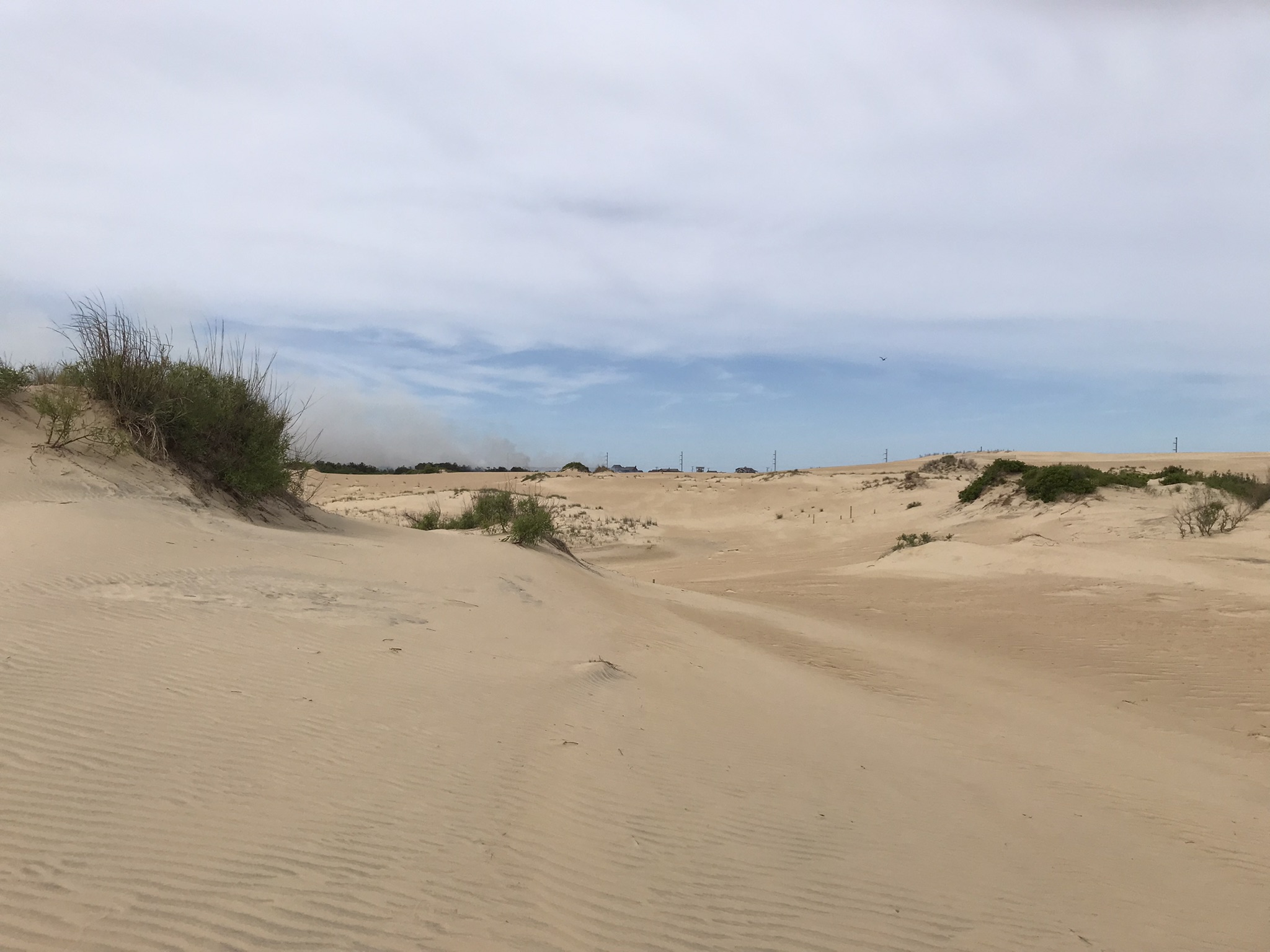
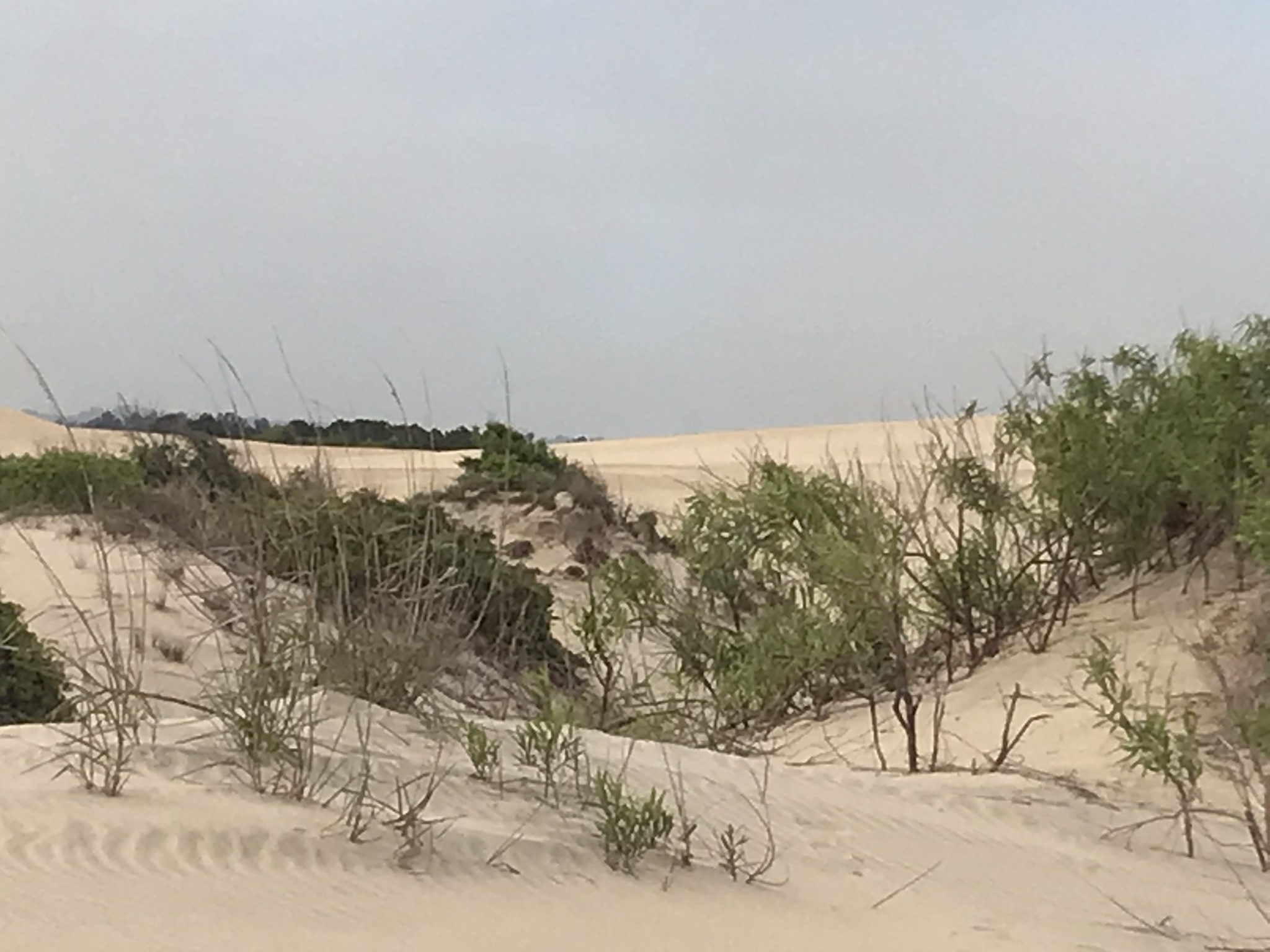
Last Monday I blogged about visiting the northern end of the Outer Banks of North Carolina in mid-May. I failed to illustrate Jockey’s Ridge adequately, so here are a few photos to show you just a little of that massive sand dune.

Amateurs learning to hang glide at Jockey’s Ridge in spite of a control burn being conducted that day.
A view of a small portion of Jockey’s Ridge
Another part of Jockey’s Ridge
Yet another view of Jockey’s Ridge.

Jockey’s Ridge State Park covers 427 acres. It is estimated that the dune contains 30 million tons of sand and has been there for 7,000 years. For more information, visit https://www.ncparks.gov/state-parks/jockeys-ridge-state-park.


The southern end of the Outer Banks

The rest of today’s post covers the sights on the southern part of those barrier islands.

I hope you will be inspired by my blog to add the Outer Banks to your “bucket list” as the 120-mile-long string of barrier islands is a natural treasure everyone should get to see at least once.

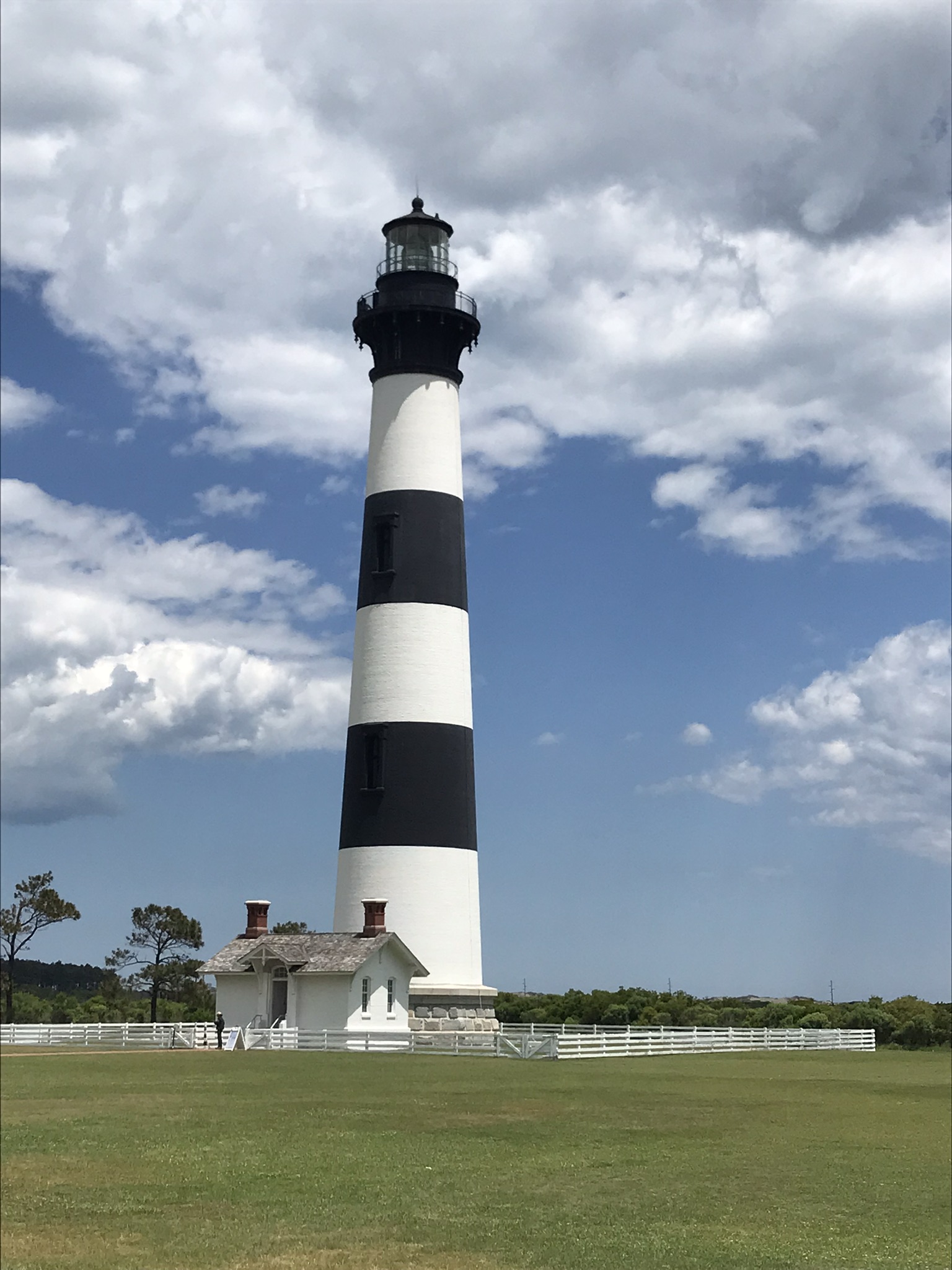
Enjoy the beautiful Bodie Island Lighthouse and adjoining boardwalk trail. https://www.nps.gov/caha/planyourvisit/bils.htm

Bodie Island Lighthouse

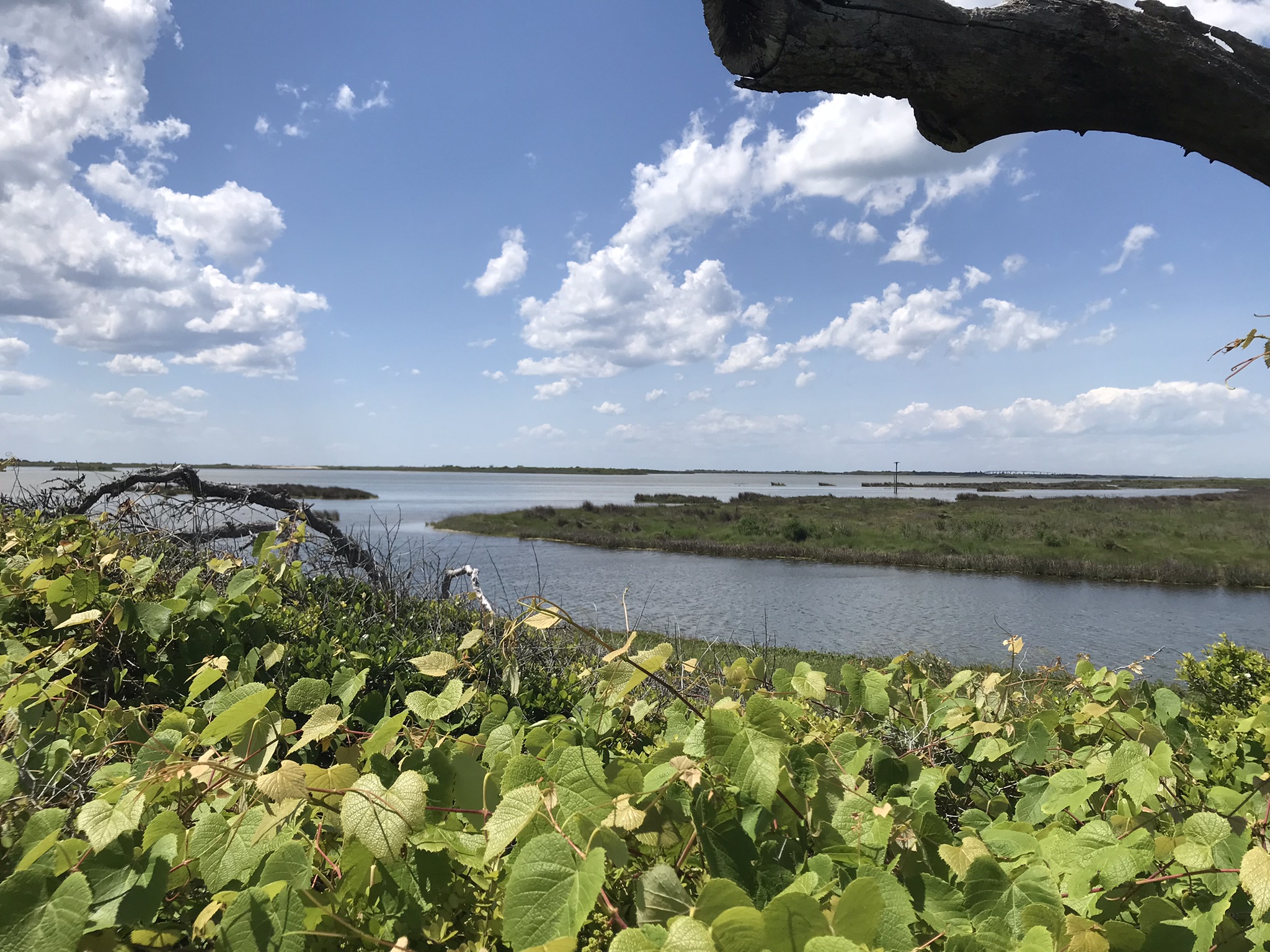
Set aside time to hike in the Pea Island National Wildlife Refuge. https://www.fws.gov/refuge/pea-island

Pea Island National Wildlife Refuge – View from hiking trail

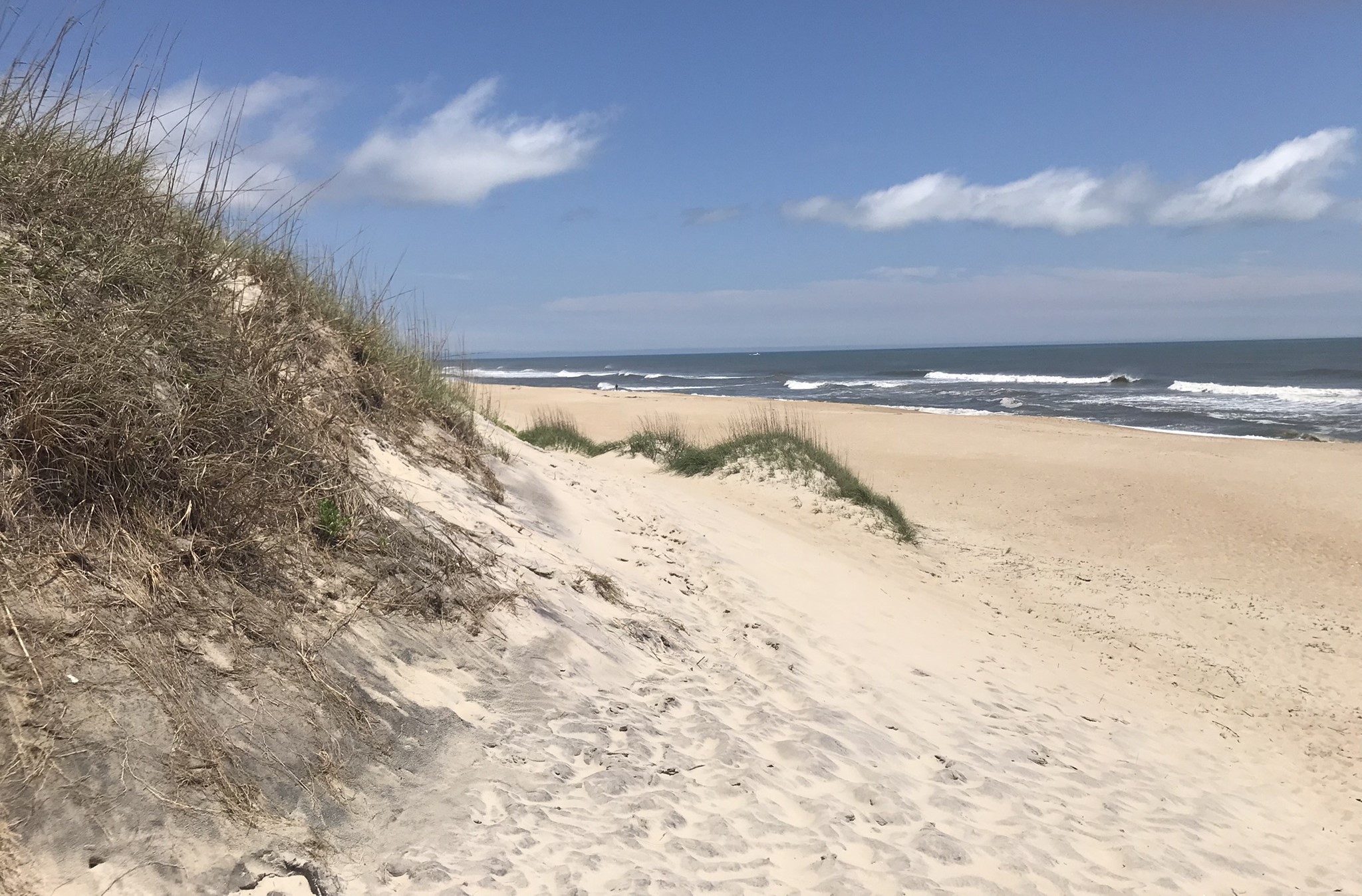
Take advantage of beach access stops along the way to enjoy the sand, the churning Atlantic Ocean, and Pamlico Sound.

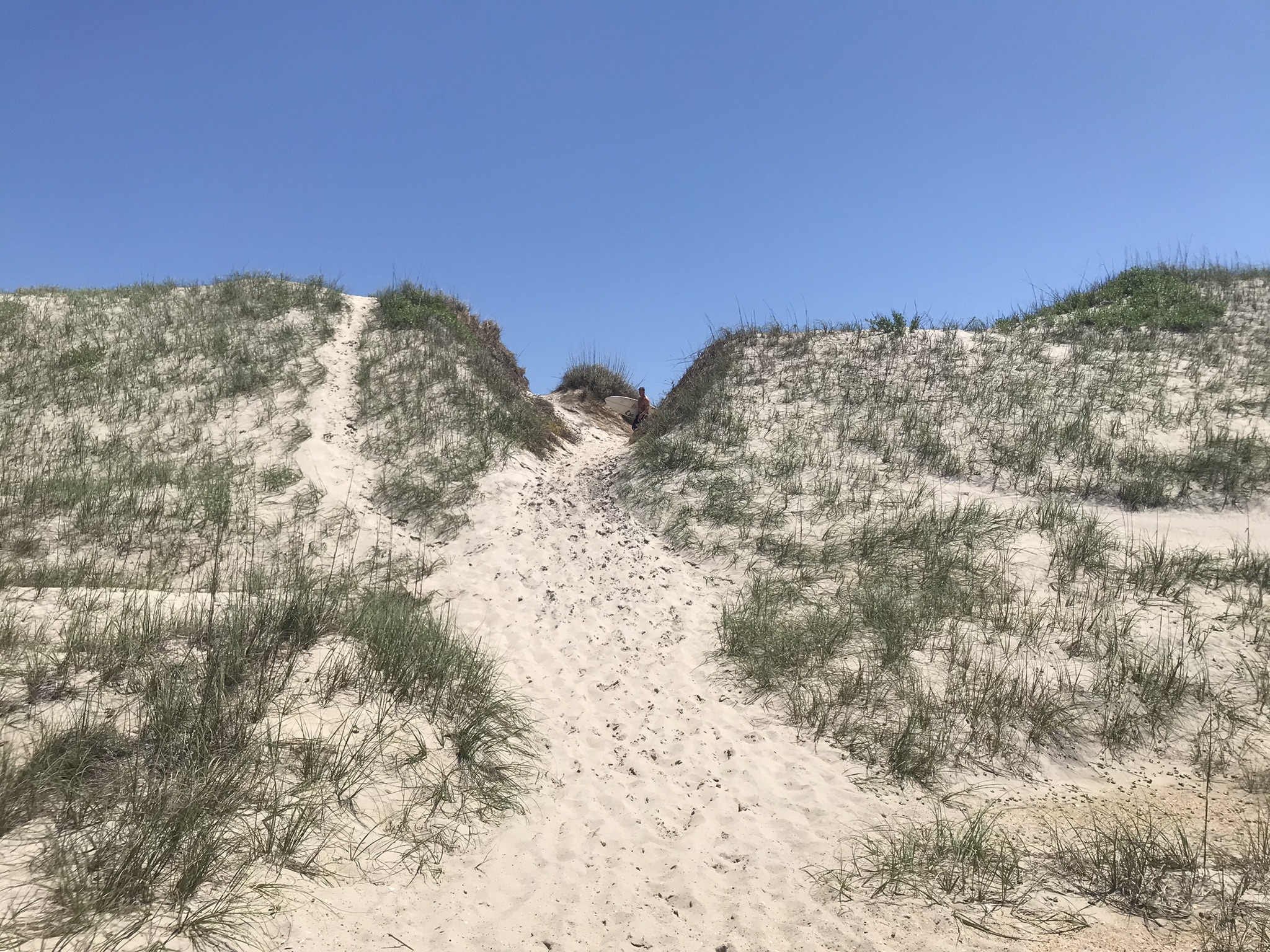
You might have to hike over a sand dune to get to the ocean!
It’s worth the climb!

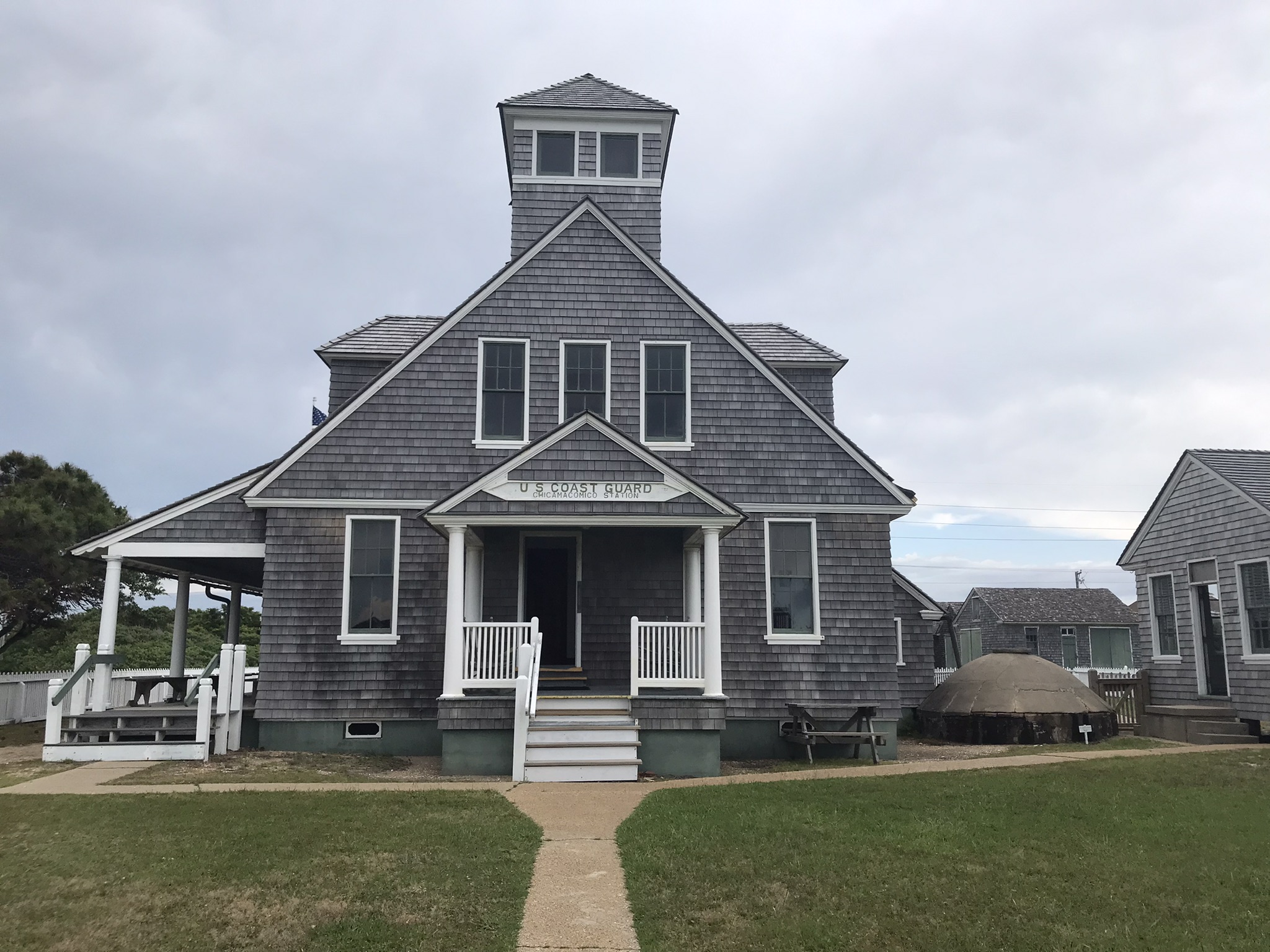
Be sure to visit the Chicamacomico Life-Saving Station in Rodanthe, established 150 years ago, to learn about the bravery of the men who risked their lives for decades to rescue sailors in distress along this “Graveyard of the Atlantic.” The video there is quite informative. For more information to help you plan your visit, this website gives details: https://chicamacomico.org/.

Chicamacomico Life Saving Station

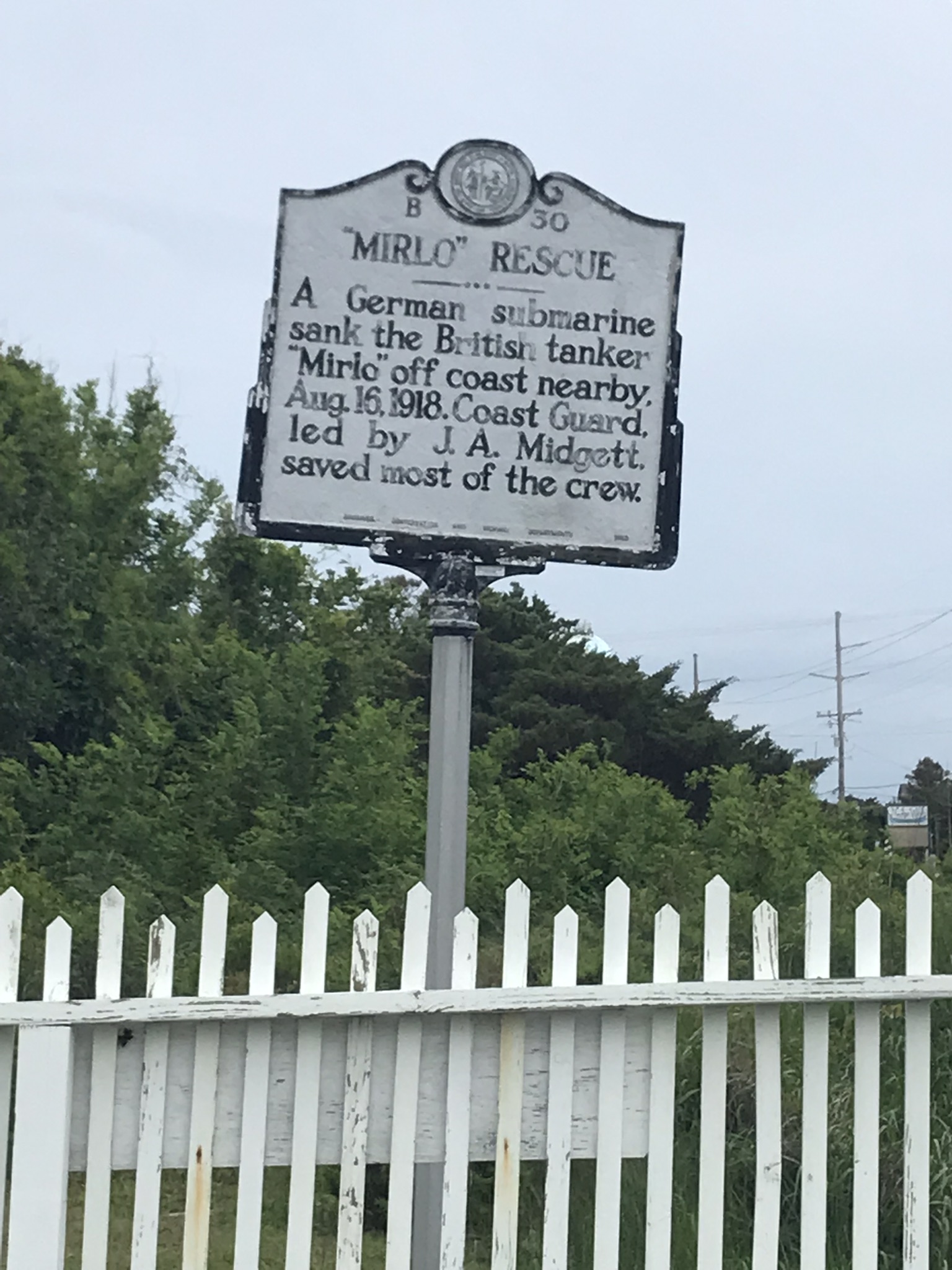
We tend to think of all of World War I taking place faraway in Europe and, indeed, most of it did; however, the Atlantic coast of the US was not immune to attack and the ramifications of sea warfare between Germany and England. Below is a photo of the roadside marker about the nearby sinking of a British tanker, Mirlo, by a German submarine. Coast Guardsmen stationed at Chicamacomico saved most of the tanker’s crew. If you want to read more about the rescue of the Mirlo, I recommend this website: https://www.ncpedia.org/mirlo-rescue.

World War I “Mirlo” Rescue Roadside Marker at Chicamacomico

Rodanthe was in the news again last week because another house fell into the ocean. According to the National Park Service, that’s the sixth privately-owned house to be claimed by the Atlantic in recent years. It makes one wonder why they were allowed to build houses there. Volunteers were sought the following day to clean up pieces of the house and its contents that had been strewn up and down the beach.

I took a picture of several houses the ocean is trying to claim on the beach at Buxton. This situation makes no sense to me.

Looks like some more houses on the Outer Banks are tempting fate!

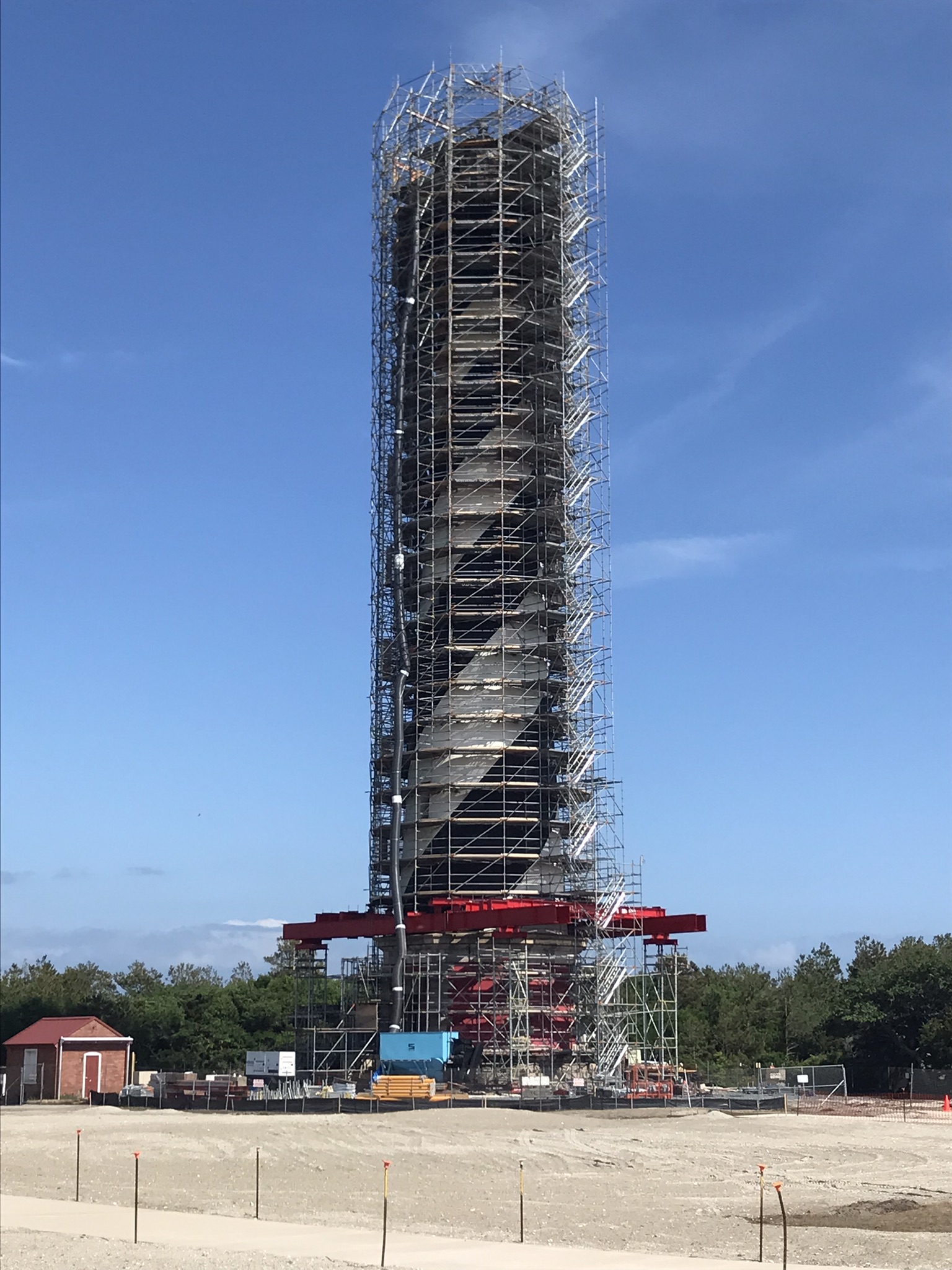
Buxton is home to the glorious Hatteras Lighthouse – at 198.49 feet it is the tallest brick lighthouse in the United States. One word of caution, though: The Hatteras Lighthouse is undergoing two years of restoration and is currently encased in scaffolding.

Cape Hatteras Lighthouse under restoration in May 2024

While it is closed, you can take virtual tour online at http://Cape Hatteras Light Station – Cape Hatteras National Seashore (U.S. National Park Service) (nps.gov). Fortunately, I saw it at its original location before its historic move in 1999 to save it from the ocean. The visitor center is open and you can get close enough to take pictures of the lighthouse during the 18- to 24-month restoration.

The iconic black and white painted swirl just can be seen through the scaffolding, but you might want to wait and visit in the summer of 2026 to see it in all its beauty. If you like lighthouses, you’ll love this one!

(This month’s experience reminded us of our once-in-a-lifetime trip to New York City in the mid-1980s. We rode the Staten Island Ferry so we could see the Statue of Liberty even though it was being restored and was completely encased in scaffolding. We have a knack for seeing national landmarks during their restorations!)

If you go to Hatteras Island now, you can visit the Graveyard of the Atlantic Museum. It has undergone a major remodel and was still closed when I was there on May 16-17. The grand re-opening was held on May 20, so I just missed getting to see the inside of it. Here’s the museum’s website: https://graveyardoftheatlantic.com/. Note that it is not open on weekends or state holidays.

Graveyard of the Atlantic Museum on Hatteras Island

Ocracoke Island

Storms along the Outer Banks wreak havoc with North Carolina Highway 12. Literally! The Department of Transportation constantly must remove sand from the highway, close it due to high water, and – occasionally – relocate the road.

A storm in April 2024 created all kinds of problems along NC-12. It had been restored to good condition down as far as Hatteras Village, but as of three weeks ago the portion on Ocracoke Island (http://First-timers Guide to Ocracoke Island – Visit Ocracoke NC) was still being worked on.

We had planned to take the free NC ferry from Hatteras Island to Ocracoke Island and the fee-supported NC ferry from Ocracoke to the mainland, but due to the one-lane traffic on part of Ocracoke Island we changed those plans and drove back up the Banks to Southern Shores and bridges to the mainland. (Here’s a important website, if you’re planning to use any of the 21 ferries operated by the NC Department of Transportation: https://www.ncdot.gov/travel-maps/ferry-tickets-services/routes/Pages/default.aspx.)

The Outer Banks of North Carolina are truly a national treasure. If you bemoan the fact that you must pay federal income tax, just remember that your hard-earned tax dollars help preserve miles and miles of the Outer Banks of North Carolina.

In fact, I’ve heard it suggested that if you resent paying income tax perhaps you should choose to think that all your tax dollars go to support the national parks, national seashores, and historic sites.

Look for the third and final installment of my blog series about my recent need for a change of scenery next week when I will tell you about the many points of interest we enjoyed on our way to and from the piedmont to the northeastern coastal plain of North Carolina. I think you are in for some surprises!

Until my next blog post

I hope you have a good book to read.

In case you missed the first part of my two-post blog series about the Outer Banks of North Carolina, here’s the link to my May 27, 2024 post: https://janetswritingblog.com/2024/05/27/this-writer-needed-a-change-of-scenery-part-i/.

Remember the people of Ukraine.

Thank you for taking the time to read my blog! When you have a couple of minutes, I invite you to visit my website to see what I was doing prior to my trip and the types of writing I will continue to do: https://www.janetmorrisonbooks.com.

Janet

This Writer Needed a Change of Scenery – Part I

Not wanting to publicize online that I was going out-of-town, you probably did not know that I spent much of the second full week of May on the Outer Banks of North Carolina. Having been there some 25 years ago, a return trip was on my and my sister’s “bucket lists.”

Along Cape Hatteras, NC

We packed so much into our trip that I decided to divide this “travelogue” into two parts. I will share Part II with you on Monday, June 3 and shift my usual “what I read last month” post to Monday, June 10.

Our departure was delayed by 24 hours by a storm that knocked out our electricity for 21 hours and took down literally hundreds of tree limbs in our yard. Yard clean up and some adjustments in our itinerary and reservations meant that we were exhausted when we finally left home, but the trip was salvaged. (And yard clean-up has continued since we returned home. Such is life when you live out in the country and have a yard full of large, old trees.)


The Outer Banks of North Carolina

The Outer Banks of North Carolina (often abbreviated as “OBX” these days) are truly a national natural treasure. They are a 120-mile-long string of barrier islands known as “The Graveyard of the Atlantic.”

Map showing locations of hundreds of shipwrecks along the Outer Banks – “Graveyard of the Atlantic”

Off Cape Hatteras is where the cold waters of the Labrador Stream collide with the warm water of the Gulf Stream. The clashing water and wind there constantly change to shape of the islands. It is said that the only constant on the Outer Banks is that they are constantly changing.

The massive sand dunes at Jockey’s Ridge are in a constant state of flux and shifts in height due to the wind. There’s a reason why the Wright Brothers decided to try out their “flying machine” there at Kitty Hawk in 1903. It seems like the wind never stops blowing.

To give you an example of the changes Mother Nature makes in the islands, the third (and present) Bodie (pronounced “body”) Island Lighthouse was completed in 1872 near the tip of Oregon Inlet. The lighthouse has never moved, but it is now two miles from the inlet! (https://www.nps.gov/caha/planyourvisit/bils.htm)

Bodie Island Lighthouse at dusk

The northern end of the Outer Banks

We knew the northern end of the Outer Banks had been highly developed since we were last there, but it was worse than we anticipated. It’s unfortunate that vacationers and summer-only residents wanted all the conveniences of home. Whether they wanted that or not, that’s what they got.

North from Whalebone Junction to Corolla is wall-to-wall development. It’s a shame what has been built on such a fragile sliver of the coast. The Nags Head Woods Preserve (https://www.nature.org/en-us/get-involved/how-to-help/places-we-protect/nags-head-woods-ecological-preserve/

Nags Head Woods Preserve

is still there protecting Jockey’s Ridge – the tallest living sand dunes in eastern United States. You can try your hand at learning to hang glide at Jockey’s Ridge State Park. (https://www.ncparks.gov/state-parks/jockeys-ridge-state-park)

There used to be miles of vacant land between Kitty Hawk and Duck and Corolla with the Spanish now-wild horses roaming freely. Now there’s a town called Southern Shores which runs into Duck which runs into Corolla. Multimillion dollar homes line NC Highway 12 and leave no vacant land.

The wild horses that have lived there for 400 years have now been corralled and fenced just north of Corolla for their own safety and one must pay a tour company big bucks to ride in a Hummer or a Jeep for a couple of hours in hopes of catching a glimpse of a few of those magnificent animals. We chose not to do that. We choose to remember them the way they used to be. Be sure and visit the gift shop of the Corolla Wild Horse Fund, Inc. (https://www.corollawildhorses.com/) where all proceeds support the maintenance and health of the wild horses.

At the north end of NC-12 there is a tiny parking lot. From there, one can hike and perhaps see some wild horses, but the lot was full when we were there.

We wanted to see the Currituck Beach Lighthouse again. (We love lighthouses!) Due to the growth of surrounding trees and the residential and commercial development in the last 25 years, the lighthouse at Corolla was more difficult to find than it was in the past. Nevertheless, we enjoyed seeing it one last time. (https://obcinc.org/currituck-beach-lighthouse/)

Currituck Beach Lighthouse

Meanwhile, traveling back south to Nags Head and Manteo…

Even if you aren’t interested in fishing, you might enjoy a stroll on Jennette’s Pier https://www.ncaquariums.com/jennettes-pier) at Nags Head. Associated with North Carolina Aquariums, this 1,000-foot-long concrete pier is a nice way to spend a few minutes or more. Fees are charged for fishing, but for $2.00 you can walk the pier and spend as much time as you like enjoying the views of the ocean and beach. The pier and its wooden predecessors have an interesting history.

We also enjoyed the North Carolina Aquarium (https://www.ncaquariums.com/roanoke-island) at Manteo on Roanoke Island. In the summer months there is a famous outdoor drama, “The Lost Colony” on Roanoke Island. That’s where North Carolina native Andy Griffith got his start in acting.

If you plan to visit the Outer Banks to see their stark beauty and leave some of the conveniences of home … well, at home, I recommend you spend two or three days on the northern banks if you must so you can visit the Wright Brothers National Memorial (https://www.nps.gov/wrbr/index.htm)

Wright Brothers Memorial, Kitty Hawk, NC

and the natural grandeur of Jockey’s Ridge,

Small portion of Jockey’s Ridge

the NC Aquarium,

One of the sea turtles at the NC Aquarium on Roanoke Island

and Jennette’s Pier,

Jennette’s Pier at Nags Head, NC

but then leave the traffic and hubbub behind and drive south from Whalebone Junction into the Cape Hatteras National Seashore.

Welcome sign at Cape Hatteras National Seashore

Please read my June 3, 2024 blog post to learn about my favorite part of the Outer Banks – the peaceful, wild, and beautiful southern end.


Until my next blog post

I hope you have a good book to read.

Remember the people of Ukraine.

Thank you for taking the time to read my blog! When you have a couple of minutes, I invite you to visit my website to see what I was doing prior to my trip and the types of writing I plan to continue to do:  https://www.janetmorrisonbooks.com.

Janet

A Wake-Up Call for this Blogger

When I started Janet’s Writing Blog more than a decade ago, I didn’t know what I was doing. I had not read many blogs, but I thought I was ready to jump in and write my own after being prompted by my niece’s husband. Craig is much more tech savvy than I. He designed my website as it served me well for 20 years. His interests, time, and business responsibilities changed over the years, so in January 2023 my website was redesigned by Carolina Custom Designs.

My blog floundered for several years in the beginning as I tried to find my niche. I played around with how often to blog and how long a blog post should be. Things have gone more smoothly since I settled on posting every Monday.

Photo by Kaitlyn Baker on Unsplash

I have slowly realized the potential my blog. In fact, I know I haven’t yet fully understood its potential.

It astounds me that people all over the world read my blog! In January 2024, for example, people in 36 countries read my blog.

I’m fortunate to live in the United States of America where I have freedom of speech and freedom to read anything I want.

I don’t want to run out of subject matter. I usually plan my blog post topics as much as a year in advance, but this year my editorial calendar just isn’t coming together like it has in the past.

Should I make some changes in my blog?

Last year was a busy year of getting my website redesigned; starting a newsletter in March; offering a free downloadable copy of my short story, “Slip Sliding Away” to everyone who subscribes to my newsletter; publishing a local history book, Harrisburg, Did You Know? Cabarrus History, Book 2; publishing my first ghost story, “Ghost of the Battle of Guilford Courthouse: An American Revolutionary War Ghost Story”; and, with my sister, Marie, published a cookbook, The Aunts in the Kitchen: Southern Family Recipes.

With all I had going on, I failed to keep expanding my editorial calendar. Having Covid in December, a health scare of a different nature at the same time which lapped over into January, and intermittent internet and telephone service for two weeks after a January 9 storm, I was in a mental fog until the first week in March. I do have the next four weekly blog posts planned and partially written; however, some weeks in the rest of 2024 need to be fleshed out.

More than 1,100 “follow” my blog, but most of them probably don’t read it every week. I try to keep in mind that although I have some loyal readers every week, there is always the chance (and hope!) that this will be the week when someone reads my blog for the first time. What can I write this week that will please my regular readers but also grab the attention of a first-time reader so much that they become a subscriber?

I don’t want to bore my loyal readers with references to my books, short stories, and website; however, I want that new reader to be aware of what I’ve written. It is a delicate balancing act.

What Ryan Lanz says a blogger should do

A list I keep in front of me as I plan my blog topics is Ryan Lanz’s “22 Ways to Impress a First-Time Blog Reader With Any Post.” Lanz sets the bar high! I don’t have Mr. Lanz’s permission to quote his list, but I’ll throw out several items on the list to give you an idea of what a blogger is challenged to do with every post:

  • “Tell them something they don’t know.”
  • “Tell them something they DO know.”
  • “Help them solve a problem.”

It only gets more challenging as you read the other 19 items on his list! The one that always trips me up is number 3. I have a feeling in my more than 13 years of blogging, I have probably never solved anyone’s problem! I just don’t see that as my responsibility.

My plan

The first months in a calendar year tend to prompt us into new beginnings and reflection. That’s what I will continue to do over the coming weeks, and I hope I’ll find enough topics of interest to keep blogging every Monday for the foreseeable future.

Stay tuned.  Next week I will blog about the books I read in April.

Until my next blog post

I hope you have a good book to read.

If you are a blogger, you can probably identify with today’s post.

Don’t forget the people of Ukraine.

Remember to subscribe to my e-newsletter before the May issue if you want to learn about an on-going archaeological dig in North Carolina! Just visit https://www.janetmorrisonbooks.com and click on “Subscribe.” My thank-you gift to you is a downloadable copy of my historical short story, “Slip Sliding Away.”

Janet

What Are You Passionate About?

I am working my way through How to Write The Short Story, by Jack M. Bickham. As the title indicates, it is a book I expect to enhance my short story writing skills. However, the first 14 pages surprised me by offering self-inventory guidelines that I think anyone – not just writers – can benefit from practicing.

Mr. Bickham was the author of 75 novels and a host of books about the craft of writing.

It would not be fair to the current owner of Mr. Bickham’s copyright to the book for me to list all 10 steps in his guidelines for self-evaluation, but I’ll try to hit enough high spots to pique your interest even if you aren’t a writer.

Since I thought I could read this 200-page book in several days, imagine my surprise when I spent that amount of time working my way through the first 14 pages!

The root premise of How to Write The Short Story is that writers cannot write to their best form without knowing what they are passionate about deep down inside. The book systematically walks the reader through Mr. Bickham’s theory of how to do a thorough self-evaluation.

The secondary premise of the book is that once writers seriously go through this exercise and the remaining recommended steps in the book, they will be able to draw on their responses to write any story.

Mr. Bickham recommends jotting down on index cards (the book was published in 1994 when personal computers were still in their infancy) the reader’s responses to the series of questions he provides. He wants this information to be written in a form that can be accessed occasionally to remind yourself what makes you tick. Your responses might be added to or deleted as you live your life.

Mr. Bickham also strongly recommends that you not move on to the next step until you have completed the prior step. Even so, I don’t think I should take the liberty of listing all 10 steps. From the five steps I’m listing, you will get the jest of the exercise and perhaps be interested enough to look for the book.

Photo by Simone Secci on Unsplash

Step 1

The first step in this self-evaluation is to write down 10 “things or ideas or places or actions that you feel very deeply about.” You might want to stop reading this blog post and do this step. You need to take your time and really think about what you feel deeply about. You might easily think of three to five things, but then it can take some thought to come up with the other five to seven ideas or places or actions. If taken seriously, this should prompt you to identify your core values.

Step 3

What are five ideas or concept in which you deeply believe? This is different from Step 1, but there will probably be some overlap.

Step 8

Write a paragraph about an event that brought you great sadness.

Step 9

Describe “a time and place that made you very angry.”

Step 10

Write about “a time and place that frightened you.”

I found this exercise helpful, did you?

If you are like me, it has been a long time – if ever – that you took the time to honestly address the above questions and requests.

Did you discover any surprises?


Since my last blog post

I have added several thousand words to the manuscript for The Heirloom after finding some historical information that was helpful and specific to the story. It was rewarding to put words on the page.

I visited Hart Square Village in Vale, North Carolina once again. I took a lot of pictures, learned about the composition of daubing used by the early settlers in the Catawba Valley, and learned about the best practices there today for the preservation of 200-year-old log structures. Again… useful for me to know as a writer of southern colonial American history.


Until my next blog post

Get back to that book you started reading but put aside.

Remember the people of Ukraine.

Janet

10 Random Facts about Myself in 2016, Revisited

In today’s blog post, I am revisiting my blog post from April 8, 2016. I had been asked to share 10 random facts about myself. It is interesting exactly eight years later to reread that post and see that little has changed.

Here are the 10 random facts about myself as I offered them eight years ago today, with new insights and details added within brackets:

1. I have what is called Chronic Fatigue Syndrome (CFS) in the United States but is known as Myalgic Encephalomyelitis (ME) in the rest of the world. My energy and stamina are limited, and my memory problems and mental fog make my research and writing tedious and time consuming. I often feel as if I live in a vat of molasses. Nothing comes easily.

2. I started working on the manuscript of my proposed historical novel, The Doubloon/The Spanish Coin, in 2005. I am still tweaking it. [I was startled to be reminded that I started writing The Doubloon/The Spanish Coin 19 years ago! After editing that manuscript down from 120,000 to 96,600 words, I am now concentrating on turning the main character’s backstory into a novel to publish before I publish The Doubloon/The Spanish Coin. The tentative title of that novel is The Heirloom.]

3. As a young adult, I was a “fiction snob.” I thought there was nothing to learn or gain by reading fiction. You can imagine how shocked my sister was when, at the age of 48 in 2001, I told her that I had registered for a fiction writing class! That’s when I started learning to write [and truly appreciate and enjoy reading] fiction.

4. Although my appearance, manner, and personality give the impression that I am conservative, I am a liberal when it comes to politics.

5. After wanting to play the Appalachian lap dulcimer since first being introduced to the instrument as a college freshman, I finally purchased one and attended a four-day dulcimer workshop in 2010. Due to random fact #1, I still don’t play well and probably never will; however, I do play for my own enjoyment. I often listen to dulcimer music while I write. (I’m listening to some as I write this blog post.) [I still don’t play the dulcimer very well, but I am once again trying to practice almost every day. This is for my own enjoyment. A huge “plus” is that learning to play a musical instrument is supposed to be good for one’s brain.]

6. I live on land that has been in my family since the 1760s.

7. I sleep in a bed that my father made using timber from our land in the 1940s.

8. I wish I could sing.

9. I could drive a tractor before I was old enough to drive a car.

10. Taking the fiction writing course and attending the dulcimer workshop were life-changing experiences for me, and I will forever be grateful that I got out of my comfort zone and took advantage of both opportunities.

No matter your age, stretch yourself and follow your dreams.

What do you have to lose?


Since my last blog post

Photo by Janet Morrison at Joara

I participated in my first archaeological dig! I checked it off my “bucket list,” but I hope it won’t be my last one. If you want to read all about it, please subscribe to my every-other-month e-newsletter by going to https://www.janetmorrisonbooks.com and clicking on the “Subscribe” button. You will also receive my free downloadable historical short story, “Slip Sliding Away.” I will write about the archaeological dig in my May 2024 e-newsletter.


I submitted a 3,575-word contemporary short story to an international short story competition recently. It was the first time I entered a piece of fiction written in first-person to a competition, so I was pleased when I learned that my story was judged to be in the top 10% of submittals. In spite of that “top 10%” label, I opened the critique with some trepidation.

Photo by Christin Hume on Unsplash

In a nutshell, the critique only had two negative comments: (1) The title (“Someone is Trying to Kill Me”) gave too much away and (2) I wrapped up the protagonist’s dilemma too quickly. The positive comments included, “It’s rare that I tell an author that the story we turned down needs to be significantly longer, because many of our entries drag a very thin, uninteresting idea out for many more pages than it is worth. But I think “Kill” needs to be a lot longer…. Detailed, interesting, step-by-step… this story has ‘detective novel’ written all over it… I’d read that story. It would be far too long for our magazine, but so what? Get it published somewhere else, or publish it yourself on Amazon or he web or something. Finish the story and put it out there.”

What a morale booster!


Until my next blog post

If there is a novel in you that is begging to be written… WRITE IT!

Read a good book or two this week.

Support your local public library and independent bookstore.

Remember the people of Ukraine.

Janet

I Feel Like the World has Passed Me By

I recently read a blog post that made my head spin. It left me wondering if I can make it as a writer. The world is changing at warp speed, and I cannot keep up.

My post today is a bit of a rant. Please bear with me. I’m curious. Do you feel the same way, or am I just an old fuddy-duddy? (Granted, if I casually use the term “fuddy-duddy,” I probably am one.)


What set off this particular rant (a.k.a., blog post)?

The blog post I’m referring to is https://writersinthestormblog.com/2024/02/social-media-best-practices-for-authors-in-2024/. This is a blog I have followed for years and I usually benefit from reading the posts. This particular one gave me pause.

I didn’t realize how much I was lagging behind in the world of social media until I learned that “you might want to consider IG Thread, Mastodon, or Bluesky (still in Beta and by invite only). The stated goal of Threads is to become part of the Fediverse (of which Mastodon is a part) so many people have just jumped straight over to Mastodon.”

WHAT?

That one paragraph was confusing on so many levels.

I continued reading and learned that there is also a social media platform called BeReal, in case I want people to know where I am at all times.

No thanks.

I learned that Reddit “has released an API in preparation for its upcoming IPO.” I have used Reddit, but I don’t know an API from an IPO. In fact, I have very little interest in learning the difference. (I’ve looked them up before, but I don’t have enough brain cells to clutter up my head with information I don’t need to recall.) It’s frustrating to read an article about what authors need to know about social media when you don’t understand the abbreviations. It’s overwhelming.

Granted, API and IPO were clickable, but the assumption is that I should already know what they are. It just reinforces my feelings that I’m so far behind there’s no hope for me to catch up. And, oh… in my spare time, when I’m not studying the latest technological advances and numerous social media platforms, I can do historical research and turn that into a novel.

I also learned from the Writers in the Storm blog post that “Google has been talking about E-A-T for a few years now, but with the extensive use of generative AI, they have added another E. This is good news for us, as their requirements and Quality Rater Guidelines for good content will almost certainly exclude most AI-created content. E-E-A-T stands for Expertise, Experience, Authoritativeness, and Trustworthiness.”

The explanation of E-E-A-T was much appreciated because I had never heard of E-A-T in the first sentence of that paragraph, much less E-E-A-T.

My readers know I’m not the most computer-savvy person in the world, but I have managed to write a blog on a regular basis since January 24, 2010, format and publish two local history books, two short stories, and a cookbook for publication. All but the cookbook are available in electronic as well as print form. I’m on Facebook and have many boards of interest on Pinterest. I’ve learned how to create book covers and memes. I put a new meme on Pinterest six days a week to publicize my various books and short stories. I’ve created bookmarks, flyers, and business cards. I publish an e-newsletter. I have my own website.

Apparently, it is not enough.

I should not have to be a technology whiz to be an author, but I have read and heard a multitude of times that I need tens of thousands of followers on social media if I stand a chance of catching the eye of a literary agent or book publisher.

Perhaps I was born in the wrong century.


And did I mention the scammers I have to deal with several times a week?

I’m proud of my vintage postcard book, The Blue Ridge Mountains of North Carolina, published by Arcadia Publishing in 2014; however, I can’t visualize it as a movie. I get numerous phone calls from people speaking broken English telling me that I can make boatloads of money if I agree to let them turn the book into a movie. I received a call a couple of weeks ago from someone claiming to be with HBO promising me $300,000 if I would allow them to turn my postcard book into a made-for-TV movie.

The Blue Ridge Mountains of North Carolina, by Janet Morrison

Yeah, right! I’m sure it would be a blockbuster.


Since my last blog post

I’m putting the finishing touches on my March newsletter. If you have not subscribed to my newsletter, please go to https://www.janetmorrisonbooks.com, click on the “Subscribe” button, and fill in your email address. In return, you will receive a free downloadable copy of one of my short stories, “Slip Sliding Away: A Southern Historical Short Story” and you will receive my newsletter every other month.

In my newsletters I give details of the “field trips” I take to do research for my historical short stories and the historical novels I’m working on as well as photographs from those trips. I give more information about the things I’m doing to move my writing career forward than I do in my weekly blog posts.

I promise I won’t bombard your inbox with emails!


Until my next blog post

I hope you have a good book to read. As usual, I’m reading several books. So many books… so little time!

Please get your news from more than one reliable source.

Remember the people of Ukraine and let your representatives in Washington, DC know how you feel about aid to that country. It just might get through to them and make a difference.

Janet

Do you associate volcanoes with North Carolina?

Now that I have your attention… today’s blog post is about ancient history. This is one of the topics I wrote about in Harrisburg, Did You Know? Cabarrus History, Book 2.

Photo of a volcano by Guille Pozzi on Unsplash.com.
Photo by guille pozzi on Unsplash

Harrisburg, North Carolina sits inside a 22-mile syenite or ring dike. One can get a feel for it from several high points in the area, such as when traveling south from Concord on US-29 near the intersection with Union Cemetery Road. It’s like looking across a gigantic bowl.

Another possible place from which to catch a glimpse of the “bowl” is on NC-49 southbound after you pass Old Charlotte Road. The Charlotte downtown skyline is visible briefly from that location as well as the one referenced above on US-29.

Harrisburg, Did You Know? Cabarrus History, Book 2, by Janet Morrison

What, you may ask, is a syenite or ring dike? I’m no expert on volcanology, but my understanding is that it is a circular dike around a volcano.

According to 2001 Encyclopedia of Earthquakes and Volcanoes, by David Ritchie and Alexander E. Gates, Ph.D.:

“If magma is removed from the magma chamber beneath a volcano, it can undergo caldera collapse. The volcano and the area around it collapse because they are no longer being held up by the liquid. A series of concentric faults and cracks develop around the collapsing volcano. As they do, magma will squeeze up around the cracks and faults forming ring dikes.”

I’ll take their word for it.

In 1966, U.S. Geological Survey geologist Harry E. LeGrand and Henry Bell III led a scientific excursion in Cabarrus County to study our ring dike and other interesting rock and mineral deposits in the county.

You might be able to access a pdf of “Guidebook of Excursion in Cabarrus County, North Carolina, October 22-23,1966” by going to https://www.carolinageologicalsociety.org. Search for “1960s Field Trip Guidebooks” and then scroll down to find that particular guidebook.

The Harrisburg area has experienced a population explosion since 1966. The landmarks noted in the 1966 guidebook are either gone or more difficult to locate today. The concentric rings that were reportedly visible from the air in 1960 by R.G. Ray might not still be intact.

If you’d like to know more about this topic, the 1849 meteorite; Harrisburg’s first organized housing and business development of 100 years ago; the Morrison-Sims Store and Old Post Office; the flood of 1886, the Piedmont Area Development Association (P.A.D.A) of the 1960s; earthquakes that have been felt here; McCachren’s Store; Rocky River bridges in the 1870s; the Sauline Players; a tribute to George L. Govan; Rocky River Academy; the Rocky River Presbyterian Church’s fourth sanctuary which was completed in 1861; a 1777 estate sale; Hugh Smith Pharr and his mill; a 1907 attempted train robbery; 1816 – the year without a summer;

Also: items such as milk, apples, and dry cleaning that were all delivered to homes in the mid-1900s; Blume’s Store; high-speed trains; the boundaries of Township 1; early Harrisburg education; Pharr Grist Mill on Back Creek; how electricity came to Harrisburg; a 1912 church homecoming; Pioneer Mills Gold Mine and Community; a fellow named Collett Leventhorpe; a 1911-1912 debating society; and the tenth anniversary of the Harrisburg Branch of the Cabarrus County Public Library system… please purchase Harrisburg, Did You Know? Cabarrus History, Book 2.

The book also contains nearly 150 pages of my research notes on subjects I didn’t get to write about when I wrote a local history newspaper column from 2006-2012.

Harrisburg, Did You Know? Cabarrus History, Book 1 and Book 2 are available in paperback at Second Look Books, 4519 School House Commons in Harrisburg, NC.

Second Look Books, 4519 School House Commons, Harrisburg, NC

They are also available in paperback and e-Book from Amazon at https://www.amazon.com/dp/B0BW2QMLHC/.

An infographic ad for Harrisburg, Did You Know? Cabarrus History, Books 1 and 2

Until my next blog post

I hope you have a good book to read.

I hope you get to spend quality time with friends and family.

Remember the people of Ukraine.

Janet

P.S. Please visit https://www.janetmorrisonbooks.com and subscribe to my e-Newsletter. Next issue due out the first week of January!

How Can Genealogy Influence Historical Fiction?

Since I have published very little historical fiction, you probably haven’t read anything yet that was influenced or inspired by my genealogy; however, I hope to remedy that with the publication of a collection of my short stories in 2024.

I’ll give you an example. People often ask fiction writers where they get their ideas. The answers run the gamut, but I have drawn on research into my family history for at least one historical short story.

Many people like to brag about their Scottish ancestors living in castles. Folks, why would someone leave a castle in Scotland in the 1700s and come to America to start life over as a farmer? Just sayin.’

Eilean Donan Castle in Scotland (Photo credit: Nicholad Beel on Unsplash.com
Eilean Donan Castle in Scotland (Photo credit: Nicholas Beel on Unsplash.com

I brag on most of my ancestors because they were farmers. They were farmers in Scotland and Ireland, and they bought land to farm when they got to America.

Cornfield. Photo Credit: Steven Weeks on Unsplash.com
Photo Credit: Steven Weeks on Unsplash.com

After having grown up out in the country and worked a vegetable garden, I have immense respect and admiration for anyone who is able to support a family and make a living by farming – especially back in the days before tractors and other mass-produced farm equipment.

Today I’m blogging about one of my immigrant ancestors who inspired me to write a short story.

He left Ireland (we think) and came to Virginia in the early 1700s. He had obviously not lived in a castle. Doing research on him in coastal Virginia was an eye-opening adventure. By following all the government records I could find about him, I learned a great deal of early Virginia history.

His court records made the fact that in colonial Virginia there was no separation of church and state very real to me. When said ancestor found himself on the wrong side of the law, he was fined a certain poundage of tobacco (or “tobo”) to be paid to the Anglican church.

Tobacco hanging in a barn to cure. Photo Credit: Rusty Watson on Unsplash.com
Photo Credit: Rusty Watson on Unsplash.com

I learned that tobacco was as good as money in colonial Virginia. My g-g-g-g-g-grandfather was on the wrong side of the law more than once, and he was always fined a certain number of pounds of tobacco.

Just so you’ll know, he wasn’t a terrible or dangerous person. He was fined for such offenses as playing cards on the Sabbath. You can read what I think will be an entertaining story about him in my (hopefully) upcoming book in 2024, Traveling through History: A Collection of Historical Short Stories.

You might want to subscribe to my every-other-month e-Newsletter so you can learn more about the research I do. One thing I love about writing historical fiction is the research it requires.

Visit my website, https://www.janetmorrisonbooks.com and click on the “Subscribe” button. You’ll immediately receive a free downloaded copy of my short story, “Slip Sliding Away” – a Southern historical short story set in the Appalachian Mountains in the 1870s.

Since my last blog post

Drumroll! Main Street Books in Davidson, North Carolina has accepted The Aunts in the Kitchen: Southern Family Recipes on consignment for the next six months. Marie and I are excited about this new opportunity.

I appreciate the comments some of you let after reading my blog last Monday about book banning – specifically, Sold, by Patricia McCormick. I’m glad I introduced the book to some of you.

In last Monday’s blog, I indicated that I had submitted a request to the Cabarrus County Public Library for Sold to be ordered. One of the librarians thanked me for bringing it to her attention. It seems that the system used to have a copy. After it was lost, they failed to order a replacement copy. That is now being rectified.

See? Sometimes all you need to do is ask your local library system to consider adding a book to the collection. In a time when too many people do nothing but criticize “the government” and express their disrespect for government employees, I’m giving a shout-out for the Cabarrus County Public Library System and its dedicated employees

Until my next blog post

I wish my fellow Americans a wonderful Thanksgiving holiday this week. It’s good that we set aside a day every year to stop and think about all we have to be thankful for.

I hope you have a good book and time to read it. If there’s a book you wish you can check out of your local public library but it’s not in the system, request that it be purchased. Your request might be turned down due to monetary restraints or another reason, but you won’t know until you try.

Remember the people of Ukraine and other parts of the world where innocent citizens are suffering due to the actions of dictators and terrorists.

Janet