Don’t look now… more banned words in America!

On Monday, I blogged about 298 words that The New York Times reported that the Trump Regime does not want US Government agencies to use. Yesterday, I blogged about an additional 53 words and topics that PEN America identified that weren’t on The New York Times list.

I hoped that would be the end of it. Silly me!

Today we’ll consider 22 of the words and combinations of words that the US Department of Agriculture can no longer use, according to leaked memo issued by the department’s Research Services Division. The New Republic reported on the list online. The report indicated that there were dozens of other words in addition to these 22 the article highlighted.

Here we go….

  • climate
  • vulnerable
  • safe drinking water
  • greenhouse gas emissions
  • methane emissions
  • sustainable construction
  • solar energy
  • geothermal
  • nuclear energy
  • diesel
  • affordable housing
  • prefabricated housing
  • runoff
  • microplastics
  • water pollution
  • soil pollution
  • groundwater pollution
  • sediment remediation
  • water collection
  • water treatment
  • rural water
  • clean water

The New Republic article reported that according to USDA’s Northeast area financial management, travel and agreements section head, Sharon Strickland, agreement including “these terms or similar terms cannot be submitted.”

This is to ensure compliance with Trump’s Executive Orders.

A problem that Trump has not anticipated is the fact that most farm equipment runs on diesel fuel. Since he has never stepped foot on a farm, much less driven a tractor (which I have since before I was old enough to drive a car), he probably doesn’t know that.

What if microplastics are discovered in soil on a farm? There will be no way for that to be reported, so I guess we’ll have to just ignore it.

On March 29, Secretary Chris Wright of the US Department of Energy had called for the expansion of geothermal energy. On March 30, Sharon Strickland’s March 20 memo was leaked saying the USDA can’t use the word.

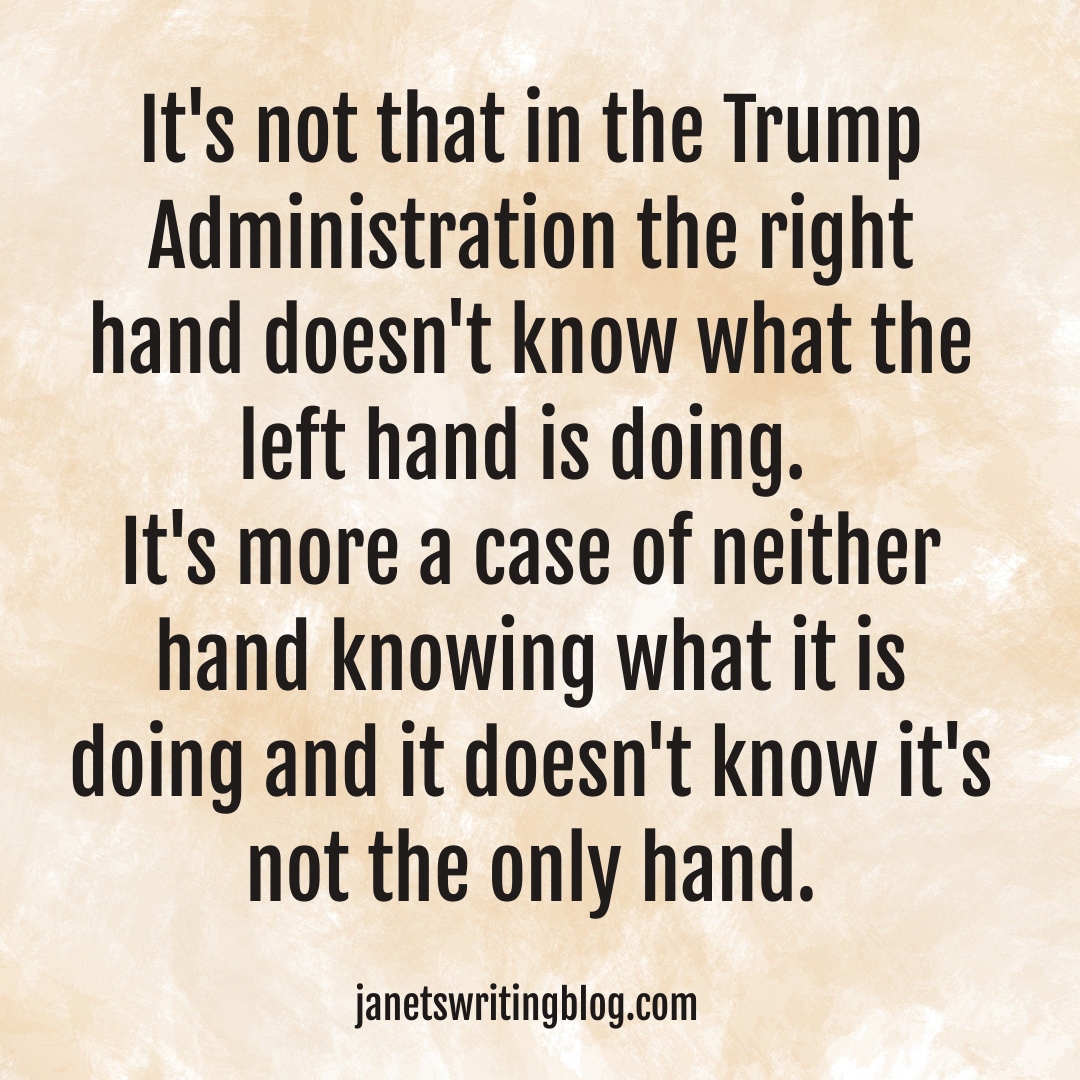
Is it possible that the right hand doesn’t know what the left hand is doing?

Can we, as citizens, utter the word “geothermal” or not? We need a user’s manual.

I do not live on a water system. I grew up and once again live out in the country and I rely on water well. Therefore, “rural water” piqued my interest. Do you know what “rural water” is?

According to the US Geological Survey, “rural water use” is “self-supplied water used in suburban or farm areas for domestic and livestock needs, and includes domestic use, drinking water for livestock, and other uses such as dairy sanitation, cleaning, and waste disposal.”

Photo of a glass of clear, clean water
Photo by engin akyurt on Unsplash

Maybe I’m biased, since I’ve drunk well water most of my life, but the above-listed uses of “rural water” sound important to me. “Safe drinking water” and “clean water” do, too.

If I’m going to eat fruits or vegetables grown on a farm or eat chicken, beef, pork, lamb, or any other meat raised on a farm or fish sold in the United States, I want to know that the water used to raise all that food was clean or relatively clean.

When I have to have a new well drilled for my household use, I’m glad that someone from the county health department is required to test that water and certify that it is safe for me to drink. If I had to depend on the USDA to do it, I would be out of luck.

And what about “soil pollution” and agriculture? If there is an oil spill on a farm, I think someone in the government should take action to monitor the situation and certify that the agricultural products coming from that farm are safe for us to consume. Do we not assume that’s something the USDA does?

Government is supposed to do those things that we cannot do for ourselves. I don’t know there was an oil spill. Even if I hear about the oil spill, I cannot visit that farm to take soil samples. I don’t have the scientific skills necessary to test those soil samples. I don’t have the scientific skill to test produce, milk, or meat samples from that farm and certify them as safe to consume.

If the USDA cannot talk about soil pollution or water pollution, where does that leave us? What about this is going to “Make America Healthy Again”?

Part of my brain is stuck in pre-January 20, 2025, so it is telling me my examples are extreme… that this would never happen in America. But fire a lot of the USDA employees and then tell the few that are still there not to use certain words. Sounds like a recipe for a disaster to me.

My thoughts

I live in North Carolina It is one of the top five pork-producing states. In 1996 and 1999, respectively, Hurricanes Fran and Floyd caused extreme flooding in the eastern part of the state… where most of the pigs are raised. Thousands of pigs drowned which caused dire and immediate health problems. Lessons were learned and safeguards were put in place for the future.

But what if another hurricane hits coastal North Carolina and in a matter of hours kills thousands of pigs? We have a State Department of Agriculture, but if you live in Kansas do you want to rely on another state to certify that the seafood coming out of the rivers and Atlantic Ocean that are downstream from those farms is safe for you to eat?

My point is that we are the United States of America, and we deserve a reliable national system of food inspection.

How is the US Department of Agriculture supposed to monitor crops or the safety of our food without using terms like water pollution, soil pollution, groundwater pollution, sediment remediation, water collection, and clean water?

How is any government agency supposed to operate without using these words?

Our country is in deep trouble when words like “clean water” cannot be used by every government agency.

Can someone please stop the madness?

Until my next blog post

Watch for my blog post tomorrow about a few of the things that have happened since January 20, 2025 – the day Trump took the oath of office without placing his hand on the Bible. A mere technicality that ten weeks after the fact doesn’t seem so important.

Pay attention to what’s happening.

Keep reading reputable nonfiction and fiction.

Don’t compromise your principles.

Remember the people of Myanmar, Thailand, Ukraine, and western North Carolina.

Janet, a disgruntled political science major

Just when you think things can’t get worse in America & fires in NC & SC

I hope you read my March 31, 2025, blog post. It was about the 298 words that The New York Times published on March 4, 2025, that the Trump Regime does not want US Government agencies to use.

The words on that list were a gut punch.

But then, on March 212, 2025, PEN America published an updated list or words and topics. (https://pen.org/banned-words-list/).

PEN Americais a nonprofit organization that works to defend free expression in the United States and around the world through the advancement of literature and human rights. The PEN America list repeats most of the words on The New York Times list.

Photo by Aaron Burden on Unsplash

My blog post today draws your attention (I hope!) to the words and topics from PEN America that were not on the New York Times list. Here they are:

abortion

accessibility

autism

Black and latinx

Cancer Moonshot

continuum

Covid-19

definition

dietary guidelines/ultraprocessed foods

disabled

discussion of federal policies

diversity and inclusion

diversity/equity efforts

EEJ

EJ

entitlement

elderly

equitable

equitableness

evidence-based

fetus

fluoride

gay

H5N1/bird flu

hate

hispanic

ideology

indigenous people

inequity

intersex

issues concerning pending legislation

male dominated

marijuana

measles

minority serving institution

MSI

NCI budget

obesity

opioids

peanut allergies

promote

science-based

self-assessed

socioeconomic status

special populations

stem cell or fetal tissue research

topics of federal investigations

topics that have received recent attention from Congress

topics that have received widespread or critical media attention

understudied

vaccines

vulnerable

woman


PEN America’s comments

PEN America’s article, “Federal Government’s Growing Banned Words List Is Chilling Act of Censorship,” is self-described as “most assuredly incomplete.”

The article goes on to say, “These policies’ tentacles already extend beyond government websites, though removing HIV resources from the Centers for Disease Control and Prevention, regardless of whether they mentioned ‘gender ideology’ or other banned terms, is bad enough. Reports say scientists are self-censoring in hopes of improving their chances of getting government grants.

“That’s exactly the sort of response the administration is hoping for, and it will immeasurably limit the research and other work supported by the federal government, universities and more, on the public’s behalf.”

The PEN America article said these restrictions on words “represent a dystopian effort to control what Americans think and say, despite President Trump’s lip service to ‘freedom of speech and ending federal censorship.’ There’s nothing ‘free’ about banning words or ideas.”


Some of the abbreviations are elusive

I had to look up EEJ, EJ, MSI, and NCI budget. In case you’re not familiar with them either, I’ll save you the trouble.

EEJ is, apparently, electroejaculation. EJ is, apparently, environmental justice. MSI is either Microsoft Installer or Micro-Star International Co., Ltd, a Taiwanese multinational information technology corporation. NCI budget is the US National Cancer Institute budget.


My two-cents’ worth

I won’t take time to comment on each word, word combination, or topic, but the following from the list leave me gobsmacked, to borrow a British word:

autism – This is a real thing. Thousands of children and adults (and their caregivers) deal with it every day. You can’t erase it by erasing the name.

Cancer Moonshot – President Biden’s plan to try to find cures for cancer

Covid-19 – Outlawing the name of a pandemic doesn’t mean it didn’t happen.

dietary guidelines/ultraprocessed foods – So how are you going to “Make America Healthy Again” without dietary guidelines?

disabled – Sort of like autism… You can’t erase it, although Nazi Germany tried to.

discussion of federal policies -This just defies reason! Does it mean I can no longer blog about federal policies?

diversity and inclusion – Dog whistle for hiring people of color and women.

diversity/equity efforts – Ditto.

elderly – Okay. I’m 72 years old. That makes me a “baby boomer,” but doesn’t it also make me elderly?

evidence-based – Another one that defies reason.

fetus – Ditto!

fluoride – I know RFKjr. doesn’t want cities to put fluoride in their water, but come on!

gay – Please don’t outlaw this word. I have a friend whose name is Gay, and we’ve already found out voters didn’t like it when you had references to the Enola Gay taken down from the Department of Defense. Give it up!

H5N1/bird flu – So what are scientists and physicians to call it if not H5N1?

hate – I’m sorry, but some people are full of hate. Some of them live and work on Pennsylvania Avenue in Washington, DC.

hispanic – I’ll let people of Spanish descent handle this one.

indigenous people – I guess I should let indigenous people handle this one, too.

issues concerning pending legislation – What are you thinking?

male dominated – No, we wouldn’t want anyone to say that any levels of government or business are male-dominated, would we? (By the way, you forgot the hyphen.)

marijuana – What word are we supposed to call this plant?

measles – Been there, done that in the second grade. Wish there had been a vaccine then. I know researchers and physicians know it as rubella, but what’s wrong with laypeople calling it measles?

obesity – We have an obesity epidemic in America, so maybe you need to rethink banning this word.

opioids – We also have a opioids epidemic in America. Fentanyl is a synthetic piperidine opioid. Isn’t that the root of the President’s attacks on Mexico and Canada?

peanut allergies – Peanut allergies are a real thing.

science-based – Here we go again down the same path as evidence-based.

topics of federal investigations – Does this just apply to government employees or does it also apply to reporters?

topics that have received recent attention from Congress – Ditto.

topics that have received widespread or critical media attention – Does this just apply to government employees or can regular citizens no longer discuss amongst ourselves things we heard on the news or read online?

vaccines – I think I know who we have to thank for this one. After dedicating your entire adult life to outlawing vaccines, at least now you’ve convinced the powers that be to ban the use of the word.

vulnerable – The way things are going, I feel like most people living here now are vulnerable. When it applies to the majority of a population, does it qualify for a new word. “Vulnerable” is starting to lose its punch.

woman – I don’t know what to say about this one. First you ban the word, then it makes it easier to ban the woman.

If today’s list and the list I shared on March 31, 2025, don’t send a shiver down your spine, you must not have a spine.

Some of you are, no doubt, laughing at these lists and at me for being concerned about them.

Some of you are, no doubt, in denial. (“Surely, a United States President would not encourage or instruct US Government employees to “limit or avoid” these words or topics. That’s just silly!”)

Keep in mind that censorship was an important weapon in Nazi Germany before and during World War II. Censorship is not laughing matter. Censorship is not silly.


A brief message about western North Carolina and South Carolina fires

I failed to mention in my blog about Hurricane Helene recovery in western NC on March 26, 2025, that firefighters had poured in from across the United States to fight the numerous wildfires in our mountains. Some of the fires are in the exact areas that were hit so hard six months ago by the hurricane.

I understand that firefighters from Arizona, California, Colorado, Georgia, Idaho, Mississippi, Montana, New York, Oregon, South Carolina, South Dakota, Tennessee, Texas, and Wyoming have come to help North Carolinians fight these fires!

Thank you, each of you!

I learned on Sunday that FEMA had awarded Polk County a Fire Management Assistance Grant. It will cover up to 75% of eligible firefighting costs.

The North Carolina Department of Environmental Quality (I’m glad we still have one of those on the state level!) issued a Code Red Air Quality Action Day for Henderson, Transylvania, and Polk counties on Sunday due to extreme smoke.

Much-needed rain fell over the area on Sunday and Monday, alleviating the fire situation and allowing some 300 firefighters to take a break. The terrain is challenging and most of it is still littered by the millions (yes, millions!) of trees that came down during the hurricane. In addition to hampering firefighters in gaining access, the downed trees are feeding the fires.

As of yesterday afternoon, the Table Rock Fire in South Carolina was only 30% contained. Arson charges have been filed by the SC Forestry Commission against two 18-year-olds and a 19-year-old who were smoking cigarettes and, through their negligence, started the 13,000-acre Table Rock Fire. A juvenile suspect in the case has been charged and released into the custody of his parents. It is the largest fire in South Carolina’s history.

It renews my faith in some of my fellow Americans to know that in times of trouble, there are still people who will go to another state’s aid not caring whether most people in that state voted for a Republican or a Democrat.

The statewide burn ban in NC will be lifted at 8 a.m. today, except the ban still exists for fires within 100 feet of a residence.


Until my next blog post tomorrow

Pay attention to what’s happening.

Watch for my blog post tomorrow about words that the United States Department of Agriculture is not allowed to use now.

Keep reading reputable nonfiction and fiction.

Don’t compromise your principles.

Remember the people of Myanmar, Thailand, Ukraine, and western North Carolina.

Janet, a disgruntled political science major

P.S. No, I didn’t even mention the tariffs that took effect today. I can’t address everything.

Words Trump wants federal agencies to “limit or avoid”

Find a comfortable chair. This is another long blog post.

I’ve been mulling over today’s topic for several weeks. It’s one thing to erase history – and the Trump Administration seems to be doing an admirable job, if that’s what you want done.

And some people do want that done. As I voiced my displeasure with everything the Trump Administration has done in two short months a classmate, whom I’ve known for 65 years, told me “it’s a beautiful thing to watch.” His comment made me nauseous.

Photo of a taxidermied elephant on display at the Smithsonian Institution in Washington, DC
A taxidermied elephant on display at the Smithsonian Institution, Washington, DC.
Photo by J. Amill Santiago on Unsplash

Several days ago, the Trump Administration (or should I say, Regime?) attacked the Smithsonian Institution and National Park Service. Both were targeted for having “divisive” and “anti-American” exhibits. “Divisive” and “anti-American” can be translated to mean that they have some exhibits about people of color and women of any color. It’s feeling more and more like 1931 in Germany around here.

I have a hunch the elephant pictured above that is displayed at the Smithsonian Institution will be safe, though, since the elephant is the mascot of the Republican Party.

Equally troubling to me as erasing history is the Trump Administration’s efforts to limit or perhaps erase perfectly good words from our vocabulary.

Photo of a pencil with an eraser on the end
Photo by Kim Leary on Unsplash

People are disappearing, history is disappearing, and words are disappearing. Our allies are disappearing, and who can blame them?

Several weeks ago, a list of words was cobbled together that the Trump Regime wants US Government agencies to “limit or avoid.” The White House denies issuing a list, but they have left government agencies to use some of their own judgment in erasing specific words from their documents and websites. It seems that the hints they’ve been given are fairly loud as they are supposed to use Trump’s too-numerous-to-mention Executive Orders as their guide.

This is rich, coming from a President who has difficulty speaking in complete sentence. (Before you jump on me… I’m not being disrespectful; there is proof all over TV, video and audio clips, the internet, and the printed word.)

You can’t make this stuff up.

In case you missed it here is the list of 298 words and combinations of words that The New York Times published on March 4, 2025, that US Government agencies are supposed to “limit or avoid”:

  • accessible
  • activism
  • activists
  • advocacy
  • advocate
  • advocates
  • affirming care
  • all-inclusive
  • allyship
  • anti-racism
  • antiracist
  • assigned at birth
  • assigned female at birth
  • assigned male at birth
  • at risk
  • barrier
  • barriers
  • belong
  • bias
  • biased
  • biased toward
  • biases
  • biases towards
  • biologically female
  • biologically male
  • BIPOC
  • Black
  • breastfeed + people
  • breastfeed + person
  • chestfeed + people
  • chestfeed + person
  • clean energy
  • climate crisis
  • climate science
  • commercial sex worker
  • community diversity
  • community equity
  • confirmation bias
  • cultural competence
  • cultural differences
  • cultural heritage
  • cultural sensitivity
  • culturally appropriate
  • culturally responsive
  • DEI
  • DEIA
  • DEIAB
  • DEIJ
  • disabilities
  • disability
  • discriminated
  • discrimination
  • discriminatory
  • disparity
  • diverse
  • diverse backgrounds
  • diverse communities
  • diverse community
  • diverse group
  • diverse groups
  • diversified
  • diversify
  • diversifying
  • diversity
  • enhance the diversity
  • enhancing diversity
  • environmental quality
  • equal opportunity
  • equality
  • equitable
  • equitableness
  • equity
  • ethnicity
  • excluded
  • exclusion
  • expression
  • female
  • females
  • feminism
  • fostering inclusivity
  • GBV
  • gender
  • gender based
  • gender based violence
  • gender diversity
  • gender identity
  • gender ideology
  • gender-affirming care
  • genders
  • Gulf of Mexico
  • hate speech
  • health disparity
  • health equity
  • hispanic minority
  • historically
  • identity
  • immigrants
  • implicit bias
  • implicit biases
  • inclusion
  • inclusive
  • inclusive leadership
  • inclusiveness
  • inclusivity
  • increase diversity
  • increase the diversity
  • indigenous community
  • inequalities
  • inequality
  • inequitable
  • inequities
  • inequity
  • injustice
  • institutional
  • intersectional
  • intersectionality
  • key groups
  • key people
  • key populations
  • Latinx
  • LGBT
  • LGBTQ
  • marginalize
  • marginalized
  • men who have sex with men
  • mental health
  • minorities
  • minority
  • most risk
  • MSM
  • multicultural
  • Mx
  • Native American
  • non-binary
  • nonbinary
  • oppression
  • oppressive
  • orientation
  • people + uterus
  • people-centered care
  • person-centered
  • person-centered care
  • polarization
  • political
  • pollution
  • pregnant people
  • pregnant person
  • pregnant persons
  • prejudice
  • privilege
  • privileges
  • promote diversity
  • promoting diversity
  • pronoun
  • pronouns
  • prostitute
  • race
  • race and ethnicity
  • racial
  • racial diversity
  • racial identity
  • racial inequality
  • racial justice
  • racially
  • racism
  • segregation
  • sense of belonging
  • sex
  • sexual preferences
  • sexuality
  • social justice
  • sociocultural
  • socioeconomic
  • status
  • stereotype
  • stereotypes
  • systemic
  • systemically
  • they/them
  • trans
  • transgender
  • transsexual
  • trauma
  • traumatic
  • tribal
  • unconscious bias
  • underappreciated
  • underprivileged
  • underrepresentation
  • underrepresented
  • underserved
  • undervalued
  • victim
  • victims
  • vulnerable populations
  • women
  • women and underrepresented

Some of my thoughts on the subject

I considered using bold font to highlight my favorites/most angering/most ridiculous words on the list, but that would have been all 298 of them.

As a writer, words are my life. Words help me communicate. I’ll bet they help you, too. Without words, our communications would be extremely limited.

I haven’t read how Trump intends to enforce this or what punishments will be meted out to offenders. And who comes next? Writers? Reporters? Universities? Teachers?

Depending on your background, gender, or ethnicity, there are probably particular words on the list that strike a nerve with you.

Here are 51 that set me off

“Black” (capitalized) — I have Black friends. I don’t see anything wrong with the word “Black.” In fact, my great-grandmother’s surname was Black. My sister and I mentioned her in one of the Morrison genealogy books we published in 1996. I hope the Trump Administration will not ban our book, but we’re on a slippery slope when we start outlawing words.

“female,” “females,” “women,” and “biologically female”– Hmmm. Now those are intriguing words to put on a government’s “limit or avoid” list. I couldn’t help but notice that “male,” “males,” and “men” are not on the list, but “biologically male” is. Surely, it was an oversight on the part of the “biologically male” person who obviously wrote the list to not include “male,” “males,” and “men” on the list.

“mental health” – I have some relatives who struggle with mental health. I’m not sure what to do with this word combination now. Does the Trump Administration think by not using the words “mental health,” mental health issues will no longer exist? How wonderful it would be if we could just use a word and make a whole category of illness disappear!

“belong” – My mind jumped back to a trip to Scotland where I learned that there instead of saying, “She’s Campbeltown,” the locals would say, “She belongs to Campbeltown.” Since the plural form of the word isn’t on the list, maybe that use of it would be legal. Otherwise, Scots might want to think twice before visiting America. Oh… my bad…. They’ve all taken America off their bucket lists since January 20.

“pronoun” and “pronouns” – This is going to be challenging for English teachers, but it will simplify diagramming sentences.

“sex” and “chestfeed” – I don’t know what to say about these. I don’t want my blog to be flagged as obscene, but is “chestfeed” really a word? Is it actually a thing we need to be concerned about?

“systematically” – What?

“orientation” – I guess there will be no more orientation meetings for new government employees or college freshmen at schools that receive federal funds.

“trauma” – Some hospitals are qualified trauma centers, but I guess they won’t be much longer. Heaven forbid if they receive any federal funds.

Photo of a poster with words like trauma, PTSD, and anger on it
Photo by Susan Wilkinson on Unsplash

“environmental quality” – You’ve got to be kidding, Trump! Just because you don’t want the citizens of the United States to have “environmental quality” doesn’t mean that the citizens of the United States don’t want “environmental quality.” Just because you want to drink contaminated water and breathe polluted air, Mr. Trump, doesn’t me the rest of us do. You can’t just outlaw the words “environmental quality” and make the whole concept of a healthy environment go away.

“disability,” and “disabilities,” – I shudder to think what will soon become of the Americans with Disabilities Act. It is that act that requires handicapped bathroom stalls, automatic doors to permit easy ingress and egress at government buildings, hotel rooms with bathrooms accessible to people in wheelchairs, etc. Need I keep going?

That leads me to “barrier” and “barriers” – which I think must be on the list because the Americans with Disabilities Act tries to prevent physical movement and communication barriers from remaining in place that make it difficult for blind, deaf, and people restricted to wheelchairs to do what they need to do. Have you ever wondered why you didn’t see many (or any?) ramps into public buildings in the 1950s, but now you do? They didn’t just happen. It wasn’t because architects started adding them out of the goodness of their hearts.

Photo of a really long staircase
Photo by Joseph Akbrud on Unsplash

“race,” “racial,” “ethnicity,” and “gender” – The folks who create US Passports better get busy figuring out how to get around those questions.

“historically” – I assume this is targeting “Historically Black Colleges and Universities.” Take out the words “historically” and “Black” and it is going to be difficult to know which “colleges and universities” one is talking about. Oh… my bad… that’s the point!

“discriminated,” “discrimination,” and “discriminatory” – Are we no longer allowed to talk about or file lawsuits regarding discrimination? This is appalling!

“minority” – Lucky for the US Congress that this list, at least for now, only applies to the agencies in the Executive Branch of the government because, otherwise, they would have to come up with a new term for “Minority Whip” and “Minority Leader” in their official titles.

“expression” – Wipe that silly expression off your face!

“identity” – Seems like a legitimate word to me.

“prejudice” – Since we still have a US Department of Justice, so to speak, I guess the lawyers are going to have to find a new way to label the rulings on certain lawsuits. You see, the term “without prejudice” is a legal phrase. It is used by judges to indicate that a case can be revisited or that the verdict is not final.

I noticed it’s acceptable to use the word “racist,” but it’s not okay to use the words “anti-racist” or “anti-racism.” Interesting.

“Native American” – I think it should be left up to the indigenous peoples of America to tell the rest of us what they want to be called. I don’t think that she be left up to Donald Trump. When I was doing the research to write my vintage postcard book, The Blue Ridge Mountains of North Carolina, I learned that the Cherokee Indians in the Qualla Boundary in North Carolina prefer to be called Indians. The official name of the tribe there is Eastern Band of Cherokee Indians.

“tribal” is also on the list. That’s unfortunate because some tribes, such as the Eastern Band of Cherokee Indians have tribal courthouses and tribal councils. Please don’t tell them they can no longer use the word “tribal.” The US Government has already taken too much from them.

“bias,” “biased,” “biased toward,” “biases,” and “biases towards” are all on the list. I agree with “biases towards” being on the list because “towards” is incorrect grammar in the United States. I have a problem with the other four, though.

“allyship” – I must admit that was a new word for me. I looked it up and discovered that it refers to those of us in relatively advantaged groups who intentionally support or advocate for disadvantaged people. I hope I’m guilty of having done “allyship” in the past, and I hope I will continue to be guilty of it in the future! As a Christian, I am called on to do that.

That leads me to “advocacy,” “advocate,” and “advocates.” – Now that’s just sad. When you are in the hospital or a nursing home, you need an “advocate” to look out for your best interests. That can be a relative or a social worker or… hut oh….

My doctor says if I have osteopenia and I don’t exercise and eat a calcium-rich diet, I am “at risk” of developing osteoporosis. I assume the Department of Health and Human Resources can no longer “advocate” for “at risk” conditions and illnesses. That’s the least of our worries, though, with RFK, Jr. in charge of that department.

“equality,” “equity,” “inequalities,” “inequality,” “inequitable,” “inequities,” and “inequity” – Does anyone else see a blatant pattern here?

I noticed the word “justice” does not appear on the list. That’s nice, because that word is used in the Preamble of the US Constitution. Whew! That was a close call!

You know the words to the Preamble, don’t you, Mr. Trump?

“We the People of the United States, in Order to form a more perfect Union, establish Justice, insure domestic Tranquility, provide for the common defence, promote the general Welfare, and secure the Blessings of Liberty to ourselves and our Posterity, do ordain and establish this Constitution for the United States of America.”

I thought about highlighting my “favorite” words on the list, but before I knew it I had pulled out 50 of them. I’ll just leave it at that for today, but my new purpose in life is to make sure I use at least one word on the list every week in my blog. Heck, I might use more than one.

Some of my comments about specific words on the list were tongue-in-cheek, but I assure you that I take this very seriously.

In essence, Trump’s putting out the word that federal government agencies can read his myriad Executive Orders and surmise the words they need to “limit or avoid” pretty much makes their use on government documents and websites illegal.

No, there is no enacted law prohibiting the use of these words. However, one definition of “illegal” is “not sanctioned by official rules.” (Merriam-Webster’s Collegiate Dictionary, Tenth Edition, 2001.)

How do you ban books in the 21st century?

You make your citizens afraid to use words on an ever-growing list.

Just when you think things can’t get worse

PEN Americais a nonprofit organization that works to defend free expression in the United States and around the world through the advancement of literature and human rights. On March 21, 2025, the organization published a growing list of words being singled out by the Trump Administration as words Trumps doesn’t want us to use.

My blog post on Wednesday, April 2, 2025, will list the words identified by PEN America that did not appear on the March 4, 2025, New York Times list.

Arlington National Cemetery

With so much going on, and a couple of long blog posts in March, I waited until today to mention how the US Department of Defense is erasing history specifically on the Arlington National Cemetery website. US history seems to be in Trump’s cross-hairs.

Photo of rows and rows of white grave markers in Arlington National Cemetery
Photo by Janne Simoes on Unsplash

Under the heading, “Arlington National Cemetery removed links to webpages about Black, Hispanic and female veterans,” Snopes.com (published March 14, 2025; updated March 15, 2025) verified that the following links had been removed from the Arlington National Cemetery website:

          African American History, removed from the Notable Graves subsection;

          Hispanic American History, removed from the Notable Graves subsection;

          Women’s History, removed from the Notable Graves subsection;

          African American History, removed from the Themes drop-down menu of the Education section; and

          Civil War, removed from the Themes drop-down menu of the Education section.

This should be no surprise, since Trump has called veterans suckers and losers.

Until my next blog post

What are your “favorite” words on the list of 298 words I shared today?

I hope you have a good book to read.

Nurture your friendships and relatives.

Remember the people of Myanmar, Thailand, Ukraine, and western North Carolina.

Janet

Six Months After Hurricane Helene

It has been six months since Hurricane Helene ravaged western North Carolina. The State of North Carolina has just allocated an additional $524 million for Hurricane Helene recovery, and the National Hurricane Center issued its final Hurricane Helene report last week.

Photo by JD Designs on Unsplash

As of Friday, March 21, 146 roads in North Carolina were still closed due to Hurricane Helene. That count included 9 US highways (that’s 2 fewer than the previous Friday), 15 state highways (that’s 2 fewer than the previous Friday), and 122 state roads (that’s 2 fewer than the previous Friday).

Last Wednesday, March 19, NC Governor Josh Stein, a Democrat, signed a bill that had finally passed the NC Legislature that will provide $524 million in hurricane relief in the western part of the state. The bill emphasizes home and private road repairs, agriculture, and infrastructure to aid businesses.

Stein had asked the Republican-controlled General Assembly for an additional $1.1 billion for Hurricane Helene recovery on top of the $1.1 billion the State of North Carolina has already spent or appropriated.

The Associated Press reported last Wednesday night: “Stein’s administration projects that disaster relief approved by Congress in December and other federal funding sources may ultimately provide more than $15 billion in Helene recovery funds to North Carolina. Stein is now seeking another $13 billion from Washington.”

About 4,600 households in western NC were still receiving temporary housing assistance as of a couple of weeks ago.

The WUNC public radio website (https://www.wunc.org) gives the following breakdown of the $524 million for western North Carolina Hurricane Helene recovery:

  • $200 million for crop loss programs and agricultural debris removal
  • $120 million for rebuilding and repairing homes
  • $100 million for repairing private roads and bridges
  • $55 million for small business infrastructure grants
  • $20 million for debris removal
  • $10 million for volunteers and nonprofits actively assisting in the disaster
  • $10 million for fire department grants
  •  $9 million for learning recovery in the Helene-affected counties 
  •  $4 million for travel and tourism marketing 

The bill also extends the state of emergency and increases the number of counties eligible for school calendar flexibility due to missed school days.

In addition to the $524 million for Hurricane Helene recovery, the legislature allocated $217 million for Hurricanes Matthew (2016) and Florence (2018) recovery on the coast.

The $9 million for a voluntary summer school program in districts that were closed for many weeks due to Hurricane Helene is less than Governor Stein requested.

Stein had requested money for two business grant programs to help companies that suffered significant losses, but the legislature omitted those programs from the final bill. Instead of Stein’s request, the legislature designated $55 million in the form of grants to local governments for sewer, utility, and sidewalk repairs which will indirectly benefit small businesses.

The dollar amount for the damage caused by Hurricane Helene in western North Carolina alone has been estimated to be $53.6 billion, so drops of relief continue to drip into the bucket.

The need is still great, but in the NC General Assembly the people who are still homeless or hanging on by a thread since the hurricane must compete for the millions of dollars our legislators want to give out in vouchers so children can go to private schools instead of our public schools. (Don’t get me started!)

The National Hurricane Center released its final report on Hurricane Helene on Friday. The full report can be found on the NOAA website: https://www.nhc.noaa.gov/data/tcr/AL092024_Helene.pdf .

Photo by Kelly Sikkema on Unsplash

A few highlights from the report as it pertains to the storm in western North Carolina:  106 deaths in NC were attributed directly or indirectly to the storm. Busick, NC in Yancey County got 30.78 inches of rain – the most recorded anywhere from the hurricane. Approximately 40 miles to the south (as the crow flies), a site in Transylvania County, NC recorded 29.98 inches. Ten counties in the state recorded more than 18 inches of rain, so you can see that a large part of the mountains in NC received incredible amounts.

Mt. Mitchell recorded sustained winds of 80 miles per hour and gusts as high as 106 miles per hour. The small town of Banner Elk recorded wind gusts of 101 miles per hour. The hurricane caused more than 2,000 landslides, most of which were in North Carolina.

The North Carolina Forest Service estimated 822,000 acres of damaged timberland, which resulted in $214 million in damages to North Carolina forests.

By the way, US Secretary of Homeland Security, Kristi Noem, announced at Monday’s meeting of the President’s Cabinet that she plans to “eliminate FEMA.” Apparently, there are no natural disasters in her home state of South Dakota. At the age of 53, she is fortunate if she’s never experienced one. She and Trump think states can handle disasters better than the nation. States don’t have the resources the US Government has… but maybe that’s just my opinion. We’ll see how this works out.

Until my next blog post

My planned topic for next Monday is the 298 words Trump wants federal agencies to limit or avoid. As you can imagine, this hit a nerve with me!

I hope you have a good book to read.

Hold your family close.

Remember the people of Ukraine and western North Carolina.

Janet

Two US Supreme Court Rulings in 1898 and 2025

There is so much we can learn from history! Today’s headlines often mirror events that happened years ago.

You get a bonus blog post from me this week. As I explained yesterday, what I wanted to say this week amounted to more than anyone wants to read in one sitting.

Today’s post is about a couple of US Supreme Court rulings. Tomorrow’s post is about Hurricane Helene recovery in western North Carolina six months after the storm

United States v. Wong Kim Ark, 1898

My sister made me aware of the United States v. Wong Kim Ark US Supreme Court case. This ruling about American birthright came down in 1898.

The 14th Amendment was ratified on July 9, 1868 – 30 years before the Wong Kim Ark case. The wording of the 14th Amendment seems straightforward, but our current US President wants to do away with it.

The first clause of the 14th Amendment to the US Constitution reads as follows: “All persons born or naturalized in the United States, and subject to the jurisdiction thereof, are citizens of the United States and of the State wherein they reside.”

Let’s take a step back and see what prompted Mr. Wong Kim Ark to take his complaint all the way to the US Supreme Court.

Who was Wong Kim Ark and what was this Court Case about?

Wong Kim Ark was born in San Francisco, California in 1873. His parents were subjects of the Emperor of China but were permanently residing in the United States. The family still lived in San Francisco in 1890 when Wong Kim Ark took a trip to China.

He returned to his home in San Francisco on July 26, 1890. He lived there and worked as a laborer as a US citizen. In 1894 he took another trip to China but, when he returned to the US in August 1895, he was denied entry on the grounds that he was not a US citizen.

A lower court ordered him to be released because he was a US citizen. The United States appealed the lower court’s decision, and the case went to the US Supreme Court.

Justice Horace Gray delivered for the majority in the 6-2 ruling by the US Supreme Court. In his statement he indicated that the Chinese Exclusion Act of 1882 had no relevance in this case.

The Chinese Exclusion Act was the first law of any significance that limited immigration into the United States. The Act was the result of violent acts committed against Chinese workers. It prohibited Chinese laborers from entering the US for ten years. Exceptions included merchants, teachers, students, travelers, and diplomats.

Justice Gray wrote, “It is conceded that, if he is a citizen of the United States, the acts of Congress, known as the Chinese Exclusion Acts, prohibiting persons of the Chinese race, and especially Chinese laborers, from coming into the United States, do not and cannot apply to him.”

As in most cases that reach the level of the US Supreme Court, there is more here than meets the eye. Having taken one Constitutional Law course in college does not qualify me as a Constitutional scholar, so I’ll just leave it at that.

If you wish to delve more deeply into the United States v. Wong Kim Ark decision, you may do so. I just found it serendipitous that the anniversary of this case fell during a time when the 14th Amendment to the US Constitution is under fire.

Why is the 14th Amendment under attack by Trump?

It is obvious that the president does not want children of undocumented Hispanic immigrants who are born in the US to automatically have US citizenship as guaranteed by the 14th Amendment.

The White House appears to be arguing its case on https://www.whitehouse.gov/presidential-actions/2025/01/protecting-the-meaning-and-value-of-american-citizenship/. It seems short-sighted to me for Trump to “show his hand” on this matter since it is destined to go before the US Supreme Court if he insists on pursuing his contempt for the 14th Amendment.

We have not heard the last of this.

A March 5, 2025 US Supreme Court ruling to consider

On March 5, 2025, we saw only five of the nine US Supreme Court Justices vote that the United States should be required to honor its promises of $2 billion in foreign aid through the now-possibly-defunct United States Agency for International Development (USAID). The slim majority decision gave me a sigh of relief but immediately angered me because the vote should have been 9-0.

Photo by Isak Engström on Unsplash

What is it in the life experiences of Associate Justices Alito, Kavanaugh, Thomas, and Gorsuch that influenced them to vote in the negative? What made those four men believe that funds authorized by the US Congress and promised to other countries and organizations should not be honored? Should not be paid?

What makes those four men think the United States should not be a country of its word? I really want to know.

Justice Alito argued in an eight-page dissent that resembled a pro-MAGA social media post that a US District Court Judge could not compel the US Government to spend money authorized by Congress. He essentially went after Judge Amir Ali, the lower court judge who had ruled in the case.

From what I have read, I think his anger is misplaced. It is the US Constitution that gives Congress the authority to allocate money. If Mr. Alito has a problem with that, perhaps he should have stated his disfavor with the Constitution instead of against Judge Amir Ali.

I certainly hope Justice Alito was not lashing out at Judge Ali because Judge Ali was born in Canada. I hope he wasn’t lashing out at Judge Ali because he was appointed by President Joe Biden. And I certainly hope he wasn’t lashing out at Judge Ali because he is a Muslim.

Perhaps I’m looking for a “there” when there’s no “there” there, but the current US Supreme Court in general seems to be in Trump’s pocket. This is the same group of Justices that ruled in 2024 that nothing a US President does is illegal.

I pray we haven’t heard the last of this!


Arlington National Cemetery

With so much going on, and a couple of long blog posts in March, I waited until today to mention how the US Department of Defense is erasing history specifically on the Arlington National Cemetery website. US history seems to be in Trump’s cross-hairs.

Under the heading, “Arlington National Cemetery removed links to webpages about Black, Hispanic and female veterans,” Snopes.com (published March 14, 2025; updated March 15, 2025) verified that the following links have been removed from the Arlington National Cemetery website:

          African American History, removed from the Notable Graves subsection;

          Hispanic American History, removed from the Notable Graves subsection;

          Women’s History, removed from the Notable Graves subsection;

          African American History, removed from the Themes drop-down menu of the Education section; and

          Civil War, removed from the Themes drop-down menu of the Education section.

This should be no surprise, since Trump has called veterans suckers and losers.


The latest US Department of Defense blunder

It seems to me that our Department of Defense (DoD) needs to spend less time erasing history and more time holding top secret war plans in a secure location (which until the Trump Administration was the policy) and much less time holding top secret war plan meetings via text messages.

Thank you, Jeffrey Goldberg, editor-in-chief of The Atlantic magazine, for being a true patriot and not leaking the plans for the United States bombing the Houthis in Yemen last week. Leaking the plans that you were texted would have put US military personnel is grave danger. Were you included on the text list by mistake, or is there someone in the DoD who wanted this information leaked to a journalist?

I wonder who DoD Secretary Hegseth will text top secret information to next.


Until my next blog post

I hope you have a good book to read.

Hold your family close.

Remember the people of Ukraine and western North Carolina.

Janet

“First they came for the…”

Every week I think I’ll write a shorter blog post, but every week there’s something in the news about which I’m compelled to comment. Every week I think I’ll get back to work on the novel I’m writing.

The original blog post I wrote for today came in at more than 3,000 words. No one wants to read a 3,000-word blog post, so I’ve divided it into three posts.

Tomorrow I will blog about a couple of US Supreme Court rulings made in 1898 and 2025 that I initially was going to blog about today.

Wednesday’s post will include a breakdown of the $524 million bill passed by the NC General Assembly and signed by Governor Josh Stein las week as well as highlights from the National Hurricane Center’s final report about Hurricane Helene.

And you know me… if something else happens before I post tomorrow and Wednesday, I’m liable to go off on another tangent. While we still have a modicum of free speech in America, I will take advantage of every opportunity to speak out about injustice and actions that run counter to the US Constitution.


A blog post update

Last week I reblogged Tangie T. Woods’ post from her “Mrs. T’s Corner” blog about Lt. Col. Charles Calvin Rogers’ information being taken down from the Department of Defense (DoD) website.

The DoD seemed to get confused about exactly what on its website qualified as the “Diversity, Equity, and Inclusion” (DEI) that the Trump Administration wants eradicated from all federal government departments and resources.

Under the Trump Administration, the online record of the Medal of Honor that Lt. Col. Rogers received on May 14, 1970 was changed to read, “dei-medal-of-honor.” There is no such medal and there was no such thing as DEI in 1970.

Of course, the teenagers working for Elon Musk would not know that. They wouldn’t care that Lt. Col. Rogers served in the war in Vietnam. They probably could not find Vietnam on a map if their lives depended on it.

And, since Elon Musk is from South Africa, he probably doesn’t know anything about the war in Vietnam either.

The last I heard, Lt. Col. Rogers’ information has been corrected, but the bigger problem still exists as every single day something else is erased from history by the computer geeks working for Elon Musk and the Department of Government Efficiency.

According to the Associated Press on Saturday, March 22, 2025: “The restoration process has been so hit or miss that even groups that the administration has said are protected, like the Tuskegee Airmen, the first Black military pilots who served in a segregated World War II unit, still have deleted pages that as of Saturday had not been restored.”

Would someone please explain to me what the online removal of the records of the Tuskegee Airmen and military Medal of Honor recipients has to do with “Efficiency” because I’m having trouble understanding it?  

Last week, Principal Chief Mitchell Hicks of the Eastern Band of Cherokee Indians issued a statement about how indigenous peoples on the North American continent have been marginalized by the government since European settlers arrived here.

Chief Hicks pointed out in his statement that even though the US Government tried to wipe out the Cherokee language, during World War I it was the Cherokee who developed a secret code based on their language for the US military to use. He said in his statement that the Cherokee people will make sure their military history is not erased.

Thank goodness the Cherokee people are doing this, because we cannot depend on the United States Government to preserve it.

We are not stupid. We all know exactly what is behind all these anti-DEI actions. White men have dominated politics and business in the US since the country’s formation, and many of them cannot accept the fact even in the 21st century that women and people whose skin is all shades of brown and black have brains.

Many of them claim to be Christians, but they reject the essence of the teachings of Jesus Christ. Their words and actions fly in the face of the teachings of Jesus Christ.

As a Presbyterian, I believe that in the eyes of God the Father, God the Son, and God the Holy Spirit, all people – women and men – of every shade of skin hold equal value. It is offensive when someone claims to be a Christian but they endorse political leaders who demean women and disrespect people of color.

If some of those old white men in the White House, the US Congress, and the US Supreme Court are not getting that message at their churches, maybe they need to find another church.

If you think I’m being disrespectful to the US President and other old white men, my words don’t hold a candle to the disrespect they are showing me and my fellow citizens every day through their words, their actions, and their inactions.

DEI was about making sure everyone had an opportunity to get into the college they were academically-qualified to attend. It did not guarantee that they would pass the courses and graduate. It was about everyone having the opportunity to apply for a job. It did not guarantee them the job. It was about making sure everyone had a chance to sit at the proverbial table.

When I was a little girl in the 1950s, it wasn’t like that. In fact, when I was a teenager in the late 1960s, things were just beginning to change. I pray our country never goes back to the dark days of racial segregation and gender discrimination.

The Republican Party (i.e., Donald Trump, for he is the Republican Party now) has twisted the opportunities that DEI offered into something ominous, vile, and discriminatory. Through Project 2025 that his friends wrote, he is attempting to erase opportunity and history.

But some of us were entering the workforce in the 1970s and we know from personal experience how it was. It makes me sick to my stomach to know that my four great-nieces who are in their early twenties will not have the same opportunities their mothers had in the 1990s.

You see, the problem wasn’t solved when Lt. Col. Rogers’ military record was restored to a website. That was accomplished only after a public outcry. But the evil, hate, ignorance, small-mindedness, and fear (yes, fear!) that resulted in his record being mislabeled and removed is very much still with us.

If you think I’m reckless in my use of the word “evil,” according to Merriam-Webster, evil is defined as “morally reprehensible,” “arising from actual or imputed bad character or conduct,” “causing harm,” and “something that brings sorrow, distress, or calamity.”

The Trump Administration and his Department of Government Efficiency is all about evil, hate, ignorance, small-mindedness, and fear (yes, fear!). They work from a place of evil. They set out to hurt everyone they hate, don’t understand, and fear. They fear that white people will soon be in the minority in the United States. They fear that since women are going to colleges and universities in greater number than men, that eventually more women will attain positions of leadership in government and business.

Elon Musk has been quoted as saying that the biggest weakness of “the West” is empathy. I beg to differ. I think empathy has been one of our strengths. We showed empathy through the work of the USAID. Through the Voice of America radio broadcasts we showed empathy toward people who were trapped in authoritarian governments.

Trump and Musk have ended USAID and stopped the Voice of America. Being from South Africa, though, Mr. Musk has little experience with empathy. The word “empathy” is not in Trump’s vocabulary.

That takes us to “ignorance.” The people who took down the photograph of the Enola Gay airplane took it down because it had the word “Gay” in it. Well, duh! “Gay” just happens to be a woman’s name.

If you don’t believe me, look it up. And if you don’t know what the Enola Gay was, by all means, look it up if you still can.


While we’re on the topic of Government Efficiency…

US Department of Agriculture has halted $500 million in deliveries to food banks nationwide that the Biden administration announced last year. Even The Washington Post has reported this. One more slam at farmers and people who need a little help putting food on the table.

And even though under 26 U.S. Code 7213 it is a felony punishable by up to five years in prison, a $5,000 fine, and mandatory termination of employment for a federal employee to give anyone access to a taxpayer’s tax return information, the US Department of Homeland Security’s Immigration and Customs Enforcement (ICE) is working on an agreement with the Internal Revenue Service (IRS) to gain access to private tax records.

ICE claims to only be going after the tax records of undocumented immigrants, but this is a slippery slope.

If you aren’t careful, Mr. Trump, someone outside the IRS could someday gain access to your tax records! We all know how much you don’t want that to happen, even though every US President for decades before your first term made their tax records public. You promised to follow suit as soon as your 2015 tax audit was completed. We’re still waiting….


Until my next blog post

I hope you have a good book to read.

Hold your family close.

Remember the people of Ukraine.

And remember the people of western North Carolina where a half-dozen wildfires were still burning out-of-control yesterday afternoon. Three of them are in Polk County, which was hit hard by Hurricane Helene last September.

Look for my next blog post tomorrow!

Janet

#OnThisDay: Ramifications of Backgrounds of US Supreme Court Justices

When I read that today is the anniversary of the 1777 birth of Roger Brooke Taney, I wondered why his birthday appeared on any lists. When I learned that Mr. Taney was a US Supreme Court Chief Justice when the landmark Dred Scott decision was made, I knew there was a story behind the story.

We are all products of the times in which we live but, fortunately, we can be influenced by forces other than majority or peer pressure. We each have freewill to come to our own conclusions and beliefs.

Some US Supreme Court Justices try harder than others to disregard their personal backgrounds and experiences when considering a case. Some don’t seem to try at all in the 2020s.

Photo of US Supreme Court Building in Washington, DC
US Supreme Court Building, Washington, DC. (Photo by Brad Weaver on Unsplash.)

Let’s learn who Dred Scott was, and then we’ll look at how the life experiences of Roger Brooke Taney and the other six Justices in majority vote probably played into the US Supreme Court Dred Scott v. Sandford case.

Settle in. This gets complicated.

Who was Dred Scott?

Dred Scott was born a slave in Southampton County, Virginia around 1799. He moved to Alabama with his owner, Peter Blow, in 1818. In 1830, he moved to St. Louis, Missouri where Mr. Blow ran a boarding house.

Dr. John Emerson purchased Mr. Scott after Mr. Blow died in 1832. Dr. Emerson took Mr. Scott to Illinois and later to the Wisconsin Territory. Illinois was a free state, and slavery was illegal in the Wisconsin Territory.

Mr. Scott married Harriet Robinson, who was also a slave. Ms. Robinson’s owner sold her to Dr. Emerson. Things got more and more confusing in the ensuing years after Dr. Emerson moved back to St. Louis, but hired out Mr. and Mrs. Scott, leaving them in Wisconsin.

Dr. Emerson moved to Louisiana. He married Eliza (Irene) Sandford in 1838. Dred Scott went there, but shortly thereafter the Emersons and their slaves, including Mr. Scott, moved back to Wisconsin.

Dr. Emerson was discharged from the US Army in 1842 and – you guessed it – he and his wife and the Scotts moved back to St. Louis. Mr. and Mrs. Scott, by then, had two daughters.

Dr. Emerson seemed to have financial problems, so he and his wife moved to Iowa. It is unclear whether the Scotts went with them or if they were hired out and remained in Missouri.

When Dr. Emerson died in 1843, the Scotts and all his other slaves became the property of his widow, Irene Sandford. She moved back to St. Louis, retained ownership of the Scotts, and hired them out.

Mr. Scott tried repeatedly to purchase his freedom from Irene, but she would not hear of it.

Photo of a dark-skin wrist and clenched fist with a rope tied around it.
Photo by Tasha Jolley on Unsplash

Dred and Harriet Scott lawsuits

Dred and Harriet Scott separately filed lawsuits against Irene Emerson in April 1846. They were firmly based on two Missouri statutes. One allowed anyone of any color to sue for wrongful enslavement. The other statute said that any slave transported to a free territory automatically became free and would remain free even when taken back into a slave state.

The Scotts’ church, abolitionists, and you’ll never guess who:  Dred’s previous owner’s family, the Blows, gave their support. Since neither Mr. or Mrs. Scott could read or write, they needed all kinds of support to fight their cases.

The St. Louis Circuit Court ruled against the Scotts in 1847, on a technicality. The cases were heard again in 1850 and the Scotts won their freedom. That should have been the end of it, but it wasn’t.

Irene Emerson appealed to the Missouri Supreme Court. That court combined the two cases and reversed the decision of the lower court in 1852, making the Scotts slaves again!

Then, Irene Emerson transferred ownership of the Scotts to her brother, John Sandford, or so was thought. (Actually, the transfer did not happen, but that’s why the case was called Dred Scott v. Sandford as the Scotts’ legal struggle continued.)

In 1853, Dred Scott filed a federal lawsuit with the United States Circuit Court for the District of Missouri. The case was heard in May 1854, and the court ruled against Mr. Scott.

The Dred Scott Decision/Dred Scott v. Sandford

US Supreme Court Building, Washington, DC. (Photo by Tim Mossholder on Unsplash.)

Later that year, Mr. Scott appealed his case to the US Supreme Court. The case gained support and notoriety by the time the Justices heard the case in 1856. A curious aside is that by then, Irene Sandford Emerson had married Calvin Chaffee. An abolitionist, Mr. Chaffee was also a US Congressman.

When Mr. Chaffee learned that Irene still owned Dred Scott and his family, he sold the Scotts to Taylor Blow, the son of Scott’s original owner, Peter Blow.

On March 6, 1857, the US Supreme Court announced its 7-2 decision in favor of Mr. Sandford.

On May 26, 1857, Taylor Blow freed the Dred Scott family. Sadly, Mr. Scott died of tuberculosis just 16 months after finally becoming a free man.

What was Chief Justice Roger Brooke Taney’s background?

Roger Brooke Taney was born in Maryland on March 17, 1777. He was educated in France. After coming home from France, he graduated from Dickinson College in Pennsylvania, and studied law with Judge Jeremiah Chase of the Maryland General Court.

In 1806 he married Francis Scott Key’s sister, Anne.

He had a private law practice. After being nominated by President Andrew Jackson, Roger Taney was sworn in as Chief Justice of the US Supreme Court in March 1836, replacing John Marshall.

Oh… and did I mention that he was a slave owner?

But what was Roger Taney’s personal track record with slaves?

Taney freed seven of his slaves on July 14, 1818. He also provided for the emancipation of the three older children of one of his freed slaves at later dates – one of them would be freed in 1836 at age 25, one in 1843 at the age of 30, and the other one in 1845 at the age of 30.

As a young lawyer, Taney was quoted as calling slavery a “blot on our national character,” but by 1857 (the year of the Dred Scott decision) he was an advocate in favor of slavery. It was then that he called the abolitionist movement “northern aggression.”

He wrote for the majority in favor of Dred Scott’s owner in Dred Scott v. Sandford.

Taney seemed to be conflicted on the subject of slavery. Yes, he gradually freed his slaves, but why did he drag it out over 27 years? If he was indeed against slavery as a young man, what didn’t he free all his slaves at that time instead of waiting until 1845 to free the last one? He made the children remain slaves until they were 25 to 30 years old. Where is the humanity in that?

What about the six Justices who sided with Chief Justice Taney?

Justice John Catron, a lifelong slave owner, joined in the majority opinion.

Justice Peter V. Daniel, who owned slaves throughout his adult life, joined in the majority opinion.

Justice Samuel Nelson voted with the majority but disagreed with Chief Justice Taney’s reasoning. Justice Nelson maintained that the states had the right to determine whether slavery was legal within their boundaries and that the federal government did not have the authority to tell the states what to do in that matter.

Justice Robert Cooper Grier voted with the majority and concurred that slaves were not citizens.

Justice James M. Wayne was a lawyer, politician, and judge from Savannah, Georgia. I did not find that he owned slaves. He agreed with President Andrew Jackson on the forced removal of Indians to the Oklahoma Territory. Surprisingly, he was against the formation of the Confederate States of America.

Justice John A. Campbell was a lawyer in Georgia and Alabama. Even though Justice Campbell did not believe that the Court could determine whether Dred Scott was a citizen, he agreed with the Chief Justice on most other points. He agreed that, as a slave under Missouri law, Mr. Scott could not sue in federal court.

The Majority Opinion of the US Supreme Court in Dred Scott v. Sandford

Although basing its decision on what was stated in the US Constitution at that time, the words are chilling. I’ll share just a fraction of the decision here.

Writing for the majority in the Dred Scott case, Chief Justice Taney stated, “A free negro of the African race, whose ancestors were brought to this country and sold as slaves, is not a ‘citizen’ within the meaning of the Constitution of the United States.

“When the Constitution was adopted, they were not regarded in any of the States as members of the community which constituted the State, and were not numbered among its ‘people or citizen.’ Consequently, the special rights and immunities guarantied to citizens do not apply to them.

“And not being ‘citizens’ within the meaning of the Constitution, they are not entitled to sue in that character in a court of the United States, and the Circuit Court has not jurisdiction in such a suit. The only two clauses in the Constitution which point to this race, treat them as persons whom it was morally lawful to deal in as articles of property and to hold as slaves.”

And, “The plaintiff having admitted, by his demurrer to the plea in abatement, that his ancestors were imported from Africa and sold as slaves, he is not a citizen of the State of Missouri according to the Constitution of the United States, and was not entitled to sue in that character in the Circuit Court. This being the case, the judgment of the court below, in favor of the plaintiff of the plea in abatement, was erroneous.”

Chief Justice Taney said in the majority decision that slaves were property and the ownership of slaves was on the same footing as the ownership or anything else. It said, that the courts could not at that time, under the Constitution, deprive a citizen of their property. It said that just because a citizen took their property into “a particular Territory of the United States,” (Rock Island, Illinois) did not mean they did not still own that property.

The majority decision referred to the Missouri Compromise, enacted in 1820, which admitted Missouri to the Union as a state allowing slavery, but it outlawed slavery from the rest of the Louisiana Purchase lands located north of the southern border of Missouri (the 36-degree 30-minute parallel.)

In the Dred Scott decision, the court ruled that the Missouri Compromise (which had been repealed by the Kansas-Nebraska Act of 1854) was unconstitutional and, therefore, Dred Scott and his family “were not made free by being carried into this territory….”

Background of the 36-degree 30-minute parallel

Since our current president likes to call borders artificial lines drawn by someone with a ruler decades ago, I looked into the history of the 36-degree 30-minute parallel. It was originally drawn as the boundary between the Colonies of Virginia and North Carolina. Later, it was extended to be the border between Kentucky and Tennessee. When the Missouri Compromise came along, that line was extended to balance the number of states that allowed slavery and the states that did not allow slavery.

The moral of the story

The next time there is a vacancy on the US Supreme Court or on your state’s Supreme Court, you need to pay attention. Dig into the nominee’s background and let your elected officials know what your concerns are or if you think that nominee will make be a fair, honest, law-abiding Justice with integrity. Watch the Congressional hearings and listen carefully to the nominee’s answers – to what they say and what they don’t say. Watch their body language. Are they at ease? Do they smirk? Do they easily lose their cool?


Hurricane Helene Update

As of Friday, 152 roads in North Carolina were closed due to Hurricane Helene damage and repairs. That count included 11 US highways, 17 state highways, and 124 state roads. This is an overall increase over a couple of weeks ago.

Asheville’s application for a $225 million Disaster Recovery Block Grant from the US Department of Housing and Urban Development (HUD) is in limbo because it includes a $15 million Small Business Support Program that would prioritize Minority and Women Owned Businesses. The City, which sustained more than $1 billion in damage in Hurricane Helene, has been given until April to submit a plan that is in line with Trump’s anti-minority and anti-women regime.

Keep in mind that the application was submitted last year according to the regulations that were in place at the time. Does anyone else found it ironic that HUD Secretary Scott Turner, who is a black man, wrote that “DEI [Diversity, Equity, and Inclusion] is dead at HUD”?

As employees of the National Park Service and National Forestry Service are fired by the Trump Administration in the name of “waste and fraud,” you can expect to see fewer post-Helene clean-up activities in the parks and forests in western North Carolina.

Photo by Janet Morrison.

As you plan a trip to the mountains in western North Carolina this spring, here’s a link to important details about the Blue Ridge Parkway: https://www.nps.gov/blri/planyourvisit/helene-recovery-projects-at-a-glance.htm. We probably need to continue to plan our mountain visits avoiding most of the parkway.


Since my last blog post

I heard from a number of you in reference to my March 10, 2025, blog post. I heard from fellow-Americans, and I heard from people in various parts of Europe and the Caribbean.

It seems we still have a lot in common with our European allies (I can’t bring myself to refer to them as “former allies” yet): We’re all deeply concerned – and dare I say scared – over the current political situation into which the US President has thrown us.

The people in Mexico, Canada, and Europe did not ask for this… and half of the Americans didn’t ask for or vote for this. The brave people of Ukraine certainly didn’t ask for and don’t deserve this chaos.


Until my next blog post

I hope you find a good book to read that will inform you and/or give you a few hours to escape into a fictional place or time.

We didn’t all vote for this, but we’re all in it together now. We’ll be watching in the coming days, months, and years to see how the US Supreme Court will rule on cases resulting from the chaos we’ve been thrown into since January 20th.

Photo by Gayatri Malhotra on Unsplash

I hope my next blog post will be shorter than this one. It depends on what’s going on.

Please remember the people of Ukraine and western North Carolina… and all the people terrorized by tornadoes over the weekend.

Janet

An Historical & Current Look at “America First”

It is sad that many Americans do not know history. I blame the results of the 2024 US Presidential election on that along with today’s popular mindset that is only concerned with how something affects “me” instead of being concerned with “the common good.”

Photo by Kyle Glenn on Unsplash

A policy of isolationism has never turned out well for the United States, and I doubt it will as we find ourselves in a true global economy in which no country can thrive in isolation.

Donald Trump campaigned for President on an America First agenda. That apparently sounded good to half the population. The picture he painted of America First did not include alienating the allies we’ve had for our entire 248-year history. It did not include turning our backs on Ukraine and embracing Vladimir Putin. Trump so successfully sold half the voters a bill of goods that they find themselves unable to admit they were hoodwinked. They cannot admit they made a grave mistake in the voting booth.

They interpreted “America First” as an idyllic country in which we would literally build walls instead of bridges, we would have cheap eggs and cheap gasoline, we would not be bothered by having under-paid migrants picking our fruits and vegetables, we would not be bothered with immigrants cleaning our hotel rooms or cutting our grass, and we would not have to compete with highly-qualified foreigners for jobs we have not prepared ourselves to assume.

It is a fact that Americans already have cheap gasoline compared to such places as Great Britain. As the “Bird Flu” continues to spread, we already look back on $4.00-a-dozen eggs as “the good old days.” And how many of us are lining up to make the beds and clean the toilets in hotels for $7.25-an-hour?

Much of America finds itself in an “us versus them” mentality. It is a mindset based in a belief that anyone who doesn’t look and talk like I do doesn’t have the right to live… not a right to live in the United States, at least. When I voiced my political views on social media in January, one commenter told me I should find another country to live in.

I was fortunate to have been born in the United States. I did nothing to deserve that. My immigrant ancestors came here in the 1700s and — fortunately for me — were not deported by the Native Americans who had been living here for thousands of years.

By merely being born in the United States I am the recipient of blessings and opportunities about which the majority of people in the world can only dream.

Photo of the Statue of Liberty with the New York City skyline in the background
Photo by Priyanka Puvvada on Unsplash

Don’t get me wrong… illegal immigration into the United States needs to be addressed, but the mistakes of the past have turned Americans into an “us versus them” mentality in which the “us” no longer view “them” as human beings. The dehumanization of people leads to hate and violence.

It is tragic that we now have a President who repeatedly tells us that we are victims, suckers, and losers being taken advantage of by other countries.


“What’s the history of “America First?” you may ask.

Former Secretary of State, the late Madeleine Korbel Albright, explained it well in her book, Fascism: A Warning, in 2018, so I will quote some of what she wrote:

“America First is a slogan with a past. Founded in 1940, the America First Committee (AFC) brought together pacifists, isolationists, and Nazi sympathizers to fight against the country’s prospective entry into World War II. The AFC opposed creation of the Selective Service and also a Roosevelt initiative known as Lend-Lease, to keep the British in food and arms as they struggled to survive the German onslaught. Within twelve months of its founding, the committee had built a membership of more than 800,000 and attracted support from across the political spectrum – corporate tycoons and Socialists alike.”

Photo of a barbed wire fence at a Nazi concentration camp during World War II
Fence at a Nazi concentration camp. (Photo by Darshan Gajara on Unsplash.)

Albright also wrote, “Four days after the Japanese attack on Pearl Harbor, Hitler declared war on the United States. The AFC soon disbanded and, in the intervening decades, its name has carried a stigma of naivete and moral blindness. Now ‘America First’ is back – but what does it mean?”

Donald Trump stated at an assembly of the United Nations that every country should put its interests first. But Albright maintains, “What the assertion ignores is the stake that all countries have in the fates of others.”


My thoughts

I started Janet’s Writing Blog more than a decade ago. Until recently, I planned to basically blog about my journey as a writer and my journey as a reader. As time passed and I wanted to establish my credibility as a writer of history and historical fiction, I began to blog about historical events and documents, usually on anniversary dates.

I did not plan, intend, or want to turn my blog into a political platform. I still do not want to do that, but I find myself in a situation in which I cannot avoid it. I must live with myself. I cannot have this public platform and pretend that everything in our country and world are going well.

Writers are cautioned against being too political, but aren’t writers, teachers, and scientists the first groups and individuals fascist governments go after? I don’t want to turn my blog into nothing but a political sounding board; however, I will not sit idly by while our government is dismantled.

Until the day that I am silenced, I will continue to voice my opinions and speak out against injustices. I will come down on the side of the United States Constitution, and I will come down on the side of the downtrodden. My Presbyterian faith instructs me to do so.

The growing mindset in the United States is “us” versus “them.” I think the 2024 Presidential Election bears that out. In the words of Secretary Albright, “To reduce the sum of our existence to a competitive struggle for advantage among more than two hundred nations is not clear-eyed but myopic. People and nations compete, but that is not all that they do.”

Photo of a painting of the western hemisphere.
Photo by Elena Mozhvilo on Unsplash

We have just experienced a week of whiplash caused by the policies, pronouncements, Executive Orders, and constantly changing mind of Donald Trump. One day we have tariffs, the next day we don’t, but the next day we do, and no one knows – apparently, not even Trump – whether they’re on or off later today, much less tomorrow.

The words of Trump supporters that “we need a businessman in the White House” echo in my head. Being a student of government and political science, I bristled at that mindset when it was first voiced and I continue to bristle and cringe at it today.

If this is the way businesses operate, I don’t think our democracy (or any democracy) can afford it. I know a democracy cannot afford this in a constitutional way – in a “this is what we stand for” way.

When facing excessive debt, do businesses fire all their employees only to try to locate and rehire the good ones later? Do businesses issue blanket lies in writing about the performance of the employees they fire or layoff in mass reorganizations in order to make it more difficult for them to find new jobs?

Oops! We didn’t mean to fire the air traffic controllers. We didn’t mean to fire the people who safeguard our nuclear stockpiles. We just meant to fire the scientists working on cures for cancer, the people who are trained to fight wildfires, the people who work at the Veterans Administration and the VA hospitals, and the people who make sure we have clean air to breathe, clean water to drink, and safe food to eat.

We just meant to cancel classes at the National Fire Academy in Emmitsburg, Maryland, the premier fire academy in the US where firefighters from all over the nation come for special training. (Too bad for the firefighters who had already bought their plane tickets, etc. for the new round of classes that were scheduled to begin this week.)

We just meant to traumatize the millions of disabled and elderly citizens who rely on Social Security. After all, we must find the money somewhere to give the millionaires and billionaires more tax breaks.

To me, that’s a sign of insanity, but I did not major in business administration in college. I majored in political science and my graduate degree is in public administration.

The government is not supposed to be a profit-making entity. It is service oriented. The government does not manufacture things. It contracts with private companies (and billionaires like Elon Musk) for those things. If the federal government is “getting ripped off” as Trump says, perhaps someone needs to take a look at federal contracts with private companies and see where the waste is.

Photo of a contract marked with a "sign here" sticky note
Photo by Kelly Sikkema on Unsplash

When I worked in government, I was required to recommend to the elected governing body that a contract be given to the lowest bidder unless the lowest bidder was deemed unable to fulfill the contract and accomplish the work as specified. If we think the federal government is paying too much for water faucets or whatever, perhaps the fault likes with the private company selling us those faucets.

If contracts are being issued to the highest bidder because an elected official has a personal relationship or a financial relationship with that bidder, perhaps the elected official needs to be impeached. And the bidder attempting to defraud the government (i.e., the American people) needs to be exposed.

In the Gettysburg Address on November 19, 1863, President Abraham Lincoln reminded us that in the United States of America we have a government of the people, by the people, and for the people. It is time for we, the people, to remind all three branches of the federal government of that.

Photo of the tops of three heads: a blonde, a brown, and a black haired and skinned group of people
Photo by Clarissa Watson on Unsplash

We are the government. We, the people, are not the enemy of the government. A free press is not the enemy of the people.


Until my next blog post

It is tempting during these uncertain and chaotic times to withdraw and stop listening to or reading the news; however, it is more important than ever that we pay attention. We need to stay as informed as possible about what is happening in and to our government. We need to get our information from a wide range of reliable sources.

I deleted my weekly western North Carolina Hurricane Helene Update today due to the length of my blog post. It should return next week.

I hope you have a good book to read. I have several going now, as usual. Regardless of your political leanings, I encourage you to read Fascism: A Warning, by Madeleine Korbel Albright.

Remember the people of Ukraine and western North Carolina.

Janet

Books I Read in February 2025 & Hurricane Helene Update

I read three books last month that I want to share with you today. The three are very different from each other, so perhaps at least one of them with pique your interest. I recommend each of them.

After my comments about the books I read, I have my weekly update on Hurricane Helene recovery in western North Carolina. I look forward to the day that I no longer need to report on that September 2024 natural disaster.


I Was Anastasia, by Ariel Lawhon

Photo of the cover of I Was Anastasia, by Ariel Lawhon
I Was Anastasia,
by Ariel Lawhon

I was so impressed with Ariel Lawhon’s writing style and writing voice while reading The Frozen River in January, that I requested I Was Anastasia from the public library.

Reading this novel transported me back to the book and movie, Dr. Zhivago.

The Romanov family ruled Russia from 1613 until 1917. In 1918, Bolshevik revolutionaries executed Nicholas II, his wife, and their five children by firing squad. History tells us there were no survivors.

The Anastasia in this novel is the alleged daughter of Czar Nicholas II.

Anastasia’s survival of the Romanov family being executed by a firing squad has remained one of those mysteries of the last 100 years. Is it fact or fiction? Is it what would be called an urban legend today or a conspiracy theory or the truth?

The Serviceberry: Abundance and Reciprocity in the Natural World, by Robin Wall Kimmerer

Photo of the front cover of The Serviceberry: Abundance and Reciprocity in the Natural World, by Robin Wall Kimmerer
The Serviceberry: Abundance and Reciprocity in the Natural World, by Robin Wall Kimmerer

I was on the waitlist for this book for so long that I forgot what it was about. It was worth the wait, though, as this 118-page book was a fast read and thought-provoking.

The author is a member of the Citizen Potawatomi Nation and is a professor of Environmental Biology at The State University of New York. She pulls on the wisdom in those Potawatomi Nation roots to offer us a path to economies of sharing and reciprocity. Ms. Kimmerer’s premise is that Mother Earth holds all the resources we need.

The problem comes in when people see those resources as commodities instead of gifts. When something is a commodity, the idea of scarcity enters the picture. Scarcity triggers greed. When a resource is valued as a gift, it is treated with respect and is cared for.

The title of the book comes from the Serviceberry, which she calls a “calendar plant.” The author encourages us to adopt the wisdom of earlier times when we enjoyed only the seasonal produce. Referring to the seasonal practices of traditional Indigenous People, she writes, “Eating with the seasons is a way of honoring abundance, by going to meet it when and where it arrives.”

She writes, “We force the food to come to us, at considerable financial and ecological costs, rather than following the practice of taking what has been given to us, each in its own time.”

I must admit that I love the convenience of freezing the blueberries I pick in July so I can enjoy them on my oatmeal and in muffins throughout the winter, but do I really need to have access to watermelon from southern Mexico in January?

Taking the ideas presented in The Serviceberry: Abundance and Reciprocity in the Natural World, by Robin Wall Kimmerer to heart even in small, incremental ways by each of us could have a impact on how we view the gifts of the Earth.

The Lady’s Handbook for Her Mysterious Illness: A Memoir, by Sarah Ramey

Photo of the front cover of The Lady's Handbook for Her Mysterious Illness, by Sarah Ramey
The Lady’s Handbook for Her Mysterious Illness,
by Sarah Ramey

I learned about this book through Ann Patchett on Instagram. Ms. Patchett, in addition to being a well-respected author, owns Parnassus Bookstore in Nashville, Tennessee. She and her dog post videos on Instagram highlighting books she wants to publicize.

Little did I know when I requested The Lady’s Handbook for Her Mysterious Illness: A Memoir, by Sarah Ramey from the public library that it was going to in a multitude of ways describe my own health journey!

Ms. Ramey has some health problems I do not have; however, we share the diagnosis of Chronic Fatigue Syndrome/Myalgic Encephalomyelitis. In her book, Ms. Ramey details the physically- and emotionally-painful 14 years it took for her to get a diagnosis. I can identify with her journey, although it did not take me that long to get a diagnosis.

As Ann Patchett did, I recommend this book to everyone.

If you have not personally experienced years of being brushed off by doctors who are ignorant of this or some other mysterious illness, if you have never been told by a doctor that your painful and debilitating symptoms “are all in your head and you need to see a psychiatrist,” consider yourself lucky. Whether you know it or not, you probably know someone who has had such an experience.


Hurricane Helene Update

Interstate 40 in the Pigeon River Gorge in western NC: A full five months since Hurricane Helene dumped up to three feet of rain and hurricane-force winds on western North Carolina, on Saturday, March 1, one lane of I-40 in each direction opened with a 35-mph speed limit. The lanes are narrow and they’re separated by a 9-inch wide and 9-inch high median. Tractor-trailer trucks are allowed, but most truck drivers interviewed by a Charlotte TV station said they will avoid that part of the interstate.

Alongside these rebuilt/repaired lanes, the original east-bound side of I-40 will be rebuilt from the Pigeon River up. It is said now that it will take two or three more years to completely rebuild and reopen I-40 in western North Carolina.

As of Saturday, 148 roads in North Carolina were still closed due to Hurricane Helene. That count included 11 US highways, 16 state highways, and 121 state roads. That is an overall decrease of seven in the last week.

Sadly, a number of wildfires have broken out in Polk and Buncombe counties (and maybe others) over the weekend in the areas that have suffered so much from the hurricane damage. It will take years and years for all the trees that were downed by the hurricane to be cleared up. Until then, they lie as dead wood on the forest floors.

Nantahala National Forest: Perhaps Elon Musk didn’t hear President Trump say in January that he was going to take care of western North Carolina that was ravaged by Hurricane Helene last September. He claimed that President Biden hadn’t helped western North Carolina at all.

Here is an example of how President Trump is helping western North Carolina recover from that natural disaster: Last week 17 federal employees working to continue to clean up the 531,148- acre Nantahala National Forest lost their jobs because some teenaged computer nerds working for Elon Musk are being paid to eliminate the federal work force. I guess rich people and geeks don’t appreciate our national parks and forests – the enjoyment they bring to taxpayers and the tax dollars they generate from the tourists who spend money for lodging, food, and shopping in the surrounding areas.

Nantahala National Forest ranges in elevation from 1,200 feet to 5,800 feet. Recreational activities include whitewater rafting and camping. There are more than 600 miles of trails for hikers, horse-back riders, mountain bikers, and off-highway vehicle riders.

Great Smoky Mountains National Park

As of Friday, 12 National Park Service employees stationed in Great Smoky Mountains National Park had lost their jobs. I can’t help but wonder if one or more of them assisted me in some way when I visited the park last summer.

Perhaps the park ranger who led a group of us on a hike to see three remote waterfalls lost her dream job last week. No doubt most, if not all of those 12 people, were still working to clear hiking trails and rebuild foot bridges damaged or destroyed by Hurricane Helene.

Visited by more than 13 million people in 2023, Great Smoky Mountains National Park is the most-visited US national park. It covers 552,427 acres in NC and TN.

Blue Ridge Parkway

At least one National Park Service employee assigned to the Blue Ridge Parkway lost their job last week. I report on the post-Helene status of the Blue Ridge Parkway almost every week in my blog. How are repairs and the rebuilding of that road and strip of right-of-way supposed to be accomplished with fewer employees than it had before the hurricane?

As I reported on February 17, 2025: “The flooding and wind from Hurricane Helene last September caused 48 landslides in one 38-mile section of the parkway between Asheville and Linville. There are no estimates for when those 38 miles will be completely rebuilt or if all of it can even be rebuilt, but it will not happen in 2025.”

While I’m on the topic of National Park Service cuts… six employees assigned to Cape Hatteras National Seashore lost their jobs last week. The Outer Banks of North Carolina were not damaged by Hurricane Helene, but the Cape Hatteras National Seashore is a fragile, beautiful, and wild strip of land that is buffeted by the part of the Atlantic Ocean known as “the Graveyard of the Atlantic” due to its storms and hundreds of shipwrecks.

The Blue Ridge Parkway, Great Smoky Mountains National Park, and Cape Hatteras National Seashore are among the most-visited parks in the United States. The statistics I include today are just a few of the some 1,000 national park service employees and 3,400 national forest service employees Elon and Trump are letting go.

You know the National Forest Service slogan: “Only you can prevent forest fires”? It is true today, and apparently only you can put out a fire in a national forest. The employees have been fired in the name of government efficiency.

WNC Nature Center in Asheville will reopen on March 17. The 42-acre park includes the 100-year-old Recreation Park Zoo and the Nature Center which opened in 1977. The center showcases wildlife of the Southern Appalachian Mountains. As western NC slowly reopens to visitors, check out the center’s website (https://wildwnc.org/) and start planning your vacation!

Innovative Bridge Company of Petal, Mississippi has built 40 bridges in seven western NC counties since Hurricane Helene. The company had never done disaster recovery work until the City of Asheville and the NC Department of Transportation reached out to them last October.

The company repurposes flat rail cars and boxcars into foot bridges and vehicular traffic bridges. These temporary emergency bridges will be in place until permanent bridges can be constructed over the next two-to-three years. There are two short videos on the company’s website showing the work they’re doing in western NC.

Precision Grading of Saluda, NC continues to donate his time, materials, and equipment to help individuals at no cost to them. He is doing this through his own money and donations from the public. So far, he has done this hard work for more than 150 days.

The 21st Century Packhorse Librarian continues to take, organize, and distribute book donations to put books in the homes of people who lost their access to books or income due to the disaster.

Brother Wolf Animal Rescue in Asheville is continuing to work from temporary quarters. After five months of fundraising, the organization is looking for a safe location where they can rebuild.


Until my next blog post

Thank you for reading my blog.

I hope you have a good book to read to take your mind off what happened at the White House on Friday.

Remember the people of Ukraine and western North Carolina.

Janet