I write southern historical fiction, local history, and I've written a devotional book. The two novels I'm writing are set in Virginia and the Carolinas in the 1760s. My weekly blog started out to follow my journey as a writer and a reader, but in 2025 it has been greatly expanded to include current events and politics in the United States as I see our democracy under attack from within. The political science major in me cannot sit idly by and remain silent.
Not everyone wants to read historical fiction. I understand that. There are several fiction genres that I don’t enjoy, so I avoid them. There are too many books I want to read to take time to read genres that don’t appeal to me. For instance, horror.
I happen to like historical fiction, but there is one big misconception that might be keeping you from reading novels that fall in that category.
Okay, what is that misconception?
Since the word “fiction” is part of the name of the historical fiction genre, there is a misconception that novels in the genre are not historically accurate. If you read reputable historical fiction writers, you know that couldn’t be further from the truth.
The Ballad of Tom Dooley: A Ballad Novel, by Sharyn McCrumb
I had the privilege of hearing Sharyn McCrumb speak in conjunction with the publication of the ninth novel in her ballad series, The Ballad of Tom Dooley. Ms. McCrumb is a meticulous historical researcher. In her speech that day, she adamantly pointed out that some historical fiction books are better researched than history books.
That has really stayed with me more than a decade after hearing Ms. McCrumb speak.
When considering to read a historical novel, I suggest you turn to the back of the book and read the Author Notes. Very often there are several pages after the last chapter in the book in which the author explains her inspiration for the book and a bit of the research involved in writing the book.
The topic of literary license is often addressed in the Author Notes. Good historical fiction writers are transparent and quick to point out any instances in which they adjusted the time or place of an event to make the story flow more smoothly.
You might not be convinced yet to read historical fiction. You might think that just because historical novels contain conversations that cannot be documented, the book cannot be trusted as being true. If written by a conscientious writer, conversations and narrative in the novel will be true to the time and place to the best of the author’s ability. Keep in mind that it’s a work of fiction, and don’t get bent out of shape if some of the dialogue doesn’t ring true to you.
I write history and I write historical fiction. The research I do for the writing of historical fiction is just as detailed and important as the research I do for the writing of history.
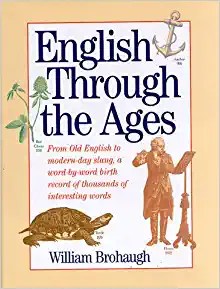
English Through the Ages, by William Brohaugh
You might be surprised to know that in the 1760s historical fiction I’m writing, I’m careful not to use words that were not in general use during that time. I keep English Through the Ages, by William Brohaugh within arm’s reach while I’m writing. Sometimes there is a perfect word I want a character to say but then I discover it wasn’t in general usage until later. I have to find another word.
And you thought I spent all my time just gazing out the window and eating bonbons!
Next week’s blog post topic
Next week I plan to blog about something that happened on October 31, 1849 in Cabarrus County, North Carolina. I wrote about it for a newspaper article a few years ago. I look forward to sharing a bit of that well-researched article with you on my blog.
Since my last blog
I’ve worked on my novel, The Heirloom, every day except yesterday. (I really try to set aside Sunday as a day of rest.) I feel great about how the manuscript is coming along. I’m really having fun with it, imagining myself on The Great Wagon Road in 1766.
I’ve made progress toward getting my website redesigned. I’m excited about that and will keep you posted.
I finished formatting Harrisburg, Did You Know?—Book 1 on Saturday. The proofreading will take another couple of weeks. By then, I hope to have a photograph to use for the cover. Everything seems to be falling in place within the publication schedule I set for myself. By this time next month, I hope to be close to it being available as an e-book.
A word about my blog
You might have noticed on my blog where it says “Join ___ other followers,” the number plummeted this week. I spent the better part of an hour in chat with WordPress tech support before they identified the cause.
The verdict was that the widget that enables me to show the number of followers on my blog changed last week without bloggers (or apparently tech support) being told.
On Wednesday it said, “Join 2,104 other followers,” but on Thursday night it said, “Join 988 other followers.” My heart sank! Tech support stayed on the case until it was determined that now the widget only displays the number of email and WordPress bloggers who follow me. It no longer includes the 1,000+ people who follow my blog on social media.
If you have a WordPress blog, did you notice this change?
Until my next blog
I hope you have a good book to read – and time to read it!
In case you want to know about more book bloggers than I’ve written about in the last weeks, I’m suggesting a few more for you to check out. These are listed in random order.
Photo credit: Ugur Akdemir on Unsplash
The Chocolate Lady’s Book Review Blog
I must admit, I was attracted to this blog by the word “chocolate” being in the title. What can I say?
Davida Chazan is originally from Illinois but moved to Israel at the age of 21. She writes this blog from her home in Jerusalem. She covers a variety of books, and you can always count on an honest review from her.
Here’s the link to Davida’s website: https://tcl-bookreviews.com/. By clicking on “A-Z Index of Book Reviews By Title” at the top of her website, you can bring up an extensive alphabetical list of the books she has reviewed. By “extensive,” I mean extensive!
Also, she has a fun drop-down list of authors you can access by clicking on “Countdown Questions Author Index.” You can really have some fun with this. Click on a book listed under the author’s name and it brings her Davida’s review of that book. Click on the author’s name, though, and it brings up a delightful list of questions Davida asked the author along with the author’s answers. The last time I checked, there are more than 40 authors on that particular list.
The website also has a clickable “Women in Translation” button at the top. Click on it to see the authors who write in a language other than English. They are celebrated in the month of August.
Photo by James Barker on Unsplash
The Reading Ladies Book Club
Carol, a retired fifth-grade teacher is the brains behind this book blog. Her favorite genres are historical fiction, literary fiction, and contemporary fiction. She is an ardent reader and enjoys sharing her thoughts about the books she reads.
Here’s the link to The Reading Ladies Book Club website: http://Reading Ladies – Book Club. On the home page, you can easily peruse and click on the titles and covers of the books Carol has recently reviewed.
Click on “Blogging Resources for Bloggers” at the top of her website for blog posts in which Carol has shared advice for bloggers.
If you’re in a book club (or if you aren’t in a book club), I highly recommend you click on “Book Club Recommendations” at the top of her website. As you might guess, it brings up a list of books by genre and how many stars Carol gave each one.
To see a list of the books Carol has reviewed, click on “Book Reviews A-Z & Book Lists.” After the alphabetical list of books is a list of her blog posts that were about more than one book.
There is a section to click on if you’re just interested in nonfiction books, and she has a special section that harkens back to her days as a teacher: “My Newberry Award Project.” Click on that button to bring up a list of the annual winner of The John Newberry Medal every year4 since 1922! That award is given by the American Library Association to the author deemed to have made the best contribution to American books for children.
As you can see, there’s something for everyone in The Reading Ladies Book Club Blog.
Photo credit: Gülfer ERGİN on Unsplash
Steph’s Book Blog
I love the subtitle of Steph’s Book Blog: “Read a Book – Be Amazed – Tell the World.” How great is that?
Steph says she is a lifelong reader who also dabbles in genealogy, local history, and photography. (Sounds a lot like me!)
By clicking on “Blog Posts” at the top of her website, https://stephsbookblog.com, you can scroll through her recent book reviews. Or, if you’re looking for her review of a book by a particular author, you can click on “Authors” for a drop-down menu of authors by alphabet.
There’s also a search box in which you can type a book title or author’s name.
Some authors participate in a “Blog Tour” in which various book bloggers read and review a specific book of theirs (usually a new release) on an organized schedule. Steph has a clickable “Blog Tours” button through which you can find a list of the books she has reviewed as part of a blog tour.
Photo by Eliabe Costa on Unsplash
Bonnie Reads and Writes
I just recently found this book blog via Twitter. Bonnie says she’s “lucky enough to live in the Smoky Mountains.” I’d say she is, therefore, “lucky enough.” I love the Great Smoky Mountains! But I digress.
The ”Launch a Bestseller” course by Tim Grahl is going great! I have learned so much already and have gotten back on track with my writing.
I continue to format my “Did You Know?” local history newspaper articles for publication as a couple of Kindle books.
Until my next blog post
I hope you have a good book to read – and time to read it!
Remember the brave people of Ukraine, the grieving people of Uvalde, the Floridians who lost so much to Hurricane Ian, and the people grieving last week’s mass murder in Raleigh.
In addition to the three novels I blogged about last week, in September I read three other novels and one nonfiction book. It’s my pleasure today to blog about those four books. I hope at least one of them will appeal to you enough that you’ll decide to read it. Support your local public library and your local independent bookstore!
The New Neighbor, by Karen Cleveland
The New Neighbor, by Karen Cleveland
I read Need to Know, by Karen Cleveland in March 2018 and blogged about it in my April 2, 2018 blog post, More March 2018 Reading. I really enjoyed that novel, so I don’t know what it took me more than four years (has it really been four years since 2018?) to read another of her books.
The New Neighbor is a spy thriller. The main character and most of her neighbors on a quiet cul-de-sac work for the CIA. She’s been trying to identify and take down a spy who is working against the United States for 18 years of her career. The code name for this person is “The New Neighbor,” so it’s a constant play on words throughout the book – Is the new neighbor the actual new neighbor on the cul-de-sac, or is it one of her long-time neighbors and friends on the cul-de-sac, or is it someone who lives who knows where, or is it …?
I look forward to reading another of Karen Cleveland’s novels as soon as I pare down my current reading list. She is a former CIA Analyst.
Switchboard Soldiers: A Novel of the Heroic Women Who Served in the US Signal Corps in World War I, by Jennifer Chiaverini
Switchboard Soldiers, by Jennifer Chiaverini
This historical novel made me aware of the first women to serve in the United States Army. It was World War I and General John Pershing needed efficient telephone operators who were fluent in both English and French to serve throughout France – including the front lines.
It was taking male soldiers one minute to connect a call. That was unacceptable, so General Pershing did a radical thing. He put out a call for qualified female telephone operators. More than 7,600 women responded. The women could connect a phone call in ten seconds.
They proved themselves just as qualified and dedicated as any male American soldiers and were credited in helping the Allies win World War I. It’s a shame their story hasn’t been told for more than a century, but author Jennifer Chiaverini has down a wonderful job telling us their story now.
I learned in the Author Notes at the end of the book that, although they were considered soldiers in the US Army during World War I, took the oath of office, were issued uniforms, had to go through the rigorous gas mask training, had to obey all rules and regulations of the US Army, etc. – after the war they were not considered military veterans and were not eligible for any veterans’ benefits until 1977 when President Jimmy Carter proclaimed them to be veterans. Of course, by then fewer than 60 of the 7,600 women were still alive to enjoy any of the benefits.
The other novels by Ms. Chiaverini that I’ve enjoyed are Mrs. Lincoln’s Dressmaker (which I read in April 2013 before I started regularly blogging about the books I read); Resistance Women (see my September 2, 2019 blog post, 3.5 of the 5.5 Books I Read in August 2019; and Mrs. Lincoln’s Sisters (see my August 10, 2020 blog post, Two Other Books I Read in July 2020.)
Listening Well: Bringing Stories of Hope to Life, by Heather Morris
Listening Well, by Heather Morris
If you’ve been reading my blog for a while, you know I’ve read three excellent novels by Heather Morris.
In Listening Well, Ms. Morris writes a lot about her life. She grew up in New Zealand and now lives in Melbourne, Australia. She writes about her growing up years as a way to tell us about the elders in her family and how they – especially her great-grandfather – taught her to listen.
She recommends that we all practice listening actively and then she sets about to give practical tips of how to listen to elders and how to listen to children. She also encourages us to listen to ourselves and trust ourselves because if we can trust ourselves and be a friend to ourselves, we can be a good friend to someone else.
She writes about listening to Lale Sokolov, the tattooist of Auschwitz, and what an honor it was to listen to him.
Ms. Morris says that all too often we listen to someone only to think of what we can say and how we can turn the conversation about us and not the other person.
This is a good read. I imagine most of us can learn something from it.
Second Street Station: A Mary Handley Mystery, by Lawrence H. Levy
Second Street Station, by Lawrence H. Levy
I wanted to read this book because it is a categorized as historical mystery. I read about 60% of it. It was a bit of stretch for there to be a female detective in the 1890s, but I was willing to suspend disbelief and go along with it.
It was a bit of a stretch to think of Thomas A. Edison being a criminal, but I kept reading. Where the wheels fell off the wagon for me, though, was when Mary Handley was able to watch the trajectory of ricocheting bullets and roll out of their way.
Since there had been no reference to Mary Handley having such superpowers, I felt completely pulled out of the story at that point. I read a few more pages and decided to move on to other library books that were needing my attention. It suddenly felt like historical fiction meets sci-fi.
If the book had been publicized as such, that would have been fine – and probably would make an interesting genre; however, that wasn’t a direction I expected “historical mystery” to take. I’ve since read several reviews online that were also thrown off by this part of the novel.
All that being said, though, I hesitate to be critical of a novel since I’ve yet to publish one of my own. I have much to learn about writing historical fiction. If you enjoy historical mysteries, give Second Street Station a try and let me know what you think of it. I’d like to be proven wrong in my assessment.
Since my last blog post
I took a free 3-Day online “How to Write a Series” course offered by Carissa Andrews of The Author Revolution. It was very helpful. And did you hear me say it was free? It will probably be offered again next year, so if you aspire to write a book series, I recommend you check out The Author Revolution online.
The historical fiction series I’m working on just might be five books instead of four. Book 2, The Doubloon is written and put away. Book 1, The Heirloom is my work in progress. Books 3-5, The Betrayal, The Revolution, and The Banjo are in various states of being outlined. My body is telling me I should have started this project decades ago.
I continued to format the local history newspaper articles I wrote from 2006 through 2012 for publication as two Kindle books. Look for future announcements about Harrisburg, Did You Know?- Book 1 and Harrisburg, Did You Know? – Book 2.
I started working through the video modules in Tim Grahl’s “Launch a Bestseller” course last week. The modules have already helped me understand the marketing tasks I need to do beginning seven to nine months before I publish my first novel.
In terms of marketing, I’ll have to condense some of those early tasks into just a couple of months or so for Harrisburg, Did You Know? – Book 1 and The Aunts in the Kitchen.
Me thinks I have too many irons in the fire!
Until my next blog post
Today I start taking the five-week online “Sticky Blogging – Master Class: “Attract Your True Fans” Course. Who knows? Perhaps in the coming weeks and months I’ll write better blog posts. Maybe I’ll come up with more interesting and eye-catching post titles.
I hope you have a good book to read.
Remember the brave people of Ukraine, the grieving people of Uvalde, and the devastated people of Florida.
I read some interesting and thought-provoking books in September. In today’s blog post, I’ll share my reactions to three of the novels I read. I hope you’ll be inspired to add one or more of them to your reading list.
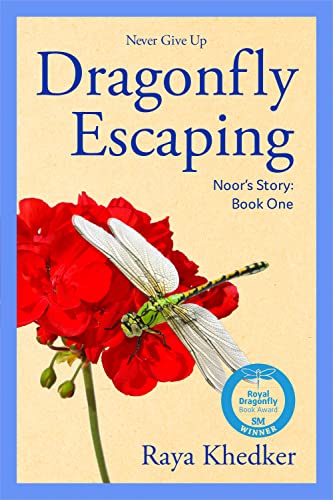
Dragonfly Escaping, Noor’s Story: Book One, by Raya Khedker
Dragonfly Escaping: Noor’s Story: Book One, by Raya Khedker
I learned about this novel through the Jennifer Tar Heel Reader book blog. After reading Jennifer’s review of the book, I went on Twitter to find out a little more about the author.
On Twitter I found a discussion about the book’s cover. I chimed in that I liked the cover, and the author and I enjoyed several days of messaging to one another about the struggles of writing and publishing.
The story immediately grabbed my attention and I knew I was hooked and would have to keep reading to find out what happened to Noor Zulfiker. Noor is bound in an arranged marriage to Rajat, an older man who is a physician and her parents think will be quite a catch for their daughter. But Noor is in love with a young man named Chirag Jagdev. Chirag isn’t rich and his financial future isn’t potentially as bright as the doctor’s.
There is physical abuse, so very soon the reader really starts pulling for the teenage Noor and hoping Rajat gets his comeuppance.
This book shines a light on the emotional and physical abuse the women in India are subjected to by men. Noor is abused from all directions and desperately wants to leave India. It is raw and unrelenting in this first novel of a planned series about Noor.
If you like exotic locations, Dragonfly Escaping takes place in New Dehli and Lima over a span of 1979 to 1992, with connections and references to Spain and Canada thrown in for interest.
If you aren’t put off by reading about an abusive relationship, I recommend this novel by Raya Khedker. It’s her debut novel and it was released in January 2022. Lo and behold, Dragonfly Hunting: Noor’s Story: Book Two, was released last week – on September 27 – so I’m already playing catch-up!
I look forward to whatever Raya Khedker and Noor have in store for us in Book Two.
Raya Khedker was born in India and currently lives in the United States.
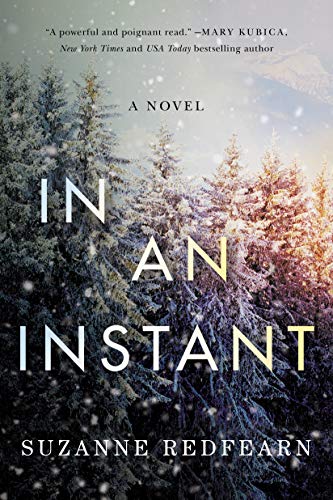
In an Instant, by Suzanne Redfearn
In an Instant: A Novel, by Suzanne Redfearn
This novel is written through the eyes of Finn, a 16-year-old girl. Spoiler alert: She’s alive in the beginning of the book but is soon dead. Probably 95% of the book is told through Finn’s eyes and ears as she moves about at will and reports how everyone reacts to her death and the other related events. It is a clever format.
The story is compelling. It delves into each person’s reaction to the incident that takes Finn’s life. It’s about family dynamics, friendships, and how individuals react to a traumatic situation. Each of us knows how we think or hope we’d react in a given circumstance, but do we truly know how we’d react when push comes to shove?
On the negative side, I had to suspend disbelief throughout a sizeable segment of the book as, although all the characters were in a situation of total darkness, they were able to move about and see everything clearly.
Also, I think the author gave Fen a vocabulary and level of understanding that a typical 16-year-old doesn’t have. And, speaking of vocabulary, I find the overuse of expletives offensive and it cheapens the writing. This becomes especially noticeable when one is listening to a book. It was excessive and pulled me out of the story. John Grisham is a reasonably successful novelist even though it is his policy and practice to not use curse words or raunchy language in his books. If John Grisham can have a lucrative writing career without using foul language, perhaps others should follow his example.
I thought the Easter dinner scene was forced. Why would a family that showed absolutely no religious inclinations suddenly put a tremendous emphasis on a traditional Easter ham dinner?
All that said, I reiterate that In an Instant is a gripping story and the premise of a person’s spirit being able to continue to roam the earth and see and hear intimate conversations and activities of family and friends is a bit unsettling and gives much food for thought.
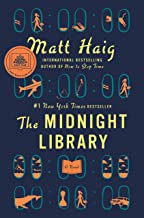
The Midnight Library, by Matt Haig
The Midnight Library, by Matt Haig
When Nora Seed “decides to die,” she finds herself in The Midnight Library. Her school librarian from long ago is there to explain to Nora that The Midnight Library isn’t exactly the afterlife. It’s an endless library of books – each one giving you the chance to undo your regrets and do something different. It’s between life and death. Disgusted at first to be there, Nora eventually appreciates the opportunities it provides.
The novel involves the theory or idea of parallel universes and allows Nora to move from one life to another and experience or re-experience an occupation or family situation.
The lesson this novel teaches is that every decision we make has an outcome. A different decision at any given time could have changed the course of our lives.
I didn’t know what to expect when I checked out the book on CD. I thoroughly enjoyed listening to it to see what Nora’s next experience would be and how it was all going to turn out for her.
The only irritation I felt in listening to the book was the fact that the British reader pronounced “library” the way the English do, turning this three-syllable word into a two-syllable word.” It’s like fingernails on a chalkboard to me. If you’re too young to understood the analogy, I’m afraid I can’t help you.
Since my last blog post
Here in the southern piedmont of North Carolina, it rained sideways all day on Friday and felt more like winter than autumn as what was left of Hurricane Ian passed through after making its third landfall near Georgetown, South Carolina. We came through it unscathed, though, and for that I’m relieved and thankful.
I’ve been working on my genealogy. I knew that three of my 16 g-g-g-grandmothers were Neelys. Last week I found their father’s will and discovered they were sisters. I guess that means I’m my own cousin. Small gene pool here in the 1700s!
Until my next blog post
My heart goes out to all the people severely affected by Hurricane Ian in Cuba, all over Florida, and the east coast of the US.
Today I’m excited to begin taking a three-day online workshop about writing a book series. It’s sure to help me as I continue to work on The Heirloom and its sequel, The Doubloon.
Last week my blog was about five book bloggers I follow. I promised to highlight more such book reviewers in the coming weeks. Today’s blog post is about five other online book reviewers.
As with last week’s list, I selected these five in random order. I hope at least one of them will appeal to you enough that you’ll start following it.
Photo by Florencia Viadana on Unsplash
LizGauffreau.com
At https://lizgauffreau.com/, you will find book reviews as well as a variety of other blog posts and information. Liz is a writer and blogger who lives in New Hampshire. As you can tell from her blog topics, she’s not a full-time book review blogger. I’ve included her on this list, though, because she sometimes reviews fiction, nonfiction, and poetry.
Her website is well-organized. You can click on her blog posts by month, or you can click on her Fiction Book Reviews, her Nonfiction Book Reviews, or her Poetry Reviews.
If you’re a fan of short stories, here’s a head’s up. Two of Liz’s short stories will be in the new anthology, Distant Flickers: Stories of Identity and Loss. It’s set for release on October 1. Look for it wherever you buy your books. If your local independent bookstore and public library haven’t ordered copies, ask them to consider doing so.
Photo by John-Mark Smith on Unsplash
Smorgasbord Blog Magazine
As you can guess from the name, Smorgasbord Blog Magazine is an online magazine that covers just about everything. It also covers just about everything very well.
Sally Cronin is the powerhouse behind this online magazine. I marvel at the variety of topics Sally tackles. She not only reviews books. She also reviews music and does excellent posts about popular music from different decades. She also has a post once a week that offers four or five cartoons. As you can see, there’s something for everyone in Smorgasbord Blog Magazine.
Sally blogs from Ireland. Her almost daily blog posts are always entertaining.
Photo by Henry Be on Unsplash
Amorina Rose’s Blog
Barbara Strickland is the voice behind Amorina Rose’s Blog. Barbara’s website address is https://brstrickland.com/. She is an author as well as a blogger. Through her website you can access her blog archives.
Barbara is of Italian and Australian ancestry. She holds a Bachelor of Education degree with TESOL (English as a Second Language) qualifications. She’s had a varied career and enjoys music, dance, art, and literature. She’s in the editing stages of her second novel.
Photo by Gülfer ERGİN on Unsplash
Linda’s Book Obsession
Linda Zagon is the book reviewer behind Linda’s Book Obcession. She is a retired teacher with a massive book collection, including signed first editions.
Reviewing books is Linda’s hobby. She is a Top Reviewer on NetGalley and has also reviewed books on Facebook, Goodreads, LibraryThing, Twitter (as @peachyteach), Amazon (as teachlz) and BookBrowse.
You can find her current and past book reviews on her website, https://lindasbookobsession.blog/. She has been known to blog twice in one day about two different books.
Go to her website and click on her September 22, 2022 blog post in which she gives a rave review of The Child Between Us, by Alison Ragsdale.
Photo by Ed Robertson on Unsplash
Portobello Book Blog
Joanne is passionate about books, and it shows in her book reviews on https://portobellobookblog.com/. She especially likes contemporary fiction and historical fiction but also enjoys a good love story, according to the bio on her website.
There, you can easily scroll down through a list of her recent blog posts. Each one includes an opening paragraph or two from the post. Just click on “more” if you want to continue reading one of them. You can also click on any of give option at the top of her landing page. One of them is “Book Reviews, A to Z.” That will give you a drop-down menu where you can click on her book reviews from any year back to 2015 and get a list of the books she reviewed that year in alphabetical order by the authors’ last names. You can tell by the lengthy lists that Joanne is a voracious reader.
Her site also includes author interviews.
Go to Joanne’s website, https://portobellobookblog.com/, and I suggest you click on her September 20, 2022 blog post in which she reviewed The Dead Romantics, by Ashley Poston. I suggest you click on that one because through it you can read the first chapter of Ashley Poston’s novel. What can beat that in a book review?
Since my last blog post
Last week I mentioned that I’d run into a bit of a roadblock on the cover I wanted for the cover of the e-book I’m working on. I was discouraged, but things opened up this past week. I was contacted by the son of the deceased artist whose painting I wanted for the book cover. He couldn’t have been more accommodating! What a relief! I literally cried tears of joy after talking to him.
I’m still formatting my local history newspaper column articles for that book, Harrisburg, Did You Know? – Book 1. I’ll keep you posted as I reach publication.
Until my next blog post
I hope you have a good book to read and an enjoyable hobby.
Find the good in the coming week. I’ll look for you back here next Monday. Please tell your friends about my blog.
Don’t forget the courageous people of Ukraine and the grieving people of Uvalde.
There are some book bloggers whose posts I read regularly to get ideas for books to read. Sometimes they review books I’ve read and it’s interesting to see if I agree with their reviews or what they picked up on that I missed. Usually, they review books I haven’t read, for many professional book reviewers receive advance copies before a book is released to the public. This isn’t the case for all book bloggers.
Today I’m writing about five of the book bloggers I follow. Perhaps some of them will be new to you. In the coming weeks, I’ll blog about other book bloggers I follow. I’ve chosen these in random order.
Photo by Susan Q Yin on Unsplash.
Jennifer Tar Heel Reader
Going to Jennifer’s website, you can peruse her blog topics and get a feel for the type books she reviews. Although I haven’t heard her say, she is obviously a creative and talented person in her own right. The photographs she includes with her book reviews are always elegant and inviting. Take a look for yourself on her website where you can read any of her past blog posts/reviews simply with a click. She’s been blogging book reviews since May 4, 2018. From the title of her blog, I believe she lives in the same state where I’ve lived my entire life – North Carolina.
Sandy is a top reviewer on Goodreads and reviews as Sandyj21 on Amazon. As you can tell from the title of her blog, she’s a voracious reader. To give you an example, she read or listened to 22 books in July! (I do well to read that many books in six months!) Here’s a link to one of her recent blog posts: The Lost Girls of Willowbrook by Ellen Marie Wiseman – Sandy’s Book a Day Blog (wordpress.com).
Sandy, like the other book bloggers I follow, offers honest assessments of the books she reviews. In this particular one, she explains why she had trouble getting her head around the abuse at Willowbrook because, thankfully, her own experience working in such a facility was nothing like that portrayed in the book. The Lost Girls of Willowbrook is also on my TBR.
Photo by Ed Robertson on Unsplash
What Cathy Read Next
Cathy amazes me with the number of books she reads and reviews. Last time I looked, she’d read 122 books so far in 2022. She has a great website and book review blog. You can go to her website, What Cathy Read 2022 – What Cathy Read Next… (wordpress.com) and click on a number of choices, such as “What Cathy Read in 2022” or “What Cathy read in 2016” and every year in between. Then, each book title is clickable and you can read her review of it.
Occasionally, Cathy attacks her TBR (To Be Read List) and blogs about a few books on her list. She goes through a process to decide which ones to leave on her TBR and which ones to delete. I need to do that myself! Here’s an example of one of her “Down the TBR Hole” blog posts: Down the TBR Hole #25 – What Cathy Read Next… (wordpress.com).
Cathy has an MA in English and appreciates good fiction, especially historical fiction and literary fiction.
Photo by hannah grace on Unsplash
Emma B Books
Emma reviews lots of thrillers and mysteries, but she also is known to have reviewed memoirs and other genres. By going to her home page, EmmabBooks.com – Book Reviews by Emma b Books, you can click on the image of any one of 18 books she’s recently reviewed.
Emma’s website is well-organized. You can click on “Home,” “Nonfiction,” “Fiction,” “Audiobooks,” “5*Related Books,” “Blog,” “About,” and “Contact.”
Each of those buttons has a drop-down menu to make any search easy. If you’d like to receive email notices when Emma posts a new review on her blog, there’s a fill-in format form on her website. If you’re a WordPress blogger, you can opt to receive her posts on your feed.
Emma is British by birth and now lives in the beautiful Austrian Alps.
The website is well-organized, with 15 categories at the top for you to choose from. Each one has a drop-down menu to assist you in your search. There’s even a “Movie of the Book” button. Other buttons have drop-down menus in which you can search by book title or author.
This reviewer is from Scotland and is one of Amazon UK’s Top 500 Reviewers.
Since my last blog post
I’ve been working on genealogy and reading books. I listen to books on CD and read print books as well as e-books.
Speaking of e-books… I’m formatting the local history columns I wrote for Harrisburg Horizons newspaper from 2006 through 2012 in preparation for putting them into two e-books. I’ve run into a bit of a roadblock on the cover I wanted, so it’s time to figure out Plan B.
Until my next blog post
I hope you have a good book to read. I hope you’ll check out the book bloggers I blogged about today.
Don’t work all the time. Take time out for family and friends.
Remember the people of Ukraine and Uvalde, and count your blessings.
There are lots of good books out there. Today’s blog post is about four of the eight books I read last month. In case you missed it, last Monday I blogged about the other four in Four of Eight Books Read in August 2022.
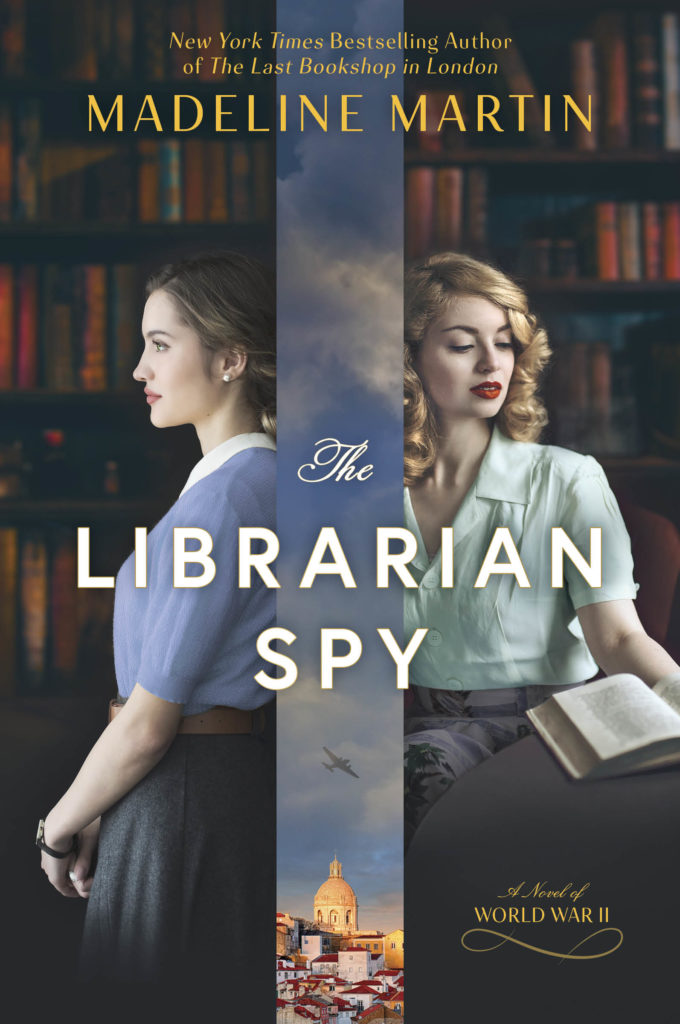
The Librarian Spy, by Madeline Martin
The Librarian Spy, by Madeline Martin
This novel follows two women during World War II. One is involved in the French Resistance. The other one is a librarian from the Library of Congress in Washington, DC who has been sent to Lisbon, Portugal to help secure and copy newspapers from the cities under Germany’s control. The copies are sent to the US to help the Allies’ cause in the war.
The chapters alternate between Ava’s story and Elaine’s story. My only complaint is that as soon as I was invested in one’s story, the next chapter would begin and I had to switch mental gears to the other one. I don’t like that in a novel, but it seems to be the trend now in historical fiction. Otherwise, Ava and Elaine each have compelling stories and you’ll want to cheer them on.
I was immediately invested in each of the two main characters as soon as I read their opening chapters. The deeper into their stories you get, the more you are anxious (not eager, but anxious) to see what happens to them next.
This novel made me stop and think about the danger both women were in all the time. They had to guard their words at all times because they never knew when a stranger – or even an acquaintance – nearby might overhear something that could aid the enemy.
I can’t imagine living under that level of stress not just for days or weeks on end but for years on end. Not only that, but they were living the war on a daily basis and had no way of knowing when it would end. That’s a luxury we have when reading historical fiction. We know the exact day and sometimes the very hour at which a war will be declared over.
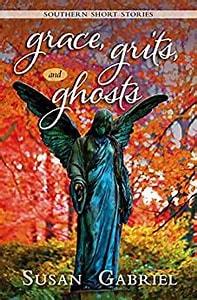
Grace, Grits and Ghosts: Southern Short Stories, by Susan Gabriel
I purchased this ebook some months ago and finally got around to reading it. I’m so glad I did. It is a collection of short stories, some of which grew out of Susan Gabriel’s novels.
Hoping to publish short stories myself, I was curious to see the book’s layout. Also, I hadn’t read any of Ms. Gabriel’s novels, so I was eager to find out about her writing style and to discover her writer’s “voice.”
And what a writer’s “voice” she has! If you enjoy southern fiction, you’ll love how Ms. Gabriel writes. Her voice, especially in “The Secret Sense of Wildflower,” comes through so strongly that I can still hear it in my head days after finishing the book. It’s told through the eyes of a young girl who has witnessed too much in her life, but tells the story with a wit, bluntness, and insight that I loved.
She even used the idiom, “as all get out” in that last story in the book, which couldn’t help but make me laugh out loud. You might recall my blog post about that idiom from March 29, 2021: #Idiom: As All Get Out.
The book includes an introduction in which Ms. Gabriel writes about how she was determined to never write southern fiction. I had to smile at that. There are nine stories of varying lengths, so it is an easy book to read if you can only find a few minutes at a time for a book; however, you’ll find yourself turning the page to see what the next story is and, before you know it, you’ve read three more stories.
The short stories in this book were varied in topic. “Reunion at the River” was about seven women who had been abused by the same man several decades ago and how they gather at the secluded mountain home of one of their number every year for a reunion and attempt to heal.
As a southern short story writer wannabe, I gained valuable ideas from this book about how to create an ebook of short stories. I don’t have published novels to draw on like Ms. Gabriel had, but I love the way she pulled the stories together and ended the book with information about her other books, her desire to get feedback from her readers, and her all-important contact links.
Subtract: The Untapped Science of Less, by Leidy Klotz
Subtract: The Untapped Science of Less, by Leidy Klotz
Jan Edmiston, General Presbyter of the Presbytery of Charlotte, recommended this book in her July 8, 2022 blog, https://achurchforstarvingartists.blog/2022/07/08/books-im-loving-this-summer/. Edmiston’s takeaway from reading the books was, “Why this book can change the culture: We in the Church (and world) have been taught that being better means adding things. Sometimes we are better when we subtract things.”
In the book, Mr. Klotz pleads with us to stop thinking of subtraction as a negative thing. Sometimes less is better. When you’re attempting to declutter your life, your home, your email in-box, the landscape, or even the atmosphere – the air we breathe, couch it in words that don’t have negative implications.
He gives examples throughout the book. One of the simple ones that stuck with me was when he and his young son were building a bridge with Legos. One of the bridges pillars was taller than the other. Human nature usually prompts us to add to the shorter pillar to make them even; however, his toddler son removed one of the blocks in the taller pillar.
Mr. Klotz encourages us to adopt that approach in all aspects of our lives. Another example he mentioned several times is the editing that writers must do. Fiction writers are told to make every word count. Make every sentence earn its keep. Edit out words, phrases, sentences, paragraphs – even scenes – that don’t move the story forward. That’s a painful thing to do!
He also encourages us to focus on people. Focus on the things that will improve lives. The winner isn’t the person with the most stuff at the end of life.
L.E.A.P.F.R.O.G.: How to hold a civil conversation in an uncivil era, Third Edition, by Janet Givens, M.A.
LEAPFROG: How to hold a civil conversation in an uncivil era, by Janet Givens, M.A.
Janet Givens has come out with a third edition of her book, L.E.A.P.F.R.O.G.: How to hold a civil conversation in an uncivil era, and I highly recommend it to anyone who wants to improve their skills of having a difficult conversation.
Be it a difficult conversation with a friend or a stranger, a relative or an employer or employee this book will help you have a more productive dialog.
The goal of this book is not to tell you how to convert the other person to your way of thinking, but rather to help you go into a conversation with an open mind and genuine curiosity about why the other person sees a particular issue or situation differently than you.
For more details about this new third edition of the book, please read my August 22, 2022 blog post, L.E.A.P.F.R.O.G. by Janet Givens
Since my last blog post
In addition to reading books and writing, I’ve worked on genealogy. I’ve also blown the dust off the local history newspaper columns I wrote from 2006 through 2012. It’s amazing how much I’ve forgotten since 2006. I hope people will enjoy reading my articles as much as I’ve enjoyed rereading some of them this week.
Since 2012 I’ve wanted to put all the articles into a book. I’m typing them in Word and formatting them ready to download the document into Atticus. Atticus is the writing software I’m using that will enable me to export the document ready for electronic publication on Amazon.
The cover is still holding up publication of the cookbook my sister and I are compiled for electronic publication.
August turned out to be one of those months when many books I’d been on the waitlist for at the public library all became available at the same time. I had to scramble to read and listen to so many books in a month. I guess it was a good thing August had 31 days.
Today’s blog post is about four of the eight books I read last month. I’ll blog about the other four next Monday.
The German Wife, by Kelly Rimmer
The German Wife, by Kelly Rimmer
The basis of this novel is “Operation Paperclip,” although that secret US intelligence program isn’t mentioned by name until the author’s note at the end of the book.
I listened to this historical novel on CD. I almost gave up on it after the second of 11 discs because I felt like as soon as I became invested in Sofie’s story, I was yanked into Lizzie’s story. I found the random switching from Lizzie’s 1930s in the Dust Bowl days in Texas to Sofie’s 1950s in Huntsville, Alabama to Sofie’s 1930s in Berlin to Lizzie’s 1950s in Huntsville, Alabama more than a bit disorienting.
That said, a couple more discs into the book, I couldn’t stop listening.
One thread that runs throughout the novel is how people can justify their actions (or inactions) in the name of keeping themselves or their families safe. How many times in history and perhaps in our own lives does the excuse, “I was just following orders” come into play?
Another thread in the book is prejudice and discrimination. Family dynamics play heavily in the book. One of the characters is a World War II veteran suffering from what was then called battle fatigue but is now known as posttraumatic stress disorder. His sister, Lizzie, tries her best to help him, but in the process she enables him.
I found the book’s description of the horrors of the dust storms in the US during the 1930s to be so realistic that I felt like I was choking as Lizzie’s family tried in vain to keep the dust out of their house.
Sofie’s abiding friendship with Mayim, a Jewish woman, is a part of the story that will stay with me. It reminds us that there were Germans who were friends with Jews and whose hearts were broken by what the Nazis did to them. I’d like to think I wouldn’t have turned my back on Jewish friends – and Jewish strangers – if I’d been in Sofie’s place. But how easily humans can be brainwashed! We’re seeing it in our own country now.
The book shines a light on how German rocket scientists were brought to the United States after World War II to help develop NASA’s space program. I was aware of this, of course, but I’d never stopped to think about the interpersonal logistics of the Germans’ being accepted by the Americans so soon after the war. The fact that some of those German scientists had been complicit in Nazi war crimes was swept under the rug, as their pasts were erased by the US government to make it possible for them to work for the US space program.
In Ms. Rimmer’s author’s note at the end of the book, she explains how she, an Australian, learned about this piece of history in a roundabout way in a park in New South Wales. The fact that she learned about “Operation Paperclip” in 2019 and has already researched and written this novel, is amazing.
If you want to learn more about “Operation Paperclip” – the secret US intelligence program that brought more than 1,600 German scientists and engineers to America between 1945 and 1959 so they could work for the US government, do an online search for it and then follow up at your local public library.
The Lord is My Shepherd: Healing Wisdom of the Twenty-Third Psalm, by Harold S. Kushner
The Lord is My Shepherd: Healing Wisdom of the Twenty-Third Psalm, by Harold S. Kushner
Many years ago I read Rabbi Harold S. Kushner’s book, When Bad Things Happen to Good People. Although Rabbi Kushner is Jewish and I’m a Christian, I found that book insightful and reassuring. It echoed many of my core beliefs. God didn’t promise us a carefree life. He promised to be with us.
When I found Rabbi Kushner’s book, The Lord is My Shepherd: Healing Wisdom of the Twenty-Third Psalm on CD for sale at a book sale at the public library, I was sad that it had been weeded from the collection. I had myself to blame, though. I’d never checked it out. Perhaps no one had checked it out in years and, therefore, it needed to be removed from the library shelf to make room for a new book. I was eager to read it, so I bought it – probably for fifty cents.
That was months ago, and I finally got around to listening to it. I enjoyed hearing the book read by the author. It was only four discs. I listened to the entire book over a two-day period.
In the book, Rabbi Kushner wrote about the Twenty-Third Psalm, line by line. He is a student of the Psalms and I appreciated his perspective. I like it when a Bible scholar tells me the nuances of the original Hebrew in which the Old Testament books were written. Rabbi Kushner did that numerous times throughout this book.
Being a Christian, I didn’t agree with what Rabbi Kushner had to say about the coming of the Messiah, but it was interesting to hear his Jewish perspective. Also, I believe that God created everything from nothing. Rabbi Kushner believes that everything already existed and God created order out of the chaos.
In The Lord is My Shepherd: Healing Wisdom of the Twenty-Third Psalm, Rabbi Kushner repeatedly revisits the theme that God doesn’t promise us a carefree life; He promises to be with us. On that, Rabbi Kushner and I agree.
Now that I’ve listened to this book, I plan to donate it to Goodwill where someone else can acquire it and ponder the Twenty-Third Psalm along with Rabbi Kushner.
Cold, Cold Bones, by Kathy Reichs
Cold, Cold Bones: A Temperance Brennan Novel, by Kathy Reichs
I really enjoyed listening to Cold, Cold Bones, by Kathy Reichs. It had the suspense we’ve come to expect in her novels with the added bonus of references to many locations in and around Charlotte.
Concord, the Appalachian Trail, and even Robeson County got mentioned. Of course, they were all mispronounced on the CD audio recording of the book, but that’s to be expected. I’m sure the reader wasn’t from North Carolina.
There were numerous clues given, and each one took me down another rabbit hole. All the time, though, I knew in the end Ms. Reichs would connect the dots and show how each thread came together.
The layers of this novel were revealed much like one peels layer after layer from an onion. Ms. Reichs certainly has pacing down pat. It kept me guessing who the chief villain was and what the common thread of each incident was until the very end.
This was a very entertaining read, and makes me eager to read another Kathy Reichs novel. The last novel of hers that I’d read was way back in May 2020. In my June 1, 2020 blog post, Books Read in May 2020, I wrote about her novel, A Conspiracy of Bones.
I don’t know why I waited two years to read another of her books. In case you aren’t familiar with Kathy Reichs, she is an adjunct professor of anthropology at the University of North Carolina at Charlotte. She is a highly-regarded forensic anthropologist who splits her time between Charlotte and Montreal. The television series, “Bones” was loosely-based on her life and ran for 11 seasons from 2005 until 2016.
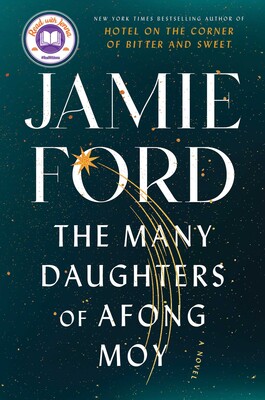
The Many Daughters of Afong Moy: A Novel, by Jamie Ford
The Many Daughters of Afong Moy, by Jamie Ford
I’ve enjoyed the other novels I’ve read by Jamie Ford, but I found this one difficult to follow. It’s received rave reviews. The writing is outstanding, but I found the jumping back and forth between centuries (past, present, and future) and the five points-of-view hard to follow.
I listened to nine of the 11 discs of this book on CD. I found the voice of one of the readers very irritating to my southern ears and the range in volume from soft to yelling was equally irritating to me as I have hearing loss and I was often listening to the book after I’d gone to bed.
All that said, the basis of the novel is a fascinating topic: epigenetics. It began with the first Chinese woman who came to America and how she became a spectacle due to her bound feet. She suffered physical and emotional pain as a result of this ancient Chinese tradition that crippled girls and women and kept them under the thumb of male society. The novel follows generations of her female descendants who carried her emotional scars.
Epigenetics is an interesting topic of study. There is debate about whether emotional traits and emotional traumas are passed from generation to generation through DNA or through a family’s traditions and oral history.
If you want to read my comments about one of Jamie Ford’s earlier books, Love and Other Consolation Prizes, go to my July 17, 2017 blog post, Reading South Africa and South Carolina Novels. I must have read Hotel on the Corner of Bitter and Sweet before I started blogging about the books I read. It was good, too.
It was the format and not the prose in which The Many Daughters of Afong Moy was presented that didn’t appeal to me. I’ll still look forward to Jamie Ford’s next novel.
Since my last blog post
It’s been a strange week with some unexpected tasks and distractions. I continue to read more than write because those library books are still piling up. It’s a nice problem to have and I’m grateful to live in a country and a region with such vast free public library resources.
The arrival of September was a rude awakening. How is it that summer flies by and winter drags on and on? My Seasonal Affective Disorder is already rearing its ugly head, so I must strive to get and keep a positive attitude.
Until my next blog post
I hope you have so many books at your fingertips that you can’t decide what to read next.
Life is short. Spend time with family and friends, and make time for a hobby.
Don’t forget the people of Ukraine, Uvalde, and Highland Park, etc
I like to mix things up with a range of topics on my blog. When thinking about an idiom to write about today, I thought of a saying my father often said. Much to my surprise when I started researching it, I discovered… nothing.
I’m left not knowing if this saying was original with my father or perhaps it was so specifically local to our community that it didn’t make it into any books of idioms. I think this is the first time I’ve searched for something online and come up empty.
Nevertheless, I’ll write about it today and speculate about its origins. This promises to be my shortest blog post ever.
“They must have let the bars down.”
Have you ever heard that said? Do you have a clue what it means?
My father would say this if he drove up to a stop sign and there was so much traffic coming that he had to wait an inordinate amount of time before he could turn onto or cross the street.
This was a confusing thing to hear as a child. Not wanting to show my ignorance, though, I didn’t ask what he meant by that.
Photo by Derek Lee on Unsplash
It was something my father said so many times that it’s permanently ingrained in my head. When I come to a stop sign and there is so much traffic coming that I have to wait more than a little while to make my turn, “They must have let the bars down” flows through my brain and I can’t help but smile.
Photo by Monika Kubala on Unsplash
I think it was sometime after my father died that the saying came to mind and I asked my mother what it meant. Her explanation was that it referred to the letting down of the bars or gate keeping cows in an enclosure or pasture. With the bars let down (or pushed aside or the gate opened) the cows would likely see they had an escape route and break loose.
Photo by Jinen Shah on Unsplash
On a trip to Scotland, my sister and I were reminded as the saying. More than once, we saw where there were heavy iron bars in the ground the width of a gate or opening in a fence. Unable to get a steady footing on the bars, which were several inches apart, a cow would not be able to get to the opening and escape the pasture but a tractor, truck/lorry, or car could drive across and get through.
Our father grew up on a farm that in fact was a dairy farm during his teenage years. Did his father and older brothers utilize such bars in any of their pastures? Or perhaps he’d seen them used for that purpose elsewhere. Or maybe it was just a way of saying a gate made of iron bars had been opened to let the cows out of one enclosure to be led to another.
It’s too bad I didn’t have enough curiosity at the time to ask my father what he meant and whether he’d heard the expression used by others.
Is that it?
Is that it? Is that all there is?
That’s all I have for you.
If you’ve ever heard the saying and have a different explanation of it, please let me know.
Until my next blog post
Thank you for reading my blog
Keep reading good books.
Spend time with family, friends, and a hobby.
Perhaps above all, ask the older people in your life those questions you’ve put off asking. Ask them the questions you’ll wish someday that you had asked them because one day it will be too late. That day could be tomorrow.
Remember the people of Ukraine, Uvalde, Highland Park, ….
As the American society becomes increasingly polarized on politics, racial justice, abortion, gun rights, public education, and free speech on social media, this is a book we can all benefit from reading. You can benefit even more by discussing the book with a group.
The book I’m referring to is the Third Edition of L.E.A.P.F.R.O.G.: How to hold a civil conversation in an uncivil era, by Janet Givens. Ms. Givens is a sociologist and Gestalt psychotherapist.
L.E.A.P.F.R.O.G.: How to hold a civil conversation in an uncivil era, by Janet Givens, M.A.
Although my opening paragraph referred to the polarization of America, this book is intended to help people have any difficult conversation, whether it’s a disagreement you’ve had with your spouse or co-worker, a difference of opinion over a belief with a fellow church member, a conversation you need to have with a family member in the grips of substance abuse, or an honest discussion you want to have about a larger issue with a group, this book will help you get there.
How I learned about the book
Janet Givens and I had connected through our blogs. I was pleased last year when she invited me to participate in a Zoom group to read and discuss an earlier edition of the book. It was a small group – Ms. Givens, six others from across the United States, and me.
Ms. Givens told us up front that she wanted to make some changes in the book and publish a new edition. She wanted our input. It was a wonderful experience to be in such a group. We bonded through our monthly virtual meetings and I miss them now that the purpose that brought us together is completed.
In appreciation for our involvement, Ms. Givens sent each of us a copy of this year’s new edition. I’ve neglected to follow up with a review of the book for several months, for which I’m embarrassed. The best excuse I can concoct is that life and numerous library book due dates I was up against constantly took my attention away from L.E.A.P.F.R.O.G. It’s a poor excuse. I apologize, Janet. (By the way, I was known as “the other Janet” in the small group of eight.)
New introduction
This Third Edition of L.E.A.P.F.R.O.G.: How to hold a civil conversation in an uncivil era has a completely new introduction. Sometimes I’m tempted to skip a book’s introduction, but please be sure to read this one. You’ll learn why Ms. Givens wrote the book, how she envisioned it being used, and she asks several questions for you to consider before launching into the meat of the book.
It used to be Americans could agree to disagree with each other over various issues, but that has become the exception rather than the rule. In this “uncivil era” it can seem impossible to civilly discuss issues with someone with whom you hold differing views.
That’s the backdrop for the book. The title is an acronym for Listening, Empathy, Assessment, Perspective, Facts: Forget them for now; Respect, Observation, and Gratitude. Each of those gets its own chapter. The chapters should be read in order for it is in that order in which one should approach any “difficult conversation.”
Ms. Givens is quick to point out in the introduction that one shouldn’t go into such a conversation with the purpose of converting the other person to their way of thinking. Something our Zoom group discussed on several occasions was the need for both/all parties discussing a difficult or divisive topic to be genuinely curious about why the other person has an opinion not like their own.
In her acknowledgements at the back of the book, Ms. Givens indicated that the Zoom group was instrumental in the birth of her “Perspective” chapter and in the reworking of the “Respect” chapter. Let’s look at those chapters.
Perspective
The fourth chapter in the earlier editions of the book was titled “Paraphrase.” Readers were encouraged to listen to the other person with empathy, assess their own state of mind to make sure they were mentally in the right place to have the conversation, and then paraphrase what they thought they heard the other person say.
In this new edition, Ms. Givens replaced “Paraphrase” with “Perspective.” (You’ll also notice in earlier editions most of the chapter titles were action words like Listen, Empathize, Assess, Paraphrase, and Observe. The new chapter titles are mostly nouns, such as Listening, Empathy, Assessment, Perspective, Facts: Forget them for now, Respect, Observation, and Gratitude.) They’re presented more as concepts instead of calls to action.
In the “Perspective” chapter, Ms. Givens invites us to think about perspective – ours and the other person’s. In doing that we will probably listen more carefully to the other person and maybe see the other person’s perspective. I might not change my mind by listening to your perspective, but I might gain a level of understanding of why you think what you think and even a clearer understanding of my own thinking.
The ”Perspective” chapter also addresses unconscious bias. For instance, an experience we had in childhood can affect how we see an issue today. You don’t need to use that as an excuse though. Once we recognize a bias, we can change.
Respect
In the reworked “Respect” chapter, Ms. Givens enlightens the reader to think of respect as something each individual deserves because that’s the foundation of society. Respect isn’t something to be meted out after we’ve judged the other person.
She addresses “othering” – the “us versus them” mindset. One way to move toward genuinely respecting the other person is to tell them you hear them and you think you understand. Then, look for what you have in common. Find something positive to say.
A call to action
I hope my blog post today will prompt you to look for L.E.A.P.F.R.O.G.: How to hold a civil conversation in an uncivil era, Third Edition wherever you purchase books. You can also order it from the author at https://janetgivens.com/. I also recommend that you request that your local public library system purchases the book. Ask for it at your local independent bookstore if you don’t see it on the shelf.
Rare is the person who can’t benefit from reading it. Putting into practice the ideas Ms. Givens presents in her book will surely result in a more civil exchange of ideas within the United States or wherever you live – even if it’s just one person at a time.
Since my last blog post
I was struggling with a short story I was writing. It just wasn’t coming together. I did some brainstorming and the pieces finally felt into place. I hope to self-publish a collection of my historical short stories. I’ll keep you posted on my progress on that project.
I’ve completed my work to-date on two branches in my family tree. My sister helped me figure out these two lines. Both lines had some squirrelly dates and connections. We’re more than ready to move on to another family line and hope for less confusion!
Work has slowed on our The Aunts in the Kitchen family cookbook. I keep procrastinating getting the photograph made for the cover of the e-book. I can’t make it myself.
Our computer guy came and got our margins corrected in Word. It’s frustrating for a writer to not be able to set one-inch margins, especially since that’s the default setting. I’m back in business now typing my short stories and formatting them in Word ready to download into Atticus. I’m a happy camper once again!
I’m trying to participate on Twitter again, with limited success. If you’d like to follow me, I’m @janetmorrisonbk. (Think Janet Morrison book.) Just don’t expect me to Tweet every day or comment on what you post in a timely manner. I’m terrible at social media.
Until my next blog post
I hope you have a good book to read or listen to. I’m reading The Librarian Spy: A Novel of World War II, by Madeline Martin and Booth, by Karen Joy Fowler. I have other books checked out and two more ready to be picked up at the library. I can’t read fast enough!
Life is short. Spend time with family and friends, and make time for a hobby.
Don’t forget the people of Ukraine, Uvalde, and Highland Park, etc. and the people in Kentucky whose lives have been turned upside down by flooding.



















 Janet's Writing Blog