
There is so much we can learn from history! Today’s headlines often mirror events that happened years ago.
You get a bonus blog post from me this week. As I explained yesterday, what I wanted to say this week amounted to more than anyone wants to read in one sitting.
Today’s post is about a couple of US Supreme Court rulings. Tomorrow’s post is about Hurricane Helene recovery in western North Carolina six months after the storm
United States v. Wong Kim Ark, 1898
My sister made me aware of the United States v. Wong Kim Ark US Supreme Court case. This ruling about American birthright came down in 1898.
The 14th Amendment was ratified on July 9, 1868 – 30 years before the Wong Kim Ark case. The wording of the 14th Amendment seems straightforward, but our current US President wants to do away with it.
The first clause of the 14th Amendment to the US Constitution reads as follows: “All persons born or naturalized in the United States, and subject to the jurisdiction thereof, are citizens of the United States and of the State wherein they reside.”
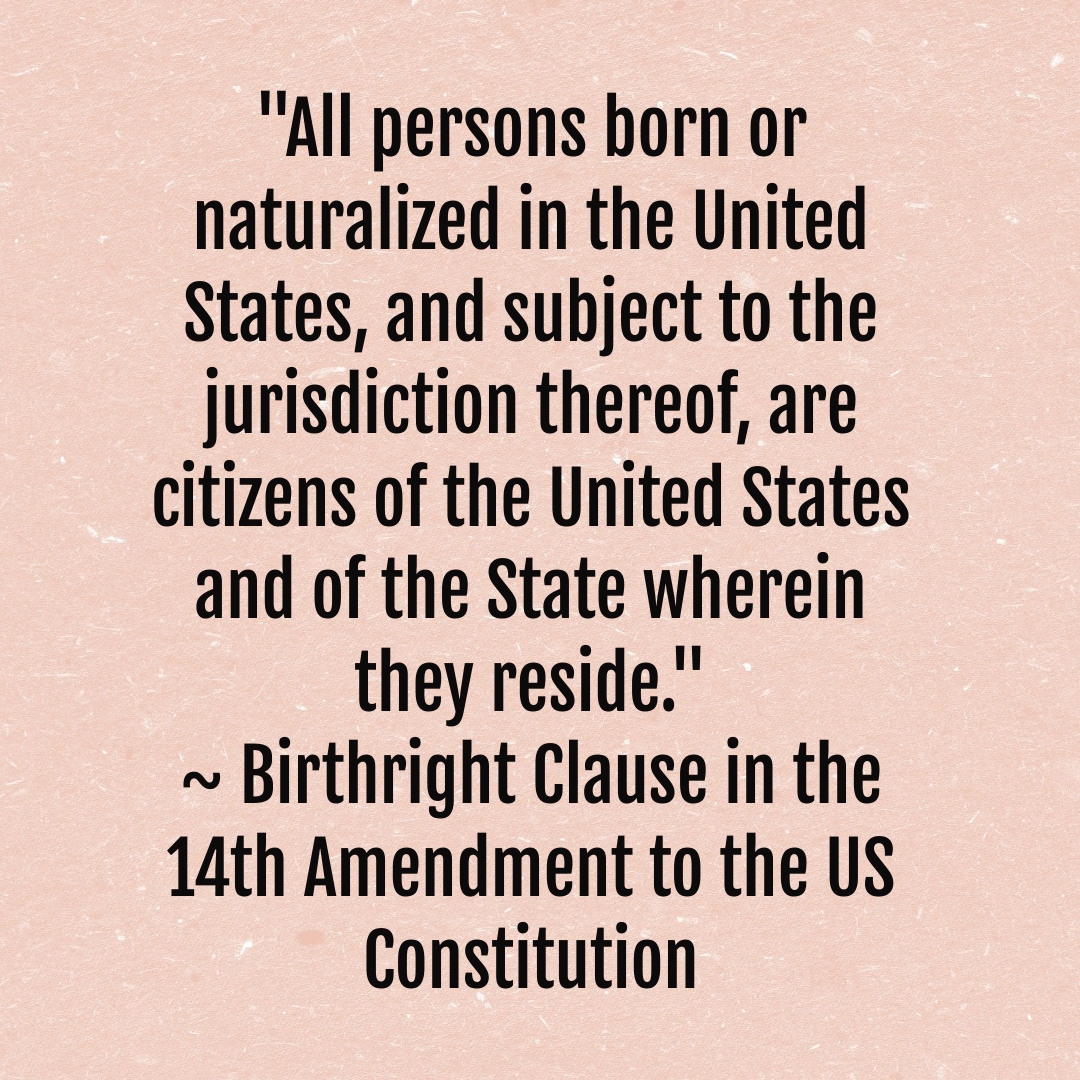
Let’s take a step back and see what prompted Mr. Wong Kim Ark to take his complaint all the way to the US Supreme Court.
Who was Wong Kim Ark and what was this Court Case about?
Wong Kim Ark was born in San Francisco, California in 1873. His parents were subjects of the Emperor of China but were permanently residing in the United States. The family still lived in San Francisco in 1890 when Wong Kim Ark took a trip to China.
He returned to his home in San Francisco on July 26, 1890. He lived there and worked as a laborer as a US citizen. In 1894 he took another trip to China but, when he returned to the US in August 1895, he was denied entry on the grounds that he was not a US citizen.
A lower court ordered him to be released because he was a US citizen. The United States appealed the lower court’s decision, and the case went to the US Supreme Court.
Justice Horace Gray delivered for the majority in the 6-2 ruling by the US Supreme Court. In his statement he indicated that the Chinese Exclusion Act of 1882 had no relevance in this case.
The Chinese Exclusion Act was the first law of any significance that limited immigration into the United States. The Act was the result of violent acts committed against Chinese workers. It prohibited Chinese laborers from entering the US for ten years. Exceptions included merchants, teachers, students, travelers, and diplomats.
Justice Gray wrote, “It is conceded that, if he is a citizen of the United States, the acts of Congress, known as the Chinese Exclusion Acts, prohibiting persons of the Chinese race, and especially Chinese laborers, from coming into the United States, do not and cannot apply to him.”
As in most cases that reach the level of the US Supreme Court, there is more here than meets the eye. Having taken one Constitutional Law course in college does not qualify me as a Constitutional scholar, so I’ll just leave it at that.
If you wish to delve more deeply into the United States v. Wong Kim Ark decision, you may do so. I just found it serendipitous that the anniversary of this case fell during a time when the 14th Amendment to the US Constitution is under fire.
Why is the 14th Amendment under attack by Trump?
It is obvious that the president does not want children of undocumented Hispanic immigrants who are born in the US to automatically have US citizenship as guaranteed by the 14th Amendment.
The White House appears to be arguing its case on https://www.whitehouse.gov/presidential-actions/2025/01/protecting-the-meaning-and-value-of-american-citizenship/. It seems short-sighted to me for Trump to “show his hand” on this matter since it is destined to go before the US Supreme Court if he insists on pursuing his contempt for the 14th Amendment.
We have not heard the last of this.
A March 5, 2025 US Supreme Court ruling to consider
On March 5, 2025, we saw only five of the nine US Supreme Court Justices vote that the United States should be required to honor its promises of $2 billion in foreign aid through the now-possibly-defunct United States Agency for International Development (USAID). The slim majority decision gave me a sigh of relief but immediately angered me because the vote should have been 9-0.

What is it in the life experiences of Associate Justices Alito, Kavanaugh, Thomas, and Gorsuch that influenced them to vote in the negative? What made those four men believe that funds authorized by the US Congress and promised to other countries and organizations should not be honored? Should not be paid?
What makes those four men think the United States should not be a country of its word? I really want to know.
Justice Alito argued in an eight-page dissent that resembled a pro-MAGA social media post that a US District Court Judge could not compel the US Government to spend money authorized by Congress. He essentially went after Judge Amir Ali, the lower court judge who had ruled in the case.
From what I have read, I think his anger is misplaced. It is the US Constitution that gives Congress the authority to allocate money. If Mr. Alito has a problem with that, perhaps he should have stated his disfavor with the Constitution instead of against Judge Amir Ali.
I certainly hope Justice Alito was not lashing out at Judge Ali because Judge Ali was born in Canada. I hope he wasn’t lashing out at Judge Ali because he was appointed by President Joe Biden. And I certainly hope he wasn’t lashing out at Judge Ali because he is a Muslim.
Perhaps I’m looking for a “there” when there’s no “there” there, but the current US Supreme Court in general seems to be in Trump’s pocket. This is the same group of Justices that ruled in 2024 that nothing a US President does is illegal.
I pray we haven’t heard the last of this!
Arlington National Cemetery
With so much going on, and a couple of long blog posts in March, I waited until today to mention how the US Department of Defense is erasing history specifically on the Arlington National Cemetery website. US history seems to be in Trump’s cross-hairs.
Under the heading, “Arlington National Cemetery removed links to webpages about Black, Hispanic and female veterans,” Snopes.com (published March 14, 2025; updated March 15, 2025) verified that the following links have been removed from the Arlington National Cemetery website:
African American History, removed from the Notable Graves subsection;
Hispanic American History, removed from the Notable Graves subsection;
Women’s History, removed from the Notable Graves subsection;
African American History, removed from the Themes drop-down menu of the Education section; and
Civil War, removed from the Themes drop-down menu of the Education section.
This should be no surprise, since Trump has called veterans suckers and losers.
The latest US Department of Defense blunder
It seems to me that our Department of Defense (DoD) needs to spend less time erasing history and more time holding top secret war plans in a secure location (which until the Trump Administration was the policy) and much less time holding top secret war plan meetings via text messages.
Thank you, Jeffrey Goldberg, editor-in-chief of The Atlantic magazine, for being a true patriot and not leaking the plans for the United States bombing the Houthis in Yemen last week. Leaking the plans that you were texted would have put US military personnel is grave danger. Were you included on the text list by mistake, or is there someone in the DoD who wanted this information leaked to a journalist?
I wonder who DoD Secretary Hegseth will text top secret information to next.
Until my next blog post
I hope you have a good book to read.
Hold your family close.
Remember the people of Ukraine and western North Carolina.
Janet


 Janet's Writing Blog