The Other Two Books I Read in May 2023

I love the months in which I get to read so many books that it takes me more than one blog post to tell about them! May was one of those months. Today’s post is about the last two books I read in May. I hope at least one of them will appeal to you.


One Thought Scares Me, by Richard Dreyfuss

In One Thought Scares Me, Richard Dreyfuss presents his thoughts about how democracy has been eroded in the United States by the removal of the study of government (or civics) in our public schools. He pinpoints this quiet removal as happening 50 years ago, so it was after I graduated from high school.

One Thought Scares Me, by Richard Dreyfuss

I remember hearing a few years ago that in North Carolina the high school American History curriculum would begin with the Presidency of George Washington. I’ve wondered since then how the Presidency of George Washington would make any sense to a student who didn’t know that it followed an American Revolution.

If an American knows nothing about the Declaration of Independence – why it was written, who wrote it, when it was written, who we were declaring our independence from — and most importantly, how the signers of it risked their very lives by signing it – then they will not know what political conditions the early American settlers lived under.

If an American knows nothing about the American Revolution – why it happened, when it happened, who we were rebelling against, etc., then that American will not value what it means to be an American citizen. If they don’t know what those who came before us suffered through just to gain the right to vote, they will not value their right to vote. They will feel no obligation to vote.

If an American knows nothing about the Bill of Rights – why those ten rights were spelled out in the United States Constitution and what they are – then they won’t know when a US President or the US Congress or their State Legislature is taking away one or more of those rights.

If an American knows nothing about US history, they won’t know that July 4th is more than just a day off from work when you eat burgers and hotdogs and shoot off fireworks.

In order to be a good citizen of the United States of America, you must know the history of the country. As Mr. Dreyfuss points out in his book, it was the system of public education in the United States in the early 1800s that made it possible for every child to learn to read and write. It made it possible for every child to learn the Pledge of Allegiance, to learn about colonial times, to learn about the American Revolution, to learn about the ugliness of slavery, to learn about the Civil War, and to learn about all the wars American have fought around the world in the name of freedom.

My two-cents’ worth:  If you take that out of the public schools – and if you disrespect public education and public school educators the way the North Carolina General Assembly continues to do – then you lose the level playing field on which our country was built and you lose what binds us together as a nation.


Seeking the Historical Cook: Exploring Eighteenth-Century Southern Foodways, by Kay K. Moss

Reading this book after taking the Open Hearth Cooking Class at Hart Square Village on May 20 was very beneficial. The hands-on class was invaluable to me in writing historical fiction, and the book made a lot more sense to me having had the class.

Seeking the Historical Cook, by Kay K. Moss

The book covers how to interpret historical “receipts” as recipes were called in the American Colonial Era, and the importance of incorporating an 18th century mindset when using the old recipes. Ms. Moss and her books are a goldmine for anyone doing research on frontier life in the Carolinas.

This book is illustrated and very detailed in cooking instructions, including the importance of getting the hot coals just right and judging the heart, cooking/baking time, and always having hot water on-hand.


Cyberspace fiasco since my last blog post

To say it was a frustrating week would be an understatement. My email service was disrupted for about 24 hours Tuesday into Wednesday. My Facebook account was hacked on Thursday. My LinkedIn account was hacked on Saturday. My Evernote account was hacked on Sunday.

Would be writers like me are told we must have a vast social media presence if we want to ever get published. We must have followers in the thousands and tens of thousands.

After what I’ve been through over the last few days, I’ve decided to remove myself from Facebook, LinkedIn, and Evernote. Each of those accounts had unique passwords. It bothers me that hackers can take control of my stuff without any problem; however, when I try to get an account back I must provide all sorts of documentation to prove that I am me. Life is short. I don’t foresee ever having time again for Facebook, LinkedIn, or Evernote. I’ll miss some things about Facebook, but the other two won’t be missed at all. Just for good measure, I’ll no longer be on Twitter either. It was a hassle anyway. I won’t miss it a bit.

If not having 40,000 followers on Facebook, Twitter, LinkedIn, etc. means I’ll never get my novels published, I guess that’s the price I’ll pay.

If you receive notification via Facebook when I’ve posted a blog, you’ll no longer receive those notifications because as of last Thursday, I have no control over my Facebook account. In fact, you won’t be notified about today’s post. Someone else, apparently in Beijing, has control of my account now. Facebook indicated it would take them 48 hours to verify that I am Janet Morrison. It’s been longer than that, so I guess they’re still just playing games with the hacker in Beijing. I regret that I didn’t get to tell my acquaintances on Facebook goodbye.

My blog is protected through a whole different server, etc., so I plan to continue to blog every week and treasure the lifeline it has become.

I envy Harper Lee and her manual typewriter. She got to just hide away in Alabama and write To Kill a Mockingbird with no worries about cyberspace. There’s something appealing about that era.

Speaking of birds… the three neighborhood cats must have miserable home lives because they want to stay in our yard all the time stalking our wild birds. In my spare time last week, I had to construct a barricade to try to prevent the cats from getting to the nest of baby Carolina Wrens in the hanging basket on my porch.

Thank you for the feedback I continue to get since posting To Write or Not To Write Historical Short Stories? What do you think? on May 29. All opinions are welcome!


Until my next blog post

I hope you have at least one good novel or non-fiction book to entertain and educate you.

With the smoke from the wildfires in Canada dissipating, we on the east coast of the US look forward to clear skies and some sunshine.

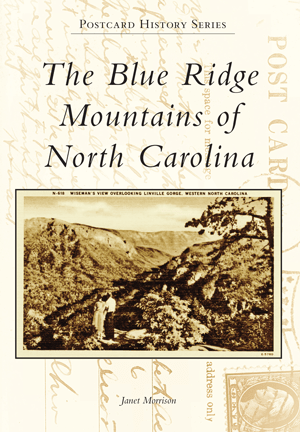
In case you’re planning a trip to Great Smoky Mountains National Park, Cherokee, or the Blue Ridge Mountains this year, be sure to pick up a copy (paperback or for Kindle) of my vintage postcard book, The Blue Ridge Mountains of North Carolina. I packed as much natural history and human history into the postcard descriptions as Arcadia Publishing would allow. I think you’ll find it entertaining and painlessly educational.

The Blue Ridge Mountains of North Carolina, by Janet Morrison

Don’t forget the people of Ukraine. Believe me… I know my life — even with all my cyberspace problems — is easy compared to their suffering. I truly know that.

Janet

Great Smoky Mountains, Revisited (Part 1 of 2)

Sign on US-441/Newfound Gap Road to alert visitors that they are entering the national park.

Several weeks ago I took a vacation from blogging, writing, and all social media. It was wonderful! I hope you can try it sometime.

My sister and I spent a week in and around the Great Smoky Mountains National Park in Tennessee and North Carolina.

For seven days, I didn’t check my blog for comments. I didn’t text. I didn’t call anyone. I didn’t Tweet. It was fabulous!


“The Great Smoky Mountains lay in the middle of the Cherokee Indians’ territory in the mid-1600s when Spanish explorer Hernando de Soto arrived.”

page 69, The Blue Ridge Mountains of North Carolina, by Janet Morrison.
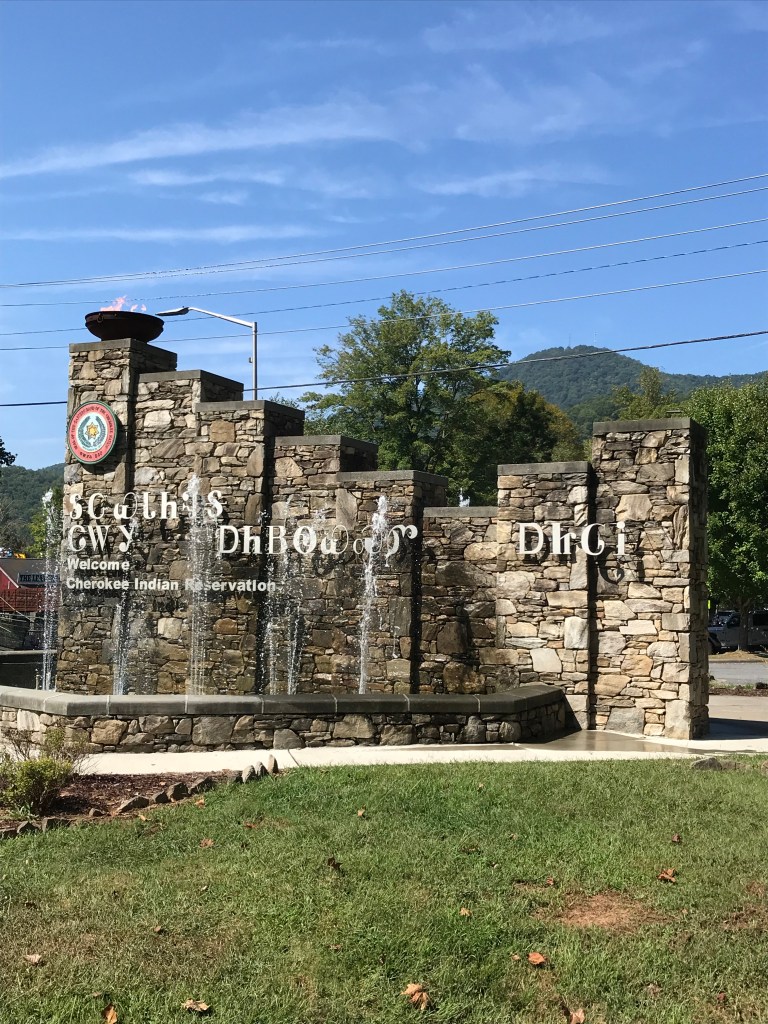
“Welcome to Cherokee Indian Reservation” sign in Cherokee and in English

The Blue Ridge Mountains of North Carolina, by Janet Morrison

Since the park was included in my vintage postcard book, The Blue Ridge Mountains of North Carolina, I enjoy visiting the park to see what has changed and what has remained the same since my childhood and since my book’s publication in 2014.

Today and next Monday, I’ll share some highlights from my trip, including a few of the pictures I took. I’ll also include photographs of some of the vintage postcards from my book, which is pictured to the right.


Elk!

Elk were reintroduced into the Great Smoky Mountains in 2001 and 2002. I’d never seen an elk until this recent trip! What a thrill it was to see a herd of elk, including this buck, in the river that runs behind the Oconoluftee Visitor Center near the main North Carolina entrance to Great Smoky Mountains National Park just north of Cherokee, NC! This bull was a jaw-dropping sight as he surveyed his herd of female elk (cows) cooling off in this cool mountains stream. (It was late afternoon and in the mid-90s F.)

An elk bull in Great Smoky Mountains National Park

It is illegal to willingly get within 150 feet of an elk or black bear in Great Smoky Mountains National Park. Don’t worry, I was behind a fence that was guarded by a park ranger, and I used the zoom feature on my cell phone camera.

Sign reminding visitors that elk are back in the park.

For more information about the reintroduction of elk in Great Smoky Mountains National Park and the safeguards people should take when seeing them, go to https://www.nps.gov/grsm/learn/nature/elk.htm.


The Loop/Helix

One of the most famous construction features on US-441/Newfound Gap Road, which traverses Great Smoky Mountains National Park from one side to the other is “The Loop.” The highway tunnels under itself to form a helix.

Here are pictures of two of the three postcards of “The Loop” in my vintage postcard book.

This is a photo of a 1936 “real photograph postcard” of “The Loop” on Newfound Gap Road in Great Smoky Mountains National Park.
This is a photo of another 1936 “real photograph postcard” of “The Loop” on Newfound Gap Road in Great Smoky Mountains National Park.

The next two paragraphs are quotes from the captions I wrote for the three postcards on pages 80-81 of my book:

“Newfound Gap Road in Great Smoky Mountains National Park tunnels under itself, forming a helix. The design replaced two dangerous switchbacks on the old Tennessee Highway 71, which was built in the 1920.”

Signage to alert drivers that they are approaching “The Loop” on Newfound Gap Road in Great Smoky Mountains National Park

“These black-and-white glossy real-photo postcards were made in 1936. The Great Smoky National Park Roads & Bridges portion of the Historic American Engineering Record of the National Park Service gives many details about the Loop. Probably designed by Charles Peterson, the Loop was constructed in 1935 by C.Y. Thomason Company of Greenwood, South Carolina, at a cost of $77,644. Stone quarried nearby and reinforced concrete were used in the construction of the bridge portion, which is 95 feet long, 42 feet wide, and 21 feet high in the center of the arch.”

Since its construction in 1935, trees and other natural vegetation has been allowed to grow and flourish. I appreciate that; however, it makes it almost impossible now to fully see and admire this engineering feat. It might still be possible to see the entire Loop from Chimney Tops Mountain nearby, but it’s impossible to get a satisfactory photograph of it from ground level due to the trees. Therefore, I had to settle for the above picture of The Loop signage.

The first time I rode through The Loop was at the age of nine. It’s still a thrill, 57 years later!


Babbling Brooks

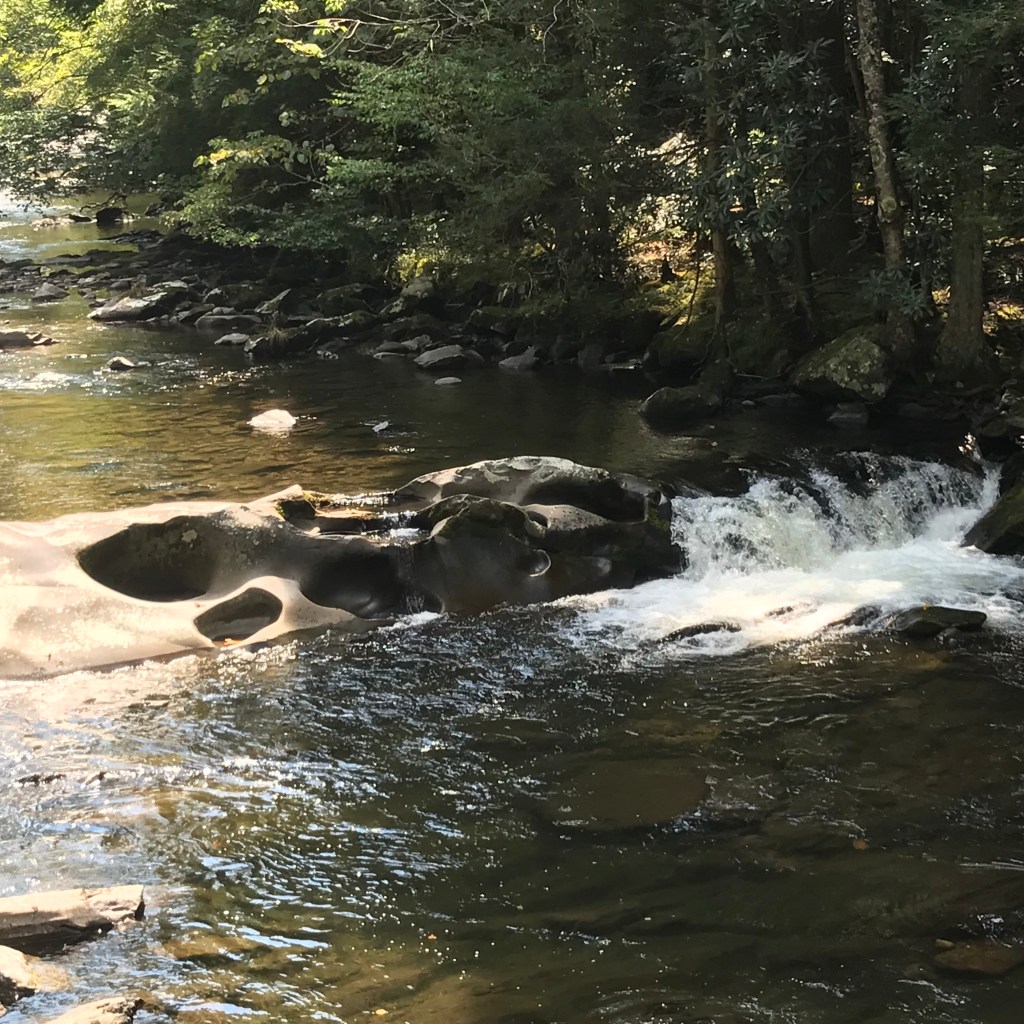
A stream in Great Smoky Mountains National Park

One of my favorite features in Great Smoky Mountains National Park is all the babbling brooks. Little River Road runs parallel to the Little River for many miles in the park between Sugarlands Visitor Center and Cades Cove. Little River and the other streams in the park are full of bounders and rocks of all sizes, indicating the history of these mountains from the Ice Age.

Another stream in Great Smoky Mountains National Park


Since my last blog post

It took much patience and persistence (and some grinding of my teeth), but I eventually worked out a new way of inserting photographs in my blog posts last Tuesday. What a relief, to be able to present today’s post and next Monday’s the way I had envisioned! I hope you enjoy the photographs today.

I had the opportunity to watch and listen to another free webinar about the craft of writing on Monday. It was about Author Accelerator’s “Inside Outline” tool. It piqued my interest. Of course, to use the tool I’d have to pay a fee, so I haven’t made that commitment. If you, like I, are learning to write a book, you might want to look into this tool at https://www.authoraccelerator.com/. The tool was developed by Jennie Nash.


Until my next blog post

I hope you have a good book to read. I’m reading The Ragged Edge of Night, by Olivia Hawker.

If you’re a writer, I hope you have productive writing time.

Thank you for reading my blog. You could have spent the last few minutes doing something else, but you chose to read my blog.

Watch for my blog post next Monday. It is a continuation of today’s post and will feature black bears, the double-peaked mountain called Chimney Tops, damage from the late November 2016 wildfires, babbling brooks, white clouds down in a valley one morning, and why the Great Smoky Mountains have that moniker.


A few words about my book

I hate to “blow my own horn.” I’d be remiss, though, if I didn’t take this opportunity to tell you how you can have your own copy of my vintage postcard book, The Blue Ridge Mountains of North Carolina, published by Arcadia Publishing in 2014.

Don’t let the name of the book fool you, it covers all the mountainous counties in western North Carolina and the three counties in eastern Tennessee that are partially in Great Smoky Mountains National Park.  Electronic and paperback copies are available from Amazon.com at https://www.amazon.com. Paperback copies are available from the publisher at https://www.arcadiapublishing.com/, at quality bookstores, or from me personally.


Let’s continue the conversation

Have you visited the Great Smoky Mountains? If so, what were your impressions of it? What was the highlight of your trip? Did you see any black bears? Did you see elk? Did you hike? Did you go camping? The recreational opportunities in the Great Smoky Mountains are unlimited! I’d love to hear about your experiences there.

Also, please let me know how you usually view my blog. Do you look at it on your desktop computer, on a tablet, or on your phone?

I’m trying to be more cognizant of the fact that a growing number of people are reading blogs on their phones. The layout of the blog translates differently on the various formats.

For instance, what looks good on a cell phone, doesn’t look quite as good on a desktop computer. Today’s blog post falls into that category. I’ve spent a lot of time on it, trying out “spacers” and “separators.” I’ve never used those tools before. Your patience is appreciated as I learn and experiment with some new blogging techniques.

Remember, I’m a writer — not a computer whiz. This is all part of my journey as a writer, which is what my blog is about.

Thank you for sharing my blog with your friends — in person and on social media!

Janet

19 Blue Ridge Mountains Trivia Answers

How many of the Blue Ridge Mountains trivia questions I asked in last week’s blog, https://janetswritingblog.com/2019/08/11/19-blue-ridge-mountains-trivia-questions/, were you able to answer?

#BlueRidgeMtnsOfNC #PostcardBook
The Blue Ridge Mountains of North Carolina by Janet Morrison

I indicated that all the answers could be found in the vintage postcard book I wrote, The Blue Ridge Mountains of North Carolina. These trivia questions (and the answers supplied in today’s blog post) are my way of celebrating the fifth anniversary of the publication of the book by Arcadia Publishing on August 25, 2014.

Here are the questions and answers

1.  Why was Grandfather Mountain named a member of the international network of Biosphere Reserves in 1992?  Because it supported 42 rare and endangered species. Just on that one mountain!

2. What does Linville Falls in North Carolina have in common with Niagara Falls?  They are both caprock waterfalls, meaning the top layer of rock is harder that the underlying stone. Erosion causes the waterfall to migrate upstream over time. It is believed that Linville Falls was once 12 miles downstream from its present location.

3.  How did Edwin Wiley Grove make his fortune which enabled him to build the Grove Park Inn in Ashevile, North Carolina?  He sold Grove’s Tasteless Chill Tonic.

4.  What part did the Civilian Conservation Corps (CCC) play in the construction of the Blue Ridge Parkway during The Great Depression?  The men who were members of the CCC assisted with the paving and landscaping of the Blue Ridge Parkway. What a magnificent gift they left us!

5.  When George W. Vanderbilt purchased Mt. Pisgah in 1897, what grand plan did the mountain become part of temporarily?  The 125,000-acre Biltmore Estate. (It’s no longer part of the estate.)

6.  What groups of people were housed at Assembly Inn in Montreat, North Carolina in 1942?  290 Japanese and German internees.

7.  Jerome Freeman bought 400 acres of land in Rutherford County, North Carolina that included the Chimney Rock around 1870 for $25. How much did the State of North Carolina pay for Chimney Rock Park in 2007?  $24 million.

8.  What new breed of hunting dog was developed by a German pioneer family in the late 1700s in the Plott Balsams subrange of the Blue Ridge Mountains?  The Plott Hound, which just happens to be the official State Dog of North Carolina.

9.  What is an early 20th century feat of engineering on the Newfound Gap Road in Great Smoky Mountains National Park?  The road crosses over itself. This example of a helix is called “The Loop.”

10.  How fast can a black bear run?   30 to 35 miles per hour.

11.  It is illegal in Great Smoky Mountains National Park to willfully get within how many feet of a black bear?  150 feet.

12.  What is the name of the 57,000 acres of land purchased by the Cherokee in the 1800s and held in trust by the United States Government?  Qualla Boundary

13.  Is Qualla Boundary technically a reservation? No, a reservation is land that the United States Government gives to an American Indian tribe. The Cherokees purchased their land.

14.  Did the Cherokee people lived in tipis in the 1700s and 1800s?  No, they lived in houses.

15.  What forest contains one of the largest groves of old-growth trees in the Eastern United States?  Joyce Kilmer Memorial Forest

16.  What hydroelectric dam was used in the 1993 Harrison Ford movie, The Fugitive?  The Cheoah Dam

17.  What is the tallest dam east of the Rocky Mountains in the United States?  Fontana Dam.

18.  One of the oldest postcards in my book is of Cullowhee Normal School in the mid- to late-1920s. What is the name of that school today?  Western Carolina University.

19.  Started in 1935, the Blue Ridge Parkway’s “missing link” was completed in 1987. What is the connecting one-fourth-mile long piece that filled the “missing link” called? The Linn Cove Viaduct.

How did you do?

How many of the 19 questions did you answer correctly? I hope you enjoyed trying to answer the questions and seeing the answers today. If you want to learn more about the mountains of North Carolina and eastern Tennessee, please ask for The Blue Ridge Mountains of North Carolina, by Janet Morrison, at your local bookstore, online at Amazon.com, or purchase it directly from the publisher at https://www.arcadiapublishing.com/. It’s available in paperback and as an ebook.

The contract I signed with Arcadia Publishing was for five years, so you’d better get a copy of the book while it’s still being published. I don’t know if my contract will be extended.

Since my last blog post

I’ve finally gotten into a rhythm for writing the scene outline according to C.S. Lakin’s template. It sounds backward to be writing the scene outline after writing the book, but the questions asked in the template, along with five questions I added after reading a couple of articles by Janice Hardy, are making every scene in the book stronger. It’s slow going, but well worth the time and effort.

Due to technical problems, I was unable to include images of any of the postcards from my book in today’s blog post.

Until my next blog post

If you’d like to follow me on Twitter, @janetmorrisonbk. If you’d like to follow my business page on Facebook, it’s Janet Morrison, Writer.

I hope you have a good book to read. I’m reading The Nickel Boys, by Colson Whitehead and still listening to Resistance Women, by Jennifer Chiaverini.

If you’re a writer, I hope you have quality writing time.

Thank you for taking the time to read my blog. You could have spent the last few minutes doing something else, but you chose to read my blog.

Let’s continue the conversation

Feel free to let me know in the comments section below or on Twitter or Facebook how you did on the trivia questions. If you have any other comments or questions for me about the Blue Ridge and Smoky Mountains, I’ll welcome and try to answer them.

Janet

Talking Leaves

When I was researching retail stores throughout the mountains of North Carolina where my vintage postcard book, The Blue Ridge Mountains of North Carolina, could be sold, I was intrigued by a bookstore in Cherokee called Talking Leaves.

A couple of weeks ago, I got to visit Cherokee and Talking Leaves. It is in a small strip shopping center at the corner of US-19 and Nickel Drive, next to KFC. The owner, Ron Blankenship, thought he had my book on the shelf. Taking a closer look, though, he realized he had confused my book with another book by Arcadia Publishing.

I showed Mr. Blankenship my book and gave him a postcard with its picture on the front and ways to contact the sales department at Arcadia. I hope he will order my book.

Oconaluftee Visitors Center

While visiting bookstores and other retail establishments that sell books in the mountains of North Carolina a couple of weeks ago, I made a point to stop by the Great Smoky Mountains National Park’s Oconaluftee Visitors Center near Cherokee, North Carolina.

I hoped to find my vintage postcard book, The Blue Ridge Mountains of North Carolina, on the shelf there, but it was not there. I was pleased, though, to get to meet Ila Hatter, a volunteer with Great Smoky Mountains Association, the 501(c)3 organization that operates the bookstore/gift shop at the Oconaluftee Visitors Center. I recognized Ms. Hatter from seeing her on UNC-TV (North Carolina public television.) She is a medicinal plant expert. It was a pleasure to meet her.

I told Ms. Hatter about my book and she told me how to e-mail the buyer for the Great Smoky Mountains Association. I did that when I returned home, and I hope to see my book on the shelves in all the GSMA gift shops on my next trip to the Great Smoky Mountains National Park.

My sister and I joined the Great Smoky Mountains Association and hope to get to take advantage of some of the programs the association offers throughout the year. Even if we don’t, though, we like knowing our membership dues help preserve the national park and provide educational opportunities for others.

You can learn more about Great Smoky Mountains Association by visiting the organization’s website at http://www.smokiesinformation.org.