I write southern historical fiction, local history, and I've written a devotional book. The two novels I'm writing are set in Virginia and the Carolinas in the 1760s. My weekly blog started out to follow my journey as a writer and a reader, but in 2025 it has been greatly expanded to include current events and politics in the United States as I see our democracy under attack from within. The political science major in me cannot sit idly by and remain silent.
On July 8, 1775, the Second Continental Congress adopted the so-called Olive Branch Petition as sort of a last-ditch effort to avoid war with Great Britain. It was written by John Dickinson of Pennsylvania. He hoped against hope that America would not break with its mother country.
Photo by Shahan Khan on Unsplash
The petition’s words were couched in language meant to convince King George III that the colonies did not want to break away but that Britain’s actions had forced her “still faithful Colonists” to arm themselves in self-defense. It mentions the “distress” the very thought of such a break was causing the colonists.
The petition ended with, “That your Majesty may enjoy long and prosperous reign, and that your descendants may govern your Dominions with honour to themselves and happiness to their subjects, is our sincere prayer.”
Photo by Donovan Reeves on Unsplash
This was just a scant three months after American militiamen had fought British troops at Lexington and Concord, Massachusetts. Colonists’ beef was primarily with Parliament. There was still hope among same of them that King George surely wanted only the best for his subjects – even those across the Atlantic.
On September 8, 1775, Richard Penn and Authur Lee, representing the Continental Congress, traveled to England to present the petition to King George III. But King George refused to accept the petition.
Photo by Mark Stuckey on Unsplash
When word came to the colonies that the king had refused to even receive the petition, the tide turned and the colonists realized the king did not have their best interest at heart.
I have blogged about today’s topic before. I try to always mention it near the anniversary date of the event because it is a little-known fact in US history. Indeed, it rarely gets mentioned even by the local journalists and reporters in the Mecklenburg County, North Carolina area today. (Of course, most of them moved here from other parts of the country and they are not aware of our local history.)
I don’t know that I can improve upon my Mecklenburg Declaration of Independence blog from 2022, so I am taking the liberty to quote from it today.
From my May 23, 2022 blog post, “Mecklenburg Declaration of Independence, 1775”:
Today, my blog is about the Mecklenburg Declaration of Independence in 1775 while present-day Cabarrus County was part of Mecklenburg County and its citizens played just as important a role in the declaration as anyone living in what is present-day Mecklenburg County, North Carolina.
Friday, May 20, 2022 was the 247th anniversary of the signing of the Mecklenburg Declaration of Independence.
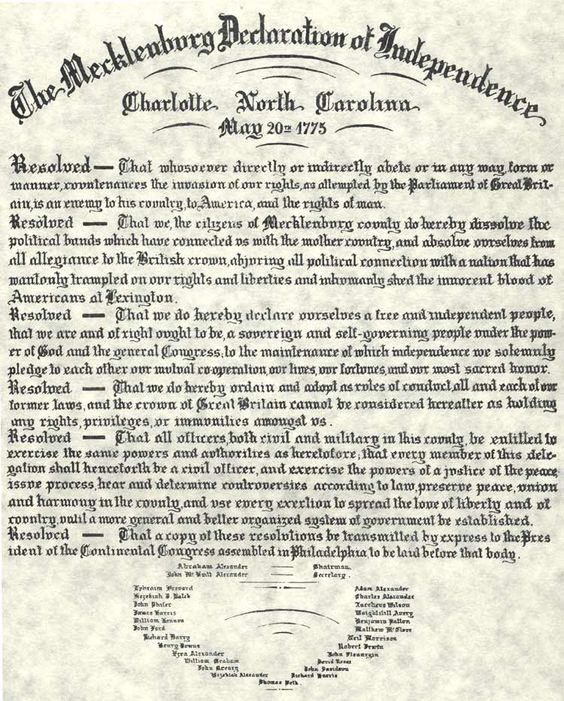
A recreation of the Mecklenburg Declaration of Independence
But what about the 1775 Mecklenburg Declaration of Independence?
I blogged about the Mecklenburg Declaration of Independence on May 21, 2018. To refresh your memory, or to introduce you to the topic if you aren’t aware of it, the following nine paragraphs are reblogged from that post:
My immigrant ancestors were among the Scottish Presbyterian pioneers who settled old Mecklenburg County, North Carolina. Years of discontent in the American colonies were piled on top of the anti-British Crown feelings they brought with them across the Atlantic.
Weary of unfair taxes imposed by the Crown and the discrimination they were subjected to as Presbyterians slowly brought the settlers to the boiling point. An example of the persecution these Presbyterians felt were the Vestry and Marriage Acts of 1769. Those acts fined Presbyterian ministers who dared to conduct marriage ceremonies. Only Anglican marriages were recognized by the government.
In May of 1771 a group of young men from the Rocky River Presbyterian Church congregation in the part of Mecklenburg County that later became Cabarrus County, disguised themselves by blackening their faces and under the cover of darkness ambushed a shipment of Royal munitions traveling north on the Great Wagon Road. The supplies were destined for Rowan County to put down the Regulator Movement.
Blowing up three wagons loaded with gunpowder and other supplies, the teens and young men who perpetrated the deed were declared outlaws by the Royal Governor and had to go into hiding until May 20, 1775 when all the citizens of Mecklenburg County were declared to be rebels against the British Crown.
On May 20, 1775, the citizens of Mecklenburg County, North Carolina declared themselves to be free and independent of the rule of Great Britain. It was a sober and sobering declaration not entered into lightly. Those American patriots meant business, and they knew the risks they were taking.
Archibald McCurdy, an Elder in Rocky River Presbyterian Church, heard the document read from the steps of the log courthouse in Charlotte. When he got home, he and his wife, Maggie, listed everyone they knew of who could be trusted in the coming fight for American independence.
No original copies of the Mecklenburg Declaration of Independence survive today. The local copy was lost in a house fire at the home of one of the signers. The copy taken to the Continental Congress in Philadelphia by Captain James Jack on horseback was also lost. Later, signers of the document recreated it from memory.
Nevertheless, those of us who were raised on stories of the Mecklenburg Declaration of Independence and the brave souls who risked their lives to sign it know that the document was real. The blood of the American patriots still flows in our veins and their spirit of freedom still beats in our hearts.
Don’t mess with our freedom of the press, freedom of speech, freedom of religion, or our freedom of assembly!
In case you think I’m spending too much time this month blogging about our local history, just keep in mind that May is an important month of historical events in Cabarrus County, North Carolina.
My May 2, 2022 blog post, __#OnThisDay: 251st Anniversary of 1771 Gunpowder Plot__ was about patriots’ blowing up the king’s munitions just off the Great Wagon Road in present-day Cabarrus County.
Today, my blog is about the Mecklenburg Declaration of Independence in 1775 while present-day Cabarrus County was part of Mecklenburg County and its citizens played just as important a role in the declaration as anyone living in what is present-day Mecklenburg County.
Friday, May 20, 2022 was the 247th anniversary of the signing of the Mecklenburg Declaration of Independence.
A recreation of the Mecklenburg Declaration of Independence.
But what about the 1775 Mecklenburg Declaration of Independence?
I blogged about the Mecklenburg Declaration of Independence on May 21, 2018. To refresh your memory, or to introduce you to the topic if you aren’t aware of it, the following nine paragraphs are reblogged from that post:
My immigrant ancestors were among the Scottish Presbyterian pioneers who settled old Mecklenburg County, North Carolina. Years of discontent in the American colonies were piled on top of the anti-British Crown feelings they brought with them across the Atlantic.
Weary of unfair taxes imposed by the Crown and the discrimination they were subjected to as Presbyterians slowly brought the settlers to the boiling point. An example of the persecution these Presbyterians felt were the Vestry and Marriage Acts of 1769. Those acts fined Presbyterian ministers who dared to conduct marriage ceremonies. Only Anglican marriages were recognized by the government.
In May of 1771 a group of young men from the Rocky River Presbyterian Church congregation in the part of Mecklenburg County that later became Cabarrus County, disguised themselves by blackening their faces and under the cover of darkness ambushed a shipment of Royal munitions traveling north on the Great Wagon Road. The supplies were destined for Rowan County to put down the Regulator Movement.
Blowing up three wagons loaded with gunpowder and other supplies, the teens and young men who perpetrated the deed were declared outlaws by the Royal Governor and had to go into hiding until May 20, 1775 when all the citizens of Mecklenburg County were declared to be rebels against the British Crown.
On May 20, 1775, the citizens of Mecklenburg County, North Carolina declared themselves to be free and independent of the rule of Great Britain. It was a sober and sobering declaration not entered into lightly. Those American patriots meant business, and they knew the risks they were taking.
Archibald McCurdy, an Elder in Rocky River Presbyterian Church, heard the document read from the steps of the log courthouse in Charlotte. When he got home, he and his wife, Maggie, listed everyone they knew of who could be trusted in the coming fight for American independence.
No original copies of the Mecklenburg Declaration of Independence survive today. The local copy was lost in a house fire at the home of one of the signers. The copy taken to the Continental Congress in Philadelphia by Captain James Jack on horseback was also lost. Later, signers of the document recreated it from memory.
Nevertheless, those of us who were raised on stories of the Mecklenburg Declaration of Independence and the brave souls who risked their lives to sign it know that the document was real. The blood of the American patriots still flows in our veins and their spirit of freedom still beats in our hearts.
Don’t mess with our freedom of the press, freedom of speech, freedom of religion, or our freedom of assembly!
Until my next blog post
I’m considering taking a week off from writing my blog, unless something interesting comes along and begs to be written. Next Monday, May 30, is Memorial Day in the United States of America. It is a day to remember all the men and women who have lost their lives while serving in the armed forces of the United States.
I hope you have a good book to read until I blog again on June 6.
Take time for a relaxing hobby and spend some time with friends and family.
It’s been four weeks since my last #OnThisDay blog post. Today’s might not be the most exciting topic for you, but I think it’s important for Americans to be reminded about the early days of our democracy. The historian in me just can’t help myself.
The Articles of Confederation document was the forerunner of the U.S. Constitution.
Photo credit: Anthony Garand on unsplash.com (Preamble of the US Constitution)
On November 15, 1777, the Continental Congress adopted the Articles of Confederation. It was that document that established the name of our country as the United States of America. It served as the defacto constitution of the nation throughout the Revolutionary War.
I reread the Articles of Confederation last week. It had been quite a while since I’d read the document.
Still stinging from oppressive British rule, the frames of the Articles of Confederation were hesitant to create a strong federal government. Much power was retained by the individual states. States’ rights have been a bone of contention throughout the history of the U.S. and still is today. It seems like every week the legislature of at least one state in the union is testing the waters and “pushing the envelope” to see just how far they can go without being reined in by the U.S. Supreme Court. The major issues today that fall in that category are abortion rights, gun rights, and Covid-19 vaccination mandates.
There were weaknesses in the Articles of Confederation. The document did not give the U.S. the authority to issue a national currency. Hence, the various states printed their own money. It makes my head spin to think what our country would be like today if that hadn’t been corrected.
Another weakness in the document was the absence of authority of the national government to levy taxes. Some people probably think things should have stayed that way, but just think how many things we would not have today if not for federal taxes. The “common treasury” was to be supported by the states, with each state contributing an amount based on the value of the land in that state.
Of all the language in the document, the wording in Article III stood out for me. Specifically, the words, “firm league of friendship.” That phrase sounds quaint to our 21st century ears.
Article III states the following: “The said states hereby severally enter into a firm league of friendship with each other, for their common defence [sic], the security of their Liberties, and their mutual and general welfare, binding themselves to assist each other, against all force offered to, or attacks made upon them or any of them, on account of religion, sovereignty, trade, or any other pretence [sic] whatever.”
Article IV went on to state that citizens of any state had the freedom to travel to and from any other state. Of course, slaves were not considered citizens, so they were not afforded that right.
Just as details of how a democratic government operates today takes a long time and much gnashing of teeth, so it was with the Articles of Confederation. The debate leading up to the adoption of the document lasted 16 months.
The Articles of Confederation served the United States of America until March 4, 1789, when it was replaced by the U.S. Constitution. The Constitution is a living, breathing document. It is continually up for interpretation and has been amended 27 times. No doubt, it will be amended many more times.
Since my last blog post
We had spectacular autumn weather last week in North Carolina! Wednesday was a crystal clear, unseasonably warm day. I took a break from raking dead, brown leaves to walk around our yard with my cell. I couldn’t stop taking pictures as I happened on one gorgeous tree after another.
I concluded that I live in paradise. I started with one of my favorite trees. It’s a maple that my father and I found as a sprout in our woods in the fall of 1965. It wasn’t much taller than I was, but it was decked out in beautiful orange leaves. The maples in our yard were yellow in the fall, and I wanted an orange one.
Daddy marked the location of the sprout and returned later to dig it up. We planted it in front of our house, and there it proudly stands today, much taller than the house. This fall, it’s orange at top and the rest of it is yellow.
Maple Tree
I’m blessed to once again live in that house. We’re blessed with a wonderful variety of trees, including pine, cedar, maple, hickory, several varieties of oak, holly, mulberry, poplar, ash, dogwood, sweet gum, persimmon, and black walnut.
Hickory Tree
Dogwood Tree
Cedar Tree
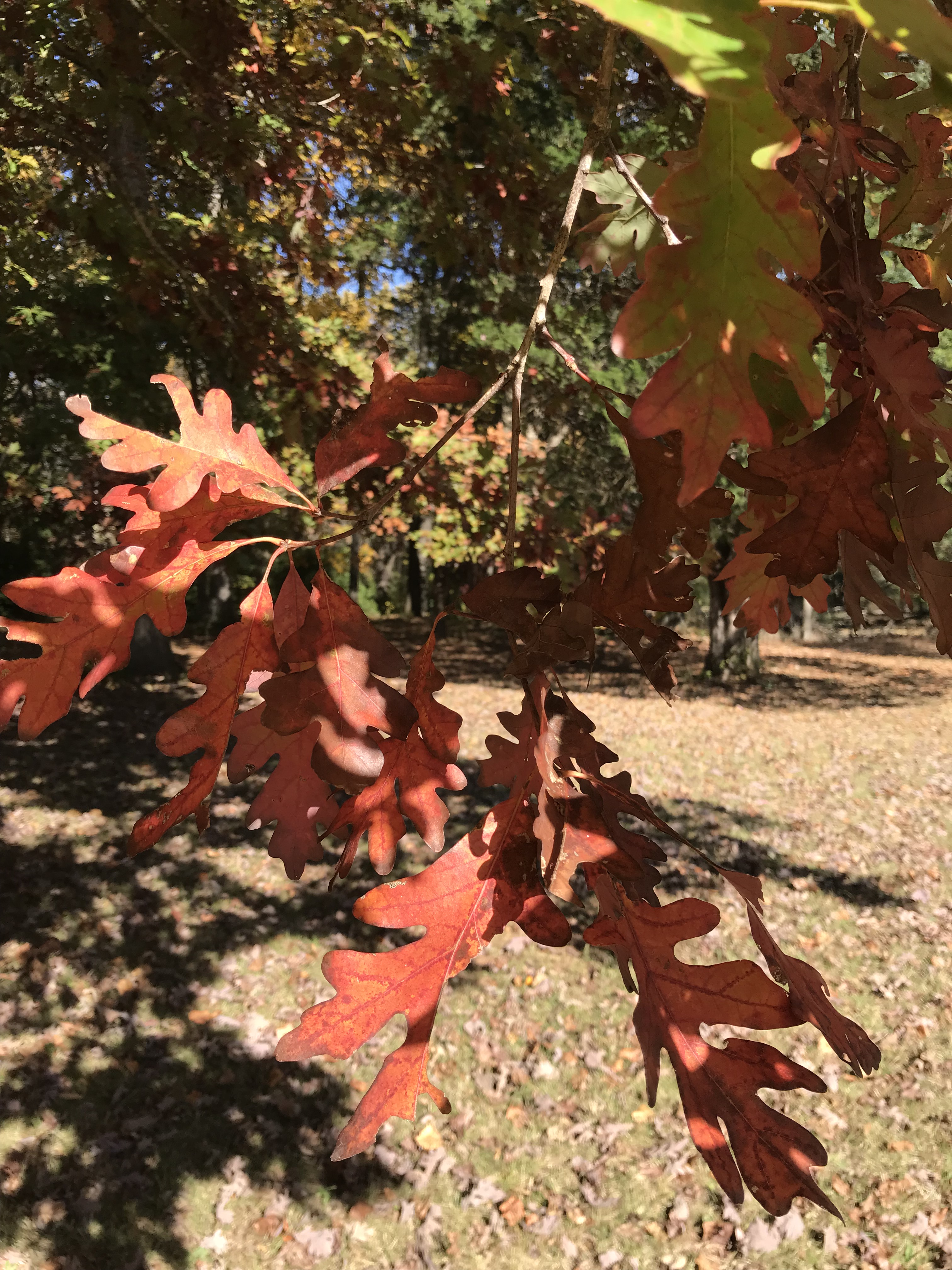
Oak Leaves
Sweet Gum Tree Leaves trying to decide whether to turn red or yellow
Dealing with the leaves in the fall after the red, yellows, golds, and oranges have faded and the spent leaves have dropped to the ground is quite a chore. I tend to dread autumn because of the multitude of leaves that must be raked, blown, carried off, or mulched with the tractor, but this year I’ve chosen to enjoy the riot of color in our yard every day. It won’t last much longer.
This tree is pretty, but I don’t know what it is! Can anyone help me?
When not outside, I worked on my novel. I’m putting into practice some of the things I recently learned in the online writing course I’ve mentioned in earlier blog posts. It feels good to be revising, editing, and improving my novel.
My reading was haphazard in May, to say the least. I read
snippets of several books here and there. I read three books, listened to one
book, and read 35% of another one before it had to go back to the public
library. I’m having some issues with my computer, but here goes.
The First Conspiracy: The Secret Plot to Kill George Washington, by Brad Meltzer and Josh Mensch
The First Conspiracy: The Secret Plot to Kill George Washington, by Brad Meltzer and Josh Mensch
I love
learning things, and it’s amazing how much I don’t know at my age. One thing I
learned from this book seems so basic I’m embarrassed to admit I didn’t know
it. In my history studies I didn’t learn that the Continental Congress created
the Continental Army in 1775. In my mind, I assumed the Continental Army was
formed after the signing of the Declaration of Independence in 1776.
The First Conspiracy: The Secret Plot to Kill George Washington, by Brad Meltzer and Josh Mensch is
almost a day-by-day telling of American Revolutionary history with focus on the
little known facts of the things that happened in the shadows – behind the
scenes. I minored in history in college, but I didn’t know about the conspiracy
to kill George Washington as Commander of the Continental Army.
Most of what I knew about William Tryon was how he robbed the citizens of North Carolina blind to build “Tryon Palace” in New Bern, North Carolina while he served as the colony’s governor. I knew he left that position to take the more lucrative office of governor of the New York colony.
One thing I
learned from The First Conspiracy was
how Tryon was ruthless in his dealings with the rebels in New York and how he
continued on that mission even after taking refuge in a British ship in New
York Harbor.
An amusing
part of the book was the description of the arrest and questioning of the four
men who had decided to print paper currency in secret for the colonies. They
hadn’t agreed on an alibi, so each one had a different explanation than the
others and, of course, one denied having any knowledge of the printing press in
the attic.
I’d read
about 70% of the book before it had to be returned to the public library
because another patron was waiting for it. I’ll check in out again later in
order to read the rest of the story.
The Waxhaws, by Louise Pettus, assisted by Nancy Crockett
The Waxhaws, by Louise Pettus with Nancy Crockett
I wish I’d known in 1983 to purchase a copy of this book
when it was published. Now, if you can find a copy to buy, it will likely cost
you more than $150. I was delighted to find a circulating library copy in May,
and I devoured the content.
This book, more than anything else I’ve read, helped me get
a feel for life in The Waxhaws just south of the North Carolina-South Carolina
border in colonial times. I hope I’m able to communicate that sense of place
and time in my historical novel, The
Doubloon, which primarily takes place in that Carolina backcountry
settlement in 1769-70.
Anyone interested in day-to-day life in colonial America
owes Louise Pettus and Nancy Crockett a debt of gratitude for all the South
Carolina history they preserved and shared with each other and their readers.
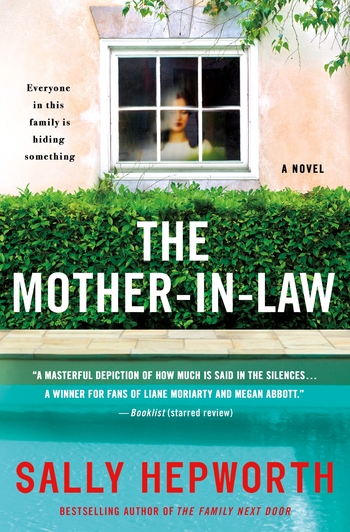
The Mother-in-Law, by Sally Hepworth
The Mother-in-Law, by Sally Hepworth
I’ve become
a fan of Sally Hepworth’s novels, so I got on the wait list for her latest book
as soon as it showed up on the “on order” list on the public library’s online
catalog. I’ve read all her novels except The
Secrets of Midwives.
This novel
will keep you guessing “who dunnit.” Everyone seems to have issues with the
mother-in-law. Her daughter-in-law tells this story. She has issues with her
mother-in-law. So does her husband, his sister, his sister’s husband. It seems
like most people who come in contact with the mother-in-law have a hard time
dealing with her quirks and aloofness.
There is a
totally different side the mother-in-law shows the people she helps through her
volunteerism, though. It’s difficult for her family members to understand this
part of her life because it seems out-of-character.
As the
reader begins to learn the mother-in-law’s backstory, he or she will understand
what made her the way she is or was. She’s found dead in her home. Who killed
her? You might be surprised.
The Personal
Philosophies of Remarkable Men and Women, edited by Jay Allison and Dan Gediman
in association with NPR (National Public Radio)
I listened to this book. It contains “This I Believe” essays
written by people from all walks of life. Some are or were famous, others I had
not heard of. Among those whose essays are in this current audio collection are
Helen Keller, John McCain, Oscar Hammerstein II, William O. Douglas, Albert
Einstein, Leonard Bernstein, Martha Graham, John Updike, Carl Sandburg, Jackie
Robinson, Eleanor Roosevelt, Gloria Steinem, Colin Powell, Helen Hays, and Bill
Gates.
The Afterword by Dan Gediman gives the history of This I
Believe. The original book contained 100 essays and was done by legendary
journalist Edward R. Murrow. The first of the essays was broadcast on radio on
Easter Sunday in 1949.
In a nutshell, the This I Believe essays are supposed to be
about “the guiding beliefs by which they live their lives.” They are short,
being about five minutes long.
One of the goals of the This I Believe organization is “to
facilitate a higher standard of public discourse.”
If you wish to know more about this international
organization, visit
Stony the Road:
Reconstruction, White Supremacy, and the Rise of Jim Crow, by Henry Louis Gates, Jr.
Stony the Road: Reconstruction, White Supremacy, and The Rise of Jim Crow, by Henry Louis Gates, Jr.
I learned a lot from this book. I knew I would. Henry Louis
Gates, Jr. is an icon when it comes to history. I only had time to read the
first two chapters of Stony the Road:
Reconstruction, White Supremacy, and the Rise of Jim Crow, before it
disappeared from my Kindle and went back to the public library. (Don’t worry. I
immediately got back on the wait list for it so I can continue reading it.)
Look for my blog post next Monday about the important lesson
I learned as a writer while reading Stony
the Road. It wasn’t a lack of interest that caused me to read only two
chapters. It was a case of “too many books, so little time” and the fact that I
dedicated most of my time to writing instead of reading in May.
Since my last blog
post
Since last Monday’s blog post, we jumped right over spring
and went into summer. Last week it was 95 degrees on five days and 94 on the
other two. According to the calendar, summer begins in three weeks. We have
gone from too much rain to no rain in about three weeks. I’d rather have heat
and drought than flooding or tornadoes like they’re having in the central part
of the US, so I’m not complaining.
I got some good feedback about last Monday’s blog post.
Thank you, Jules Horne and all the others who took the time to comment on here
and on my Facebook pages.
Until my next blog
post
A couple of weeks ago I read that a blogger should use
second person point-of-view instead of first person. There are too many rules. I’ll
try to do better in the future.
If you’re a writer, I hope you have quality writing time and your projects
are moving right along.
Thank you for reading my blog. You could have spent the last few minutes
doing something else, but you chose to read my blog.
Let’s continue the
conversation
Have you read any of these books? If so, please share your
thoughts below. What are you reading?







 Janet's Writing Blog