
Today’s blog post is in honor and memory of all those brave soldiers who stormed the beaches of Normandy on June 6, 1944 — 82 years ago today. I knew one of them – Mr. Ira Lee Taylor of Harrisburg, North Carolina, and was privileged to interview him in 2007 about his World War II experiences while I was writing a local history column for Harrisburg Horizons newspaper. He was 93 years old.
I offer the following essay that I wrote in memory of Mr. Taylor:
“Memories of World War II”
His 93-year-old blue eyes were clear as his mind was sharp, though his back was bent and he relied on a walker to navigate inside his home. When I called and asked if I could interview him about his memories of World War II, he agreed without hesitation.
Born after the war, I was embarrassed by my ignorance of its details. It seemed that every year in school we started by studying Plymouth Rock and by the end of the year scarcely managed to get to Appomattox.
With pen in hand, I knocked on Mr. Taylor’s door. The only question I had in mind to ask him was, “What did you do in the war?” That question was enough for Mr. Taylor. Over the next several visits, he recounted in amazing chronological order the places he was sent and the things he saw, heard, smelled, tasted, and felt that forever changed his life. There was a reverence in his voice. We were treading on hallowed ground.
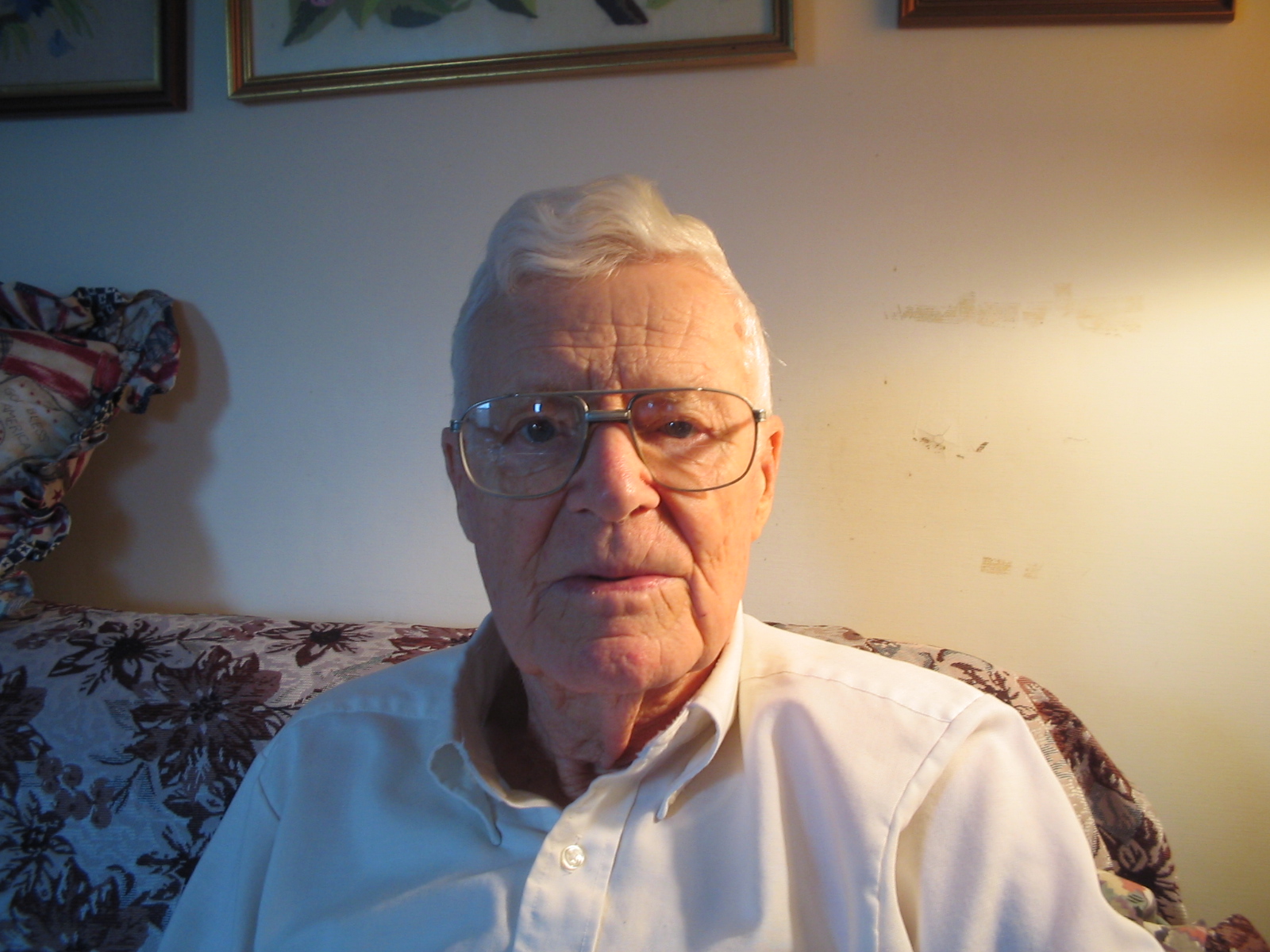
Training for the war was thrilling and boring for a young man from a piedmont North Carolina community of fewer than 300 people. Although he had gone off to “State College” (now, North Carolina State University at Raleigh) and earned a degree in forestry, there was a naiveté about this army draftee that followed him through the battlefields of France, Belgium, and Germany. As he regaled me with his memories of the war, I sensed that many other recruits were as “wet behind the ears” as was Mr. Taylor. They shared a heavy responsibility and had in common the mindset, “You do what you have to do.” No self-pity in that generation!
It took 11 harrowing days for Mr. Taylor’s ship to cross the Atlantic along with other troop and liberty ships. German torpedoes picked off liberty ships on the perimeter of the convoy of more than 100 ships that transported and accompanied the U.S. Army 4th Division to England. The rough ocean made some men so seasick that they said if they survived the war they were going to stay in Europe.
Mr. Taylor recalled the training he got in England for the invasion of Normandy. He just didn’t know that was what he and thousands of others were being prepared for or when their skills would be put to the test. They were ordered to waterproof the trucks in the motor pool by packing something like Play-Doh around the sparkplugs and rigging up elbow pipes to the tailpipes that could carry exhaust up higher than the roof of the trucks in case the trucks were in deep water.
It was a time of “loose lips sink ships” and even journalists understood the necessity for complete secrecy of military plans and troop movements. The soldiers didn’t know much of what was going on in the war, but it wasn’t their business to know. It was their business to train, be ready, look out for one another, and follow orders.
The night before the scheduled invasion, the men of the 4th Division were briefed. They were told that they would make the landing on Normandy and it was expected that 80 percent of them would be killed in the process. They got halfway across the English Channel when a huge storm forced them to return to Plymouth, England.
Twenty-four hours later, Mr. Taylor was on one of the 499 vessels that took part in the invasion. Utah Beach was the code name of the speck of sand on the coast of France where he began his trek across continental Europe. “The beach was filled with black smoke, dust, dirt, and the smell of gunpowder. Boy, it smelled awful!” he said.
Another thing he mentioned that is not learned by reading a history book or watching a movie is the terrible smell of the fatigues the soldiers had to wear for the invasion and for the next several days. The fatigues were impregnated with chemicals to protect the soldiers in case they were gassed.
As Mr. Taylor’s narrative progressed through the war, he spoke of the ground quivering from the concussion of exploding bombs, booby-trapped bodies of American soldiers, countless nearly-impenetrable hedgerows, the French Resistance, foxholes, rumbling tanks, waves of blooming red poppies on Flanders Field, being surrounded at Bastogne in Belgium, The Battle for Huertgen Forest where the pine and fir trees in that beautiful forest were shirred off into matchsticks, shoe mines that would blow your foot off, the snow and cold of the Battle of the Bulge, Gen. Dwight D. Eisenhower walking up one day and talking to him like he was just another G.I., seeing the snow-capped Alps, and seeing lots of sights he had tried to forget.
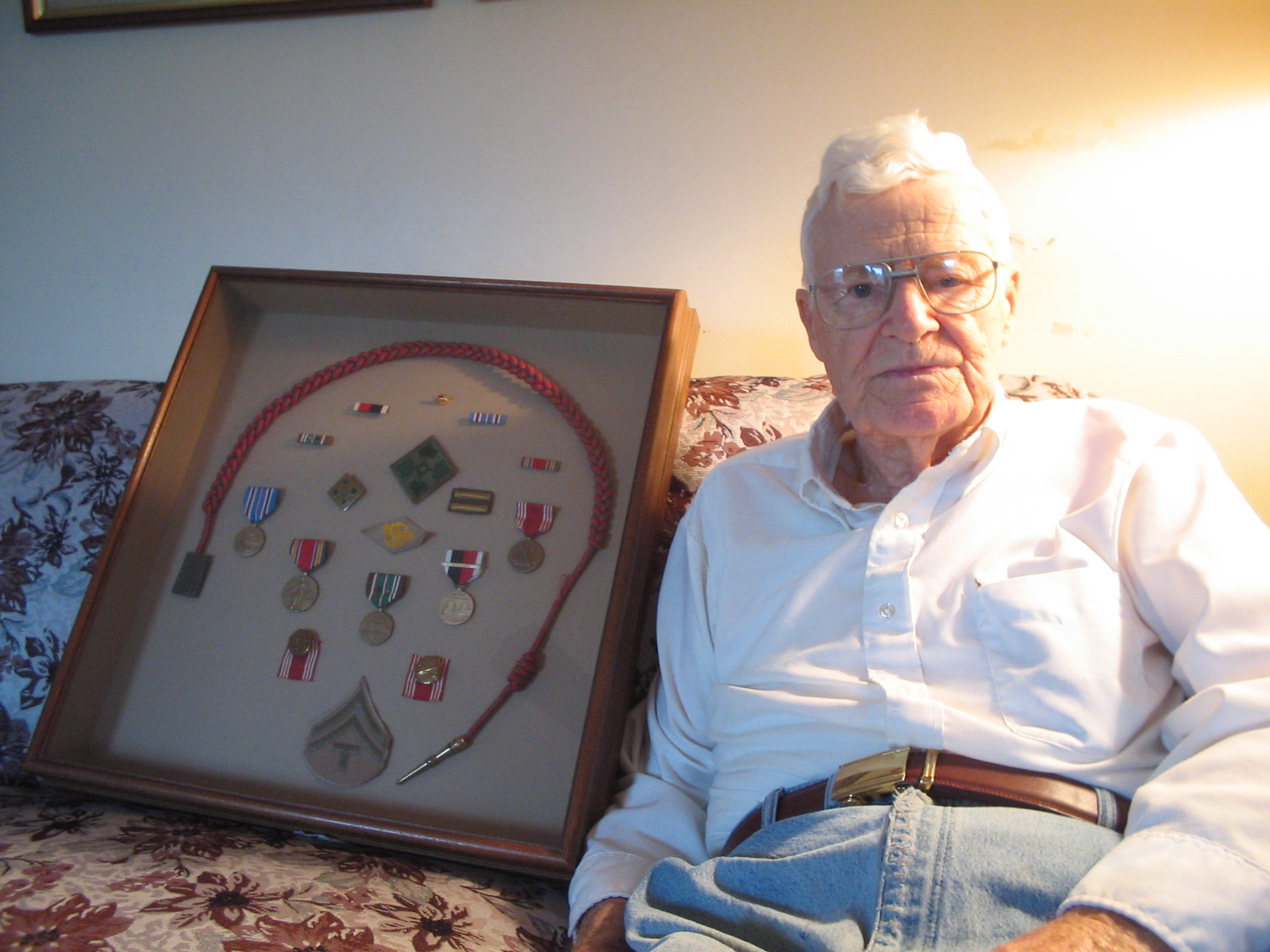
After a seven-day calm voyage back to the States during which the troops were treated to wonderful food and entertainment and sightings of whales and their waterspouts, the ship Mr. Taylor was on entered New York Harbor. Everyone rushed to one side of the ship to see the Statue of Liberty, but the ship started listing so badly that they were ordered to redistribute themselves on the deck.
Rewarded with a 30-day furlough, Mr. Taylor returned home to North Carolina where he got married and then boarded a bus bound for Camp Butner to be trained for the invasion of Japan. One of the men on the bus had a transistor radio over which came the announcement that Japan had surrendered and the war was over. That’s how close Mr. Taylor came to being shipped to Japan after what he had lived through in Europe.
The 4th Division suffered the third highest number of casualties of any United State military Division (22,600) in World War II. Mr. Taylor considered himself very fortunate to have come home alive. He delivered mail to my house for 32 years until he retired in 1980. It was only in 2007 that I learned that he had taken part in the largest military invasion in history.
If you want to read the whole story and other things I learned while writing the “Harrisburg, Did You Know?” local history column for Harrisburg Horizons newspaper, look for my books, Harrisburg, Did You Know? Cabarrus History, Book 1 and Book 2 on Amazon and at Second Look Books in Harrisburg, North Carolina.

Janet
All history is local, but no history is just local.





 Janet's Writing Blog