Memories of a World War II D-Day Veteran

Today’s blog post is in honor and memory of all those brave soldiers who stormed the beaches of Normandy on June 6, 1944 — 82 years ago today. I knew one of them – Mr. Ira Lee Taylor of Harrisburg, North Carolina, and was privileged to interview him in 2007 about his World War II experiences while I was writing a local history column for Harrisburg Horizons newspaper. He was 93 years old.

I offer the following essay that I wrote in memory of Mr. Taylor:

“Memories of World War II”

          His 93-year-old blue eyes were clear as his mind was sharp, though his back was bent and he relied on a walker to navigate inside his home. When I called and asked if I could interview him about his memories of World War II, he agreed without hesitation.

          Born after the war, I was embarrassed by my ignorance of its details. It seemed that every year in school we started by studying Plymouth Rock and by the end of the year scarcely managed to get to Appomattox.

          With pen in hand, I knocked on Mr. Taylor’s door. The only question I had in mind to ask him was, “What did you do in the war?” That question was enough for Mr. Taylor. Over the next several visits, he recounted in amazing chronological order the places he was sent and the things he saw, heard, smelled, tasted, and felt that forever changed his life. There was a reverence in his voice. We were treading on hallowed ground.
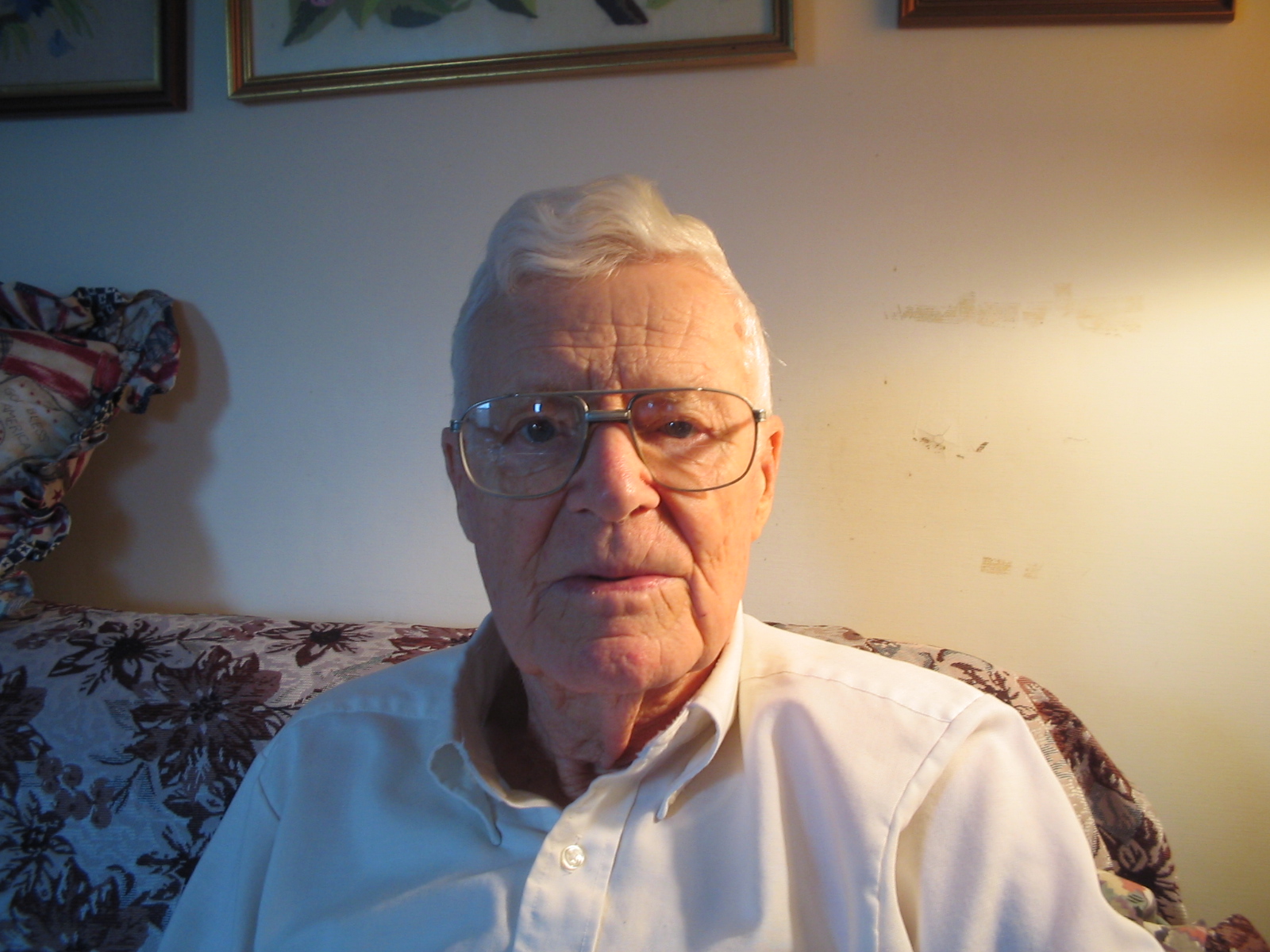
World War II Veteran and Harrisburg Mail Carrier, Ira Lee Taylor

          Training for the war was thrilling and boring for a young man from a piedmont North Carolina community of fewer than 300 people. Although he had gone off to “State College” (now, North Carolina State University at Raleigh) and earned a degree in forestry, there was a naiveté about this army draftee that followed him through the battlefields of France, Belgium, and Germany. As he regaled me with his memories of the war, I sensed that many other recruits were as “wet behind the ears” as was Mr. Taylor. They shared a heavy responsibility and had in common the mindset, “You do what you have to do.” No self-pity in that generation!

          It took 11 harrowing days for Mr. Taylor’s ship to cross the Atlantic along with other troop and liberty ships. German torpedoes picked off liberty ships on the perimeter of the convoy of more than 100 ships that transported and accompanied the U.S. Army 4th Division to England. The rough ocean made some men so seasick that they said if they survived the war they were going to stay in Europe.

          Mr. Taylor recalled the training he got in England for the invasion of Normandy. He just didn’t know that was what he and thousands of others were being prepared for or when their skills would be put to the test. They were ordered to waterproof the trucks in the motor pool by packing something like Play-Doh around the sparkplugs and rigging up elbow pipes to the tailpipes that could carry exhaust up higher than the roof of the trucks in case the trucks were in deep water.

          It was a time of “loose lips sink ships” and even journalists understood the necessity for complete secrecy of military plans and troop movements. The soldiers didn’t know much of what was going on in the war, but it wasn’t their business to know. It was their business to train, be ready, look out for one another, and follow orders.

          The night before the scheduled invasion, the men of the 4th Division were briefed. They were told that they would make the landing on Normandy and it was expected that 80 percent of them would be killed in the process. They got halfway across the English Channel when a huge storm forced them to return to Plymouth, England.

          Twenty-four hours later, Mr. Taylor was on one of the 499 vessels that took part in the invasion. Utah Beach was the code name of the speck of sand on the coast of France where he began his trek across continental Europe. “The beach was filled with black smoke, dust, dirt, and the smell of gunpowder. Boy, it smelled awful!” he said.

          Another thing he mentioned that is not learned by reading a history book or watching a movie is the terrible smell of the fatigues the soldiers had to wear for the invasion and for the next several days. The fatigues were impregnated with chemicals to protect the soldiers in case they were gassed.

          As Mr. Taylor’s narrative progressed through the war, he spoke of the ground quivering from the concussion of exploding bombs, booby-trapped bodies of American soldiers, countless nearly-impenetrable hedgerows, the French Resistance, foxholes, rumbling tanks, waves of blooming red poppies on Flanders  Field, being surrounded at Bastogne in Belgium, The Battle for Huertgen Forest where the pine and fir trees in that beautiful forest were shirred off into matchsticks, shoe mines that would blow your foot off, the snow and cold of the Battle of the Bulge, Gen. Dwight D. Eisenhower walking up one day and talking to him like he was just another G.I., seeing the snow-capped Alps, and seeing lots of sights he had tried to forget.
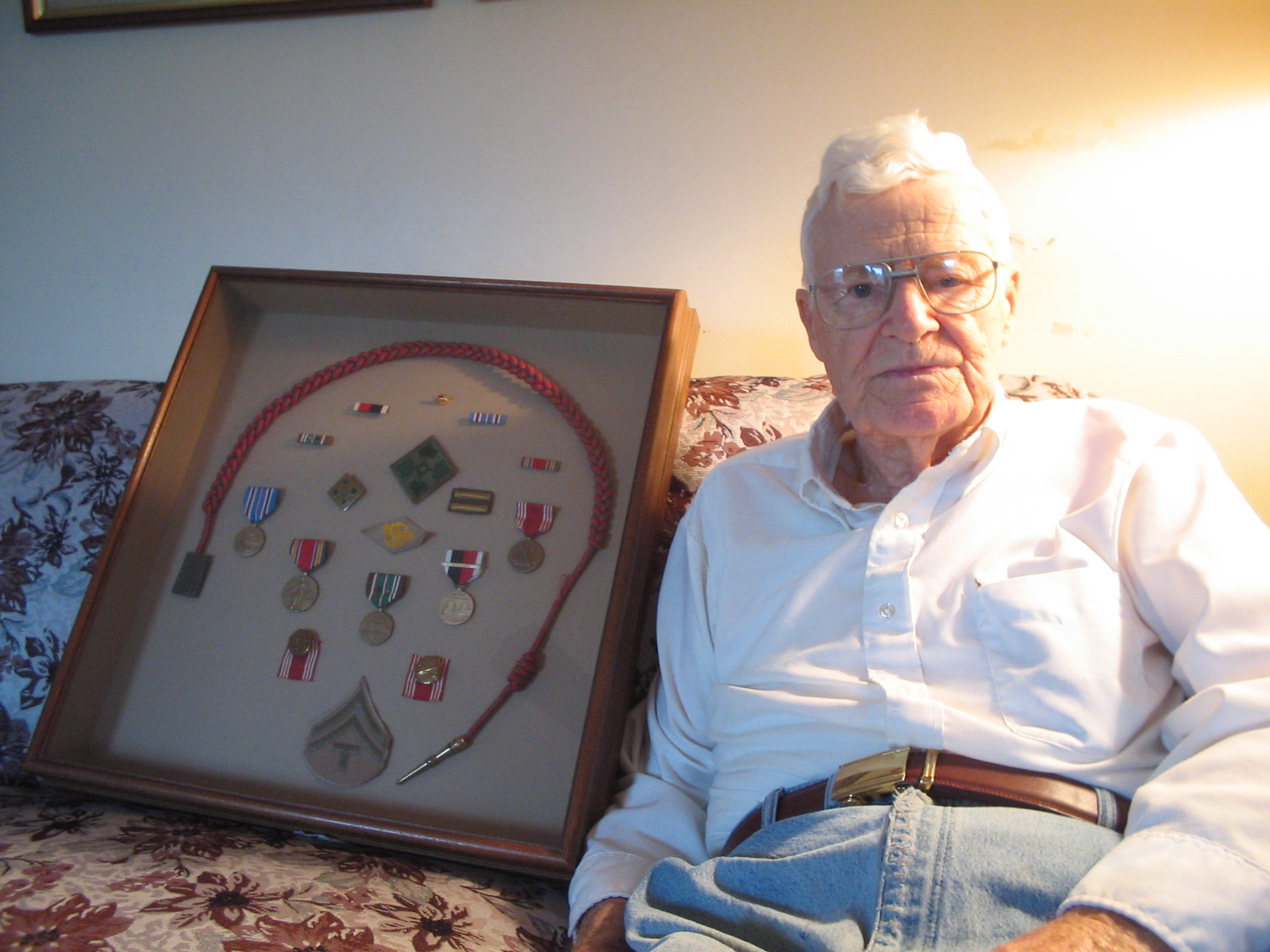
Mr. Ira Lee Taylor of Harrisburg, North Carolina, with his framed military service medals

          After a seven-day calm voyage back to the States during which the troops were treated to wonderful food and entertainment and sightings of whales and their waterspouts, the ship Mr. Taylor was on entered New York Harbor. Everyone rushed to one side of the ship to see the Statue of Liberty, but the ship started listing so badly that they were ordered to redistribute themselves on the deck.

          Rewarded with a 30-day furlough, Mr. Taylor returned home to North Carolina where he got married and then boarded a bus bound for Camp Butner to be trained for the invasion of Japan. One of the men on the bus had a transistor radio over which came the announcement that Japan had surrendered and the war was over. That’s how close Mr. Taylor came to being shipped to Japan after what he had lived through in Europe.

          The 4th Division suffered the third highest number of casualties of any United State military Division (22,600) in World War II. Mr. Taylor considered himself very fortunate to have come home alive. He delivered mail to my house for 32 years until he retired in 1980. It was only in 2007 that I learned that he had taken part in the largest military invasion in history.

If you want to read the whole story and other things I learned while writing the “Harrisburg, Did You Know?” local history column for Harrisburg Horizons newspaper, look for my books, Harrisburg, Did You Know? Cabarrus History, Book 1 and Book 2 on Amazon and at Second Look Books in Harrisburg, North Carolina.

Janet

All history is local, but no history is just local.

Remembering a Veteran of D-Day

Mr. Ira Lee Taylor of Harrisburg, North Carolina, was an unassuming man. I grew up knowing him as my mailman and the father of a friend at school. It wasn’t until 2006, when I started writing a local history column for Harrisburg Horizons newspaper that I learned from another local World War II U.S. Army veteran that Mr. Taylor took part in the invasion of Normandy on D-Day.

That invasion took place 81 years ago today. Very few veterans are still here to tell their stories. Interviewing Mr. Taylor a number of times in the six years I wrote for the newspaper was one of the privileges of my life.

Instead of June 6, 1944, only being a date in a history book, it became a day of incredible heroism and sacrifice as I heard Mr. Taylor’s vivid memories of that day, the training in preparation for it, and the other battles he was in throughout the war in Europe.

Mr. Taylor served in the U.S. Army’s 4th Division. The entire 4th Division left New York City on four ships on January 19, 1944. About passing the Statue of Liberty, he said, “That was a beautiful thing. We said, ‘We don’t know whether we’ll ever see you again or not.’” Many of them never did.

More than one hundred other ships joined the 4th Division over the next three days. The Liberty Ships were carrying ammunition, food, and other supplies. He said the ships would scatter during the day, but at night they would close in almost touching each other. It took eleven days for them to cross the Atlantic and arrive in Liverpool, England.

They were transported by train from there to Devonshire, England, where they trained for the invasion of Normandy which was occupied and heavily fortified by the Germans.

He talked about how they meticulously prepared their trucks and other equipment so they would be sea worthy. They practiced loading everything up and going to the port of Plymouth. From there, they would sail down the English Channel to a place that was set up to look like “Utah Beach” in Normandy where they would train for the invasion.

Each time they set out, they didn’t know whether it was the real thing or another practice run. Of course, they did not know exactly what they were training for.

After months of planning and incredible secrecy, the invasion was scheduled for June 5, 1944. General Dwight D. Eisenhower knew he had a small window of opportunity before the moon would begin to wane.

No, June 5 is not a typo. That was set as the day for the invasion. The night before, Mr. Taylor said the troops were briefed. They were told, “The 4th Division will make the landing on D-Day. We’re sacrificing the 4th Division to make that landing. We anticipate eighty percent casualties. You’ll pass two islands in the Channel on the way – one’s Guernsey and the other one’s Jersey. You might hear some shooting and all, but don’t worry about it. That doesn’t concern you at all. Two other outfits are taking care of that.”

“The morning of June 5, the gate was locked with an MP guarding it. They wouldn’t let us out, and the boys started singing, ‘Don’t Fence Me In,’” Mr. Taylor said with a chuckle. But then the mood turned somber and they knew this was it.

Mr. Taylor’s outfit set out late on the evening of June 4. They got halfway across the English Channel and a huge storm came up. General Eisenhower was forced to call off the mission, but the invasion had to take place no later than June 6.

So Mr. Taylor’s outfit loaded up again on the night of June 5 before dark. He was on one of 499 ships that took part in the invasion.

Patton’s 3rd Division, the 90th Division, and the 4th Division were all lined up, but the 4th went out first because it was to hit the beach in the first wave.

If you’ve seen the movie, “Saving Private Ryan” or some war documentaries, you might have an inkling of an idea what the invasion was like, but I don’t think any of us can really grasp the horror of it. One thing a film doesn’t give you is the smell, but Mr. Taylor talked about the smell.

He talked about how special troops sneaked onto the Normandy coast before daybreak on June 6 and disarmed many of the mines on the beaches, right under the noses of the German soldiers. At the same time, glider troops were silently landing inland carrying tanks and infantrymen. The 82nd and 101st Airborne dropped ten miles inland, behind enemy lines.

Mr. Taylor talked about the four hundred light and heavy bombers that flew over them until six o’clock in the morning.

The 4th Division missed its target by about a mile, but started landing on Utah Beach at 6:30 a.m. on June 6, 1944.

Mr. Taylor talked about the mines and the iron crosses all over the beach as the Germans anticipated an invasion, the 50-caliber machine guns, the wounded soldiers being taken back to the Landing Ship, Tank (LST) he was on. It carried twenty tanks and 200 troops and doubled as a hospital.

Mr. Taylor was in many battles, including the Battle of the Bulge and the Battle of Huertgen Forest. He had majored in Forestry at North Carolina State University at Raleigh, so he had a particular appreciation for the Huertgen Forest of fir and pine trees, but it was there that the 4th Division lost half of its men and the forest was shattered in the fighting.

Photo of Mr. Ira Lee Taylor with his World War II medals in a frame on February 24, 2007.
Mr. Ira Lee Taylor with his World War II medals, February 24, 2007.

Needless to say, Mr. Taylor felt fortunate to survive the war. He came home, married his sweetheart, and got a job at the post office. Somehow, he put the horrors he had witnessed behind him, but in his later years he wanted to share his story. And I’m a better person for having interviewed him.

If you are interested in reading all of Mr. Taylor’s stories, my five-part newspaper series can be found in Harrisburg, Did You Know? Cabarrus History, Book 1, which is available in paperback at Second Look Books in Harrisburg and in paperback and e-book from Amazon (https://www.amazon.com/Harrisburg-Did-You-Know-Cabarrus-ebook/dp/B0BNK84LK1/). That book contains the first 91 articles I wrote for the newspaper.


Until my next blog post

Take some time today to think about the men who took part in the D-Day invasion. We owe them a debt of gratitude that we can never repay.

Janet

Meet & Greet at Second Look Books, April 15th

What?        Author Meet & Greet

Where?      Second Look Books, 4519 School House Commons in Harrisburg

When?       Saturday, April 15, 2023

What Time?         2:00 – 4:00 p.m.

Second Look Books, 4519 School House Commons, Harrisburg, NC

Copies of Harrisburg, Did You Know? Cabarrus History, Book 1 and Book 2 have arrived and been autographed.

Photocopies of my 11×14-inch “Harrisburg in the 1900s” two-map sets have been made.

Business cards and bookmarks are printed.

Saturday, April 15 is the big day for my Meet & Greet at Second Look Books in Harrisburg, North Carolina! I’ll be there from 2:00 p.m. until 4:00 p.m.

Please drop by, even if you’ve already purchased both books.

The bookmarks and Harrisburg maps are free while supplies last.

What maps?

I drew the maps based on detailed memories that Mr. Ira Lee Taylor shared with me while I was writing the “Did You Know? local history column for Harrisburg Horizons newspaper (2006-2012.)

One map covers from along NC-49 to Back Creek. The other map covers from Back Creek to Reedy Creek and where McKee Creek flows into Reedy Creek.

Mr. Taylor told me where such things as the telephone switchboard, spoke factory, two cotton gins, railroad houses, corn fields, cotton fields, and livery stable were in the early 1900s.

He told me where the various stores and post offices were. Being the town’s only mail carrier for several decades, he knew where everybody lived, so I included much of that information The map show where the roads were (and were not) before the coming of the high-speed rail.

In case you arrived in Harrisburg after the two-story red brick old Harrisburg School was torn down, this set of maps will show you the layout of the school grounds. The school property is where School House Commons Shopping Center is now.

The maps also show the locations of the Oak Grove Rosenwald School and the Bellefonte Rosenwald School that you read about in Harrisburg, Did You Know? Cabarrus History, Book 1.

Some things you’ll learn about in my two books

There are stories of local heroism from 1771 and the detailed memories of a World War II US Army veteran who told me about his training for D-Day through to the end of the war.

There are stories about the original Hickory Ridge School, which was a one-room school on Hickory Ridge Road.

There are stories about the Rosenwald Schools that served the black students in the early 1900s.

There are stories about the man from Russia (actually, Ukraine) who settled in Harrisburg in the 1920s to practice medicine until his death in 1960. He was a country doctor who made house calls

There are stories about the construction of the Charlotte Motor Speedway and the first World 600 Race when the track was in such bad shape that chunks of asphalt broke the windshields out of some of the race cars.

There is information about the 22-mile syenite ring-dike that Harrisburg sits in. It’s what remains of an ancient volcano.

Until my next blog post

Remember the people of Ukraine – where Dr. Nicholas E. Lubchenko was born and lived until young adulthood.

I hope to see you on Saturday!

In case you don’t have a good book to read, please consider purchasing my local history books. They’re available in paperback at Second Look Books. They’re also available in paperback and for Kindle from Amazon.

Even if you don’t live or have never lived in Harrisburg, North Carolina, I think you’ll find some interesting stories that you can probably relate to if you are of a certain age. And if you a child, teen, or young adult I think you’ll find it interesting to read about how life used to be in our sleepy little farm village of a couple hundred people in the early 1900s that has grown to nearly 20,000 people in 2023.

What?        Author Meet & Greet

Where?      Second Look Books, 4519 School House Commons in Harrisburg

When?       Saturday, April 15, 2023

What Time?         2:00 – 4:00 p.m.

I hope to see you there!

Janet