
Every year on May 20 or sometime that week I blog about the Mecklenburg Declaration of Independence. It was signed on May 20, 1775 – a full year before the national declaration.
Unfortunately, the original copy was lost when John McKnitt Alexander’s house burned. The writers and signers got together after the fire and reconstructed the document from memory.
Since the original copy was lost, there are naysayers today. I don’t know what their motives are, but they insist on seeing the original in order to believe it existed. A newspaper account in the Raleigh Register on April 30, 1819 does not suffice as proof for them.
There has never been any love lost between Raleigh – the State Capital – and Charlotte (in Mecklenburg County), so I find it surprising that a Raleigh newspaper ever acknowledged the document. For a newspaper in Raleigh – of all places – to do so only indicates to me a level of certification.
May 20, 1775 was added to the North Carolina state flag in 1861, so there must have been a high degree of belief that the document was real. Again, with the historical seat of power in North Carolina being in the eastern part of the state, the legislators would not have been quick to given Mecklenburg County any credit on the state flag.
Here is the wording of the Mecklenburg Declaration of Independence, as it was recreated after being lost in a fire, and as it is found in The Hornet’s Nest: The Story of Charlotte and Mecklenburg County, by LeGette Blythe and Charles Raven Brockmann, published in 1961:
- That whosoever directly or indirectly abetted or in any way, form or manner countenanced the unchartered & dangerous invasion of our rights as claimed by G. Britain is an enemy to this County – to America & to the inherent & inaliable rights of man.
- We the Citizens of Mecklenburg County do hereby desolve the political bands which have connected us to the Mother Country & hereby absolve ourselves from all allegiance to the British crown & abjure all political connection, contract or association with that nation who have wantonly trampled on our rights & liberties & inhumanely shed the innocent blood of American patriots at Lexington.
- We do hereby declare ourselves a free and independent people – are & of right ought to be a sovereign & self-governing association, under the control of no power other than that of our God & the general government of the congress, to the maintainence of which independence civil & religious we solemnly pledge to each other our mutual cooperation, our lives, our fortunes & our most sacred honor.
- As we now acknowledge the existence & control of no law or legal officers, civil or military, within this County, we do hereby ordain & adopt as a rule of life, all, each & every of our former laws – wherein nevertheless the crown of great Britain never can be considered as holding rights, privileges, immunities, or authority therein.
- It is also further decreed that all, each & every military officer in this County is hereby reinstated in his former command & authority, he acting conformably to these regulations. And that every member present of this delegation shall henceforth be a civil officer, viz, a Justice of the peace in the character of a “Committee-man” to issue process, hear & determine all matters of controversy according to sd. Adopted laws – to preserve peace, union & harmony in sd. County & to use every exertion to spread the love of country & fire of freedom throughout American until a more general & organized government be established in this province. A selection from the members present shall constitute a Committee of public safety for sd. County.
- That a copy of these resolutions be transmitted by express to the President of the Continental Congress assembled in Philadelphia, to be laid before that body.
Ephraim Brevard
Hezekiah J. Balch
John Phifer
James Harris
William Kennon
John Foard
Richard Barry
Henry Downs
Ezra Alexander
Charles Alexander
Zaccheus Wilson
Waightstill Avery
Benjamin Patton
Matthew McClure
Neil Morrison
Robert Irwin
John Flennegin
David Reese
William Graham
John Queary
Hezekiah Alexander
Adam Alexander
John Davidson
Richard Harris
Thomas Polk
Abraham Alexander
John McKnitt Alexander
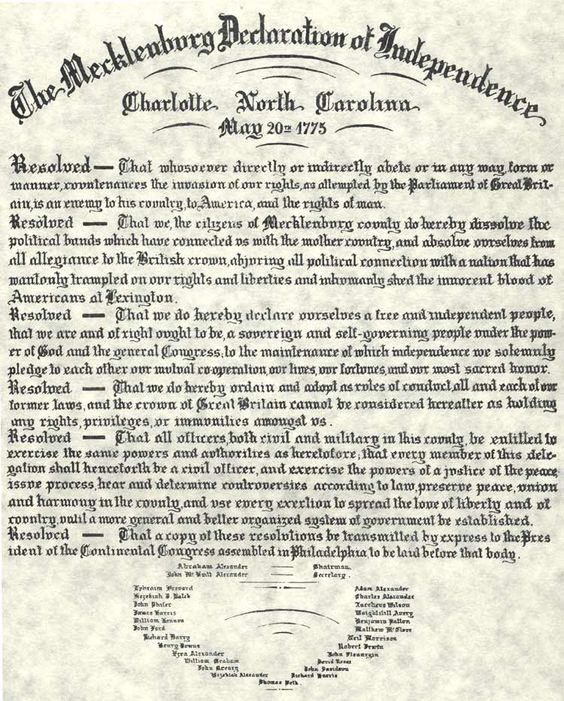
Mecklenburg Declaration of Independence
Captain James Jack rode horseback from Charlotte to Philadelphia to deliver a copy of the Mecklenburg Declaration of Independence and a copy of the May 31, 1775 Mecklenburg Resolves to the Second Continental Congress. It is disputed that he made it to Philadelphia with the Declaration, but he did get there with the Mecklenburg Resolves.
Archibald and Maggie Sellers McCurdy lived in the part of Mecklenburg County that became Cabarrus County in 1792. Mr. McCurdy stood on the steps of the Mecklenburg County courthouse in Charlotte on May 20, 1775 and heard the declaration read.
He came home and told his wife, Maggie, that they needed to make a list – perhaps written, perhaps mental – of all the people in the community that they could trust. The community was dominated by patriots, but they needed to evaluate which of their neighbors and associates could be trusted in the coming inevitable war for independence.
I wrote a story about the Mecklenburg Declaration of Independence and the McCurdy’s, “Whom Can We Trust?” and included it in my book, Traveling Through History: A Collection of Historical Short Stories.
My book is available in paperback and e-book on Amazon, and the paperback is available sometimes at Second Look Books in Harrisburg, NC.
Janet
All history is local, but no history is just local


