#OnThisDay: Trustees of Dartmouth College v. Woodward   

I see you’re scratching your head over the topic of my blog post today. I don’t blame you. Unless you are a graduate of Dartmouth, a resident of New Hampshire, or an expert on contract law, you’ve probably never heard of this U.S. Supreme Court case.

I was tempted to just brush it off and blog about a story in my new book, Traveling Through History: A Collection of Historical Short Stories, but then I remembered the significance of the case and why learning about it is important for us today.

I’ll give a brief version of the story, for that’s really all you probably want to know. If you want to know more, you can dive into it.

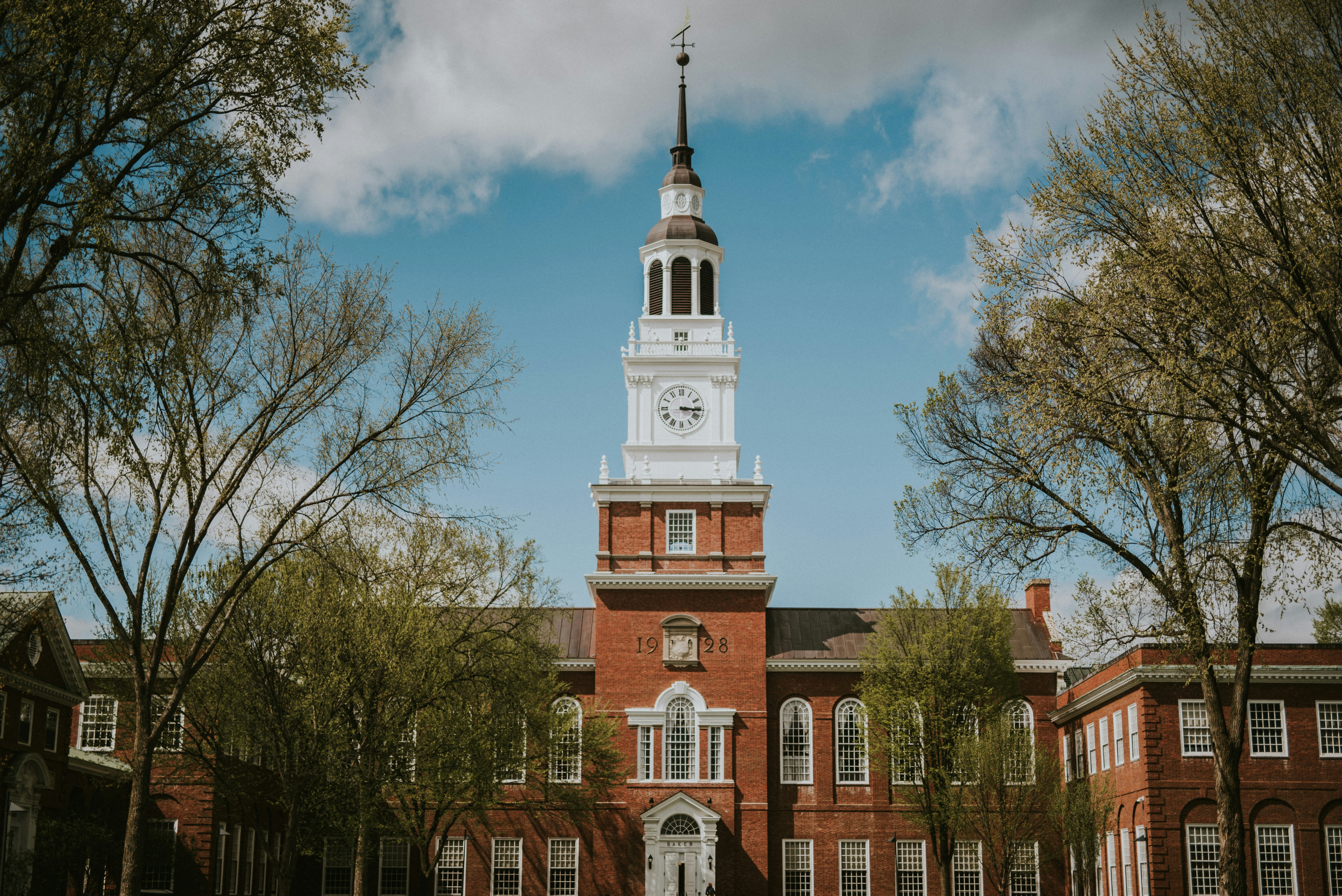
An iconic building at Dartmouth College. Photo by Ronni Kurtz on Unsplash.

In 1769, King George III of Great Britain issued a charter to Dartmouth College as a privately-funded school.

In 1816, the state legislature in New Hampshire decided to convert Dartmouth College into a state university. The legislators, as state legislators tend to do, thought they could just change Dartmouth’s charter by shifting control of the college to a board of trustees appointed by the governor. The school’s corporate seal, other corporate property, and record books were removed.

“Not so fast!” said the former trustees. Those earlier trustees filed a lawsuit against William H. Woodward, the secretary of the new board of trustees. They hired none other than Daniel Webster to represent them. He was a graduate of Dartmouth, but was yet to gain fame as a U.S. Senator and as the 14th and 19th U.S. Secretary of State.

It is reported that Mr. Webster made such an impassioned argument before the Supreme Court in Trustees of Dartmouth College v. Woodward that Chief Justice John Marshall was nearly moved to tears.

Webster was apparently extremely convincing, for the Court handed down its decision in favor of Dartmouth on February 2, 1819. The actions taken by the New Hampshire Legislature were invalidated, and Dartmouth returned to being a privately-funded institution of higher learning.

Photo by Markus Winkler on Unsplash

The Court’s decision was based on the sanctity of a contract. The Dartmouth College’s corporate charter qualified as a contract between the King and the school’s trustees, and the United States Constitution, Article 1, Section 10 prohibits a state from passing laws to impair a contract.

In case you’re wondering why I thought it apropos to blog about Dartmouth today…

Dartmouth’s administration refused to sign the agreement that U.S. Secretary of Education Linda McMahon sent to nine colleges and universities (Brown University, Dartmouth College, Massachusetts Institute of Technology, University of Arizona, University of Pennsylvania, University of Southern California, University of Texas at Austin, University of Virginia, and Vanderbilt University) on October 1, 2025.

In my October 15, 2025, blog post, Some good news from Massachusetts Institute of Technology!, I wrote about the agreement McMahon had put forth.

To refresh your memory, the agreement would dictate how the signing colleges and universities would change their admissions policies and the way faculty would be hired. As I stated in that blog post, “By signing the compact, the colleges and universities give up their right to make public a stance on societal or political events. They must be neutral, as in no opinion, no free thinking, no thoughts whatsoever. You know, sort of like operating in an authoritarian nation.

“They must also agree to define sex as ‘male’ and ‘female.’ They must do all this while they ensure there is ‘a broad spectrum of viewpoints’ on their campuses. I’m not sure how you can do that while meeting the other requirements. Some of the requirements appear to negate the others.

“In return for signing the compact, a college would receive preferential treatment for federal funding. It seems like a high price to pay.”

The ten-page agreement was called “Compact for Academic Excellence in Higher Education,” which strikes me as a misnomer.

The President of the Massachusetts Institute of Technology (MIT) was the first to refuse to sign the agreement, so that’s what I wrote about in that October 15 blog post.

Two days later, Dartmouth College and the University of Virginia joined MIT in rejecting the agreement.

Being from North Carolina, I don’t know a lot about Dartmouth, but Trustees of Dartmouth College v. Woodward and the Dartmouth administrators’ October 2025 refusal to cave in to the blackmail deal offered by the Trump Administration tell me all I need to know.

Hurrah for college and university administrators with morals and courage to stand up to bullies!

Hurricane Helene Recovery Update

I haven’t given a Hurricane Helene recovery update since January 8, so I will do so today. The rest of the nation may have forgotten about Hurricane Helene, but North Carolinians have not forgotten.

Portions of the Blue Ridge Parkway have not reopened since Hurricane Helene damage in September 2024. I-40 at the North Carolina-Tennessee border remains just one lane in each direction with a 35 mile-per-hour speed limit.

I was unable to find a detailed report from the North Carolina Department of Transportation about the roads still closed due to the hurricane. Friday’s report dealt with road closures due to ice and snow.

Governor Josh Stein and North Carolina Attorney General Jeff Jackson continue to seek funding and reimbursement from the federal government, but the response lags behind the U.S. Government’s response to earlier national disasters. It is a sign of the times.

Repair work continues on the Lake Lure dam on the Broad River, and debris removal there also continues. It is hoped that the lake will be back to full pond and ready to reopen in May in time for the summer tourist season.

Local TV stations in Charlotte have hurricane recovery news items occasionally. They try to remind us that our lives in the piedmont went on after Helene, but our fellow citizens here and there in the mountains are still dealing with the loss of homes and businesses as well as transportation routes that were destroyed.

There was a news item from WLOS in Asheville last week celebrating the reopening of a Walgreen’s on Tunnel Road in Asheville. It was so heavily damaged by the flooding of the Swannanoa River during Helene that it closed for 16 months for a complete remodel. It reopened on January 22. The article noted that a U-Haul store had also reopened. That’s indicative of how long it has taken for life to return to normal in the mountains in North Carolina and Tennessee since the hurricane. Businesses – even national chain businesses – have struggled to rebuild. I have no idea how many small family-owned businesses will never recover.

Life has not returned to “normal” in portions of the mountains in North Carolina. I think the people are adjusting to a new normal. Hurricane Helene changed much of the landscape forever.

Janet

The government should be afraid of its citizens, not the other way around.

#OnThisDay: Olive Branch Petition, 1775

On July 8, 1775, the Second Continental Congress adopted the so-called Olive Branch Petition as sort of a last-ditch effort to avoid war with Great Britain. It was written by John Dickinson of Pennsylvania. He hoped against hope that America would not break with its mother country.

Photo by Shahan Khan on Unsplash

The petition’s words were couched in language meant to convince King George III that the colonies did not want to break away but that Britain’s actions had forced her “still faithful Colonists” to arm themselves in self-defense. It mentions the “distress” the very thought of such a break was causing the colonists.

The petition ended with, “That your Majesty may enjoy long and prosperous reign, and that your descendants may govern your Dominions with honour to themselves and happiness to their subjects, is our sincere prayer.”

Photo by Donovan Reeves on Unsplash

This was just a scant three months after American militiamen had fought British troops at Lexington and Concord, Massachusetts. Colonists’ beef was primarily with Parliament. There was still hope among same of them that King George surely wanted only the best for his subjects – even those across the Atlantic.

On September 8, 1775, Richard Penn and Authur Lee, representing the Continental Congress, traveled to England to present the petition to King George III. But King George refused to accept the petition.

Photo by Mark Stuckey on Unsplash

When word came to the colonies that the king had refused to even receive the petition, the tide turned and the colonists realized the king did not have their best interest at heart.

Photo by Rusty Watson on Unsplash

The rest, as they say, is history.

Until my next blog post

I hope you are reading a good book.

Remember the people of Ukraine.

Janet

Mecklenburg Declaration of Independence, Revisited

Even though we can’t show you an original copy of this declaration, it is written on our hearts as the descendants of those who whole-heartedly supported it as they prepared for the inevitable war against King George III of Great Britain.

The Americans’ beef wasn’t with the people of Great Britain – many of them were their relatives and friends – their beef was with the King – and they knew their friends and relatives back in Scotland were secretly wishing them well for they were also under the thumb of the King.

The year was 1775. The date was May 20.

The people of Mecklenburg County in the backcountry of North Carolina had had all they could take of King George and the oppressive laws and taxes he and the British Parliament continued to impose on the American colonists. After all, the reason most of them had left Europe was to escape monarchs who had little or no regard for their subjects.

The years leading up to May 20, 1775 had been tense. On May 2, 1771 a group of Mecklenburg County residents had taken matters into their own hands and blown up a shipment of munitions King Charles had ordered to be transported from Charleston, South Carolina to Rowan and Orange counties in North Carolina to put down The Regulator Movement.

The perpetrators of that gunpowder plot had been declared traitors and were still being hunted down by the Royal Government authorities when the county militias sent representatives to a convention in Charlotte to debate political conditions. The result was the writing of the Mecklenburg Declaration of Independence more than a year before the more famous one was written in Philadelphia.

The document set out the citizens’ grievances and declared themselves free and independent of Great Britain. Sadly, the original copy of the declaration was lost in a fire at the home of John McKnitt Alexander on April 6, 1800. The Declaration was reconstructed from the memories of those who had written it and signed it.

A recreation of the Mecklenburg Declaration of Independence.

There are Mecklenburg Declaration of Independence doubters today, but I have no doubt that it existed. It was followed just 11 days later by the Mecklenburg Resolves, which was a similar document.

Captain Archibald McCurdy of the Rocky River Presbyterian Church area of old Mecklenburg County that is present-day Cabarrus County, stood at the Mecklenburg County log courthouse steps and heard the Declaration read. He went home and told his wife, Maggie, they needed to make a list of the people they knew they could trust. There were a few Loyalists in the area.

Whatever you’re doing this Saturday, May 20, take a moment to reflect on what the brave people of Mecklenburg County, North Carolina did 248 years ago. If you live in the United States of America, ponder the stand they took on that day. The King proclaimed them to be in a state of rebellion, and the men who signed the document risked their very lives by proclaiming they were free.

Since my last blog post

Spring is finally in full force here in North Carolina. All I have to do is put a hanging basket of pretty flowers on a hook on the side porch and I can count on “Mama Bird” – a Carolina Wren – to build a nest in it. She’s done is for decades.

Having bronchitis and no set schedule allowed me time to do some reading last week. I have some interesting books to tell you about in my May 22 and June 5 blog posts.

I continue to remind folks on Facebook to purchase my local history books. I’m trying not to be a nuisance.

Until my next blog post

I hope you have a good book to read, including Harrisburg, Did You Know? Cabarrus History, Books 1 and 2, as well as The Blue Ridge Mountains of North Carolina.

Don’t forget to visit my website (https://www.janetmorrisonbooks.com) and subscribe to my newsletter. I have special plans for May 20 and I can’t wait to tell you all about them in my July newsletter!

Make time for family and friends.

Remember the people of Ukraine.

Happy Mecklenburg Declaration of Independence Day on Saturday!

Janet

9 Little-Known Facts about the Declaration of Independence

Since Independence Day in the United States falls on a Monday this year, I thought it only fitting to blog about it today. Next Monday, I’ll do my usual first-Monday-of-the-month blog about the books I read the previous month.

In an effort to take a slightly different approach to today’s topic, I decided to write about a few of the little-known facts about the Declaration of Independence.

Photo credit: Tim Mossholder on unsplash.com

1. The Declaration of Independence wasn’t signed on July 4, 1776. The Second Continental Congress voted on it on July 4, but it would be August 2 before most delegates signed it. One reason for the delay was that it took two weeks for the document to be written in a clear handwriting on a piece of parchment.

2. Five men – including Thomas Jefferson, John Adams, and Benjamin Franklin — were given the task of overseeing the reproduction of the document. The copies were printed by John Dunlap in his Philadelphia print shop and distributed to each of the 13 American colonies. Of the perhaps hundreds of copies printed at that time, only 26 remain.

3. When a copy of the Declaration of Independence reach New York City, George Washington read it aloud from in front of City Hall. That was on July 9. Before the day was over, a riot of sorts broke out and resulted in the tearing down of a statue of King George III. (That 4,000-pound statue was sent up the East River before British troops in New York harbor could stop them. It was eventually melted down and turned into 42,000 musket balls for the Continental Army.)

4. Richard Stockton, one of the Declaration signers from New Jersey, was captured by the British on November 30, 1776. For months, he was mistreated and nearly starved until he broke down and recanted. He swore his allegiance to King George III and was subsequently released. (He took an oath of loyalty to New Jersey in December 1777.)

5. In 1989, a man in Philadelphia purchased a picture frame for $4.00 at a flea market. Much to his surprise, in the back of the frame was an original John Dunlap Broadside of the Declaration of Independence! It was sold to TV producer Norman Lear in 2000 for $8.1 million.

6. In 2009, an original John Dunlap copy of the Declaration was found in a box of papers the British captured from the Americans during the Revolutionary War. It has since found a home at the National Archives in Washington, DC.

7. Just two or three weeks after the Japanese attack on Pearl Harbor on December 7, 1941, the Declaration of Independence and the United States Constitution were moved from the National Archives in Washington, DC to Fort Knox in Kentucky. The Declaration was encased in 150 pounds of protective material to ensure its transport by train from Washington to St. Louis. From St. Louis, it was taken by the 13th Armored Division of the U.S. Army to Fort Knox. Those documents were returned to the National Archives late in 1944.

8. Two signers of the Declaration of Independence were just 26 years old. They were Thomas Lynch, Jr. and Edward Rutledge, both of South Carolina.

9. The University of Virginia owns two rare copies of an early printing of the Declaration of Independence. One of those possibly belonged to George Washington. After Washington died in 1799, Tobias Lear (I wonder if he’s an ancestor of Norman Lear?) who was a personal secretary of Washington’s in his later years, is thought to have stolen some of Mr. Washington’s papers.


On this 4th of July, I wish all Americans at home and abroad a Happy Independence Day! On this 246th anniversary of the creation of the Declaration of Independence, this experiment in democracy is under attack from within the nation.

The Declaration of Independence and the U.S. Constitution held fast and survived the attempted coup on January 6, 2021, but there are those within our country’s borders who still believe “the big lie.” They proved on January 6, 2021 that they are willing to trample on the very ideals and human rights verbalized in those documents. Democracy is far more fragile than any of us realized until that infamous day.

The men who signed the Declaration of Independence (and the women in their families!) were willing to risk their reputations, their earthly possessions, and their very lives. The least we can do 246 years later is to stand up against our country’s enemies – both foreign and domestic — by letting our voices be heard in the public arena and, most importantly, at the polls.

Be sure to vote in all elections. You owe it to future generations. Otherwise, they might not have the luxury of voting, and July 4 could just become an insignificant average day for them. Don’t let that happen.

Happy 4th of July!

Photo credit: Jim Strasma on unsplash.com

Janet

P.S.   Remember the people of Ukraine and the people of Uvalde, Texas.