I write southern historical fiction, local history, and I've written a devotional book. The two novels I'm writing are set in Virginia and the Carolinas in the 1760s. My weekly blog started out to follow my journey as a writer and a reader, but in 2025 it has been greatly expanded to include current events and politics in the United States as I see our democracy under attack from within. The political science major in me cannot sit idly by and remain silent.
After my blog post for yesterday got too long for anyone to want to read, I split it up into two posts.
The books I write about today will sound familiar to those of you who follow my blog, but I think both warrant a revisit.
White Hoods and Broken Badges, by Joe Moore
White Robes and Broken Badges, by Joe Moore
If this book sounds familiar, it might because I blogged about it on October 7, 2024, in What I Read Last Month & a Hurricane Helene Update . I read it again last month because on my recommendation it was the June book for the book club I’m in.
It was sobering the first time I read it, but it was even more chilling to read it during Donald Trump’s second term in the White House. All the things Moore anticipated and predicted about a second Trump term are coming to fruition right before our eyes.
We are in a bad place in the United States, and we have the 2024 voters to blame. I’m beyond mincing words about the people who brought authoritarianism down upon us when they put on their red MAGA baseball caps and voted last fall.
After reading White Hoods and Broken Badges, I have a better understanding of just how deeply embedded in our government and all levels of law enforcement the Ku Klux Klan and all the various allied white supremacy and white nationalist people are.
Moore says whereas the KKK and militia groups like the Proud Boys used to not mix or associate with each other, now they have joined forces under a common cause: the destruction of our democracy. Their goal is a second civil war in the US, and it has already started. All it needed was the blessing of a second Trump term as US President.
Moore says that whereas it used to be that white supremacist tried to infiltrate law enforcement, now there are people in law enforcement who recruit them. Therein lies the KKK’s power. He writes about the part white nationalist groups played in the January 6, 2021, insurrection and how they fueled the mob attack on the US Capitol.
He went so far as to state, “It’s estimated that somewhere between half and three quarters of all self-identifying Republicans either identify as white nationalists or hold white nationalist beliefs. That means as much as 30 percent of the United States population wants to see the country burn.”
He knows whereof he speaks. As a confidential informant for the FBI, he infiltrated the KKK twice over a ten-year period. He and his family are living under assumed names.
Please read this book. The statistics I’ve cited are in the opening pages of the book. The book itself is a well-written account of Moore’s time infiltrating the KKK and the things he witnessed. You won’t be able to be complacent after reading it.
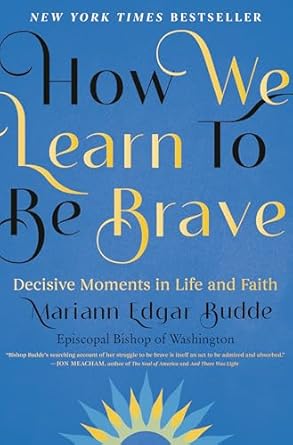
How We Learn to Be Brave: Decisive Moments in Life and Faith, by Mariann Edgar Budde.
How We Learn to Be Brave: Decisive Moments in Live and Faith, by Mariann Edgar Budde
I blogged about the fourth chapter in this book in my June 20, 2025 blog post, Reacting to the Cards You Are Dealt. I invite you to read that book and the post I wrote in response to reading the fourth chapter. I hope to eventually read the entire book.
Until my next blog post
Get a good book to read. Your local public library has lots of them, and a library card is free!
Don’t forget the people of Ukraine and western North Carolina.
Many of my blog posts this year have been about the mess we’re in. American democracy is being challenged like no other time in recent history, if ever.
Some people have been known to say in the last six months that we could have another civil war in the United States. Perhaps you’ve thought it yourself or heard someone else say those words.
Series of Webinars Sponsored by The Carter Center
President Jimmy Carter
Photo by Library of Congress on Unsplash
This spring I watched a series of webinars sponsored by The Carter Center about our divided country. Panelists explored how we got to this place, how we can learn from other countries, what we can do to avoid what other countries have experienced, and where we can start.
The country that served as the example in the four webinars was Northern Ireland.
The facilitator for the webinars was the Rev. Dr. Gary Mason, a Methodist minister, peacemaker, and peacebuilder from Northern Ireland. Dr. Mason founded Rethinking Conflict in 2015. It seeks to model the principles of Northern Ireland’s Good Friday Agreement.
That agreement finally ended the conflict on Good Friday, April 10, 1998. Dr. Mason has taken this model to the Middle East and now, to the United States.
Dr. Mason spoke from personal experience growing up during “The Troubles.”
What if “The Troubles” happened in the United States?
British troops occupied Northern Ireland in August 1969. Everyone thought it would be over before Christmas, but there was an amazing amount of violence over the next 30 years. It was the longest occupation by the British Army in history.
To give Americans some perspective on the amount of violence that took place in Northern Ireland during “The Troubles,” Dr. Mason gave the following statistics: At that time, Northern Ireland had a population of 1.5 million. During The Troubles, nearly 4,000 were killed, 47,000 were injured, there were 37,000 shootings, 30,000 people went through the penal system, there were 22,000 armed robberies, and 16,000 bombings.
He extrapolated that out to compare with the population of the United States over a 30-year conflict. If we had such a civil war in the US, we could see 800,000 killed, 9 million injuries, 7 million shootings, 6 million political prisoners, 4 million armed robberies, and 3 million bombings.
Imagine that level of carnage in America. I can’t.
An estimated 618,000 Americans died in our Civil War in the 1860s. To bring it “home,” I’ve studied the local losses in my own church in that war. Out of a membership of 400 white members and 200 black enslaved members, the congregation lost 74 men in the war. I cannot imagine that number of deaths in this community.
Just like it, undoubtedly, took decades for my community to recover from the war, 27 years after the Good Friday Agreement, Dr. Mason says in Northern Ireland “we are still wrestling with the legacy of the conflict. It’s really the one piece of unfinished business of the peace process.”
Indeed, in the United States we’re still wrestling with the legacy of our civil war. Confederate statues were taken down, but Trump wants them put back in place. Confederate names were removed from US military installations, but now the names are being restored, albeit technically they are not being renamed for the Confederates.
For example, Fort Bragg here in North Carolina was originally named for Braxton Bragg, a Confederate Army General who owned slaves. His name was removed, all the signs and letterhead replaced to say “Fort Liberty” in June 2023, and then in February 2025, Fort Liberty was renamed Fort Bragg but this time for a decorated Private in World War II, Roland X. Bragg.
We are still wrestling with the legacy of our Civil War, so it is not surprising that 27 years after the fact, the people of Northern Ireland are wrestling with theirs.
In Northern Ireland, People Hated Each Other
When peace talks began in Northern Ireland, the people in the room hated each other. No wonder it took so many years for them to develop a peace agreement.
Is that where we are today in the United States of America?
In polite society, we generally get along with each other. But, as I wrote about in my April 17, 2025, blog post, Is your family getting together during Holy Week? Brace yourself!, it only takes one person making an inflammatory remark and a heated argument can break out even among a group of friends or a family gathering.
Do Americans hate each other?
I don’t hate anyone, but I hate what some individuals and groups are doing to our country.
I hate that the US Congress has relinquished its legislative responsibilities to a US President who is legislating via Executive Orders.
I hate that thousands of federal employees have been fired or forced to take early retirement.
I hate that medical research funds and researchers have been eliminated.
I hate that people are being shipped off to a prison in El Salvador without due process.
I hate when people are shipped off to a prison El Salvador by mistake, the US President says he is powerless to do anything about it.
I hate that USAID was halted and will result in people starving.
I hate that universities, museums, and libraries are being targeted and punished.
I hate that Moms for Liberty think they have the right to dictate which books should not be read.
I hate that the Heritage Foundation was able to slide Project 2025 into the White House while the Republican Presidential nominee denied having anything to do with it.
I hate that many of the most vocally hateful voices in this country come from people who claim to be Christians. They give Christianity and Christians a bad name.
So how do we get out of this mess?
If we take the peacemaking and peacebuilding experience of Dr. Gary Mason into consideration, since he has lived through a civil war, we will open avenues of communication with people with whom we disagree.
LEAPFROG: How to hold a civil conversation in an uncivil era, by Janet Givens, M.A.
Taking Dr. Mason’s advice, we will then calmly and sincerely ask the person or persons why they feel the way they do about the topic with which we know we disagree with them, and then we will respectfully listen to their story.
Hopefully, they will be equally curious about our story and allow us to explain our position and why or how we arrived at it. Without honesty by both parties and a genuine curiosity by both parties, and a real listening by both parties… it won’t be a successful conversation.
Then, we move on to another person with whom we disagree and repeat the process.
Hmmm. Sounds easy on paper?
No, it doesn’t even sound easy on paper, much less in real life.
Bottom line is, I don’t know how we get out of this mess.
It has been my experience that people who stand on the opposite end of the political spectrum from where I stand, are not interested in hearing my story. They tend to be loud, rude, and condescending. They tend to call names and belittle, like their political leader on Pennsylvania Avenue.
So I really don’t know how we will get out of this mess. When I consider having “that difficult conversation” with anyone I know who supports Trump, I honestly cannot imagine that I would be able to have a productive conversation with them about politics. Our worldviews and core beliefs about democracy are just that far apart.
A chilling perspective
I just reread White Robes and Broken Badges: Infiltrating the KKK and Exposing the Evil Among Us, by Joe Moore. I blogged about that book on October 7, 2024, in What I Read Last Month & a Hurricane Helene Update, and I will blog about it again on July 7.
White Robes and Broken Badges, by Joe Moore
Speaking from the unique place of having infiltrated the Ku Klux Klan twice for the FBI, Moore stated in his book, “The radical right cares nothing about process, only outcome. They’re not interested in a civil discussion to work out differences, because they are so consumed by ideology that it has hijacked their civility. They have a clear vision of what they want the country to look like, and democracy itself is the only thing standing in their way.”
That leaves us in a hopeless situation. I don’t want to be hopeless, but I admit I don’t know how to have a productive conversation about politics with anyone who supports Donald Trump.
Even when Donald Trump is no longer in office, the people who agree with his tactics will still be with us. Our mess is bigger than an election or two can clean up.
Until my next blog post
How do you think we can get out of this mess?
What have you tried? Did it work?
It is going to take all of us to get our country out of this mess. The politicians certainly aren’t going to save us!
Remember the people of Northern Ireland, Ukraine, and western North Carolina.
Janet
P.S. I wrote and scheduled today’s blog post before the United States bombed three nuclear facilities in Iran on Saturday night, Eastern Time.




 Janet's Writing Blog