“Whom Can We Trust?” – historical short story

Once-a-week, since November 25, I have blogged about a different story from my new book, Traveling Through History: A Collection of Historical Short Stories.

The sixth story in the book is “Whom Can We Trust? A Mecklenburg Declaration of Independence Short Story.”

Tradition tells us that Archibald and Maggie Sellers McCurdy built their log cabin in what is now Cabarrus County, North Carolina, in 1773. At that time, Cabarrus had not yet been formed out of the eastern part of old Mecklenburg County. Their house was on the National Register of Historic Places until vandals burned it down a few years ago. Sadly, I never did see the house, but I have seen photographs of it and detailed floor plans and exterior drawings have been preserved.
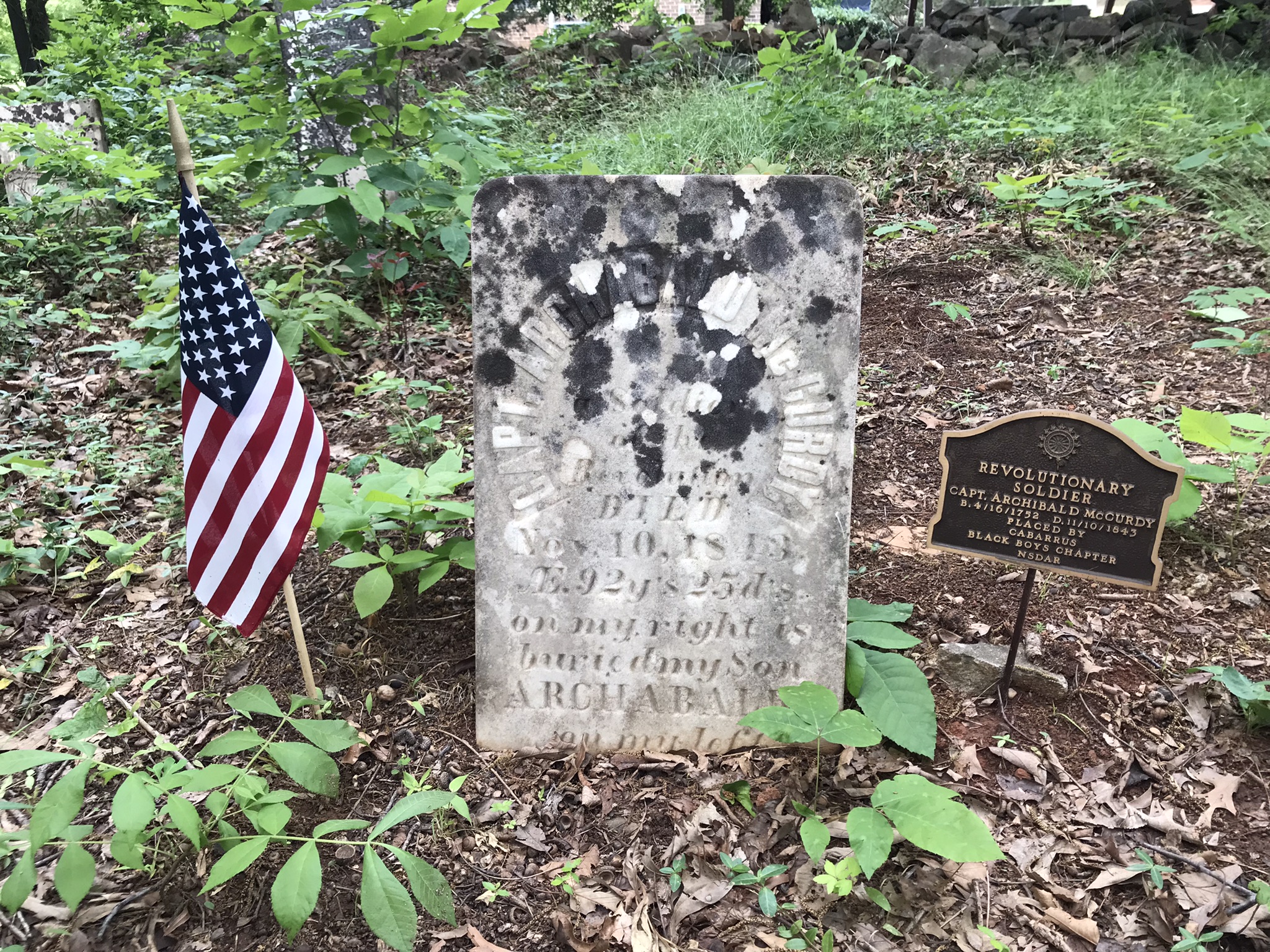
Archibald McCurdy’s gravestone at Spears Graveyard of Rocky Ri er Presbyterian Church, Cabarrus County, North Carolina

Those drawings and photographs made it easy for me to imagine the McCurdys’ lives. Theirs are names I’ve heard all my life. Archibald was a foot solider in the militia during the Revolutionary War. Maggie was a patriot in her own right, as she earned the name “She-Devil” by the British and Tories. I explain a couple of her feats in the Author’s Note at the end of “Whom Can We Trust?”
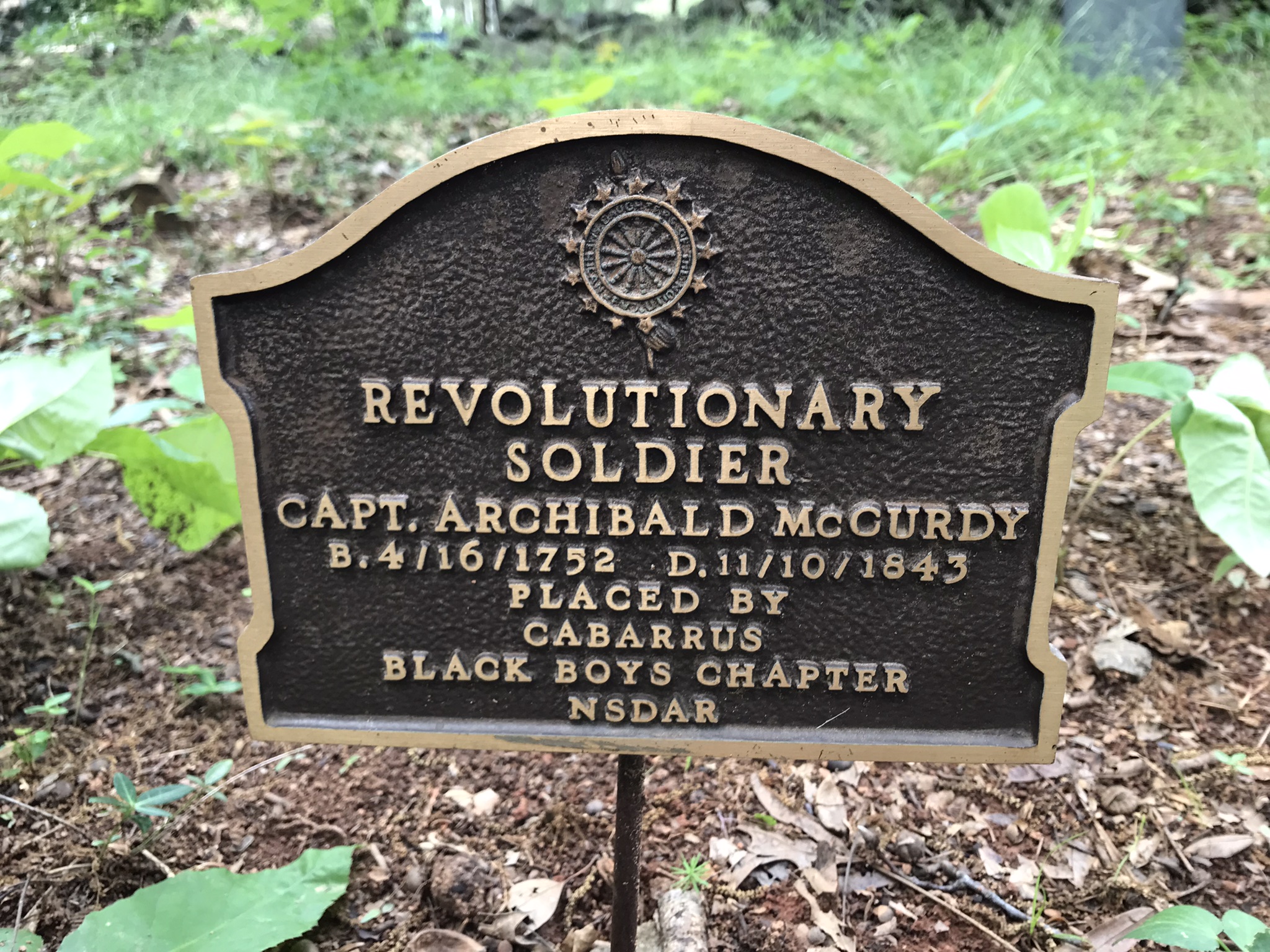
Marker placed at Archibald McCurdy’s grave by the Daughters of the American Revolution

The story is set in May 1775 at the time of the signing of the Mecklenburg Declaration of Independence. I was inspired by a story I’ve heard all my life about what Archibald McCurdy did on the day that document was signed.
In case you missed them here are the links to my blog posts about the first five stories in my book: “The Tailor’s Shears” – Historical Short Story, “You Couldn’t Help But Like Bob” — historical short story, “To Run or Not to Run” – historical short story, “Making the Best of a Tragedy” – historical short story, and “From Scotland to America” – historical short story.

Where to purchase Traveling Through History: A Collection of Historical Short Stories

You can find my new short story collection on Amazon in e-book (https://www.amazon.com/Traveling-Through-History-Collection-Historical-ebook/dp/B0FZQBMC2Q/)  and paperback (https://www.amazon.com/Traveling-Through-History-Collection-Historical/dp/B0FZSR6FPX/.)

You can find the paperback at Second Look Books in Harrisburg, NC, or ask for it at your local independent bookstore. Bookstores can order it from IngramSpark.

Janet

#OnThisDay: Mecklenburg Declaration of Independence, 1775

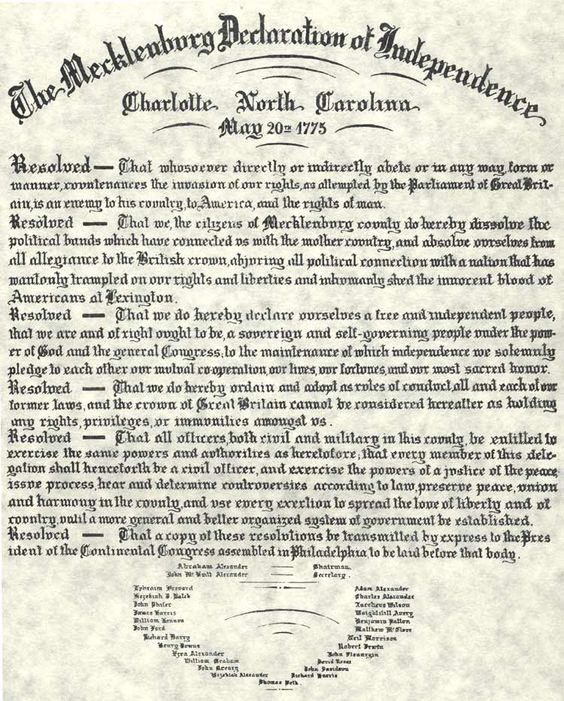
Today is the 250th anniversary of the signing of the Mecklenburg Declaration of Independence in Mecklenburg County, North Carolina. It predated the national Declaration of Independence by more than a year.

A recreation of the
Mecklenburg Declaration of Independence.

In case it sounds familiar, I have blogged about the Mecklenburg Declaration of Independence on or near May 20th several times in the more than ten years I’ve been blogging.

My immigrant ancestors were among the Scottish Presbyterian pioneers who settled old Mecklenburg County, North Carolina. Years of discontent in the American colonies were piled on top of the anti-British Crown feelings they brought with them across the Atlantic.

Weary of unfair taxes imposed by the Crown and the discrimination they were subjected to as Presbyterians slowly brought the settlers to the boiling point. An example of the persecution these Presbyterians felt were the Vestry and Marriage Acts of 1769. Those acts fined Presbyterian ministers who dared to conduct marriage ceremonies. Only Anglican marriages were recognized by the government.

On May 20, 1775, the citizens of Mecklenburg County, North Carolina declared themselves to be free and independent of the rule of Great Britain. It was a sober and sobering declaration not entered into lightly. Those American patriots meant business, and they knew the risks they were taking.

Archibald McCurdy, an elder in Rocky River Presbyterian Church, heard the document read from the steps of the log courthouse in Charlotte. When he got home, he and his wife, Maggie, listed everyone they knew of who could be trusted in the coming fight for American independence.

No original copies of the Mecklenburg Declaration of Independence survive today. The local copy was lost in a house fire at the home of one of the signers. The copy taken to the Continental Congress in Philadelphia by Captain James Jack on horseback was also lost. Later, signers of the document recreated it from memory.

Nevertheless, those of us who were raised on stories of the Mecklenburg Declaration of Independence and the brave souls who risked their lives to sign it know that the document was real. The blood of the American patriots still flows in our veins and their spirit of freedom still beats in our hearts.


Hurricane Helene Update

As of last Friday, 54 roads in North Carolina were still closed due to Hurricane Helene. That count included five US highways, four state highways, and 45 state roads. That’s a decrease of one state highway and one state road since the week before.


Until my next blog post

I hope you have a good book to read.

Remember the people of Ukraine and western North Carolina. Their situations are quite different, but the people in both places are stressed and weary.

Janet

Mecklenburg Declaration of Independence, Revisited

Even though we can’t show you an original copy of this declaration, it is written on our hearts as the descendants of those who whole-heartedly supported it as they prepared for the inevitable war against King George III of Great Britain.

The Americans’ beef wasn’t with the people of Great Britain – many of them were their relatives and friends – their beef was with the King – and they knew their friends and relatives back in Scotland were secretly wishing them well for they were also under the thumb of the King.

The year was 1775. The date was May 20.

The people of Mecklenburg County in the backcountry of North Carolina had had all they could take of King George and the oppressive laws and taxes he and the British Parliament continued to impose on the American colonists. After all, the reason most of them had left Europe was to escape monarchs who had little or no regard for their subjects.

The years leading up to May 20, 1775 had been tense. On May 2, 1771 a group of Mecklenburg County residents had taken matters into their own hands and blown up a shipment of munitions King Charles had ordered to be transported from Charleston, South Carolina to Rowan and Orange counties in North Carolina to put down The Regulator Movement.

The perpetrators of that gunpowder plot had been declared traitors and were still being hunted down by the Royal Government authorities when the county militias sent representatives to a convention in Charlotte to debate political conditions. The result was the writing of the Mecklenburg Declaration of Independence more than a year before the more famous one was written in Philadelphia.

The document set out the citizens’ grievances and declared themselves free and independent of Great Britain. Sadly, the original copy of the declaration was lost in a fire at the home of John McKnitt Alexander on April 6, 1800. The Declaration was reconstructed from the memories of those who had written it and signed it.

A recreation of the Mecklenburg Declaration of Independence.

There are Mecklenburg Declaration of Independence doubters today, but I have no doubt that it existed. It was followed just 11 days later by the Mecklenburg Resolves, which was a similar document.

Captain Archibald McCurdy of the Rocky River Presbyterian Church area of old Mecklenburg County that is present-day Cabarrus County, stood at the Mecklenburg County log courthouse steps and heard the Declaration read. He went home and told his wife, Maggie, they needed to make a list of the people they knew they could trust. There were a few Loyalists in the area.

Whatever you’re doing this Saturday, May 20, take a moment to reflect on what the brave people of Mecklenburg County, North Carolina did 248 years ago. If you live in the United States of America, ponder the stand they took on that day. The King proclaimed them to be in a state of rebellion, and the men who signed the document risked their very lives by proclaiming they were free.

Since my last blog post

Spring is finally in full force here in North Carolina. All I have to do is put a hanging basket of pretty flowers on a hook on the side porch and I can count on “Mama Bird” – a Carolina Wren – to build a nest in it. She’s done is for decades.

Having bronchitis and no set schedule allowed me time to do some reading last week. I have some interesting books to tell you about in my May 22 and June 5 blog posts.

I continue to remind folks on Facebook to purchase my local history books. I’m trying not to be a nuisance.

Until my next blog post

I hope you have a good book to read, including Harrisburg, Did You Know? Cabarrus History, Books 1 and 2, as well as The Blue Ridge Mountains of North Carolina.

Don’t forget to visit my website (https://www.janetmorrisonbooks.com) and subscribe to my newsletter. I have special plans for May 20 and I can’t wait to tell you all about them in my July newsletter!

Make time for family and friends.

Remember the people of Ukraine.

Happy Mecklenburg Declaration of Independence Day on Saturday!

Janet

How’s That “Writing Plan of Action” Working For You?

On January 18, 2015, I posted a seven-point “Writing Plan of Action” and promised an occasional update. It’s been a month, so I decided to assess how I’m doing.

(1) Schedule book signings/author events. I have scheduled a book signing on April 11 at 2pm at The Book Shelf in Tryon, North Carolina. I haven’t had any success with public library bookings. I’m not giving up!

(2) Continue to blog every day. I was doing very well with that until I read that I shouldn’t blog every day. (That was the one thing I thought I was doing right!) I’m struggling to find a schedule that suits me and will keep my followers interested. I have a lot of learn.

(3) Continue to research and write captions for a Piedmont NC vintage postcard book. I continue to work on that.

(4) Spend two hours each week building a list of places that might sell a Piedmont NC vintage postcard book. I haven’t kept a record of the time I’ve spent doing that, but I have worked on it a little.

(5) Continue to search for writing contests to enter or magazine articles to write. I’m pleased with the progress I’ve made on meeting this point of my plan. I have entered one contest and made a chronological list of more contests to enter this year. I’ll be ready in a few days to pitch an idea to Cobblestone magazine. I’ve written a piece about Maggie McCurdy that I hope the magazine will use in its March, 2016 issue. I wrote an article for Cobblestone in 2007 titled, “Aunt Lula Buys a Model-T.” Putting this “Writing Plan of Action” on paper nudged me into working on this aspect of my freelance writing.

(6) Set aside one day each week to edit my historical novel manuscript. This is where the wheels fell off the wagon. I have only worked on this one day in the last four weeks.

(7) If Arcadia Publishing rejects my author proposal for a Piedmont NC vintage postcard book, start in earnest to find a literary agent to represent me and my novel. I cannot submit a proposal to Arcadia until after February 25.

Overall, I’m pleased with what I have accomplished since making this writing plan. It definitely helps me to have a written plan. Based on this plan, I have made daily lists of things to do. I tend to be too optimistic and end up moving many items from one day to the next.

I will eventually get most things on the list done, and I will try not to beat myself up over the things left undone.