I write southern historical fiction, local history, and I've written a devotional book. The two novels I'm writing are set in Virginia and the Carolinas in the 1760s. My weekly blog started out to follow my journey as a writer and a reader, but in 2025 it has been greatly expanded to include current events and politics in the United States as I see our democracy under attack from within. The political science major in me cannot sit idly by and remain silent.
Once-a-week, since November 25, I have blogged about a different story from my new book, Traveling Through History: A Collection of Historical Short Stories.
The sixth story in the book is “Whom Can We Trust? A Mecklenburg Declaration of Independence Short Story.”
Tradition tells us that Archibald and Maggie Sellers McCurdy built their log cabin in what is now Cabarrus County, North Carolina, in 1773. At that time, Cabarrus had not yet been formed out of the eastern part of old Mecklenburg County. Their house was on the National Register of Historic Places until vandals burned it down a few years ago. Sadly, I never did see the house, but I have seen photographs of it and detailed floor plans and exterior drawings have been preserved.
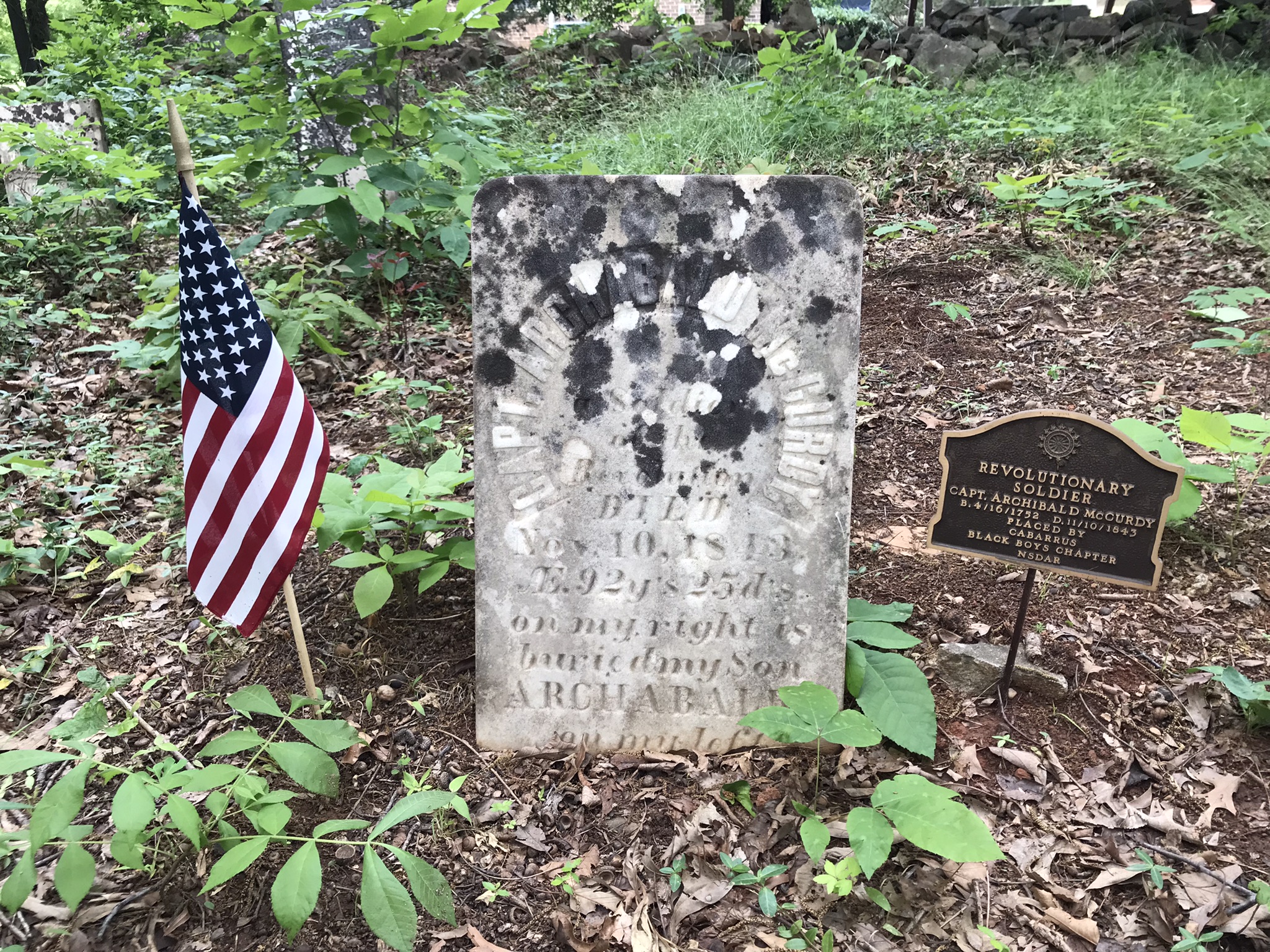
Archibald McCurdy’s gravestone at Spears Graveyard of Rocky Ri er Presbyterian Church, Cabarrus County, North Carolina
Those drawings and photographs made it easy for me to imagine the McCurdys’ lives. Theirs are names I’ve heard all my life. Archibald was a foot solider in the militia during the Revolutionary War. Maggie was a patriot in her own right, as she earned the name “She-Devil” by the British and Tories. I explain a couple of her feats in the Author’s Note at the end of “Whom Can We Trust?”
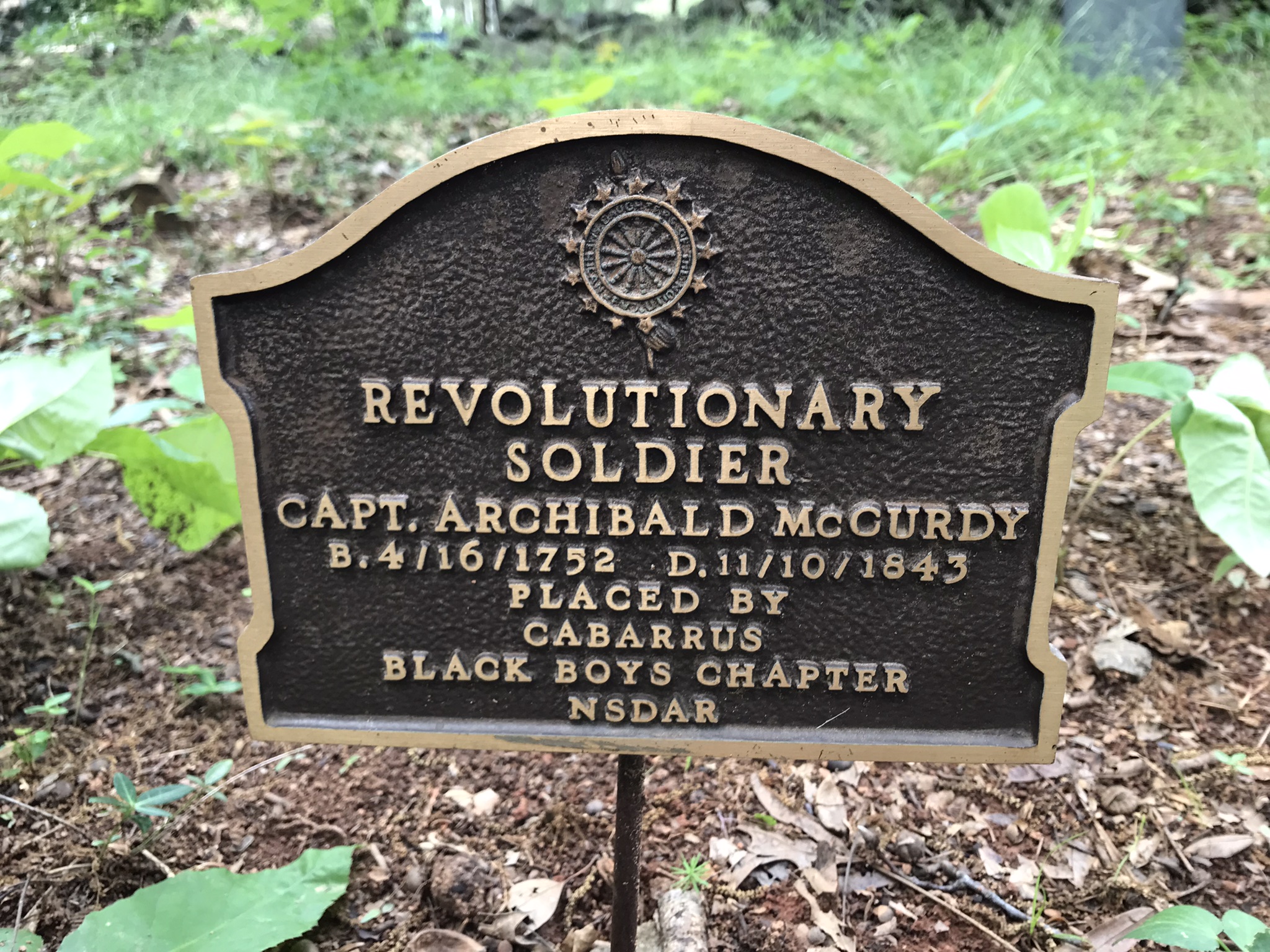
Marker placed at Archibald McCurdy’s grave by the Daughters of the American Revolution
The story is set in May 1775 at the time of the signing of the Mecklenburg Declaration of Independence. I was inspired by a story I’ve heard all my life about what Archibald McCurdy did on the day that document was signed.
You can find the paperback at Second Look Books in Harrisburg, NC, or ask for it at your local independent bookstore. Bookstores can order it from IngramSpark.
Today is the 250th anniversary of the signing of the Mecklenburg Declaration of Independence in Mecklenburg County, North Carolina. It predated the national Declaration of Independence by more than a year.
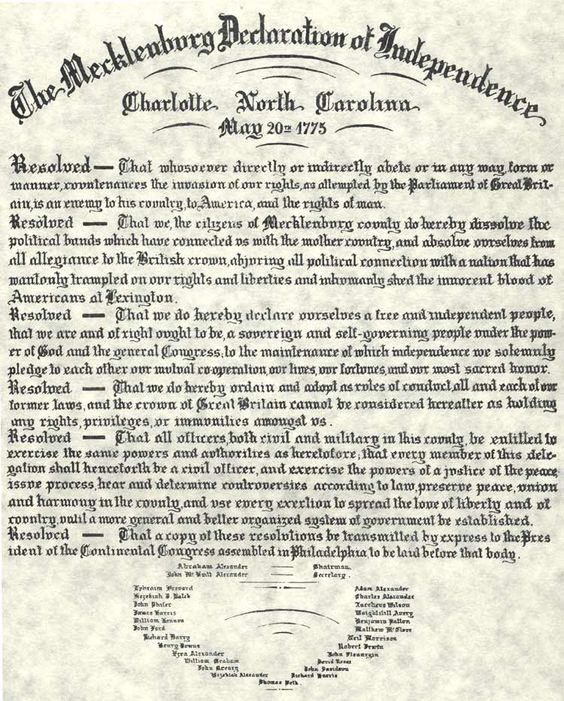
A recreation of the Mecklenburg Declaration of Independence.
In case it sounds familiar, I have blogged about the Mecklenburg Declaration of Independence on or near May 20th several times in the more than ten years I’ve been blogging.
My immigrant ancestors were among the Scottish Presbyterian pioneers who settled old Mecklenburg County, North Carolina. Years of discontent in the American colonies were piled on top of the anti-British Crown feelings they brought with them across the Atlantic.
Weary of unfair taxes imposed by the Crown and the discrimination they were subjected to as Presbyterians slowly brought the settlers to the boiling point. An example of the persecution these Presbyterians felt were the Vestry and Marriage Acts of 1769. Those acts fined Presbyterian ministers who dared to conduct marriage ceremonies. Only Anglican marriages were recognized by the government.
On May 20, 1775, the citizens of Mecklenburg County, North Carolina declared themselves to be free and independent of the rule of Great Britain. It was a sober and sobering declaration not entered into lightly. Those American patriots meant business, and they knew the risks they were taking.
Archibald McCurdy, an elder in Rocky River Presbyterian Church, heard the document read from the steps of the log courthouse in Charlotte. When he got home, he and his wife, Maggie, listed everyone they knew of who could be trusted in the coming fight for American independence.
No original copies of the Mecklenburg Declaration of Independence survive today. The local copy was lost in a house fire at the home of one of the signers. The copy taken to the Continental Congress in Philadelphia by Captain James Jack on horseback was also lost. Later, signers of the document recreated it from memory.
Nevertheless, those of us who were raised on stories of the Mecklenburg Declaration of Independence and the brave souls who risked their lives to sign it know that the document was real. The blood of the American patriots still flows in our veins and their spirit of freedom still beats in our hearts.
Hurricane Helene Update
As of last Friday, 54 roads in North Carolina were still closed due to Hurricane Helene. That count included five US highways, four state highways, and 45 state roads. That’s a decrease of one state highway and one state road since the week before.
Until my next blog post
I hope you have a good book to read.
Remember the people of Ukraine and western North Carolina. Their situations are quite different, but the people in both places are stressed and weary.
I have blogged about today’s topic before. I try to always mention it near the anniversary date of the event because it is a little-known fact in US history. Indeed, it rarely gets mentioned even by the local journalists and reporters in the Mecklenburg County, North Carolina area today. (Of course, most of them moved here from other parts of the country and they are not aware of our local history.)
I don’t know that I can improve upon my Mecklenburg Declaration of Independence blog from 2022, so I am taking the liberty to quote from it today.
From my May 23, 2022 blog post, “Mecklenburg Declaration of Independence, 1775”:
Today, my blog is about the Mecklenburg Declaration of Independence in 1775 while present-day Cabarrus County was part of Mecklenburg County and its citizens played just as important a role in the declaration as anyone living in what is present-day Mecklenburg County, North Carolina.
Friday, May 20, 2022 was the 247th anniversary of the signing of the Mecklenburg Declaration of Independence.
A recreation of the Mecklenburg Declaration of Independence
But what about the 1775 Mecklenburg Declaration of Independence?
I blogged about the Mecklenburg Declaration of Independence on May 21, 2018. To refresh your memory, or to introduce you to the topic if you aren’t aware of it, the following nine paragraphs are reblogged from that post:
My immigrant ancestors were among the Scottish Presbyterian pioneers who settled old Mecklenburg County, North Carolina. Years of discontent in the American colonies were piled on top of the anti-British Crown feelings they brought with them across the Atlantic.
Weary of unfair taxes imposed by the Crown and the discrimination they were subjected to as Presbyterians slowly brought the settlers to the boiling point. An example of the persecution these Presbyterians felt were the Vestry and Marriage Acts of 1769. Those acts fined Presbyterian ministers who dared to conduct marriage ceremonies. Only Anglican marriages were recognized by the government.
In May of 1771 a group of young men from the Rocky River Presbyterian Church congregation in the part of Mecklenburg County that later became Cabarrus County, disguised themselves by blackening their faces and under the cover of darkness ambushed a shipment of Royal munitions traveling north on the Great Wagon Road. The supplies were destined for Rowan County to put down the Regulator Movement.
Blowing up three wagons loaded with gunpowder and other supplies, the teens and young men who perpetrated the deed were declared outlaws by the Royal Governor and had to go into hiding until May 20, 1775 when all the citizens of Mecklenburg County were declared to be rebels against the British Crown.
On May 20, 1775, the citizens of Mecklenburg County, North Carolina declared themselves to be free and independent of the rule of Great Britain. It was a sober and sobering declaration not entered into lightly. Those American patriots meant business, and they knew the risks they were taking.
Archibald McCurdy, an Elder in Rocky River Presbyterian Church, heard the document read from the steps of the log courthouse in Charlotte. When he got home, he and his wife, Maggie, listed everyone they knew of who could be trusted in the coming fight for American independence.
No original copies of the Mecklenburg Declaration of Independence survive today. The local copy was lost in a house fire at the home of one of the signers. The copy taken to the Continental Congress in Philadelphia by Captain James Jack on horseback was also lost. Later, signers of the document recreated it from memory.
Nevertheless, those of us who were raised on stories of the Mecklenburg Declaration of Independence and the brave souls who risked their lives to sign it know that the document was real. The blood of the American patriots still flows in our veins and their spirit of freedom still beats in our hearts.
Don’t mess with our freedom of the press, freedom of speech, freedom of religion, or our freedom of assembly!
Even though we can’t show you an original copy of this declaration, it is written on our hearts as the descendants of those who whole-heartedly supported it as they prepared for the inevitable war against King George III of Great Britain.
The Americans’ beef wasn’t with the people of Great Britain – many of them were their relatives and friends – their beef was with the King – and they knew their friends and relatives back in Scotland were secretly wishing them well for they were also under the thumb of the King.
The year was 1775. The date was May 20.
The people of Mecklenburg County in the backcountry of North Carolina had had all they could take of King George and the oppressive laws and taxes he and the British Parliament continued to impose on the American colonists. After all, the reason most of them had left Europe was to escape monarchs who had little or no regard for their subjects.
The years leading up to May 20, 1775 had been tense. On May 2, 1771 a group of Mecklenburg County residents had taken matters into their own hands and blown up a shipment of munitions King Charles had ordered to be transported from Charleston, South Carolina to Rowan and Orange counties in North Carolina to put down The Regulator Movement.
The perpetrators of that gunpowder plot had been declared traitors and were still being hunted down by the Royal Government authorities when the county militias sent representatives to a convention in Charlotte to debate political conditions. The result was the writing of the Mecklenburg Declaration of Independence more than a year before the more famous one was written in Philadelphia.
The document set out the citizens’ grievances and declared themselves free and independent of Great Britain. Sadly, the original copy of the declaration was lost in a fire at the home of John McKnitt Alexander on April 6, 1800. The Declaration was reconstructed from the memories of those who had written it and signed it.
A recreation of the Mecklenburg Declaration of Independence.
There are Mecklenburg Declaration of Independence doubters today, but I have no doubt that it existed. It was followed just 11 days later by the Mecklenburg Resolves, which was a similar document.
Captain Archibald McCurdy of the Rocky River Presbyterian Church area of old Mecklenburg County that is present-day Cabarrus County, stood at the Mecklenburg County log courthouse steps and heard the Declaration read. He went home and told his wife, Maggie, they needed to make a list of the people they knew they could trust. There were a few Loyalists in the area.
Whatever you’re doing this Saturday, May 20, take a moment to reflect on what the brave people of Mecklenburg County, North Carolina did 248 years ago. If you live in the United States of America, ponder the stand they took on that day. The King proclaimed them to be in a state of rebellion, and the men who signed the document risked their very lives by proclaiming they were free.
Since my last blog post
Spring is finally in full force here in North Carolina. All I have to do is put a hanging basket of pretty flowers on a hook on the side porch and I can count on “Mama Bird” – a Carolina Wren – to build a nest in it. She’s done is for decades.
Having bronchitis and no set schedule allowed me time to do some reading last week. I have some interesting books to tell you about in my May 22 and June 5 blog posts.
I continue to remind folks on Facebook to purchase my local history books. I’m trying not to be a nuisance.
Until my next blog post
I hope you have a good book to read, including Harrisburg, Did You Know? Cabarrus History, Books 1 and 2, as well as The Blue Ridge Mountains of North Carolina.
Don’t forget to visit my website (https://www.janetmorrisonbooks.com) and subscribe to my newsletter. I have special plans for May 20 and I can’t wait to tell you all about them in my July newsletter!
Make time for family and friends.
Remember the people of Ukraine.
Happy Mecklenburg Declaration of Independence Day on Saturday!
In case you think I’m spending too much time this month blogging about our local history, just keep in mind that May is an important month of historical events in Cabarrus County, North Carolina.
My May 2, 2022 blog post, __#OnThisDay: 251st Anniversary of 1771 Gunpowder Plot__ was about patriots’ blowing up the king’s munitions just off the Great Wagon Road in present-day Cabarrus County.
Today, my blog is about the Mecklenburg Declaration of Independence in 1775 while present-day Cabarrus County was part of Mecklenburg County and its citizens played just as important a role in the declaration as anyone living in what is present-day Mecklenburg County.
Friday, May 20, 2022 was the 247th anniversary of the signing of the Mecklenburg Declaration of Independence.
A recreation of the Mecklenburg Declaration of Independence.
But what about the 1775 Mecklenburg Declaration of Independence?
I blogged about the Mecklenburg Declaration of Independence on May 21, 2018. To refresh your memory, or to introduce you to the topic if you aren’t aware of it, the following nine paragraphs are reblogged from that post:
My immigrant ancestors were among the Scottish Presbyterian pioneers who settled old Mecklenburg County, North Carolina. Years of discontent in the American colonies were piled on top of the anti-British Crown feelings they brought with them across the Atlantic.
Weary of unfair taxes imposed by the Crown and the discrimination they were subjected to as Presbyterians slowly brought the settlers to the boiling point. An example of the persecution these Presbyterians felt were the Vestry and Marriage Acts of 1769. Those acts fined Presbyterian ministers who dared to conduct marriage ceremonies. Only Anglican marriages were recognized by the government.
In May of 1771 a group of young men from the Rocky River Presbyterian Church congregation in the part of Mecklenburg County that later became Cabarrus County, disguised themselves by blackening their faces and under the cover of darkness ambushed a shipment of Royal munitions traveling north on the Great Wagon Road. The supplies were destined for Rowan County to put down the Regulator Movement.
Blowing up three wagons loaded with gunpowder and other supplies, the teens and young men who perpetrated the deed were declared outlaws by the Royal Governor and had to go into hiding until May 20, 1775 when all the citizens of Mecklenburg County were declared to be rebels against the British Crown.
On May 20, 1775, the citizens of Mecklenburg County, North Carolina declared themselves to be free and independent of the rule of Great Britain. It was a sober and sobering declaration not entered into lightly. Those American patriots meant business, and they knew the risks they were taking.
Archibald McCurdy, an Elder in Rocky River Presbyterian Church, heard the document read from the steps of the log courthouse in Charlotte. When he got home, he and his wife, Maggie, listed everyone they knew of who could be trusted in the coming fight for American independence.
No original copies of the Mecklenburg Declaration of Independence survive today. The local copy was lost in a house fire at the home of one of the signers. The copy taken to the Continental Congress in Philadelphia by Captain James Jack on horseback was also lost. Later, signers of the document recreated it from memory.
Nevertheless, those of us who were raised on stories of the Mecklenburg Declaration of Independence and the brave souls who risked their lives to sign it know that the document was real. The blood of the American patriots still flows in our veins and their spirit of freedom still beats in our hearts.
Don’t mess with our freedom of the press, freedom of speech, freedom of religion, or our freedom of assembly!
Until my next blog post
I’m considering taking a week off from writing my blog, unless something interesting comes along and begs to be written. Next Monday, May 30, is Memorial Day in the United States of America. It is a day to remember all the men and women who have lost their lives while serving in the armed forces of the United States.
I hope you have a good book to read until I blog again on June 6.
Take time for a relaxing hobby and spend some time with friends and family.
When the first week of May rolls around every year, I’m reminded of a bold, dangerous, and exciting event in our local history in Cabarrus County, North Carolina. It dates back to the early days of the American Revolution. In fact, it predates the American Declaration of Independence by five years. Most Americans have never heard of it.
Gunpowder Shipment
As the Regulator Movement reached the boiling point in Alamance County, North Carolina in April 1771, word came to the Rocky River Community in present-day Cabarrus County (but then part of Mecklenburg County) that a shipment of gunpowder was on its way from Charleston, South Carolina to General Waddell in Salisbury (in Rowan County.)
Knowing that the gunpowder was destined to be used to put down the Regulator Movement in counties north of Mecklenburg, eight or nine youths and young men from the Rocky River Presbyterian congregation put their heads together and designed a plan to make sure the gunpowder never reached General Waddell.
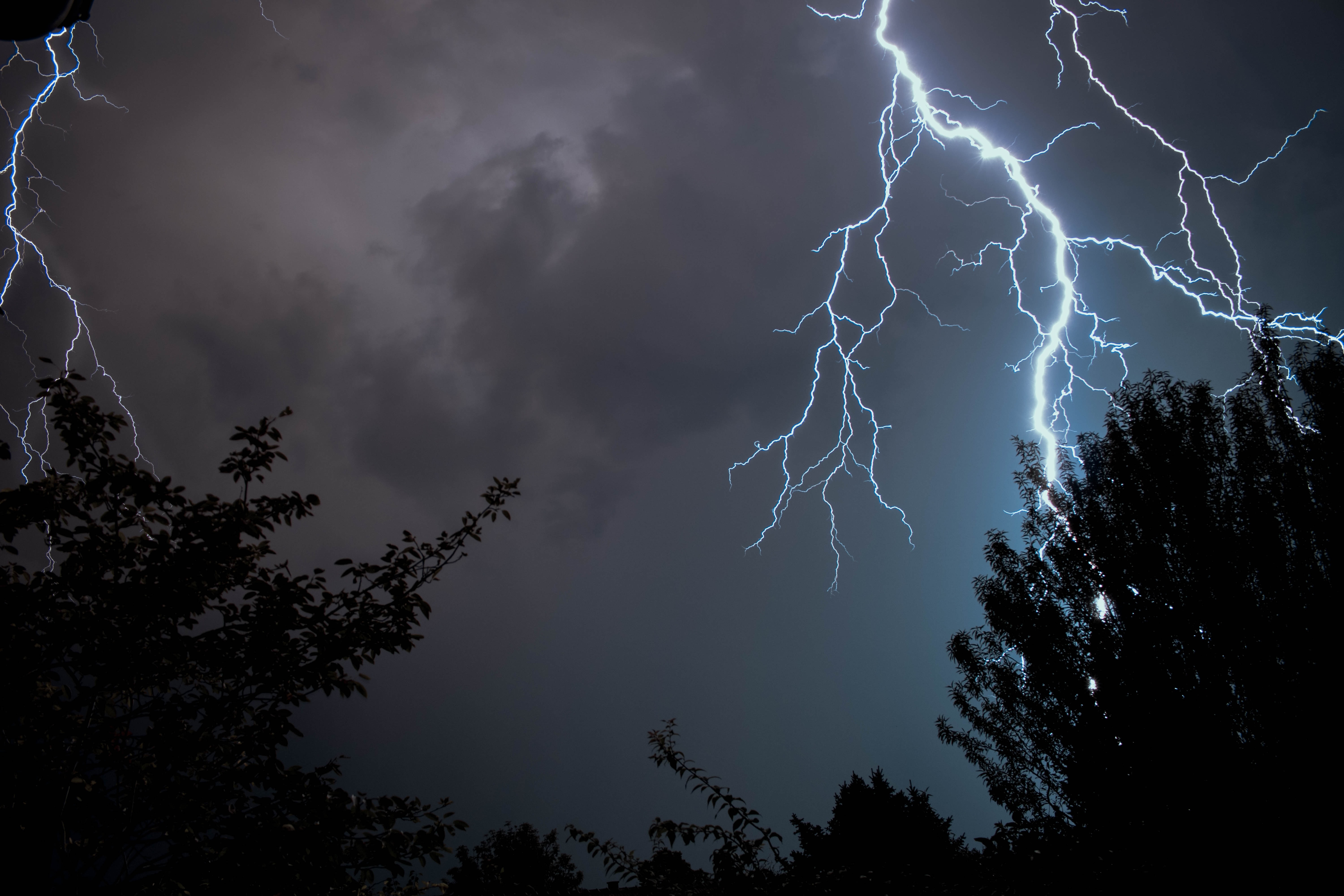
While making plans in secret to intercept the gunpowder shipment, the young men took cover from a late April 1771 thunderstorm in the springhouse on the Andrew Logan farm near where Reedy Creek now passes under Lower Rocky River Road.
Photo credit: Jonas Kaiser on unsplash.com
Not all sources agree on the names or even the number of conspirators, but it is believed they were as follows, based on the sworn testimony of James Ashmore: James White, Jr.; John White, Jr.; William White; Robert (Bob) Caruthers (who was married to a sister of James White, Jr.); Robert Davis; Benjamin Cochran; William White (cousin of the other Whites and son of the “Widow White”); James Ashmore; and Joshua Hadley, a half-brother of James Ashmore.
Photo credit: Mick Haupt on unsplash.com
One source credits Joshua Hadley with producing a New Testament on which each one swore that if anyone should ever divulge their plot that a ball might be shot through his heart and his soul sent to the lowest hell. Furthermore, they swore that if one of them ever revealed the names of the participants, he might die where no one should see him and that he should be denied a Christian burial.
Meanwhile…
Three munitions wagons from Charleston arrived in Charlotte but, upon learning that the gunpowder was destined to be used to put down the Regulators in Alamance and Rowan counties, the teamsters refused to take the munitions any further. It is said that Militia Colonel Moses Alexander had difficulty securing volunteers to take the wagons on to Salisbury.
An informant took word to the conspirators at Rocky River that the wagons were in Charlotte and they would stop for the night at the muster grounds near the present-day intersection of US-29 and Poplar Tent Road in Concord. (Since US-29 essentially follows the route of The Great Wagon Road, that’s the route the wagons would have taken to Salisbury.)
Thursday, May 2, 1771
The conspirators met at the home of James White, Sr. They blackened their faces to disguise themselves and set out for the muster grounds. They cut across the county and sometime on the night of May 2, 1771, converged on Phifer’s old muster grounds.
Can’t you just image those teenage boys and young men nervously waiting from a vantage point near the muster grounds? Can’t you imagine their hearts pounding as they ran down the hill and approached the wagons?
It is thought that James White, Jr. was the ringleader. The signal was given! The band of patriots surprised the guards! One of the teamsters was James Caruthers. He recognized his brother, Bob, as one of the attackers. In a low voice he said, “You’ll rue this, Bob.”
“Hold your tongue, Jim,” came his brother’s reply.
The conspirators moved the guards and teamsters to safety. They emptied the wagons and put the gunpowder and blankets in a pile. A train of powder was laid. James White, Jr., fired his pistol into the train.
Photo credit: Cee on unsplash.com
The resulting explosion was heard nine miles away in the vicinity of Rocky River Presbyterian Church. Some people thought it was thunder, while others mistook it for an earthquake.
Photo credit: Andy Watkins on unsplash.com
It is said that James White, Jr. carried a scar for the rest of his life where a flying stave from one of the gunpowder barrels hit him above his eye and cut to the bone before he could run from the explosion.
Photo credit: Christopher Burns on unsplash.com
The conspirators got home the best way they could in the wee hours of Friday, May 3, cleaned themselves up, and said nothing of their overnight adventure.
The Consequences
The Battle of Alamance took place on May 16, 1771, and the Regulator Movement in North Carolina was effectively put down by the royal government. Gov. William Tryon proclaimed on May 17 that he would pardon the rebels if they would turn themselves in by May 21. Bad weather and other circumstances prompted Tryon to postpone the deadline.
Some of the Regulators were put on trial on May 30. The trial was expected to last three weeks. No doubt, news of all this was moving up and down the Great Wagon Road and the conspirators from Rocky River were anxiously awaiting the outcome.
Photo credit: Jon Toney on unsplash.com
Giving in to exhaustion, at one point some of the gunpowder conspirators set out for Hillsborough to take the governor up on his offer of pardon. Before they reached their destination, they were warned that it was a trick and were told the Governor Tryon intended to hang them. Some returned to the canebrakes of Reedy Creek, while others fled to Georgia and Virginia.
June 11, 1771
Governor Tryon proclaimed that he knew some of the rebels in the colony wanted to turn themselves in, so he extended the deadline by which they could do so to July 10, except for “all the Outlaws, the Prisoners, all those concerned in blowing up General Waddell’s Ammunition in Mecklenburg County” and sixteen named Regulators.
The Governor sensed that he was losing control of North Carolina. He wanted the young men who destroyed his gunpowder brought to justice, but he didn’t know who they were.
In mid- to late-June, the Regulators’ trial came to a close. Twelve Regulators were tried and found guilty of high treason. Six were hanged while the other six waited for the King to decide their fate.
Photo credit: Alireza Jalilian on unsplash.com
Perhaps word of the Regulator trial results reached Rocky River, or maybe James Ashmore and Joshua Hadley simply feared that one of the other conspirators would disclose their identities. For whatever reason, Ashmore and Hadley went independently to tell Colonel Moses Alexander (who lived on a plantation at the present-day site of Charlotte Motor Speedway) what they knew.
Imagine their surprise when they ran into each other on Colonel Alexander’s front porch!
The two half-brothers jockeyed for position. James Ashmore eventually pushed his way into the house and told Col. Alexander that he was ready to talk.
June 22, 1771
James Ashmore was taken to Charlotte, where he gave a sworn deposition before Thomas Polk, a Mecklenburg County Justice of the Peace. That’s when things went from bad to worse for the conspirators.
Photo credit: Alessio Fiorentino
In his deposition, Ashmore told Polk how the conspirators had met at Andrew Logan’s old plantation after James McCaul advertised a sale or something to be held there. It was there that James White, Jr. asked Ashmore if he would be interested in helping to blow up the gunpowder shipment.
Ashmore said in his deposition that he was asked in the planning stages if he thought there was any harm in blowing up the gunpowder. He said he didn’t see any harm in it. He said the next morning between ten and eleven o’clock he stopped working on his plantation and went three-quarters of a mile to look for his horses.
Photo credit: Aurelien Faux on unsplash.com
Ashmore claimed it was there that he met six men on the road “who in appearance resembled Indians.” One was either recognized or identified himself as James White, Jr. White persuaded Ashmore to come back and join them after taking his horses home and recruiting his half-brother, Joshua Hadley.
They joined the men later about a half-mile from the Ashmore home. It was at that point in the deposition that Ashmore named six men with whom he and Hadley assembled.
Ashmore’s deposition goes on to describe the attack on the munitions wagons and how the conspirators had been sworn to secrecy.
In hiding
Once the names were revealed, the search for the men began in earnest. As stated earlier, some escaped to Georgia and Virginia. Others hid the canebrakes of Reedy Creek in the vicinity of the bridge on present-day Lower Rocky River Road where the women of Rocky River Presbyterian Church took them food and clothing.
Photo credit: Gorrin Bel on unsplash.com
When in need of something, one of the young men would pop up in a ravine and whistle. Nearby resident of around 40 years of age, William Spears, would acknowledge the fugitive by removing his hat. He would then walk off in the opposite direction so he would not be seen as aiding the conspirators.
Agnes Spears, William’s wife, would then take them food. For nearly one year the women of Rocky River Presbyterian Church fed and concealed the young men who took refuge along the banks of Reedy Creek. The authorities would never think to question the women because they couldn’t imagine that the women of the community had anything to do with the plot or its aftermath.
Photo credit:
The Rev. Hezekiah James Balch openly prayed for the safety of the young men from the pulpit of Rocky River Presbyterian Church.
The participants in the gunpowder plot were fugitives until independence was declared. After the Mecklenburg Declaration of Independence was issued on May 20, 1775, all Mecklenburg County citizens were considered to be in rebellion. After the Declaration, the conspirators were finally able to move about as freely as anyone else and prepare to fight in the coming Revolutionary War.
When May 2 and July 4 roll around every year, think about those brave young men from Rocky River who risked their lives to help gain our freedom in America.
Since my last blog post
Is it me, or are the weeks just flying by? I’m hard-pressed to remember what I’ve done since last Monday. I just know I’ve been busy. I visited a bookstore in downtown Concord, North Carolina on Friday. More on that in next week’s blog post. I’ve done some reading and quite a bit of brainstorming over the plot of my novel-in-progress. I work out many of the plot twists and some of the dialog while on my daily walks.
Yesterday we celebrated “May Meeting” at Rocky River Presbyterian Church. The tradition started as early as 1757. On the first Sunday in May, present members of the congregation, others associated with the church throughout its history, and other visitors from the community gather for worship, the Lord’s Supper, and Dinner in the Grove. It’s been a mainstay in my life since 1953.
We had perfect weather for Dinner in the Grove. Everyone brings food and spreads it out on a long four-foot-wide wire “table” that’s put up just for such occasions. It’s fun to try a little bit of this and a little bit of that. Some people bring special dishes they’re known for. There’s always good food and fellowship as we all eat together. After having an abbreviated version during the Covid-19 pandemic, it was exciting this year to get back to the way it used to be.
Until my next blog post
My blog post next Monday will be about some of the books I read in April.
I hope you have at least one good book to read and a hobby to enjoy.
I had a bit of fun last week in posting a five-part series about my bizarre accident in January and the equally strange ensuing weeks. I hope you enjoyed my tale of woe.
Today it’s back to work, though, on the craft of writing. This post is geared toward writers, but I think we can all learn how to communicate our thoughts more vividly whether in the written word or in our conversations.
Photo by Aaron Burden on Unsplash
Advice from Barbara Kyle
In her email on March 27, 2020, author and writing coach Barbara Kyle gave some welcomed advice for writers having trouble concentrating on their writing during the coronavirus-19 pandemic. She recommended that writers use this time to do research, if they’re having difficulty producing creative words on the page.
In my recent weeks of confinement due to my fractured leg, I’ve worked on some blog posts in advance. That’s the case with today’s post as I continue my sporadic #FixYourNovel series.
Time and place
The more a writer knows about the geography, demographics, history, culture, and people of her story’s location and time period, the better. You don’t have to tell everything you know. In fact, please don’t! You do need to draw from your first-hand knowledge and research to discern which details to give the reader.
Example: The historical novel I’m working on
The historical novel I’m still editing is set in the backcountry of the Carolinas at the close of the 1760s. Specifically, the story is set in present-day Lancaster County, South Carolina and present-day Cabarrus, Mecklenburg, and Rowan counties in North Carolina.
Without knowing what I was preparing myself for, I’ve soaked in the history of this region all my life. My study of local history, colonial American history, and my own family’s history have grounded me in the time and place in which my novel manuscript is set.
Have you heard of en.esosounds.net? (Pardon the pun!)
I recently discovered a helpful website (http://en.ecosounds.net/) as I was trying to add local flavor to the sounds my characters were hearing as they rode along a dirt road in July of 1769. It was a cold, dreary, blustery day as I was trying to transplant my mind and ears to a hot and humid piedmont Carolina day in July. Since I grew up in a rural area there, I know in my head the sounds I want to share with my reader. Putting those sounds on the page can be a challenge. I have to assume my reader is not familiar with the mid-summer sounds in rural South Carolina.
Something I found beneficial as I wrote the sounds my characters were hearing in the countryside on that hot July day in 1769 was this website: en.ecosounds.net. On that site you can listen to recorded sounds form various localities. Listening to a couple of those recordings was the perfect backdrop for me to listen to while I edited that particular scene.
Borrowing the wisdom of Barbara Kyle again
In her book, Page-Turner: Your Path to Writing a Novel that Publishers Want and Readers Buy, Ms. Kyle writes about the importance of using “concrete” words and images in one’s writing. Here’s a quote from chapter seven:
“For example, let’s say you’re describing a man in clothes that are damp from rain. If the reader is given just the appearance of those clothes, the man could be across the room, but if they read that the man’s sweater gives off the musty, wet-dog smell of damp wool, they’re right next to him.”
Ms. Kyle goes on to explain that including sensory details in our writing pulls on the reader’s emotions and thereby makes the writing more memorable for the reader.
Barbara Kyle’s website is https://www.barbarakyle.com/, in case you want to know more of what she has to offer writers.
A case of serendipity
I love when serendipity happens. I had been working on this blog post on March 3 when I changed gears and stopped to read some blogs. I follow Joanna Penn’s Creative Penn blog. I read her March 2, 2020 blog post, ”Opportunities in Audiobook Publishing with Michele Cobb.” (Here’s the link to it: thecreativepenn.com/2020/03/02/opportunities-in-audiobook-publishing-with-michele-cobb/.)
Michele Cobb is executive director of the Audio Publishers Association, the publisher of AudioFile magazine, and a consultant for the audiobook business at Forte Business Consulting.
In an interview Joanna Penn did with Ms. Cobb, they discussed the speed at which audiobooks have caught on around the world and the trend that audiobooks are the thing of the future as people like to listen to books while driving, cooking, crafting, or doing any number of other things.
The thing that jumped out at me from the interview was the following quote from Michele Cobb:
“And when you create specifically for the audio format, you might have multiple narrators, you might have music, you might have sound effects, and you may never want to put that experience into a print format because it wouldn’t work with your eyes.”
Joanna Penn added, “Actually, enhanced ebooks are audiobooks with all the sound effects.”
Maybe such ebooks exist. I haven’t listened to one yet.
I couldn’t help but think about my experience of listening to meadow and forest sounds on en.ecosounds.net while editing that scene in my book. How the book listening experience could be enhanced if there were sound effects on an audiobook! The possibilities are limitless.
In the meantime, a writer still needs to hone her skills in writing sensory details. I think we’ll always have printed books, even if eventually the only “printed” format of books is electronic. If the prose is particularly beautiful, I want to read it over and over again. If I were writing this in 2040 or even 2030, perhaps I’d say, “I want to listen to it over and over again.”
My head is swimming as I try to imagine an audio of my novel with the buzzing of flies and bees, and the chirping of native birds playing in the background as my written words are being read.
I guess you could say I’m “old school.” I just started listening to books on CD a year or so ago, and more recently started downloading MP3 books onto my tablet. In the interview with Joanna Penn, Michele Cobb said that of the CD versus digital books being published today, 4% are on CD and 96% are digital!
Since my last blog post
I’ve sat in my chair with my fractured leg elevated on a stool. My chair is by a south-facing window through which I can watch a variety of birds at one of our birdfeeders. Over the last couple of weeks I’ve watched the maple tree go from bare limbs to tiny red buds that blossomed into green leaves.
Dogwood blossoms. Photograph by Janet Morrison
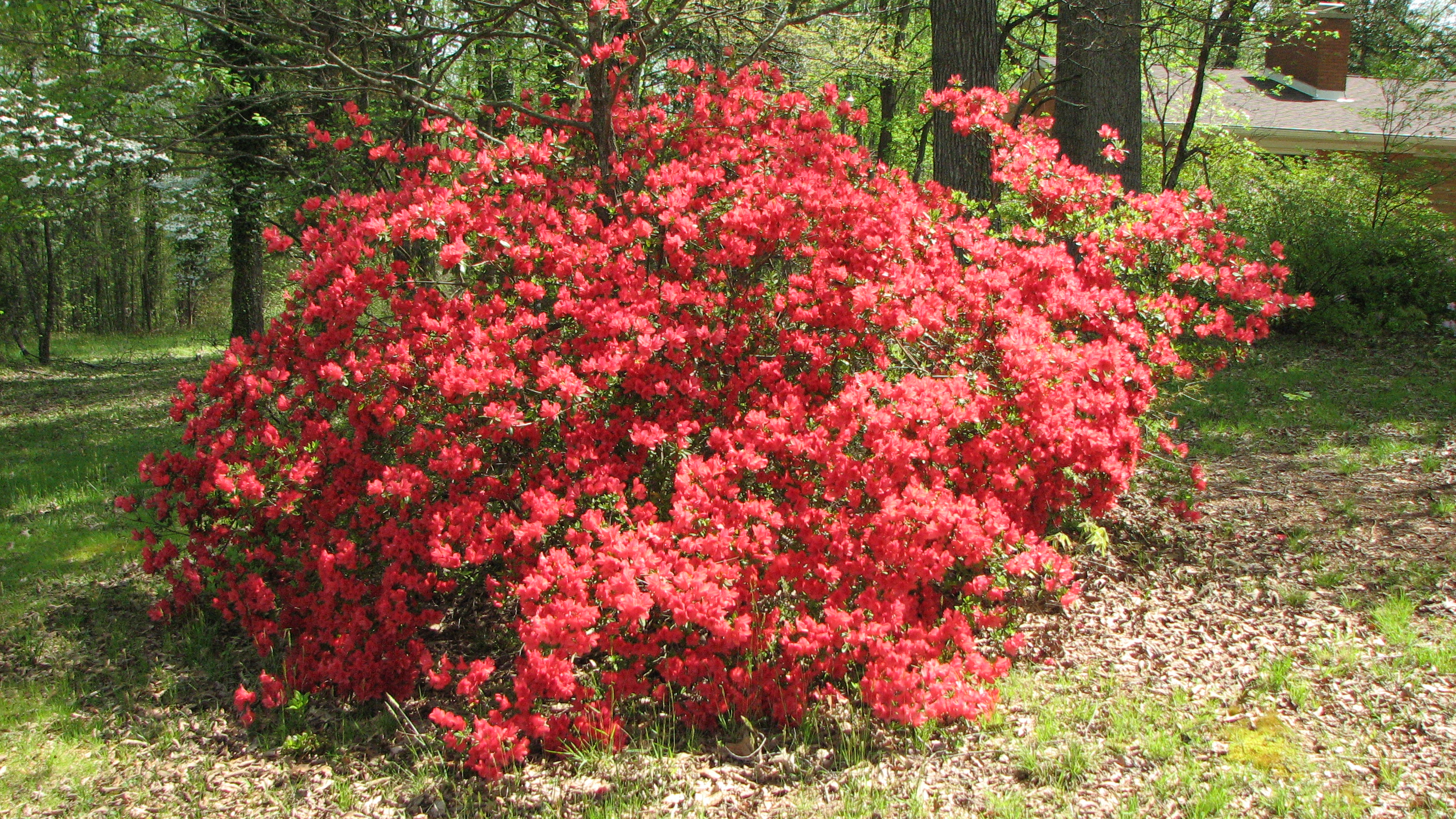
I’ve watched a dogwood tree transition from bare limbs to tiny buds to gorgeous white blooms. I’ve watched as the goldfinches almost overnight went from their drab winter US Army greenish brown to their brilliant yellow and black feathers. The Ruby-Throated Hummingbirds are due back from Central America any day now, so it’s time to put out our hummingbird feeders. Many of our azaleas are in full bloom.
Azalea. Photograph by Janet Morrison.
I am blessed to live where I do. Sunshine streams through my south-facing window every morning. I can see the road on which an occasional car, truck, bicycle, moped, or green John Deere tractor passes. I can see the Carolina blue sky and puffy white clouds. I can see the pollen piling up on my red pick-up truck. I can see my brother’s pine tree farm.
I can see the open meadow across the road that is now harvested for hay to feed local cattle. In my mind’s eye, I can still see the rows of soybeans Uncle Ross used to grow there, but I especially remember the years he planted red clover to replenish the soil – and how the red heads of the clover swayed in a soft summer breeze when I was a child.
What more could a person have than what I have outside my window?
Until my next blog post
I hope you stay safe and well as we all journey through this coronavirus-19 pandemic. We truly are all in this together.
I hope you have a good book to read or listen to while you live under “stay-at-home orders.”
Please tell your friends about my blog.
Let’s continue the conversation
As recently as a couple of years ago I did not like listening to books. Now audiobooks make up probably 75% of my reading.
What about you?
What are the pros and cons of audiobooks?
Have you listened to an ebook that included sound effects?
I love to make plans. Ask me to plan a trip, and I’ll get into the minutiae of where you’ll be and what you’ll be doing every minute of the day.
My sister is my traveling buddy, and sometimes my attention to detail drives her crazy! On the other hand, she doesn’t enjoy planning trips so she doesn’t complain too much.
In my Reading Like a Writer blog post (“Reading Like a Writer”) on April 9, 2018, I told you that I had developed a social media plan. Making the plan was easy. The hard part came when I entered the implementation phase. Today’s blog post is about the Pinterest aspect of my plan.
Pinterest Best Practices
In the process of developing the plan, I learned the following from Amy Lynn Andrews’ Userletter Issue No. 234 (https://madmimi.com/p/9af10c/):
“Kate Ahl recently noted an addition to Pinterest’s own best practices for success: ‘The first 5 Pins you save each day will be prioritized for distribution. Save to the most relevant board first…that Pin will get distribution priority.’”
That was a revelation for me. No more willy-nilly saving pins to my Recipes: Cheesecake Board! Since reading Amy Lynn Andrews’ Userletter, I’ve made myself save five pins to my writing-related Pinterest boards every day before pinning any recipes, quilts, or Maxine-isms.
Old habits are hard to break, so there is definitely a learning curve involved in this.
“When I started deleting my boards, Pinterest’s algorithms better learned the content of my niche, and my traffic grew.”
and
“I deleted my boards about food and entertainment, for example. Pinterest will be more likely to show your pins to people if the algorithms know what your site is about.”
and
“I read you’ll get better visibility at Pinterest if it’s clear to the site what your niche is. This makes sense. Search engines show your blog to people when they’re clear what you specialize in.”
That second quote from Janice Wald is a hard pill for me to swallow. I don’t want to give up my recipe and quilting boards. I could make them secret board that only I can see, but I had hoped that when someone looked at one of those boards they’d also notice I wrote a vintage postcard book (The Blue Ridge Mountains of North Carolina) and I’m writing a historical novel (The Spanish Coin) set in the Carolinas in the 1760s.
I’ll have to give that some thought. For the time being, I have 80 boards on Pinterest.
What I’ve Accomplished on Pinterest since Last Monday
I’ve learned how to create my own pins for Pinterest on Canva.com. Those of you who know me, know that I am technologically challenged, so this was no minor feat for me. I am not getting compensated for mentioning Canva; however, I’ve been able to create some pretty cool graphics for free using that website, http://www.canva.com.
How to move graphics from Canva.com to Pinterest
I soon discovered that I didn’t know how to move the graphics I created on Canva.com and saved to my hard drive. A search on Google quickly brought up the instructions. You simply go to the Pinterest toolbar, click on the red “+” sign, and then click on “Upload an image.” (This just might be the first time I’ve been able to give any technology advice to anyone!)
Want to see what I’ve done on Pinterest?
Please go to my Pinterest page (https://www.pinterest.com/janet5049) and look at the graphics I created this past week for the following boards: The Spanish Coin – My Novel in Progress; Blue Ridge Mountains; Great Smoky Mountains; Books & Authors; and Rocky River Presbyterian Church.
Here’s a graphic I created about my vintage postcard book, The Blue Ridge Mountains of North Carolina, for my Great Smoky Mountains board on Pinterest:
One of the first graphics I made on Canva.com.
My mistakes
There are lots of things to keep in mind when making a graphic for social media. Looking at the one shown above, I realize using a color background would have made it more eye-catchy, although I think it shows up better on Pinterest than on my blog.
Also, at the bottom of the graphic, I should have included my blog’s URL, my website’s URL, and my handle on Twitter. I have edited it in light of that, in case I decide to reuse it at a later date.
My social media plan for Pinterest
Mondays: Pin link to my weekly blog post to Janet’s Writing Blog board (set up to post automatically by WordPress.com) and a colonial history factoid or A Spanish Coin teaser to The Spanish Coin – My Novel in Progress;
Tuesdays: Pin a factoid from my vintage postcard book to my Great Smoky Mountains;
Wednesdays: Pin a Rocky River Presbyterian Church history factoid from one of my church history booklets to my Rocky River Presbyterian Church;
Thursdays: Pin a factoid from my vintage postcard book to my Blue Ridge Mountains;
Fridays: Pin a Rocky River Presbyterian Church women’s history factoid to my Rocky River Presbyterian Church & Cabarrus-Mecklenburg boards; OR Pin a Rocky River Presbyterian Church history factoid to my Rocky River Presbyterian Church & Cabarrus-Mecklenburg boards with a link to the church’s website where a copy of Dr. Thomas Hugh Spence, Jr.’s book, The Presbyterian Congregation on Rocky River, can be ordered.
Saturdays: Create factoids/infographics for the following week(s).
This is a grand plan for someone with Chronic Fatigue Syndrome, so I know I will not accomplish this every week. I fell short last week even though I was enthusiastic about starting this new plan. I might miss some weeks altogether. The schedule gives me something to aim for, though.
80/20 Rule of Social Media Marketing
I have read in various sources that 80% of your posts on social media should inform, educate, or entertain and only 20% should promote your business. That rule prompted me to strive to shine a light on a book about the history of Presbyterian Women at Rocky River Presbyterian Church or Dr. Spence’s church history book on Pinterest on Fridays.
I wrote neither of the books, and the proceeds from their sales benefit the ongoing work of the Presbyterian Women at Rocky River and the church’s cemetery fund. (The church dates back to 1751 and has several very old cemeteries that have to be maintained.)
My social media plan for Pinterest looks a little out of whack in light of the 80/20 Rule; however, I hope all the pins I create will fall into the “inform, educate, or entertain” categories.
Since my last blog post
In addition to learning how to create my own Pinterest pins and pinning my creations last week, I have continued to work on the rewrite of my historical novel, The Spanish Coin.
Until my next blog
I hope you have a good book to read.
If you’re an avid reader who has never considered the possibilities of using Pinterest, you might want to check it out. You just might find that your favorite authors have pages there and boards about their books. After looking for your favorite authors on Pinterest, please let me know if this was an enjoyable experience for you and specifically what you liked about it.
If you’re a writer, I hope you have productive writing time. Please let me know what your experience has been on Pinterest. If you haven’t thought about using it as part of your writer’s platform, perhaps you’ll consider it after reading this blog post.
Don’t be shy about spreading the word about my blog. Feel free to use the buttons below to put today’s post on Facebook, Tweet about it, reblog it on your blog, or Pin it on Pinterest. Thank you!
Occasionally, I like to present samples of my writing in this blog. My blog post on May 23, 2017 was “No Place for a Preacher’s Son?” (No Place for Preacher’s Son?) The “no place for a preacher’s son” was the Pioneer Mill community in Township One of Cabarrus County, North Carolina in the 1870s.
Gold Fever!
The reason for Pioneer Mill being a “boom” place in the 1800s was due to the development of a gold mine there. Gold was first discovered in the United States in Cabarrus County in 1799.
“Gold fever” soon took hold of the region and numerous gold mines were developed in Cabarrus County in the early 1800s. In fact, so much gold was found in the area that in 1837 a branch of the United States Mint was opened in Charlotte in adjoining Mecklenburg County
I heard about the Pioneer Mill Gold Mine when I was a young child. I knew where it had been. I should have asked “the older generation” some questions about it, but now that generation is gone.
Finding myself in “the older generation,” I researched the gold mine in order to write a two-part series about it for the now defunct Harrisburg Horizons newspaper in 2012. Today’s blog hits the highlights of those newspaper articles.
After the 1799 discovery of gold on John Reed’s land in Township Ten, everyone in Cabarrus County probably started searching for gold on their property. The date that gold was first discovered at Pioneer Mill is unknown, but the 1869 Branson Business Directory described the mine as “among the earliest discovered mines in the State.
The land on which the Pioneer Mill Mine was worked in the 1800s was purchased in the 1760s by James Morrison, an immigrant from Campbeltown, Scotland. It passed down to his son, John. John and his wife, the former Mary McCurdy, had 11 children. Their youngest child, Robert Harvey Morrison, was born in 1817.
Robert Harvey Morrison remained on the family land and was quite prosperous. The stately two-story house at the entrance to the present-day Cedarvale subdivision on Morrison Road was the home he built for his family of eight children.
Mineral Rights
From a deed registered in Cabarrus County, we know that in 1853 Robert H. Morrison sold the mineral rights on his 640 acres of land to Collett Leventhorpe of Rutherford County, North Carolina and Richard H. Northrop of Albany, New York for $5,000.
In June of 1854, Messrs. Leventhorpe and Northrop, both identified as being of Rutherford County, sold the mineral rights and mining machinery to Francis Rider of New York City for $475,000.
Mr. Rider was identified as the president of the Pioneer Mill Mining Company, “an association incorporated in pursuance of the provisions of an act of the Legislature of the State of New York” that authorized the formation of “Corporations for Manufacturing, Mining, Mechanical or Chemical purposes Passed February 17th 1848.”
I requested a copy of the incorporation papers of the Pioneer Mill Mining Company from the State Archives of New York State, but the researchers there were unable to find a record of the company.
Geology
Ebenezer Emmons served as State Geologist in North Carolina from 1851 until 1863. Dr. Emmons described the veins of gold at the Pioneer Mill Mine in an undated report, “Geological Report of the Midland Counties of North Carolina” as a fine example of veins of gold coming off a foot-wall.
An electronic copy of the Emmons report can be found online through the University of North Carolina’s Documents of the South Collection at http://docsouth.unc.edu/nc/emmonsml/emmons.html. He wrote, “In some instances the segments are so distinct that on being removed the lode seems to have run out, but on working back to the foot-wall, another segment is encountered.”
“Foot-wall” is the rock underlying a mineral deposit. The report noted that the Pioneer Mill Mine was in syenite granite.
I have heard it said that in the days of dirt roads and horse-drawn wagons, when horses’ hooves clacked along the road at the intersection of Morrison Road and Pioneer Mill Road, there was a hollow sound that led to speculation that there was an old mine shaft under the roadway.
Dr. Ebenezer Emmons wrote that the Pioneer Mill Mine was in a cluster of interesting mines for which he held great expectations, although the Pioneer Mill Mine was the only one in the cluster in operation at the time of the report.
He described it as “twelve miles east of Concord, and situated upon the eastern border of the sienitic [also spelled syenite] granite, and in a belt upon which there are numerous veins carrying both gold and copper. The vein fissure in the granite is between sixteen and seventeen feet wide. Its direction is N.70°E. The true vein stone is quartz from eight to thirty inches thick, both sides of which is bounded by the killas.”
“Killas” is a Cornish mining term for metamorphic rock strata of sedimentary origin altered by heat from intruding granite.
The Emmons report indicated that there were four veins of gold on the Robert Harvey Morrison plantation. The first vein was a mile south of the Pioneer Mill Mine. Dr. Emmons found refuse ore rich in gold around an old shaft at that vein which was in quartz interspersed with “sulphurets.”
The second vein was a mile east and resembled the first. The third was a vein of gold in combination with copper pyrites. The fourth vein was of quartz and iron pyrites in the northeast part of the plantation. All four veins generally ran northeast.
Dr. Emmons reported that the Pioneer Mill Mine ground 30-40 bushels of ore daily, although he noted that at 11 revolutions per minute, the Chilean millstones in operation were not set at the proper speed for the ore being ground.
The report listed 14 totals of bushels ranging from 38 bushels to 154 bushels and the corresponding yield in gold in dollars. (It is not known if these were weekly totals over a period of time or exactly what time frame is covered by the list.) The list totaled 1,677 bushels of ore producing $5,674 in gold. That was in mid-19th century dollars, when gold was valued at $18.93 per troy ounce.
The Pioneer Mill Mine employed 15-20 men from 18 to 20 days-a-month. The cost of operating the mine was $400 per month. Dr. Emmons noted that the mine had nearly gone under after incurring too much debt, but under a new agent who was more attentive to the machinery and who had started using mercury in the Chilean mill the mine started turning the handsome profit detailed above.
Part of a gold ore grinding stone from the Pioneer Mill Gold Mine.
Dr. Emmons wrote that the Pioneer Mill Mine would have had truly impressive profits had it had machinery capable of grinding 100 bushels of ore per day.
The glory days of the Pioneer Mill Mine ended with the American Civil War in 1861. It took decades for our local economy to recover from the years of the War and Reconstruction. With the passage of time, it ceased to be cost effective to mine for gold in Cabarrus County.
According to the Carolina Watchman newspaper on September 17, 1891, the Pioneer Mill Mine was then owned by Mr. E.C. Black “and he is making some nice finds. He has found several large nuggets; one worth $50, another $12 and still another $37.”
Needless to say, I was thrilled to find Dr. Emmons’ report for without it we would know almost nothing about the Pioneer Mill Mine. Driving through the Pioneer Mill community today, one would never guess that 160 years ago it was a gold mining boom town.
Until my next blog post
I hope you have a good book to read. Just for fun, I’m reading Hardcore Twenty-Four, by Janet Evanovich. All the books I requested at the public library in November (or earlier) have become available to me at the same time. I have three that have come to my Kindle and one traditional book at the library. Time will tell if I’m able to get them read in the time I have allotted by the library system.
If you’re a writer, I hope you have quality writing time.
Sometimes a novel’s story summary sounds interesting but fails to deliver. Sometimes it’s a matter of it just not being the right time for you to read that particular book. Sometimes the opening “hook” does its job and pulls you into the story, but the following pages fall short and your interest wanes.
Life is short. There are too many good books out there to spend time reading one that does not measure up or appeal to you.
I used to think if I started reading a book, I owed it to the author to finish reading it. I no longer abide by that. When I joined a book club a few years ago at the Kannapolis branch of the Cabarrus County Library system, I was introduced to a “Reader’s Bill of Rights.” Perhaps you are familiar with it. It is attributed to Daniel Pennac in Better Than Life, published by Coach Press in 1996:
“Reader’s Bill of Rights
The right to not read
The right to skip pages
The right to not finish
The right to reread
The right to read anything
The right to escapism
The right to read anywhere
The right to browse
The right to read out loud
The right to not defend your tastes” – Daniel Pennac
If you do not live in the United States, “Bill of Rights” might be an unfamiliar term for you. That is what the first 10 amendments to the U.S. Constitution are collectively called. It is not coincidental that Mr. Pennac listed 10 items in his “Reader’s Bill of Rights.”
In the United States, we take for granted our access to books and other reading material. Millions of people in the world are not that fortunate. Americans tend to take free public libraries for granted until elected local government officials threaten to close libraries or radically curtail their hours of operation due to financial constraints. Many of them see libraries as an easy target. They see libraries as “fluff.” We suffered through this in the county in which I live during the downturn of the economy that started in 2008. What was taken from us in a proverbial “blink of an eye” took several years to reinstate.
We have wonderful public library systems in Cabarrus and Mecklenburg Counties in North Carolina. I utilize both systems most weeks. The Harrisburg branch of the Cabarrus County system is a very inviting hub of activity. When Harrisburg’s public library branch opened in 2001, our community started to feel like a real town.
I do not take my right to read lightly. I hope you have the right to read anything you want to read. As you can see from the table of flags on this blog page, people from at least 73 different countries have read my blog. When I write my blog posts, I try to be mindful of that.
Some of my readers live in countries where there is no free press and there are heavy prices to pay (such as prison life at hard labor or even execution) if you read something that is banned. Knowing that a few individuals in such countries are putting themselves at risk by reading one of my blog posts has put unexpected pressure on me.
Please don’t take your right to read for granted! This Thanksgiving season in America, I’m thankful for my right to read and for free public libraries.
Until my next blog post
I hope you have a nice Thanksgiving Day with family and friends.
I hope you have a good book to read. I’m reading Quantum Spy, by David Ignatius.
If you are a writer, I hope you have quality writing time.
I hope you live in a country where you have the freedom to write and read anything you want.













 Janet's Writing Blog