I write southern historical fiction, local history, and I've written a devotional book. The two novels I'm writing are set in Virginia and the Carolinas in the 1760s. My weekly blog started out to follow my journey as a writer and a reader, but in 2025 it has been greatly expanded to include current events and politics in the United States as I see our democracy under attack from within. The political science major in me cannot sit idly by and remain silent.
Once-a-week, since November 25, I have blogged about a different story from my new book, Traveling Through History: A Collection of Historical Short Stories.
The sixth story in the book is “Whom Can We Trust? A Mecklenburg Declaration of Independence Short Story.”
Tradition tells us that Archibald and Maggie Sellers McCurdy built their log cabin in what is now Cabarrus County, North Carolina, in 1773. At that time, Cabarrus had not yet been formed out of the eastern part of old Mecklenburg County. Their house was on the National Register of Historic Places until vandals burned it down a few years ago. Sadly, I never did see the house, but I have seen photographs of it and detailed floor plans and exterior drawings have been preserved.
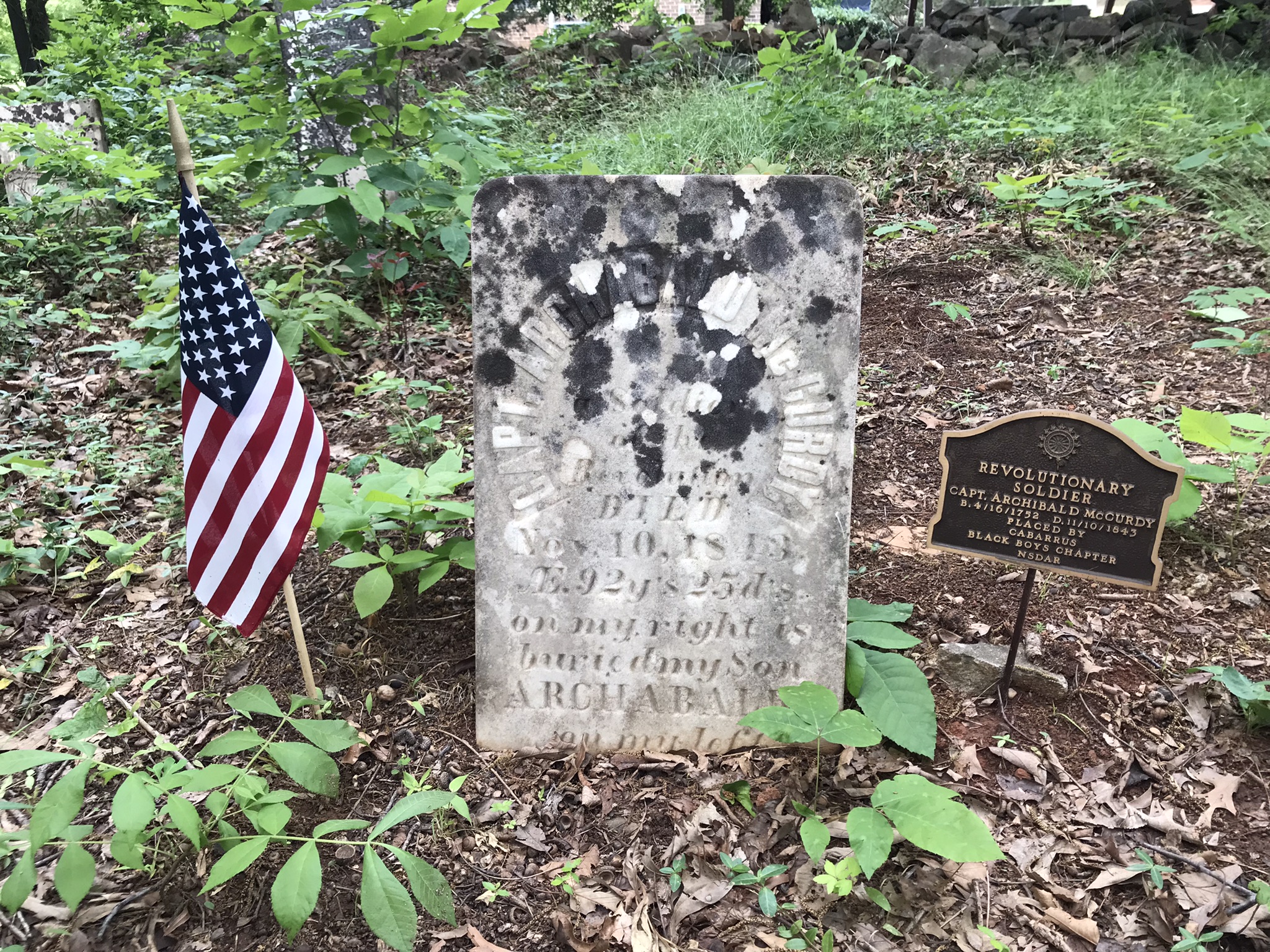
Archibald McCurdy’s gravestone at Spears Graveyard of Rocky Ri er Presbyterian Church, Cabarrus County, North Carolina
Those drawings and photographs made it easy for me to imagine the McCurdys’ lives. Theirs are names I’ve heard all my life. Archibald was a foot solider in the militia during the Revolutionary War. Maggie was a patriot in her own right, as she earned the name “She-Devil” by the British and Tories. I explain a couple of her feats in the Author’s Note at the end of “Whom Can We Trust?”
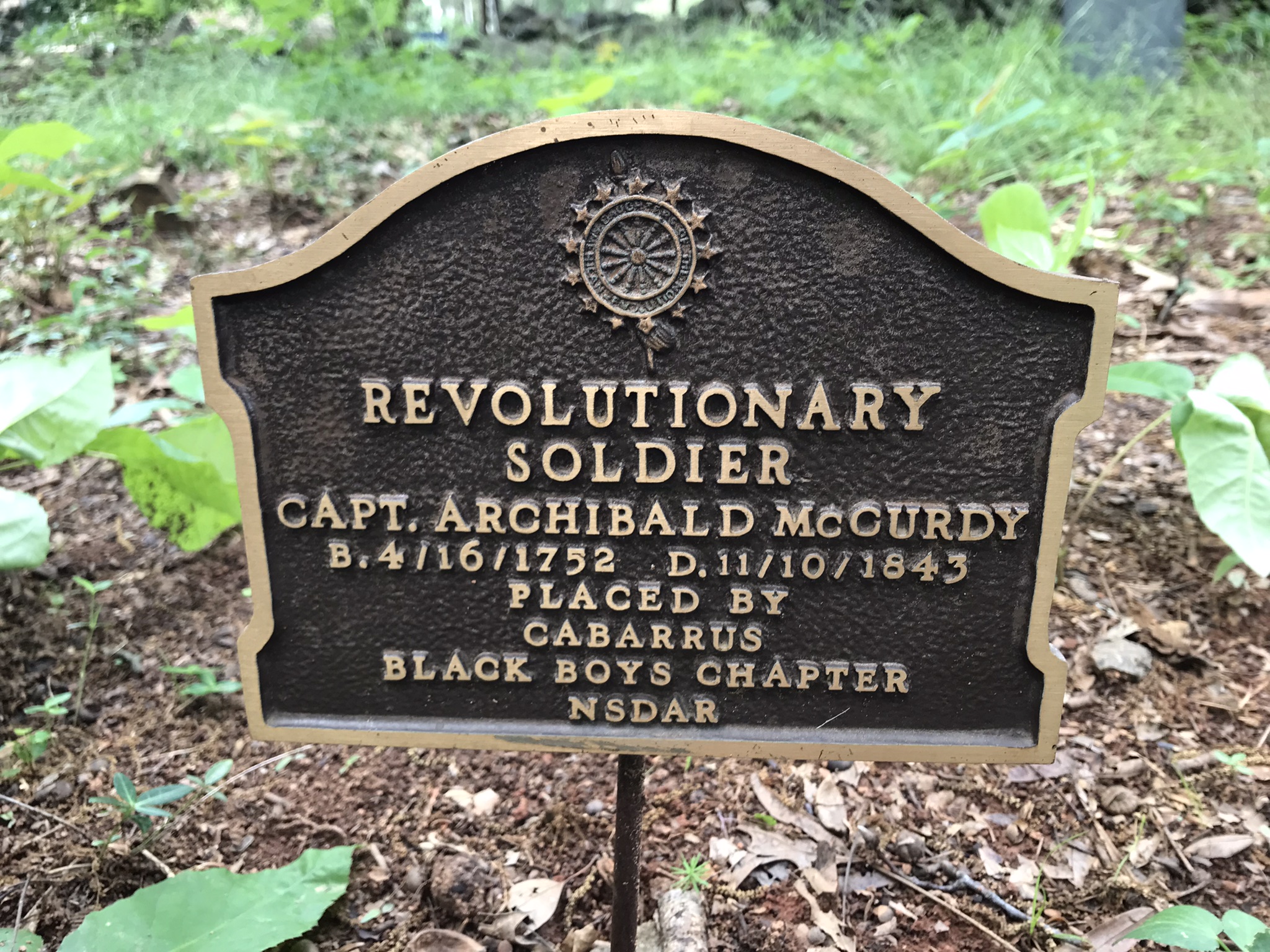
Marker placed at Archibald McCurdy’s grave by the Daughters of the American Revolution
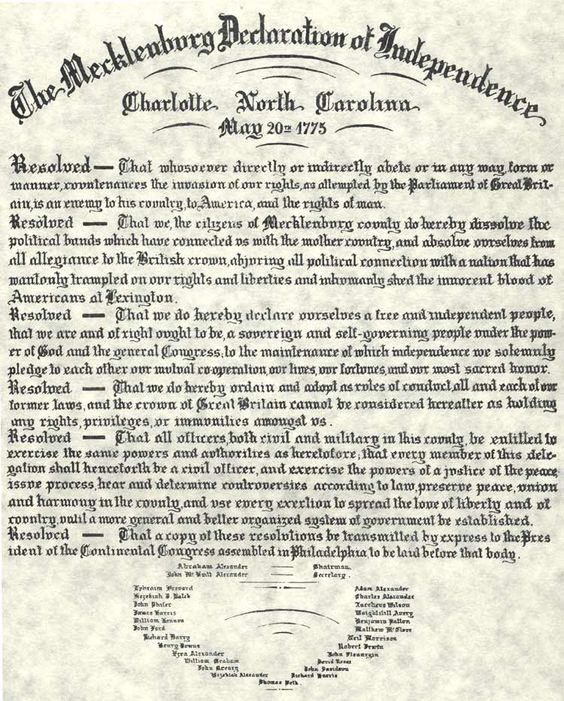
The story is set in May 1775 at the time of the signing of the Mecklenburg Declaration of Independence. I was inspired by a story I’ve heard all my life about what Archibald McCurdy did on the day that document was signed.
You can find the paperback at Second Look Books in Harrisburg, NC, or ask for it at your local independent bookstore. Bookstores can order it from IngramSpark.
Today’s blog post is an edited local history newspaper column I wrote for the August 23, 2006 edition of Harrisburg Horizons newspaper, Harrisburg, North Carolina. Appearing in the newspaper as “Pioneer Mills: No Place for a Preacher’s Son,” it paints a picture of the Rocky River and Pioneer Mills communities in Cabarrus County in the 1870s.
Manse wasn’t ready!
The Rev. Joseph B. Mack came from Charleston, South Carolina in 1871 to be the pastor of Rocky River Presbyterian Church. When he and his family arrived, the manse the congregation was building for his family to live in was not completed.
Church members Robert Harvey Morrison and his wife, the former Mary Ann Stuart, moved their family into a tenant house and gave the new minister’s family their home in the Pioneer Mills community. This was no small sacrifice because the manse was not completed until 1873! The Morrisons’s two youngest children, an 18-year-old daughter and a 16-year-old son were still in the household, and Mr. and Mrs. Morrison were in their 50s.
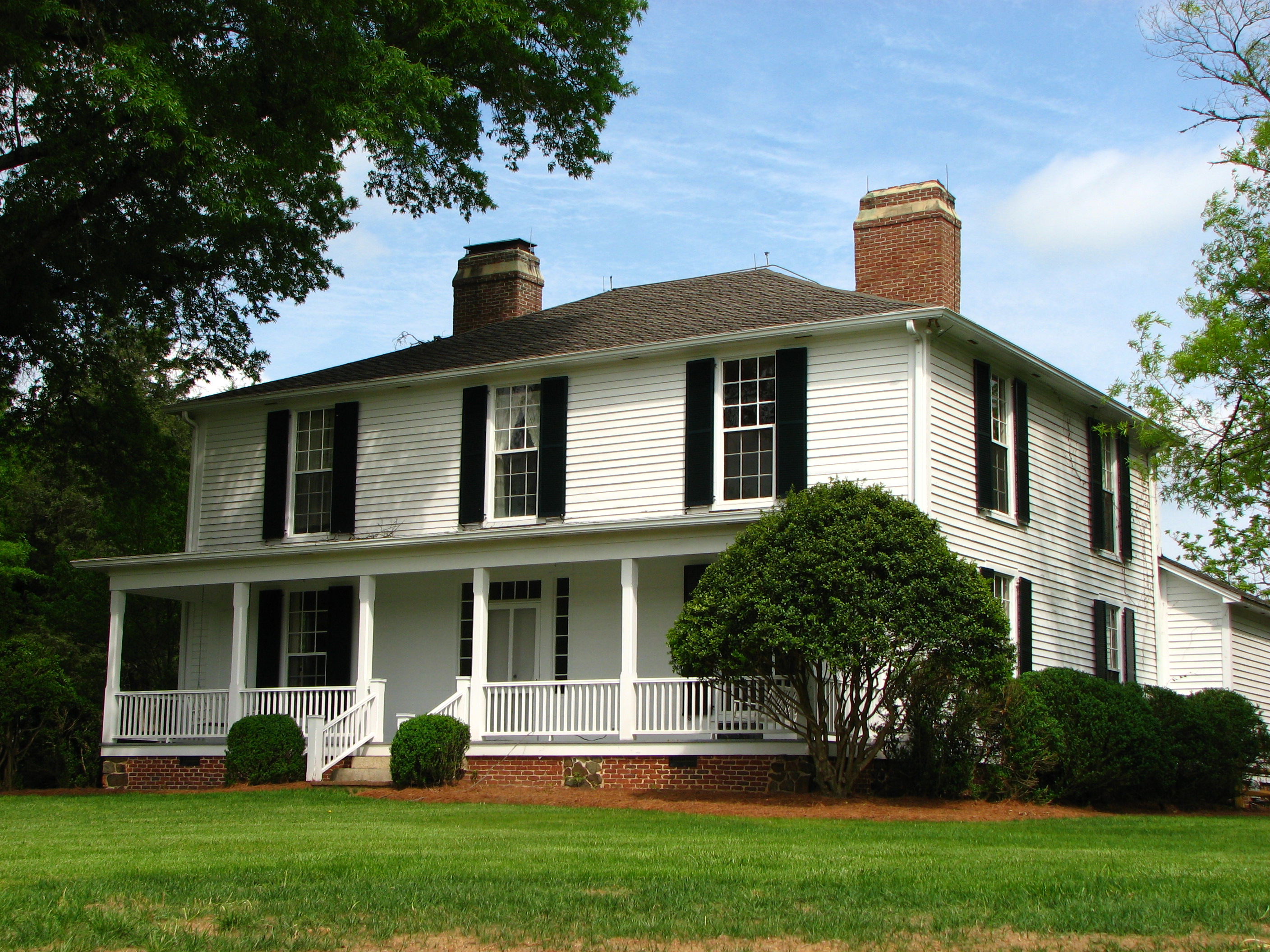
Robert Harvey Morrison Home, built circa 1846. (Photograph taken by Janet Morrison, May 3, 2008.)
The Robert Harvey Morrison home was built as early as 1846 when he inherited the land from his father. The house and its numerous out-buildings have been on the National Register of Historic Places since 1990.
In case you’re wondering
Robert Harvey Morrison was a relative of mine but not a direct ancestor. In the 1800s my part of the family didn’t live in grand houses like the one pictured. Gold was never found on the property my part of the family owned. There was a gold mine on the land that Robert Harvey Morrison inherited from his father.
Pioneer Mills was a gold-mining boom town in the early- to mid-19th century. It was apparently still a rip-roarin’ place in 1871.
Dr. William Mack’s memories in 1912
A special homecoming was held at the church on August 12, 1912. Rev. Mack’s son, Dr. William Mack, was unable to attend. He sent his regrets from New York and put some of his childhood memories on paper. Fortunately for us, his letter to homecoming master of ceremonies Mr. Morrison Caldwell was printed in the Concord newspapers the following week.
Dr. Mack wrote, “My first Rocky River recollection is of getting off the train at Harris Depot [now, Harrisburg, NC] and going in the dark to the home of Uncle Solomon Harris.” I don’t believe Dr. Mack was related to Mr. Harris. This was probably a term of endearment and respect.
He continued, “There we met Ed and ‘Little Jim’ (to distinguish him from ‘Big Jim,’ the son of Mr. McKamie Harris.) Uncle Solomon had the biggest fire-place I ever saw; it seemed as big as a barn door.
“Shortly afterwards we went to Pioneer Mills…. There… was the old Gold mine, Barnhardt’s store and McAnulty’s shoemaker shop…. While there I decided to become either a merchant or shoemaker, for Barnhardt’s store and McAnulty’s shop kindled young ambitions; better to ‘keep store’ or ‘mend shoes,’ than as a preacher’s son to be moving around from place to place.
“But Pioneer Mills was ‘no place for a preacher’s son.’ Soon we moved again; this time to the brand new brick parsonage, close by the church. We used to go to church in a big closed carriage drawn by two mules; now, every Sunday, we walked to church, going down a steep hill, across a branch, and through the grove to the famous old house of worship.”
Dr. Mack’s letter also read, “Those were happy years; happy in springtime with its apple blossoms, song birds, morning-glories and Tish McKinley’s Sassafras tea; happy in the summertime, with its blackberries and plums, its bob-whites in the wheat fields, its lightning and thunder storms, its bare-footed boys and girls, and its bitter quinine to keep off third-day chills; happy in the autumn time, with its white fields of unpicked cotton and its beautiful trees with leaves of myriad hues; and happy in the wintertime, with its snows, its big hickory back-logs, its boys in boots red-topped and toes brass-tipped, its red-cheeked girls in wraps and ‘choke rags,’ and its Christmas Holidays and turkeys.”
Dr. Mack’s colorful memories paint an idyllic picture of life in Township One in Cabarrus County in the early 1870s. I hope the children growing up here in the 21st century will have equally-as-fond memories of this place.
My sources
My sources for this blog post were the following: The Presbyterian Congregation on Rocky River, by Thomas Hugh Spence, Jr, 1954; The Concord Daily Tribune, August 16, 1912; The Concord Times, August 19, 1912; http://www.hpo.ncdcr.gov/nr/CA0498.pdf (photocopy of the National Register of Historic Places Registration Form for Robert Harvey Morrison Farm and Pioneer Mills Gold Mine); and Descendants of James & Jennet Morrison of Rocky River, by Alice Marie Morrison and Janet Sue Morrison.
Until my next blog post
Please share this or any of my other blog posts on social media by using the buttons below. Thank you!
I hope you have a good book to read. If you’re a writer, I hope you have productive writing time.



 Janet's Writing Blog