Newspaper Columnists Day – and My Experiences

When I say it was a great privilege for me to get to write 175 local history articles for a free local weekly newspaper in Harrisburg, North Carolina for almost seven years, it is an understatement.

I was paid $25 per article, which in no way compensated me for my time and any skill I had to write the pieces. My true payment came in the form of new friendships I formed, old friendships that were renewed, the incredible amount of history I learned, and the confidence the experience gave me to think that perhaps I did have some potential as a writer.

Harrisburg Horizons (NC) newspaper banner

As a white woman in my 50s, I did not fully understand that it was partly my white privilege that opened many doors for me – and had opened doors for me my entire life. I was genuinely curious about the lives of the elderly black people who had lived their entire lives in the township in which I lived, but I will never be able to fully grasp what I was doing when I asked several of them individually to allow me into their homes to ask them some personal questions.

They had been born into a segregated society in the early years of the 20th century. I had been born into a segregated society in the early 1950s, but I was white. I could not identify with the challenges they had faced all their lives.

They opened up to me and told me things they maybe had never even told their children. I heard stories of discrimination that were mandated by law. What I did not hear from a single one of them was bitterness. That was the most impressive lesson I learned from my experience as a low-level newspaper columnist.

Getting to sit for hours with a veteran of World War II who was eager to share his memories was another experience I was honored to have while writing for Harrisburg Horizons newspaper. I got to hear first-hand the vivid memories he had while training for the D-Day invasion of France. It was from him I heard about the sights, sounds, and smells of D-Day. I heard about the relentless trudging along through non-stop war through the bloody beaches, the towns, the villages, the forests, and the farmlands of Europe.
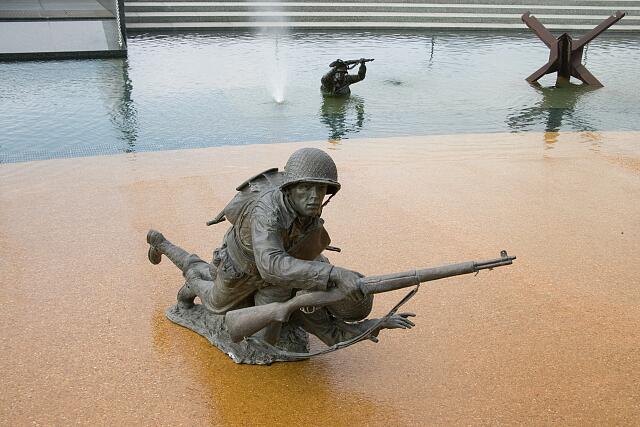
Photo from National D-Day Memorial in Bedford, Virginia. Photograph from Library of Congress website

A stark contrast between that war and the wars in the late 20th century and early 21st century is that the World War II soldiers were there for the duration of the war. There was no deployment with a pre-announced ending date. The only way they could communicate with their loved ones was through slow-moving letters.

I approached another local World War II veteran who was on the USS Missouri and witnessed Japan’s surrender to General MacArthur, but he was disinclined to speak of the war. I respected his wishes and never spoke to him about it again. Many combat veterans do not want to talk about their experiences and we should always respect their wishes.

Many of the men and women I interviewed were parents of schoolmates of mine. I had known them to various degrees. I’d never met the mother of one of my black classmates until I went to interview her. She shared memories of attending a Rosenwald School.
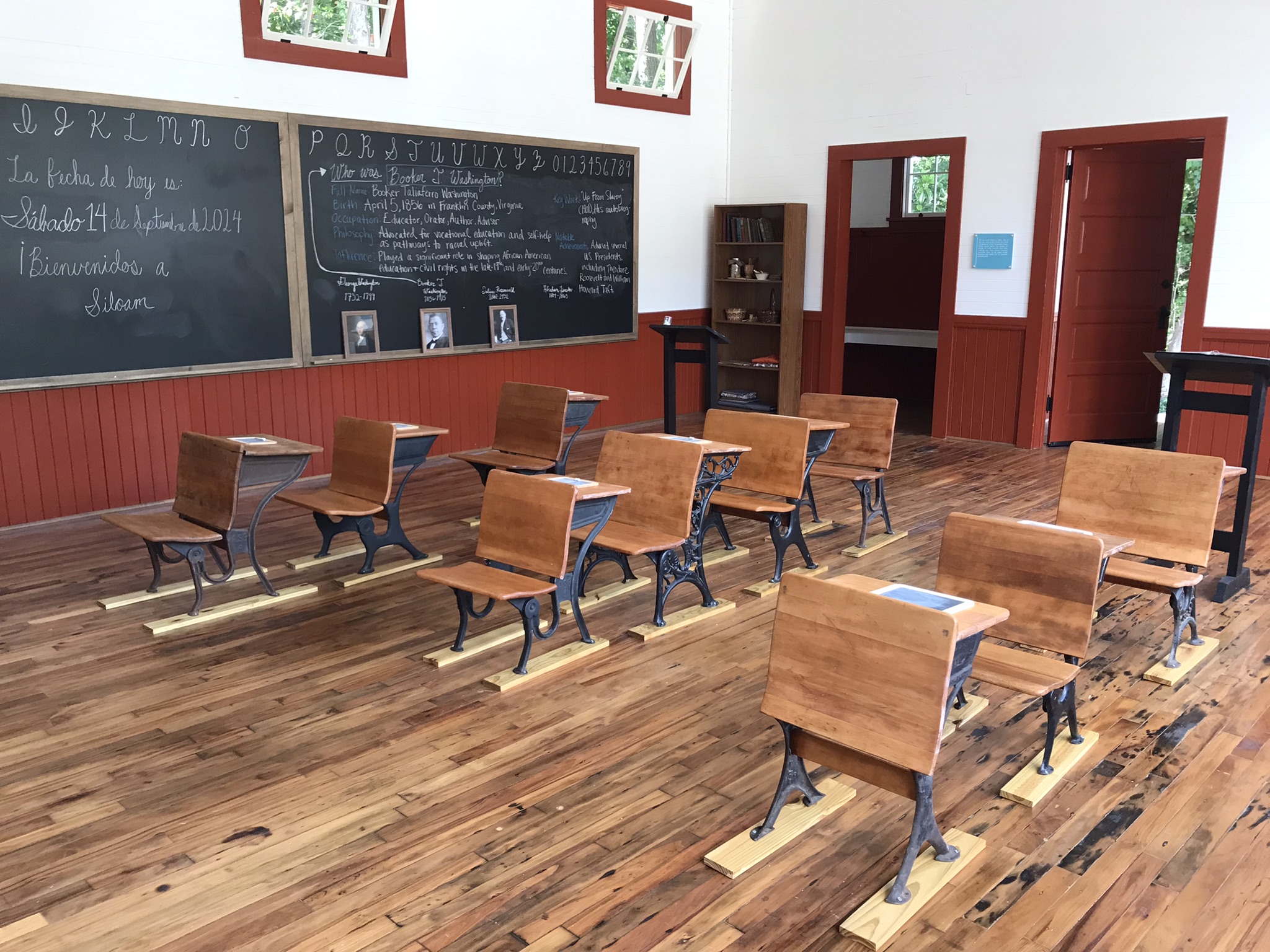
Classroom in restored Siloam Rosenwald School in Charlotte, NC, 2024

The veteran of D-Day was my family’s mail carrier for decades, so I also got to interview him about his days as the only mail carrier for decades in the wider community. I only knew him as my mailman and Gail’s dad, so it was a revelation to learn that he had participated in the D-Day invasion, the Battle of the Bulge, Bastogne, the Huertgen Forest, … seeing General Dwight D. Eisenhower in person, etc.

After I wrote about a fighter pilot from Harrisburg being killed when his plane was shot down over Buigny, France during World War II, I heard from a resident of Buigny. He sent me photographs of the village and the field where Carl Higgins’ plane crashed on March 5, 1944. The D-Day veteran I interviewed said, “Carl is my hero.”
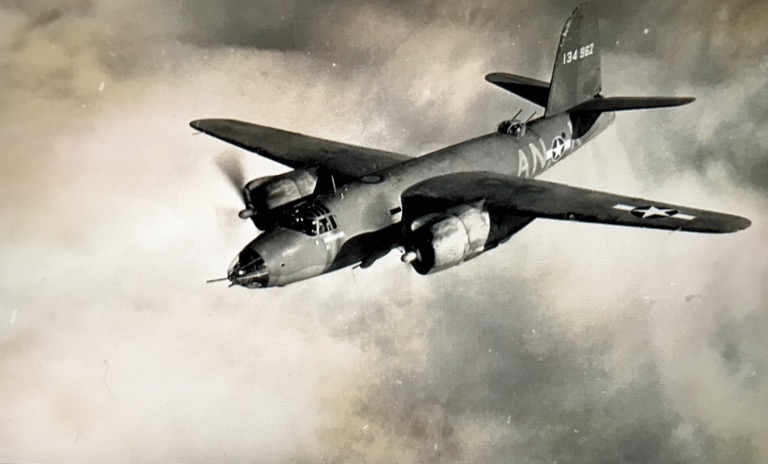
The B-26 Marauder flown by Carl Higgins, Jr. of Harrisburg, NC.

Later in his business life, the father of another of my classmates met Madame Chiang Kai-shek, wife of the Chairman of the National Government of the Republic of China. When he identified himself as being from Harrisburg, North Carolina, Madame Chiang immediately lit up and told that she remembered stopping at the depot in Harrisburg when she rode the train from Boston to Macon, Georgia to visit her sister!
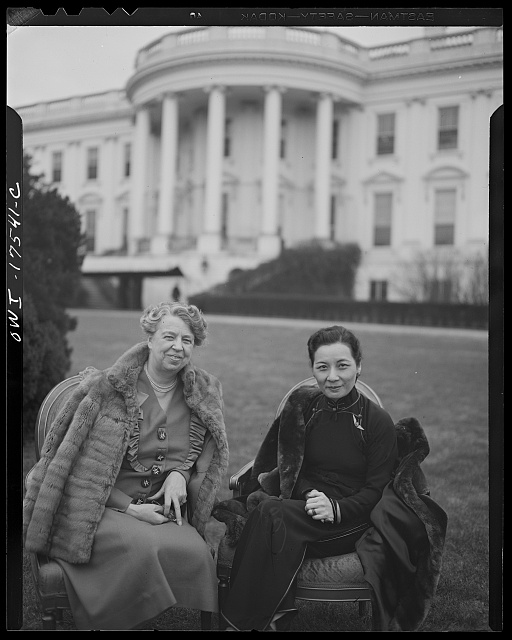
First Lady Eleanor Roosevelt with Madame Chiang Kai-shek. Photo from Library of Congress website.

The father of another classmate regaled me with his memories of growing up very poor, his family moving from one farm to another as sharecroppers, his marriage to his childhood sweetheart in 1936, purchasing his first car – and being berated about that purchase by the farmer he was a sharecropper for, how he had to quit school when his older brother literally jumped a train in Harrisburg during the Great Depression and made his way to Washington, DC… and much more.

In addition to interviewing individuals, I spent hours at the public library reading old newspapers and some hand-written records on microfilm. Oh, the headaches and eye strain!

One of the unexpected gifts of writing the local history column was the vast amount of history – local and national – that I learned. I had proposed to the editor of the new (week old!) newspaper that I had an idea for a column: local history. I did so because I knew a lot of local history and I enjoyed writing.

I quickly learned that there was a massive amount of local history that I did not know. While pouring over microfilmed newspapers from the 1800s and early 1900s, I often happened upon a tidbit about an event, an organization, a government policy, a person about which I was unaware.

Examples of the things I learned by chance from those old newspapers and other resources are the meteorite that fell here in 1849, a man whose occupation in the 1880 U.S. census of Cabarrus County was listed as “witch doctor,” the evolution of information gathered over the years via the U.S. Census, a head-on collision of two trains in Harrisburg in 1897, the oldest woman in North Carolina died here in 1930 at the age of 112, and the Sauline Players whose performances I enjoyed in elementary school was a theatre troupe based here in North Carolina.

I got to correspond with a Hollywood actress, Joan McCrea, whose career started with the Sauline Players. After contacting her former agent, who contacted her current agent, Ms. McCrea called me! She gave me invaluable background and behind-the-scenes details about the Sauline Players. The two newspaper articles I wrote about the Sauline Players have garnered more response from readers here and online than any of the other columns I wrote.
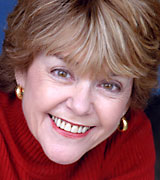
Actress Joan McCrea, who got her start with the Sauline Players in North Carolina

I have just scratched the surface of my 175 newspaper articles in today’s post. When I say, “All history is local, but no history is just local,” I base that on my experience as a newspaper columnist. It was an almost seven-year writing gig that opened my eyes to delve deeper into the things I knew and to explore the new things I learned.

I count my stint as a small-time, small-town newspaper columnist as one of the highlights of my life.

If you would like to read more about the topics I’ve mentioned today and all the topics I did not mention, please look for my two books – Harrisburg, Did You Know? Cabarrus History, Book 1 and Harrisburg, Did You Know? Cabarrus History, Book 2 – on Amazon in paperback and e-book. If you live in the Charlotte area, you can find all my books in paperback at Second Look Books in Harrisburg.
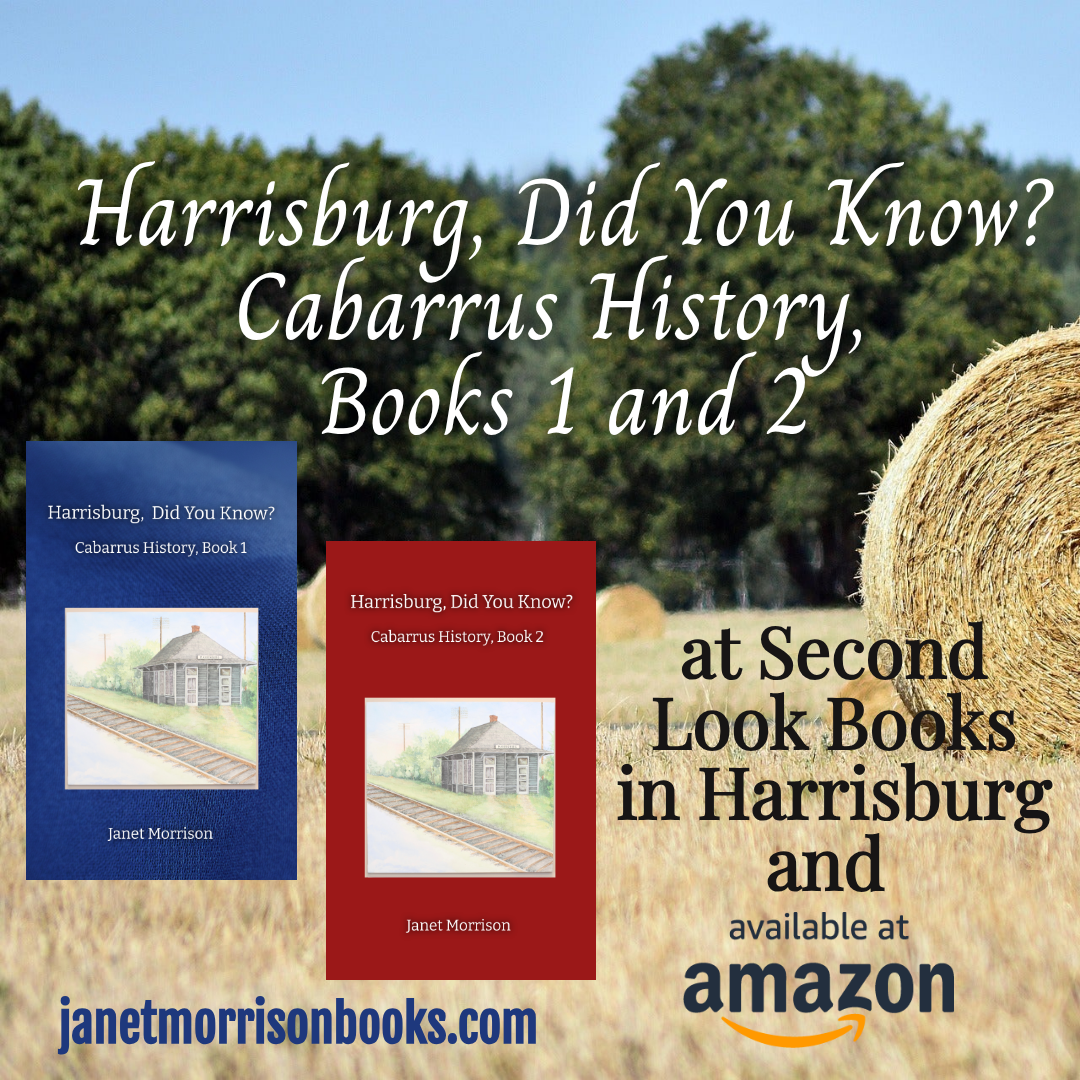
Book 1 contains the first 91 newspaper columns I wrote. Book 2 contains not only the other 84 columns but also my research notes from the numerous topics I did not get to write about when Harrisburg Horizons newspaper ceased operation in 2012.

Happy reading!

Janet

All history is local, but no history is just local.

Do you associate volcanoes with North Carolina?

Now that I have your attention… today’s blog post is about ancient history. This is one of the topics I wrote about in Harrisburg, Did You Know? Cabarrus History, Book 2.

Photo of a volcano by Guille Pozzi on Unsplash.com.
Photo by guille pozzi on Unsplash

Harrisburg, North Carolina sits inside a 22-mile syenite or ring dike. One can get a feel for it from several high points in the area, such as when traveling south from Concord on US-29 near the intersection with Union Cemetery Road. It’s like looking across a gigantic bowl.

Another possible place from which to catch a glimpse of the “bowl” is on NC-49 southbound after you pass Old Charlotte Road. The Charlotte downtown skyline is visible briefly from that location as well as the one referenced above on US-29.

Harrisburg, Did You Know? Cabarrus History, Book 2, by Janet Morrison

What, you may ask, is a syenite or ring dike? I’m no expert on volcanology, but my understanding is that it is a circular dike around a volcano.

According to 2001 Encyclopedia of Earthquakes and Volcanoes, by David Ritchie and Alexander E. Gates, Ph.D.:

“If magma is removed from the magma chamber beneath a volcano, it can undergo caldera collapse. The volcano and the area around it collapse because they are no longer being held up by the liquid. A series of concentric faults and cracks develop around the collapsing volcano. As they do, magma will squeeze up around the cracks and faults forming ring dikes.”

I’ll take their word for it.

In 1966, U.S. Geological Survey geologist Harry E. LeGrand and Henry Bell III led a scientific excursion in Cabarrus County to study our ring dike and other interesting rock and mineral deposits in the county.

You might be able to access a pdf of “Guidebook of Excursion in Cabarrus County, North Carolina, October 22-23,1966” by going to https://www.carolinageologicalsociety.org. Search for “1960s Field Trip Guidebooks” and then scroll down to find that particular guidebook.

The Harrisburg area has experienced a population explosion since 1966. The landmarks noted in the 1966 guidebook are either gone or more difficult to locate today. The concentric rings that were reportedly visible from the air in 1960 by R.G. Ray might not still be intact.

If you’d like to know more about this topic, the 1849 meteorite; Harrisburg’s first organized housing and business development of 100 years ago; the Morrison-Sims Store and Old Post Office; the flood of 1886, the Piedmont Area Development Association (P.A.D.A) of the 1960s; earthquakes that have been felt here; McCachren’s Store; Rocky River bridges in the 1870s; the Sauline Players; a tribute to George L. Govan; Rocky River Academy; the Rocky River Presbyterian Church’s fourth sanctuary which was completed in 1861; a 1777 estate sale; Hugh Smith Pharr and his mill; a 1907 attempted train robbery; 1816 – the year without a summer;

Also: items such as milk, apples, and dry cleaning that were all delivered to homes in the mid-1900s; Blume’s Store; high-speed trains; the boundaries of Township 1; early Harrisburg education; Pharr Grist Mill on Back Creek; how electricity came to Harrisburg; a 1912 church homecoming; Pioneer Mills Gold Mine and Community; a fellow named Collett Leventhorpe; a 1911-1912 debating society; and the tenth anniversary of the Harrisburg Branch of the Cabarrus County Public Library system… please purchase Harrisburg, Did You Know? Cabarrus History, Book 2.

The book also contains nearly 150 pages of my research notes on subjects I didn’t get to write about when I wrote a local history newspaper column from 2006-2012.

Harrisburg, Did You Know? Cabarrus History, Book 1 and Book 2 are available in paperback at Second Look Books, 4519 School House Commons in Harrisburg, NC.

Second Look Books, 4519 School House Commons, Harrisburg, NC

They are also available in paperback and e-Book from Amazon at https://www.amazon.com/dp/B0BW2QMLHC/.

An infographic ad for Harrisburg, Did You Know? Cabarrus History, Books 1 and 2

Until my next blog post

I hope you have a good book to read.

I hope you get to spend quality time with friends and family.

Remember the people of Ukraine.

Janet

P.S. Please visit https://www.janetmorrisonbooks.com and subscribe to my e-Newsletter. Next issue due out the first week of January!

The Sauline Players Theatrical Troupe Thrilled Audiences in 20th Century

Did you ever see the Sauline Players perform? Chances are you did if you went to school in the piedmont of North Carolina in the early- to mid-1900s.

As I write that, though, it occurs to me that I don’t know if they performed at the schools for black children. I hope they did, for their performances were a real treasure for those of us who lived in rural areas and didn’t have easy access to live theatrical performances.

Two of the 91 local history articles in my new book, Harrisburg, Did You Know?  Cabarrus History, Book 1, are about the Sauline Players. I’ll share some highlights from those articles in today’s blog post.

When I researched the Sauline Players for Harrisburg Horizons newspaper in 2011, I was surprised to learn that the theatrical troupe was based in the small Gaston County town of Belmont, North Carolina. I have fond memories of their performances in the auditorium at Harrisburg High School in the early 1960s when I was in elementary school.

In 2010, I learned that Joseph Sauline was with another traveling acting troupe in Charlotte in the 1920s when that company went broke. Not to be outdone, Mr. Sauline stayed in the area and organized his own acting group — the Sauline Players.

An online search in 2010 led me to a Sauline Players listing on the acting resume of Ms. Joan McCrea. I was able to get in touch with her agent, who in turn gave Ms. McCrea my contact information. Imagine my surprise one day when I answered the phone and found actress Joan McCrea in Los Angeles on the other end of the line!

The ensuing correspondence with Ms. McCrea turned my single newspaper article about the Sauline Players into a two-part series.

If you want to know more about the Sauline Players and other local history articles I wrote for Harrisburg Horizons newspaper, look for my book, Harrisburg, Did You Know?  Cabarrus History, Book 1.


Harrisburg, Did You Know?
Cabarrus History, Book 1,
by Janet Morrison

Where to purchase Harrisburg, Did You Know?  Cabarrus History, Book 1

Paperback available at Second Look Books, 4519 School House Commons, Harrisburg, NC

Paperback and e-book available from Amazon:  ­­­­­­­­­­https://www.amazon.com/Harrisburg-Did-You-Know-Cabarrus/dp/1888858044/.


Since my last blog post

My book received a lot of positive and well-placed publicity last week. The proprietor of Second Look Books in Harrisburg tells me sales have been brisk.

I took a long enough break from formatting Harrisburg, Did You Know?  Cabarrus History, Book 2 to design the cover for the paperback. Then, it was back to formatting. I’m pleased to have the cover designed so I could mark that task off my to-do list.


Until my next blog post

I hope you have a good book to read. I’m reading a couple of books now. It’ll be interesting to see how many I get read in January.

Remember the brave, freezing people in Ukraine.

Janet