
It was on this date 156 years ago that African American men were given the right to vote when the 15th Amendment to the U.S. Constitution was ratified.
You might be surprised to know that it was the Republicans who pushed for this amendment. Yes, the same party which today turns itself into a pretzel dreaming up ways to make it more difficult for citizens to vote is the party that fought to give black American men the right to vote in 1870. The irony!
The 15th Amendment did not address the fact that women of any skin color did not have the right to vote.
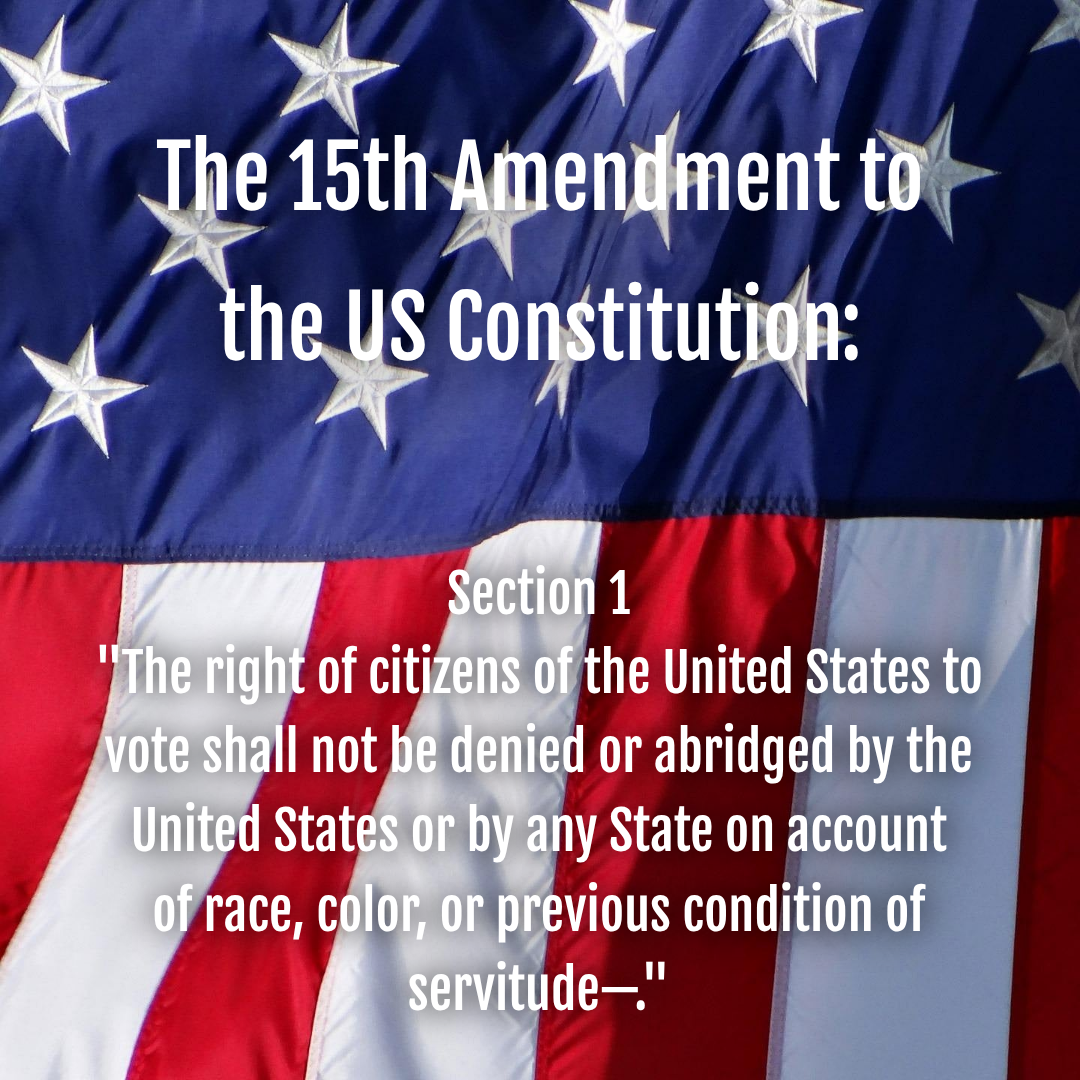
Section 1 of the 15th Amendment states: “The right of citizens of the United States to vote shall not be denied or abridged by the United States or by any State on account of race, color, or previous condition of servitude–.”
Although ratified in 1870, it would take the Voting Rights Act of 1965 before many black people were registered to vote. Laws varied by state and state legislatures – much like today – resorted to creative ways and wording in laws to restrict voting rights.
Popular opinion is that it was only southern states that restricted voting to white people, so I decided to do a little research into state laws prior to 1870. (Keep in mind that women were not given the right to vote by the U.S. Constitution until the 19th Amendment was ratified in 1920.)
I wanted to know if black men were allowed to vote in states outside the South before passage of the 15th Amendment in 1870. Out of curiosity, I randomly looked at New York, Ohio, Pennsylvania, and New Jersey.
In the State of New York, there was a mish-mash of voting rights for black men. In the 1820’s it was unlawful for a black person who did not own property valued at $250 or more to vote. Slave owners along the Hudson River (yes, even New Yorkers owned slaves!) did not let their slaves vote. Some black men in the state’s cities were able to vote.
Although the “Black Laws” in the state of Ohio were repealed in 1849, African Americans were still not allowed to vote. An informative article about the history of laws regarding African Americans in Ohio can be found here: https://eji.org/news/ohios-black-laws/.
What about Pennsylvania? Quoting from “The Disenfranchisement of Black Pennsylvanians in the 1838 State Constitution: Racism, Politics, or Economics? – A Statistical Analysis,” by David A. Latzko of Pennsylvania State University’s York campus, as found at https//:tupjournals.temple.edu: “In 1838, Pennsylvania’s voters approved a state constitution that restricted the right to vote to ‘white freemen.’ Blacks had voted for many years in some parts of the state, but under the new constitution Pennsylvania’s black males could no longer vote.”
I found the following information on https://libguides.njstatelib.org/votesforwomen/timeline: In 1807, a new law restricting voting was passed by the New Jersey General Assembly: “Whereas doubts have been raised, and Great diversities in practice obtained through-out the state in regard to the admission of aliens, females and persons of color, or negroes to vote in elections… Sec. 1. Be it enacted …That … no person shall vote in any state or county election… unless such person be a free, white, male … of the age of twenty-one years, worth fifty pounds proclamation money….”
New Jersey adopted a new State Constitution in 1844, and people of color were still not allowed to vote.
In the decades after the ratification of the 15th Amendment, racists in various states passed laws to make it hard for minorities to vote. Such things as poll taxes and literacy tests were codified.
This was still in the decades of Reconstruction following the Civil War. Most of the former slaves had not been allowed to learn how to read or write, so the passage of literacy laws was a not-so-subtle way to prevent many black people from voting.
My conclusion is that people of color have been discriminated against in every state in the United States of America. Our nation has a long and sorted history of dividing ourselves based on the color of our skin.
It is that 250-year history that has brought us to 2026 – a year in which the U.S. Constitution gives all citizens — regardless of skin color or gender – the right to vote. But women and people of color must remain vigilant in every State to guard our right to vote.
In 2026, various State legislatures and even the United States Congress are working behind the scenes as well as blatantly in public to make it more difficult for all citizens to exercise their right to vote. The so-called SAVE America Act is currently being batted back and forth between the U.S. House and U.S. Senate.
A segment of our society has been convinced by Conservatives that there is rampant voting by undocumented immigrants. Under the guise of putting an end to that problem — which has been proven not to exist — through passage of the SAVE America Act the Conservatives in Congress are working very hard to codify wording that will once again make it more difficult for many women and many people of color to vote.
The more things change, the more they stay the same. White men in America continue to be afraid of losing their power. It is a history much older and more widespread than the United States of America.
Janet
The government should be afraid of its citizens, not the other way around.




 Janet's Writing Blog