Seasonal Affective Disorder in November

I tried reading several novels in November that just didn’t grab my attention. I will not name them here. It’s disappointing to sit down to read a book and just not get “into it” even after 10 or 20 pages.

Still Life, by Louise Penny

The only book I read in November was Still Life, by Louise Penny. It was the book read by the Rocky River Readers Book Club last month. I really tried to like it, but I just couldn’t stay interested in it. Don’t blame the author or the book. Louise Penny is a popular author. I believe it wasn’t the right time for me to try to read her first book.

One of the items in the Reader’s Bill of Rights (my blog post two weeks ago:  Reader’s Bill of Rights) is the right to skip pages. I did too much of that while reading Still Life, so when I got to the last page I still didn’t know “who dunnit.” I enjoyed the book club discussion of the book last Monday night and found out how much I’d missed by not giving it my full attention.

After reading four to six books every month in 2017, suddenly in November I lost my motivation to read. I wanted to read. At first, I thought I was distracted by my desire to get back to work on my historical novel manuscript. It just didn’t work out very well.

Seasonal Affective Disorder

As I wrote today’s blog post, I concluded that the culprit in my recent inability to concentrate enough to read is Seasonal Affective Disorder. In case you aren’t familiar with this disorder, there is reliable information about it at the Mayo Clinic’s website:  https://www.mayoclinic.org/diseases-conditions/seasonal-affective-disorder/symptoms-causes/syc-20364651. I think I’ve had it all my life but just got a diagnosis several years ago.

cameron-stow-91861

Photo by Cameron Stow on Unsplash

What I’m reading

As November came to a close, I was halfway through The Quantum Spy, by David Ignatius. I’m eager to find out who the “mole” is, but Seasonal Affective Disorder is restricting my reading time and messing with my ability to concentrate.

I’ve checked out A Gentleman in Moscow twice. This time, I hope to finish reading it. Last Christmas in Paris, by Hazel Gaynor and Heather Webb. It is the December book choice for an online book club I joined earlier this fall. It’s a book reminiscent of The Guernsey Literary and Potato Peel Pie Society, by Annie Barrows.

I also continue to listen to The Rooster Bar, by John Grisham, but you know I’m not a fan of books on CD. I’m on the waitlist for the electronic copy of it at the public library. One way or the other, I will finish it.

The Spanish Coin

I’ve worked on my scenic plot outline for the rewrite of The Spanish Coin several days in the last week in an effort to get it off “the back burner.” The outline kept calling my name in November and I was excited to get back to it. I hadn’t worked on it in several months, so I had to reacquaint myself with the new plot line.

My blog is about my journey as a writer, and that includes my reading. That journey was bumpy in November. Better days lie ahead as my Seasonal Affective Disorder symptoms abate in the coming months. Too bad I can’t live in the northern hemisphere from April until mid-September and then live in the southern hemisphere for the remainder of the year!

Until my next blog post

I hope you have a good book to read. I’ll try to finish the books I’ve started.

If you’re a writer, I hope you have quality writing time.

Janet

“More in common than we think”

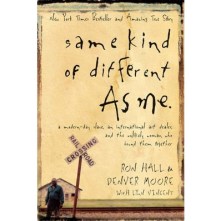
For today’s blog post I’m highlighting two sentences from Same Kind of Different As Me, by Ron Hall and Denver Moore with Lynn Vincent. You may recall that I read this nonfiction book in September and commented about it in my October 2, 2017 blog post, Some Great September Reads.

0849900417.jpg.1458336228
Same Kind of Different as Me, by Ron Hall and Denver Moore, with Lynn Vincent

“ʻEver man should have the courage to stand up and face the enemy,’ I said, “ʻcause ever person that looks like a enemy on the outside ain’t necessarily one on the inside. We all has more in common than we think.’” – Homeless man Denver Moore speaking in Same Kind of Different As Me, by Ron Hall and Denver Moore with Lynn Vincent.

Lessons to learn

We can all probably learn many lessons from Same Kind of Different As Me. I think the theme of the book is that under the pigment shade of our skin, we are all the same. When we judge others based on their outward appearance, we often rob ourselves of an opportunity for making a new friend, or at the very least, an opportunity to have cordial interaction with a stranger.

I’m not naïve enough to advocate that we just approach strangers willy-nilly and befriend them. There are people out there who are up to no good; however, that is not a good excuse for being afraid of everyone who does not look like we do.

Polarization in America

In our current polarized population in the United States, it seems we’re becoming more a nation of “they” and “us” than the “melting pot” I grew up learning about in history classes. We tend to fear the unknown. As long as our fellow citizens whose skin is a different shade from our own are seen as people to be feared or as an enemy, we will continue to be a divided people and none of us will be able to reach our potential. Our nation certainly won’t reach its potential until we learn how to get along with one another.

This applies to people of another racial or ethnic background, but it also applies to people who espouse political stances different from our own. I’m old enough to remember when Democrats and Republicans could agree to agreeably disagree. Now it seems that neither side has any desire to try to reach common ground on any issue.

Discovering the fun of compromise

As a political science major in college, one of the courses that still stands out in my memory is the one called The Legislative Process. Going into the course, I wasn’t very excited. I had never been a political person. I was studying political science to prepare myself for a career in city management (or so I thought.) Much to my surprise, The Legislative Process turned out to be an invigorating course.

Class members were arbitrarily divided into two groups. Each group was assigned a piece of legislation they had to fight to get passed. Of course, the two proposed laws were polar opposites of each other. The two groups had to work together and create a compromise bill.

I recall that one day when the bell rang and we were supposed to leave the classroom so another class could come in, the professor struggled to get us to stop debating and leave. Although we knew we could pick up where we left off at our next class meeting two days later, we were so wrapped up in the process – and HAVING SO MUCH FUN – that we didn’t want to stop. I have forgotten many of the intricacies of that political science course, but I accidentally learned that compromise can be fun.

The “takeaway”

Let’s stop being afraid of one another and start letting ourselves find the fun and joy that come from interacting with one another and finding common ground. And when we cannot readily find common ground, let’s remember how – or learn how – to compromise.

Find a place for compromise in your own life and work to get compromise back into the vocabulary and mindset of our local, state, national, and world leaders.

When I sat down to write about those two sentences from Same Kind of Different As Me, I thought I knew where I was going. I anticipated writing a short, maybe 300-word blog post. Like life and the legislative process, though, writing has many surprises. One of them is that this blog post is approaching 1,000 words.

Until my next blog post

I hope you have a good book to read. David Ignatius’s new thriller, The Quantum Spy is in transit to me at the public library. I have enjoyed his other novels, so I’m looking forward to reading this one.

After being overwhelmed this year with books I wanted to read, I plan to cut back somewhat on my reading for a while and spend more time on my writing. It is said that one has to read a lot in order to be a good writer.

I’ve learned a lot from the many good books I’ve read in 2017, and now I look forward to putting some of that new knowledge into practice by getting back to work on my historical novel manuscript with the working title, The Spanish Coin.

It’s been fun to work on my manuscript’s outline the last few days. There’s another surprise! I never thought I would use the words “outline” and “fun” in the same sentence. Outlining a work of fiction is hard work but, when I’m in the proper frame of mind, it can also be fun.

If you are a writer, I hope you have found the perfect balance between reading and writing. I hope you have productive writing time.

Janet

Some Good New Books

I’ve read some very good books this year, and it’s been a pleasure to share my thoughts about them on my blog. Today’s blog post highlights the five novels I read in October. Four of them (Love and Other Consolation Prizes, by Jamie Ford; The Deep Dark Descending, by Allen Eskens; The Last Ballad, by Wiley Cash; and The Stolen Marriage, by Diane Chamberlain) were published in October. The other book, News of the World, by Paulette Jiles, was published in October of 2016.

 Love and Other Consolation Prizes, by Jamie Ford

9780804176750
Love and Other Consolation Prizes, by Jamie Ford

I eagerly awaited the release of Jamie Ford’s latest novel, Love and Other Consolation Prizes, and it did not disappoint. After hearing Mr. Ford speak at the Bookmarks Festival of Books and Authors in Winston-Salem, North Carolina in September, I really looked forward to reading this book. My September 18, 2017 blog post, Bookmarks Festival of Books and Authors, was about that festival and the seven authors I got to hear speak.

Historical fiction is near and dear to my heart, so it’s no wonder that I enjoyed reading Love and Other Consolation Prizes. Mr. Ford took a reference to an actual shocking event at the 1909 Alaska-Yukon-Pacific Exposition held in Seattle, Washington and created a powerful story about the young boy named Ernest who was raffled off at the Exposition. Yes. You read that correctly. Something different was raffled off each day of the fair, and one day it was an orphaned child!

The Chinese slave trade around the turn of the 20th century and the thriving red light district of Seattle in the early 1900s provided the perfect backdrop for this book. Mr. Ford gives us chapters set in 1909-1911 and chapters set in 1962 around the World’s Fair in Seattle so we can follow the amazing fictional life of Ernest – a mixed race boy from China.

 The Deep Dark Descending, by Allen Eskens

deep-dark-descending-225
The Deep Dark Descending, by Allen Eskens

I became a fan of Allen Eskens’s writing when I read his first novel, The Things We Bury. I’ve now read all four of his novels. Here are the links to my blog posts that talked about his first three novels:  The Life We Bury, by Allen Eskens; What I read in January; My writer’s notebook; and What I Read in April  ­.

The Deep Dark Descending is a dark story of just how deeply a person can descend when his anger, bitterness, and desire for revenge become an obsession.

In this novel, Minneapolis homicide detective Max Rupert sets out to find and punish the person or persons who murdered his wife. The case had been ruled an accident, but Rupert could not accept that.

The Deep Dark Descending takes the reader to the frigid Minnesota-Canada border and a frozen lake. Put this novel on your winter reading list.

The Last Ballad, by Wiley Cash

lastballadhc_c
The Last Ballad, by Wiley Cash

The Last Ballad is author Wiley Cash’s newly-released novel. It is set in Gaston County, North Carolina and is based on the life of textile millworker Ella May Wiggins. Ms.Wiggins was murdered in Gastonia, North Carolina in 1929 during a riot that resulted from efforts to organize the millworkers into a union. Labor unions have never been popular in the state, and that was definitely the case in the textile industry in the early 20th century.

Although I grew up an hour from Gastonia, I had never heard about this incident. In fact, Wiley Cash is a native of Gastonia and he only recently learned of it.

The Last Ballad takes the reader into a world of poverty inhabited by both black and white millworkers in the 1920s. Ms. Wiggins was a white single mother who lived in an otherwise black neighborhood. She was instrumental in trying to get her black neighbors and co-workers the right to strike for better wages. The white workers didn’t have the right to strike either, but until Ms. Wiggins pushed the point, the possibility of black workers going on strike was unimaginable in that time and place.

This is a story of a woman’s courage as she fought for better working and living conditions for her children and her neighbors.

The Stolen Marriage, by Diane Chamberlain

newcoverTSM
Diane Chamberlain Author Event The Stolen Marriage, by Diane Chamberlain

After having met Diane Chamberlain at the On the Same Page Book Festival in West Jefferson, North Carolina last year (Diane Chamberlain Author Event )and enjoying two of her other novels (Pretending to Dance A Novel’s First Line and The Secret Sister Books I’ve been reading), I got on the waitlist for The Stolen Marriage as soon as it was “on order” at the public library. The novel’s October 3, 2017 release date finally arrived!

I love it when I can read an expertly-written novel and learn something at the same time. Like Wiley Cash’s The Last Ballad, Diane Chamberlain’s The Stolen Marriage delivered in a big way. I regret that I cannot read The Stolen Marriage again for the first time. It was that good!

The Stolen Marriage was inspired by the true story of the citizens of Hickory, North Carolina building – and getting up and running – a hospital for polio patients in just 54 hours in 1944. Being a native of North Carolina, born in 1953, this is another piece of history that I didn’t know. It was an amazing feat in this small town in Catawba County, and it was covered by Life magazine. In historical literature, it is referred to as “The Miracle in Hickory.”

The fictional story Ms. Chamberlain created around this event is one of trust, love, and betrayal. There are numerous plot twists in this novel. It will keep you up at night turning pages.

 News of the World, by Paulette Jiles

6.png
News of the World, by Paulette Jiles

The premise and title of News of the World, by Paulette Jiles, intrigued me when I read a blurb about it, so I borrowed it from the public library.

This is a tale of a fictional character known as Captain Kidd who traveled around Texas in the 1800s getting paid to have public readings of articles from various newspapers. Many people were illiterate and newspapers were rare in the region.

Captain Kidd agrees to return Johanna, a young white girl, to her family in southwest Texas. Years earlier, Johanna had been kidnapped by the Kiowa tribe of Native Americans. Being raised by the Native Americans, Johanna had no recollection of the habits and mores of her white family.

Johanna and Captain Kidd had a shaky and unpredictable relationship as Kidd tried his best to fulfill his promise to return Johanna to her family. Their journey across Texas is filled with misunderstandings, attacks by outsiders, challenging traveling conditions, and additional attempts to kidnap Johanna. The two of them gradually learn how to communicate and co-exist.

News of the World is the second novel I’ve read recently that did not use quotation marks in dialogue. I guess I’m just old-fashioned, but I don’t like this practice. When I have to stop and think or reread something in a novel to figure out what’s narration and what’s dialogue or who’s talking, it pulls me out of the story and reminds me I’m reading. I’m sure dropping all the quotation marks saved the publisher some money, but I hope this doesn’t become common practice.

Until my next blog post

I hope you have a good book to read. I seem to have trouble “getting into” a book at the moment. I’m more in the mood to write than to read, so I’m taking advantage of that. The last several days I’ve worked on the timeline and outline for my historical novel I’m calling The Spanish Coin. I’ll keep you posted.

If you are a writer, I hope you have quality writing time.

Janet


Anne Lamott’s Gems for Novelists

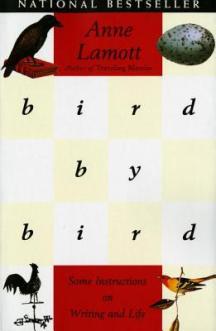
My blog post on August 7, 2017 (Late July Reading) was about the three books I read during the second half of July. I wanted to share more words of wisdom I gleaned from Anne Lamott’s book, Bird-by-Bird: Some Instructions on Writing and Life.

12543
Bird-by-Bird: Some Instructions on Writing and Life, by Anne Lamott

As I stated in that post, as someone learning the art and craft of writing, I enjoyed Bird-by-Bird, by Anne Lamott. The following quote from the book also sums up how I feel about good novelists.

“Ever since I was a little kid, I’ve thought that there was something noble and mysterious about writing, about the people who could do it well, who could create a world as if they were little gods or sorcerers. All my life I’ve felt that there was something magical about people who could get into other people’s minds and skin, who could take people like me out of ourselves and then take us back to ourselves. And you know what? I still do.”  ~  Anne Lamott

Ms. Lamott waxes poetic about what makes a book a good book. I cannot say it any better than she does in the first chapter. She writes about all the things books do for us.

She has some words of wisdom for people like me. One takeaway I took from the book was that I need to get over being a perfectionist.

Ms. Lamott talks about characters and gives tips about how to get acquainted with a character before you write about him or her. However, she cautions that you won’t really get to know your characters until “you’ve started working with them.”

My interpretation of one of her recommendations is for writers to focus on character and the plot will fall into place. You have to know what means the most to your protagonist so you’ll understand and can convey to the reader what is at stake in your novel. To quote her again:

“That’s what plot is:  what people up and do in spite of everything that tells them they shouldn’t,….” ~ Anne Lamott

Ms. Lamott writes about the parts of a novel and the importance of the writer paying attention to those details. If no one is changed in the course of the novel, it has no point. She writes about dialogue and how it must be written as real people talk. It’s essential to get voice right in order to get character right.

She writes, “We start out with stock characters, and our unconscious provides us with real, flesh-and-blood, believable people.” (I hope she’s right. I hope the unconscious part of my brain kicks in as I rewrite my manuscript for The Spanish Coin!)

All this is just the tip of the iceberg. She writes about a writer’s self-confidence and the importance of a novelist deeply knowing the setting for their novel. She says that a writer needs to recapture the intuition they had as a child and let that lead their opinions.

I could go on and on, but I’ll leave you with two more quotes from the book:

“Don’t look at your feet to see if you are doing it right. Just dance.” ~ Anne Lamott

“Risk being unliked. Tell the truth as you understand it. If you are a writer, you have a moral obligation to do this. And it is a revolutionary act –  truth is always subversive.” ~ Anne Lamott

Until my next blog post

I hope you have a good book to read. If you’re a writer, I hope you have productive writing time. I also recommend that you read Bird-by-Bird: Some Instructions on Writing and Life, by Anne Lamott.

Janet

Where My Blog and Novel Stand

Photo by Kari Shea on Unsplash


Janet’s Writing Blog

Since writing Friday’s blog post (Getting Blog Traffic in 2017,) I’ve decided to change my routine and just blog on Mondays. When I read that blogging once-a-week was ideal for someone trying to establish their brand, I thought, “That’s not for me. I like blogging twice-a-week.” I couldn’t get the theory out of my head. By late Friday night I had decided to start blogging just once-a-week.

I’ve chosen Mondays. I wanted to choose Tuesdays, but for those of us who manage the WordPress.com blogs we read by getting them in a weekly format, they arrive on Monday. If I wait until Tuesday to blog, some readers won’t receive my post until the following Monday. That’s not good. I’ll try early Mondays (right after midnight on Sundays) for a while and see how that works. The great thing about a blog is that the blogger makes up her own rules. My kind of activity!

The Spanish Coin

Something happened on Saturday that told me I’d made the right decision about my blog. Or, perhaps what happened on Saturday came about as the result of the stress relief Friday night’s decision gave me. Follow?

If you’ve been following my blog for very long, you know I’ve been working on a novel manuscript with the working title of The Spanish Coin for more than a decade. (I’m not only a slow reader, I’m a slow writer!) Several months ago I discovered some facts that made it clear that I needed to make major changes in my historical novel. Another name for that is REWRITE, as in START OVER! After 10 years of work, this realization knocked the wind out of my sails. I have struggled over this for about three months – maybe longer. (It feels like three years.)

I knew I had to change the names and location of my novel. I believed I could keep the working title, The Spanish Coin, but many of the details of the story and perhaps most importantly, the climax, had to change. After kicking around ideas for weeks, on Saturday I finally settled on a new location for the story. I changed the names of most of the characters, and I changed the year it happened. Those decisions freed me up to start writing the new outline. By the time I turned off the computer at 2:30 a.m. on Sunday, June 25, I had written 300 words of backstory, more than 2,500 words of outline, and 250 words of character sketches. I felt like a weight had been lifted from my shoulders!

Saturday was just the beginning, but I can’t tell you how invigorated I feel knowing that I have started the rewrite. I’m optimistic about what I will get accomplished this week!

Until my next blog post on July 3

I hope you have a good book to read. I’m reading The Secret Speech, by Tom Rob Smith.

If you’re a writer, I hope you have productive writing time and feel as optimistic about your work in progress as I do mine.

Janet

“Like a Throwback to Dracula”

I’ve been reading about describing characters. There are two schools of thought regarding that. Since writers write for readers, some readers were asked what they thought about character descriptions in novels.

Some readers want every last detail about the physical appearance of a character to be spelled out, but it seems that most readers don’t want a lot of physical details. They prefer to take what the author gives them and take it from there. They like to imagine in their minds what each character looks like.

damaged-front-cover
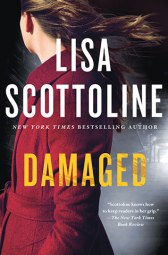
Damaged, by Lisa Scottoline

In Damaged, by Lisa Scottoline, protagonist Mary DiNunzio managed in the following quote to give just enough description of fellow lawyer Nick Machiavelli:

“He wore his hair slicked back, like a throwback to Dracula, and his eyes were narrow slits, with dark brown irises that were the exact color of baking chocolate, and Mary would know.” – from Damaged, by Lisa Scottoline.

Ms. Scottoline could have written, “Nick Machiavelli was greasy” or “Nick Machiavelli was a greaser” and I would have conjured a picture in my mind; however, the phrase “like a throwback to Dracula” and his eyes that were narrow slits paints a more vivid picture of him in my mind.

“the exact color of baking chocolate”

Ms. Scottoline also cleverly threw in that Machiavelli’s irises “were the exact color of baking chocolate, and Mary would know.” That is more accurate than her just saying that he had brown eyes, and I love the phrase “and Mary would know.”

If that’s all we knew about Mary, we’d know that she either likes to bake with chocolate or she likes to eat things made with baking chocolate. Maybe both. Any chocolate-loving reader will immediately identify with Mary!

As I start to rewrite my novel, The Spanish Coin, and flesh out all the characters, I’m learning from writers and from readers what readers prefer. Therefore, I will minimize physical details and concentrate on describing them through their words and actions.

Until my next blog post

I hope you have a good book to read. I’m reading The Stars Are Fire, by Anita Shreve. If you’re a writer, I hope you have productive writing time.

Janet

You Need to Read These Books!

I had another good month of reading in May. I’m on a roll for 2017! If I were a faster reader, I could devour more books. In the meantime, though, I’ll enjoy as many as I can.

A Man Called Ove, by Fredrik Backman

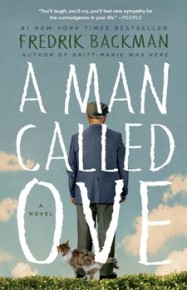
I’m running out of superlatives for the books I’ve read this year. I kept hearing about A Man Called Ove, by Fredrik Backman, so I got on the waitlist for it at the public library. It’s a popular book, so it took a while for my name to gravitate to the top of the list.
a-man-called-ove-9781476738024_lg

I thoroughly enjoyed this book. At times outrageously funny and at times heartwarming and touching, it held my interest from start to finish. Ove is a 59-year-old man. I could see my father, my brother, and even myself in him. I could see myself in his late wife when he recalled how it drove him up the wall because she delighted in planning the details of a trip to the extreme. That’s me! Thank goodness I have a sense of humor! Poor Ove is at odds with the world and having trouble keeping up with the modern world. For the most part, he’s not even trying to keep up.

The author, Fredrik Backman, is from Sweden, where his books have gained much acclaim. I am amazed at how well the humor in this book translated so well from Swedish into English. Although I don’t speak or read Swedish, I don’t believe the book lost anything in the translation. I look forward to reading Mr. Backman’s other books.

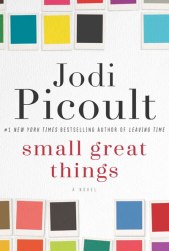
Small Great Things, by Jodi Picoult

Maybe it’s because Mother’s Day was approaching when I was reading this book, or maybe the sentence would have struck me like a ton of bricks any time of the year. Ms. Picoult has an uncommon gift when it comes to writing. Her books tackle some of the most heart-wrenching issues of our day, and she has a wonderful way with words.
small-great-things-hc-400w

I featured the following sentence in my Being the Balloon blog post on May 5, 2017:

“What it’s like to be the balloon, when someone lets go of the string.”   – from Small Great Things, by Jodi Picoult

The context of that sentence is that Ruth, the protagonist who is a seasoned labor and delivery nurse, a mother, and the widow of an American soldier killed in Afghanistan, reacts to the death of her mother with, “What it’s like to be the balloon, when someone lets go of the string.”

I highly recommend Small Great Things. In it, Ms. Picoult takes on the issue of race in America, and she has an uncanny talent for getting inside the skin of individuals from one end of that spectrum to the other in Small Great Things. The line that I focused on from the book in my blog on May 5 speaks to the humanity of us all.

In a nutshell, Small Great Things is about an African-American nurse in Connecticut who is barred from caring for the newborn infant of a white supremacist couple. Author Jodi Picoult masterfully writes from the point-of-view of the nurse, the white-supremacist father, and the white lawyer who defends the nurse. There is an explosive trial during which all kinds of raw emotions erupt. I think we all can learn some life lessons by reading and pondering Small Great Things, by Jodi Picoult!

The Hidden Life of Trees, by Peter Wohlleben

I kept hearing good things about this book, which had been translated into English from its original German. I finally got it from the public library, but with too many other books to read and a lot I was trying to learn about the craft or writing. Therefore, I only got 40% of the book read before I had to return it to the library for the next person on the wait list. I will definitely check it out again so I can finish it.
index

The Hidden Life of Trees:  How They Feel, How They Communicate – Discoveries from a Secret World might not appeal to everyone, but I thought it was very interesting. That might be because I grew up and again live out in the country. My parents instilled an appreciation and respect for trees in us. We have a variety of trees in our yard – dogwood, pine, ash, poplar, cedar, several varieties of oak, mulberry, sycamore, black walnut, sweet gum, holly, persimmon, and maple.

I thought I knew a lot about trees until I started reading Peter Wohlleben’s book. I now know that there’s a whole world out there I can’t see or hear. The book explains how certain tree species work together and how other tree species work against one another. It talks about how trees pump water out of the ground. It talks a lot about fungi and how fungal networks underground help trees in numerous ways. It really is quite fascinating!

The Nightingale, by Kristin Hannah

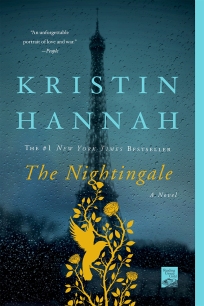
I highly recommend The Nightingale, by Kristin Hannah. It is a historical novel about two sisters in France during the German occupation in World War II. The sisters cope with the occupation and resulting cruelties of war very differently.
Nightingale-PB-658

One sister joins the French Resistance and risks her life helping shot down Allied airmen across the Pyrennes and into Spain. The other sister’s nerves and wits are pushed to the limits as two German officers are billeted in her home. The book was inspired by a 19-year-old Belgian woman, Andrée De Jongh, who created an escape route out of Nazi-occupied France.

This book will pull on all your emotions. When the characters are cold and hungry – which was most of the time – you will feel cold and hungry, although I’m certain that I truly can’t imagine the level of hunger or fear the people who lived through the ordeal actually endured.

When we study World War II or hear stories about it, the emphasis is almost always on the battles. The Nightingale gives a paints a picture of life on the home front in France. It was this month’s book for discussion by Rocky River Readers Book Club. Everyone at our meeting had only praise for the book – how much it taught us and how well-written it was.

Homegoing, by Yaa Gyasi

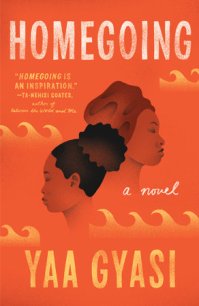
This historical novel is Yaa Gyasi’s debut as a fiction writer. It is different from any novel I’ve ever read. It is set in Africa. As part of my 2017 Reading Challenge I wanted to read a book set on each of the continents this year, so I was drawn to this novel. Unfortunately, I couldn’t finish reading it before it was due at the public library.
9781101971062

Each chapter is about a different member of this family. It is about family ties and the horrible conditions in the slave trade. It puts a human face on slavery – a subject we tend to think of in terms of numbers and not the families that were torn apart in Africa. If I get a chance, I’d like to check this book out again.

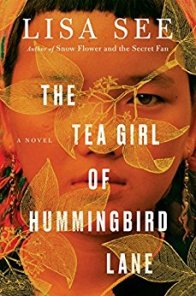
The Tea Girl of Hummingbird Lane, by Lisa See

Like Homegoing and The Hidden Life of Trees, I didn’t get to finish reading The Tea Girl of Hummingbird Lane before it had to be returned to the library. I couldn’t renew any of the three books because there were people on the wait list. The part of The Tea Girl of Hummingbird Lane that I got read was fascinating in how it shed light on some of the superstitions held by the Chinese. I had no idea!
51nbXr3ZbXL._SY346_

The novel follows a young Chinese girl who is painfully aware from birth that she is not valued because she is female. Her family has to walk for hours to pick tea leaves for a meager amount of income. It is a difficult life. Her mother is the local midwife and she tells her daughter that she must follow in her footsteps in that occupation.

There is a ray of hope, though, because the girl’s teacher tells her that she can leave the harsh mountain environment and make something of herself. I look forward to checking the book out again in order to see how her life turns out!

Until my next blog post

I hope you have a good book to read. I have come to the conclusion this week that I am trying to read too many books and not spending enough time on my writing. My goal in June is to strike a happy medium.

If you’re a writer, I hope you have productive writing time. I’m writing bios of my characters in the “new and improved” The Spanish Coin.

Janet

The Spanish Coin, Rescued?

In my H is for Historical Fiction blog post on April 10, 2017, I announced that I needed to make some major plot changes and rewrite my novel manuscript titled The Spanish Coin. I wasn’t sure I had it in me to do that. All is not lost, though!

The-Spanish-Coin-Rescued


I’ve brainstormed and come up with an idea for rescuing the book! I hope to start the actual rewrite by the end of the summer. I plan to retain the working title – The Spanish Coin. It won’t be the same story as the original idea, but it will still take place in the Carolinas in the years just prior to the American Revolution. This weekend I started doing deep character work on my protagonist.

I’m getting help!

Barbara Kyle’s “Your Path to a Page-Turner” program [https://www.barbarakyle.com] has been a tremendous help to me as I start creating the people who live in my novel. Andrea Lundgren, my writing coach, [https://andrealundgren.com] cheers me on and gives constructive feedback. I am also encouraged by the comments my blog posts receive on the blog itself and on my Facebook pages.

You have all been very patient with me on my journey as a writer. I hope we will all be rewarded someday with The Spanish Coin held together by a spine and two book covers!

Liebster and Versatile Blogger Awards

A few weeks ago, Andrea Lundgren nominated me for the Liebster Award and blogger YellowFuzzyDuck nominated me for the Versatile Blogger Award. While I was honored by both nominations, I had to decline due to my health.

I thought it only fair that I acknowledge the nominations in this blog post and explain why I couldn’t fulfill the requirements. I thought that telling this personal story might also serve as an explanation for anyone thinking that I’m taking too long to write a book.

CFS/ME

One requirement of both those blogging awards is that the nominee must tell some things about themselves that their readers probably do not know. Something that most of my readers don’t know is that I have Chronic Fatigue Syndrome. That’s its lame name in the United States. In most of the rest of the world it is called Myalgic Encephalopathy or Myalgic Encephalomyelitis. I was diagnosed in 1987. My energy level remained essentially the same throughout the first 29 years except for a very gradual decline.

Shingles

Having shingles (May 2016 until recently) has taken an additional toll on me, and I have been unable to regain the energy level I had prior to that illness. My right cornea is still not happy!

Energy slumps

I’ve had slumps before. I choose to believe that this is just a longer-than-usual slump. I choose to expect to improve any day now. That positive attitude has gotten me through the last 30 years. I am, by no means, an invalid. I don’t want to leave that impression!

My life at the present time

I am pretty much at home, though, because getting out and about is draining. For instance, a trip to the grocery store can land me in bed or on the couch for a day or two. I’m fortunate that writing is, for the most part, a sedentary occupation.

Having to rewrite The Spanish Coin is daunting. I love to write and I enjoy doing the research required in order to write historical fiction; however, that doesn’t mean it isn’t work. I refuse to give up, though!

Call to Action!

Please visit Andrea Lundgren’s blog, https://andrealundgren.com. Andrea writes insightful and informative blog posts about various aspects of writing. As my writing coach, she has her work cut out for her!

Also, please visit YellowFuzzyDuck’s Turtledesk blog, https://turtledesk.wordpress.com. This blog takes on a variety of topics and contains beautiful photographs.

Until my next blog post

I hope you have a good book to read. My blog post on Friday will be about the books I read during the month of May. I read some good ones!

If you’re a writer, I hope you have productive writing time. If you are still learning the craft of writing, you might want to visit https://www.barbarakyle.com and check out Barbara’s “Your Path to a Page-Turner” program.

Janet

“Like A Butterfly Stepping Out”

The following is a line I like from The Guise of Another, a novel by Allen Eskens:

“The name lifted from her lips with tentative wings, like a butterfly stepping out of its chrysalis and taking flight for the first time.” – from The Guise of Another, by Allen Eskens.

Since I don’t have a photo of “a butterfly stepping out of its chrysalis,” I’m including this picture I took of my favorite butterfly variety.

Flowers and Garden 6-25-09 005
Yellow Swallowtail Butterfly on “Buttered Popcorn” Daylily

Until my next blog post

I hope you have a good book to read. If you’re a writer, I hope you have productive writing time.

I’m busy working on ideas for rewriting my novel manuscript, The Spanish Coin, and feeling better about it than I did a couple of weeks ago.

Janet

Z is for Zilch!

Zilch is what I’ve accomplished toward starting over to write my first historical novel. I have successfully completed the 2017 A to Z Blog Challenge by writing a post today that has something to do with the letter “Z.” I enjoyed parts of the challenge, but I’m glad English only has 26 letters! It was interesting and I picked up some new followers, but I don’t think I’ll do it again. Beginning on Tuesday, May 2, I plan to return to my former routine of blogging on Tuesdays and Fridays.

2017 A to Z Challenge Badge
Blogging from A to Z Challenge Badge 2017

With this blog challenge finished

I look forward to having more time to delve back into the various resources available to me as I keep researching the facts surrounding the core event in The Spanish Coin manuscript. Several more books are coming from two public library systems, so you know what I’ll be doing next week.

What happened to The Spanish Coin?

I revealed in my “H is for Historical Fiction” blog post on April 10, 2017 (H is for Historical Fiction) that I had discovered some pertinent information about the core of my story that necessitated my starting over. Several years (actually a decade) and 96,000 words later, I’m back to having a blank page.

My options

Since April 10 I have done a lot of thinking and reading. I’ll need to do a little more work on the research end of things and then determine how to rewrite The Spanish Coin. It might not survive with that working title. Or I might be able to salvage that title and change the circumstances of its importance. Or I might just take the spark of the true story as my inspiration and write a totally new story.

When I figure out which option to settle on, I’ll let you know.

With the A to Z Blog Challenge Finished

I look forward to having time to read more books. My current “Books I Want to Read” list is so long I fear I won’t live long enough to read all of them. With new books being released every month, the list just keeps growing.

Until my next blog (which should be on May 2)

I hope you have a good book to read. I’m enjoying Small Great Things, by Jodi Picoult, World of Toil and Strife: Community Transformation in Backcountry South Carolina, 1750-1805, by Peter N. Moore, and The Art and Craft of Writing Historical Fiction, by James Alexander Thom. I have to take note and reread parts of Mr. Thom’s book occasionally. The bibliography in Mr. Moore’s book has already led me to more books I need to read before I figure out the verdict for The Spanish Coin.

If you’re a writer, I hope you have productive writing time. I hope you’ve gotten past the blank page stage on your first novel.

Janet