More Trump Administration Shenanigans

I originally had most of today’s post included in yesterday’s, but at 2,500 words I was afraid no one would read it. Meanwhile, today’s post grew to 2,000 words. The sad and frightening part is that I am only learning about the tip of the iceberg.

As I get ready to publish this, President Trump is touring the Middle East. It remains to be seen how many “deals” he makes and how many promises he makes. It remains to be seen if he has kept the best interest of the United States or his own business interests as a priority.

Here are the items I salvaged from my draft of yesterday’s post to share with you today. They are in no particular order and cover and wide range of topics. None of this is good news, in my opinion.


US Department of Justice Attorney Richard Lawson said when questioned by US District Court Judge Loren AilKhan in federal court last Thursday that he has not seen any written agreements between President Trump and the nine big law firms that Trump claimed on Truth Social to have made agreements in which those firms will represent Trump’s pet projects pro bono. Do those agreements only exist in Trump’s mind?


Trump has fired all three Democrat-appointed US Consumer Product Safety Commission commissioners. They maintain their firings are illegal since Congress established the agency and, therefore, it is not under the President’s control. The agency has always been bipartisan, but I cannot imagine Trump will appoint anyone who isn’t one of his MAGA supporters. Maybe there are still some employees left at Fox News that he can draw from.


Fifty-nine white Afrikaners from South Africa were given refugee status in the United States on Monday. It is reported that up to 1,000 Afrikaners will be admitted as refugees in the US this year. The Trump Administration has closed America’s doors to all other refugees. White House Deputy Chief of Staff Stephen Miller said it is a textbook case of how the refugee program is supposed to work.

A process that normally takes years only took the Afrikaners several months.

Just go ahead and read between the lines. That’s what I’m doing. (Be sure to read “Another bit of encouragement” below.)


The New York Times reports that 44 US Government contracts amounting to $220 million that Elon Musk and DOGE cancelled… have been restored. Don’t be fooled by any official DOGE reports or its website, though, because Musk is still listing them as cancelled. No surprise there.


According to the Associated Press, on Monday, “a federal judge refused to block the Internal Revenue Service from sharing immigrants’ tax data with Immigrations and Customs Enforcement for the purpose of identifying and deporting people illegally in the U.S.” The irony is that they are paying federal income tax and now that fact is going to be used to track them down and make their deportation possible.


Mexico’s Secretariat of Foreign Relations has reported that 181 Mexican nationals have died between January and April 2025 while trying to illegally cross into the United States. That is twice as many as the 91 who died in the same period in 2024. The Trump Administration’s crackdown on illegal border crossings is blamed, as people are trying to cross in more dangerous areas than before. I’m not in favor of people coming into the United States illegally, but I think this drastic increase in deaths is worth noting. Of course, the United States is not reporting any of this.


In 2021, President Joe Biden signed into a law that had passed Congress with an overwhelming bipartisan vote. The Digital Equity Act was designed to make sure seniors and all parts of the United States would have access to the internet.

President Trump heard about it. Calling is “racist” and “unconstitutional,” he ordered an immediate end to the funding that was mandated by the Act.

The funding provided for states and localities, including indigenous tribal councils and school districts, to come up with plans to best serve their citizens and then be eligible for funds to implement the infrastructure aspect.

Trump has suddenly ended the funding! This is nothing more than a ruse for Trump to appear to be anti-racist, constitutional, and saving taxpayers “billions of dollars.” Like he proudly said during his campaign, “I love the uneducated!”


Trump’s blatant attacks on public education, private education, universities, libraries, museums, and now the internet should be a wake-up call to all Americans, but it won’t be.

I mentioned in at least one earlier blog post the Trump Administration’s termination of the Institute of Museum and Library Services (IMLS) which provided some funding for local libraries and museums. Congress had appropriated the funds for this fiscal year, but Trump suddenly pulled the plug. More than 100 libraries on federally-recognized tribal lands lost their funding. Many of them are in remote areas where internet service is sparse. Those libraries are a lifeline for the indigenous communities.


Meanwhile… it is reported by various sources that Trump is prepared to accept an extravagant Boeing 747-8 luxury aircraft from the royal family of Qatar. I heard on Tuesday that the plane is already in the United States. It is reported that this plane will be used as Air Force One until Trump leaves office, at which time it will go to the Trump Presidential Library Foundation.

The Foreign Emoluments Clause in Article 1, Section 9 of the US Constitution prohibits anyone holding federal office or employment from accepting gifts, emoluments, office, or titles from foreign governments unless that get congressional approval. The purpose of this is to prevent undue external influence from outside the United States by decision-makers.

So far, I have not found any mention of the US Congress approving the transfer of this airplane. The acceptance of such an aircraft for any purpose – but especially for use by the US President – is wrong on more levels than I can enumerate.

During his first administration, Trump entered an agreement with Boeing that the company would modernize two Boeing 747s that would become two new Air Force One airplanes. The price tag on that contract has already gone more than $2 billion over budget and the planes aren’t scheduled to be ready until 2027 or later. In 2019 (the most recent year a price was made public), the cost of a new Boeing 747-800 series was around $400 million.

All the legal and ethical and common sense concerns aside… this flying palace from Qatar would have to be stripped down to nothing and rebuilt just to remove all the hidden listening devices. That alone will take years! But what do I know? I’m just a citizen. Maybe Qatari spying devices are not a concern of the Trump Administration.


The Washington Post reports that Director of National Intelligence Tulsi Gabbard fired two of the top officials on the National Intelligence Council. The council wrote a report that contradicted President Trump’s rationale for invoking the Alien Enemies Act and the deporting of alleged Venezuelan gang members without due process. Apparently, an honest assessment by intelligence agents is not allow if it does not repeat what Donald Trump says.

Michael Collins, the acting chair of the National Intelligence Council, and his deputy, Maria Langan-Riekhof, were fired.

The Washington Post reports states: “The actions are the latest purge by Gabbard, who has said she is fighting politicization of the intelligence community but has removed or sidelined officials perceived to not support Trump’s political agenda.

“The NIC is the top U.S. intelligence community body for analyzing classified intelligence and providing secret assessments to the president and other top policymakers. Its reports include spy agencies’ annual global threat assessment and studies of the possible causes of anomalous health incidents, also known as Havana syndrome and the origins of the coronavirus that led to the pandemic in 2020.”


It has been reported that in his first 100+ days in office, President Trump has only had 12 “daily” briefings. That’s an even worse record than the first time he was President. They are called “daily briefings” for a reason. I can’t imagine being President of the United States and having no interest in what’s going on in the world.


According to the ACLU, members of Congress doing Trump’s bidding have snicked a provision into the “big, beautiful tax bill” still under consideration that would give the executive branch the power to shut down any nonprofit organization. The Trump Administration has no appreciation or patience for anyone or any organization that is not turning a profit.


The Trump Administration has cancelled a $6.7 million grant that would allow Dr. James Antaki, a professor of biomedical engineering at Cornell University, to continue researching his PediaFlow device that could boost blood flow in infants with heart defects. He has been working on this device since 2003. It is designed to help infants survive until they can have a heart transplant.

His grant was withdrawn on April 8. It would have funded research over four years. His years of research are now in jeopardy, as well as the jobs of PhD students who were working with him.


The Trump Administration has shut down the office leading the Safe to Sleep campaign, which provided education on safe sleep practices for infants. Infant deaths decreased by 50 percent after the campaign launched in 1994. It is said that the campaign has saved thousands of infants’ lives.

This and the withdrawal of the PediaFlow device research both seem at odds with Trump’s plans to reward women who have more babies. It is sort of like the conservative’s “Pro-Life” motto. They are only interested in the baby being born. After it is born, they don’t want it to have adequate food or healthcare. They vote against all such support programs for children. They even threaten now to end the Head Start program which provides early childhood education and meals.

Go figure. I have no words for this level of evil in the richest country in the world.


Finally, the tiniest of tiny glimmers of hope from the US Senate

Finally! This has been a long time in coming, but on Tuesday the Republican US Senate Majority Leader John Thune of South Dakota sided with the Democrats in their fight to deny President Trump’s takeover of the Library of Congress!

As I reported in yesterday’s blog post, Trump fired Dr. Carla Hayden, the Librarian of Congress last week along with the head of the US Copyright Office, Shira Perlmutter. Trump named US Department of Justice people with no library or copyright experience to assume those and other positions.

The Library of Congress is not a library in the commonly accepted understanding of the word. The Library of Congress goes way beyond that! The US Copyright Office is part of the Library of Congress. Within three months of any copyrightable work being published in the United States, two copies must be submitted to the US Copyright Office for inclusion in the collection at the Library of Congress.

It is not a circulating library. People can obtain access to the collection for research purposes, but materials are not checked out. Members of the United States Congress have access to the materials held there. As the name indicates, it is the Library of Congress.

On Tuesday, May 13, 2025, Senator Thune reported that people from the Trump Administration met with the US Senate Rules Committee, and “we made it clear that there needs to be a consultation around this” and congressional “equities” must be respected and protected.

I would have liked to have seen much stronger language. In fact, there doesn’t need to be any “consultation” with the White House about the Library of Congress!

As the Democratic US House Minority Leader Hakeem Jeffries stated, “It’s the Library of Congress, not the library of the executive branch.”

We’ll have to wait and see how this shakes out but, personally, I would not trust anyone in Donald Trump’s realm of influence or friends with one single book or sheet of music in the Library of Congress. This whole mess started because Elon Musk wanted Dr. Carla Hayden to turn over a trove of books to him to use for Artificial Intelligence training and she refused!


Another bit of encouragement

I’m pleased to report that the Episcopal denomination has ended its decades-long partnership with the US Government to resettle refugees, citing this week’s plane load of 59 white Afrikaners brought into the United States as refugees from South Africa. The organization cited its ties with the Anglican Church of Southern Africa. Two weeks ago, the federal government informed the Episcopal Church that it was expected to resettle the white Afrikaners.

The request crossed a moral line for the Episcopal Church. The Most Reverend Sean W. Rowe, the presiding bishop of the Episcopal Church explained that the denomination is part of the global Anglican Communion that boasts among its leaders the late Archbishop Desmond Tutu, a celebrated opponent of apartheid in South Africa.

Hurrah for the Episcopalians! Seeing individuals and groups standing up for their principles is a wonderful thing to see in 2025!


Until my next blog post

I hope you have a good book to read.

Don’t forget the people of Ukraine and western North Carolina. Parts of the mountains in western North Carolina received more than five inches of rain in a couple of days earlier this week and experienced flooding and there was at least one mudslide on US-74 between Bat Cave and Gerton. These people can’t seem to get a break.

Janet

Abrego Garcia, Student Visas, DOJ Weaponization, & What Else Happened This Week

As we near the end of another week of governmental and stock market chaos, today I’m writing about various things happening in the United States. As I finished drafting this blog post at 7:45 last night, I hoped we would have an uneventful news evening so I wouldn’t have to edit it.

We didn’t. I could have added to it, but I chose not to. It will be published at 5:00 a.m. on April 10 without any more additions or edits. I’m sorry it is 2,400 words long. Keeping up with what the Trump Administration is doing is now a full-time job and it is exhausting.

President Trump wants $92 million four-mile long military parade from the Pentagon to the White House on his 79th birthday on June 14. It just happens to also be the 250th anniversary of the US Army and Flag Day, but we all know the real reason for the parade. He begged for one during his first term until people who had some sense told him the city streets of Washington, DC would buckle under the weight of missile launchers and such. He really, really wanted a military parade like they have in Beijing. I don’t know what will happen when he finds out his birthday falls on a Saturday this year. He’s usually in Florida playing golf every Saturday.

How many little blunders will the Executive Branch make before they get their act together? On April 3, Ukrainians who have sought legal safety here during the war in their homeland were told by the US Department of Homeland Security that they had seven days to get out of the United States. The next day they received emails telling them to disregard the earlier notice. Can you imagine the anguish they experienced overnight thinking they had to return to a war zone this week?

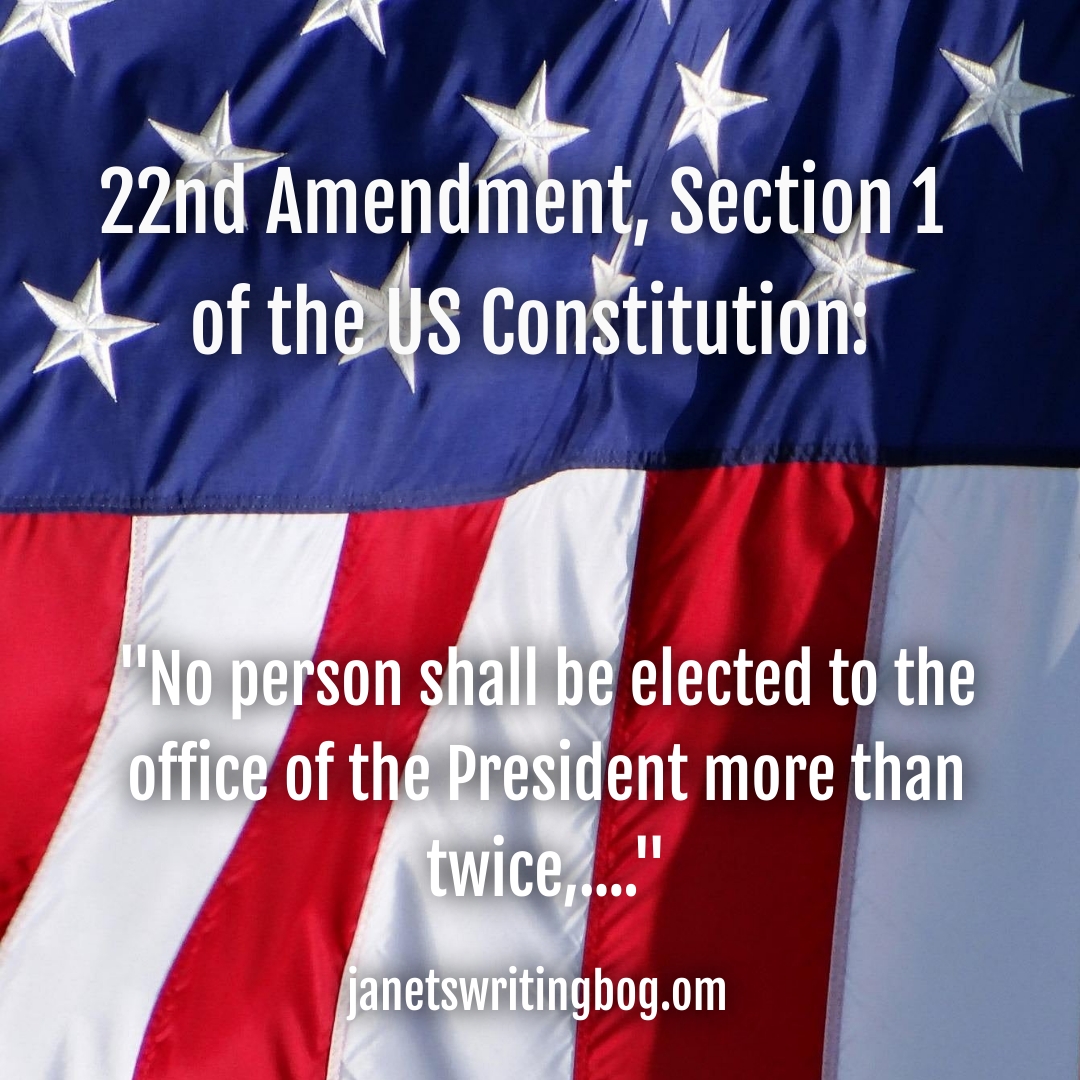
In US Senate hearings for her nomination to be US Attorney General, Pam Bondi firmly answered, “No, Senator, not unless they change the Constitution” when asked if President Trump could run for a third term; however, Forbes quoted her as saying in a Fox News interview on April 5, 2025, “We’d have to look at the Constitution” and “it would be a “heavy lift.” I’m not a Constitutional scholar and I know it is possible to repeal an Amendment (i.e. 18th Amendment about prohibition), but it seems clear to me…

Vice Adm. Shoshana Chatfield, the U.S. military representative to the NATO Military Committee in Brussels, was fired last weekend. She is at least the ninth senior US military officer to be fired by the Trump Administration, four of them being women.

After slashing National Park Service personnel numbers, Secretary of the US Interior Department Doug Burgum has ordered all national parks to remain open regardless of severe staffing shortages this summer. That’s good news for those of us hoping to visit a national park this summer and support small businesses outside the park that have had a horrible time getting back on their feet since Hurricane Helene, but not such good news for the remaining park rangers and support personnel.

With promises of selling off the timber in our national parks, I don’t know what will be left of any of them if Trump clear cuts them. Maybe he won’t, but there is no one stepping up so far to stop him. Would someone please tell him that the lumber from the northern forests in Canada is stronger wood and less likely to warp than our pine trees? That’s why we buy lumber for construction from Canada. It takes the fir trees in Canada longer to grow than in most of the US. The slower a tree grows, the stronger the wood.

And would someone please tell him how many decades it takes to grow a pine tree or a hardwood tree? He probably doesn’t know, but the worst part is that he doesn’t care. He only sees dollars signs when he sees a tree. I feel sorry for people who have no sense of a forest’s true worth. It’s not measured in dollars.

Elon Musk’s company, SpaceX, was awarded a $5.92 billion contract by the Pentagon to conduct Space Force rocket launches. No conflict of interest there!

Yesterday afternoon, US Trade Representative Jamieson Greer learned about the 90-day pause in all tariffs except those against China while he was appearing before a Congressional committee. In other words, while he was on Capitol Hill to explain his president’s tariff policies, he learned about Trump’s about-face at the same time the rest of us did.

Anyone who agreed to work for Trump should have known from history, though, exactly what level of chaos they were signing up for. All they needed to do was see how he went through top officials during his first term. To work for Trump is to have your desk anchored to a revolving door.

The National Weather Service (NWS) will no longer provide any weather alerts in any language other than English although nearly 68 million people living in the US speak a language other than English in their homes. Of course, with so many firings in the NWS, extreme weather alerts will probably soon be a thing of the past. Who needs tornado warnings anyway?

The president now takes his human resources advice from Linda Loomer, a conspiracy theorist who says the attack on the US on September 11, 2001, was “an inside job.” After a meeting with Loomer, Trump fired two top national security advisors because they weren’t loyal enough to him. He said she didn’t tell him who to fire – she just told him who to hire.

US Department of Defense Secretary Pete Hegseth said he might cut US military personnel by 90,000 because we’re turning our attention to Asia and away from Europe and we’ll rely more on technology than people in uniform.

Trump talked again about Gaza on Monday, calling it “real estate,” and casually saying “we’re” going to “own it” and the Palestinians will just be moved into other countries… other countries that are going to welcome them. Does that sound like a good plan to anybody? Just shove the people around like you’re playing chess but, if you were playing chess, you would give more thought to your moves. In Trump’s eyes, these aren’t human beings. Plain and simple.

What kind of person refers to part of another State (in this case, part of the State of Palestine) as “real estate” as if it is a parcel of land that’s for sale on the open market? Only a person who is up to no good and only looking out for himself.

In the midst of the stock market jumping all over the place and retirees seeing the value of their 401K accounts being jerked around yesterday, it was reassuring that President Trump was signing an Executive Order that removed limitation on water pressure from shower heads and household appliances. We each have priorities.

Trump saw on Monday how the stock market reacted from a rumor that he was going to lift tariffs. The market shot up for a few minutes until the Trump Administration denied that tariffs were going to be paused. On Tuesday he said a tariff pause was not being considered. Wednesday morning, he got on social media and told people to buy stock, but not just any stock. He ended his advice with “DJT.” He never does that. Those are his initials, but “DJT” is also the ticker symbol or stock symbol for his Trump Media & Technology Group Corporation. That stock opened at $15.52 per share Wednesday morning. A few hours later Trump suddenly paused all the tariffs except the 125% tariff on goods from China. DJT closed at $20.27.

On Tuesday, Trump said, “We’re making a fortune with tariffs. $2 billion a day, do you believe it? I was told $2 billion a day.” Who told him that? Probably one of his “yes men.”

As this week progressed, Trump has played with tariffs like a yo-yo. No one knows from one hour to the next where any of the tariffs stand. It’s just a game for him to play and he delights in the power he has. Americans and everyone around the world are left not being able to trust the President of the United States. There is no credibility. There is nothing to trust. There is nothing to rely on.

Irreparable damage has been done to America’s standing in the world.

As I write this at 3:15 (ET) on Wednesday afternoon, April 9, Trump is taking questions from reporters on live TV. His responses to questions go seamlessly from tariffs to gangs cutting off the fingers of people who call the police to Liberation Day to the various geniuses who work in his Administration to Joe Biden’s incompetence to other countries sending us their prisoners to the “good old days” when Trump was young and already thinking about tariffs to the need for flexibility to walls to NASCAR and Indy race “champions” to China ripping us off to people “getting yippy”….

We’re left to wonder if the people “getting yippy” are the same people he called “panicans” earlier in the week. My dictionary is inadequate.

Trump’s press conferences and speeches are “word salads” (Trump calls it “weaving”) of endless incomplete sentences and nonsensical trains of thought in which no rail car is connected to another rail car and there is no locomotive leading the way. No one knows where the train is going or why it left the station.


Update on Abrego Garcia

On April 4, a district court judge gave the Trump Administration until 11:59 p.m., Monday, April 7 to return Abrego Garcia to the US after he was mistakenly shipped off to a prison in El Salvador. Trump was so concerned about this “administrative error” that he had to fly to Florida and play golf to deal with his stress. (Forgive my sarcasm.)

The White House line maintains that Mr. Garcia is now in the custody of El Salvador and the US must honor that diplomatic principle. That seems like a lame excuse to me while at the same time Trump is literally threatening to take Greenland away from Denmark by force if he has to. Where is the diplomacy?

On April 5, the immigration lawyer fighting for Mr. Garcia was fired by Attorney General Pam Bondi because he wasn’t toeing the Trump line. In other words, he argued that there was a court order allowing Mr. Garcia to stay in the United States and he should not have been deported to a prison in El Salvador.

Later Monday afternoon, April 7, the US Supreme Court “paused” the Monday night deadline so they could take more time to consider the case.

As far as I have been able to find, that’s where Mr. Garcia’s case sits. Why does everything have to get so complicated? He was sent to El Salvador in error, and he should be returned to his wife and son in Maryland.


Trump’s Treatment of Universities & Student Visas

Add Brown, Cornell, and Northwestern to the list of universities being threatened with loss of funds if they don’t cease the Diversity, Equity, and Inclusion policies.

US Secretary of State Marco Rubio bragged that he had revoked the student visa for 300 international students in the United States. He said they were “lunatics” and that they had come to our country under false pretenses. He said they planned to do us harm. We were led to believe it was because 300 specific international students had either broken US law or posed a threat to US security

Now, we’re learning that student visas are being revoked to punish the governments of their home countries. How sad is that? How cruel to the students! For the most part, these young people have excelled in their studies and wanted the opportunity to pursue university degrees from some of the most respected institutions of higher learning in the world.

I’m beginning to wonder about the numbers. At least six visas have been revoked from students at the University of North Carolina at Charlotte, at least two from North Carolina State University at Raleigh, at least six from the University of North Carolina at Chapel Hill, and two Duke University graduate student and an alumnus on Optional Practical Training.

That’s 17 revoked student visas at just four universities in North Carolina. Why would six percent of the 300 revoked student visas target four campuses in North Carolina? Or is the total more than 300?


Weaponization of the US Justice Department

Late yesterday afternoon, Trump ordered the US Justice Department to investigate Chris Krebs and Miles Taylor. Investigate them for what? For using words? For having the audacity of thinking they had freedom to criticize the US President under the First Amendment to the US Constitution?

Chris Krebs was the director of the Cybersecurity and Infrastructure Security Agency during the first Trump Administration. Trump is accusing Krebs of being part of an effort to steal the 2020 election for Joe Biden just because Krebs repeatedly said he could find no evidence of election fraud.

Miles Taylor was chief-of-staff at the US Department of Homeland Security when he wrote an op-ed for the New York Times about the resistance he was witnessing within Trump’s first term as President. Taylor wrote that op-ed anonymously but later revealed in 2020 that he had written it. He had resigned from the Trump Administration the year before. He has written two books and has a podcast, “The Whistleblowers.” Trump is accusing Taylor of treason.

What will US Attorney General Pam Bondi do with this order? In her hearings before Congress, she said in no uncertain terms that she would not weaponize the Justice Department against Trump’s political enemies.

Two months in, what will Pam Bondi do? Will she stick by her words or will she make a farce out of her earlier words? Will she cave in to Trump’s rein of tyranny? What will the US Congress do?

What we have here is a Constitutional Crisis. It’s time for members of the US Congress and the American people to stop looking the other way. Stop thinking or saying anything about this is normal.

Who is Trump’s next target?


Until my next blog post

I apologize if I didn’t catch all my typos.

My planned blog post for tomorrow is an open letter to Trump supporters, but you’re welcome to read it, too.

I hope you have a good book to read.

Keep paying attention.

Remember the people of Kentucky, Myanmar, Ukraine, and western North Carolina.

Janet

Words Trump wants federal agencies to “limit or avoid”

Find a comfortable chair. This is another long blog post.

I’ve been mulling over today’s topic for several weeks. It’s one thing to erase history – and the Trump Administration seems to be doing an admirable job, if that’s what you want done.

And some people do want that done. As I voiced my displeasure with everything the Trump Administration has done in two short months a classmate, whom I’ve known for 65 years, told me “it’s a beautiful thing to watch.” His comment made me nauseous.

Photo of a taxidermied elephant on display at the Smithsonian Institution in Washington, DC
A taxidermied elephant on display at the Smithsonian Institution, Washington, DC.
Photo by J. Amill Santiago on Unsplash

Several days ago, the Trump Administration (or should I say, Regime?) attacked the Smithsonian Institution and National Park Service. Both were targeted for having “divisive” and “anti-American” exhibits. “Divisive” and “anti-American” can be translated to mean that they have some exhibits about people of color and women of any color. It’s feeling more and more like 1931 in Germany around here.

I have a hunch the elephant pictured above that is displayed at the Smithsonian Institution will be safe, though, since the elephant is the mascot of the Republican Party.

Equally troubling to me as erasing history is the Trump Administration’s efforts to limit or perhaps erase perfectly good words from our vocabulary.

Photo of a pencil with an eraser on the end
Photo by Kim Leary on Unsplash

People are disappearing, history is disappearing, and words are disappearing. Our allies are disappearing, and who can blame them?

Several weeks ago, a list of words was cobbled together that the Trump Regime wants US Government agencies to “limit or avoid.” The White House denies issuing a list, but they have left government agencies to use some of their own judgment in erasing specific words from their documents and websites. It seems that the hints they’ve been given are fairly loud as they are supposed to use Trump’s too-numerous-to-mention Executive Orders as their guide.

This is rich, coming from a President who has difficulty speaking in complete sentence. (Before you jump on me… I’m not being disrespectful; there is proof all over TV, video and audio clips, the internet, and the printed word.)

You can’t make this stuff up.

In case you missed it here is the list of 298 words and combinations of words that The New York Times published on March 4, 2025, that US Government agencies are supposed to “limit or avoid”:

  • accessible
  • activism
  • activists
  • advocacy
  • advocate
  • advocates
  • affirming care
  • all-inclusive
  • allyship
  • anti-racism
  • antiracist
  • assigned at birth
  • assigned female at birth
  • assigned male at birth
  • at risk
  • barrier
  • barriers
  • belong
  • bias
  • biased
  • biased toward
  • biases
  • biases towards
  • biologically female
  • biologically male
  • BIPOC
  • Black
  • breastfeed + people
  • breastfeed + person
  • chestfeed + people
  • chestfeed + person
  • clean energy
  • climate crisis
  • climate science
  • commercial sex worker
  • community diversity
  • community equity
  • confirmation bias
  • cultural competence
  • cultural differences
  • cultural heritage
  • cultural sensitivity
  • culturally appropriate
  • culturally responsive
  • DEI
  • DEIA
  • DEIAB
  • DEIJ
  • disabilities
  • disability
  • discriminated
  • discrimination
  • discriminatory
  • disparity
  • diverse
  • diverse backgrounds
  • diverse communities
  • diverse community
  • diverse group
  • diverse groups
  • diversified
  • diversify
  • diversifying
  • diversity
  • enhance the diversity
  • enhancing diversity
  • environmental quality
  • equal opportunity
  • equality
  • equitable
  • equitableness
  • equity
  • ethnicity
  • excluded
  • exclusion
  • expression
  • female
  • females
  • feminism
  • fostering inclusivity
  • GBV
  • gender
  • gender based
  • gender based violence
  • gender diversity
  • gender identity
  • gender ideology
  • gender-affirming care
  • genders
  • Gulf of Mexico
  • hate speech
  • health disparity
  • health equity
  • hispanic minority
  • historically
  • identity
  • immigrants
  • implicit bias
  • implicit biases
  • inclusion
  • inclusive
  • inclusive leadership
  • inclusiveness
  • inclusivity
  • increase diversity
  • increase the diversity
  • indigenous community
  • inequalities
  • inequality
  • inequitable
  • inequities
  • inequity
  • injustice
  • institutional
  • intersectional
  • intersectionality
  • key groups
  • key people
  • key populations
  • Latinx
  • LGBT
  • LGBTQ
  • marginalize
  • marginalized
  • men who have sex with men
  • mental health
  • minorities
  • minority
  • most risk
  • MSM
  • multicultural
  • Mx
  • Native American
  • non-binary
  • nonbinary
  • oppression
  • oppressive
  • orientation
  • people + uterus
  • people-centered care
  • person-centered
  • person-centered care
  • polarization
  • political
  • pollution
  • pregnant people
  • pregnant person
  • pregnant persons
  • prejudice
  • privilege
  • privileges
  • promote diversity
  • promoting diversity
  • pronoun
  • pronouns
  • prostitute
  • race
  • race and ethnicity
  • racial
  • racial diversity
  • racial identity
  • racial inequality
  • racial justice
  • racially
  • racism
  • segregation
  • sense of belonging
  • sex
  • sexual preferences
  • sexuality
  • social justice
  • sociocultural
  • socioeconomic
  • status
  • stereotype
  • stereotypes
  • systemic
  • systemically
  • they/them
  • trans
  • transgender
  • transsexual
  • trauma
  • traumatic
  • tribal
  • unconscious bias
  • underappreciated
  • underprivileged
  • underrepresentation
  • underrepresented
  • underserved
  • undervalued
  • victim
  • victims
  • vulnerable populations
  • women
  • women and underrepresented

Some of my thoughts on the subject

I considered using bold font to highlight my favorites/most angering/most ridiculous words on the list, but that would have been all 298 of them.

As a writer, words are my life. Words help me communicate. I’ll bet they help you, too. Without words, our communications would be extremely limited.

I haven’t read how Trump intends to enforce this or what punishments will be meted out to offenders. And who comes next? Writers? Reporters? Universities? Teachers?

Depending on your background, gender, or ethnicity, there are probably particular words on the list that strike a nerve with you.

Here are 51 that set me off

“Black” (capitalized) — I have Black friends. I don’t see anything wrong with the word “Black.” In fact, my great-grandmother’s surname was Black. My sister and I mentioned her in one of the Morrison genealogy books we published in 1996. I hope the Trump Administration will not ban our book, but we’re on a slippery slope when we start outlawing words.

“female,” “females,” “women,” and “biologically female”– Hmmm. Now those are intriguing words to put on a government’s “limit or avoid” list. I couldn’t help but notice that “male,” “males,” and “men” are not on the list, but “biologically male” is. Surely, it was an oversight on the part of the “biologically male” person who obviously wrote the list to not include “male,” “males,” and “men” on the list.

“mental health” – I have some relatives who struggle with mental health. I’m not sure what to do with this word combination now. Does the Trump Administration think by not using the words “mental health,” mental health issues will no longer exist? How wonderful it would be if we could just use a word and make a whole category of illness disappear!

“belong” – My mind jumped back to a trip to Scotland where I learned that there instead of saying, “She’s Campbeltown,” the locals would say, “She belongs to Campbeltown.” Since the plural form of the word isn’t on the list, maybe that use of it would be legal. Otherwise, Scots might want to think twice before visiting America. Oh… my bad…. They’ve all taken America off their bucket lists since January 20.

“pronoun” and “pronouns” – This is going to be challenging for English teachers, but it will simplify diagramming sentences.

“sex” and “chestfeed” – I don’t know what to say about these. I don’t want my blog to be flagged as obscene, but is “chestfeed” really a word? Is it actually a thing we need to be concerned about?

“systematically” – What?

“orientation” – I guess there will be no more orientation meetings for new government employees or college freshmen at schools that receive federal funds.

“trauma” – Some hospitals are qualified trauma centers, but I guess they won’t be much longer. Heaven forbid if they receive any federal funds.

Photo of a poster with words like trauma, PTSD, and anger on it
Photo by Susan Wilkinson on Unsplash

“environmental quality” – You’ve got to be kidding, Trump! Just because you don’t want the citizens of the United States to have “environmental quality” doesn’t mean that the citizens of the United States don’t want “environmental quality.” Just because you want to drink contaminated water and breathe polluted air, Mr. Trump, doesn’t me the rest of us do. You can’t just outlaw the words “environmental quality” and make the whole concept of a healthy environment go away.

“disability,” and “disabilities,” – I shudder to think what will soon become of the Americans with Disabilities Act. It is that act that requires handicapped bathroom stalls, automatic doors to permit easy ingress and egress at government buildings, hotel rooms with bathrooms accessible to people in wheelchairs, etc. Need I keep going?

That leads me to “barrier” and “barriers” – which I think must be on the list because the Americans with Disabilities Act tries to prevent physical movement and communication barriers from remaining in place that make it difficult for blind, deaf, and people restricted to wheelchairs to do what they need to do. Have you ever wondered why you didn’t see many (or any?) ramps into public buildings in the 1950s, but now you do? They didn’t just happen. It wasn’t because architects started adding them out of the goodness of their hearts.

Photo of a really long staircase
Photo by Joseph Akbrud on Unsplash

“race,” “racial,” “ethnicity,” and “gender” – The folks who create US Passports better get busy figuring out how to get around those questions.

“historically” – I assume this is targeting “Historically Black Colleges and Universities.” Take out the words “historically” and “Black” and it is going to be difficult to know which “colleges and universities” one is talking about. Oh… my bad… that’s the point!

“discriminated,” “discrimination,” and “discriminatory” – Are we no longer allowed to talk about or file lawsuits regarding discrimination? This is appalling!

“minority” – Lucky for the US Congress that this list, at least for now, only applies to the agencies in the Executive Branch of the government because, otherwise, they would have to come up with a new term for “Minority Whip” and “Minority Leader” in their official titles.

“expression” – Wipe that silly expression off your face!

“identity” – Seems like a legitimate word to me.

“prejudice” – Since we still have a US Department of Justice, so to speak, I guess the lawyers are going to have to find a new way to label the rulings on certain lawsuits. You see, the term “without prejudice” is a legal phrase. It is used by judges to indicate that a case can be revisited or that the verdict is not final.

I noticed it’s acceptable to use the word “racist,” but it’s not okay to use the words “anti-racist” or “anti-racism.” Interesting.

“Native American” – I think it should be left up to the indigenous peoples of America to tell the rest of us what they want to be called. I don’t think that she be left up to Donald Trump. When I was doing the research to write my vintage postcard book, The Blue Ridge Mountains of North Carolina, I learned that the Cherokee Indians in the Qualla Boundary in North Carolina prefer to be called Indians. The official name of the tribe there is Eastern Band of Cherokee Indians.

“tribal” is also on the list. That’s unfortunate because some tribes, such as the Eastern Band of Cherokee Indians have tribal courthouses and tribal councils. Please don’t tell them they can no longer use the word “tribal.” The US Government has already taken too much from them.

“bias,” “biased,” “biased toward,” “biases,” and “biases towards” are all on the list. I agree with “biases towards” being on the list because “towards” is incorrect grammar in the United States. I have a problem with the other four, though.

“allyship” – I must admit that was a new word for me. I looked it up and discovered that it refers to those of us in relatively advantaged groups who intentionally support or advocate for disadvantaged people. I hope I’m guilty of having done “allyship” in the past, and I hope I will continue to be guilty of it in the future! As a Christian, I am called on to do that.

That leads me to “advocacy,” “advocate,” and “advocates.” – Now that’s just sad. When you are in the hospital or a nursing home, you need an “advocate” to look out for your best interests. That can be a relative or a social worker or… hut oh….

My doctor says if I have osteopenia and I don’t exercise and eat a calcium-rich diet, I am “at risk” of developing osteoporosis. I assume the Department of Health and Human Resources can no longer “advocate” for “at risk” conditions and illnesses. That’s the least of our worries, though, with RFK, Jr. in charge of that department.

“equality,” “equity,” “inequalities,” “inequality,” “inequitable,” “inequities,” and “inequity” – Does anyone else see a blatant pattern here?

I noticed the word “justice” does not appear on the list. That’s nice, because that word is used in the Preamble of the US Constitution. Whew! That was a close call!

You know the words to the Preamble, don’t you, Mr. Trump?

“We the People of the United States, in Order to form a more perfect Union, establish Justice, insure domestic Tranquility, provide for the common defence, promote the general Welfare, and secure the Blessings of Liberty to ourselves and our Posterity, do ordain and establish this Constitution for the United States of America.”

I thought about highlighting my “favorite” words on the list, but before I knew it I had pulled out 50 of them. I’ll just leave it at that for today, but my new purpose in life is to make sure I use at least one word on the list every week in my blog. Heck, I might use more than one.

Some of my comments about specific words on the list were tongue-in-cheek, but I assure you that I take this very seriously.

In essence, Trump’s putting out the word that federal government agencies can read his myriad Executive Orders and surmise the words they need to “limit or avoid” pretty much makes their use on government documents and websites illegal.

No, there is no enacted law prohibiting the use of these words. However, one definition of “illegal” is “not sanctioned by official rules.” (Merriam-Webster’s Collegiate Dictionary, Tenth Edition, 2001.)

How do you ban books in the 21st century?

You make your citizens afraid to use words on an ever-growing list.

Just when you think things can’t get worse

PEN Americais a nonprofit organization that works to defend free expression in the United States and around the world through the advancement of literature and human rights. On March 21, 2025, the organization published a growing list of words being singled out by the Trump Administration as words Trumps doesn’t want us to use.

My blog post on Wednesday, April 2, 2025, will list the words identified by PEN America that did not appear on the March 4, 2025, New York Times list.

Arlington National Cemetery

With so much going on, and a couple of long blog posts in March, I waited until today to mention how the US Department of Defense is erasing history specifically on the Arlington National Cemetery website. US history seems to be in Trump’s cross-hairs.

Photo of rows and rows of white grave markers in Arlington National Cemetery
Photo by Janne Simoes on Unsplash

Under the heading, “Arlington National Cemetery removed links to webpages about Black, Hispanic and female veterans,” Snopes.com (published March 14, 2025; updated March 15, 2025) verified that the following links had been removed from the Arlington National Cemetery website:

          African American History, removed from the Notable Graves subsection;

          Hispanic American History, removed from the Notable Graves subsection;

          Women’s History, removed from the Notable Graves subsection;

          African American History, removed from the Themes drop-down menu of the Education section; and

          Civil War, removed from the Themes drop-down menu of the Education section.

This should be no surprise, since Trump has called veterans suckers and losers.

Until my next blog post

What are your “favorite” words on the list of 298 words I shared today?

I hope you have a good book to read.

Nurture your friendships and relatives.

Remember the people of Myanmar, Thailand, Ukraine, and western North Carolina.

Janet
Two US Supreme Court Rulings in 1898 and 2025

There is so much we can learn from history! Today’s headlines often mirror events that happened years ago.

You get a bonus blog post from me this week. As I explained yesterday, what I wanted to say this week amounted to more than anyone wants to read in one sitting.

Today’s post is about a couple of US Supreme Court rulings. Tomorrow’s post is about Hurricane Helene recovery in western North Carolina six months after the storm

United States v. Wong Kim Ark, 1898

My sister made me aware of the United States v. Wong Kim Ark US Supreme Court case. This ruling about American birthright came down in 1898.

The 14th Amendment was ratified on July 9, 1868 – 30 years before the Wong Kim Ark case. The wording of the 14th Amendment seems straightforward, but our current US President wants to do away with it.

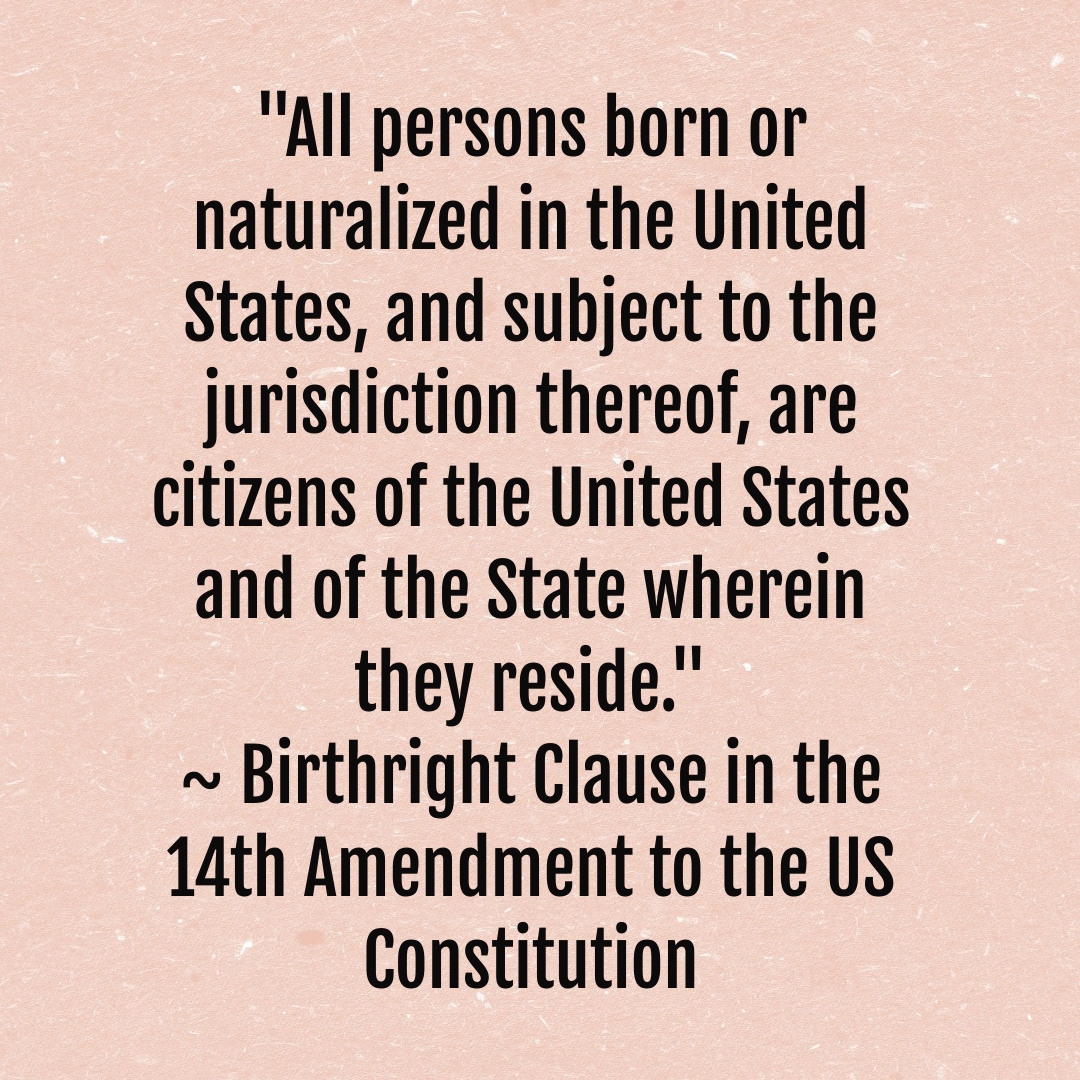
The first clause of the 14th Amendment to the US Constitution reads as follows: “All persons born or naturalized in the United States, and subject to the jurisdiction thereof, are citizens of the United States and of the State wherein they reside.”

Let’s take a step back and see what prompted Mr. Wong Kim Ark to take his complaint all the way to the US Supreme Court.

Who was Wong Kim Ark and what was this Court Case about?

Wong Kim Ark was born in San Francisco, California in 1873. His parents were subjects of the Emperor of China but were permanently residing in the United States. The family still lived in San Francisco in 1890 when Wong Kim Ark took a trip to China.

He returned to his home in San Francisco on July 26, 1890. He lived there and worked as a laborer as a US citizen. In 1894 he took another trip to China but, when he returned to the US in August 1895, he was denied entry on the grounds that he was not a US citizen.

A lower court ordered him to be released because he was a US citizen. The United States appealed the lower court’s decision, and the case went to the US Supreme Court.

Justice Horace Gray delivered for the majority in the 6-2 ruling by the US Supreme Court. In his statement he indicated that the Chinese Exclusion Act of 1882 had no relevance in this case.

The Chinese Exclusion Act was the first law of any significance that limited immigration into the United States. The Act was the result of violent acts committed against Chinese workers. It prohibited Chinese laborers from entering the US for ten years. Exceptions included merchants, teachers, students, travelers, and diplomats.

Justice Gray wrote, “It is conceded that, if he is a citizen of the United States, the acts of Congress, known as the Chinese Exclusion Acts, prohibiting persons of the Chinese race, and especially Chinese laborers, from coming into the United States, do not and cannot apply to him.”

As in most cases that reach the level of the US Supreme Court, there is more here than meets the eye. Having taken one Constitutional Law course in college does not qualify me as a Constitutional scholar, so I’ll just leave it at that.

If you wish to delve more deeply into the United States v. Wong Kim Ark decision, you may do so. I just found it serendipitous that the anniversary of this case fell during a time when the 14th Amendment to the US Constitution is under fire.

Why is the 14th Amendment under attack by Trump?

It is obvious that the president does not want children of undocumented Hispanic immigrants who are born in the US to automatically have US citizenship as guaranteed by the 14th Amendment.

The White House appears to be arguing its case on https://www.whitehouse.gov/presidential-actions/2025/01/protecting-the-meaning-and-value-of-american-citizenship/. It seems short-sighted to me for Trump to “show his hand” on this matter since it is destined to go before the US Supreme Court if he insists on pursuing his contempt for the 14th Amendment.

We have not heard the last of this.

A March 5, 2025 US Supreme Court ruling to consider

On March 5, 2025, we saw only five of the nine US Supreme Court Justices vote that the United States should be required to honor its promises of $2 billion in foreign aid through the now-possibly-defunct United States Agency for International Development (USAID). The slim majority decision gave me a sigh of relief but immediately angered me because the vote should have been 9-0.

Photo by Isak Engström on Unsplash

What is it in the life experiences of Associate Justices Alito, Kavanaugh, Thomas, and Gorsuch that influenced them to vote in the negative? What made those four men believe that funds authorized by the US Congress and promised to other countries and organizations should not be honored? Should not be paid?

What makes those four men think the United States should not be a country of its word? I really want to know.

Justice Alito argued in an eight-page dissent that resembled a pro-MAGA social media post that a US District Court Judge could not compel the US Government to spend money authorized by Congress. He essentially went after Judge Amir Ali, the lower court judge who had ruled in the case.

From what I have read, I think his anger is misplaced. It is the US Constitution that gives Congress the authority to allocate money. If Mr. Alito has a problem with that, perhaps he should have stated his disfavor with the Constitution instead of against Judge Amir Ali.

I certainly hope Justice Alito was not lashing out at Judge Ali because Judge Ali was born in Canada. I hope he wasn’t lashing out at Judge Ali because he was appointed by President Joe Biden. And I certainly hope he wasn’t lashing out at Judge Ali because he is a Muslim.

Perhaps I’m looking for a “there” when there’s no “there” there, but the current US Supreme Court in general seems to be in Trump’s pocket. This is the same group of Justices that ruled in 2024 that nothing a US President does is illegal.

I pray we haven’t heard the last of this!


Arlington National Cemetery

With so much going on, and a couple of long blog posts in March, I waited until today to mention how the US Department of Defense is erasing history specifically on the Arlington National Cemetery website. US history seems to be in Trump’s cross-hairs.

Under the heading, “Arlington National Cemetery removed links to webpages about Black, Hispanic and female veterans,” Snopes.com (published March 14, 2025; updated March 15, 2025) verified that the following links have been removed from the Arlington National Cemetery website:

          African American History, removed from the Notable Graves subsection;

          Hispanic American History, removed from the Notable Graves subsection;

          Women’s History, removed from the Notable Graves subsection;

          African American History, removed from the Themes drop-down menu of the Education section; and

          Civil War, removed from the Themes drop-down menu of the Education section.

This should be no surprise, since Trump has called veterans suckers and losers.


The latest US Department of Defense blunder

It seems to me that our Department of Defense (DoD) needs to spend less time erasing history and more time holding top secret war plans in a secure location (which until the Trump Administration was the policy) and much less time holding top secret war plan meetings via text messages.

Thank you, Jeffrey Goldberg, editor-in-chief of The Atlantic magazine, for being a true patriot and not leaking the plans for the United States bombing the Houthis in Yemen last week. Leaking the plans that you were texted would have put US military personnel is grave danger. Were you included on the text list by mistake, or is there someone in the DoD who wanted this information leaked to a journalist?

I wonder who DoD Secretary Hegseth will text top secret information to next.


Until my next blog post

I hope you have a good book to read.

Hold your family close.

Remember the people of Ukraine and western North Carolina.

Janet

#OnThisDay: Ramifications of Backgrounds of US Supreme Court Justices

When I read that today is the anniversary of the 1777 birth of Roger Brooke Taney, I wondered why his birthday appeared on any lists. When I learned that Mr. Taney was a US Supreme Court Chief Justice when the landmark Dred Scott decision was made, I knew there was a story behind the story.

We are all products of the times in which we live but, fortunately, we can be influenced by forces other than majority or peer pressure. We each have freewill to come to our own conclusions and beliefs.

Some US Supreme Court Justices try harder than others to disregard their personal backgrounds and experiences when considering a case. Some don’t seem to try at all in the 2020s.

Photo of US Supreme Court Building in Washington, DC
US Supreme Court Building, Washington, DC. (Photo by Brad Weaver on Unsplash.)

Let’s learn who Dred Scott was, and then we’ll look at how the life experiences of Roger Brooke Taney and the other six Justices in majority vote probably played into the US Supreme Court Dred Scott v. Sandford case.

Settle in. This gets complicated.

Who was Dred Scott?

Dred Scott was born a slave in Southampton County, Virginia around 1799. He moved to Alabama with his owner, Peter Blow, in 1818. In 1830, he moved to St. Louis, Missouri where Mr. Blow ran a boarding house.

Dr. John Emerson purchased Mr. Scott after Mr. Blow died in 1832. Dr. Emerson took Mr. Scott to Illinois and later to the Wisconsin Territory. Illinois was a free state, and slavery was illegal in the Wisconsin Territory.

Mr. Scott married Harriet Robinson, who was also a slave. Ms. Robinson’s owner sold her to Dr. Emerson. Things got more and more confusing in the ensuing years after Dr. Emerson moved back to St. Louis, but hired out Mr. and Mrs. Scott, leaving them in Wisconsin.

Dr. Emerson moved to Louisiana. He married Eliza (Irene) Sandford in 1838. Dred Scott went there, but shortly thereafter the Emersons and their slaves, including Mr. Scott, moved back to Wisconsin.

Dr. Emerson was discharged from the US Army in 1842 and – you guessed it – he and his wife and the Scotts moved back to St. Louis. Mr. and Mrs. Scott, by then, had two daughters.

Dr. Emerson seemed to have financial problems, so he and his wife moved to Iowa. It is unclear whether the Scotts went with them or if they were hired out and remained in Missouri.

When Dr. Emerson died in 1843, the Scotts and all his other slaves became the property of his widow, Irene Sandford. She moved back to St. Louis, retained ownership of the Scotts, and hired them out.

Mr. Scott tried repeatedly to purchase his freedom from Irene, but she would not hear of it.

Photo of a dark-skin wrist and clenched fist with a rope tied around it.
Photo by Tasha Jolley on Unsplash

Dred and Harriet Scott lawsuits

Dred and Harriet Scott separately filed lawsuits against Irene Emerson in April 1846. They were firmly based on two Missouri statutes. One allowed anyone of any color to sue for wrongful enslavement. The other statute said that any slave transported to a free territory automatically became free and would remain free even when taken back into a slave state.

The Scotts’ church, abolitionists, and you’ll never guess who:  Dred’s previous owner’s family, the Blows, gave their support. Since neither Mr. or Mrs. Scott could read or write, they needed all kinds of support to fight their cases.

The St. Louis Circuit Court ruled against the Scotts in 1847, on a technicality. The cases were heard again in 1850 and the Scotts won their freedom. That should have been the end of it, but it wasn’t.

Irene Emerson appealed to the Missouri Supreme Court. That court combined the two cases and reversed the decision of the lower court in 1852, making the Scotts slaves again!

Then, Irene Emerson transferred ownership of the Scotts to her brother, John Sandford, or so was thought. (Actually, the transfer did not happen, but that’s why the case was called Dred Scott v. Sandford as the Scotts’ legal struggle continued.)

In 1853, Dred Scott filed a federal lawsuit with the United States Circuit Court for the District of Missouri. The case was heard in May 1854, and the court ruled against Mr. Scott.

The Dred Scott Decision/Dred Scott v. Sandford

US Supreme Court Building, Washington, DC. (Photo by Tim Mossholder on Unsplash.)

Later that year, Mr. Scott appealed his case to the US Supreme Court. The case gained support and notoriety by the time the Justices heard the case in 1856. A curious aside is that by then, Irene Sandford Emerson had married Calvin Chaffee. An abolitionist, Mr. Chaffee was also a US Congressman.

When Mr. Chaffee learned that Irene still owned Dred Scott and his family, he sold the Scotts to Taylor Blow, the son of Scott’s original owner, Peter Blow.

On March 6, 1857, the US Supreme Court announced its 7-2 decision in favor of Mr. Sandford.

On May 26, 1857, Taylor Blow freed the Dred Scott family. Sadly, Mr. Scott died of tuberculosis just 16 months after finally becoming a free man.

What was Chief Justice Roger Brooke Taney’s background?

Roger Brooke Taney was born in Maryland on March 17, 1777. He was educated in France. After coming home from France, he graduated from Dickinson College in Pennsylvania, and studied law with Judge Jeremiah Chase of the Maryland General Court.

In 1806 he married Francis Scott Key’s sister, Anne.

He had a private law practice. After being nominated by President Andrew Jackson, Roger Taney was sworn in as Chief Justice of the US Supreme Court in March 1836, replacing John Marshall.

Oh… and did I mention that he was a slave owner?

But what was Roger Taney’s personal track record with slaves?

Taney freed seven of his slaves on July 14, 1818. He also provided for the emancipation of the three older children of one of his freed slaves at later dates – one of them would be freed in 1836 at age 25, one in 1843 at the age of 30, and the other one in 1845 at the age of 30.

As a young lawyer, Taney was quoted as calling slavery a “blot on our national character,” but by 1857 (the year of the Dred Scott decision) he was an advocate in favor of slavery. It was then that he called the abolitionist movement “northern aggression.”

He wrote for the majority in favor of Dred Scott’s owner in Dred Scott v. Sandford.

Taney seemed to be conflicted on the subject of slavery. Yes, he gradually freed his slaves, but why did he drag it out over 27 years? If he was indeed against slavery as a young man, what didn’t he free all his slaves at that time instead of waiting until 1845 to free the last one? He made the children remain slaves until they were 25 to 30 years old. Where is the humanity in that?

What about the six Justices who sided with Chief Justice Taney?

Justice John Catron, a lifelong slave owner, joined in the majority opinion.

Justice Peter V. Daniel, who owned slaves throughout his adult life, joined in the majority opinion.

Justice Samuel Nelson voted with the majority but disagreed with Chief Justice Taney’s reasoning. Justice Nelson maintained that the states had the right to determine whether slavery was legal within their boundaries and that the federal government did not have the authority to tell the states what to do in that matter.

Justice Robert Cooper Grier voted with the majority and concurred that slaves were not citizens.

Justice James M. Wayne was a lawyer, politician, and judge from Savannah, Georgia. I did not find that he owned slaves. He agreed with President Andrew Jackson on the forced removal of Indians to the Oklahoma Territory. Surprisingly, he was against the formation of the Confederate States of America.

Justice John A. Campbell was a lawyer in Georgia and Alabama. Even though Justice Campbell did not believe that the Court could determine whether Dred Scott was a citizen, he agreed with the Chief Justice on most other points. He agreed that, as a slave under Missouri law, Mr. Scott could not sue in federal court.

The Majority Opinion of the US Supreme Court in Dred Scott v. Sandford

Although basing its decision on what was stated in the US Constitution at that time, the words are chilling. I’ll share just a fraction of the decision here.

Writing for the majority in the Dred Scott case, Chief Justice Taney stated, “A free negro of the African race, whose ancestors were brought to this country and sold as slaves, is not a ‘citizen’ within the meaning of the Constitution of the United States.

“When the Constitution was adopted, they were not regarded in any of the States as members of the community which constituted the State, and were not numbered among its ‘people or citizen.’ Consequently, the special rights and immunities guarantied to citizens do not apply to them.

“And not being ‘citizens’ within the meaning of the Constitution, they are not entitled to sue in that character in a court of the United States, and the Circuit Court has not jurisdiction in such a suit. The only two clauses in the Constitution which point to this race, treat them as persons whom it was morally lawful to deal in as articles of property and to hold as slaves.”

And, “The plaintiff having admitted, by his demurrer to the plea in abatement, that his ancestors were imported from Africa and sold as slaves, he is not a citizen of the State of Missouri according to the Constitution of the United States, and was not entitled to sue in that character in the Circuit Court. This being the case, the judgment of the court below, in favor of the plaintiff of the plea in abatement, was erroneous.”

Chief Justice Taney said in the majority decision that slaves were property and the ownership of slaves was on the same footing as the ownership or anything else. It said, that the courts could not at that time, under the Constitution, deprive a citizen of their property. It said that just because a citizen took their property into “a particular Territory of the United States,” (Rock Island, Illinois) did not mean they did not still own that property.

The majority decision referred to the Missouri Compromise, enacted in 1820, which admitted Missouri to the Union as a state allowing slavery, but it outlawed slavery from the rest of the Louisiana Purchase lands located north of the southern border of Missouri (the 36-degree 30-minute parallel.)

In the Dred Scott decision, the court ruled that the Missouri Compromise (which had been repealed by the Kansas-Nebraska Act of 1854) was unconstitutional and, therefore, Dred Scott and his family “were not made free by being carried into this territory….”

Background of the 36-degree 30-minute parallel

Since our current president likes to call borders artificial lines drawn by someone with a ruler decades ago, I looked into the history of the 36-degree 30-minute parallel. It was originally drawn as the boundary between the Colonies of Virginia and North Carolina. Later, it was extended to be the border between Kentucky and Tennessee. When the Missouri Compromise came along, that line was extended to balance the number of states that allowed slavery and the states that did not allow slavery.

The moral of the story

The next time there is a vacancy on the US Supreme Court or on your state’s Supreme Court, you need to pay attention. Dig into the nominee’s background and let your elected officials know what your concerns are or if you think that nominee will make be a fair, honest, law-abiding Justice with integrity. Watch the Congressional hearings and listen carefully to the nominee’s answers – to what they say and what they don’t say. Watch their body language. Are they at ease? Do they smirk? Do they easily lose their cool?


Hurricane Helene Update

As of Friday, 152 roads in North Carolina were closed due to Hurricane Helene damage and repairs. That count included 11 US highways, 17 state highways, and 124 state roads. This is an overall increase over a couple of weeks ago.

Asheville’s application for a $225 million Disaster Recovery Block Grant from the US Department of Housing and Urban Development (HUD) is in limbo because it includes a $15 million Small Business Support Program that would prioritize Minority and Women Owned Businesses. The City, which sustained more than $1 billion in damage in Hurricane Helene, has been given until April to submit a plan that is in line with Trump’s anti-minority and anti-women regime.

Keep in mind that the application was submitted last year according to the regulations that were in place at the time. Does anyone else found it ironic that HUD Secretary Scott Turner, who is a black man, wrote that “DEI [Diversity, Equity, and Inclusion] is dead at HUD”?

As employees of the National Park Service and National Forestry Service are fired by the Trump Administration in the name of “waste and fraud,” you can expect to see fewer post-Helene clean-up activities in the parks and forests in western North Carolina.

Photo by Janet Morrison.

As you plan a trip to the mountains in western North Carolina this spring, here’s a link to important details about the Blue Ridge Parkway: https://www.nps.gov/blri/planyourvisit/helene-recovery-projects-at-a-glance.htm. We probably need to continue to plan our mountain visits avoiding most of the parkway.


Since my last blog post

I heard from a number of you in reference to my March 10, 2025, blog post. I heard from fellow-Americans, and I heard from people in various parts of Europe and the Caribbean.

It seems we still have a lot in common with our European allies (I can’t bring myself to refer to them as “former allies” yet): We’re all deeply concerned – and dare I say scared – over the current political situation into which the US President has thrown us.

The people in Mexico, Canada, and Europe did not ask for this… and half of the Americans didn’t ask for or vote for this. The brave people of Ukraine certainly didn’t ask for and don’t deserve this chaos.


Until my next blog post

I hope you find a good book to read that will inform you and/or give you a few hours to escape into a fictional place or time.

We didn’t all vote for this, but we’re all in it together now. We’ll be watching in the coming days, months, and years to see how the US Supreme Court will rule on cases resulting from the chaos we’ve been thrown into since January 20th.

Photo by Gayatri Malhotra on Unsplash

I hope my next blog post will be shorter than this one. It depends on what’s going on.

Please remember the people of Ukraine and western North Carolina… and all the people terrorized by tornadoes over the weekend.

Janet

An Historical & Current Look at “America First”

It is sad that many Americans do not know history. I blame the results of the 2024 US Presidential election on that along with today’s popular mindset that is only concerned with how something affects “me” instead of being concerned with “the common good.”

Photo by Kyle Glenn on Unsplash

A policy of isolationism has never turned out well for the United States, and I doubt it will as we find ourselves in a true global economy in which no country can thrive in isolation.

Donald Trump campaigned for President on an America First agenda. That apparently sounded good to half the population. The picture he painted of America First did not include alienating the allies we’ve had for our entire 248-year history. It did not include turning our backs on Ukraine and embracing Vladimir Putin. Trump so successfully sold half the voters a bill of goods that they find themselves unable to admit they were hoodwinked. They cannot admit they made a grave mistake in the voting booth.

They interpreted “America First” as an idyllic country in which we would literally build walls instead of bridges, we would have cheap eggs and cheap gasoline, we would not be bothered by having under-paid migrants picking our fruits and vegetables, we would not be bothered with immigrants cleaning our hotel rooms or cutting our grass, and we would not have to compete with highly-qualified foreigners for jobs we have not prepared ourselves to assume.

It is a fact that Americans already have cheap gasoline compared to such places as Great Britain. As the “Bird Flu” continues to spread, we already look back on $4.00-a-dozen eggs as “the good old days.” And how many of us are lining up to make the beds and clean the toilets in hotels for $7.25-an-hour?

Much of America finds itself in an “us versus them” mentality. It is a mindset based in a belief that anyone who doesn’t look and talk like I do doesn’t have the right to live… not a right to live in the United States, at least. When I voiced my political views on social media in January, one commenter told me I should find another country to live in.

I was fortunate to have been born in the United States. I did nothing to deserve that. My immigrant ancestors came here in the 1700s and — fortunately for me — were not deported by the Native Americans who had been living here for thousands of years.

By merely being born in the United States I am the recipient of blessings and opportunities about which the majority of people in the world can only dream.

Photo of the Statue of Liberty with the New York City skyline in the background
Photo by Priyanka Puvvada on Unsplash

Don’t get me wrong… illegal immigration into the United States needs to be addressed, but the mistakes of the past have turned Americans into an “us versus them” mentality in which the “us” no longer view “them” as human beings. The dehumanization of people leads to hate and violence.

It is tragic that we now have a President who repeatedly tells us that we are victims, suckers, and losers being taken advantage of by other countries.


“What’s the history of “America First?” you may ask.

Former Secretary of State, the late Madeleine Korbel Albright, explained it well in her book, Fascism: A Warning, in 2018, so I will quote some of what she wrote:

“America First is a slogan with a past. Founded in 1940, the America First Committee (AFC) brought together pacifists, isolationists, and Nazi sympathizers to fight against the country’s prospective entry into World War II. The AFC opposed creation of the Selective Service and also a Roosevelt initiative known as Lend-Lease, to keep the British in food and arms as they struggled to survive the German onslaught. Within twelve months of its founding, the committee had built a membership of more than 800,000 and attracted support from across the political spectrum – corporate tycoons and Socialists alike.”

Photo of a barbed wire fence at a Nazi concentration camp during World War II
Fence at a Nazi concentration camp. (Photo by Darshan Gajara on Unsplash.)

Albright also wrote, “Four days after the Japanese attack on Pearl Harbor, Hitler declared war on the United States. The AFC soon disbanded and, in the intervening decades, its name has carried a stigma of naivete and moral blindness. Now ‘America First’ is back – but what does it mean?”

Donald Trump stated at an assembly of the United Nations that every country should put its interests first. But Albright maintains, “What the assertion ignores is the stake that all countries have in the fates of others.”


My thoughts

I started Janet’s Writing Blog more than a decade ago. Until recently, I planned to basically blog about my journey as a writer and my journey as a reader. As time passed and I wanted to establish my credibility as a writer of history and historical fiction, I began to blog about historical events and documents, usually on anniversary dates.

I did not plan, intend, or want to turn my blog into a political platform. I still do not want to do that, but I find myself in a situation in which I cannot avoid it. I must live with myself. I cannot have this public platform and pretend that everything in our country and world are going well.

Writers are cautioned against being too political, but aren’t writers, teachers, and scientists the first groups and individuals fascist governments go after? I don’t want to turn my blog into nothing but a political sounding board; however, I will not sit idly by while our government is dismantled.

Until the day that I am silenced, I will continue to voice my opinions and speak out against injustices. I will come down on the side of the United States Constitution, and I will come down on the side of the downtrodden. My Presbyterian faith instructs me to do so.

The growing mindset in the United States is “us” versus “them.” I think the 2024 Presidential Election bears that out. In the words of Secretary Albright, “To reduce the sum of our existence to a competitive struggle for advantage among more than two hundred nations is not clear-eyed but myopic. People and nations compete, but that is not all that they do.”

Photo of a painting of the western hemisphere.
Photo by Elena Mozhvilo on Unsplash

We have just experienced a week of whiplash caused by the policies, pronouncements, Executive Orders, and constantly changing mind of Donald Trump. One day we have tariffs, the next day we don’t, but the next day we do, and no one knows – apparently, not even Trump – whether they’re on or off later today, much less tomorrow.

The words of Trump supporters that “we need a businessman in the White House” echo in my head. Being a student of government and political science, I bristled at that mindset when it was first voiced and I continue to bristle and cringe at it today.

If this is the way businesses operate, I don’t think our democracy (or any democracy) can afford it. I know a democracy cannot afford this in a constitutional way – in a “this is what we stand for” way.

When facing excessive debt, do businesses fire all their employees only to try to locate and rehire the good ones later? Do businesses issue blanket lies in writing about the performance of the employees they fire or layoff in mass reorganizations in order to make it more difficult for them to find new jobs?

Oops! We didn’t mean to fire the air traffic controllers. We didn’t mean to fire the people who safeguard our nuclear stockpiles. We just meant to fire the scientists working on cures for cancer, the people who are trained to fight wildfires, the people who work at the Veterans Administration and the VA hospitals, and the people who make sure we have clean air to breathe, clean water to drink, and safe food to eat.

We just meant to cancel classes at the National Fire Academy in Emmitsburg, Maryland, the premier fire academy in the US where firefighters from all over the nation come for special training. (Too bad for the firefighters who had already bought their plane tickets, etc. for the new round of classes that were scheduled to begin this week.)

We just meant to traumatize the millions of disabled and elderly citizens who rely on Social Security. After all, we must find the money somewhere to give the millionaires and billionaires more tax breaks.

To me, that’s a sign of insanity, but I did not major in business administration in college. I majored in political science and my graduate degree is in public administration.

The government is not supposed to be a profit-making entity. It is service oriented. The government does not manufacture things. It contracts with private companies (and billionaires like Elon Musk) for those things. If the federal government is “getting ripped off” as Trump says, perhaps someone needs to take a look at federal contracts with private companies and see where the waste is.

Photo of a contract marked with a "sign here" sticky note
Photo by Kelly Sikkema on Unsplash

When I worked in government, I was required to recommend to the elected governing body that a contract be given to the lowest bidder unless the lowest bidder was deemed unable to fulfill the contract and accomplish the work as specified. If we think the federal government is paying too much for water faucets or whatever, perhaps the fault likes with the private company selling us those faucets.

If contracts are being issued to the highest bidder because an elected official has a personal relationship or a financial relationship with that bidder, perhaps the elected official needs to be impeached. And the bidder attempting to defraud the government (i.e., the American people) needs to be exposed.

In the Gettysburg Address on November 19, 1863, President Abraham Lincoln reminded us that in the United States of America we have a government of the people, by the people, and for the people. It is time for we, the people, to remind all three branches of the federal government of that.

Photo of the tops of three heads: a blonde, a brown, and a black haired and skinned group of people
Photo by Clarissa Watson on Unsplash

We are the government. We, the people, are not the enemy of the government. A free press is not the enemy of the people.


Until my next blog post

It is tempting during these uncertain and chaotic times to withdraw and stop listening to or reading the news; however, it is more important than ever that we pay attention. We need to stay as informed as possible about what is happening in and to our government. We need to get our information from a wide range of reliable sources.

I deleted my weekly western North Carolina Hurricane Helene Update today due to the length of my blog post. It should return next week.

I hope you have a good book to read. I have several going now, as usual. Regardless of your political leanings, I encourage you to read Fascism: A Warning, by Madeleine Korbel Albright.

Remember the people of Ukraine and western North Carolina.

Janet

The Importance of Marbury v. Madison Today

This is a timely anniversary date that landed in my lap!

The US Supreme Court heard the arguments for the Marbury v. Madison case on February 11, 1803, and handed down its decision 222 years ago today on February 24, 1803. That’s a quick turn around compared to today’s Supreme Court!

A photo of the US Supreme Court building.
The US Supreme Court Building.
(Photo by Tim Mossholder on Unsplash.)

It isn’t often that one hears a reference made to this US Supreme Court case, but a news commentator on TV mentioned it just 11 days ago and another one mentioned it four or five days ago. I chose Marbury v. Madison for today’s blog post when I created my 2025 editorial calendar last year. Talk about serendipity! Little did I know last fall what a place we would be politically today.

In a nutshell, Marbury v. Madison established the right of the courts to determine constitutionality of the actions of the Executive and Legislative branches of government in the United States.

The three branches of the federal government are equal; however, the Judicial branch has the authority to rein in the other two branches when they take actions deemed to be in conflict with the United States Constitution.

Photo of a top spinning in perfect balance.
And image of what balance looks like. (Photo by Christophe Hautier
on Unsplash.)

Until January 20, 2025, I took Marbury v. Madison for granted. I will never take it for granted again.

When I started writing today’s post a week ago, I copied what the National Archives website said about Marbury v. Madison and saved it as a Word document in case the National Archives website disappeared. (The USAID website disappeared for a while before being moved to the US State Department website. Incidentally, as I wrote this paragraph on Friday afternoon, a judge ruled that the Trump Administration can proceed to dismantle USAID.) Trump fired the National Archivist about 10 days ago. We historians fear that he or Elon will torch the National Archives. That’s one way to erase history, but I digress. (It is a real fear, though.)

Back to Marbury v. Madison

Quoting the National Archives website (https://www.archives.gov/milestone-documents/marbury-v-madison) because I cannot state the case’s background any better: “In 1801, outgoing President John Adams had issued William Marbury a commission as justice of the peace — but the new Secretary of State, James Madison, refused to deliver it. Marbury then sued to obtain it. With his decision in Marbury v. Madison, Chief Justice John Marshall established the principle of judicial review, an important addition to the system of “checks and balances” created to prevent any one branch of the Federal Government from becoming too powerful.”

Photo of the National Archives building in Washington, DC
US National Archives, Washington, DC. (Photo by Juliana Uribbe on Unsplash.)

Also, quoting from the National Archives website: “‘A Law repugnant to the Constitution is void.’ With these words written by Chief Justice Marshall, the Supreme Court for the first time declared unconstitutional a law passed by Congress and signed by the President.”

I think some folks living and working on Pennsylvania Avenue in Washington, D.C. need to read up on this. We now have a US President who wrote on social media nine days ago, “He who saves his Country does not violate any Law.” It’s up for debate whether he is doing anything to save our country, but the frightening thing is that he has put in writing that he is above the law.

He also said that when it comes to agencies of the Executive Branch only he and the US Attorney General can interpret laws. That might be in conflict with the principle established by Marbury v. Madison.

It is the US Supreme Court that will ultimately decide if the US President does anything that is unconstitutional.

The US Constitution gave the President the power to veto an act of Congress and appoint federal judges with the advice and consent of the US Senate, and it gave Congress the power to impeach the President or a judge. The powers of the Supreme Court were not spelled out in such detail. When Marbury v. Madison came along in 1803, Chief Justice Marshall – who strongly believed that the Supreme Court was equal in power to the Executive and Legislative branches – led the court in seizing the opportunity to establish the principle of Judicial Review.

The US Supreme Court’s authority to declare federal or state laws unconstitutional has never been seriously challenged. I hope that will still be true in 2029.

In case you’re wondering what happened to William Marbury…

With the decision made in the Marbury v. Madison case, the Secretary of State was directed to deliver to William Marbury his commission as a justice of the peace for the county of Washington, in the District of Columbia.

In the big scheme of things, I wonder if the parties involved in this case had any idea going into it that it was destined to be a landmark decision.

In conclusion

I still have freedom of speech and I will continue to use my blog as a platform to share my opinions and my research into the US. Constitution. Those of you who have been reading my blog for more than 10 years know that is nothing new. I just feel more compelled now to blog about the US Constitution.

The words of the preamble to the US Constitution with a slightly blurred image of the American flag in the background.
Preamble to the Constitution of the United States of America

My college major was political science, and I regret that I only took one Constitutional Law course. In fact, I was so intimidated by the subject that I procrastinated taking the required course until my final quarter. (The university was on the quarter system then instead of the semester system.)

As it turned out, the course was fascinating and I wished I’d taken it earlier so I would have had time to take more constitutional law courses. I readily admit that one constitutional law course does not a constitutional law expert make, but I’m trying to shine a light on the document.


Hurricane Helene Update

As of Friday, 155 roads in North Carolina are still closed due to Hurricane Helene, including Interstate 40 near the Tennessee line. That is a decrease of 14 in the last week, inspite of snow and some sub-zero wind chills. This week’s count consists of 1 interstate highway (I-40), 11 US highways, 17 state highways, and 126 state roads. (To give some perspective, it has now been five months since the hurricane.)

I failed to report in last Monday’s blog post that Eric Church’s foundation, Chief
Cares, has purchased land in Avery County, NC and hopes to place 40 modular homes to house families that lost their homes due to Hurricane Helene. A road must be built and water and sewer lines installed. Church and his foundation hope to secure land in adjoining counties so they can provide more housing for hurricane victims. Church and fellow-country music singer Luke Combs organized and spearheaded a concert at Bank of America Stadium in Charlotte last October to raise money for hurricane relief.

The work of Brother Wolf Animal Rescue and The 21st Century Packhorse Librarian continue and will appreciate your support for the foreseeable future.

Jake Jarvis of Precision Grading in Saluda continues to work in the area every day free-of-charge with his heavy earth-moving equipment. He has built bridges, reconstructed driveways and private roads, and excavated places for homes to be rebuilt. The last couple of weeks have been challenging due to ice, snow, and high winds.


Until my next blog post

I hope you have a good book to read. Next Monday I plan to blog about the books I’ve read in February.

Value your freedoms, family, and friends.

Remember the people of Ukraine and western North Carolina.

Janet

25th Amendment Ratified, 1967

Is that date correct? Yes, it was 1967. Since this is the US Constitutional Amendment about presidential succession, it begs the question, “What procedure was in place before February 10, 1967?”

The words of the preamble to the US Constitution with a slightly blurred image of the American flag in the background.
Preamble to the Constitution of the United States of America

Prior to Enactment of the 25th Amendment

Prior to the enactment of the 25th Amendment, it was up to each presidential administration to set its own plan to deal with presidential and vice-presidential vacancies.

Yikes! Can you imagine that today?

It would be disastrous today and it was not good in 1841 when President William Harrison died in office. Harrison’s cabinet gave Vice President John Tyler the title “Vice President Acting President.” Tyler moved into the White House, assumed all presidential powers, and gave an inaugural address, all before being confirmed by Congress.

And we all know how in 1919 First Lady Edith Wilson and her husband’s doctor, Cary Grayson, banded together to keep President Woodrow Wilson’s massive stroke a secret.

After his mild stroke, President Dwight D. Eisenhower wrote Vice President Richard M. Nixon a letter with instructions on what to do if he became incapacitated. He gave Nixon the authority to determine when and if that incapacity began.

Again, yikes! All that was needed was a power-hungry vice president put in charge of determining when the president should no longer serve!

Nixon did step in as acting president when Eisenhower had a heart attack in 1955 and in 1956 when he had surgery. Nixon was not sworn in as president either time.

Part of the time in our history, the Speaker of the House was considered to be next in line after the Vice President, while in other times in our history the President Pro Tempore of the Senate was considered to be next in line after the Vice President. It wasn’t always clear.


What brought things to a head

As you might guess, the assassination of President John F. Kennedy in 1963 put more focus on presidential succession. What if Vice President Lyndon B. Johnson had also been severely wounded or killed that day?

There was no protocol in place to handle such a situation.


A Constitutional Amendment was needed

On January 1, 1965, joint resolutions were introduced in the House of Representatives and in the Senate recommending a succession amendment. Both chambers approved their versions by April.

A committee was created to iron out differences in the two bills, and the joint resolution was passed by Congress on July 6, 1965. It was sent to the states for ratification, and that requirement was met on February 10, 1967.

The 25th Amendment was signed into law by President Johnson on February 23, 1967.


The text of the 25th Amendment

In case you’ve never read it or want to refresh your memory, here is the text of the amendment:

Section 1

“In case of the removal of the President from office or of his death or resignation, the Vice President shall become President.

Section 2

“Whenever there is a vacancy in the office of the Vice President, the President shall nominate a Vice President who shall take office upon confirmation by a majority vote of both Houses of Congress.

Section 3

“Whenever the President transmits to the President pro tempore of the Senate and the Speaker of the House of Representatives his written declaration that he is unable to discharge the powers and duties of his office, and until he transmits to them a written declaration to the contrary, such powers and duties shall be discharged by the Vice President as Acting President.

Section 4

“Whenever the Vice President and a majority of either the principal officers of the executive departments or of such other body as Congress may by law provide, transmit to the President pro tempore of the Senate and the Speaker of the House of Representatives their written declaration that the President is unable to discharge the powers and duties of his office, the Vice President shall immediately assume the powers and duties of the office as Acting President.

“Thereafter, when the President transmits to the President pro tempore of the Senate and the Speaker of the House of Representatives his written declaration that no inability exists, he shall resume the powers and duties of his office unless the Vice President and a majority of either the principal officers of the executive department or of such other body as Congress may by law provide, transmit within four days to the President pro tempore of the Senate and the Speaker of the House of Representatives their written declaration that the President is unable to discharge the powers and duties of his office. Thereupon Congress shall decide the issue, assembling within forty-eight hours for that purpose if not in session. If the Congress, within twenty-one days after receipt of the latter written declaration, or, if Congress is not in session, within twenty-one days after Congress is required to assemble, determines by two-thirds vote of both Houses that the President is unable to discharge the powers and duties of his office, the Vice President shall continue to discharge the same as Acting President; otherwise, the President shall resume the powers and duties of his office.”


What the 25th Amendment accomplished

Section 1 was already the law.

Section 2 of the 25th Amendment finally addressed how a new Vice President would be chosen in the event the elected Vice President had stepped in as President.

Sections 3 and 4 of the amendment spell out the nitty-gritty of how a case of a President’s incapacitation shall be handled, including a time frame.


The Presidential Succession Act of 1947

The Presidential Succession Act of 1947 set the order in which elected officials and cabinet members would be in line for the presidency. It was decided that the cabinet members should be in the order in which their position was created. As new cabinet departments are created, they are added to the list. (And as existing federal departments are eliminated by Elon Musk… they will disappear from the list and from our lives.) There were just 11 cabinet departments in 1947 when The Presidential Succession Act was adopted.

This might be good for members of Congress to keep in mind when holding confirmation hearings for cabinet appointees.

The full order of presidential succession is as follows:

1. Vice President

2. Speak of the House

3. President Pro Tempore of the Senate

4. Secretary of State

5. Secretary of the Treasury

6. Secretary of Defense

7. Attorney General

8. Secretary of the Interior

9. Secretary of Agriculture

10. Secretary of Commerce

11. Secretary of Labor

12.Secretary of Health and Human Services

13. Secretary of Housing and Urban Development

14. Secretary of Transportation

15. Secretary of Energy

16. Secretary of Education

17. Secretary of Veterans Affairs

18. Secretary of Homeland Security


Until my next blog post

Thank you for reading my blog. I hope you occasionally find it helpful, educational, or entertaining.

I hope you have a good book to read.

Remember the people of Ukraine, western North Carolina, and California.

Janet

#OnThisDay: 19th Amendment to U.S. Constitution, 1920

The 19th Amendment: The right of citizens of the United States to vote shall not be denied or abridged by the United States or by any State on account of sex.

Congress shall have power to enforce this article by appropriate legislation.

It was 104 years ago today that women in the United States finally got the right to vote. The year 1920 might seem like ancient history to some of you, but I always think of it in terms of my mother having her eighth birthday that autumn.

Early- to mid-1800s

Women getting the right to vote came after a long, hard fight. In the early- and mid-1800s, women advocated for the abolition of slavery. Their speeches evolved into words in support of women’s suffrage. Two such women, Elizabeth Cady Stanton and Lucretia Mott, organized a women’s suffrage convention in Seneca Falls, New York in 1848.

Sojourner Truth and Sarah Redmond, two former slaves – who could not vote because of their race and their gender – organized women’s suffrage conventions. Slowly, it was becoming more of a public issue of discussion.

Post American Civil War/Reconstruction Era

The State of Michigan allowed women to vote in school board elections after the Civil War.

With the passage of Reconstruction Era U.S Constitutional Amendments granting black men the right to vote came contentious political and public discourse because it brought to the forefront that women still could not vote. As a result of their disfavor with women still not being granted the right to vote, Susan B. Anthony and Elizabeth Cady Stanton left the American Equal Rights Association (AERA), which they had founded in 1866, and formed the National Woman Suffrage Association (NWSA) in 1869. Later that year, women who thought it more plausible to push for women’s suffrage by getting it adopted state-by-state formed the American Women Suffrage Association.

The Territory of Wyoming (it was not yet a state) granted women full voting rights in 1869. The Territory of Utah followed Wyoming in 1870, but Congress took that right away in 1887.

Photo of an "I Voted" sticker on a woman's finger
Photo by Joshua Sukoff on Unsplash

Virginia Minor of Missouri, after being denied the right to vote in 1872, took her complaint to the U.S. Supreme Court. Minor maintained that the 14th Amendment gave her the right to vote because it stated that “no State shall make or enforce any law which shall abridge the privileges or immunities of citizens of the United States.”

In a classic example of the high court going by the “letter of the law” instead of taking a more pragmatic stance, the Court, in its majority decision in Minor v Happersett, said that the right to vote was not a necessary privilege of citizenship because it was not a right included when the U.S. Constitution was ratified in 1788.

The “bottom line” of this decision was that states did indeed have the authority to deny women the right to vote. Let that sink in for a few minutes.

Late 1800s

In 1878 and again in 1887, there were efforts in Congress to introduce a women’s suffrage amendment, but they failed.

The AERA and NWSA merged in 1890, but some of the leaders worked to exclude black women from participating in events. In 1896, the black women formed the National Association of Colored Women to advocate for women’s voting rights along with other issues that were important to women of color.

Photo of a woman putting her ballot in the voting box
Photo by Unseen Histories on Unsplash

In 1896, the Constitution of the State of Utah once again gave female citizens the right to vote.

1910s

By 1916, 11 western states had granted women the right to vote, but petitions to Congress and litigation in federal courts repeatedly came up short. In the election in Montana that year, Jeannette Rankin was elected to Congress. She was the first women elected to the U.S. House of Representatives.

The joint resolution to propose a women’s suffrage amendment (See the 1878 and 1887 references above) was reintroduced in the U.S. House of Representatives in 1917 – thirty years after it had last been shot down. Proponents of states’ rights argued that the passage of such an Amendment would interfere with each state’s authority to dictate the composition of its electorate and that it would also disrupt the traditional family. Some lawmakers opposed it because they feared it would give black women the right to vote.

(Does anything about the states’ rights argument sound familiar? The current U.S. Supreme Court in 2023 conveniently decided to give states the authority to pass laws about women’s health.)

Photo of turn of the 20th century women
Photo by Library of Congress on Unsplash

The opposition was narrowly defeated as a two-thirds majority voted to pass the proposed Amendment on January 10, 1918. The Senate debated the joint resolution for months with many of the same arguments that had been overcome in the House. President Woodrow Wilson spoke in favor of the Amendment on October 31, 1918, citing the contributions women had made on the home front during World War I.

The following day, the resolution was defeated in the Senate. It failed again in the Senate on February 10, 1919. But President Wilson called a special session of Congress in May 1919. The House passed the 19th Amendment on May 21, 1919, and it was approved by the Senate on June 4, 1919.

During World War I, some of the views of gender roles in the country began to change as women took on many of the jobs that had earlier been considered men’s work. The 19th Amendment was proposed in Congress in June 1919.

August 26, 1920

It took 14 months for a three-fourths majority of states to accept the 19th Amendment. It was ratified on August 18, 1920 and on August 26, 1920, U.S. Secretary of State Bainbridge Colby certified that the Amendment had been ratified.

Photo of "I Voted" stickers
Photo by Element5 Digital on Unsplash

Obstacles such as poll taxes and literacy tests continued to prevent many black women and other females of color from voting until the 24th Amendment was ratified in 1964 and enforced by the Voting Rights Act in 1965.

Since my last blog post

I’ve been reading several books, pushing myself to do some yard work, and watching some online videos about the craft of writing. I’m motivated to get back to work on my novel!

Until my next blog post

I hope you have a good book to read.

Don’t take your family for granted.

Remember the people of Ukraine.

Janet

#OnThisDay: Gideon v. Wainwright

I should have kept my notes from studying the Gideon v. Wainwright US Supreme Court case when I took Constitutional Law as a senior political science major in college. Fifty years later, I remembered the Gideon case as the one that gave individuals charged with a crime in the United States the right to legal counsel, but I was more than a little fuzzy on the details. Hence, today’s post necessitated my doing some research.

Who was Wainwright?

Louie L. Wainwright was the Secretary of Florida Department of Corrections from 1962 to 1967.

Who was Gideon?

Clarence Earl Gideon had an eighth-grade education. He reportedly ran away from home while a middle school student. He was no stranger to the law throughout his life as he was jailed or in prison more than once for committing nonviolent crimes.

So how in the world did his name get attached to a landmark US Supreme Court case in 1963?

Photo by Jon Tyson on Unsplash

Earlier charges against Gideon bear no bearing on the Gideon v. Wainwright case. The pertinent background facts in the determination of this case are as follows:

Gideon was charged with breaking and entering with intent to commit a misdemeanor after allegedly breaking into a pool hall in Panama City, Florida in June 1961 with intent to commit a misdemeanor. At that time (I do not know the current Florida laws) that charge constituted a felony. Gideon asked the judge in that case to appoint legal counsel from him because he could not afford an attorney. Florida law only permitted for free legal counsel in capital offense cases at that time.

After the judge was forced under state law to deny Gideon’s request, Gideon represented himself in the trial. Despite doing a commendable job considering his education and background, he was found guilty and sentenced to five years in prison.

On the grounds of his constitutional rights having been violated, Gideon filed a petition with the Florida Supreme Court. The state court denied the petition.

Against all odds, Gideon then filed a handwritten petition with the United States Supreme Court and the justices agreed to hear the case. What Gideon was calling into question was the interpretation of the last clause in the Sixth Amendment to the US Constitution.

The Sixth Amendment was ratified with the following wording in 1791 and has never been amended:

“In all criminal prosecutions, the accused shall enjoy the right to a speedy and public trial, by an impartial jury of the State and district wherein the crime shall have been committed, which district shall have been previously ascertained by law, and to be informed of the nature and cause of the accusation; to be confronted with the witnesses against him; to have compulsory process for obtaining witnesses in his favor, and to have the Assistance of Counsel for his defence.”

The US Supreme Court agreed to hear Gideon’s case in part to determine if the 1942 Betts v. Brady case should be reconsidered. In Betts v. Brady, the US Supreme Court had ruled that persons charged with a felony in a State Court was not guaranteed legal counsel under the Due Process Clause of the Fourteenth Amendment.

The Outcome of Gideon v. Wainwright

The US Supreme Court unanimously overturned the Betts v. Brady decision. The Court found the Court had ignored precedent set by Powell v. Alabama (1932) when it decided Betts v. Brady.

Justice Hugo Lafayette Black wrote the opinion for the Court. In part, he stated that “reason and reflection require us to recognize that in our adversary system of criminal justice, any person hauled into court, who is too poor to hire a lawyer, cannot be assured a fair trial unless counsel is provided for him.”

Justice Black went on to say that the ideal of a fair trial cannot be met if a poor defendant is not granted the right of legal counsel.

Therefore, today we have the perseverance of Clarence Earl Gideon and a decision by the US Supreme Court 61 years ago today on March 18, 1963 for the right individuals in the United States have to free legal counsel to defend them in-person in a trial whether it be in a state or federal district case, if they cannot afford to hire an attorney.

Being in the Bill of Rights, the right to a fair trial is fundamental in the United States. This is a right people in such countries as Russia, China, and North Korea cannot imagine.

Remember that when you vote in November.

Until my next blog post

I hope you have at least one good book to read this week.

Don’t forget to visit https://www.janetmorrisonbooks.com to subscribe to my e-newsletter and to read about the books and short stories I have written.

Remember the people of Ukraine, Gaza, and all the other places in the world where innocent people are suffering.

You and I do not have to agree on politics but, at least for now, I am free to state my opinions. I hope you are free to state yours.

Janet