I write southern historical fiction, local history, and I've written a devotional book. The two novels I'm writing are set in Virginia and the Carolinas in the 1760s. My weekly blog started out to follow my journey as a writer and a reader, but in 2025 it has been greatly expanded to include current events and politics in the United States as I see our democracy under attack from within. The political science major in me cannot sit idly by and remain silent.
After my blog post for yesterday got too long for anyone to want to read, I split it up into two posts.
The books I write about today will sound familiar to those of you who follow my blog, but I think both warrant a revisit.
White Hoods and Broken Badges, by Joe Moore
White Robes and Broken Badges, by Joe Moore
If this book sounds familiar, it might because I blogged about it on October 7, 2024, in What I Read Last Month & a Hurricane Helene Update . I read it again last month because on my recommendation it was the June book for the book club I’m in.
It was sobering the first time I read it, but it was even more chilling to read it during Donald Trump’s second term in the White House. All the things Moore anticipated and predicted about a second Trump term are coming to fruition right before our eyes.
We are in a bad place in the United States, and we have the 2024 voters to blame. I’m beyond mincing words about the people who brought authoritarianism down upon us when they put on their red MAGA baseball caps and voted last fall.
After reading White Hoods and Broken Badges, I have a better understanding of just how deeply embedded in our government and all levels of law enforcement the Ku Klux Klan and all the various allied white supremacy and white nationalist people are.
Moore says whereas the KKK and militia groups like the Proud Boys used to not mix or associate with each other, now they have joined forces under a common cause: the destruction of our democracy. Their goal is a second civil war in the US, and it has already started. All it needed was the blessing of a second Trump term as US President.
Moore says that whereas it used to be that white supremacist tried to infiltrate law enforcement, now there are people in law enforcement who recruit them. Therein lies the KKK’s power. He writes about the part white nationalist groups played in the January 6, 2021, insurrection and how they fueled the mob attack on the US Capitol.
He went so far as to state, “It’s estimated that somewhere between half and three quarters of all self-identifying Republicans either identify as white nationalists or hold white nationalist beliefs. That means as much as 30 percent of the United States population wants to see the country burn.”
He knows whereof he speaks. As a confidential informant for the FBI, he infiltrated the KKK twice over a ten-year period. He and his family are living under assumed names.
Please read this book. The statistics I’ve cited are in the opening pages of the book. The book itself is a well-written account of Moore’s time infiltrating the KKK and the things he witnessed. You won’t be able to be complacent after reading it.
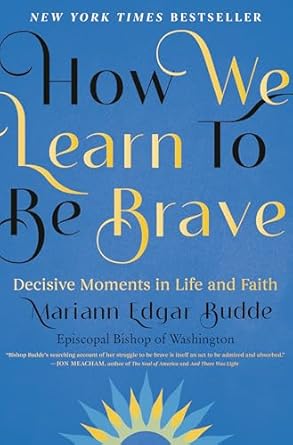
How We Learn to Be Brave: Decisive Moments in Life and Faith, by Mariann Edgar Budde.
How We Learn to Be Brave: Decisive Moments in Live and Faith, by Mariann Edgar Budde
I blogged about the fourth chapter in this book in my June 20, 2025 blog post, Reacting to the Cards You Are Dealt. I invite you to read that book and the post I wrote in response to reading the fourth chapter. I hope to eventually read the entire book.
Until my next blog post
Get a good book to read. Your local public library has lots of them, and a library card is free!
Don’t forget the people of Ukraine and western North Carolina.
Many of my blog posts this year have been about the mess we’re in. American democracy is being challenged like no other time in recent history, if ever.
Some people have been known to say in the last six months that we could have another civil war in the United States. Perhaps you’ve thought it yourself or heard someone else say those words.
Series of Webinars Sponsored by The Carter Center
President Jimmy Carter
Photo by Library of Congress on Unsplash
This spring I watched a series of webinars sponsored by The Carter Center about our divided country. Panelists explored how we got to this place, how we can learn from other countries, what we can do to avoid what other countries have experienced, and where we can start.
The country that served as the example in the four webinars was Northern Ireland.
The facilitator for the webinars was the Rev. Dr. Gary Mason, a Methodist minister, peacemaker, and peacebuilder from Northern Ireland. Dr. Mason founded Rethinking Conflict in 2015. It seeks to model the principles of Northern Ireland’s Good Friday Agreement.
That agreement finally ended the conflict on Good Friday, April 10, 1998. Dr. Mason has taken this model to the Middle East and now, to the United States.
Dr. Mason spoke from personal experience growing up during “The Troubles.”
What if “The Troubles” happened in the United States?
British troops occupied Northern Ireland in August 1969. Everyone thought it would be over before Christmas, but there was an amazing amount of violence over the next 30 years. It was the longest occupation by the British Army in history.
To give Americans some perspective on the amount of violence that took place in Northern Ireland during “The Troubles,” Dr. Mason gave the following statistics: At that time, Northern Ireland had a population of 1.5 million. During The Troubles, nearly 4,000 were killed, 47,000 were injured, there were 37,000 shootings, 30,000 people went through the penal system, there were 22,000 armed robberies, and 16,000 bombings.
He extrapolated that out to compare with the population of the United States over a 30-year conflict. If we had such a civil war in the US, we could see 800,000 killed, 9 million injuries, 7 million shootings, 6 million political prisoners, 4 million armed robberies, and 3 million bombings.
Imagine that level of carnage in America. I can’t.
An estimated 618,000 Americans died in our Civil War in the 1860s. To bring it “home,” I’ve studied the local losses in my own church in that war. Out of a membership of 400 white members and 200 black enslaved members, the congregation lost 74 men in the war. I cannot imagine that number of deaths in this community.
Just like it, undoubtedly, took decades for my community to recover from the war, 27 years after the Good Friday Agreement, Dr. Mason says in Northern Ireland “we are still wrestling with the legacy of the conflict. It’s really the one piece of unfinished business of the peace process.”
Indeed, in the United States we’re still wrestling with the legacy of our civil war. Confederate statues were taken down, but Trump wants them put back in place. Confederate names were removed from US military installations, but now the names are being restored, albeit technically they are not being renamed for the Confederates.
For example, Fort Bragg here in North Carolina was originally named for Braxton Bragg, a Confederate Army General who owned slaves. His name was removed, all the signs and letterhead replaced to say “Fort Liberty” in June 2023, and then in February 2025, Fort Liberty was renamed Fort Bragg but this time for a decorated Private in World War II, Roland X. Bragg.
We are still wrestling with the legacy of our Civil War, so it is not surprising that 27 years after the fact, the people of Northern Ireland are wrestling with theirs.
In Northern Ireland, People Hated Each Other
When peace talks began in Northern Ireland, the people in the room hated each other. No wonder it took so many years for them to develop a peace agreement.
Is that where we are today in the United States of America?
In polite society, we generally get along with each other. But, as I wrote about in my April 17, 2025, blog post, Is your family getting together during Holy Week? Brace yourself!, it only takes one person making an inflammatory remark and a heated argument can break out even among a group of friends or a family gathering.
Do Americans hate each other?
I don’t hate anyone, but I hate what some individuals and groups are doing to our country.
I hate that the US Congress has relinquished its legislative responsibilities to a US President who is legislating via Executive Orders.
I hate that thousands of federal employees have been fired or forced to take early retirement.
I hate that medical research funds and researchers have been eliminated.
I hate that people are being shipped off to a prison in El Salvador without due process.
I hate when people are shipped off to a prison El Salvador by mistake, the US President says he is powerless to do anything about it.
I hate that USAID was halted and will result in people starving.
I hate that universities, museums, and libraries are being targeted and punished.
I hate that Moms for Liberty think they have the right to dictate which books should not be read.
I hate that the Heritage Foundation was able to slide Project 2025 into the White House while the Republican Presidential nominee denied having anything to do with it.
I hate that many of the most vocally hateful voices in this country come from people who claim to be Christians. They give Christianity and Christians a bad name.
So how do we get out of this mess?
If we take the peacemaking and peacebuilding experience of Dr. Gary Mason into consideration, since he has lived through a civil war, we will open avenues of communication with people with whom we disagree.
LEAPFROG: How to hold a civil conversation in an uncivil era, by Janet Givens, M.A.
Taking Dr. Mason’s advice, we will then calmly and sincerely ask the person or persons why they feel the way they do about the topic with which we know we disagree with them, and then we will respectfully listen to their story.
Hopefully, they will be equally curious about our story and allow us to explain our position and why or how we arrived at it. Without honesty by both parties and a genuine curiosity by both parties, and a real listening by both parties… it won’t be a successful conversation.
Then, we move on to another person with whom we disagree and repeat the process.
Hmmm. Sounds easy on paper?
No, it doesn’t even sound easy on paper, much less in real life.
Bottom line is, I don’t know how we get out of this mess.
It has been my experience that people who stand on the opposite end of the political spectrum from where I stand, are not interested in hearing my story. They tend to be loud, rude, and condescending. They tend to call names and belittle, like their political leader on Pennsylvania Avenue.
So I really don’t know how we will get out of this mess. When I consider having “that difficult conversation” with anyone I know who supports Trump, I honestly cannot imagine that I would be able to have a productive conversation with them about politics. Our worldviews and core beliefs about democracy are just that far apart.
A chilling perspective
I just reread White Robes and Broken Badges: Infiltrating the KKK and Exposing the Evil Among Us, by Joe Moore. I blogged about that book on October 7, 2024, in What I Read Last Month & a Hurricane Helene Update, and I will blog about it again on July 7.
White Robes and Broken Badges, by Joe Moore
Speaking from the unique place of having infiltrated the Ku Klux Klan twice for the FBI, Moore stated in his book, “The radical right cares nothing about process, only outcome. They’re not interested in a civil discussion to work out differences, because they are so consumed by ideology that it has hijacked their civility. They have a clear vision of what they want the country to look like, and democracy itself is the only thing standing in their way.”
That leaves us in a hopeless situation. I don’t want to be hopeless, but I admit I don’t know how to have a productive conversation about politics with anyone who supports Donald Trump.
Even when Donald Trump is no longer in office, the people who agree with his tactics will still be with us. Our mess is bigger than an election or two can clean up.
Until my next blog post
How do you think we can get out of this mess?
What have you tried? Did it work?
It is going to take all of us to get our country out of this mess. The politicians certainly aren’t going to save us!
Remember the people of Northern Ireland, Ukraine, and western North Carolina.
Janet
P.S. I wrote and scheduled today’s blog post before the United States bombed three nuclear facilities in Iran on Saturday night, Eastern Time.
I did more reading in September than this blog post will reflect, but there was only one book I read from cover-to-cover: White Robes and Broken Badges, by Joe Moore.
White Robes and Broken Badges, by Joe Moore
White Robes and Broken Badges, by Joe Moore
This nonfiction book will stay in my mind forever. The author infiltrated the Ku Klux Klan (KKK) for the Federal Bureau of Investigation (FBI) not once but twice. He infiltrated it both times to a level never done before, gaining access to the top echelon in the organization.
I’ve never known many details about the workings of the KKK. Never needed to. Never wanted to. However, considering where society in America stands today, it seemed like a good time to get better educated about the threat the KKK holds.
This book sheds light on just how insidious the work of the KKK is and how many its members are employed as law enforcement officers in our country. It is widespread and probably even more of a problem than the FBI knows.
It was through the undercover work of “Joe Moore” that the FBI was alerted that the problem is greater than had been realized. Joe was not an FBI agent. He was recruited by them because of his skill set.
After infiltrating the organization the first time, Joe never imagined he would be called on to do it a second time. But he was so good at it, the FBI needed him. Joe and his wife and children sacrificed a lot for what he did. Ultimately, they lost their home, most of their earthly possessions, their family connections, and friends in a matter of several hours.
The book is chilling. I know of no better word to describe the effect it had on me. Chilling. The details should make every law-abiding citizen in the country – no matter your color, race, ethnicity, or nationality – shiver.
After reading this book, I now have a better understanding of why black people in the United States do not trust law enforcement officers. How can they, when they don’t know in a traffic stop whether they are being pulled over by an honest police officer or sheriff’s deputy or if they’re being pulled over by a member of the KKK who just doesn’t happen to be hiding under a white hood?
It has always seemed a great sign of cowardice that when members of the KKK do their dirty work, they hide in their white robes. If you’re doing something you shouldn’t be doing, though, I suppose you don’t want to reveal your identity.
These are misguided people, and as a Christian I am offended that they use the cross as their symbol. Jesus Christ died on a cross for me (and for them!), so how dare they desecrate that symbol of Christ’s great sacrifice!
I highly recommend this book. It is not a pleasant read, but how do we improve as a society if we bury our heads in the sand and don’t open ourselves up to what is going on not only in the shadows but also in broad daylight?
Update on Hurricane Helene in Western North Carolina
I wish I could include photographs, but I don’t want to run the risk of sharing an image that is undocumented or not in the public domain. You can use some of the links below if you wish to see pictures.
Another reason I am not including photos is that I know from my own experience after Hurricane Hugo in 1989 that pictures don’t do a disaster justice. Unless you are in the middle of a natural disaster and destruction is all you can see, hear, smell, or touch in any direction, you can’t grasp the enormity of the situation.
I know that Hurricane Helene left a wide path of destruction in Florida, Georgia, South Carolina, Tennessee, and Virginia; however, I have lived in North Carolina all my life – four of my 71 years in the mountains. The mountains are near and dear to my heart. I will blog about North Carolina and leave it to people in those other states to blog about the conditions in their states.
A couple of my blog readers said they hoped I would continue to shine a light on the destruction caused by Hurricane Helene in the mountains of North Carolina on September 26.
I do not live in the disaster zone. I’m about 100 miles east of the mountains. We just had a lot of rain, some wind, and a lot of tree branches to pick up and deal with. That is ongoing, but that and our 13-hour power outage pale in comparison to what happened in our beautiful Appalachian Mountains.
Ten days after the storm, many areas of the mountains are still inaccessible. Damage assessments are still being made. Recovery will be measured in years, not months. Some locations were wiped off the map and will not be restored because the landscape has been changed completely and forever.
The United States Geological Survey has identified 244 landslides caused in the Southeast by Hurricane Helene. Most of those are in North Carolina. More landslides will, no doubt, occur in the coming weeks with additional rainfall and freezing conditions.
As of the data I found last night, the death toll in North Carolina so far was 115, with 72 of those being in Buncombe County. There are still people unaccounted for. Many communities still have no water or sewer service. Cell phone service was spotty before the storm and restoration has been slow.
Hundreds and hundreds of power poles and thousands of miles of overhead power lines are down. Thousands of people are homeless. You might grow weary of hearing about it, but many of the people of western North Carolina are in dire straits.
As always, though, the worst of nature brings out the best in most people. The outpouring of support has been amazing. Electrical workers have come from all over the country and from Canada. Four hundred nurses have arrived in Asheville from as far away as Alaska to pitch in and help local medical personnel who have worked around the clock since September 26 even though most of them have catastrophic damage at their own homes.
Pack mules are being utilized to haul water, non-perishable food, and other necessities into the steep and rugged terrain where vehicles cannot gain access.
Two interstate highways are closed. I-40 near the Tennessee state line will probably be closed for a year. Repairs to I-26 might allow it to reopen next March. Roads and bridges washed away, houses, cars, and businesses floated away, and overnight all the necessities most of us take for granted every day vanished.
The area of devastation in western North Carolina alone covers more than 600 square miles, and it is not flat land! Every mile of those 600 square miles is not devastated. The severity of destruction various from place to place as rain totals were, of course, higher in some places than in others. Also, some areas of the mountains received more rain than others in the days leading up to the arrival of Hurricane Helene. Elevations range from around 1,500 feet to more than 6,000 feet. The destruction is unprecedented. Since 1916, all floods in western and piedmont North Carolina have been measured against The Flood of 1916. Future floods will be measured against The Flood of 2024 because by all statistics it surpassed the one in 1916.
Classes at my alma mater, Appalachian State University in Boone, have been cancelled until at least October 16. (That’s three weeks of fall semester lost.) Students at Lees-McRea College in nearby Banner Elk were evacuated by air to Hickory. Classes have been cancelled at Western Carolina University in Cullowhee the University of North Carolina at Asheville, Montreat College, Warren-Wilson College, Mars Hill University, and numerous community colleges. Blue Ridge Community College in Flat Rock, NC is closed indefinitely. Some county school systems are unable to announce when they will reopen.
The beautiful Blue Ridge Parkway that I’ve waxed poetic about so many times is closed indefinitely. US-441/Newfound Gap Road through Great Smoky Mountains National Park has reopened; however, it was not designed to handle commercial traffic, so it is not an alternate to I-40 or I-26 for large trucks. Sadly, a few people decided that did not apply to them, so they attempted to drive on Newfound Gap Road. Two serious accidents resulted – one caused by a car hauler. The highway will be closed to all traffic from 10pm until 7:30 a.m. until further notice. (https://www.nps.gov/grsm/learn/news/update-on-us441-newfound-gap-road-overnight-closure.htm)
The images coming out of the mountains are gut-wrenching. The needs are great and will continue to be for a long, long time. I hesitate to start naming charities because there are hundreds of reputable ones that are on-site and providing remarkable goods and services. World Central Kitchen (https://wck.org/), the Cajun Navy from Louisiana, Mountain Mule Packer Ranch (https://www.mountainmulepackers.com/), the Red Cross, and Samaritan’s Purse are just a few.
The Manna Food Bank (https://www.mannafoodbank.org/) which serves the Asheville and surrounding areas lost their facility and its contents. Brother Wolf Animal Rescue (https://www.bwar.org/) was flooded out but the 150 animals they were housing on September 26 were rescued by volunteers. Organizations like food banks and animal rescues need to be rebuilt and aren’t necessarily eligible for government assistance. (I saw on the Brother Wolf Animal Rescue website last night that donations to that organization are currently being matched!)
The Appalachian State University Disaster Fund (https://www.appstate.edu/disaster-relief/) is another organization for you to consider. It has stepped up to assist students, staff, and faculty members who have lost their homes. The fund also provides much-needed counselling for those traumatized by the storm.
Atrium Medical Center in Charlotte has set up its mobile hospital in Tryon in Polk County. Many towns and counties across the state have sent teams of medical personnel and swift water rescue teams to assist with the aftermath of the storm. The National Guard and 1,000 active-duty personnel from Fort Liberty (formerly, Fort Bragg) were deployed and have been on the ground since weather allowed access. Numerous restaurants are giving out free meals as they are able to prepare food.
Having just visited Boone and West Jefferson on September 12-13 and having visited Hendersonville, Asheville, Bryson City, and Cherokee this summer, it is difficult to grasp the scope of the damage. I drove on the Blue Ridge Parkway from Asheville to its southern end at Great Smoky Mountains National Park in June. I drove from Hickory through Old Fort, Black Mountain, Asheville, and Canton and into Tennessee on I-40 the last week in August.
I always breathe a sigh of relief when I make it through that treacherous stretch of I-40 approaching Tennessee because rock slides are not unusual. To know that part of that interstate literally washed away 10 days ago is hard to get my head around, though.
Know that any support you can give to the people of western North Carolina is appreciated.
Since my last blog post
I was told (again) in a webinar last week that the purpose of a blog is to solve someone else’s problem. Until I figure out how to do that, I’ll just keep blogging like I have for the last 10+ years. As of last week, I have 1,200 subscribers to my blog, so maybe I’m doing all right. If you came to my blog today seeking a solution to a problem, you are probably disappointed.
On the other hand, if you were looking for a way to lend a little aid to people trying to rebuild their lives after Hurricane Helene, I hope one of the organizations I mentioned today struck a nerve with you.
Until my next blog post
I hope you have a good book to read, a roof over your head, enough food to eat, and clean water to drink.
If all you are hearing is that FEMA and all levels of government are failing to respond to those affected by Hurricane Helene, then you are listening to the wrong sources. More than a week of lies about this from the immediate-past-twice-impeached-34-times-indicted-president is wearing thin here in North Carolina. Please fact check your sources and get your news from a variety of reputable news media.
Hold your friends and family close, for we never know what tomorrow will bring.
Don’t forget the people of Ukraine or the people of western North Carolina.




 Janet's Writing Blog