Giving God the Right of Way

I plan. I make lists. I find great satisfaction in checking off the items I complete on my to-do list. There are some problems with this.

First, I always think I can accomplish more in a day than I can. This leads to frustration and feelings of guilt.

Second, I don’t allow for “down days.” Even if I didn’t have chronic fatigue syndrome and fibromyalgia, having a rigid daily to-do list would be foolish.

Third, and most importantly, I tend to leave God out of the process.

If you followed my blog this summer, you know I’ve gone through some upheaval with the novel I’m writing. I started writing it more than a decade ago. I honestly don’t know when I started it. It languished on my computer for the last several years.

In July, I decided it was “no or never.” I hired a professional editor to critique the first 50 pages of my 303-page manuscript. The feedback I got from her was constructive and attention-grabbing. At the same time, it was disheartening yet exactly what I needed to hear.

A failed plan

That detailed critique prompted me to stop procrastinating and start focusing my attention and energy on learning the skills I needed to learn so I could finally finish that novel. I made a plan. I made a daily (Monday through Saturday) to-do list for what to study and what to practice or write each day. I thought by not working on my book on Sundays I was doing the Christian thing. I would give myself Sundays off and, thereby, do what was pleasing to God. That worked fairly well for a couple of weeks.

But guess what happened. I became a slave to my plan. It was my plan. I thought I had been clever to create this plan with its one-day-a-week set aside not to work on my writing. By doing so, I thought I was “keeping the Sabbath.”

It was my plan, but it was wearing me out.

Photo credit: Glenn Carstens Peters on unsplash.com

I fell behind on August 16. I’d assigned myself too much reading, too much writing, and way too much nuts-and-bolts work on my novel regarding details about my characters.

I’d set myself up for failure.

By pushing myself to do everything on my list, I threw myself into a chronic fatigue syndrome relapse for the next three weeks; however, I read something on August 17 that got my attention. It was the third chapter in Seven Things That Steal Your Joy: Overcoming the Obstacles to Your Happiness, by Joyce Meyer.

Led by the Spirit

Ms. Meyer wrote the book in 2004. I’d bought it as a used book many years later and kept meaning to read it. I read the first chapter on August 15 and the second chapter on August 16. It was “on my list” to read the third chapter on August 17.

Little did I know that God had a reason for leading me to Chapter Three on August 17. I don’t believe in happenstance when it comes to such things. The title of that chapter is “Joy Keeper: Be Led of the Spirit.” By “Spirit,” Ms. Meyer is referring to the Holy Spirit.

The Holy Spirit is our Helper, if we are just open to It. From the first sentence in Chapter Three (“One of the most dynamic ways to keep our joy is to allow the Holy Spirit to lead us in the way we should go.”) to the last sentence in the chapter (“God will write His laws on your heart, then you won’t need reminders to keep your joy.”), that chapter was exactly what I needed to read in the emotional and physical place I was in on August 17.

It didn’t take me long to realize that my six days-a-week reading and writing plan – as detailed and as carefully- and methodically-planned as it was – lacked one thing. It lacked the most important thing. It lacked God. I spent hours working out a plan that I thought would lead me to a point next February when I’d have all this knowledge in my head and be ready to rewrite my novel’s outline and then start rewriting the manuscript.

But aside from setting aside the Sabbath to not work on my novel or my writing skills, I’d left God and the Holy Spirit out of my grandiose plan. I shredded my plan.

What’s next?

Don’t get me wrong – I still believe in having a plan, but what’s new is that I want to start each day by seeking God’s will for me that day. He may want me to tackle the next item on my novel “to-do” list, or He might have a better “to-do” list for me for that day.

I still believe God wants me to write. He might want me to write the novel I’ve had in my head and on paper for 10+ years. He might have an entirely different novel in His plan for me. He might have something else altogether in store for me.

Ms. Meyer wrote in the third chapter of her book, “If you keep your plan before the Lord, you must be ready to let Him change anything at any time. If you do this, your path will always be right and prosperous.”

She also wrote, “… and we will never find joy if we think we have to know everything before we take our first step in the direction He is leading us.”

Today is the last class in the “Eight Weeks to Writing a Commercially Successful Novel” online course I started on September 6, so it’s time for me to create a new plan.

This time, though, I’ll try to be reasonable, and I’ll try to remember to seek God’s will every morning and be ready to ditch my plan for His plan.

Since my last blog post

I’ve always been a pack rat. I keep things “because I might need it someday.” I’ve transitioned into, “I’m never going to need this.” Last week I concentrated on my file cabinets. That alone dates me. I’ve purged file folders of all descriptions.

I don’t need the paperwork for the car insurance I had in 1995. I don’t need most of the recipes I kept in the 1980s. I don’t have the energy to do much cooking. Plus, I’m trying to eat healthier in 2021 than I did in 1981. The list goes on.

This is a work in progress, but it feels good to let go of some things.

Until my next blog post

I hope you have a good book to read or productive time if you’re writing one.

Whatever season you’re transitioning into where you live, try to enjoy the gift each day is. This is a challenge for me. You know I don’t like cold weather.

Thank you for taking time out of your day to read my blog post.

I’ll leave you with this short sentence from the third chapter of Joyce Meyer’s book: “To walk in the presence of God, we must give the Holy Spirit the right of way.”  I love that!

Until my next blog post – which I have planned for next Monday – I hope you and I both give the Holy Spirit the right of way.

And wait on tiptoe to see what happens.

Janet

#OnThisDay: Russia Transferred Alaska to US, 1867

The thought of Russia selling Alaska to the United States in 1867 – or any other time – makes my head spin. My first thought was, I bet the Russians are still kicking themselves over this! That led to me look up the origins of the idiom to kick oneself.

According to my handy reference book, The American Heritage Dictionary of Idioms, by Christine Ammer, this idiom, which means to berate or reproach oneself, dates back to the late 1800s. One wonders if the expression was coined by the Russians after selling Alaska to the United States, but I guess not.

Back to Russia Selling Alaska to the US

Back to the topic of today’s blog post… I remember reading about something called “Seward’s Folly” in a lower grades’ history book, but if given only seconds to come up with the answer I’d be hard pressed to recall that it refers to U.S. Secretary of State William Seward negotiating the transaction.

Many Americans thought it foolish to purchase Alaska for the exorbitant price of $7.2 million, or around two cents per acre. That converts to a mere $120 million or so in 2021.

Photo credit: Hari Nandakumar on unsplash.com

Putting the event in historical context, though, it makes sense that people were up in arms over the federal government spending $7.2 million for a place a world away. It was a place virtually no one in the nation expected to visit. To a great extent, that still holds true today.

A four-year civil war had taken a terrible toll on the nation. The Confederate states were being brought back into the fold of the United States, although there were deep-seated hatreds on both sides of that conflict – so deeply ingrained that remnants of those feelings still exist 160 years later.

In 1867, just two years after the end of that war, the federal government pays more than $7 million for a vast wilderness at the top of the world. No wonder it seemed like folly to the average American.

Photo credit: Deon Van Zyl on unsplash.com

All that taken into account, today Alaska seems like a bargain any way you look at it. It’s one of the places I’d like to visit, but that’s highly unlikely now. The photographs of the landscape and the wildlife are breathtaking.

Just think: 663,267 square miles. Denali and other National Parks. National forests. Wildlife refuges. Fishing. Glaciers. Whales. It’s one-fifth the size of the rest of the United States put together.

Alaskan Salmon, for crying out loud! It’s delicious and so nutritious.

Photo credit: Peter Hansen on unsplash.com

Alaska became a US territory on May 11, 1912 and was admitted as the 49th state in the Union on January 3, 1959.

Fifteen percent of Alaska’s population is indigenous. Nearly two dozen native languages are spoken in Alaska. No other US state is so rich in natural beauty, wildlife, natural resources, and human history.

Thank you, William Seward!

Since my last blog post

I continue with the eight-week online writing course. A couple more weeks to go.

We had beautiful days in the mid- and high-80s last week. It was probably summer’s last gasp. I’ll miss the warm weather. The weather last week was perfect for taking care of some yardwork. It’s time to get the yard ready for the coming winter.

Until my next blog post

I hope you have a good book to read. My reading for pleasure lately has been almost nil.

I look forward to getting my Covid-19 Moderna booster shot soon.

Janet

Myths and Legends Day

Myths and Legends Day is an internationally-celebrated day on October 11 every year. Who knew? I’d never heard of it until this year.

I found it on a list of days.

This week seems to have more than its share of such days. Tomorrow wins the special day contest. It’s Cookbook Launch Day, Free Thought Day, and Old Farmers Day. My favorite thing to celebrate tomorrow, though, is International Moment of Frustration Scream Day.

International Moment of Frustration Scream Day

I think most of us could really get into International Moment of Frustration Scream Day during this pandemic. If I were a betting person, I’d bet money that there are some healthcare workers and teachers who could show us how to do it.

I wanted to scream when I learned that the local legend in Lancaster County, South Carolina around which I had written the first draft of a novel was just that. A legend. It makes for a wonderful story, but as with many yarns spun for 250 years, it’s just not true. At least, it’s not provable.

Nevertheless, I took a bit or that legend and something I saw years ago on a segment of the PBS TV series, “History Detectives,” and I’ve spun my own unique story. The working title is The Doubloon or The Spanish Coin and, if you and I live long enough, we’ll get to see it in print. Authors use the abbreviation WIP for Work in Progress. My novel is definitely a WIP.

Back to Myths and Legends Day

That brings me back to Myths and Legends Day. Look online and you can hardly find anything about it. Several websites actually use the same photograph to illustrate the day: children dressed as their favorite characters such as Superman, Robinhood, and several I can’t identify. It does sound like something fun for elementary students to celebrate and might even encourage some of them to read.

Paul Revere

One legend that came to my attention recently is the famous “midnight ride of Paul Revere.” It’s a wonderful story, and it’s true. The problem is, it’s not the whole story.

On the night of April 18, 1775, Paul Revere rode horseback through the northern Boston area to warn the Americans about the movement of British troops. I hate to burst your bubble, but he did not ride through the countryside shouting, “The British are coming! The British are coming!” I know. That’s what I’ve thought all my life, too.

Henry Wadsworth Longfellow’s poem, “Paul Revere’s Ride” has been memorized by many a school student. Paul Revere took on a superhuman aura. He did make that ride, and I don’t mean to take anything away from him; however, he’s not the only person to make such a dangerous journey.

William Dawes

William Dawes was also sent to ride that night to Lexington, Massachusetts to warn Samuel Adams and John Hancock that they were soon to be arrested. Also, his task was to alert the Minutemen that the British troops were on the move. Revere got to Lexington a half hour before Dawes. It’s thought that Revere had the faster horse. Also, Dawes was thrown by his horse as he and Revere headed on to Concord, Massachusetts, his horse escaped, and Dawes had to walk back to Lexington.

Samuel Prescott

Paul Revere recruited Samuel Prescott of Concord to meet him along the way since he was more familiar with the Concord area. He supposedly guided Revere through the darkness. When Revere, Dawes, and Prescott were met by British officers on the way to Concord, they split up and Prescott was the only one that made it all the way to Concord. Revere was captured.

Israel Bissell

Then, there was Israel Bissell. He rode 345 miles on the Old Post Road from Watertown, Massachusetts to Philadelphia to warn militia companies of British troop movements. He covered that amazing feat in four days and six hours. The horse he started out with died near Worchester, Massachusetts.

You think all that’s astounding and possibly news to you? Just wait.

What about Sybil Ludington?

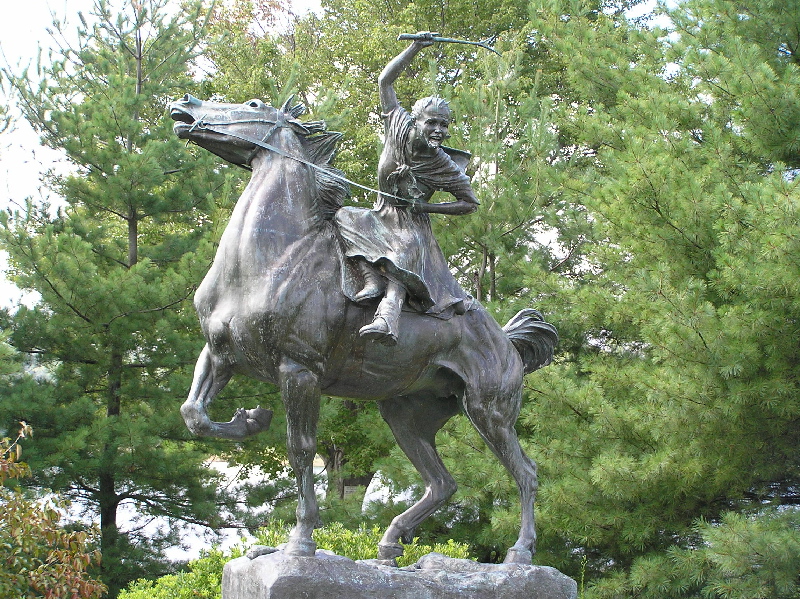
I wish I’d been told about Sybil Ludington when I was in school! Her journey was more than two years after that of the above four men, but she rode 40 miles (twice as far as Paul Revere) to alert the residents of Danbury, Connecticut that the British were approaching. She was all of 16 years old.

She made her roundtrip journey between 9:00 p.m. on April 26, 1777 and dawn the next morning. Unfortunately, the British had already torched Danbury. That doesn’t take anything away from her efforts, though. She was later commended by George Washington and this statue of her atop her horse is in Carmel, New York.

Statue of Sybil Ludington in Carmel, New York

“Remember the ladies” ~ Abigail Adams

I’m reminded of Abigail Adams’ often quoted excerpt from her March 31, 1776 letter to her husband, John Adams, as he was away at a meeting of the Continental Congress in Philadelphia helping to work out the details of the American Revolution:

 “I long to hear that you have declared an independency. And, by the way, in the new code of laws which I suppose it will be necessary for you to make, I desire you would remember the ladies and be more generous and favorable to them than your ancestors. Do not put such unlimited power into the hands of the husbands. Remember, all men would be tyrants if they could. If particular care and attention is not paid to the ladies, we are determined to foment a rebellion, and will not hold ourselves bound by any laws in which we have no voice or representation.”

Yes, indeed. Remember the ladies!

Since my last blog post

My reading list so far this month might raise some eyebrows and get me some attention from the police. In conjunction with the novel I’m writing, this month I’ve read a variety of forensics books.

Until my next blog post

Note: I drew heavily in my post today from the following website: https://www.constitutionfacts.com/us-declaration-of-independence/the-five-riders/. That’s where I also found the photo of the Sybil Ludington statue.

Don’t forget to celebrate International Moment of Frustration Scream Day tomorrow!

Janet

Books Read & Analyzed in September 2021

I dedicated the month of September to read books about the art and craft of writing. It’s slower than reading novels – that’s for sure!

At least, that was my plan. I had it all mapped out, down to how many pages I’d read each day. Then, that online writing course I’m taking began on September 6, and my plans went out the window.

Studying historical novels and historical mystery novels dominated my reading time in September. Weekly online course assignments included analyzing various elements of novels in our chosen genre. My genre is historical fiction, with an element of mystery in my first novel – the manuscript I’m currently working on. At least, I hope this turns out to be my first novel.

Today’s blog post might appeal more to writers than readers but, since it’s definitely part of my journey as a writer, I feel compelled to share it with you.

I evaluated one book I’ve read and five books I haven’t read. I was looking for such things as scene length, chapter length, sensory detail, point-of-view, tense, noun and verb strength, microtension, high moment, amount of narrative, amount of dialogue, and the action-reaction-processing cycle.

Until taking this “8 Weeks to Writing a Commercially Successful” online course by C.S. Lakin, I’d never tried to analyze the elements of a novel. I just read for enjoyment. I look forward to reading for enjoyment again someday, for I find analyzing novels a bit of a drag.

Even though today’s blog post takes a much different approach than my usual first blog of a month about the books I read the previous month, I hope you’ll bear with me a few minutes. My remarks about each of the following books might pique your interest, even if you’re not interested in the elements considered in the writing of a novel.

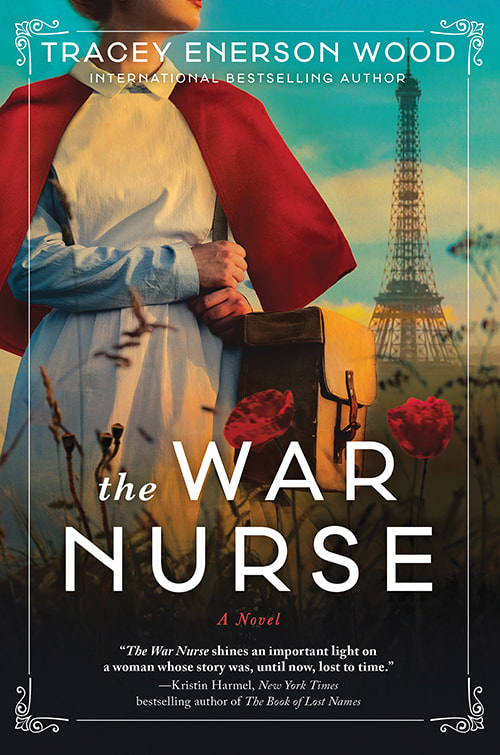
The War Nurse, by Tracey Enerson Wood

The War Nurse, by Tracey Enerson Wood

Published this year, I found The War Nurse to be an excellent example of historical fiction for me to evaluate. I’d read Tracey Enerson Wood’s first novel, The Engineer’s Wife, and liked it. The War Nurse is full of rich prose. She uses strong verbs and vivid adjectives. Writing like that has to be learned. It is hard work. I want to write like that. I wish I’d had time to read the entire book instead of skimming through it to look for specific writing techniques and elements.

The Kitchen House, by Kathleen Grissom

The Kitchen House, by Kathleen Grissom

This book was published in 2010. I read it in 2017. (See what I said about it and other books in my February 3, 2017 blog post, What I read in January 2017.) It was a novel that stayed with me for a long time and it’s one that still clearly comes to mind when I think back on historical novels I’ve especially enjoyed. I checked it out of the library last month just so I could analyze it in relation to my class assignments.

Like in The War Nurse, I found an Author’s Note, Acknowledgments, Book Club Questions, and “A Conversation with Kathleen Grissom” at the end of The Kitchen House. I think these are items that fans of historical fiction like to see – and expect to see.

Historical fiction readers like for Author’s Notes to tell them which characters and events in a novel are real and which ones are a creation of the author’s skill. I find myself reading the Author’s Note at the back of novels before I read the actual novel.

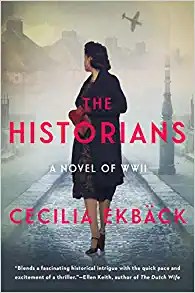
The Historians, by Cecilia Ekbäck

The Historians, by Cecilia Ekback

This is a 2021-published historical mystery. I didn’t get to read much of the book. I made note of how the book was organized and some of the features it included, such as a map of the setting, a preface, and “Cast of Characters.” All these were in the front of the book before the story itself began.

I found the list of 44 characters intimidating. I would never be able to keep up with so many people. The 19 or so introductory pages included sections like “Lapland, January 1943,” “Stockholm, February 1, 1943,” and “Blackäsen Mountain, March 31, 1943.”

The book is 431 pages plus a four-page “Author’s Note and Historical Background,” and a list of nine “Sources” in the back of the book.

Scenes varied from two to eight-and-a-half pages. Some paragraphs were half a page long. The story is told in an unbroken pattern of “Laura” chapters, “Jens” chapters, and “Blackäsen Mountain” chapters and ends with “Lapland, June 1943.”

The settings in this book are a refreshing change from all the World War II novels of recent years that have almost exclusively been set in France, Poland, or Germany.

I regret I didn’t have time to actually read this book; however, I was overwhelmed by the pages and pages of introductory material. One would have to be keenly interested in the settings and time period in order to read those 19 pages before getting to the story.

It was an eye-opening exercise related to the writing course I’m taking to analyze the elements of this historical mystery. This was the first recently-published historical mystery I analyzed.

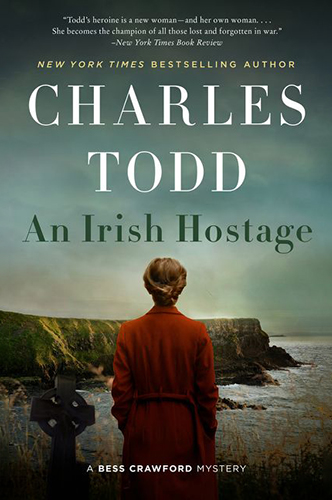
An Irish Hostage, by Charles Todd

An Irish Hostage, by Charles Todd

Charles Todd is the pen name for a mother-son writing duo. An Irish Hostage is the 12th novel in their Bess Crawford Mysteries. I haven’t read any of them. This is their 2021 novel, so I chose it to analyze.

Like The Historians, this is an historical mystery. Although I didn’t have time to read much of it, this novel appealed to me more than the other book. That’s just personal preference, and not a criticism of Cecilia Ekbäck’s book.

It’s written in first-person past tense and is set in Somerset, June 1919.

The opening narrative paragraphs set a pleasant tone with such phrases as, “the long windows open to a surprisingly mild spring evening, and a bit of a breeze pleasantly lifting the lilac curtains just a little.” But then the mood suddenly turns with, “The only thing that spoiled this charming scene were the expressions on our faces.”

Of course, the novel being categorized as “historical mystery,” the reader should already know the tide is going to turn.

I found the style of writing to be more to my liking than the “heavier” Ekbäck book. Chapters ranged in length from around four or five pages to about 20 pages.

There is a page of acknowledgments and a two-sentence “About the Author” page at the end of the book.

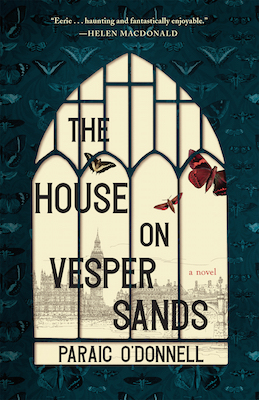
The House on Vesper Sands, by Paraic O’Donnell

The House on Vesper Sands, by Paraic O’Donnell

This is another 2021 historical mystery. It’s set in February through June of 1893. It begins with “I. Requiem Æternam” and the five succeeding sections also have Latin names. That technique in itself gives the reader a hint about the mood of the book.

The opening paragraph introduces Esther Tull feeling “the first gentleness of the snow.” In the second paragraph, Esther extends “a gloved hand to the railing…. The pain was returning, but it was not yet more than she could bear….”

Interesting wording there. The inclusion of the word “yet,” adds a level of intrigue for the reader. Every word matters in a novel – or should.

This novel is mostly narrative, with scenes averaging six or seven pages. There’s an Afterword and Acknowledgments on page 401.

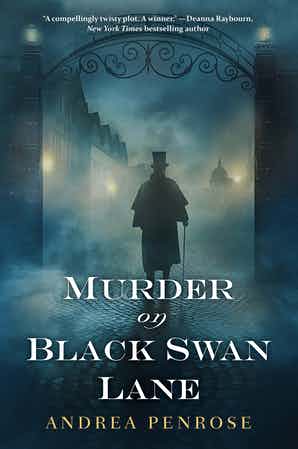
Murder on Black Swan Lane, by Andrea Penrose

Murder on Black Swan Lane, by Andrea Penrose

When I searched for best-selling historical mysteries, I noticed Andrea Penrose’s name coming up repeatedly in the top 50 or top 100. I borrowed her 2017 novel, Murder on Black Swan Lane from the library. It’s set in Regency London, which appears to be Ms. Penrose’s favorite era and location.

I’m not a fan of prologues, but hers was just four pages and I wanted to get a feel for her writing style. Her rich language using strong verbs and spot-on adjectives drew me in. For example, the prologue opened with, “A flicker of weak light skittered over the stone floor, followed by the soft scrapes of steps and the whispered whoosh, whoosh of mist-dampened wool.”

The book’s 27 chapters range from nine to 16 pages in length, based on the seven I counted. They’re followed by a two-page “Author’s Note” and then the prologue and first chapter of her book, Murder at Half Moon Gate.

The biography on the inside of the back cover reveals that “Andrea Penrose is a pseudonym for an author who has also written as Cara Elliott for Grand Central and Andrea Pickens for NAL.” Perhaps you’ve read one of her books under those other names. I haven’t.

I look forward to reading or at least perusing more of Andrea Penrose’s books. The rich language skills she has are something I’d like to emulate.

Since my last blog post

I completed the fourth week of my eight-week writing course, and have been busy editing my novel manuscript. Trying to work in all I’ve learned in the last month isn’t easy. I’m into the third chapter now. There will be many more revisions in my future. I enjoy the process of fiddling with words.

I’ve also worked on the notes from my local history research. I still hope to get those notes in book form eventually.

Until my next blog post

I hope you have a good book to read. I just finished reading Making Good Habits, Breaking Bad Habits, by Joyce Meyer. It was a nice diversion from all the books and scenes I analyzed for my class.

Making Good Habits, Breaking Bad Habits, by Joyce Meyer

Now that the deer have devoured the leaves on the hydrangeas and other plants and shrubs in our yard, this week they started eating the azaleas. Now they’ve gone too far!

It’s officially autumn in North Carolina. There are spots of leaf color here and there here in the southern piedmont. Many leaves seem to just be dying and falling off. Of course, it won’t be peak fall leaf season here for several weeks. There’s a hint of fall in the air at night and in the mornings, but our daytime temperatures are still mainly in the low- to mid-80s.

It’s warmer than it was last week when I mentioned being cold. None of my southern hemisphere readers took the bait last week when I volunteered to go down under and visit for a few months. I guess they’re enjoying spring now. I will be, too, in six months!

Janet