I write southern historical fiction, local history, and I've written a devotional book. The two novels I'm writing are set in Virginia and the Carolinas in the 1760s. My weekly blog started out to follow my journey as a writer and a reader, but in 2025 it has been greatly expanded to include current events and politics in the United States as I see our democracy under attack from within. The political science major in me cannot sit idly by and remain silent.
In case you think I’m spending too much time this month blogging about our local history, just keep in mind that May is an important month of historical events in Cabarrus County, North Carolina.
My May 2, 2022 blog post, __#OnThisDay: 251st Anniversary of 1771 Gunpowder Plot__ was about patriots’ blowing up the king’s munitions just off the Great Wagon Road in present-day Cabarrus County.
Today, my blog is about the Mecklenburg Declaration of Independence in 1775 while present-day Cabarrus County was part of Mecklenburg County and its citizens played just as important a role in the declaration as anyone living in what is present-day Mecklenburg County.
Friday, May 20, 2022 was the 247th anniversary of the signing of the Mecklenburg Declaration of Independence.
A recreation of the Mecklenburg Declaration of Independence.
But what about the 1775 Mecklenburg Declaration of Independence?
I blogged about the Mecklenburg Declaration of Independence on May 21, 2018. To refresh your memory, or to introduce you to the topic if you aren’t aware of it, the following nine paragraphs are reblogged from that post:
My immigrant ancestors were among the Scottish Presbyterian pioneers who settled old Mecklenburg County, North Carolina. Years of discontent in the American colonies were piled on top of the anti-British Crown feelings they brought with them across the Atlantic.
Weary of unfair taxes imposed by the Crown and the discrimination they were subjected to as Presbyterians slowly brought the settlers to the boiling point. An example of the persecution these Presbyterians felt were the Vestry and Marriage Acts of 1769. Those acts fined Presbyterian ministers who dared to conduct marriage ceremonies. Only Anglican marriages were recognized by the government.
In May of 1771 a group of young men from the Rocky River Presbyterian Church congregation in the part of Mecklenburg County that later became Cabarrus County, disguised themselves by blackening their faces and under the cover of darkness ambushed a shipment of Royal munitions traveling north on the Great Wagon Road. The supplies were destined for Rowan County to put down the Regulator Movement.
Blowing up three wagons loaded with gunpowder and other supplies, the teens and young men who perpetrated the deed were declared outlaws by the Royal Governor and had to go into hiding until May 20, 1775 when all the citizens of Mecklenburg County were declared to be rebels against the British Crown.
On May 20, 1775, the citizens of Mecklenburg County, North Carolina declared themselves to be free and independent of the rule of Great Britain. It was a sober and sobering declaration not entered into lightly. Those American patriots meant business, and they knew the risks they were taking.
Archibald McCurdy, an Elder in Rocky River Presbyterian Church, heard the document read from the steps of the log courthouse in Charlotte. When he got home, he and his wife, Maggie, listed everyone they knew of who could be trusted in the coming fight for American independence.
No original copies of the Mecklenburg Declaration of Independence survive today. The local copy was lost in a house fire at the home of one of the signers. The copy taken to the Continental Congress in Philadelphia by Captain James Jack on horseback was also lost. Later, signers of the document recreated it from memory.
Nevertheless, those of us who were raised on stories of the Mecklenburg Declaration of Independence and the brave souls who risked their lives to sign it know that the document was real. The blood of the American patriots still flows in our veins and their spirit of freedom still beats in our hearts.
Don’t mess with our freedom of the press, freedom of speech, freedom of religion, or our freedom of assembly!
Until my next blog post
I’m considering taking a week off from writing my blog, unless something interesting comes along and begs to be written. Next Monday, May 30, is Memorial Day in the United States of America. It is a day to remember all the men and women who have lost their lives while serving in the armed forces of the United States.
I hope you have a good book to read until I blog again on June 6.
Take time for a relaxing hobby and spend some time with friends and family.
The recent “leak” that the United States Supreme Court is on track to abolish the 1973 landmark decision Roe v Wade should stand as a wake-up call to all Americans.
Even a 49-year-old Supreme Court decision that has stood the test of time and numerous challenges, can be undone by five Supreme Court Associate Justices who claimed under oath before Congress that they had no intention of voting to undo that 1973 Court decision.
This begs the question, “What comes next? What other US Supreme Court decisions will be wiped away by this Court which was “stacked” by our former president and the radical “right” in Congress?
If I just “stepped on your toes,” so be it.
Brown v Board of Education of Topeka, 1954
This brings me to the topic of today’s blog post, which I chose months ago because it is the anniversary of another landmark US Supreme Court decision, Brown v Board of Education of Topeka. It was 68 years ago today that the Court published its unanimous decision on that case, which made it illegal to have separate public school systems based on race.
Photo credit: CDC on unspash.com
Until Brown v Board of Education of Topeka, it was legal for states to have “separate but equal” school systems for the different races. Everyone knew there was nothing equal about them, but they were legal in the eyes of the law.
The Brown v Board of Education of Topeka decision overturned the 1896 US Supreme Court case, Plessy v Ferguson. Plessy v Ferguson is proof that the US Supreme Court can make terrible mistakes. That decision ruled that having “separate but equal” school systems for each racial group was all right, and now it was deemed legal under the U.S. Constitution.
I grew up in the racially-segregated South. Before you get too puffed up about being from one of the other sections of the United States, though, take a moment to consider your childhood. Segregation might not have been mandated where you lived, but were your community and schools racially-integrated prior to the 1960s?
In a recent conversation with a friend from the Midwest, I said that our public schools here in Cabarrus County, NC were integrated when I was in the seventh grade. That was 1965. The person I was talking to made an interesting remark: “I lived in a non-segregated state, but I didn’t go to school with black students until high school. I lived in a farming community and there just weren’t any black people.”
Since I also grew up in a farming community, I found it strange that there weren’t a mix of white people and black people where she grew up. It was interesting to hear her perspective on the issue.
To our more-enlightened 21st century minds, it seems ridiculous that prior to Brown v Board of Education of Topeka it was legal to have racially-segregated public school systems. Since I was born in 1953, 1954 doesn’t seem very long ago. (Please stop rolling your eyes. If you don’t already understand, you will someday.)
The dual school systems didn’t disappear overnight – not by long shot. They continued here in Cabarrus County until the beginning of the 1966-67 school year. The previous school year, students had the option of attending the school not designated for their race. Few students chose to do that. For instance, in the previously all-white school of 1,000 students that I attended, only three black students chose to enroll in 1965. Looking back on it, I can’t imagine the courage it took for them to do so.
The following school year, the previously all-black schools in the county were closed. The buildings weren’t even used! I believe that’s proof in and of itself that the school board members knew that previously all-black schools weren’t on par with the previously all-white schools. Or, perhaps they knew that most white parents wouldn’t want their children assigned to those previously all-black schools. They carried a stigma which was based on racial bias and a deep-seated prejudice.
What a luxury the school board had then to let school buildings sit empty. It was just a couple of years before the county’s population started growing so fast that the school board was never again able to build schools fast enough to keep up.
The mid-1960s were volatile years as school desegregation took place. Southern states were held up by the national media as a backward place where white people resented black people and wanted their schools kept separate. That’s what we were told and we didn’t know any better until race riots broke out in Boston in September 1974 when the public schools there were ordered to desegregate.
In conclusion
In light of this history and what I read last week in Viola Davis’ memoir, Finding Me, I’m left to conclude that people everywhere are prejudiced against people who don’t look like they do.
We see racial profiling and discrimination all over the United States. Housing redlining takes place every day as mortgage lenders find ways to disguise such practices which limits where people of color can purchase homes. Every time I think this no longer takes place, investigative reporters uncover proof that I’m wrong.
I’ve come to realize that the desegregation of public schools didn’t always translate into equal opportunity. Students of all races and economic backgrounds experience different levels of support and nurture at home. Those of us who grew up in happy homes were blissfully unaware that some of our fellow students were subjected to abuse and neglect in their homes. Teachers — knowingly or unknowingly — bring their own prejudices into the classroom. So do students. It’s human nature, and it’s something we all need to be aware of as we interact with one another in our daily lives. You don’t know what the other person might be going through in his or her personal life.
Until my next blog post
I hope you have one or more good books to read this week.
In case you checked out my blog post last week expecting it to be about the books I read in March, I’m sorry you were disappointed. I hope you found last Monday’s topic of interest, though. It dealt with my favorite local history story.
Today I’m writing about some of the books I read last month. There was quite a variety, as this is all part of my journey as a writer.
The Man from St. Petersburg, by Ken Follett
The Man from St. Petersburg, by Ken Follett
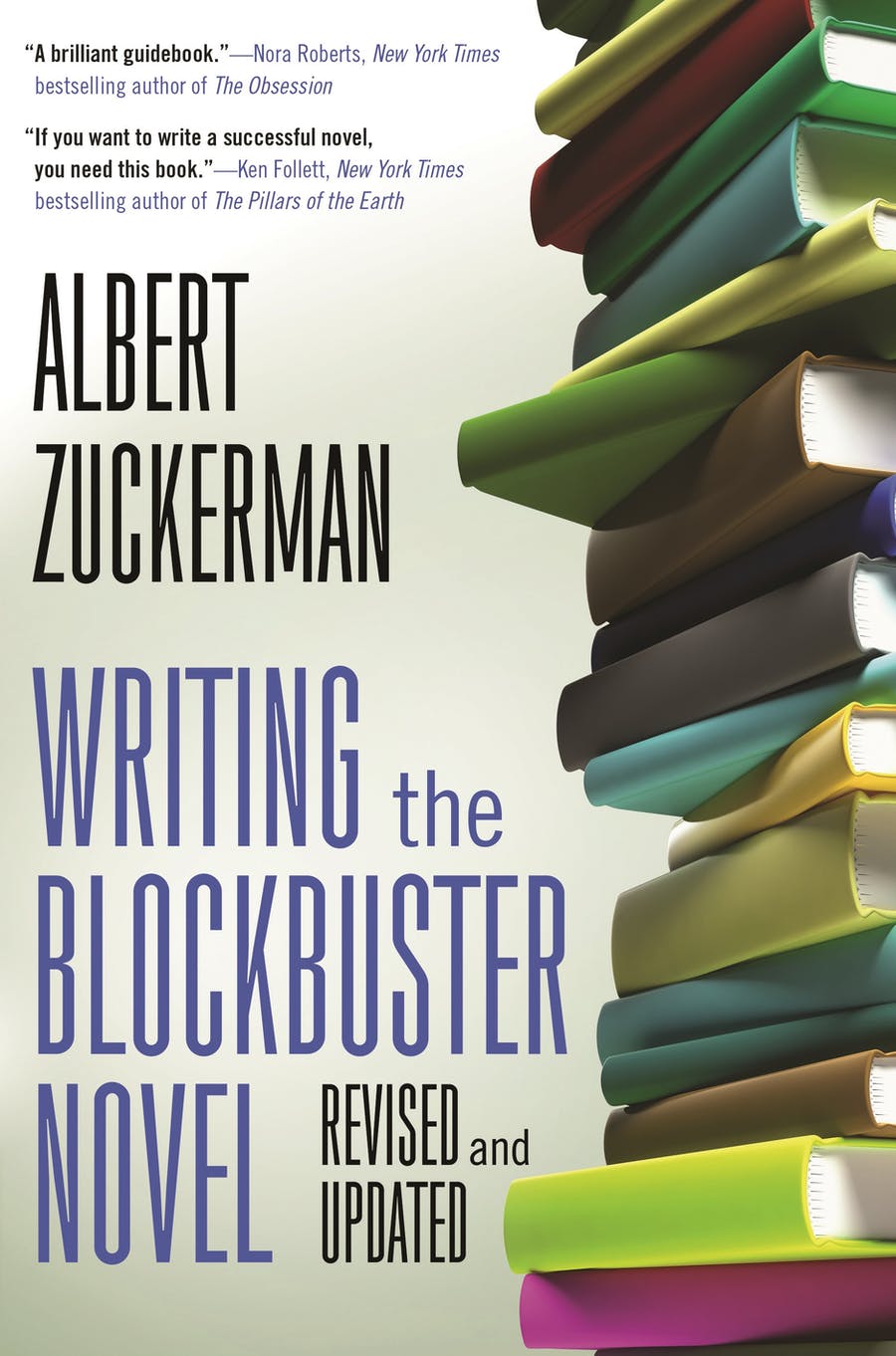
I’m embarrassed to admit that I’d never read a Ken Follett book until last month. I don’t really know why. What prompted me to read this particular novel by him was another book I was reading, Writing the Blockbuster Novel, by Albert Zuckerman. The Zuckerman book was recommended by author A.J. Mayhew of The Dry Grass of August and Tomorrow’s Bread fame.
The Man from St. Petersburg was filled with political intrigue during the early years of the 20th century. A Russian anarchist comes to London to assassinate a Russian prince who is in England trying to work out an alliance between Great Britain and Russia against Germany. It is assumed that war is coming, so it’s time for countries to choose sides.
Personal secrets are revealed along the way in this novel that will keep you turning pages. It was written in 1982, but I hope your public library still has a copy in case you haven’t read it.
Writing the Blockbuster Novel, by Albert Zuckerman
Writing the Blockbuster Novel, by Albert Zuckerman
This book, referenced above, has been very helpful to me. It takes The Man from St. Petersburg, by Ken Follett;The Godfather, by Mario Puzo; The Witness, by Nora Roberts; and Gone with the Wind, by Margaret Mitchell and examines how they were outlined and written. The main focus is on Ken Follett’s book. It was interesting to see four different outlines of The Man from St. Petersburg to see how even a good writer like Follett went through the process of outlining, making changes, and making more changes before he produced the final product.
The Younger Wife, by Sally Hepworth
The Younger Wife, by Sally Hepworth
I became a fan of Sally Hepworth’s novels when I read her third novel in 2017, The Mother’s Promise. Shortly thereafter, I read her second novel, The Things We Keep. Since then, I’ve read The Family Next Door, The Mother-in-Law, The Good Sister, and last month I read The Younger Wife.
The Younger Wife is Hepworth’s seventh novel. I just realized I’ve never read her first one, The Secrets of Midwives. It’s been on my to-be-read list for years.
The Younger Wife deals with several difficult issues, including Alzheimer’s Disease and how it affects the entire family and not just the person who has the illness. It also deals with physical and psychological abuse. I can see how, if a person is living with those traumas or has lived with them, this might not be a book for them to read.
A History of Rockbridge County, Virginia
I was delighted to find an online copy of this book online because it supplied me with little tidbits of information that I found interesting as I continue to research life along the Great Wagon Road in Virginia for the historical novel I’m writing.
Blueprint for a Book: Build Your Novel from the Inside Out, by Jennie Nash
Blueprint for a Book: Build Your Novel from the Inside Out, by Jennie Nash
If there ever was a bargain “how-to” book for fiction writers, this book is it. I paid $2.99 plus tax for it for Kindle. In it, Ms. Nash spells out how to “outline” a novel. I never have followed the old outline model we had to use in elementary school (and probably high school, too) because it was too confining. I could never write an outline that way for a book.
I usually write my outlines in paragraph form if I’m writing a novel or short story. I’ve taken a number of writing classes and I’ve read more how-to-write-a-novel books than I care to admit. For some reason, some things fell into place as I read Ms. Nash’s book.
The idea that if something happens there has to be a reaction finally fell into place for me. I already knew it, but Ms. Nash’s book drilled it into me that as I’m planning/outlining a novel I have to make a conscious effort to make sure everything happens for a reason and everything that happens has consequences.
I know, you’re probably saying, “Well, duh!” Perhaps it was Ms. Nash’s explanation, but I finally got it! In the past, I concentrated on the actions in my outlines and didn’t always give equal consideration to planning every reaction.
One of the points Ms. Nash makes in the book is that if you’ll use her way of outlining – which she calls “the inside-outline,” your novel won’t fall apart in the middle. If you follow her advice, there will be tension throughout your novel and your reader won’t lose interest.
Power Penmanship: An Illustrated Guide to Enhancing Your Image Through the Art of Handwriting Style, by Janet Ernst
I mentioned this book in passing in an earlier blog post. I checked it out of the public library out of curiosity. I soon found myself doing the writing exercises and enjoying it. My handwriting isn’t terrible, although taking shorthand in high school nearly ruined it. I thought I could probably improve on my penmanship, so it was worth reading the book. It has made me aware of several letters I’ve become sloppy with, so I’m trying to do better.
Since my last blog post
In last Monday’s blog post, I promised to write a little more today about my trip to a bookstore in Concord, North Carolina. Since the big-box bookstore at the shopping mall closed years ago, Concord had been in need of a bookstore. A husband-and-wife team opened Goldberry Books at 12 Union Street, South in downtown Concord in November 2020. Due to the Covid-19 pandemic, I hadn’t had the opportunity to visit the store until recently.
It is a beautiful, store that offers both new and top-quality used books. My sister and I browsed for probably an hour. It was very quiet when we arrived, but by mid-afternoon customers were flooding in. The best I could tell, although I couldn’t see all of the children’s section in the back, there were at least 25 people there when we left. The best part was the excitement exhibited by the numerous children. It made my heart sing.
If you’re traveling on Interstate-85 through North Carolina, take a break and drive into Concord. It has a quaint downtown with various restaurants and shops and many Victorian homes on both ends of Union Street have been lovingly restored.
Disclaimer: I wrote this about Goldberry Books and the city of Concord on my own free will just because I thought they both needed an endorsement. Here’s the link to Goldberry Books: https://www.goldberrybooks.com/.
I love public libraries, but I also love independent bookstores! Goldberry Books is an excellent one.
Until my next blog post
I hope you have a good book to read. As usual, I’m reading several at the same time.
When the first week of May rolls around every year, I’m reminded of a bold, dangerous, and exciting event in our local history in Cabarrus County, North Carolina. It dates back to the early days of the American Revolution. In fact, it predates the American Declaration of Independence by five years. Most Americans have never heard of it.
Gunpowder Shipment
As the Regulator Movement reached the boiling point in Alamance County, North Carolina in April 1771, word came to the Rocky River Community in present-day Cabarrus County (but then part of Mecklenburg County) that a shipment of gunpowder was on its way from Charleston, South Carolina to General Waddell in Salisbury (in Rowan County.)
Knowing that the gunpowder was destined to be used to put down the Regulator Movement in counties north of Mecklenburg, eight or nine youths and young men from the Rocky River Presbyterian congregation put their heads together and designed a plan to make sure the gunpowder never reached General Waddell.
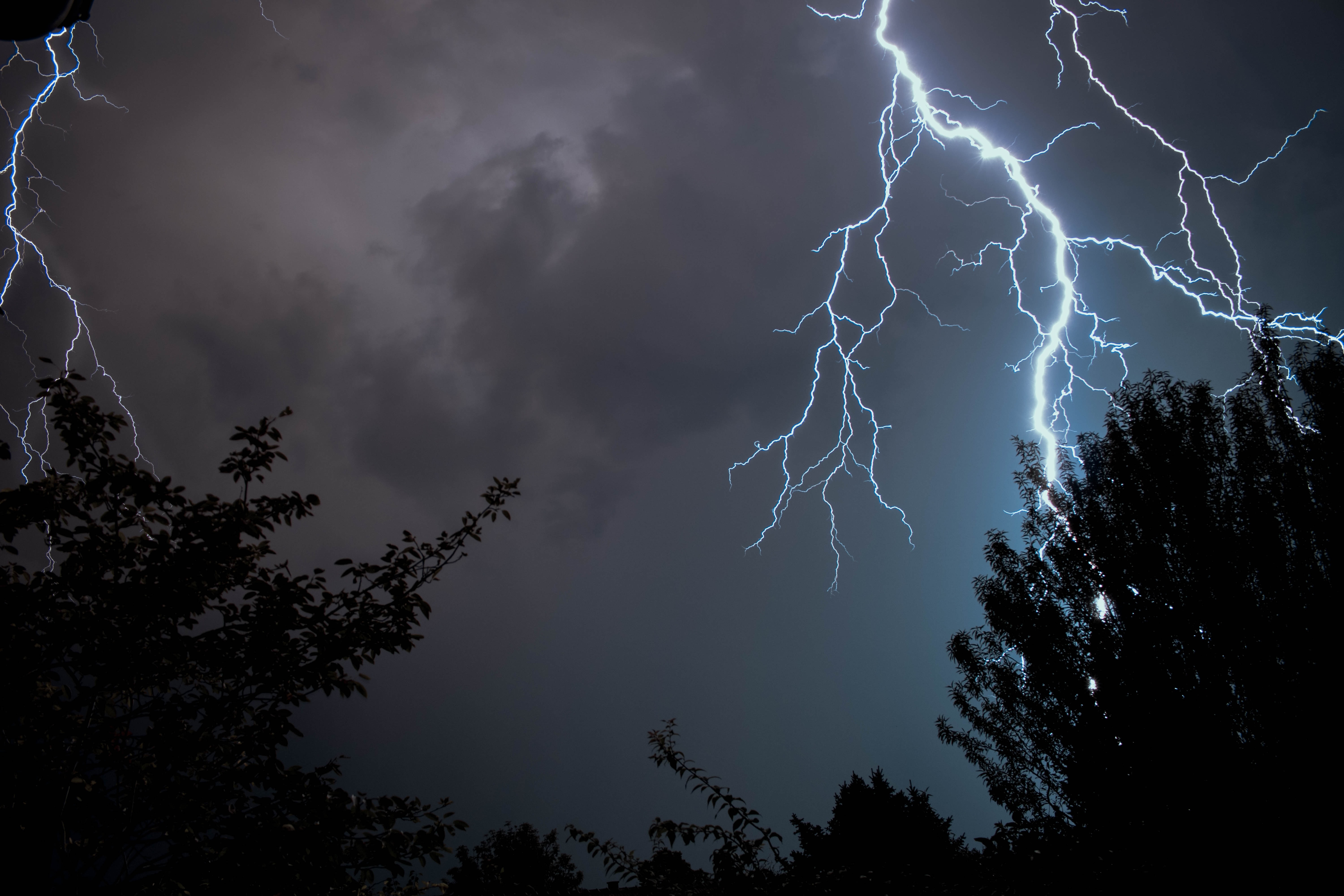
While making plans in secret to intercept the gunpowder shipment, the young men took cover from a late April 1771 thunderstorm in the springhouse on the Andrew Logan farm near where Reedy Creek now passes under Lower Rocky River Road.
Photo credit: Jonas Kaiser on unsplash.com
Not all sources agree on the names or even the number of conspirators, but it is believed they were as follows, based on the sworn testimony of James Ashmore: James White, Jr.; John White, Jr.; William White; Robert (Bob) Caruthers (who was married to a sister of James White, Jr.); Robert Davis; Benjamin Cochran; William White (cousin of the other Whites and son of the “Widow White”); James Ashmore; and Joshua Hadley, a half-brother of James Ashmore.
Photo credit: Mick Haupt on unsplash.com
One source credits Joshua Hadley with producing a New Testament on which each one swore that if anyone should ever divulge their plot that a ball might be shot through his heart and his soul sent to the lowest hell. Furthermore, they swore that if one of them ever revealed the names of the participants, he might die where no one should see him and that he should be denied a Christian burial.
Meanwhile…
Three munitions wagons from Charleston arrived in Charlotte but, upon learning that the gunpowder was destined to be used to put down the Regulators in Alamance and Rowan counties, the teamsters refused to take the munitions any further. It is said that Militia Colonel Moses Alexander had difficulty securing volunteers to take the wagons on to Salisbury.
An informant took word to the conspirators at Rocky River that the wagons were in Charlotte and they would stop for the night at the muster grounds near the present-day intersection of US-29 and Poplar Tent Road in Concord. (Since US-29 essentially follows the route of The Great Wagon Road, that’s the route the wagons would have taken to Salisbury.)
Thursday, May 2, 1771
The conspirators met at the home of James White, Sr. They blackened their faces to disguise themselves and set out for the muster grounds. They cut across the county and sometime on the night of May 2, 1771, converged on Phifer’s old muster grounds.
Can’t you just image those teenage boys and young men nervously waiting from a vantage point near the muster grounds? Can’t you imagine their hearts pounding as they ran down the hill and approached the wagons?
It is thought that James White, Jr. was the ringleader. The signal was given! The band of patriots surprised the guards! One of the teamsters was James Caruthers. He recognized his brother, Bob, as one of the attackers. In a low voice he said, “You’ll rue this, Bob.”
“Hold your tongue, Jim,” came his brother’s reply.
The conspirators moved the guards and teamsters to safety. They emptied the wagons and put the gunpowder and blankets in a pile. A train of powder was laid. James White, Jr., fired his pistol into the train.
Photo credit: Cee on unsplash.com
The resulting explosion was heard nine miles away in the vicinity of Rocky River Presbyterian Church. Some people thought it was thunder, while others mistook it for an earthquake.
Photo credit: Andy Watkins on unsplash.com
It is said that James White, Jr. carried a scar for the rest of his life where a flying stave from one of the gunpowder barrels hit him above his eye and cut to the bone before he could run from the explosion.
Photo credit: Christopher Burns on unsplash.com
The conspirators got home the best way they could in the wee hours of Friday, May 3, cleaned themselves up, and said nothing of their overnight adventure.
The Consequences
The Battle of Alamance took place on May 16, 1771, and the Regulator Movement in North Carolina was effectively put down by the royal government. Gov. William Tryon proclaimed on May 17 that he would pardon the rebels if they would turn themselves in by May 21. Bad weather and other circumstances prompted Tryon to postpone the deadline.
Some of the Regulators were put on trial on May 30. The trial was expected to last three weeks. No doubt, news of all this was moving up and down the Great Wagon Road and the conspirators from Rocky River were anxiously awaiting the outcome.
Photo credit: Jon Toney on unsplash.com
Giving in to exhaustion, at one point some of the gunpowder conspirators set out for Hillsborough to take the governor up on his offer of pardon. Before they reached their destination, they were warned that it was a trick and were told the Governor Tryon intended to hang them. Some returned to the canebrakes of Reedy Creek, while others fled to Georgia and Virginia.
June 11, 1771
Governor Tryon proclaimed that he knew some of the rebels in the colony wanted to turn themselves in, so he extended the deadline by which they could do so to July 10, except for “all the Outlaws, the Prisoners, all those concerned in blowing up General Waddell’s Ammunition in Mecklenburg County” and sixteen named Regulators.
The Governor sensed that he was losing control of North Carolina. He wanted the young men who destroyed his gunpowder brought to justice, but he didn’t know who they were.
In mid- to late-June, the Regulators’ trial came to a close. Twelve Regulators were tried and found guilty of high treason. Six were hanged while the other six waited for the King to decide their fate.
Photo credit: Alireza Jalilian on unsplash.com
Perhaps word of the Regulator trial results reached Rocky River, or maybe James Ashmore and Joshua Hadley simply feared that one of the other conspirators would disclose their identities. For whatever reason, Ashmore and Hadley went independently to tell Colonel Moses Alexander (who lived on a plantation at the present-day site of Charlotte Motor Speedway) what they knew.
Imagine their surprise when they ran into each other on Colonel Alexander’s front porch!
The two half-brothers jockeyed for position. James Ashmore eventually pushed his way into the house and told Col. Alexander that he was ready to talk.
June 22, 1771
James Ashmore was taken to Charlotte, where he gave a sworn deposition before Thomas Polk, a Mecklenburg County Justice of the Peace. That’s when things went from bad to worse for the conspirators.
Photo credit: Alessio Fiorentino
In his deposition, Ashmore told Polk how the conspirators had met at Andrew Logan’s old plantation after James McCaul advertised a sale or something to be held there. It was there that James White, Jr. asked Ashmore if he would be interested in helping to blow up the gunpowder shipment.
Ashmore said in his deposition that he was asked in the planning stages if he thought there was any harm in blowing up the gunpowder. He said he didn’t see any harm in it. He said the next morning between ten and eleven o’clock he stopped working on his plantation and went three-quarters of a mile to look for his horses.
Photo credit: Aurelien Faux on unsplash.com
Ashmore claimed it was there that he met six men on the road “who in appearance resembled Indians.” One was either recognized or identified himself as James White, Jr. White persuaded Ashmore to come back and join them after taking his horses home and recruiting his half-brother, Joshua Hadley.
They joined the men later about a half-mile from the Ashmore home. It was at that point in the deposition that Ashmore named six men with whom he and Hadley assembled.
Ashmore’s deposition goes on to describe the attack on the munitions wagons and how the conspirators had been sworn to secrecy.
In hiding
Once the names were revealed, the search for the men began in earnest. As stated earlier, some escaped to Georgia and Virginia. Others hid the canebrakes of Reedy Creek in the vicinity of the bridge on present-day Lower Rocky River Road where the women of Rocky River Presbyterian Church took them food and clothing.
Photo credit: Gorrin Bel on unsplash.com
When in need of something, one of the young men would pop up in a ravine and whistle. Nearby resident of around 40 years of age, William Spears, would acknowledge the fugitive by removing his hat. He would then walk off in the opposite direction so he would not be seen as aiding the conspirators.
Agnes Spears, William’s wife, would then take them food. For nearly one year the women of Rocky River Presbyterian Church fed and concealed the young men who took refuge along the banks of Reedy Creek. The authorities would never think to question the women because they couldn’t imagine that the women of the community had anything to do with the plot or its aftermath.
Photo credit:
The Rev. Hezekiah James Balch openly prayed for the safety of the young men from the pulpit of Rocky River Presbyterian Church.
The participants in the gunpowder plot were fugitives until independence was declared. After the Mecklenburg Declaration of Independence was issued on May 20, 1775, all Mecklenburg County citizens were considered to be in rebellion. After the Declaration, the conspirators were finally able to move about as freely as anyone else and prepare to fight in the coming Revolutionary War.
When May 2 and July 4 roll around every year, think about those brave young men from Rocky River who risked their lives to help gain our freedom in America.
Since my last blog post
Is it me, or are the weeks just flying by? I’m hard-pressed to remember what I’ve done since last Monday. I just know I’ve been busy. I visited a bookstore in downtown Concord, North Carolina on Friday. More on that in next week’s blog post. I’ve done some reading and quite a bit of brainstorming over the plot of my novel-in-progress. I work out many of the plot twists and some of the dialog while on my daily walks.
Yesterday we celebrated “May Meeting” at Rocky River Presbyterian Church. The tradition started as early as 1757. On the first Sunday in May, present members of the congregation, others associated with the church throughout its history, and other visitors from the community gather for worship, the Lord’s Supper, and Dinner in the Grove. It’s been a mainstay in my life since 1953.
We had perfect weather for Dinner in the Grove. Everyone brings food and spreads it out on a long four-foot-wide wire “table” that’s put up just for such occasions. It’s fun to try a little bit of this and a little bit of that. Some people bring special dishes they’re known for. There’s always good food and fellowship as we all eat together. After having an abbreviated version during the Covid-19 pandemic, it was exciting this year to get back to the way it used to be.
Until my next blog post
My blog post next Monday will be about some of the books I read in April.
I hope you have at least one good book to read and a hobby to enjoy.











 Janet's Writing Blog