
I wrote a local history column for Harrisburg Horizons newspaper from May 2006 through December 2012. Before you residents of Harrisburg, Pennsylvania get too excited, I will clarify that this free weekly newspaper existed in Harrisburg, North Carolina.
Of the 175 newspaper columns I wrote, six were a series of articles I wrote about “The Coming of the Railroad.” This is an important local topic for without the North Carolina Railroad there would be no Town of Harrisburg, NC today.
It’s hard to imagine the town without a railroad today, even though in an effort to establish “high-speed” rail between Charlotte and Raleigh, the at-grade railroad crossings in Harrisburg were replaced with bridges in 2013. That’s a story for another day.
Imagine a rural farming community in 1854, about halfway between Charlotte and Concord. Was everyone excited about the coming of the railroad? Farmers were probably not happy about the piercing whistles of the steam engines scaring their livestock, but they were possibly pacified by the fact that the depot planned for the community would give them a convenient way to sell their agricultural products.
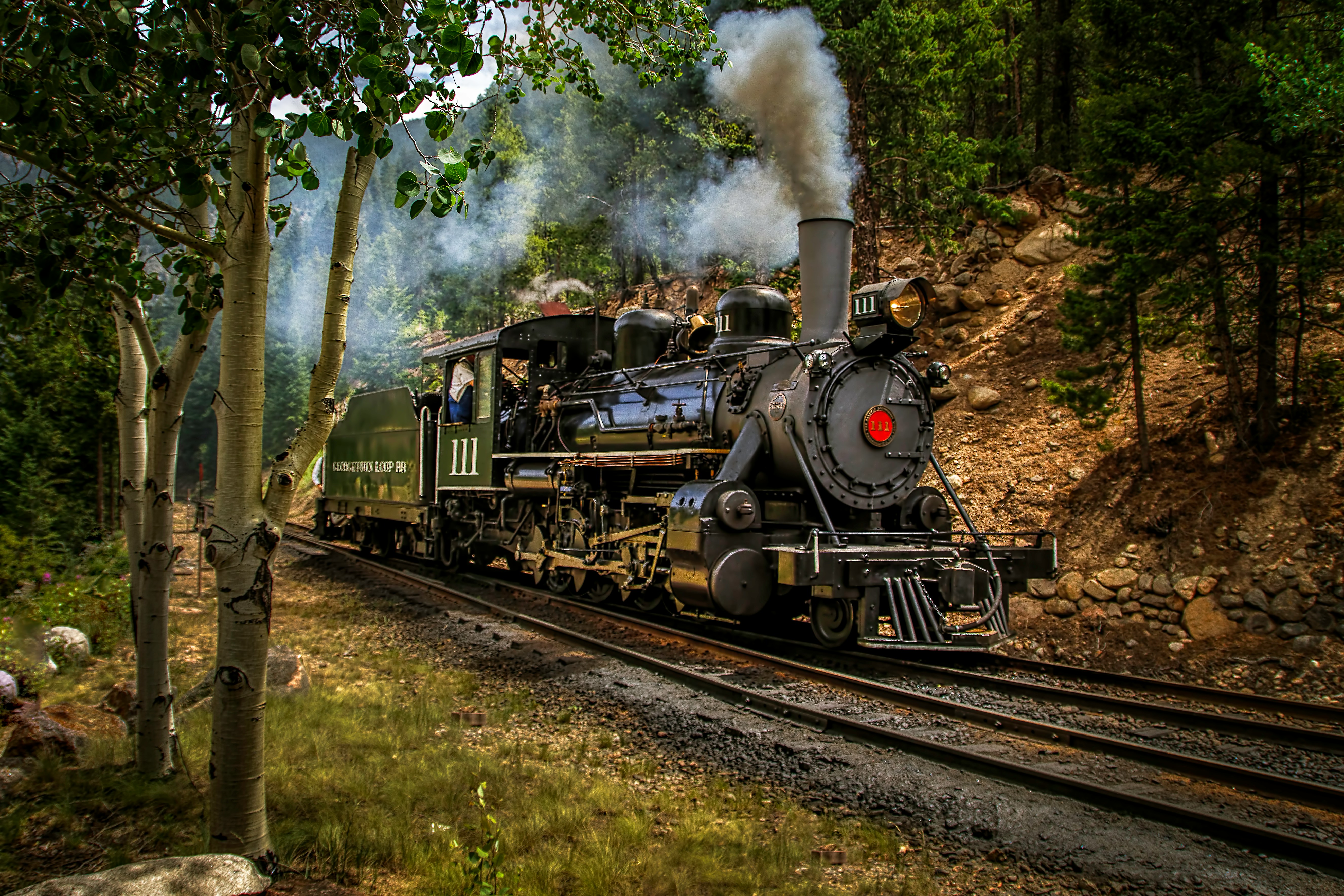
Prior to the coming of the railroad, it is said that it sometimes cost a farmer half his profits to transport his produce to market by wagon. Poor roads and distances to markets prohibited the transporting of perishables very far.
Although Charlotte has a population of a million people now, in 1854 it had a whopping 1,000. The State of North Carolina decided it would be good for the economy to construct a railroad from Goldsboro, in the eastern part of the state, to Charlotte in the southern piedmont.
The State sold bonds in New York City to finance the project. Ten thousand shares were sold at $100 each.
Goldsboro was chosen because it had rail service to the port at Wilmington, NC. A railroad from the south to Charlotte and one from the north to Danville, Virginia, which threatened to extend a line to Charlotte, would surely mean that goods from western North Carolina would be shipped to Virginia or to the port at Charleston, South Carolina.
It was understood from the beginning that much of the construction labor for the project would be undertaken by slaves of property owners living along the rail right-of-way. Some of the slave owners were paid on a yearly basis for supplying their slaves for the project.
I found it interesting that wrought iron T-rails manufactured in Wales were used in the initial construction of the 223-mile-long railroad. The rails weighed 60 pounds per yard and were brought in through the port at Charleston.
In the early 1850s, a steam locomotive needed on average a cord of wood (that’s a stack of wood eight feet long, four feet wide, and four feet high) and 1,000 gallons of water for every twenty-five miles. A tender could carry that much wood and water. That is what dictated the approximate distances between some train stations.
That’s how the little farming community of Harrisburg, North Carolina got a train depot and the designation as Harris Depot on maps.
If you are interested in learning more about the North Carolina Railroad and the ways the coming of the railroad and depot changed life in a farming community in the early 1850s, look for my book, Harrisburg, Did You Know? Cabarrus History, Books 1 and 2. Book 1 contains the first 94 local history articles I wrote, including the series about the railroad. Book 2 contains the other 84 local history articles I wrote, including more articles that reference the railroad.
Topics in the two books include such things as the blowing up of the King’s gun powder in 1771, a minuteman in the American Revolution, President George Washington’s 1791 visit, the 22-mile ring dyke the town sits in, general stores, family-owned groceries stores, education in the 1800s and three Rosenwald Schools, how the town got phone service and electricity, our Ukrainian doctor (Nicholas E. Lubchenko) who escaped from the Russian Army, the cotton economy of the area until the mid-20th century, Hurricane Hugo in 1989, floods, earthquakes, the building of roads and bridges, the changes necessitated by the high-speed rail project, mail service from the 1800s until the early 21st century, the construction of the Charlotte Motor Speedway and the running of the first World 600 NASCAR race in 1960… and much more.
Here are the links for purchasing the books on Amazon:
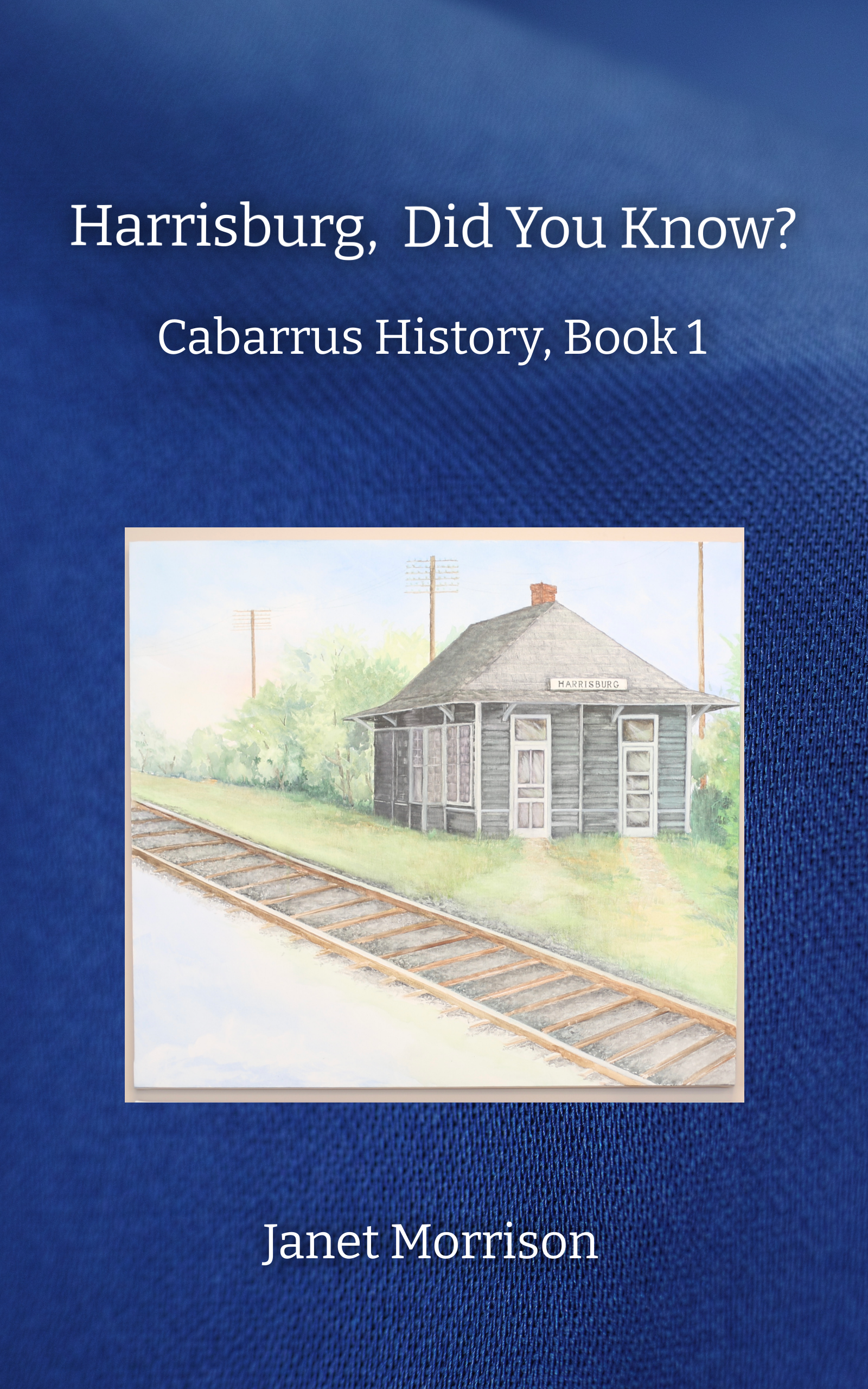
by Janet Morrison
Book 1, in paperback: https://www.amazon.com/Harrisburg-Did-You-Know-Cabarrus/dp/1888858044/
Book 1, in e-book: https://www.amazon.com/Harrisburg-Did-You-Know-Cabarrus-ebook/dp/B0BNK84LK1/

by Janet Morrison
Book 2, in paperback: https://www.amazon.com/Harrisburg-Did-You-Know-Cabarrus/dp/B0BW2QMLHC/
Book 2, in e-book: https://www.amazon.com/Harrisburg-Did-You-Know-Cabarrus-ebook/dp/B0BXBQ1F79/
If you live in the Harrisburg, NC area, you can find the books in paperback, Tuesday through Saturday, at Second Look Books, 4519 School House Commons.
I hope my blog post today whetted your appetite for reading more about the history of our little town of 20,000 now. I imagine many of our local stories are similar to ones in your town’s history.
Janet
The government should be afraid of its citizens, not the other way around.

 Janet's Writing Blog
Fascinating Janet and it is so hard to imagine the difference the railroad made to all of the remote towns and outposts in the vast country that is the USA…We have got so used to having arterial networks of roads and tracks and moving so easily from A to B and we take it all for granted. xxx
LikeLiked by 1 person
Thank you so much for reading my blog post today, Sally! How do you have the time to read the blogs of your numerous followers and fans? I’m flattered! Yes, we certainly do take easy and fast transportation for granted today. Hugs!
LikeLiked by 1 person
Just finished your short story collection and my review on Saturday.. Was engaged from first to last page.. fascinating. ♥
LikeLiked by 1 person
Sally, all I can say is, “WOW!” For me to say, “Thank you so much!” is woefully inadequate. I am at a loss for words!
LikeLiked by 1 person
I wish I could get around more Janet… but delighted to read your post today. hugs x
LikeLiked by 1 person
Thank you. If you drop by my blog often, you will see that it has transitioned from being primarily about my writing, my reading, and the occasional history piece to more of a political/frustrated tone over the last 14 months. I majored in political science in college and I am devastated by the state of affairs since the orange one became U.S. President again. I feel compelled to use my little platform to speak the truth and put out warnings about the danger he is. I look forward to the day I can once again blog about my writing and reading!
LikeLiked by 1 person
It was my pleasure to read Janet… ♥
LikeLiked by 1 person
Thank you, Sally.
LikeLiked by 1 person
The more voices the stronger the message Janet and too many injustices happen when people are silent. ♥
LikeLiked by 1 person
I agree.
LikeLiked by 1 person
That’s fascinating history of the coming of the railroad to Harrisburg! The locomotives must have changed to burning coal at some point?
LikeLiked by 1 person
You are probably right about that, Liz. I hadn’t thought about it, but yes I think the later locomotives really created a stench! By the way, I moved Thursday’s rant to tomorrow and wrote a new rant for Thursday. Just wanted to warn you!
LikeLiked by 1 person
Thanks for the rant trigger-warning!
LikeLiked by 1 person
You’re welcome, Liz.
LikeLiked by 1 person
Janet, this is wonderful—rich with the kind of detail that makes local history feel alive rather than archival. I especially enjoyed the practical realities you included: a cord of wood and 1,000 gallons of water every 25 miles—suddenly those depot spacings make perfect sense.
Your piece echoes what I often see here in the Finger Lakes: how a single piece of infrastructure quietly reshapes an entire landscape—economically, socially, even psychologically. The tension you note—between disruption (frightened livestock, divided fields) and opportunity (access to markets)—feels timeless.
And that detail about Welsh iron rails arriving through Charleston—there’s a global story embedded in what seems like a very local one.
You’ve certainly whetted my appetite—this is exactly the kind of grounded storytelling that turns a map into a lived place.
LikeLiked by 1 person
Thank you so much for your detailed comment! You have given me a much-needed boost as I still try to find my way as a blogger and a writer. I struggle to convey how my local history articles are more than “local.” You have captured that in a nutshell! You have no idea how much I appreciate your words. I decided a couple of weeks ago to begin this week to share some details in a weekly blog post about my local history columns. Perhaps, in time, others will realize that all history is local, but no history is just local.
LikeLiked by 1 person